Kor. J. Hort. Sci. Technol. 31(4):393-399, 2013 DOI http://dx.doi.org/10.7235/hort.2013.12178
Cucumber Growth and Nitrogen Uptake as Affected by Solution Temperature and NO 3 - :NH 4 + Ratios during the Seedling
Qiu-yan Yan
1, Zeng-qiang Duan
1*, Jun-hui Li
2, Xun Li
1, and Jin-long Dong
11State Key Laboratory of Soil and Sustainable Agriculture, Institute of Soil Science, Chinese Academy of Sciences, Nanjing 210008, P.R. China
2Department of Civil and Environmental Engineering, Faculty of Science and Technology, University of Macau, Macau SAR, China
Abstract. The effect of solution temperature and nitrogen form on cucumber (Cucumis sativus L.) growth, photosynthesis and nitrogen metabolism was investigated in hydroponic culture. Cucumber plants were grown for 35 days in a greenhouse at three constant solution temperatures (15°C, 20°C, and 25°C) within a natural aerial temperature (15-30°C). Four nitrate:ammonium (NO
3-:NH
4+) ratios (10:0, 8:2, 5:5, and 2:8 mmol・L
-1) at constant nitrogen (N) concentration of 10 mmol・L
-1were applied within each solution temperature treatment.
Results showed an increasing solution temperature enhanced plant growth (height, dry weight, and leaf area) in most N treatments. Dry weight accumulation was greatest at the 10:0 NO
3-:NH
4+ratio in the 15°C solution, the 5:5 ratio in the 20°C solution and the 8:2 ratio in the 25°C solution. Photosynthetic rate (Pn) response to solution temperature and NO
3-:NH
4+ratio was similar to that of plant growth. Probably, the photosynthate shortage played a role in the reduced biomass formation. Increasing solution temperature enhanced the nitrate reductase (NR) activity, and further reduced shoots nitrate content. Our results indicate that the optimal ratio of nitrate to ammonium that promotes growth in hydroponic cucumber varies with solution temperature.
Additional key words: Cucumis sativus L., dry weight, net photosynthetic rate, nitrate:ammonium ratio, nitrate reductase (NR) activity
*Corresponding author: [email protected]
※ Received 13 September 2012; Revised 6 March 2013; Accepted 12 March 2013. This work was supported by the National Natural Science Foundation of China (No. 41101272).
Introduction
Nitrogen (N) is one of the major nutrients in plants.
Nitrogen form, nitrate (NO
3-) and ammonium (NH
4+) play a key role in plant growth and development (Bar-Tal et al., 2001). Excessive nitrogen fertilizer application can result in secondary soil salinisation and high nitrate accumulation in plant tissues (Mengel and Pilbeam, 1992), which are dangerous to human health. Furthermore, when exposed to high ammonium concentration, plants show excessive growth (Gerendás et al., 1997) or can be restrained by ammonium toxicity (Britto and Kronzucker, 2002). So proper NO
3-:NH
4+ratio is important to nitrogen fertilizer utilization.
It has generally been observed that the favorable nitrogen source depends on plant species and environmental factors (Taghavi et al., 2004). The effect of NO
3-:NH
4+ratios on plant growth has been studied among many species such as tomato, Chinese cabbage (Kafkafi, 1990), melon (Feigin, 1990), wheat (Silberbush and Lips, 1991), rape (Ali et al.,
1998; Macduff et al., 1987), coffee (Vaast et al., 1998), lettuce (El-Nemr et al., 2012; Lastra et al., 2009), pepper (Bar-Tal et al., 2001), rice flower (Silber et al., 2004) and so on. For example, the rape shoot dry weight could be maximal in NO
3-:NH
4+ratio of 6:4 (Ali et al., 1998). While, pepper fruit dry weight production could be enhanced with high percentage NO
3-concentration than NH
4+(Bar-Tal et al., 2001). These comparative studies indicate the differences in NO
3-:NH
4+ratios exist among species. In addition, plant growth, nitrogen accumulation and uptake can be largely affected by root-zone temperature (Legros and Smith, 1993).
Ganmore-Neumann and Kafkafi (1980) reported the optimal NO
3-:NH
4+ratio for tomato plants growth was 1:1 at wide range of root temperature from 8°C to 34°C.
Cucumber is one of the most important horticultural crops in the world. Excessive accumulation of nitrate inhibits cucumber plant growth and development (Gao et al., 2008).
Moreover, cucumber is very sensitive to root temperature
(Lee et al., 2005). Therefore, the objective of this work was
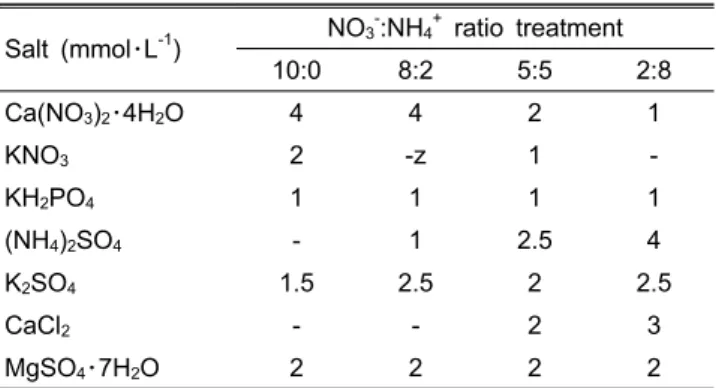
Table 1. Composition of solutions used to grow cucumber with 10 mmol・L-1 N form different ratios of NO3-:NH4+.
Salt (mmol・L-1) NO3-:NH4+ ratio treatment
10:0 8:2 5:5 2:8
Ca(NO3)2・4H2O 4 4 2 1
KNO3 2 -z 1 -
KH2PO4 1 1 1 1
(NH4)2SO4 - 1 2.5 4
K2SO4 1.5 2.5 2 2.5
CaCl2 - - 2 3
MgSO4・7H2O 2 2 2 2
zThe treatment did not contain this salt.
to find the optimal NO
3-:NH
4+ratio under different root temperatures, toward the growth, photosynthesis and nitrogen composition of cucumber plants, to optimize the nitrogen fertilizer utilization and to minimize the N losses.
Materials and Methods
Plants, Growth Conditions, and Experimental Design Cucumber (Cucumis sativus L.) seeds, ‘Jinlv 3’ (Tianjin Lvfeng gardening new technology development Co., Ltd, China), were germinated in an illuminating incubator at 28°C with a humidity of 80%. After two days of germination, the seeds were transplanted to trays containing a peat-vermiculite mixture (2:1, V/V). Seedlings were chosen after the second set of true leaves emerged and transplanted to a plastic beaker with 1 L of nutrient solutions containing one of the four NO
3-:NH
4+ratios (10:0, 8:2, 5:5, and 2:8 mmol・L
-1) with a constant total N concentration (10 mmol・L
-1) in each solution temperature box (Table 1). Each nutrient treatment also contained 0.1 mmol・L
-1of EDTA-Fe-Na, 20 μmol・L
-1of H
3BO
3, 5 pmol・L
-1of (NH
4)
6Mo
7O
24, 1 μmol・L
-1of MnSO
4, 0.2 μmol・L
-1of CuSO
4, and 1 μmol・L
-1of ZnSO
4. The nutrient solutions were changed weekly in order to ensure a consistent nutrient supply. The temperature control equipment contained for the nutrient solutions consisted of a polyvinyl chloride box, plastic pots, sand and heating wires.
The internal dimensions of the polyvinyl chloride box were 240 (L) × 70 (W) × 20 (H) cm deep. Each box contained 32 pots. The space between pots in the box was filled with sand, in which heating wires (DV, Ningbo China, 800 W 100 m) were immersed. Through the heating wires, heat was delivered to sand, and then to the solutions in the plastic pots. Temperature was regulated by a temperature controller and timing device.
Plant roots were subjected to each treatment from the day they were transferred to the root-containers and allowed
to be acclimated to each nutrient concentration for one week, and then exposed to different root temperatures for four weeks. After five weeks from planting, a sample of eight plants was selected from each temperature × N ratio treatment from each box.
Determination of Plant Growth Characteristics
Plant height was measured with a ruler from cotyledon scar to base of petiole on last fully expanded leaf. The initial five euphylla areas on each plant were measured by leaf area meter (Li-3000C, LI-COR, USA). Plants were separated into shoot and root tissues after the whole plants were removed from the pots. The fresh shoots and roots were dried carefully at 105°C for 30 min, and then further dried at 80°C for 24 h.
Determination of Photosynthesis Light-response Curve Photosynthetic rate (Pn) was measured on clear days from 9:00 to 12:00 after 30 days of temperature treatments, using a portable photosynthetic apparatus (Li-6400, LI-COR, USA), choosing three plants per temperature × N ratio treatment and measuring the third function leaf from bottom. Twelve photosynthetic photon flux density (PPFD) (2000, 1800, 1400, 1000, 500, 200, 150, 100, 50, 20, 10, and 0 μmol・m
-2・s
-1) were set. Before measuring, leaves were acclimated to high intensity light (1800 μmol・m
-2・ s
-1) for 4 min. Pn-PPFD curves were plotted using the mean values of Pn measured at each PPFD.
Chlorophyll Content
Leaves on the same plants used for Pn measurements were collected for later determinations of chlorophyll contents based on modified measurement of Li et al. (2000). Chlorophyll was extracted by placing 0.5 g leaves in 50 mL mixture of acetone and ethanol (1:1) in the dark for 24 h. Chlorophyll a and b were determined using a UV-visible spectrophotometer (UV-2000, Shanghai, China).
Nitrate (NO
3-), Nitrite (NO
2-), and Ammonium (NH
4+) Concentration
Tissue nitrate (NO
3-) concentration was determined by the modified method of Li et al (2000). Shoots/roots (2 g) were homogenized in 10 mL distilled water. The extract was centrifuged at 4000 r・min
-1for 15 min, the supernatant was used to nitrate measurement. 0.1 mL extract with 0.4 mL 5%
salicylic acid sulfate were mixed for 20 min, then added 9.5
mL sodium hydroxide. Nitrogen concentration was determined
at 410 nm using a UV-visible spectrophotometer (UV-2000,
Shanghai, China).
A
B
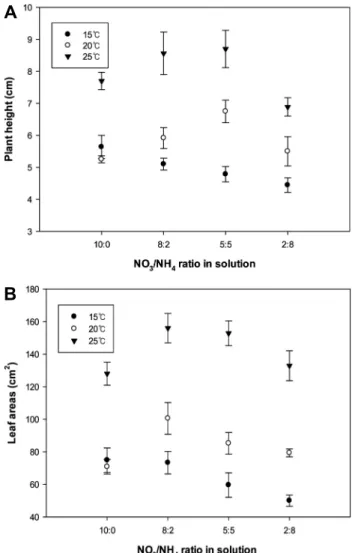
Fig. 1. Effects of solution temperature on plant height (A) and leaf areas (B) of 35-days-old cucumber seedlings grown with solutions containing different NO3-:NH4+ ratios. Data are means of three replicates, with standard (n = 3) deviations shown by vertical bars.
Plant nitrite concentration was measured based on Fox et al. (1981). Shoots/roots (2 g) were homogenized in 10 mL distilled water and filtered. Nitrite concentration was determined colorimetrically at 520 nm (UV-visible spectrophotometer UV-2000, China) by adding 2 mL sulfanilic amide (SAN) and 2 mL 1-naphthylamine (1-NA).
Ammonium (NH
4+) concentration was measured according to Li et al. (2000). Shoots/roots (1.0 g) were homogenized in 5 mL ethanoic acid and diluted with distilled water to 100 mL constant volume. 1.0 mL filtrate and 1.0 mL distilled water were added to tube, then added 3.0 mL ninhydrin and 0.1 mL ascorbic acid. Ammonium concentration was determined at 570 nm using a UV-visible spectrophotometer (UV-2000, Shanghai, China).
Nitrate Reductase (NR) Activity
Nitrate reductase (NR) activity was determined with modified methods described by Hageman and Hucklesby (1971). Four parts of disks (0.5 g) with a diameter of 1 cm were punched out from mature leaves and placed to four centrifuge tube containing 9 mL of 100 mmol・L
-1potassium phosphate buffer (pH 7.5) and 100 mmol・L
-1KNO
3. One of the tubes was with 1 mL 30% trichloroacetic acid (TCA) except the 9 mL buffer solution, as the control. Then the tubes were placed in a dryer, the air between leaf tissues was removed using a vacuum pump. When leaves sunk to the tube bottom, 1 mL TCA was added to the test tubes to stop the enzymatic reaction. Nitrite reductase was determined colorimetrically at 540 nm (UV-visible spectrophotometer UV-2000, China) by adding 1% sulphanilamide and 0.02% (w/v) naphthalene base ethylene amines.
Statistical Analysis
Analysis of variance (ANOVA) was performed using the general linear model univariate procedure from the SPSS (17.0) software based on the main effects of root zone temperature and NO
3-:NH
4+ratio treatments with Duncan's multiple range test (DMRT) at the 5% level.
Data are means of three replicates.
Results
Growth Characteristics
Elevated solution temperature increased plant height in most N ratio treatments with the exception of the NO
3-treatment (10:0) at 15°C and 20°C (Fig. 1A). Different performances were obtained among variance NO
3-:NH
4+ratios at each solution temperature. At 15°C, plant height reduced with the increasing NH
4+concentration. Plant height in all
the nutrient treatments was higher at 25°C than that at 20°C.
The maximal height at 20°C and 25°C was obtained when the NO
3-:NH
4+ratio was 5:5 (Fig. 1A).
The effect of solution temperature on leaf area was similar to that on plant height (Fig. 1B). With the increasing solution temperature, leaf area increased except a treatment with the ratio of 10:0 at 15°C than that at 20°C. At 15°C, leaf area was inhibited by the increasing NH
4+concentration. At 20 and 25°C, the maximal leaf area was in the ratio of 8:2.
Percentage of NH
4+concentration (larger than 20%) inhibited leaf area performance (Fig. 1B).
At low solution temperature of 15°C, an increased percentage
of NH
4+in the solution significantly (P < 0.05) restrained
shoot and root dry matter production, but slightly increased
shoot:root ratio, as shown in Table 2. Different from that
at 15°C, proper addition of NH
4+promoted shoot and root
dry weight at 20 and 25°C. In general, at 20°C and 25°C,
Table 2. Effects of solution temperature on dry weight (DW) of 35-days-old cucumber seedlings grown with solutions containing different NO3-:NH4+ ratios (unit: g).
NO3-:NH4+ Shoot DW Root DW Shoot : root ratio
15°C 20°C 25°C 15°C 20°C 25°C 15°C 20°C 25°C
10:0 0.961 az 0.595 b 1.322 b 0.231 a 0.076 b 0.154 b 4.503 b 7.784 a 8.584 a
8:2 0.561 b 0.964 ab 1.948 a 0.103 b 0.132 a 0.317 a 5.420 b 7.275 a 6.135 a
5:5 0.569 b 1.226 a 1.491 b 0.069 c 0.240 a 0.206 ab 8.187 a 5.110 b 7.220 a
2:8 0.450 b 0.553 b 0.829 c 0.049 c 0.061 b 0.096 c 9.101 a 9.073 a 8.640 a
zMean values followed by different letters within a row line indicated significant differences at P < 0.05.
A
(15℃)B
(20℃)C
(25℃)Fig. 2. Effects of solution temperature on net photosynthesis rate - photosynthetic photon flux density (PPFD) curve of 35- days-old cucumber seedlings grown with solutions containing different NO3-
:NH4+
ratios. Values are mean of two replicates (n = 2).
solutions with NO
3-:NH
4+ratios of 5:5 and 8:2 have greater shoot and root dry weights. Elevating solution temperature enhanced shoot dry matter production in the same NO
3-:NH
4+ratio except a relatively lower value in higher NO
3-:NH
4+ratio at 20°C. Shoot dry weight increased by 71.8% (elevating solution temperature from 15 to 20°C) and 102.1% (from 20 to 25°C) in NO
3-:NH
4+ratio (8:2), 115.4% and 21.6%
in the ratio of 5:5, 22.8% and 49.9% in the ratio of 2:8, individually.
Photosynthesis and Chlorophyll Content
Net photosynthetic rate (Pn) increased with the increased photosynthetic photon flux density (PPFD) (Fig. 2). Net photosynthesis rate curve (Pn-PPFD) showed Pn was increased with the increasing NO
3-concentration at low solution tem- perature of 15°C. At 20°C, the Pn value with the ratio of 10:0 was lower than the other N ratio treatments, whereas Pn decreased with the increasing NH
4+concentration in treatments when the mixture of NO
3-and NH
4+was used.
At 25°C, Pn was, in decreasing order: 8:2 > 10:0 > 5:5 >
2:8 (NO
3-:NH
4+ratios).
Total chlorophyll (Chl) concentration was not significantly affected by the NO
3-:NH
4+ratio at 15°C and, but significant (P < 0.05) differences existed at 20°C and 25°C (Table 3).
The ratio of NO
3-:NH
4+in solution had no influence on Chl a/Chl b at 20°C and 25°C. At 15°C, plants grown in 10:0 ratios had the highest Chl a/Chl b values.
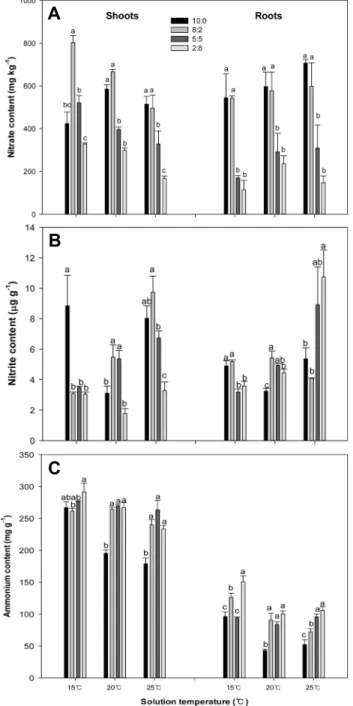
Nitrogen Metabolism and Nitrate Reductase (NR) Activity Roots nitrate concentration decreased with an increasing NH
4+proportion regardless of solution temperatures (Fig. 3A).
Shoot nitrate contents showed diverse patterns at different solution temperature in the order of NO
3-:NH
4+ratios (8:2
> 5:5 > 10:0 > 2:8) at 15°C, 8:2 > 10:0 > 5:5 > 2:8 at 20°C, 10:0 > 8:2 > 5:5 > 2:8 at 25°C, respectively. Regarding the ratio of 10:0, shoot nitrate contents were greater at 20°C and 25°C than that at 15°C, whereas root nitrate uptake was highest at 25°C. With respect to other NO
3-:NH
4+ratio treatments (8:2, 5:5 and 2:8), shoot nitrate content reduced with the increasing solution temperature. In contrast, root
nitrate contents were enhanced slightly with the increasing solution temperature except 2:8 ratio.
At 15°C, highest nitrite content in shoot occurred in NO
3-:
Table 3. Effects of solution temperature on chlorophyll (Chl) concentration in leaves of 35-days-old cucumber seedlings grown with solutions containing different NO3-:NH4+ ratios.
NO3-:NH4+ Total Chl (a + b) concentration (mg・g-1) Chl a/Chl b
15°C 20°C 25°C 15°C 20°C 25°C
10:0 1.184 ± 0.004 az 0.830 ± 0.078 c 1.094 ± 0.026 bc 3.131 ± 0.008 a 2.882 ± 0.067 a 3.167 ± 0.056 a 8:2 0.990 ± 0.083 a 1.126 ± 0.006 a 1.207 ± 0.027 a 2.975 ± 0.024 b 3.082 ± 0.033 a 3.201 ± 0.045 a 5:5 1.038 ± 0.066 a 1.074 ± 0.039 ab 1.137 ± 0.021 ab 3.000 ± 0.043 b 3.178 ± 0.000 a 3.167 ± 0.016 a 2:8 1.007 ± 0.075 a 0.933 ± 0.029 bc 1.009 ± 0.013 c 3.015 ± 0.095 b 2.506 ± 0.642 a 3.228 ± 0.016 a
zMean ± Standard deviation (n = 3).
Values followed by different letters within a column indicated significant differences at P < 0.05.
A
B
C
Fig. 3. Effects of solution temperature on cucumber nitrate (A), nitrite (B), ammonium (C) concentration of 35-days-old cucumber seedlings grown with solutions containing different NO3-:NH4+
ratios. Data are means of three replicates, with standard deviations (n = 3) shown by vertical bars. Bars sharing different letters indicate significant differences at P ≤ 0.05.
Fig. 4. Effects of solution temperature on nitrate reductase (NR) activity of 35-days-old cucumber seedlings grown with solutions containing different NO3-:NH4+ ratios. Data are means of three replicates, with standard deviations (n = 3) shown by vertical bars. Bars sharing different letters indicate significant differences at P ≤ 0.05.
NH
4+ratios of 10:0 (Fig. 3B). At 20°C, shoots and roots nitrite content were relatively high in NO
3-:NH
4+ratios (5:5 and 8:2). At 25°C, shoot nitrite contents followed the order of NO
3-:NH
4+ratios (8:2 > 10:0 > 5:5 > 2:8), and root nitrite contents showed the reverse results. Lower shoot nitrite contents were observed in NO
3-:NH
4+ratios (10:0 and 2:8) at 20°C with comparison to 15°C and 25°C, but those in NO
3-:NH
4+ratios (8:2 and 5:5) increased with the increasing solution temperature. Root nitrite content at 20°C in ratio of 10:0 was lower than that at 15°C and 25°C. And in ratio of 8:2, root nitrite content at 25°C was lower than that at 15°C and 20°C. Root nitrite contents in ratios of 5:5 and 2:8 increased as the solution temperature increased.
At 15°C, shoot ammonium content increased with the increasing NH
4+concentration, whereas those in root followed the order of NO
3-:NH
4+ratios (2:8 > 8:2 > 10:0 > 5:5) (Fig.
3C). At 20°C, no significant differences were found in most
nutrient treatments except a relatively low shoot and root
ammonium content in the highest NO
3-percentage treatment.
When exposed to 25°C solution temperature, root ammonium content was promoted as the NH
4+concentration increased, and shoot ammonium content followed the order of NO
3-:NH
4+ratios (5:5 > 2:8 > 8:2 > 10:0). Generally, ammonium content in shoot and root decreased with the increasing solution temperature in all NO
3-:NH
4+ratios treatments.
The leaf nitrate reductase (NR) activity in highest NO
3-treatments (10:0) was significantly higher than those in the other NO
3-:NH
4+ratios treatments at 15°C (Fig. 4). At 20°C, the NR activity in NO
3-:NH
4+ratios 8:2 and 5:5 were significantly higher than those in ratios 10:0 and 2:8. At 25°C, NR activity was maximum in NO
3-:NH
4+ratios 8:2 and minimum in the 2:8 ratio treatments. Both the treatments of NO
3-:NH
4+ratios 10:0 and 2:8 showed a relatively lower NR activity at 20°C than those at 15°C and 25°C, while the NR activities increased with the increasing solution temperature in ratios 8:2 and 5:5.
Discussion
Results of this study showed that plant growth was inhibited under high NH
4+concentration at low solution temperature of 15°C, but the negative effects of NH
4+on plant growth could be relieved at higher solution temperature of 20°C and 25°C. Therefore, high NH
4+concentration at low solution temperature might be unfavorable for cucumber growth. As previously reported, low root temperature (8°C and 16°C) inhibited tomato plant growth in high percentage of NO
3-, but was favorable at high root temperature (24°C and 34°C) (Ganmore-Neumann and Kafkafi, 1980). In this current study, plants grown with NO
3-:NH
4+ratio 2:8 generally grew less, regardless of solution temperatures. Generally, it is better that ammonium percentage does not exceed more than 50%
of total nitrogen in the nutrient solution (Taghavi et al., 2004).
Bybordi (2011) also reported high quality canola growth when ammonium and nitrate at 50:50 ratios. Compared to 28.2°C, maize yield at 14.8°C were greatly reduced in different form nitrogen solution, especially those in high NH
4+percentage (Moraghan and Porter, 1975). Ammonium results in lower root biomass and leaf area, which may contribute to the low carbon gain and then inhibit plant growth (Guo et al., 2007). Low root temperature (12°C and 16°C) significantly reduced the dry weight of cucumber plants (Lee et al., 2005).
Similar response of the rape plants to root temperature was reported by Ali et al. (1998). Dry weight of cucumber shoots showed direct relationship with roots dry weight in response to root temperature and NO
3-:NH
4+ratios (Table 2). It is possible that the relative size of root enable to assimilate nutrients required by shoots.
The NO
3-:NH
4+ratios and root temperature had less sig-
nificant effect on the cucumber leaf chlorophyll content (Table 3). Similar effect on pepper was reported by Bar-Tal et al.
(2001). Root temperature effects on cucumber plants photo- synthesis were significant, similar to shoot dry weight biomass.
It indicates that Chl content was not the crucial factor for Pn, while affected by solution temperature and NO
3-:NH
4+ratios. With regard to each nutrient treatment, low solution temperature inhibited the rate of CO
2uptake, while photo- synthesis rate could be improved as solution temperature increased. Similarly, Vapaavuori et al. (1992) reported the CO
2uptake of conifer was inhibited at low root temperature.
Pn of cucumber seedlings grown with high percentage NH
4+was lowest at most times, this is according with Guo et al.
(2006) study on tobacco. Therefore, cucumber grown with appropriate mixture of NO
3-and NH
4+can increase Pn, and this effect can be promoted by elevated solution temperature.
In general, plant tissues contained higher nitrate concentrations compared to the nitrite and ammonia concentrations (Fig.
3). Chantarotwong et al. (1976) also reported that plants can accumulate nitrate in large amounts, whereas usually very low concentrations of nitrite and ammonium are presented.
Ammonium concentrations in shoots were higher than those in roots, and both NH
4+concentration in shoots and roots increased as NH
4+percentage increased. NO
3-concentration in shoots and roots, however, did not increase due to the sufficient substrate of NH
4+for nitrification. It showed that NO
3-percentage in the solution was the primary cause of NO
3-uptake in plant tissues. Addition of NH
4+could decrease NO
3-uptake and decrease nitrate accumulation. The first step of nitrogen absorption is the reduction of nitrate to nitrite, in which nitrate reductase (NR) take the key effect on the process (Kaiser et al., 1999; Toselli et al., 1999).
As previously reported, wheat NR activity increased at low temperature treatment (Yaneva et al., 2002). In our study, NR activity in ratios of 8:2 and 5:5 increased with the increasing solution temperature, which indicates that nitrate assimilation in plants can be improved at suitable root temperature (20°C and 25°C).
It is concluded that optimal nitrate:ammonium ratio for
cucumber growth during solution temperature of 15°C, 20°C,
and 25°C was 10:0, 5:5 and 8:2, respectively. Ammonium
applied at the rate of 20% to 50% at higher solution
temperature of 20°C and 25°C showed well plant growth,
while harmful effects on plant growth occurred once ammonium
percentage exceed 50%. Elevating solution temperature inhibited
nitrate accumulation in plants. It is further concluded that
both ammonium and nitrate are useful for cucumber growth
while the suitable NO
3-:NH
4+ratio for growth depend upon
root temperature.
Literature Cited
Ali, I.A., U. Kafkafi, I. Yamaguchi, Y. Sugimoto, and S. Inanaga.
1998. Response of oilseed rape plant to low root temperature and nitrate: Ammonium ratios. J. Plant Nutr. 21:1463-1481.
Bar-Tal, A., B. Aloni, L. Karni, and R. Rosenberg. 2001. Nitrogen nutrition of greenhouse pepper. II. Effects of nitrogen con- centration and NO3:NH4 ratio on growth, transpiration, and nutrient uptake. HortScience 36:1252-1259.
Britto, D.T. and H.J. Kronzucker. 2002. NH4+ toxicity in higher plants: A critical review. J. Plant Physiol. 159:567-584.
Bybordi, A. 2011. Effect of ammonium: Nitrate ratio on fatty acid composition and proline accumulation of canola cultivars grown under salinity stress. Afr. J. Biotechnol. 10:16826-16832.
Chantarotwong, W., R.C. Huffaker, B.L. Miller, and R.C. Granstedt.
1976. In vivo nitrate reduction in relation to nitrate uptake, nitrate content, and in vitro nitrate reductase activity in intact barley seedlings. Plant Physiol. 57:519-522.
El-Nemr, M.A., A.M.R. Abdel-Mawgoud, M.M.H. Abd El-Baky, E.S. Mettawee, and S.R. Salman. 2012. Responses of yield and leaf nitrate content of two lettuce cultivars to different sources of nitrogen in NFT system. J. Appl. Sci. Res. 8:2050- 2056.
Feigin, A. 1990. Interactive effects of salinity and ammonium/
nitrate ratio on growth and chemical composition of melon plants. J. Plant Nutr. 13:1257-1269.
Fox, J.B., T.E. Zell, and A.E. Wasserman. 1981. Interaction between sample preparation techniques and colorimetic reagents in nitrite analysis in meat. J. Assoc. Off. Anal. Chem. 64(6):1397-1402.
Ganmore-Neumann, R. and U. Kafkafi. 1980. Root temperature and percentage NO3-/NH4+ effect on tomato development II.
nutrients composition of tomato plants. Agron. J. 72:762-766.
Gao, Q.H., M. Wei, F.J. Yang, Q.H. Shi, X.F. Wang, and Y.H.
Zhang. 2008. The response of dry matter accumulation, turgor pressure and photosynthetic rate in cucumber seedlings to nitrate and ammonium nitrogen (In chinese). Plant Nutr. Fert.
Sci. 14:120-125.
Gerendás, J., Z.J. Zhu, R. Bendixen, R.G. Ratcliffe, and B.
Sattelmacher. 1997. Physiological and biochemical processes related to ammonium toxicity in higher plants. J. Plant Nutr.
Soil Sci. 160:239-251.
Guo, H.X., W.Q. Liu, and Y.C. Shi. 2006. Effects of different nitrogen forms on photosynthetic rate and the chlorophyll fluorescence induction kinetics of flue-cured tobacco. Photo- synthetica 44:140-142.
Guo, S., Y. Zhou, Q. Shen, and F. Zhang. 2007. Effect of ammonium and nitrate nutrition on some physiological processes in higher plants-growth, photosynthesis, photorespiration, and water relations. Plant Biol. 9:21-29.
Hageman, R.H. and D.P. Hucklesby.1971. Nitrate reductase. Methods Enzymol. 23:497-503.
Kafkafi, U. 1990. Root temperature, concentration and the ratio NO3-/NH4+ effect on plant development. J. Plant Nutr. 13:1291-1306.
Kaiser, W.M., H. Weiner, and S.C. Huber. 1999. Nitrate reductase
in higher plants: A case study for transduction of environmental stimuli into control of catalytic activity. Physiol Plant. 105:385-390.
Lastra, O., M.L. Tapia, B. Razeto, and M. Rojas, 2009. Response of hydroponic lettuce cultivars to different treatments of nitrogen:
growth and foliar nitrate content. IDESIA (Chile) Enero 27(1):83-89.
Lee, S.H., G.C. Chung, and E. Steudle. 2005. Low temperature and mechanical stresses differently gate aquaporins of root cortical cells of chilling-sensitive cucumber and -resistant figleaf gourd. Plant Cell Environ. 28:1191-1202.
Legros, T. and D.L. Smith. 1993. Root zone temperature sensitivity of nitrogen fixing and nitrate supplied soybean [Glycine max (L.) Merr. Cv maple arrow] and lupin (Lupinus albus L. cv.
Ultra) plants. Environ. Exp. Bot. 34:117-127.
Li, H.S. 2000. Principles and techniques of plant physiological biochemical experiment. Higher Education Press, Beijing, China.
(In Chinese)
Macduff, J.H., M.J. Hopper, and A. Wild. 1987. The effect of root temperature on growth and uptake of ammonium and nitrate by Brassica napus L. cv. Bien venu in flowing solution culture. II. Uptake from solutions containing NH4NO3. J. Exp.
Bot. 38:53-66.
Mengel, K. and D.J. Pilbeam. 1992. Nitrogen: Agricultural productivity and environmental problems, p. 1-15. In: editors name??.
Nitrogen metabolism of plants. Oxford Science Publications Clarendon Press, publication place??.
Moraghan, J.T. and O.A. Porter. 1975. Maize growth as affected by root temperature and form of nitrogen. Plant Soil. 43:479-487.
Silber, A., L. Ben Yones, and I. Dori. 2004. Rhizosphere pH as a result of nitrogen levels and NH4/NO3 ratio and its effect on zinc availability and on growth of rice flower (Ozothamnus diosmifolius). Plant Soil. 262:205-213.
Silberbush, M. and S.H. Lips. 1991. Potassium, nitrogen, ammonium/
nitrate ratio, and sodium chloride effects on wheat growth I. Shoot and root growth and mineral composition. J. Plant Nutr. 14:751-764.
Vaast, P., R.J. Zasoski, and C.S. Bledsoe. 1998. Effects of solution pH, temperature, nitrate/ammonium ratios, and inhibitors on ammonium and nitrate uptake by Arabica coffee in short-term solution culture. J. Plant Nutr. 21:1551-1564.
Vapaavuori, E.M., R. Rikala, and A. Ryyppö. 1992. Effects of root temperature on growth and photosynthesis in conifer seedlings during shoot elongation. Tree Physiol. 10:217-230.
Taghavi, T.S., M. Babalar, A. Ebadi, H. Ebrahimzadeh, and M.A.
Asgari. 2004. Effects of nitrate to ammonium ratio on yield and nitrogen metabolism of strawberry (Fragaria × Ananassa cv. Selva). Int. J. Agri. Biol. 6:994-997.
Toselli, M., J.A. Flore, B. Marangoni, and A. Masia. 1999. Effects of root-zone temperature on nitrogen accumulation by non- bearing apple trees. J. Hort. Sci. Biotech. 74:118-124.
Yaneva, I.A., G.W. Hoffmann, and R. Tischner. 2002. Nitrate reductase from winter wheat leaves is activated at low tem- perature via protein dephosphorylation. Physiol. Plant. 114:65-72.