염생식물 나문재의 여러 가지 환경 조건 하에서의 종자 발아 및 초기생장특성
권혁규1 ・ 정재혁2 ・ 이승재3 ・ 정남진1,4,†
Germination and Early Growth Characteristics of the Halophyte Suaeda Asparagoides Under Various Environmental Conditions
Hyeok-Gyu Kwon
1, Jae-Hyeok Jeong
2, Seung Jae Lee
3, and Nam-Jin Chung
1,4,†ABSTRACT This research was carried out to investigate the germination and seedling growth characteristics of the halophyte Suaeda asparagoides under various salt concentrations, temperatures, and the presence or absence of light S. asparagoides has a non-endospermic dicotyledonous seed structure that is go stone-shaped with a dark brown color and covered by a star-shaped perianth. Germination within the temperature range 5~40°C varied from 8% to 65%. The highest germination occurred at 15°C.
In seeds exposed to salt concentrations in the range 0~400 mM, the highest germination occurred at 0 mM, and the germination progressively decreased as the salt concentration increased. When the perianth of the seed was removed, the germination increased significantly. In the presence or absence of light, germination under white light was 5~20% higher than that under darkness, which varied according to salt concentrations in the range 0~300 mM. The plant growth of S. asparagoides, evaluated by plant height, branch number, root length, fresh weight, and dry weight, was higher in the concentration range 50~100 mM, and it decreased in the other concentrations. In conclusion, the seeds of S. asparagoides showed higher germination in fresh water at low temperature of approximately 15°C under light when the perianth was removed, and the plant growth was higher at salt concentrations of 50~100 mM.
Keywords : germination, halophytes, light, salt concentration, Suaeda asparagoides, temperature
DOI : http://dx.doi.org/10.7740/kjcs.2016.61.3.222Original Research Article
ⓒ 본 학회지의 저작권은 한국작물학회지에 있으며, 이의 무단전재나 복제를 금합니다.
This is an Open-Access article distributed under the terms of the Creative Commons Attribution Non-Commercial License (http://creativecommons.org/licenses/by-nc/3.0) which permits unrestricted non-commercial use, distribution, and reproduction in any medium, provided the original work is properly cited.
1)전북대학교 작물생명과학과 (Department of Crop Science & Biotechnology, Chonbuk National University Jeonju 54896, Republic of Korea)
2)농촌진흥청 국립식량과학원 (Crop Production and Physiology Research Division, National Institute of Crop Science, Rural Development Administration, Jeonju, Republic of Korea)
3)전북대학교 화학과 (Department of Chemistry and Research Institute of Physics and Chemistry, Chonbuk National University Jeonju 54896, Republic of Korea)
4)전북대학교 생리활성물질연구소 (Research Center of Bioactive materials, Chonbuk National University Jeonju, Republic of Korea)
†
Corresponding author: Nam-Jin Chung; (Phone) +82-63-270-2512; (E-mail) [email protected]
<Received 4 August, 2016; Revised 31 August, 2016; Accepted 31 August, 2016>
우리나라
는 삼면이 바다로 둘러싸여 있어 국토의 효율적 이용을 위하여 간척지개발이 여러 지역에서 추진되어 왔으 며, 현재까지 간척된 토지의 총면적은 135,100 ha로 논 면 적의 약 14%에 해당된다(Choi et al., 2011). 이 중 최근에 개발되고 있는 새만금 간척지의 면적은 약 28,300 ha이며, 이 면적의 30%에 해당하는 8,570 ha가 고품질 첨단농업, 수출농업, 농업생태 공간 등 다양한 농산업 용지로 활용될 계획이다(Kang et al., 2014). 따라서 새만금 간척지의 신규 농업용지를 이용한 농작물의 확대 재배가 여러 분야에서 모색되고 있으나 작물재배가 가능한 염농도인 0.3% 이하
의 토지는 전체 면적의 17%에 불과하다(Kim and Son, 2013).
새만금 간척지의 대부분의 토양은 같은 구획 내에서도 염 농도가 0.1~2.5%로 큰 변이를 보이기 때문에, 내염성이 없 는 일반작물의 재배는 현실적으로 불가능하다. 따라서, 염 농도가 높은 간척지 토양에서도 안정적 생육이 가능한 염 생식물을 활용한 사료나 바이오매스 식물의 생산체계가 필 요하다.
염생식물은 해안염습지에서 생육이 가능한 일년생 또는
다년생식물로, 퉁퉁마디, 칠면초, 해홍나물, 나문재, 갈대,
번행초 등 약 40~100종의 다양한 염생식물이 우리나라 서
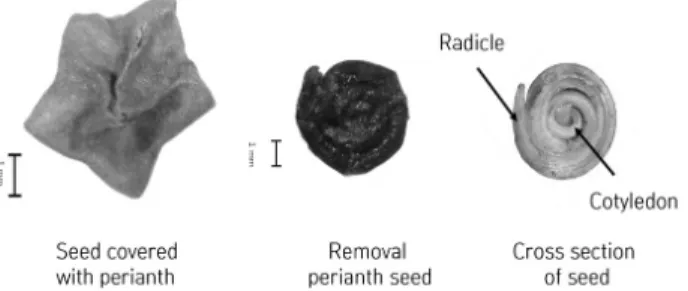
Fig. 1. Morphology and longitudinal section of the seed of Suaeda asparagoides.
남해안 갯벌에 분포하고 있다(Min, 1998). 과거에는 염생 식물의 가치와 기능이 잘 알려져 있지 않았기 때문에 잡초 와 같은 활용성이 없는 식물로 여겨졌으며, 기껏해야 땔감 으로 사용되는 정도였다. 그러나 지금은 다양한 염생식물 들이 소득 작물로 활용되고 있고, 생태공원, 자연학습장, 염 생식물원 등의 관광자원으로도 활용되고 있다.
이러한 염생식물 중에서 나문재(Suaeda asparagoides)는 한해살이풀로 명아주과에 속하며 간척지, 해안가 등에 분 포하고 있다. 나문재는 갯솔나무로 불리기도 하며 잎이 좁 은 선형으로 녹색이고 끝은 뾰족하며, 키가 크고 전체적으 로 털이 없으며 가지가 많이 발생한다. 꽃은 7~8월에 줄기 나 가지 윗부분의 잎겨드랑이에 핀다. 생육초기의 식물은 나물로 먹기도 하며, 하루에 약 20~40g 정도를 물로 달여 서 먹기도 하는데(Lee et al., 2003), 나문재는 고혈압과 간 에 쌓인 독을 풀어 간 기능을 회복하는데 효과가 있는 것으 로 알려져 있다(Lee et al., 2002).
본 연구는 토양 염농도의 변이가 큰 간척지에서 염생식 물 나문재의 안정적인 재배와 생산을 목적으로 다양한 환 경조건에서 나문재 종자의 발아특성과 초기생장특성을 구 명하고자 실시하였다.
재료 및 방법
본 연구에 사용된 나문재 종자는 2015년 12월에 새만금 간척지에 자생하는 식물체에서 채종하였다. 채종한 종자는 수분함량이 10~12% 정도로 실험실 내의 상온 조건에서 건 조하여 4°C에서 냉장보관 하여 실험에 사용하였다.
나문재 종자의 형태 및 구조는 해부 현미경(SZ61, Olympus) 을 사용하여 관찰하였다. 종자와 화피의 길이, 너비, 폭, 및 천립중을 조사하였고, 종자를 수직으로 절단하여 자엽, 유 아, 유근, 종피 등의 종자구조를 관찰하였다. 또한, 종자의 배유 유무를 확인하기 위해 수직절단 종자를 요오드용액 (0.2% I2 와 2% KI)으로 15분 동안 실온에 처리하여 염색 반응을 관찰하였다(Koo et al., 2014).
종자의 발아과정을 살펴보기 위하여, 직경 90 mm의 petri- dish 에 여과지(Quantitative filter paper No. 2, Advantec, Japan) 2 장을 깐 후 5 ml의 증류수를 공급하고 종자 50립을 치상 하였다. 치상한 petri-dish는 30°C의 incubator (VS-1203PI-LN, Vision Scientific Co., Korea) 로 옮겨 14일 동안 발아와 초 기생장을 관찰하였다.
종자 발아에 미치는 화피의 영향을 검토하기 위하여 1.7 mm sieve 위에 raw seed를 놓고 부드러운 부직포로 감싼 막자 를 이용하여 종자의 화피를 제거하였다(Lee et al., 2016).
Raw seed 와 화피를 제거한 종자의 발아에 필요한 적정 온도와 염농도를 알아보기 위하여, 직경 90 mm의 petri-dish 에 여과지 2장을 깔고 증류수를 5 ml씩 처리한 후 종자 100 립씩 치상하여 4반복으로 발아율을 조사하였다. 종자를 치상한 petri-dish는 5, 10, 15, 20, 25, 30, 35, 40°C의 8개 온도로 조절된 incubator에 넣어 백색광 조명하에서 14일간 처리한 후 발아율 검정을 실시하였다(ISTA, 2010). 염농도 에 따른 발아율 검정은 염농도(NaCl solution)를 0, 50, 100, 200, 300, 400 mM 등의 6개 처리하여 검토하였다.
한편, 종자의 발아에 미치는 광의 영향을 알아보기 위해 petri-dish 에 파종된 종자에 광(90 μmole m
-2s
-1, Phillips TL8 W/33) 과 암처리를 하여 발아율을 비교하였다. 암처리 를 위하여 carbon paper 2장으로 petri-dish를 완전히 감싸 서 광을 완전히 차단 후 알루미늄 호일로 한번 더 감싸서 carbon paper 를 고정하였다.
나문재의 초기생육은 유묘를 이식하여 조사하였다. 평균 온도 20°C의 유리온실에서 파종상자에 담긴 상토(바이오 생생상토, 흥농)에 종자를 산파하여 2주간 육묘하여 확보하 였고, 유묘는 직경 15.5 cm, 높이 20 cm의 포트에 육묘에 사용했던 것과 동일한 상토를 15 cm까지 채우고 포트 당 2 개체씩 이식하였다. 염농도는 발아실험과 같이 0 mM, 50 mM, 100 mM, 200 mM, 300 mM, 400 mM 의 6개 농도의 염수를 조제하여 포트에 매일 저면관수하여 처리하였고, 15~25°C ( 평균 20°C) 온실에서 8주 동안 재배하였다. 포트는 4반복 으로 완전임의로 배치하였다. 식물체 생육은 초장, 분지 수, 근장, 생체중, 건물중을 조사하였다.
결과 및 고찰
나문재 종자는 Fig. 1에서 보는 바와 같이 종자 전체가
별 모양의 황색 화피에 감싸여 있다. 화피를 제거한 종자는
암갈색의 납작한 바둑돌 모양으로 종자표면에 나선형의 주
름이 있다. 세로로 절단한 종자 단면에서 볼 수 있듯이, 긴
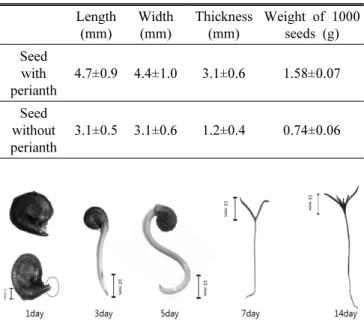
Table 1. Size and weight of the seed and perianth of Suaeda asparagoides.
Length (mm)
Width (mm)
Thickness (mm)
Weight of 1000 seeds (g) Seed
with perianth
4.7±0.9 4.4±1.0 3.1±0.6 1.58±0.07
Seed without perianth
3.1±0.5 3.1±0.6 1.2±0.4 0.74±0.06
Fig. 2. Germination and seedling growth process in Suaeda asparagoides. Seeds were imbibed with distilled water at 30°C under light conditions.
Fig. 3. Effect of temperature on germination in both raw and perianth-removed seeds of Suaeda asparagoides. Vertical bars in the graphs indicate standard deviations. Within temperature treatments for each raw and perianth-removed seed, means followed by the same small letter are not significantly different, as determined by Duncan’s multiple range test at α = 0.05. Within each temperature, means followed by the same capital letter are not significantly different, as determined by the t-test at α = 0.05.
두개의 자엽과 radicle이 나선형으로 말려있는 상태로 종피 에 싸여 있고 무배유인 종자구조를 가지고 있다.
화피를 포함한 종자의 크기는 길이가 4.7 mm, 너비가 4.4 mm, 두께가 3.1 mm이었고, 천립중은 1.58 g이었다. 화 피를 제거한 종자는 길이가 3.1 mm, 너비 3.1 mm, 폭 1.2 mm 이었고, 천립중은 0.74 g이었다(Table 1). 화피를 제거한 종 자는 전체 종자 무게의 약 50% 정도였다.
나문재 종자의 발아와 유묘의 생장과정은 Fig. 2와 같다.
나문재 종자는 침종 후 하루가 지나면 유근이 돌출되었고, 3 일 정도가 지나면 유근의 신장과 함께 자엽이 지상부로 돌출되면서 나선형의 종자가 풀리기 시작하였고, 5일 정도 지나면 나문재 종자의 자엽이 종피 밖으로 돌출되었다. 침 종 후 7일경에 유아가 자라기 시작하였고 14일이 경과되면 분지가 발생하기 시작하였다.
나문재 종자의 적정 발아 온도 구명을 위하여 5~40°C의 온도범위에서 5°C 간격으로 8개 온도 처리를 하여 발아율 검정한 결과, 화피가 있는 종자(raw seed)의 경우 5°C에서 40%, 10°C 에서 62%, 15°C에서 65%, 20°C에서 61%, 25°C 에서 54%, 30°C에서 39%, 35°C에서 30%, 40°C에서 8%
로 10~20°C의 비교적 저온에서 발아율이 높았으며 15°C에 서 가장 높은 발아율을 보였다. 화피를 제거한 종자(perianth- removed seed) 의 경우에는 5°C에서 71%, 10°C에서 79%, 15°C 에서 87%, 20°C에서 76%, 25°C에서 69%, 30°C에서
59%, 35°C 에서 51%, 40°C에서 31%로 모든 온도조건에서 raw seed 보다 발아율이 유의하게 상승되었으며, 화피를 제 거한 종자도 15°C에서 가장 높은 발아율을 보였다.
새만금 간척지의 염습지에서 나문재의 유묘출현율 보고 에 의하면 나문재는 야생상태에서 2~10월 사이에 출현하며 2 월에 출현율이 최대가 되고 3월부터 서서히 감소하여 10 월에 가장 낮았다(Kim, 2009). 이것으로 보면, 나문재 종자 는 자연상태에서 상당히 긴 발아기간을 가지는데, 이는 해 안염습지의 특수한 환경에 대한 생태적 적응 특성으로 생 각되며, 본 실험의 연구결과에서 처럼 5~40°C의 비교적 넓 은 범위의 온도에서 종자가 발아하는 이유로 볼 수 있다.
일반적으로 종자에서 화피나 영과 같은 조직은 내부의 종자를 보호하고 종자확산에 도움을 주며, 또한 종자의 수 명을 연장시키기도 하는 반면, 종자의 휴면이나 발아 지연 의 원인이 되기도 한다(Lee et al., 2016; Chung and Paek, 2003; Wei et al., 2008). 본 실험 결과에서 보는 바와 같이 나문재 종자의 경우에도 화피가 종자의 발아를 억제하는데 영향을 미치고 있는데, 이것의 원인이 화피에 포함된 발아 억제물질에 의해서 인지 또는 발아에 필요한 수분과 산소 의 투과를 물리적으로 억제하고 있는 지에 대해서는 추가 적인 연구가 필요한 부분이다.
나문재의 염농도에 따른 발아율은 Fig. 4와 같다. Raw
seed 의 발아율은 0 mM에서 65%, 50mM에서 48%, 100 mM
에서 37%, 200 mM에서 16%, 300 mM에서 7%, 400 mM
에서 0%로 0 mM에서 발아율이 가장 높았으며 염농도가
증가할수록 발아율이 감소하였다. 화피를 제거한 종자의
발아율도 같은 경향을 보였으나 raw seed보다 발아율이 유
의하게 증가하였으며, 특히 염농도가 높아 질수록 발아율
Fig. 4. Effect of NaCl concentrations on the germination of both raw seed and perianth-removed seeds of Suaeda asparagoides. The germination test was carried out at the optimum germination temperature, 15°C. Vertical bars in the graph indicate standard deviations. Within NaCl concentration treatments for each raw and perianth- removed seed, means followed by the same small letter are not significantly different, as determined by Duncan’s multiple range test at α = 0.05. Within each NaCl concentration, means followed by the same capital letter are not significantly different, as determined by t-test at α = 0.05.
Fig. 5. Effect of the presence of light on germination under various NaCl concentrations in Suaeda asparagoides. The germination test was carried out by using raw seeds at the optimum germination temperature, 15°C. Vertical bars in the graph indicate standard deviations. Within each light and dark treatment, means followed by the same small letter are not significantly different, as determined by Duncan’s multiple range test at α = 0.05. Within the same NaCl concentration, means followed by the same capital letter are not significantly different, as determined by the t-test at α = 0.05.
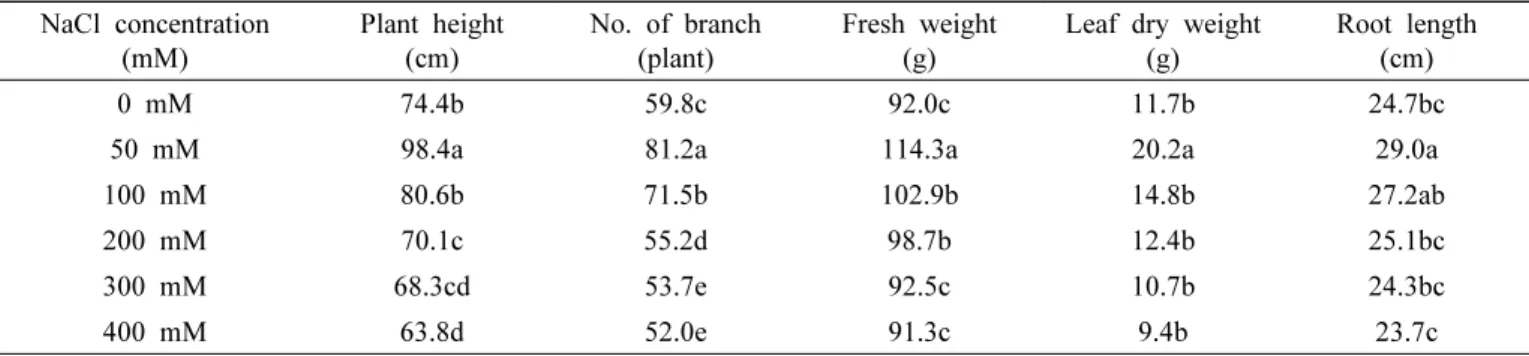
Table 2. Effect of soil salinities on the growth of Suaeda asparagoides. Within the same column, means followed by the same small letter are not significantly different, as determined by Duncan’s multiple range test at α = 0.01. Vertical bars indicate standard deviations.
NaCl concentration (mM)
Plant height (cm)
No. of branch (plant)
Fresh weight (g)
Leaf dry weight (g)
Root length (cm)
0 mM 74.4b 59.8c 92.0c 11.7b 24.7bc
50 mM 98.4a 81.2a 114.3a 20.2a 29.0a
100 mM 80.6b 71.5b 102.9b 14.8b 27.2ab
200 mM 70.1c 55.2d 98.7b 12.4b 25.1bc
300 mM 68.3cd 53.7e 92.5c 10.7b 24.3bc
400 mM 63.8d 52.0e 91.3c 9.4b 23.7c
상승효과는 더 크게 나타났다.
해안 염습지에 적응한 나문재 종자의 발아에서 염수보다 증류수에서 발아율이 더 높은 것은 흥미로운 사실이다. 본 연구결과뿐만 아니라 증류수에서 높은 발아율을 보이는 특 성은 대부분의 다른 염생식물에서도 유사하게 보고되어 있 어서(Khan et al., 2002; Lee et al., 2016; Ungar, 1995;
Wei et al., 2008), 이 것은 염생식물 종자의 일반적 발아 특성으로 볼 수 있으며, 염습지에서 발아시기의 변이를 넓 히기 위한 생태적 특성으로 이해할 수 있다.
나문재 종자의 광의 유무에 따른 발아율은 Fig. 5와 같다.
암처리에서의 발아율은 0 mM에서 61%, 50 mM에서 42%,
100 mM 18%, 200 mM 에서 13%, 300 mM에서 5%, 400 mM 에서 1%로 모든 염농도에서 광조건보다 발아율이 감소하 였다. 즉, 나문재 종자의 발아에 있어 광은 암상태보다 5~20%
정도 발아를 촉진하였다.
나문재의 염농도에 따른 초기생장장 특성은 Table 2와
같다. 초장은 0 mM에서 74.4 cm, 50 mM에서 98.4 cm,
100 mM 에서 80.6 cm, 200 mM에서 70.1 cm, 300 mM에
서 68.3 cm, 400 mM에서 63.8 cm를 보였다. 분지는 0 mM
에서 59개, 50 mM에서 81개, 100 mM에서 71개, 200 mM
에서 55개, 300 mM에서 53개, 400 mM에서 52개로 나타
났으며, 생체중은 0 mM에서 92 g, 50 mM에서 114 g, 100 mM
에서 102 g, 200 mM에서 98.7 g, 300 mM에서 92.5 g, 400 mM
에서 91.3 g으로 나타났다. 건물중은 0 mM에서 11 g, 50 mM
에서 20 g, 100 mM에서 14 g, 200 mM에서 12 g, 300 mM 에서 10 g, 400 mM에서 9 g으로 나타났다. 근장은 0 mM 에서 24.7 m, 50 mM에서 29.0 cm, 100 mM에서 27.2 cm, 200 mM 에서 25.1 cm, 300 mM에서 24.3 cm, 400 mM에 서 23.7 cm였다. 즉, 염농도에 따른 초기생장은 모든 조사 특성들이 50~100 mM에서 양호하였으며, 그 이상 또는 그 이하의 염농도에서는 생육이 감소하는 경향을 보였다.
적 요
본 연구는 토양 염농도의 변이가 큰 간척지에서 염생식 물 나문재의 안정적인 재배와 생산을 위한 연구의 하나로, 나문재 종자의 발아특성과 초기생육특성을 구명하고자 실 시하였다. 나문재 종자는 무배유 쌍자엽 구조를 가지며 별 모양의 황색 화피에 싸여 있다. 종자크기는 길이가 4.7 mm, 너비가 4.4 mm, 그리고 두께가 3.1 mm이며, 천립중은 1.58 g 이다. 종자의 발아는 5~40°C의 온도범위에서 8~65%의 변 이를 보이며, 15°C에서 가장 높았다. 염농도에 따른 발아율 은 증류수에서 발아율이 가장 높았으며 염농도가 증가할수 록 발아율이 감소하였다. 종자에서 화피를 제거했을 때의 발아율은 온도나 염농도에 관계 없이 모든 처리에서 유의 하게 증가하였다. 종자발아에서 광의 영향을 보면, 0~300 mM 의 염농도 범위에서 광조건이 암조건보다 5~20% 정도 발 아율이 높게 나타났다. 한편, 염농도 따른 나문재의 초기생 장을 초장, 경수, 생체중, 건물중, 근장 등으로 조사한 결과, 모든 특성들이 50~100 mM의 염농도에서 양호하였고, 증 류수나 높은 농도의 염수에서는 생장이 크게 감소되었다. 결 론적으로, 나문재의 발아율을 높이기 위해서는 화피를 제거 한 종자를 증류수에 침종하여 15°C 정도의 저온과 광 조건에 서 발아시키는 것이 유리하며, 식물체의 생장은 50~100 mM 의 염농도 하에서 재배하는 것이 유리하다.
사 사
본 논문은 농촌진흥청 연구사업(세부과제번호: PJ011067 012016) 의 지원에 의해 이루어진 것임.
인용문헌(REFERENCES)