*준회원, 울산대학교, 전기전자정보시스템공학부
**정회원, 울산대학교, 전기전자정보시스템공학부 (교신저자) 접수일자: 2010.11.25 수정일자: 2010.12.15
게재확정일자: 2011.2.11
논문 2011-1-4
무선 인지 센서 네트워크를 위한 퍼지 및 러닝 오토메타 기반의 채널 선택 기법
A Channel Selection Algorithm Based on Fuzzy Logic and Learning Automata for Cognitive Radio Sensor Networks
퉁 안 투안
*
, 구인수**
Truong Anh Tuan, In-soo Koo
요 약 본 논문은 무선 인지 센서 네트워크에서 2차 사용자를 위한 효율적 채널 선택 알고리즘을 제안한다. 제안된 알고리즘은 러닝 오토메타와 퍼지 로직을 기반하고 있으며, 러닝 오토메타는 무선 전송 채널을 2차 사용자가 학습하 여 그 결과를 채널 선택 확률값로 나타내며, 퍼지 로직은 최종 채널 선택을 위하여 다양한 입력 변수를 고려할 수 있 도록 한다. 즉, 퍼지 로직은 러닝 오토메타의 결과인 채널 선택 학률값, 기사용자와 2차사용자 사이의 채널 SNR, 송 수신 2차 사용자들 사이의 SNR값을 고려하여 다중의 가용 채널로부터 최적으로 전송 채널을 선택할 수 있도록 한다. 시뮬레이션 결과를 통해, 제안된 알고리즘이 기존 알고리즘들 보다 높은 처리율(throughput)을 제공할 수 있음을 보였다.
Abstract
In this paper, we propose a channel selection scheme for secondary users in cognitive radio sensor networks, which includes learning automata and fuzzy logic system (FLS). In the proposed scheme, FLS is used as the channel selection mechanism while the learning automata algorithm is being used to learn the radio environment such as channel link quality. Signal to noise ratio of the link between primary user (PU) and secondary user (SU), the probability of choosing channel, and signal to noise ratio of the link between secondary users are chosen as input parameters for the FLS to decide one data channel among multiple channels. Simulation results show that the proposed scheme does indeed provide advantages in improving the throughput of CR networks, in comparison with some other previous schemes.Key Words :
Fuzzy Logic, Learning Automata, Channel Selection, Cognitive Radio Sensor NetworksⅠ. Introduction
Recently, Cognitive Radio Sensor Network (CRSN) which enables opportunistic access to under-utilized licensed bands has been proposed as a promising technology for the improvement of spectrum exploitation
[1]. In CRSN network, secondary users
(SUs) share spectrum that primary users (PUs) do not
use. But a prerequisite of SU access is no interference
to PUs. Due to the random characteristics of PUs in the
CRSN networks, SUs need to switch the using channel
adaptively and consistently. But inefficient channel
switching may cause the packet loss problem to
CRSNs. Therefore, appropriate channel switching
selection mechanisms should be proposed in place in
order to guarantee QoS constraints of CRSNs on the
activities of PUs. With respect to SUs, the channel
selection strategy is invented to solve the above problem of CRSNs. Finding the optimal channel for SUs not only reduces channel switching, but also increases throughput of SUs
[2]. With suitable channel selection strategy for SUs, further PUs also avoids interference caused by SUs such that the activity of PUs can be guaranteed well
[3].
In the reference [4] and [5], a novel stochastic channel selection algorithm for SUs was proposed where a learning automata algorithm is used to determine a proper channel at a stage based on the past actions and corresponding outputs. However it is not enough to determine the channel for SUs based on historical performance of each channel, which is mainly due to the fact that there are many parameters that affect channel selection of secondary users such as SNR, fading, pass loss, wireless link error and probability of idling channel etc. The secondary user has to consider all of these effects before choosing channel.
In the paper, we propose a channel selection scheme for secondary users which includes the learning automata and fuzzy logic system (FLS). In the proposed scheme, FLS is used to evaluate the channel selection probability by considering multiple inputs such as the choosing probability, SNR of link between CRs and SNR of link between CR user and PU. On the other hand, the learning automata algorithm is used to learn the radio environment based on the past actions and corresponding outputs. Through the combination of fuzzy logic system and learning automata, channel choosing parameters can be considered more effectively while learning radio environment.
The rest of this paper is organized as follows: In Section II, we present the brief introduction of Learning Automata. In Section III, we present the system model.
In Section IV, we describe the proposed channel selection scheme. In Section V, we provide the simulation results. Finally, we draw our conclusion in section VI.
Ⅱ. SYSTEM MODEL
In this paper we consider a network with
primary users and
secondary users. Secondary user has a pair of transmitter and receiver which are both cognitive radios. Primary user can use the assigned channel whenever they want. Otherwise, the secondary user is allowed to operate at idle channels (primary user is absent). Secondary user will exit immediately and switch to another idle channel (among
⋯) if primary user comes back.
Ⅲ. THE PROPOSED CHANNEL SELECTION SCHEME
In the proposed channel selection algorithm, each secondary user has to operate all of these functions, shown in Figure 1.
FUZZY LOGIC SYSTEM
(FLS) CHANNEL SELECTION LEARNING
AUTOMATA
p
i SNR(PU_SU)SNR(SU_SU)
1 { }
arg max
ii M
i u
≤ ≤
= u
i그림 1. 제안된 채널 선택 기법.
Fig. 1 The proposed selection scheme.
Fuzzy logic system is used to evaluate the utility of channel at each SU. The channel that has maximized utility will be selected for transmission. Based on the probability of successful transmission, the probability of choosing channel is estimated by the learning automata algorithm and it will be feed back to fuzzy logic system for next cycle.
In our model, we consider two kinds of signal to
noise ratio (SNR). One is the SNR between PU and SU
and it is denoted as
. The other is SNR
between two SUs and it is denoted as
.
The SNR between PU and SU indicates the estimated
distance between PU and SU while the SNR between
two SUs indicates the link quality of communicating
channel.
1. Fuzzy logic system for channel selection At initialization step, each SU keeps channel choosing probability
…
and an estimation vector
…
, where
is the probability of choosing the
channel and
is the estimated possibility of successful transmission when the
channel is selected.
Fuzzy logic system is designed for making the decision on channel selection of SU. Depending on three inputs:
,
and probability of choosing channel
, the SU can easily estimate the status of channel (busy or available) and the channel’s stability (to avoid the return of primary user). The secondary user will select the channel which maximizes value of the output (
) from fuzzy logic system. The value of output from fuzzy logic can indicate the utility of channel.
SNR(SU_SU)
L M H
-10 10
1
(a)
SNR(PU_SU)
L M H
-20 -2
1
(b)
P
iL M H
0 1
1
(c)
그림 2. 퍼지 입력변수에 대한 membership 함수 ((a) :
에 대한 membership 함수, (b) :
에 membership 함수, (c) :
에 membership 함수).Fig.2 Membership functions of input parameters.
Each input variable is characterized by the term of three fuzzy sets {Low (L), Medium (M), and High (H)}
and the output is characterized by the term of another
three fuzzy sets {Bad (B), Normal (N), Good (G)}.
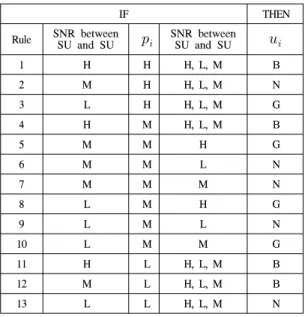
Table 1 represents the fuzzy rules base to be contained in the FLC. For example, in the
rule, if the SNR (PU_SU) is “Medium”, the SNR (SU_SU) is “High”
and the choosing probability pi is “Medium” then the output (estimated status of channel) is “Good”.
B N G
0 1
1
u
i그림 3. 출력변수에 대한 membership 함수.
Fig. 3 Membership function of output parameter.
IF THEN
Rule SNR between
SU and SU
SNR between SU and SU
1 H H H, L, M B
2 M H H, L, M N
3 L H H, L, M G
4 H M H, L, M B
5 M M H G
6 M M L N
7 M M M N
8 L M H G
9 L M L N
10 L M M G
11 H L H, L, M B
12 M L H, L, M B
13 L L H, L, M N
표 1. 퍼지 규칙.
Table 1 Fuzzy rules base.
2. Learning automata for updating
probability of choosing channel
The learning automata algorithm is designed to
learn and update its action from the environment. At
the beginning of a time slot, the transmitter picks a
channel that maximizes value of output from fuzzy
logic system. If the selected channel is busy, i.e., the
PU is present or occupied by another SU, the same
process is repeated until an available channel is selected and transmission begins. If the transmission is successful, SU will set
= 0 otherwise
= 1. Based on the received value of
, SU updates the probability vector P(n) and the estimation vector
by using learning automata algorithm. Then the next time slot will be considered.
Let :
•
is the resolution parameter.
•
is the number of primary users, i.e, number of channel opportunities.
•
is the number of secondary users.
•
is the number of channels which have higher values in the estimation vector
than the current selected channel.
•
is the step size of adjusting the probability vector and
•
is the number of slots where the transmission with the
channel are successful, up to
time slots.
•
is the number of slots where the channel
are chosen to transmit packet up to
time slots.
The learning algorithm for updating
is given as follows:
Initialization:
- The SU sets
…
where
=
for all
≤ ≤ . - Initializes
…
where
Do:
- Selects an available transmission channel
that maximizes the output of FLS. That is,
(1)- The SU adjusts the successful transmission
possibility of the channel, by
observing the success of data transmission as follows :
(2)
where = 1 if the transmission is successful and
otherwise.
- Update the probability vector
according to the following equations.
≦
(3)
≠
(4)Ⅳ. SIMULATION RESULTS
In this section, simulation results are performed to evaluate the performance of the proposed scheme. The simulation parameters will be set as follow:
–Resolution is set to = 50.
–Initialization parameter is set to = 10.
–There are 4 primary user, = 4 with the returning probability vector is µ = [0.2 0.1 0.3 0.4]
–Step size, is set to = 0.02.
–
= [-8 -6 -7 -9] (dB) –
= [4 2 6 8] (dB)
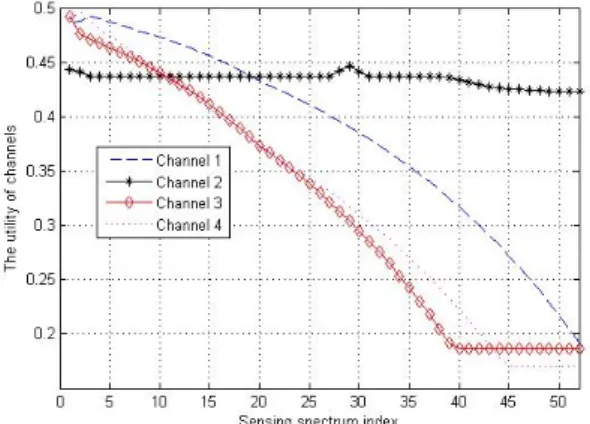
Figure 4 shows the output (
) from fuzzy logic
system according to sensing spectrum index. We can
see that at the initialization period, the channel 2 has
lower output value (
) from fuzzy logic system, in
comparison with channel 1, 3 and 4. Output value (
)
from fuzzy logic system of the channel 2 is stable after
few sensing spectrum intervals. Beside that, the
outputs of channel 1, 3 and 4 are decreased in all of
sensing spectrum time. This result shows that the
channel 2 is the optimal channel selection for the secondary user in this simulation.
그림 4. 채널 센싱 인덱스에 따른 퍼지 출력 값(
)의 변화.Fig. 4 Outp ut (
) from fuzzy logic system according to the spectrum index.In Figure 5, the total throughputs of our proposed scheme and other compared schemes are plotted.
Obviously, the proposed scheme always gives the highest throughput in comparison with the scheme in reference [4] and random channel selection scheme.
Through the proposed channel selection scheme the secondary user can get highest data rate delivered in network.
그림 5. 2차 사용자의 처리율.
Fig. 5 The total throughput of secondary user.
Ⅴ. CONCLUSIONS
In this paper we consider the design channel selection strategy for secondary user in cognitive radio networks. We propose a channel selection based on the combination of fuzzy logic system and learning automata technique. Depending on our propose scheme, the secondary user can choose the optimal channel with high throughput before transmitting data. Our result analysis shows the effectiveness of the proposed scheme.
참 고 문 헌
[1] Ekram Hossain, Dusit Niyato, Zhu Han,“Dynamic Spectrum Access and Management in Cognitive Radio Networks”, pp. 39-40.
[2] Akyildiz, I.F, Won-Yeol Lee, Vuran, M.C., and Mohanty, S. “A survey on spectrum management in cognitive radio networks”, IEEE, 2008.
[3] Ian F. Akyildiz, Won-Yeol Lee and Kaushik R.
Chowdhury.” CRAHNs: Cognitive radio ad hoc networks”, 2009.
[4] Song, Y.Fang and Yanchao Zhang, “Stochastic channel selection in cognitive radio networks”, Global Telecommunications Conference, pp.
4878-4882, November 2007.
[5] Thi Hong Chau Pham, Insoo Koo, “An Efficient Channel Selection Algorithm for Cognitive Radio Networks”., 8th IFAC International Conference on Fieldbuses & Networks in Industrial &
Embedded Systems, pp.84-88.
[6] Anastasios A. Economides. “Multiple response
learning automata”, Systems, Man, and
Cybernetics, Part B: Cybernetics, IEEE
Transactions, Feb 1996.
저자 소개 퉁 안 투안(준회원)
∙2008년 Assumption University, Bangkok, Thailand, 2008 (학사)
∙2010~현재 울산대학교 전기전자정 보시스템공학부 석사과정
<주관심분야 :인지무선시스템, 무선센서네트워크>
구 인 수(정회원)
∙1996년 건국대학교 전자공학과 졸업 (학사)
∙1998년 광주과학기술원 정보통신공학 과 졸업(석사)
∙2002년 광주과학기술원 정보통신공학 과 졸업(박사)
∙2005년~현재 울산대학교 전기전자정 보시스템공학부 부교수
<주관심분야 : 차세대 이동통신, 무선 센서네트워크>
※ This work was supported by KRF funded by MEST (Mid-Carrier Researcher Program 2010- 0009661).