1. 서 론
배관의 피로는 파괴형태의 하나이다. 재료의 항복 응력에 미치지 않는 작은 응력으로도 재료에 반복적 으로 작용하여 어느 한계를 넘으면 금속 표면에 작은 균열이 발생하며 계속해서 반복응력이 작용하면 균 열이 진전하여 최종적으로는 배관은 파괴하게 된다.
배관에 작용하는 응력의 원인으로는 진동 등 기계 적인 것과 온도변화에 기인하는 열적인 것이 있으며 온도변화에 기인하는 피로를 열피로라 한다. 금속재 료의 일반적인 성질로써 열을 가하면 팽창하고 식으 면 수축하는 것이 일반적이며 배관의 경우 구조상의 구속에 의해 팽창/수축으로 인한 응력, 즉 열응력이 발생한다.
배관에 작용하는 온도가 반복적으로 변하면 재료 도 팽창/수축을 반복하고 열응력도 반복적으로 작용 하여 재료 표면에 미세한 균열이 생성되어 진전하게 되면 최종적으로는 균열이 관통한다.
원자력발전소의 경우 운전 및 정지시 마다 계통의 온도변화를 동반하기 때문에 기기/배관에 열피로가 생길 위험이 상존하여 건전성에 영향을 미치므로 설 계시에 배관 재료별로 피로한계를 정하여 발전소 수 명 기간 중에는 피로한계를 초과하지 않게끔 기기/
배관이 설계되어 있다. 그러나 국소적으로 기기나 배관이 설계시 고려치 못한 열성층 현상에 기인한 열피로에 의하여 기기/배관이 손상되어 운전에 지장 을 초래한 사례가 다수 발생하고 있다.
열성층 현상에 의한 배관 손상이 처음으로 알려진 것은 1979년 미국 PWR형인 D.C.Cook 급수배관의 누설이다. 이것은 고온정지상태에서 증기발생기내 의 고온수와 저온/저유량의 급수에 의하여 증기발생
국내원전 배관계통 열성층 연구개발 현황
이선기†
Status of Thermal Stratification Research on Piping System in Korea Nuclear Power Plant
Sun Ki Lee†
(Received 2 December 2016, Revised 27 December 2016, Accepted 29 December 2016)
ABSTRACT
The thermal stratification phenomenon in the nuclear power plant can cause abnormal deformation of the piping, contact with the support, damage to the support system. Repetition of the thermal stratification phenomenon or variation of the thermal boundary layer can cause thermal fatigue. Thermal stratification phenomenon in nuclear power plants is still an ongoing issue and active research has been carried out. In this paper, the current situation in Korean nuclear power plants is described, followed by the status of research and the future problems on the thermal stratification phenomenon in Korea.
Key Words : Thermal Stratification(열성층), Surge Line(밀림관), Branch Line(분기관), Turbulence Penetration(난류 관통), Thermal Mixing(열혼합), Valve Leakage(밸브누설), Thermal Stress(열응력), Thermal Fatigue (열피로), Plant Heat Up Condition(발전소 가열조건)
† 책임저자, 회원, 한수원 중앙연구원 [email protected]
TEL: (042)870-5513 FAX: (042)870-5549
기와 연결된 급수배관에서 열성층 현상이 발생하고 펌프 운전 상태에 따른 반복적인 발생-소멸로 인하 여 열피로에 이르렀다.
1987년부터 1988년에 걸쳐서 미국 Farley 2호기, 벨기에 Tihange 1호기, 일본 Genkai 1호기에서 차단 밸브의 누설에 기인한 열성층/열피로 손상이 발생하 였다. 미국 NRC(Nuclear Regulatory Commission)에 서는 Bulletin 88-08(1)을 통하여 기존 원전뿐만 아니 라 설계중인 원전에 대해서도 주요 배관들을 대상으 로 열성층화(열피로) 현상의 존재여부 검토 및 평가 를 수행하여 배관의 건전성을 확인하고 설계 수명기 간중의 건전성 유지 방안을 촉구하였다. 특히, 가압 기 밀림배관에 국한한 열성층화 현상에 대해서는 NRC Bulletin 88-11(2)에서 건전성 평가 수행을 요구 하였다.
한편 1997년 미국 Oconee 원전 충전배관 용접부 손상, 1998년 프랑스 Civaux 1호기 열교환기 후단 배 관 균열, 1999년 일본 Tsuruga 2호기 재생열교환기 배관 균열 등은 배관내에서 고온수와 저온수의 혼합 시 발생하는 온도 경계층의 변동에 의한 열피로가 원인으로 판명되었다. 또한, 1999년 일본 Mihama 2 호기 취출수 배관에서 발생한 균열은 저온의 격리된 분기관에 고온수가 침투하는 난류관통(turbulence penetration)형 열성층 현상이 원인으로 판명되었다.
이렇듯 원전에서 발생하는 열성층 현상은 발생 메 카니즘이 다양하고 복잡하나 운전관리나 밸브 정비 등을 통해서 일부 열성층 현상의 발생은 예방 가능 하다. 그러나 원전 설계상 열성층 현상의 발생을 피 할 수 없는 계통이 있는 것도 사실이다.
원전에서의 열성층 현상은 현재까지도 진행 중인 현안으로써 국내외에서 비교적 활발한 연구 활동이 진행되고 있으며 본 논문에서는 열성층 현상에 대한 국내의 연구 동향 및 발전소에서의 관리 현황에 대 하여 살펴보기로 한다.
2. 국내 연구 동향
2.1 가압기 밀림관(surge line) 열성층
국내에서 열성층 현상에 대한 연구가 본격적으로 수행되기 시작한 것은 미국 NRC Bulletin 88-08(1), 88-11(2) 이후이다. 먼저 가압기 밀림관에 대한 열성 층 유동이 이슈가 되었다.
가압기 밀림관(surge line)은 원자로 냉각재 계통의 가압기(pressurizer)와 고온관(hot leg)을 연결하는 배 관으로서 이 배관 내에서 가압기측의 고온 냉각재와 이에 비해 상대적으로 낮은 온도인 고온관(hot leg) 측의 냉각재가 만나 배관의 상하부 간에 온도차가 항시 상존 가능하다.
가압기 밀림관내에서의 배관 단면을 대상으로 2차 원 비정상상태 열성층 현상의 유동특성 및 시간변화 에 따른 온도분포 거동에 대한 수치해석 모델이 제 안되었으며(3,4), 발전소 가열(heat-up) 조건에서 열성 층 현상의 발생 여부 및 열응력에의 영향 등을 평가 하였다(5). 또한 열성층 현상의 완화 방안으로 배관 외부가열 가능성에 대해서 검토하였다(6,7). 밀림관 내 에서의 열성층 유동 및 온도 경계층의 거동이 배관 벽면에 미치는 영향 평가가 이루어 졌다(8).
한편 열성층 현상의 온도 경계면 거동이 배관 벽 면에 미치는 영향, 즉 배관 두께방향의 과도온도분 포를 예측하였다(9,10,11).
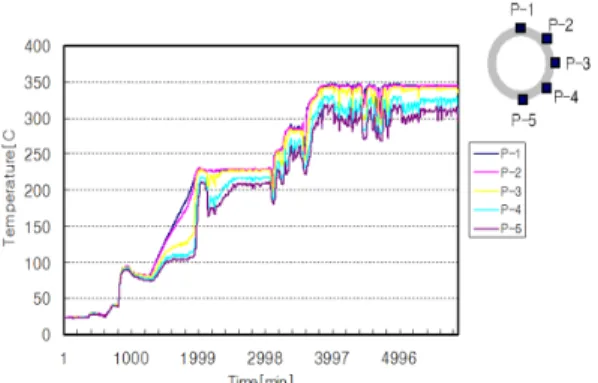
실제 고리4호기 밀림관을 대상으로 발전소 heat-up 부터 cool-down까지 1주기 운전동안 배관 원주방향 의 온도분포를 실측함으로써 열성층 현상의 발생 및 정도를 확인(Fig. 1)하였으며 실측 데이터로 열성층 영향을 평가하였다(12). 또한 한울 5,6호기를 대상으 로 발전소 가열조건에서 3차원 열유동 해석으로 열 성층 현상의 발생 및 구조건전성을 확인하였으며(13), 냉각재 환경이 피로수명에 미치는 영향(환경피로)(14), 열성층 현상을 정확하게 모사하기 위한 해석인자의 영향(15) 및 열응력 평가를 위한 해석 모델링(pipe element, shell element, solid element)의 비교 검토가 수행되었다(16).
Fig. 1 Temperature distribution of surge line at plant heat-up condition in Kori unit 4(12)
2.2 난류관통 및 차단밸브 누설에 의한 분기관 열성층
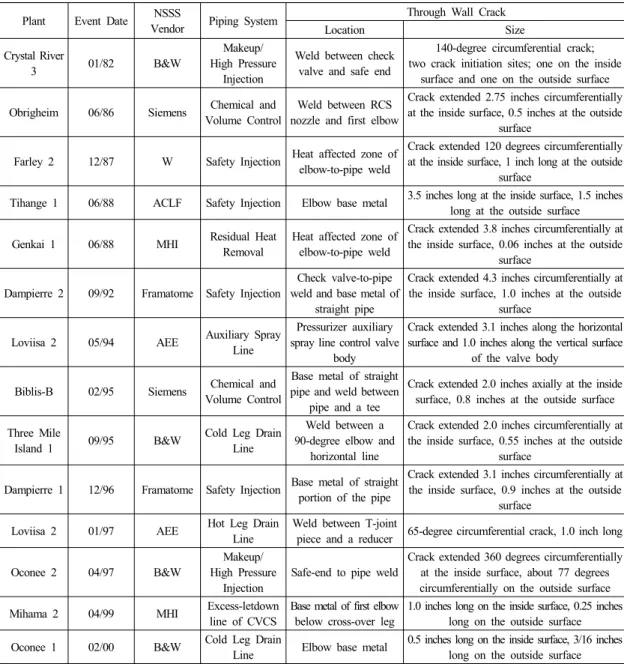
Table 1은 가압경수로형 원전 RCS 분기관에서 열 성층/열피로에 기인한 배관 균열 발생 사례를 균열 위치 및 크기에 대해서 정리한 것이다.
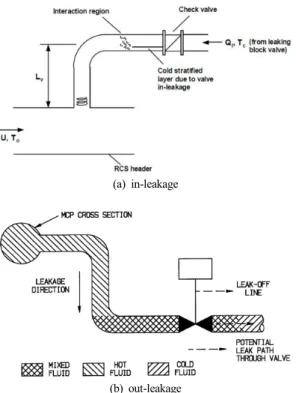
한편, EPRI 보고서(17,18,19,20)에서는 원전 분기관에 서 발생하는 열성층 현상 발생 메커니즘을 다음과 같이 설명하고 있다.
RCS 배관에서 분기관으로 난류관통(turbulent
penetration 또는 swirl penetration) 현상으로 고온 유 체가 스며들어 분기관 수평 배관부에 온도 경계층이 생길 수 있다(Fig. 2).
또한 주배관과 연결된 분기관 후단의 격리밸브 에서 저온의 물이 주배관 쪽으로 누설(in-leakage) 이 발생하는 경우(Fig 3(a))와 반대로 주배관측 고 온의 물이 분기관측으로 누설(out-leakage)이 발생 하는 경우(Fig. 3(b))에도 온도 경계층이 발생 가능 하다.
Table 1. PWR Reactor coolant leakage in non-isolable lines attributed to thermal fatigue(19) Plant Event Date NSSS
Vendor Piping System Through Wall Crack
Location Size
Crystal River
3 01/82 B&W
Makeup/
High Pressure Injection
Weld between check valve and safe end
140-degree circumferential crack;
two crack initiation sites; one on the inside surface and one on the outside surface
Obrigheim 06/86 Siemens Chemical and Volume Control
Weld between RCS nozzle and first elbow
Crack extended 2.75 inches circumferentially at the inside surface, 0.5 inches at the outside
surface
Farley 2 12/87 W Safety Injection Heat affected zone of elbow-to-pipe weld
Crack extended 120 degrees circumferentially at the inside surface, 1 inch long at the outside
surface
Tihange 1 06/88 ACLF Safety Injection Elbow base metal 3.5 inches long at the inside surface, 1.5 inches long at the outside surface
Genkai 1 06/88 MHI Residual Heat Removal
Heat affected zone of elbow-to-pipe weld
Crack extended 3.8 inches circumferentially at the inside surface, 0.06 inches at the outside
surface
Dampierre 2 09/92 Framatome Safety Injection
Check valve-to-pipe weld and base metal of
straight pipe
Crack extended 4.3 inches circumferentially at the inside surface, 1.0 inches at the outside
surface
Loviisa 2 05/94 AEE Auxiliary Spray Line
Pressurizer auxiliary spray line control valve
body
Crack extended 3.1 inches along the horizontal surface and 1.0 inches along the vertical surface
of the valve body
Biblis-B 02/95 Siemens Chemical and Volume Control
Base metal of straight pipe and weld between
pipe and a tee
Crack extended 2.0 inches axially at the inside surface, 0.8 inches at the outside surface
Three Mile
Island 1 09/95 B&W Cold Leg Drain Line
Weld between a 90-degree elbow and
horizontal line
Crack extended 2.0 inches circumferentially at the inside surface, 0.55 inches at the outside
surface
Dampierre 1 12/96 Framatome Safety Injection Base metal of straight portion of the pipe
Crack extended 3.1 inches circumferentially at the inside surface, 0.9 inches at the outside
surface Loviisa 2 01/97 AEE Hot Leg Drain
Line
Weld between T-joint
piece and a reducer 65-degree circumferential crack, 1.0 inch long
Oconee 2 04/97 B&W
Makeup/
High Pressure Injection
Safe-end to pipe weld
Crack extended 360 degrees circumferentially at the inside surface, about 77 degrees circumferentially on the outside surface Mihama 2 04/99 MHI Excess-letdown
line of CVCS
Base metal of first elbow below cross-over leg
1.0 inches long on the inside surface, 0.25 inches long on the outside surface Oconee 1 02/00 B&W Cold Leg Drain
Line Elbow base metal 0.5 inches long on the inside surface, 3/16 inches long on the outside surface
Fig. 2 Thermal stratification caused by turbulent penetration(17)
(a) in-leakage
(b) out-leakage
Fig. 3 Thermal stratification caused by valve leakage(17)
분기관 열성층 현상에 대해서는 안전주입배관을 대상으로 난류관통에 따른 열성층 현상 발생 여부 및 차단밸브에서 분기관 측으로 in-leakage가 발생 했을 경우를 가정하여 수치해석으로 검토하였으며
(21,22) 주배관 유속이 분기관 열성층 현상에 미치는
영향(23), 분기관 측으로 in-leakage 유량 영향(24), 분기 관의 기울기가 열성층 현상에 미치는 영향(25) 및 각 종 유동인자의 변화가 분기관 열성층 현상에 미치는 영향에 대해서도 분석하였다(26).
한편, 원전 분기관의 모형을 통하여 주배관의 유속 영
향 및 분기관 차단밸브의 in-leakage 유량 변화에 따른 열 성층 현상을 실험적으로 확인하였으며(27) 발생한 온도 경 계층의 주기적 변동성을 관찰하였다(28).
분기관 열성층 현상으로 인한 열하중이 배관 열피 로에 미치는 영향을 평가하고 강화검사 방법이 검토 되었으며(29), 국내 원전에서의 발생 가능성 및 배관 건전성에 미치는 영향이 평가되었다(30,31).
설계적 관점에서 분기관 열성층 현상 완화 방안에 대 해서 분기관 직경, 길이, 차단밸브 위치 및 누설량 등의 영향에 대해서도 해석적인 검토가 이루어 졌다(32).
(a) Temperature distribution at 450s
(b) Temperature distribution 1,000s
Fig. 4 Temperature distribution of branch line caused by valve in-leakage(31)
2.3 유체 혼합 유동에 의한 열성층
1998년 5월 프랑스 Civaux-1호기 잔열제거계통 (Residual Heat Removal System, RHR계통) 열교환기 후단에서 균열로 인한 다량의 냉각수가 누설된 사 고가 발생하였다. 균열 발생 위치는 열교환기 후단 의 엘보우 부위이다. 가압경수로형 원전의 잔열제거 계통 혹은 정지냉각계통(Shutdown Cooling System, SDC계통)의 열교환기 후단에서는 열교환기를 통과 한 저온의 유체와 열교환기를 통과하지 않은 (by-pass) 고온의 유체가 합쳐지는 부위가 존재한다.
이 유체 혼합부위에서의 온도 경계층의 발생을 해 석적으로 확인하였으며(33,34), 온도 경계층의 빠른 변 동(Fig. 5)에 의한 배관 고주기 열피로 평가 방법을 제안하고 있다(34,35).
(a) t=4.0 sec
(b) t=4.3 sec
Fig. 5 Temperature distribution of high-low temperature fluid flow mixing condition(34)
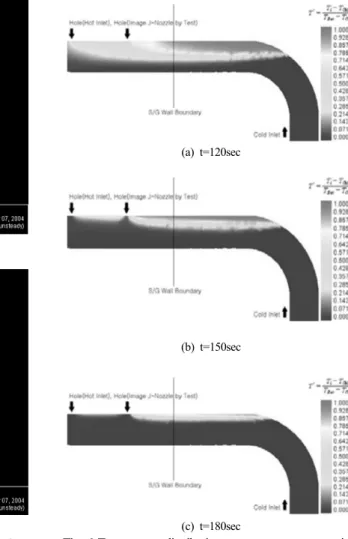
2.4 증기발생기 급수관 및 타 분야 열성층 증기발생기 급수배관에서 저유량으로 급수될 때 증기발생기 내부의 고온수와 급수배관사이의 수평배 관 및 노즐 부위에서 열성층 현상의 발생 가능성을 실험 및 수치해석(Fig. 6)을 통하여 검토하였으며(36), 원자로 용기의 DVI(Direct Vessel Injection) 배관에서 의 열성층 현상에 따른 피로평가(37)가 수행되었다.
액체금속로 상부구조물에서의 열성층 현상을 해 석적으로 모사하기 위한 난류모델의 적절성을 일 본 JNC(Japan Nuclear Corporation) 실험결과와 비 교하여 EBM(Elliptic Blending Model)의 우위성을 제시하였으며 온도 경계층의 빠른 변동 해석을 위 해서는 LES(Large Eddy Simulation) 방법을 사용하 였다(38,39,40,41).
(a) t=120sec
(b) t=150sec
(c) t=180sec
Fig. 6 Temperature distribution at steam generator straight piping(36)
참고로 재생에너지 분야에서는 열에너지 저장 및 활용을 위한 저장조 내에서의 열성층 유동 특성 에 관한 연구가 수행되고 있다. 태양열 에너지의 효과적인 저장과 활용을 위해서는 축열조 내의 열 성층 현상의 유지가 유리하여 축열조 내의 열성층 유동 특성을 수치해석 및 실험으로 관찰하고 있으
며(42,43,44,45,46), 열에너지의 거대한 지하 암반공동 저
장시의 열성층 유동특성 및 열손실 등을 해석적으로 검토하고 있다(47,48,49).
한편, 대기환경오염 측면에서는 열성층 유동의 확 산 촉진으로 열성층 현상의 빠른 제거가 유리하다.
이와 관련하여 열성층 유동장의 발생을 위한 풍동 제작(50), 온도분포 제어 방법(51) 및 열성층 유동장에 서의 원주 후류특성을 분석하였다(52,53,54,55).
2.5 발전소 열성층 관리 현황
가압기 밀림관의 경우 고리3,4호기 이후의 원전 (한빛 3,4호기부터)에서는 열성층 현상을 고려하여 설계되었다. 가압기 밀림관은 배관 형상이 열성층 현상 발생에 따른 배관 거동에 많은 영향을 미치므 로 최적의 형상을 도출하여 설계에 반영하였다.
한편, 고리 3,4호기 이전의 밀림관에 대해서는 발 전소 1주기 운전 동안 배관 단면 온도분포 및 거동 을 실측함으로써 건전성을 평가하였으며, 평가 결과 에 따라 검사 강화 부위를 선정하여 주기적으로 확 인, 관리하고 있다.
또한 분기관에 대해서도 상기에서 기술한 많은 연 구를 바탕으로 국내 가동 중인 전 원전을 대상으로 열성층 현상 발생 가능배관을 선정하고 열피로 평가 를 수행하였다. 평가 결과에 따라 열피로 위험 부위 를 선정하여 주기적인 검사를 강화함으로써 건전성 을 유지하고 있다.
3. 맺음말
원전 배관시스템에서의 열성층 현상은 배관 이상 변형, 지지구조물과의 접촉, 지지대 손상 등을 유발 할 수 있으며 열성층 현상의 반복 또는 열성층 온도 경계층의 변동 등은 열피로를 야기할 수 있다.
국내 원전에서는 열성층 현상의 실측 및 해석적 평가를 바탕으로 열피로 발생 가능 부위를 선정하여 검사를 강화함으로써 건전성을 유지하고 있다.
열성층 현상은 비교적 오래전부터 원전에서 알려 져 온 현상으로 발생 메커니즘이 다양하고 복잡하여 정성적인 설명으로 이해하고 있었으나 많은 해석적, 실험적인 연구를 통하여 현재에는 정량적인 평가가 이루어지고 있다. 그러나 고온-저온 유체 혼합시에 발생하는 온도 경계층에 대한 거동 주기 및 배관 벽 면과의 상관 등에 대해서는 불명확한 점이 있어 향 후의 실험적인 연구가 기대된다.
참고문헌
(1) USNRC, 1988, "Thermal stress in piping connected to reactor coolant system," NRC Bulletin 88-08.
(2) USNRC, 1988, "Pressurizer surge line thermal stratification," NRC Bulletin 88-11.
(3) Yeom, H. G., Park, M. H. and Kim, S. R., 1996,
“The Unsteady 2-D Numerical Analysis in a Horizontal Pipe with Thermal Stratification Phenomena,” J. of KNS, Vol. 28, No. 1, pp. 27-35.
(4) Yeom, H. G. and Park, M. H., 1996, “Unsteady Thermal Stratified Flow and Heat Transfer in a Horizontal Feedwater Pipe,” Trans. of KSME(B), Vol.
20, No. 2, pp. 680-688.
(5) Jeong, I. S., Kim, Y., Youm, H. K. and Park, M.
H., 1996, “Thermal Stratification in a Horizontal Pipe of Pressurizer Surge Line,” Trans. of KSME(B), Vol.
20, No. 4, pp.1449-1457.
(6) Jeong, I. S. and Kim, Y., 1997, “Numerical Analysis for Mitigating Thermal Stratification Flow of Pressurizer Surge Horizontal Pipe by Outside Heating,” Trans. of KSME(B), Vol. 21, No. 5, pp.
670-678.
(7) Jeong, I. S. and Song, W. Y., 1997, “An Analysis of Unsteady 2-D Heat Transfer of the Thermal Stratification Flow inside Horizontal Pipe with Electrical Heat Tracing,” J. of Energy Eng., Vol. 6 No. 2, pp.119-128.
(8) Jo, J. C., Kim, Y. I., Min, B. K., Oh, K. M. and Choi, S. K., 1998, “ Numerical Analysis of Thermally Stratified Flow in the Pressurizer Surge Line”, Trans.
of KNS Spring Meeting, p.133.
(9) Jo, J. C., Cho, S. J., Kim, Y. I., Park, J. Y., Kim, S. J. and Choi, S. K., 2001, “Prediction of Transient Temperature Distributions in the Wall of Curved Piping System Subjected to Internally Thermal Stratification Flow”, Proc. of 2001 KSME Spring
Meeting, pp. 474-481.
(10) Jo, J. C., and Choi, H. K., 2002, “Numerical Analysis of Conjugate Heat Transfer in a Curved Piping System Subjected to Internal Stratified Laminar Flow,” J.
of Compute Fluids Eng., Vol. 7, No. 3, pp.35-43.
(11) Jo, J. C., Jim, B. S., and Choi, H. K., 2002, “Three Dimensional Heat Transfer Analysis of a Thermally Stratified Pipe Flow,” Proc. of the Second National
Congress on Fluids Eng., pp. 103-106.
(12) Lee, S. K., Lee, H., Kim, T. R. and Kim, B. N., 1998, “Evaluation of Thermal Stratification on Surge Line in Kori Nuclear Power Plant Unit 4,” Trans.
of KNS Meeting, pp. 857-863.
(13) Kim, Y. J., Kim, M. W. and Ko, E. M., 2008,
“3-Dimensional Numerical Analysis for Thermal Stratification in Surgeline in Nuclear Power Plant,”
Proc. of KSME Fall Meeting, pp.729-734
(14) Choi, S. B., Woo, S. W., Chang, Y. S., Choi, J. B.,Kim, Y. J., Lee, J. H. and Chung, H. D., 2008,
“Evaluation of Thermal Stratification and Primary Water Environment Effects on Fatigue Life of Austenitic Piping,” Trans. of KSME(A), Vol. 32 No.
8, pp. 660-670.
(15) Jeong, J. U., Kim, S. H., Chang, Y. S., Choi, J. B., Kim, Y. J., Kim, J. S. and Chung, H. D., 2009,
“Numerical Analyses to Simulate Thermal Stratification Phenomenon in a Piping System,” Trans.
of KSME(B), Vol. 33, No. 5, pp. 381-388.
(16) Jhung, M. J. and Choi, Y. H., 2008, “Surge Line Stress Due To Thermal Stratification,” Nucl. Eng.
& Tech., Vol. 40, No. 3, pp. 239-250
(17) EPRI, 1994, “Thermal Stratification, Cycling and Striping(TASCS),” EPRI-TR-103581.
(18) EPRI, 2004, "Materials Reliability Program: Thermal Cycling Screening and Evaluation Model for Normally Stagnant Non-Isolable Reactor Coolant Branch Line Piping With a Generic Application Assessment (MRP-132)."
(19) EPRI, 2005, "Materials Reliability Program:
Management of Thermal Fatigue in Normally Stagnant Non-Isolable Reactor Coolant System Branch Lines (MRP-146)."
(20) EPRI, 2009, "Materials Reliability Program: Management of Thermal Fatigue in Normally Stagnant Non-Isolable Reactor Coolant System Branch Lines - Supplemental Guidance (MRP-146S)."
(21) Lee, S. K. and Kim, T. R., 2001, "Numerical Analysis of Turbulent Penetration and In-Leakage Flow at the NSSS Branch Line," Trans. of KNS Fall Meeting, pp. 1-9,
(22) Park, M. H., Kim, K. K., Youm, H. K., Kim, T.
Y., Lee, S. K. and Kim, K. H., 2001, “Analysis for the Behavior of Thermal Stratification in Safety Injection Piping of Nuclear Power Plant,” Proc. of
KSME Fall Meeting, pp. 110-114.
(23) Hong, S. W, Choi, Y. D., Park, M. S. and Seo, J.
H., 2001, “Numerical Analysis of Thermal Stratification due to Turbulence Penetration into Leaking Flow in a T Branch,” Proc. of KSME Fall
Meeting, pp.729-734.
(24) Kim, K. C., Park, M. H., Youm, H. K., Kim, T.
Y. and Lee, S. K., 2003, “A Study on Thermal Stratification Phenomenon due to In-Leakage in the Safety Injection Piping of Nuclear Power Plant,” Proc.
of KSME Spring Meeting, pp.1633-1638.
(25) Han, S. M. and Choi, Y. D., 2003, “Numerical Analysis of Thermal Stratification and Turbulence Penetration into Leaking Flow in a Circular Branch Piping,” Proc.
of KSME Spring Meeting, pp.1833-1838.
(26) Hong, S. W., Choi, Y. D. and Park, M. S., 2003,
“The Effect of Turbulence Penetration on the Thermal Stratification Phenomenon Caused by Leaking Flow in a T-Branch of Square Cross-Section,” Kor. Air-Cond.
and Ref. Eng., Vol. 15, No. 3, pp. 239-245.
(27) Song, D. I., Choi, Y. D. and Park, M. S., 2001,
“Experimental Research for Identification of Thermal Stratification Phenomena in the Nuclear Power Plnat Emergency Core Coolant System(ECCS),” Proc. of
KSME Fall Meeting, pp.735-740.
(28) Han, S. M., Choi, Y. D. and Park, M. S., 2006, “Study of Thermal Stratification into Leaking Flow in the Nuclear Power Plant, Emergency Core Coolant System,” Kor. Air-Cond. and Ref. Eng., Vol. 18, No.
3, pp. 202-210.
(29) Yeom, H. K., Seo, Y. H., Kim, H. S., Kim, K. C., Park, M. H., Jin, T. E., Lee, S. K. and Kim, T. R., 2003, “Assessment of Fatigue Effect for RCS Branch Line by Thermal Stratification”, Trans. of KNS Spring
Meeting, p. 384.
(30) Park, J. S., Choi, Y. H., Lim, K. H. and Kim, S.
H., 2010, “Thermal Cycling Screening Criteria to RCS Branch Lines in Domestic Nuclear Power Plant”,
Trans. of KPVP, Vol. 6, No. 2, pp. 54-60.
(31) Kim, S. H., Choi, J. B., Park, J. S., Choi, Y. H.
and Lee, J. H., 2013, “A Coupled CFD-FEM Analysis on the Safety Injection Piping Subjected to Thermal Stratification,” Nucl. Eng. & Tech., Vol. 45, No. 2, pp.237-248.
(32) Park, M. H., Kim, K. C. and Lee, S. C., 2006, “A
Study on the Mitigation Schemes of Thermal Stratification Phenomenon in a Branch Piping,” Kor.
Air-Cond. and Ref. Eng., Vol. 18, No. 7, pp. 603-611.
(33) Park, M. H., Kim, K. C. and Kim, K. H., 2003, “An Analysis on Thermal Stratification in Residual Heat Removal System Piping of Nuclear Power Plant,” Proc.
of KSME Fall Meeting, pp.1597-1602.
(34) Lee, S. K., Lee, S. K., Lee, W. R., Lee, H. H. and Kim, T. R., 2004, “Evaluation of High Cycle Thermal Fatigue Caused by Mixing Flow at RHR System,”
Trans. of KNS Spring Meeting, pp.1-15.
(35) Lee, S. K. and Lee, S. K., 2006, “Estimation of High Cycle Thermal Fatigue Caused By Mixing Flow at RHR System (II),” Trans. of KNS Spring Meeting, pp.1-2.
(36) Ji, J. S., Youn, B. S., Jeong, H. C. and Kim, S. N., 2009, “Simulation of Thermal Stratification in Inlet Nozzle of Steam Generator,” Nucl. Eng. & Tech., Vol.
41, No. 3, pp.287-294.
(37) Lee, B. H., Koo, J. S., Lee, H. H., and Park, M.
B., 2016, “Fatigue analysis of the DVI piping subsystem by considering thermal stratification,”
KOPEC Paper, pp.1-10.
(38) Choi, S. K., We, M. H., Jeon, W. D. and Kim, S.
O., 2004, “Evaluation of Turbulence Models for Analysis of Thermal Stratification in a Liquid Metal Reactor,” Trans. of KNS Spring Meeting, pp. 2004.
(39) Choi, S. K., Kim, S and Kim, S. O., 2005, “Evaluation of Turbulence Models for Analysis of Thermal Stratification,” J. of Compute Fluids Eng., Vol. 10, No. 4, pp.12-17.
(40) Choi, S. K. and Kim, S. O., 2006, “Computation of Natural Convection and Thermal Stratification Using the Elliptic Blending Model,” Proc. of Compute
Fluids Eng., pp. 77-82.
(41) Choi, S. K. and Lee, T. H., 2012, “Computational Fluid Dynamic Analysis of Thermal Stratification in the Upper Plenum of the MONJU Fast Breeder Reactor,” J. of Compute Fluids Eng., Vol. 17, No.
4, pp. 41-48.
(42) Hwang, S. J. and Pak, E. T., 1988, “Thermal Stratification Effects Near an Interface by Horizontal Inflow of Cold Water in Thermal Storage Tank,” The
Korean Solar Energy, Vol. 8, No. 2, pp. 45-56.
(43) Pak, E. T., 1993, “Experimental Study on the Effective Use of Thermally Stratified Hot Water Storage System,” The Korean Solar Energy, Vol. 13, No.
2, pp. 45-52.
(44) Jang, Y. K. and Pak, J. W., 2002, “A Study on Thermal
stratification Characteristics and Useful Rate of Hot Water in Thermal Storage Tank during Hot Water Extraction Process,” Kor. Air-Cond. and Ref. Eng., Vol.
14, No. 6, pp. 503-511.
(45) Joo, H. J., Kim, J. B. and Kwak, H. Y., 2008,
“Numerical Study on Thermal Stratification of the Aspect ratio of Solar Thermal Storage Tank,” Proc.
of the Korean Solar Energy, pp. 178-183.
(46) Kim, S. H., Kim, S. Y. and Kang, B. H.,2003, “Effect of a solid insert on thermal stratification in a side-heated cavity,” Proc. of Kor. Air-Cond. and Ref. Eng., pp.191.
(47) Park, D., Kim, H. M., Ryu, D. W. Choi, B. H., Choon, S. W. and Han, K. C., 2012, “Numerical Study on the Thermal Stratification Behavior in Underground Rock Cavern for Thermal Energy Storage(TES),”
Tunnel & Underground Space, Vol. 22, No. 3, pp.
188-195.
(48) Park, D., Kim, H. M., Ryu, D. W. Choi, B. H., Choon, S. W. and Han, K. C., 2013, “Thermal Stratification and Heat Loss in Underground Thermal Storage Caverns with Different Aspect Ratios and Storage Volumes,” Tunnel & Underground Space, Vol. 23, No. 4, pp. 308-318.
(49) Park, D., Ryu, D. W., Choi, B. H., Choon, S. W.
and Han, K. C., 2013, “Methods to Characterize the Thermal Stratification in Thermal Energy Storages,”
Tunnel & Underground Space, Vol. 23, No. 1, pp.
78-85.
(50) Kim, K. C., Jung, Y. B. and Kim, S. K., 1994, “A Study on the Characteristics of Cylinder Wake Placed in Thermally Stratified Flow(I),” Trans. of KSME, Vol. 18, No. 3, pp.690-700.
(51) Bu, K. S. and Kim, K. C., 1996, “Control of Temperature Distribution in a Thermal Stratified Wind Tunnel by using Neutral Networks,” Proc. of KACC, pp. 147-150.
(52) Kim, K. C. and Jung, Y. B., 1994, “A Study on the Effect of Thermal Stratification of a Heated Cylinder Wake,” Trans. of KSME, Vol. 18, No. 6, pp.
2454-2462..
(53) Kim, K. C., Jung, Y. B. and Kang, D. K., 1994,
“A Study on the Characteristics of Cylinder Wake Placed in Thermally Stratified Flow(II),” Trans. of
KSME, Vol. 18, No. 5, pp.1322-1329.
(54) Kim, K. C. and Jung, Y. B., 1995, “A Study on the Characteristics of Cylinder Wake Placed in Thermally Stratified Flow(III),” Trans. of KSME, Vol. 19, No.
5, pp. 1300-1307.
(55) Kim, K. C. and Jung, Y. B., 1995, “A Study on the Characteristics of Cylinder Wake Placed in Thermally
Stratified Flow(IV),” Trans. of KSME, Vol. 19, No.
5, pp. 1340-1350.