The auto-flocculent strain Zymomonas mobilis ZM401 was obtained from the parental strain ZM4 (ATCC31821) via chemical mutagenesis. The genome analysis on this mutant using PacBio RS HGAP and Illumina sequencings revealed that one chromosome (2,058,774 bp with 46.3% G + C content) and four plasmids were major components. The annotation analysis with total genomic sequence 2,204,959 bp was able to provide a total of 1,958 genes, 1, 898 CDSs, 51 tRNAs, and 9 rRNAs. In conclusion, this work unveiled that the potential variants including insertion, deletion, and SNPs associated with the auto-flocculation phenotype as compared to the reference genome of parental strain ZM4 were respectively 1, 2, and 77.
Keywords: Zymomonas mobilis, ZM401, auto-flocculation mutant, bioethanol, complete genome
A Gram-negative bacterium Zymomonas mobilis with Entner- Doudouroff pathway connected to ethanol fermentation pathway, has been recognized as an ideal bacterium used in the production of bioethanol and other green chemicals from lignocellulosic feedstocks (Rogers et al., 2007; He et al., 2014;
Kalnenieks et al., 2020). Attractive physiological characteristics on this bacterium including high sugar uptake rate and ethanol
yield, low biomass yield, and high ethanol tolerance up to 16%
(v/v) make it ideal for ethanol production (Rogers et al., 2007).
Zymomonas mobilis ZM4 (ATCC31821) has been the most frequently used platform strain for metabolic and evolutionary engineering studies to develop economically efficient bioethanol production process. For example, Z. mobilis ZM401 (ATCC 31822), an auto-flocculent mutant of ZM4 (ATCC31821) has been isolated through the chemical mutagenesis method (Lee et al., 1982). This mutant strain has been demonstrated that high density cells and cost-efficient cell recycling strategies used in continuous fermentation can provide high volumetric pro- ductivity for ethanol production (Davis et al., 2006; Zhao et al., 2014; Xia et al., 2018). In this recognition, the draft genome of ZM401 has been reported using whole genome shotgun sequencing method with Illumina HiSeq 2000 platform to identify genes responsible for the morphological changes on this mutant strain (Zhao et al., 2012). However, many genome sequencing data generated with this Illumina sequencing platform suggest extensive errors found in the number of genes in the draft genomes (Denton et al., 2014) and also failed to provide the sequence information of native plasmids in the strain (Zhao et al., 2012).
In this view, whole genome sequencing of Z. mobilis ZM401 was performed in order to identify variants on chromosome and plasmid. At first, PacBio long-read sequences generated by
Korean Journal of Microbiology (2021) Vol. 57, No. 3, pp. 220-222 pISSN 0440-2413
DOI https://doi.org/10.7845/kjm.2021.1064 eISSN 2383-9902
Copyright ⓒ 2021, The Microbiological Society of Korea
Complete genome sequence of the auto-flocculent strain Zymomonas mobilis ZM401
Jun Ho Yim
1,2†, Jong-Oh Kim
1,2†, and Young Jae Jeon
1,2*
1
Department of Microbiology, Pukyong National University, Busan 48513, Republic of Korea
2
School of Marine and Fishery Life Sciences, Pukyong National University, Busan 48513, Republic of Korea
자가 응집 균주 Zymomonas mobilis ZM401의 유전체 서열 분석
임준호
1,2†・ 김종오
1,2†・ 전용재
1,2*
1
부경대학교 미생물학과,
2부경대학교 해양수산생명과학부
(Received August 9, 2021; Revised August 18, 2021; Accepted August 20, 2021)
†
These authors contributed equally to this work.
*For correspondence. E-mail: [email protected];
Tel.: +82-51-629-5612; Fax: +82-51-692-5619
Complete genome sequence of Zymomonas mobilis ZM401 ∙ 221
Korean Journal of Microbiology, Vol. 57, No. 3 RS HGAP (v3.0) was preassembled as a de novo assembly
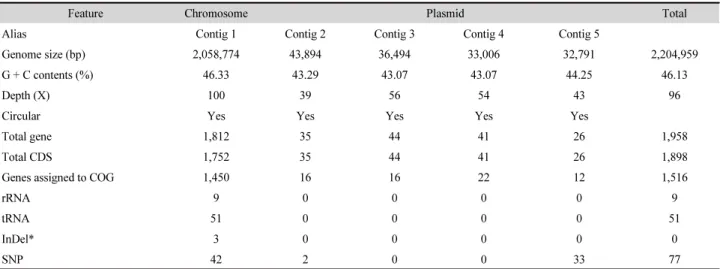
following Illumina short reads mapped to the de novo assembled sequence to validate accuracy of the assembly for error corrections by Pilon (v1.21). A total of five contigs (total base, 2,204,959) consisting of one chromosome (2,058,774 bp with 46.3 mol% G + C content) and four plasmids (43,894 bp, 43.29 mol%; 36,494 bp 43.07 mol%; 33,006 bp, 43.07 mol%; 32,791 bp, 44.25 mol%) were generated after assembly. All contigs were circular (Table 1). The genome features were annotated using NCBI Prokaryotic Genome Annotation Pipeline (PGAP) based on GeneMarks-2+ method (Tatusova et al., 2016). A total of 1,958 genes, 1,898 CDSs, 51 tRNAs, 9 rRNAs, and 3 ncRNAs genes were annotated from chromosome and plasmids (Table 1).
The assembled genome sequence data were further used to identify genetic variation involved in auto-flocculation pheno- type on ZM401 in comparison to the reference genome of parental strain ZM4 (GenBank No. CP023715). After removing duplicated reads with Sambamba v0.6.7 (Tarasov et al., 2015), variants were identified with SAMTools (Li, 2011). The number of variants including insertions, deletions and SNPs as compared to the reference genome of the parental strain ZM4 were respectively 1, 2, and 77. One insertional mutation found in the coding region of thioredoxin family protein (locus tag = ZM01_RS06260) and the other two deletions found in non-coding regions (chromosomal location at 1,268,401 and 1,090,376) in chromosome (contig 1) were major changes in
the genome. A part from InDel mutation, additional SNPs on structural genes and non-coding regions including 42 SNPs from contig 1, two SNPs from contig 2, and 33 SNPs from contig 5 were potentially involved in this phenotypic change on this bacterium (Table 1).
The auto-flocculent strain ZM401 used in this study has been demonstrated as a cost efficient ethanologen used in continuous fermentation system allowing to eliminate the cost used in the centrifugation step required for cell recycling (Zhao et al., 2014). In comparison to the planktonic phenotype of ZM4, the auto-flocculent phenotype of ZM401 cells to be self-immobilized surrounded by extracellular polymer provides a high-density culture permitting to improve ethanol productivity (Davis et al., 2006). Recently such self-immobilized charac- teristics also make an additional benefit to reinforce cell robustness against various physicochemicals stresses during the lignocellulosic ethanol production process (Zhao et al., 2014). Although several gene knock studies and transcriptomic analysis were previously performed (Jeon et al., 2012; Xia et al., 2018), still major responsible gene mutation involved in the auto-flocculent phenotype remained still unclear due to the poor quality of genome sequencing data. In this regard, the complete genome sequence information generated in this study may play important role to understand genetic makeup related to auto-flocculation phenotype not only for ethanol production but also other relevant strain development for other bio- technological commodities.
Table 1. Genome characteristics of Z. mobilis ZM401 (ATCC31822)
Feature Chromosome Plasmid Total
Alias Contig 1 Contig 2 Contig 3 Contig 4 Contig 5
Genome size (bp) 2,058,774 43,894 36,494 33,006 32,791 2,204,959
G + C contents (%) 46.33 43.29 43.07 43.07 44.25 46.13
Depth (X) 100 39 56 54 43 96
Circular Yes Yes Yes Yes Yes
Total gene 1,812 35 44 41 26 1,958
Total CDS 1,752 35 44 41 26 1,898
Genes assigned to COG 1,450 16 16 22 12 1,516
rRNA 9 0 0 0 0 9
tRNA 51 0 0 0 0 51
InDel* 3 0 0 0 0 0
SNP 42 2 0 0 33 77
* Abbreviation of insertion and deletion.
222 ∙ Yim et al.
미생물학회지 제57권 제3호
Nucleotide sequence accession number
Zymomonas mobilis ZM401 is available in the American Type Culture Collection under the deposition number ATCC 31822 and the complete genome sequences for chromosome and plasmids were deposited in NCBI GenBank with accession number NZ_CP079220-4.
적 요
자가 응집 균주 Zymomonas mobilis ZM401는 모 균주인 ZM4 (ATCC31821)의 화학적 돌연변이법을 통해 분리되었 다. PacBio RS HGAP 및 Illumina 분석을 통해 하나의 염색체 (2,058,774 bp 크기의 G + C 함량 46.3% mol%)와 네 개의 플라 스미드 서열이 확인되었다. 이 균주의 유전체들은 총 1,958개 의 유전자, 1,898개의 CDS, 51개의 tRNA, 9개의 rRNA 유전 자를 포함한다. 모 균주 ZM4(ATCC31821) 유전체 분석 결과 와 비교하였을 때 자가 응집 표현형과 관련된 삽입, 결실 및 SNP를 포함한 잠재적 변이체 갯수가 각각 1, 2 및 77임을 확인 하였다.
Acknowledgments
This work was supported by a Research Grant of Pukyong National University (2019).
Conflict of Interest
The authors have no conflicts of interest to report.
References