* Corresponding author : Soo-Ki Kim, Department of Animal Science and Technology, Konkuk University, Seoul 05029, Korea, Tel: +82-2-450-3728, Fax: +82-2-458-3728, E-mail: [email protected]
Research Article
말분변 미생물을 이용한 주스박 사료의 발효 특성
황원욱
1, 김겸헌
1, 우개민
1, 임정호
1, 우제훈
2, 채현석
2, 박남건
2, 김수기
1*1
건국대학교 동물자원과학과
2
농촌진흥청 국립축산과학원 난지축산시험장
Fermentation Characteristics of Juice Pomace Feed by Horse Feces Microbes
Won-Uk Hwang
1, Gyeom-Heon Kim
1, Kai-Min Niu
1, Joung-Ho Lim
1, Jae-Hoon Woo
2, Hyun-Seok Chae
2, Nam-Geon Park
2and Soo-Ki Kim
1*1
Department of Animal Science and Technology, Konkuk University, Seoul 05029, Korea.
2
National Institute of Animal Science, RDA, Jeju 63242, Korea.
ABSTRACT
In vitro fermentation was conducted to figure out alternative fiber sources for horse feed. For the development of value-added products as a horse feed resource, the pomaces from apple, carrot, grape, and citrus were fermented under solid-state conditions in the presence of 60% soybean meal with 40% of each fruit pomace at 60% of moisture content. Lactobacillus plantarum SK3873, Lactobacillus plantarum SK3893, Weissella cibaria SK3880, and Bacillus subtilis SK3889 were isolated from the fermented fruit pomace by inoculation of horse feces. For the growth of Bacillus subtilis, Saccharomyces cerevisiae, and Lactobacillus plantarum, they were inoculated in 3-step order at 0, 12, and 24 h, respectively. The fruit pomace was fermented for 48 h at 35°C. The pH of the apple, carrot, grape, citrus and all mixed pomaces decreased from 5.45∼6.25 to 4.40∼4.77. Microbial growth was maintained at 108∼109 cfu/g. After 12 and 24 h incubation, dry matter of carrot pomace were highest at 54.84 and 56.66%, respectively (P<0.05) and that of grape pomace was lower than others during fermentation (P<0.05). Dry matter was generally reduced by about 20%. NDF decreased gradually or maintained after 24 h, indicating the fiber degradation. Ash content tended to decrease during fermentation.
After 48 hours fermentation, Bacillus, yeast and Lactobacillus showed an excellent growth by using juice by-products. These results suggest that fermented juice pomace has a potential as horse feedstuff with probiotics to maintain beneficial microflora in horse gut.
(Key words : Horse feed, Solid state fermentation, Juice pomace)
Ⅰ. 서 론
국내 말산업 규모는 2015년도 3조 2,303억원에서 2016년 도 말에는 3조 4,120억원으로 5.6% 성장하였다 (http://www.
horsepia.com). 말 사육두수는 27,116두로 2015년에 비해 3.0%
성장하였으며, 산업체수는 약 2,278개소로 보고되었다. 따라 서 국내 말산업을 확대 발전시키기 위해서는 우리나라 실정 에 맞는 경제적인 말 사료의 개발에 대한 연구가 필요하다 . 말은 비반추 초식동물로 영양소 요구량을 충족시키기 위해서 는 많은 양의 조사료를 필요로 하고, 곡류의 급여를 통해 에 너지 요구량을 충족시켜야 한다 (Oliveira et al., 2003). 그러 나 사료 원료의 대부분이 수입에 의존하고 있어 국제곡물 가
격의 불안정과 조사료의 가격 상승 때문에 농가에 경제적 부 담으로 이어진다 . 말에 있어서도 다양한 농산부산물을 이용 한 조사료 대체는 중요하다 (Silva et al., 2016). 국내에서 주 스박과 같은 농산부산물을 사료로 적극 이용할시 사료 원료 의 1,714톤 이상을 대체할 수 있는 것으로 보고되었다 (Ministry of Agriculture, Food and Rural Affairs, 2014).
주스 생산 과정 중에 원료의 20~30%로 생산되는 부산물인
주스박은 섬유소함량이 풍부하고 가격이 저렴하다 (Kumar et
al., 2010). 사과박, 당근박, 포도박 그리고 감귤박은 펙틴을 다
량 함유하고 있어 탄수화물을 주요 에너지원으로 이용하는 말
의 조사료로 가능하다 (Manzano et al., 1999; NRC, 2007; Silva
et al., 2016; Sudha et al., 2007). 사과박은 수분함량 84.91%,
조단백질 0.87%, 조지방 1.06%, 조섬유 2.68%, 조회분 0.54%
로 조단백질의 함량은 낮지만 비구조탄수화물 , 유기산, 비타 민 C와 미량광물질의 함량이 높고 기호성이 좋다 (Joshi and Sandhu, 1996; Rahmat et al, 1995; http://www.nongsaro.go.kr).
또한 사과박은 착유우와 면양과 같은 반추동물을 대상으로 많 은 연구가 보고되었다 (Alibes et al., 1984; Joshi and Sandhu, 1996; Sun et al., 2010). 당근박은 수분함량 78.18%, 조단백질 5.28%, 조지방 1.46%, 조섬유 3.62%, 조회분 0.83%로 식이섬 유 , β-carotene, thiamine 그리고 riboflavin과 같은 비타민류, 미량광물질 등의 생리활성 물질을 다량 함유하고 있다 (Sharma et al., 2012; Walde et al., 1992; http://www.nongsaro.
go.kr). 포도박은 수분함량 89.21%, 조단백질 1.14%, 조지방 0.96%, 조섬유 3.43%, 조회분 0.81%로 단백질, 비가소화성 섬 유 및 미량광물질이 풍부하며 장관 내 유용 미생물의 성장을 촉진한다고 알려져 있다 (Hervert-Hernández et al., 2009; Kim and Han, 2010; Yu and Ahmedna 2013; http://www.nongsaro.
go.kr). 감귤박은 수분함량 86.92%, 조단백질 1.12%, 조지방 0.34%, 조섬유 2.42%, 조회분 0.49%로 pectin이 풍부하고 면역 기능과 항산화기능을 향상시킨다고 보고되었다 (Lee et al., 2015; http://www.nongsaro.go.kr). 이와 같이 주스박은 영양학 적 가치가 우수하여 말의 조사료 자원으로 이용할 수 있다.
현재까지 국내에서는 말 사료에 관련된 연구는 그다지 많 지 않으며 , 농산부산물을 이용한 연구는 건조 감귤박과 소맥 피의 급여 연구가 보고되었다 (Chae et al., 2013). 말의 사료 및 영양과 관련된 연구는 사료 급여량의 변화, 비육기간 조 절 , 사료 급여 방법 등이 보고되었다 (Oh et al., 1993; Chae et al., 2015a; Chae et al., 2015b).
본 연구에서는 다양한 생리활성 물질 , 미네랄, 수용성 탄수 화물인 펙틴을 함유하고 있는 사과박, 당근박, 포도박 및 감 귤박을 이용하는 미생물을 동정하였고, 이들 균주들을 접종 하여 주스박을 고체발효 시키면서 말의 영양적 사료가치를 알아보고자 하였다 .
Ⅱ. 재료 및 방법 1. 시험재료
시험재료로 이용한 주스박은 사과박 , 당근박, 포도박 그리 고 감귤박을 이용하였다 . 모든 원료들은 일반 시장 (서울시 광진구 )에서 구입하였으며 세척한 후 착즙기 (Ang-7700, Angeljuicer, Busan, Korea)를 이용하여 착즙하고 나오는 잔류
부산물을 이용하였다 .
2. 말분변을 접종한 주스박으로부터 유용균주 분리 및 동정
주스박을 영양분으로 이용하는 말 장내에 서식하는 유용한 균을 분리하기 위해 상기의 사과박 , 포도박, 당근박의 각 1 g을 미네랄 용액 (KH
2PO
40.07 g, MgSO
40.07 g, NaCH
3CO
20.07 g, NaCl 0.07 g, Distilled water 0.7 L) 9 ㎖로 희석하여 여기에 더러브렛 말의 분을 멸균증류수로 10배 희석한 것을 1 ㎖ 접종 하였다. 그 후 30℃ 진탕배양기 (BF-60SIRL, Biofree, Korea)에 서 3일간 배양하였다. 이 배양액을 각각 LB (Difco, USA) agar plate, MRS agar plate, YM (Difco, USA) agar plate에 도말하였 다. 도말된 plate는 MRS plate와 LB plate는 35℃에서 배양하였 고 YM plate는 30℃에서 배양하였다. 형성된 콜로니들을 육안 으로 관찰하여 형태학적으로 서로 상이한 콜로니들을 분리하 여 실험에 사용하였다 . 선발된 균주는 16S rDNA 유전자 서열 분석을 분석하여, BLAST 검색을 통해 상동성을 조사하였다.
3. 고체 발효
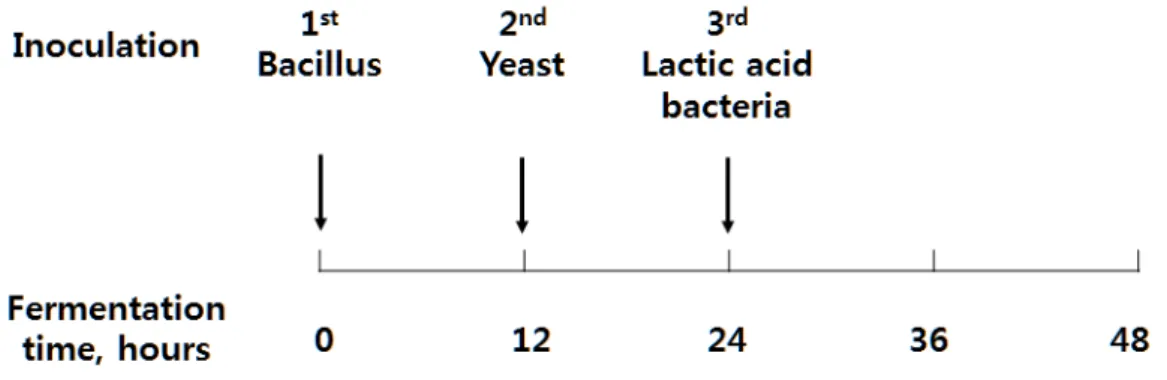
본 연구에서는 분리한 유용균주 중에 Lactobacillus plantarum SK3873, Lactobacillus plantarum SK3893, Weissella cibaria SK3880 및 Bacillus subtilis SK3889를 선택하여 주스박의 고체 발효에 이용하였다. 감귤박의 경우에는 Lactobacillus plantarum SK1305를 이용하였다 (Niu, 2015). 고체발효를 진행하기 위해 서 121℃에서 15분간 멸균한 주스박과 대두박을 4:6으로 혼합 하였으며 발효 0시간에 바실러스, 12시간에 효모 그리고 24시 간째에 유산균을 각각 단계적으로 접종하여 발효를 진행하였 다 (Fig. 1). 발효 조건은 수분 60%로 하여 35℃에서 48시간 동안 진행하였다 . 각 부산물 발효에 이용된 균주와 부산물의 량은 아래의 Table 1과 같다.
4. pH 변화와 생균수 변화
시간대별로 샘플링한 각 샘플을 15 mL conical tube에 옮 긴 후 , 증류수와 샘플을 9:1로 희석한 후 pH/ISE meter 735P (Istek, Republic of Korea)로 측정하였다. 생균수의 변화는 MRS, LB, YM (Difco, USA) 평판배지에서 측정하였다. 각 시 간대별 시료 1g을 멸균 증류수 9 ㎖에 넣은 후 균질화 과정을 거쳐 순차적으로 희석하였다 . 희석한 상등액 100 ㎕를 MRS, LB, YM plate에 각각 분주하여 MRS, LB는 35℃, YM은 30℃
항온 배양기에서 24시간동안 배양한 후 colony 수를 log
10CFU/g로 계산하였다.
Fermentation Pomace material Stock No. Inoculation microbes Addition amount, g
Pomace SBM D.W.
Single pormace
Citrus
SK3889 SK3587 SK3121
Bacillus subtilis Saccharomyces cerevisiae
Lactobacillus plantarum
200 300 131.84
Apple
SK3889 SK3587 SK3873
Bacillus subtilis Saccharomyces cerevisiae
Lactobacillus plantarum
200 300 150.00
Grape
SK3889 SK3587 SK3893
Bacillus subtilis Saccharomyces cerevisiae
Lactobacillus plantarum
200 300 154.31
Carrot
SK3889 SK3587 SK3880
Bacillus subtilis Saccharomyces cerevisiae
Weissella cibaria
200 300 123.76
Mixture of pomaces
Citrus
SK3889 SK3587 SK3121
Bacillus subtilis Saccharomyces cerevisiae
Lactobacillus plantarum
50 - -
Apple 50 - -
Grape 50 - -
Carrot 50 - -
Total 200 300 139.98
Table 1. Formulation of pomace mixture used for solid state fermentation Fig. 1. Schematic diagram of three-step inoculation.
5. 성분 분석
젖산의 함량은 Amplite
™Colorimetric L-Lactate Assay Kit (AAT Bioquest®, CA, USA)를 이용하여 분석하였으며, 건물 량 (Dry matter: DM)은 60℃ dry oven (WFO-600SD, EYELA, Japan) 에서 하루 동안 건조하여 건조 전과 후의 무게를 통해 계산하였으며 , 중성세제 불용성 섬유소 (Neutral detergent fiber: NDF)와 산성세제 불용성 섬유소 (Acid detergent fiber:
ADF)는 ANKOM 200 fiber analyzer (ANKOM Technology, USA)를 이용하여 매뉴얼에 따라 분석하였다. 조회분은 500℃
회화로 (Thermo Scientific, USA)에서 2시간 동안 회화시킨 후 정량하였으며, 모든 성분 함량은 건물 기준으로 표기하였다.
6. 통계분석
통계분석은 SAS (Statistical Analysis System, Version 9.1, USA) program package를 이용하여 각 처리구간의 평균값을 Duncan's multiple range test를 실시하면서 시간대별 각 부산물 의 영양성분 변화를 비교 검정하였다 (Steel and Torrie, 1980).
Ⅲ. 결과 및 고찰
1. 말분변을 접종한 주스박으로부터 유용균주의 분리 및 동정
Stock No.
Isolated source
Homology
Characteristics Reference Coverage Identity Identification
SK3873
Apple pomace
100 100 Lactobacillus plantarum Probiotics, fermentation of glucose, found in vegetable
Park et al., 2013 López et al., 2015 SK3874 100 99 Enterococcus casseliflavus Bacteremia, pathogenic Safari et al., 2016 SK3875 100 100 Lactococcus lactis Probiotics Bermúdez-Humarán et al.,
2013
SK3876 100 100 Meyerozyma guilliermondii Found in yoghurt Kuo et al., 2015 SK3878 100 100 Pediococcus pentosaceus Found in Kimchi and vegetable
fermentation Dawood, et al., 2015 SK3879 100 100 Hanseniaspora uvarum Found in wine, alcohol fermentation,
acetate fermentation Batista et al., 2015 SK3880 Carrot
pomace 100 100 Weissella cibaria Immune activity Lee et al., 2013 SK3886
Grape pomace
100 99 Pantoea agglomerans Found in spoiled vegetable Bonaterra et al., 2014 SK3887 100 100 Rahnella aquatilis Pathogenic, bacteremia Tash 2005
SK3893 100 100 Lactobacillus plantarum Probiotics, glucose fermentation, found in vegetable
Park et al., 2013 López et al., 2015 SK3894 100 99 Lactococcus lactis Probiotics Bermúdez-Humarán et al.,
2013
SK3895 100 100 Hanseniaspora uvarum Found in wine Batista et al., 2015 SK3889
Horse feces
99 100 Bacillus subtilis Antibacteria and enzyme acitivity Jayaraman et al., 2013 SK3890 100 100 Bacillus aerius Plant growth Khianngam et al., 2014 SK3891 100 100 Bacillus cereus Soil and water Altmeyer et al., 2014 SK3892 100 100 Weissella confusa Kimchi Kajala et al., 2015 SK1305 Kimchi 100 100 Lactobacillus plantarum Kimchi Niu 2015
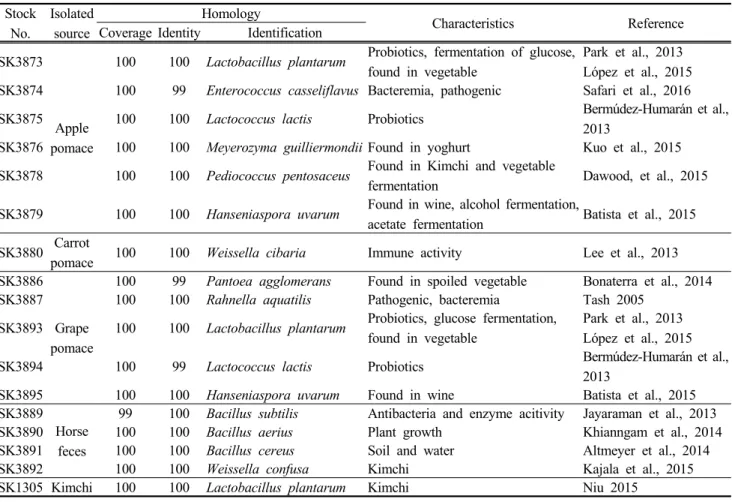
Table 2. Isolation and identification of the microbes from fruit pomace, vegetable pomace and horse feces 주스박을 말 사료 용으로 이용하고자 이에 적합한 유용한
균주를 동정하였다 . 사과박, 포도박, 당근박에 더러브렛 말의 분을 접종한 후 여기에서 자라는 우점 균 그리고 말분변에서 직접 균을 분리하였다. 결과적으로 각각 6종, 5종, 1종 및 4종의 세균들을 분리하였다 (Table 2). 사과박에서는 Lactobacillus plantarum, Enterococcus casseliflavus, Lactococcus lactis, Meyerozyma sp., Pediococcus pentosaceus, Hanseniaspora uvarum을 분리하였으며, 당근박에서는 Weissella cibaria, 포도 박에서는 Pantoea agglomerans, Rahnellaaquatilis sp., Lactobacillus plantarum, Lactococcus lactis와 Hanseniaspora uvarum을 분리 하였다 . 또한 말의 분에서는 Bacillus subtilis, Bacillus aerius, Bacillus cereus와 Weissella confusa를 분리하였다. 유산균은 Lactobacillus, Lactococcus, Enterococcus, Pediococcus, Weissella 등 이 동정되었고 , 효모는 Meyerozyma과 Hanseniaspora, 고초균 은 Bacillus subtilis와 Bacillus aerius를 분리하였다. Lactobacillus plantarum, Bacillus subtilis, Weissella 등은 생균제로 활용한 보고가 많으며 (Nguyen et al., 2007 ; Kang et al., 2006), Pantoea agglomerans, Hanseniaspora uvarum, Weissella confusa, Meyerozyma sp., Pediococcus pentosaceus 및 Hanseniaspora uvarum 등은
야채류의 발효나 요거트와 같은 발효식품으로부터 많이 동정 되었다 (Kuo et al., 2015; Dawood et al., 2015; Bonaterra et al., 2014). Soccol et al., (2017)의 보고에 따르면 곰팡이가 고체 발효에 가장 적합하지만 효모와 바실러스류도 고체발효 환경 에서도 성공적으로 발효가 진행된다고 하였다 . Table 1에서 분 리된 토착균주들은 농산부산물인 주스박을 발효하는데 유용하 게 사용할 수 있을 것으로 판단된다.
2. 총 균수 변화
주스박의 효과적인 발효를 위해서 바실러스 , 효모 그리고
유산균의 순으로 각각 접종하였다 (Fig. 1). 발효초기인 1단계
에는 다양한 환경에서 잘 성장하는 바실러스균을 접종하였으
며 , 효모의 적정 pH 범위인 5.0∼5.5를 고려하여 2단계로 접
종하였다 . 마지막으로 pH 4.0 이하에서도 생존할 수 있는 유
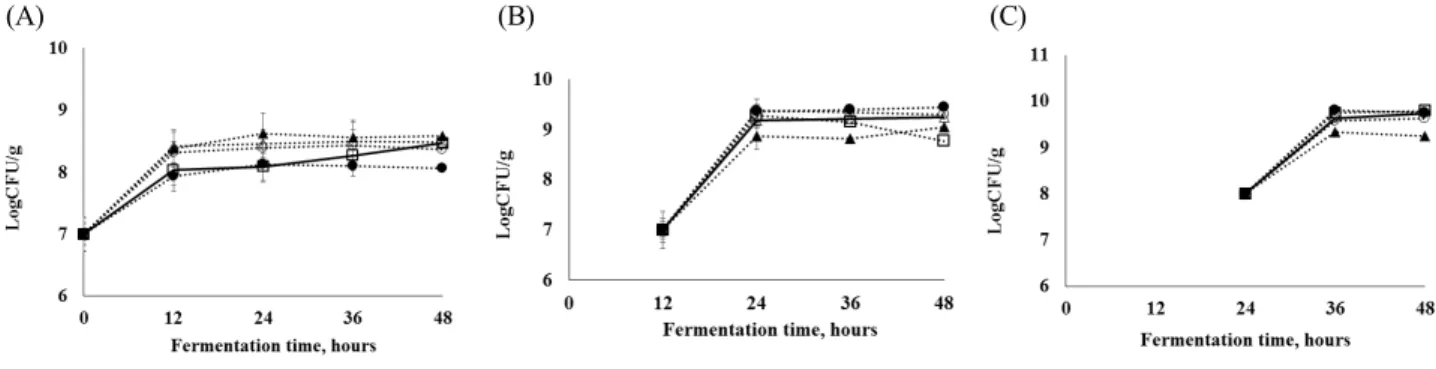
산균을 3단계로 접종하였다. Fig. 2는 상기 단계별 접종에 의
한 주스박의 고체발효에서 바실러스, 효모 그리고 유산균의
생균수 변화를 시간대별로 나타내었다 . 바실러스는 발효 초
기에 비해 12시간 후까지 증가하였고, 포도박에서는 균수가
(A) (B) (C)
Fig. 2. Change of viable cell count on fruit and vegetable pomace by the fermentation time ; (A) Bacillus, (B) Yeast, (C) Lactic acid bacteria
일정하게 증가하는 경향을 보였다 . 당근박을 제외한 주스박 은 모든 시간대에서 10
8CFU/g을 유지하였다 (Fig. 2A). Kun et al. (2008)의 보고에 따르면 Bifidobacterium을 10
7으로 접종 한 당근주스의 발효 후 6시간에 균수가 10
8CFU/ml을 보였으 며 , 24시간까지 계속 유지하였다고 보고하였다. Bacillus subtilis와 Lactobacillus plantarum의 혼합 접종이 청국장의 품 질에 미치는 영향에 대한 연구에서 Bacillus subtilis를 단독 접종하였을 때 초기 접종량 3.9×10
5CFU/g에서 12시간 후 1.1×10
9CFU/g까지 성장하였다고 보고하였으며, 혼합배양시 도 B. subtilis의 성장은 단독배양과 유사한 경향을 보였지만, Lactobacillus plantarum의 생균수는 감소한다고 보고하였다 (Ju and Oh, 2009).
효모인 Saccharomyces cerevisiae는 포도박과 감귤박의 고 체발효에서만 36시간대 이후부터 변화를 보일 뿐 다른 처리 구들은 모두 24시간대의 수를 유지하였다 (Fig. 2B). 24시간 이후부터 사과박과 당근박은 10
9CFU/g를 유지하였고, 포도 박은 36시간까지 10
9을 유지하다 48시간부터 10
8CFU/g으로 감소하였다 . 또한 감귤박은 36시간까지 10
8CFU/g을 유지하 다 48시간부터 10
9으로 증가하였다 . 포도박에 효모를 10
8CFU/g을 접종하여 고체발효한 연구에서는 48시간에 2×10
8CFU/g, 96시간에 1.5×10
8CFU/g로 유지하였다 (Rodríguez et al., 2010).
유산균은 모든 처리구에서 큰 변화를 찾아볼 수 없었다 (Fig. 2C). 모든 주스박 부산물이 36시간 이후 10
9을 유지하였 으며, 전반적으로 발효 시간에 따른 총 균수는 10
8∼ 10
9CFU/g을 유지하여 분리한 유용균에 의한 발효가 우수하다고 판단되었다 . Yoon et al. (2004)은 4종의 유산균 (Lactobacillus acidophilus LA39, Lactobacillus plantarum C3, Lactobacillus casei A4 및 Lactobacillus delbrueckii D7)을 이용하여 토마토 를 발효한 연구에서 최종 pH가 4.1까지 감소하였으며 생균수 는 9.0×10
9CFU/mL까지 증가하였고, 4℃에서 보관하였을 때
10
6∼ 10
8CFU/mL에서 4주간 유지하였다. MRS 배지에서 포 도박 추출물의 첨가 여부에 따른 Lactobacillus acidophilus의 성장 차이를 비교한 실험에서 48시간 발효한 결과 포도박 첨 가구가 첨가하지 않은 처리구에 비해 증가하였다고 하였다 (p<0.05) (Hervert-Hernández et al., 2009). 본 연구에서 바실러 스 , 효모 그리고 유산균의 단계적 접종 이후 주스박 고체발효 내 생균수가 발효 이전 보다 모두 증가하였다 . 발효 48시간까 지 생균수를 높게 유지하였으므로 사용한 균주들은 주스박의 섬유소 이용성이 우수한 생균제로로 판단된다 .
3. pH 변화
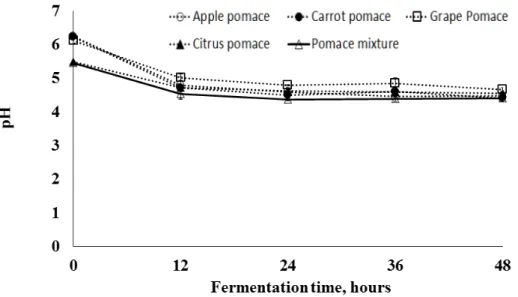
Fig. 3은 농산부산물의 고체발효 동안 시간대별 pH 변화를
나타내었다 . 발효가 시작되기 전 사과박, 당근박, 포도박, 감귤
박 그리고 이들을 혼합한 박의 pH는 각각 6.25, 6.23, 6.12,
5.49 그리고 5.45였다. 12시간에서 4.79, 4.72, 5.01, 4.72 및
4.52로 감소하였고, 48시간대의 최종 pH는 사과박이 4.47, 당
근박이 4.41, 포도박이 4.66, 감귤박이 4.56 그리고 혼합한 박
은 4.40의 값을 보였다. 48시간에 당근박이 발효전과 비교하였
을 때 1.82차로 가장 많이 감소하였으며, 혼합한 박은 0.89로
가장 작은 변화를 보였다 . 대두박을 Bacillus amyloliquefaciens,
Lavtobacillus acidophilus, Lavtobacillus plantarum과 Saccharomyces
cerevisiae을 이용하여 각각 접종하여 고체발효한 연구에서 발
효 전 대두박의 pH인 6.8보다 Bacillus amyloliquefaciens를 접
종한 처리구에서는 pH가 증가하였으며, 그 외의 처리구에서
는 모두 감소하였다 (Chi and Cho, 2016). Zhang et al. (2014)
은 대두박을 Lactobacillus plantarum, Lactobacillus casei,
Bacillus subtilis로 혼합 접종한 고체발효에서 발효 시작부터
24시간까지 pH가 점차적으로 감소하여 32시간까지 계속적으
로 감소하였다고 보고하였다. 이러한 pH의 감소는 주스박의
발효에 의해 생산되는 젖산을 비롯한 다양한 유기산의 생성
때문으로 판단된다 .
Fig. 4. Change of lactic acid on fruit and vegetable pomace by the fermentation time.
Fig. 3. Change of pH on fruit and vegetable pomace by the fermentation time.
4. 젖산 함량 변화
고체발효 동안 젖산함량을 측정한 결과 (Fig. 4), 발효 전 부산물중 감귤박과 혼합박의 젖산의 함량은 214.95 mMol/g 와 219.06 mMol/g으로 다른 처리구에 비해 높았다 (p<0.05).
12시간대에는 감귤박과 사과박의 젖산 함량이 각각 647.39 mMol/g, 632.40 mMol/g로 가장 낮았다 (p<0.05). 24간대에는 처리구간 차이가 없었으며 36시간대에는 사과박 (687.57 mMol/g)과 혼합박 (737.70 mMol/g)의 젖산함량이 가장 높았 으며, 48시간에는 포도박이 672.41 mMol/g으로 낮은 수치를 보였다 (p<0.05). 발효시점부터 12시간까지 젖산의 함량이 급
격히 증가하였지만, 그 이후부터는 유지하는 경향을 보였다
(p<0.10). 젖산은 주로 전분을 함유한 기질의 효소적 가수 분
해에 의해 얻어진 당의 발효에 의해 생성되며 (Alonso et al.,
2009), 유기산, 당류 및 미네랄 등은 유익한 미생물의 성장을
촉진한다 (Lee et al., 2009). 젖산을 섭취하면 장내에 있는 유
해 세균의 발육을 억제하고 장의 기능을 개선하여 가축들의
건강에 도움을 준다고 하였다 (Mozzi et al., 2010). 따라서 농
산부산물을 이용한 고체발효로부터 생산되는 젖산은 부패균
을 억제하고 사료적 가치를 향상시킬 수 있어 가축의 건강에
도움을 줄 수 있을 것이다 (Giang et al., 2010; Joshi and
Sandhu, 1996).
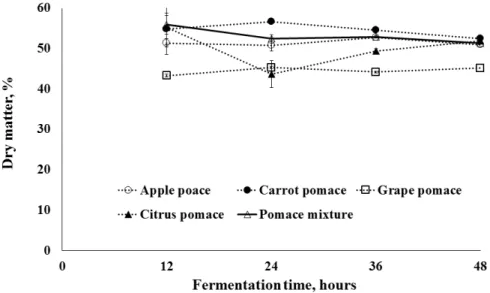
Fig. 5. Change of dry matter on fruit and vegetable pomace by the fermentation time.
5. 발효 성상 변화
발효 시간에 따른 건물함량을 측정한 결과 (Fig. 5), 초기 건물함량인 60%에서 12, 24시간 발효 후 당근박의 건물함량 이 각각 54.84%, 56.66%로 다른 처리구와 비교하여 유의적으 로 높은 값을 보였으며 , 포도박은 다른 처리구에 비해 43.26%, 45.3%, 44.15% 그리고 45.1%로 낮은 건물량을 보였 다 (p<0.05). 고체발효에서 수분함량은 산물의 양을 결정하는 매우 중요한 요소이다 (Sun et al., 2010). 본 연구에서는 수분 을 60%로 하여 고체발효를 하였으나, 유산균과 효모를 이용 한 양돈용 발효 사료의 연구에서는 수분 함량에 따른 생균수 를 비교하였을 떄 적정 수분은 40∼50% 수준이라고 하였다 (Cho et al., 2012). 본 연구에서 전반적으로 건물량은 원물의 20%정도 감소되었으며, 발효 시간에 따라서는 큰 영향을 보 이지 않았다 .
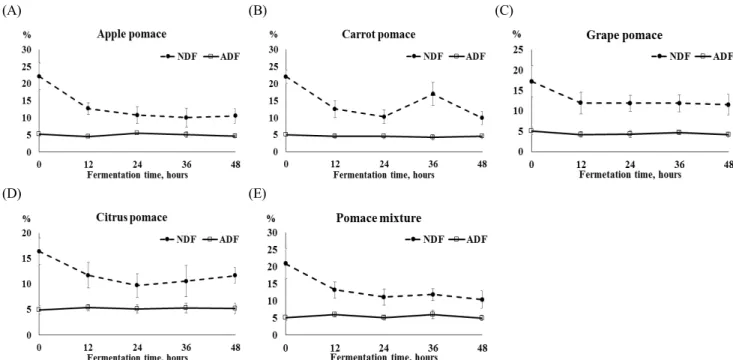
NDF와 ADF 측정결과 NDF는 모든 쥬스박에서 발효 후 12 시간에서 많은 감소를 보였으며 , 24시간부터 서서히 감소 또 는 같은 수준으로 유지를 하였다 (Fig. 6). ADF는 발효 시간에 따라 변화를 거의 보이지 않았다 . 발효가 진행되면서 NDF 함 량은 감소하였지만 ADF는 변화가 거의 없는 것은 주스박에 포함된 hemicellulose가 분해된 것으로 판단된다. Hemicellulose는 식물체의 세포벽을 이루는 물질로 다양한 효소에 의해서 분해 될 수 있으며 , 산도 (pH) 및 온도에 따라 효소의 활성의 차이를 보인다 . 배추부산물의 hemicellulose 최적 분해 조건은 pH 5.0 과 40℃라고 보고하였다 (Park and Yoon, 2015). 따라서 본 연 구에서도 발효 12시간에 pH가 4.5∼5.0의 범위는 hemicellulose 분 해 효소의 적정 pH로 사료된다. 또한 사용 균주인 Bacillus
subtilis, Saccharomyces cerevisiae 그리고 Lactobacillus plantarum 은 hemicellulose를 분해하기 위해서 사일리지 발효와 바이오 에탄의 생산 분야에서 주로 사용하고 있다. Bacillus subtilis는 xylanase와 β-xylosidase 효소를 분비하며 (Banka et al., 2014), Saccharomyces cerevisiae는 hemicellulose에 존재하는 arabinose와 xylose를 분해하여 산업적으로 많이 사용하는 균주이다 (Hasunuma et al., 2013; Hasunuma et al., 2015). Guo et al., (2014)은 옥수수와 보릿짚의 혼합 사일리지의 사료가치 향상 을 위한 발효연구에서 Lactobacillus plantarum 처리구는 hemi- cellulose의 분해로 인하여 그 함량이 대조구보다 감소하였다.
본 연구에서도 발효 과정 중에 Bacillus subtilis, Saccharomyces cerevisiae 그리고 Lactobacillus plantarum이 hemicellulose를 분해하여 NDF의 함량이 감소된 것으로 판단된다.
발효 시간에 따른 농산 부산물의 조회분을 측정한 결과
(Fig. 7), 부산물별 차이를 보이지 않았다 (p<0.05). 전체적으
로는 발효 시간에 따라 조회분은 감소되는 경향을 보였다. 대
두박을 Bacillus amyloliquefaciens, Lactobacillus. acidophilus,
Lactobacillus plantarum과 S. cerevisiae를 각각 접종하여 고체
발효를 진행한 보고에서 조회분의 함량은 Bacillus amylo-
liquefaciens과 Saccharomyces cerevisiae를 접종하여 발효한
대두박에서 조회분이 증가하였으며 (p<0.05), 그 외의 균들에
서는 발효전과의 차이를 보이지 않았다고 하였다 (Chi and
Cho, 2016).
(A) (B) (C)
(D) (E)
Fig. 6. Change of NDF and ADF on fruit and vegetable pomace by the fermentation time. (A) Apple pomace, (B) Carrot pomace, (C) Grape pomace, (D) Citrus pomace, (E) Mixture of pomaces.
Fig. 7. Change of crude ash on fruit and vegetable pomace by the fermentation time.
Ⅳ. 요 약
본 연구에서는 주스박에 토착하고 있는 미생물을 분리하고 이를 발효에 이용하여 사료적 가치를 평가하고자 하였다. 주 스박과 대두박을 원료로 하여 바실러스, 효모 그리고 유산균 을 혼합 접종하여 수분 60%에서 고체발효 후의 pH변화, 총 균수의 변화와 같은 발효특성과 원료의 시간대별 일반성분의 변화를 확인하고자 하였다. 사과박, 당근박, 포도박, 감귤박에
서 발효에 이용하기 위한 토착균주들을 분리, 동정하였으며
분리균 중 Lactobacillus plantarum, Weissella cibaria 및 Bacillus
subtilis를 선택하여 농산부산물 고체발효에 이용하였다. 발효
주스박의 원료로는 사과박 , 당근박, 포도박, 감귤박과 각 박을
동일비율로 혼합한 혼합박을 이용하여 5개의 시험구를 구성
하였다 . 위의 박들을 대두박과 2:3의 비율로 혼합하였으며 수
분은 60%로 하여 발효 출발점에 바실러스, 12시간대에 효모
그리고 24시간에 유산균을 단계적으로 접종하여 35℃에서 총
48시간 동안 발효하였다.
발효에 의한 pH변화는 발효 전후에서 사과박, 당근박, 포 도박 , 감귤박 그리고 혼합박에서 각각 6.25→4.47, 6.23→4.41, 6.12→4.66, 5.49→4.56 그리고 5.45→4.40로 낮아지는 변화를 보였다 . 발효 시간에 따른 생균수를 조사한 결과 발효 최초 접종시 초기 균수인 10
7에 비해 12, 24 그리고 48시간 발효 후에 모든 처리구에서 10
8∼ 10
9로 증식되면서 발효가 지속적 으로 진행되어 선별한 균주와 단계별 균주의 접종조건이 주 스박을 발효함에 있어 적합한 것으로 판단되었다 . 발효 초기 인 12시간까지 젖산의 생성이 급격히 진행되었으며 사과박, 당근박 , 포도박, 감귤박 그리고 혼합박에서 각각 632.40, 726.74, 674.29, 647.39 그리고 748.77 mMol/g으로 생성되었다.
발효 시간에 따른 건물함량은 초기 건물함량인 60%에서 12, 24시간 발효 후 당근박의 건물함량이 각각 54.84%, 56.66%로 다른 처리구들보다 유의적으로 높은 값을 보였으며 (p<0.05), 포도박은 45.3%, 44.15%로 낮은 건물량을 보였다 (p<0.05). 전반적으로 건물함량은 원물의 20%정도가 감소되 었으며 , 발효 시간에 따라서는 크게 변하지 않았다. 발효 시간 대별 NDF는 발효 12시간째 모든 주스박에서 많은 감소를 보 였으며 24시간부터 서서히 감소 또는 유지를 하였으며, 24 시간대에는 포도박과 사과박이 가장 높은 경향을 보였다 (p<0.10). ADF는 전반적으로 발효 시간에 따라 큰 변화를 보 이지 않았으나 , 사과박은 발효초기에 비해 12시간 때부터 급 격히 감소하는 경향을 보였다 (p<0.10). 발효 시간에 따른 조 회분은 쥬스박 별로 차이를 보이지 않았으나 (p<0.05), 전체적 으로 감소되는 경향을 보였다 .
주스박을 이용한 말용 사료를 개발하기 위해 사과박, 당근 박, 포도박 그리고 말분변을 접종하였을 때 이들을 이용하는 우점 균주를 분리할 수 있었다 . 이들 균주 중에서 발효에 유 용하게 사용할 수 있는 바실러스와 유산균을 선별하였다 . 바 실러스 , 효모 그리고 유산균을 3단계로 12시간 간격으로 각 각 순서에 따라 접종하였다. 각 균주의 접종이후 12시간부터 는 총 균수가 각각 10
8이상으로 유지하였다. 48시간 배양 후 는 바실러스 , 효모 그리고 유산균이 거의 균등하게 성장하였 으며 이러한 주스박 발효물을 이용하여 말 사료로 이용하면 식품부산물을 사료자원으로 이용할 수 있을 뿐만 아니라 말 을 위한 생균제의 급여로 말의 장내에서 유익한 균총의 유지 에 도움이 될 수 있을 것으로 기대된다 .
Ⅴ. 사 사
본 연구는 농촌진흥청 연구사업 (과제번호 PJ01190502)의 지원에 의해 수행되었습니다 .
Ⅵ. REFERENCES
Alibes, X., Munoz, F. and Rodriguez, J. 1984. Feeding value of apple pomace silage for sheep. Animal Feed Science and Technology.
11:189-197
Alonso, J.L., Garrote, G., Domínguez, H., Santos, V. and Parajó, J.C.
2009. Lactic acid from apple pomace: A laboratory experiment for teaching valorisation of wastes. CyTA–Journal of Food. 7:83-88.
Altmeyer, S., Kröger, S., Vahjen, W., Zentek, J. and Scharek-Tedin, L.
2014. Impact of a probiotic Bacillus cereus strain on the jejunal epithelial barrier and on the NKG2D expressing immune cells during the weaning phase of piglets. Veterinary Immunology and Immunopathology. 161:57-65.
Banka, A.L., Guralp, S.A. and Gulari, E. 2014. Secretory expression and characterization of two hemicellulases, xylanase, and β-xylosidase, isolated from Bacillus subtilis M015. Applied Biochemistry and Biotechnology. 174:2702-2710.
Batista, N.N., Ramos, C.L., Ribeiro, D.D., Pinheiro, A.C.M. and Schwan, R.F. 2015. Dynamic behavior of Saccharomyces cerevisiae, Pichia kluyveri and Hanseniaspora uvarum during spontaneous and inoculated cocoa fermentations and their effect on sensory characteristics of chocolate. LWT-Food Science and Technology.
63:221-227.
Bermúdez-Humarán, L.G., Aubry, C., Motta, J.P., Deraison, C., Steidler, L., Vergnolle, N., Chatel, JM and Langella, P. 2013. Engineering lactococci and lactobacilli for human health. Current Opinion in Microbiology. 16:278-283.
Bonaterra, A., Badosa, E., Rezzonico, F., Duffy, B and Montesinos, E.
2014. Phenotypic comparison of clinical and plant-beneficial strains of Pantoea agglomerans. International Microbiology. 17:81-90.
Chae, H.S., Kim, N.Y., Cho, I.C., Cho, S.R., Cho, W.M., Park, Y.S., Oh, S.A., Jang, A., Seong, P.N. and Ko, M.S. 2013. Effect of dietary supplementation of dried-citrus pulp and wheat bran on growth and meat quality in horses. Journal of Animal Science and Technology.
55:219-227.
Chae, H.S., Kim, N.Y., Woo, J.H., Cho, I.C., Seong, P.N., Back, K.S., Park, S.H., Kim, J.H., Jang, A. and Park, N.G. 2015a. Effects of fattening period on nutritional composition and physico-chemical quality properties of Jeju-horses (Ι). Korean Journal for Food Science of Animal Resources. 25:123-130.
Chae, H.S., Kim, N.Y., Woo, J.H., Cho, I.C., Seong, P.N., Back, K.S.,
Park, S.H., Kim, J.H., Jang, A. and Park, N.G. 2015b. Effects of fattening period on nutritional composition and physico-chemical quality properties of Jeju-horses (Ⅱ). Annals of Animal Resources Sciences. 26:56-66.
Chi, C.H. and Cho, S.J. 2016. Improvement of bioactivity of soybean meal by solid-state fermentation with Bacillus amyloliquefaciens versus Lactobacillus spp. and Saccharomyces cerevisiae. LWT-Food Science and Technology. 68:619-625.
Dawood, M.A., Koshio, S., Ishikawa, M. and Yokoyama, S. 2015.
Interaction effects of dietary supplementation of heat-killed Lactobacillus plantarum and β-glucan on growth performance, digestibility and immune response of juvenile red sea bream, Pagrus major. Fish & Shellfish Immunology. 45:33-42.
Giang, H.H., Viet, T.Q., Ogle, B. and Lindberg, J.E. 2010. Effects of different probiotic complexes of lactic acid bacteria on growth performance and gut environment of weaned piglets. Livestock Science. 133:182-184.
Guo, G., Yuan, X., Li, L., Wen, A. and Shao, T. 2014. Effects of fibrolytic enzymes, molasses and lactic acid bacteria on fermentation quality of mixed silage of corn and hulless–barely straw in the Tibetan Plateau. Grassland science. 60:240-246.
Hasunuma, T., Ishii, J. and Kondo, A. 2015. Rational design and evolutional fine tuning of Saccharomyces cerevisiae for biomass breakdown. Current Opinion in Chemical biology. 29:1-9.
Hasunuma, T., Okazaki, F., Okai, N., Hara, K. Y., Ishii, J., and Kondo, A. 2013. A review of enzymes and microbes for lignocellulosic biorefinery and the possibility of their application to consolidated bioprocessing technology. Bioresource technology. 135:513-522.
Hervert-Hernández, D., Pintado, C., Rotger, R. and Goñi, I. 2009 Stimulatory role of grape pomace polyphenols on Lactobacillus acidophilus growth. International Journal of Food Microbiology.
136:119-122.
Jayaraman, S., Thangavel, G., Kurian, H., Mani, R., Mukkalil, R. and Chirakkal, H. 2013. Bacillus subtilis PB6 improves intestinal health of broiler chickens challenged with Clostridium perfringens-induced necrotic enteritis. Poultry Science. 92:370-374.
Joshi, V.K. and Sandhu, D.K. 1996. Preparation and evaluation of an animal feed byproduct produced by solid-state fermentation of apple pomace. Bioresource Technology. 56:251-255.
Ju, K.E. and Oh, N.S. 2009. Effect of the mixed culture of Bacillus subtilis and Lactobacillus plantarum on the quality of Cheonggukjang.
Korean Journal of Food Science and Technology. 41:399-404.
Kajala, I., Shi, Q., Nyyssölä, A., Maina, N.H., Hou, Y., Katina, K., Tenkanen, M. and Juvonen, R. 2015. Cloning and characterization of a Weissella confusa dextransucrase and its application in high fibre baking. PloS one. 10:e0116418.
Kang, M.S., Kim, B.G., Chung, J., Lee, H.C. and Oh, J.S. 2006.
Inhibitory effect of Weissella cibaria isolates on the production of
volatile sulphur compounds. Journal of Clinical Periodontology.
33:226-232.
Khianngam, S., Pootaeng-on, Y., Techakriengkrai, T. and Tanasupawat, S. 2014. Screening and identification of cellulase producing bacteria isolated from oil palm meal. Journal of Applied Pharmaceutical Science. 4:90-96.
Kim, D.Y., and Han, G.D. 2010. Effects of dietary pegmatite, precious stone and grape pomace extracts on the meat quality of pigs. Korean Journal for Food Science of Animal Resources. 30:252-260.
Kumar, N., Sarkar, B.C., Sharma, H. K. 2010. Development and characterization of extruded product of carrot pomace, rice flour and pulse powder. African Journal of Food Science. 4:703-717.
Kun, S., Rezessy-Szabo, J.M., Nguyen, Q.D., Hoschke, A. 2008.
Changes of microbial population and some components in carrot juice during fermentation with selected Bifidobacterium strains.
Process Biochemistry. 43:816-821.
Kuo, H.W., Zeng, J.K., Wang, P.H. and Chen, W.C. 2015. A novel exo-glucanase explored from a Meyerozyma sp. fungal strain.
Advances in Enzyme Research. 3:53.
Lee, C., Kim, Y. and Lee, H.J. 2015. Dietary supplementation of citrus and fermented citrus by-product for Juvenile red seabream pagrus major at low water temperature. Korean Journal of Fisheries and Aquatic Sciences. 48:454-458.
Lee, S.W., Ham, S.N., Shin, T.S., Kim, H.K., Yeon, I.J. and Kim, K.Y.
2009. Resource of food waste using indigenous bacteria isolated from soils. Journal of Korean Society of Environmental Engineers.
31:35-41.
Lee, W.K., Ahn, S.B., Park, H.E., Lee, S.M., Kim, S.Y. and Shon, M.Y.
2013. Characteristics and immuno-modulatory effects of Weissella cibaria JW15 isolated from Kimchi, Korea traditional fermented food, for probiotic use. Journal of Biomedical Research. 14:206-211.
López, I., López, R., Santamaría, P., Torres, C. and Ruiz-Larrea, F. 2015.
Performance of malolactic fermentation by inoculation of selected Lactobacillus plantarum and Oenococcus oeni strains isolated from Rioja red wines. VITIS-Journal of Grapevine Research. 47:123.
Manzano, A., Freitas, A.R., Esteves, S.N. and Novaes, N.J. 1999. Polpa de citros peletizada na alimentação de equinos. Revista Brasileira de Zootecnia. 29:1327-1332.
Ministry of Agriculture, Food and Rural Affairs. 2014. The revitalization plan of agri-food by-products for animal feed.
Mozzi, F. and Vignolo, G.M. (Eds.). 2010. Biotechnology of lactic acid bacteria: novel applications. John Wiley & Sons.
Nguyen, T.D.T., Kang, J.H. and Lee, M.S. 2007. Characterization of Lactobacillus plantarum PH04, a potential probiotic bacterium with cholesterol-lowering effects. International Journal of Food Microbiology. 113:358-361.
Niu, K.M. 2015. In vitro biological evaluation of probiotic L. pantarum SK1305 under submerged liquid and solid state fermentation.
Thesis. Seoul. Korea.
Oh, W.Y., Kim, D.C., Jin, S.H., Jung, J.H., Kang, T.H., Hong, S.K. and Yang, S.J. 1993. Effect of feeding method on growth performance and carcass characteristics of Cheju native horses. Korean Journal of Animal Sciences (Korea Republic).
Oliveira, C.A.D.A., Almeida, F.Q., Vieira, A.A., Lana, Â.M.Q., Macedo, R., Lopes, B.A. and Corassa, A. 2003. Kinetics of passage of digesta and water and nitrogen balance in horses fed diets with different ratios of roughage and concentrate. Revista Brasileira de Zootecnia. 32:140-149.
Park, D.Y., Ahn, Y.T., Park, S.H., Huh, C.S., Yoo, S.R., Yu,R. and Choi, M.S. 2013. Supplementation of Lactobacillus curvatus HY7601 and Lactobacillus plantarum KY1032 in diet-induced obese mice is associated with gut microbial changes and reduction in obesity. PLoS One. 8:e59470.
Park, S.Y. and Yoon, K.Y. 2015. Production of enzymatic hydrolysate including Water-soluble Fiber from hemicellulose fraction of chinese cabbage waste. Korean Journal of Food Science and Technology.
47:6-12
Rahmat, H., Hodge, R.A., Manderson, G.J. and Yu, P.L. 1995.
Solid-substrate fermentation of Kloeckera apiculata! and Candida utilis on apple pomace to produce an improved stock-feed. World Journal of Microbiology and Biotechnology. 11:168-170.
Rodríguez, L.A., Toro, M.E., Vazquez, F., Correa-Daneri, M.L., Gouiric, S.C. and Vallejo, M.D. 2010. Bioethanol production from grape and sugar beet pomaces by solid-state fermentation. International Journal of Hydrogen Energy. 35:5914-5917.
Safari, R., Adel, M., Lazado, C.C., Caipang, C.M.A. and Dadar, M.
2016. Host-derived probiotics Enterococcus casseliflavus improves resistance against Streptococcus iniae infection in rainbow trout (Oncorhynchus mykiss) via immunomodulation. Fish & Shellfish Immunology. 52:198-205.
SAS. 2003. Statistical Analysis System, Version 9.1 USA.
Sharma, K.D., Karki, S., Thakur, N.S. and Attri, S. 2012. Chemical composition, functional properties and processing of carrot—a review. Journal of food science and technology. 49:22-32.
Silva, R.H.P., de Rezende, A.S.C. and da Silva Inácio, D.F. 2016.
Pectin-rich by-products in feeding horses—A review. Cogent Food
& Agriculture. 2:1193925.
Soccol, C.R., da Costa, E.S.F., Letti, L.A.J., Karp, S.G., Woiciechowski, A.L. and de Souza Vandenberghe, L.P. 2017. Recent developments and innovations in solid state fermentation. Biotechnology Research and Innovation.
Sudha, M.L., Baskaran, V. and Leelavathi, K. 2007. Apple pomace as a source of dietary fiber and polyphenols and its effect on the rheological characteristics and cake making. Food Chemistry.
104:686-692.
Sun, H., Ge, X., Hao, Z. and Peng, M. 2010. Cellulase production by Trichoderma sp. on apple pomace under solid state fermentation.
African Journal of Biotechnology. 9:163-166.
Tash, K. 2005. Rahnella aquatilis bacteremia from a suspected urinary source. Journal of Clinical Microbiology. 43:2526-2528.
Walde, S.G., Math, R.G., Chakkravarthi, A. and Rao, D.G. 1992.
Preservation of carrots (Daucus carota L.) By dehydration techniques.
Indian Food Packer. 46:37-37.
Yoon, K.Y., Woodams, E.E. and Hang, Y.D. 2004. Probiotication of tomato juice by lactic acid bacteria. Journal of microbiology (Seoul, Korea), 42:315-318.
Yu, J. and Ahmedna, M. 2013. Functional components of grape pomace:
their composition, biological properties and potential applications.
International Journal of Food Science & Technology. 48:221-237.
Zhang, S., Shi, Y., Zhang, S., Shang, W., Gao, X. and Wang, H. 2014.
Whole soybean as probiotic lactic acid bacteria carrier food in solid-state fermentation. Food control. 41:1-6.
(Received : June 20, 2017 | Revised : September 23, 2017 | Accepted : November 12, 2017)