Natural Product Sciences 22(3) : 216-219 (2016)
http://dx.doi.org/10.20307/nps.2016.22.3.216
216
New Production of Antibacterial Polycyclic Quinazoline Alkaloid, Thielaviazoline, from Anthranilic Acid by the Marine-Mudflat-Derived Fungus Thielavia sp.
Alain Simplice Leutou, Keumja Yun, and Byeng Wha Son*
Department of Chemistry, Pukyong National University, Busan 608-737, Korea
Abstract − The microbial transformation of anthranilic acid (1) by the marine-mudflat-derived fungus Thielavia sp. produced an antibacterial polycyclic quinazoline alkaloid, thielaviazoline (2). The stereostructure of the metabolite was assigned based on detailed spectroscopic data analyses including comparison of the NMR (1H and 13C) data with those of reported compound (2). Compound 2 displayed in vitro antimicrobial activity against methicillin- resistant and multidrug-resistant Staphylococcus aureus (MRSA and MDRSA), with minimum inhibitory concen- trations (MICs) of 6.25 and 12.5µg/mL, respectively. Compound 2 also showed potent radical-scavenging activity against 2,2-diphenyl-1-picrylhydrazyl (DPPH) with an IC50 of 11µM, which was more active than the positive control, L-ascorbic acid (IC50, 20.0µM).
Keywords − Thielaviazoline, Polycyclic quinazoline alkaloid, Thielavia sp., Microbial transformation
Introduction
Microbial transformation of natural products is a powerful tool for generating active, less toxic derivatives.
1,2We have been exploring the microbial transformation of bioactive compounds by marine-derived microorganisms, and have found that some marine-derived bacteria and fungi regioselectively oxidize bioactive natural products to new, more bioactive compounds.
3-10In our continuing studies, we initially screened many growing cultures for their ability to catalyze interesting biotransformation reactions with anthranilic acid (1) as substrate. Anthranilic acid (1), which is an important starting material to synthesize medicine, flavor, pigment, and dye,
11was isolated with aromatic polyols from a marine isolate of the fungus Aspergillus sp.
12A culture of the mudflat-derived fungus Thielavia sp.
metabolized and transformed compound 1 to a less polar metabolite. Therefore, this strain was selected for preparative- scale fermentation of 1
Experimental
General experimental procedures – Optical rotation was determined on a Perkin Elmer model 341 polarimeter.
UV/visible spectra were measured on a Hitachi U-2001 UV/Vis spectrometer. IR spectra were recorded on a Bruker FT-IR model IFS-88 spectrometer.
1H (400 MHz) and
13C NMR (100 MHz) spectra were obtained on a JEOL JNM-ECP 400 NMR spectrometer, using TMS or solvent peaks [DMSO-d
6:
1H ( δ 2.50) and
13C ( δ 39.5)] as reference standard. LC-MS and MS spectra were obtained on API 2000 (Applied Bio System) and IT-TOF (Shimadzu, Japan) spectrometer, respectively. HPLC was performed on a Young Lin ACME HPLC system using a reversed- phase analytical column (Gemini C18, 4.6 × 250 mm, 5 μm) with UV detection. Incubations of microorganisms and biotransformations were performed on an Incubator Shaker JS-FS-2500 (Johnsam Co., Inchon, Korea).
Fungal Isolation − The fungal strain, Thielavia sp.
(emb/AJ271583.1), was isolated from the marine mudflat collected at Gomso Bay, Korea, and identified based on 18S rRNA an alyses (SolGent Co., Ltd., Daejeon, Korea), with an identity of 98%. A voucher specimen is deposited at Pukyong National University (code MSac49).
Biotransformation of 1 − A two-stage fermentation protocol
13was used for preparative scale formation of the metabolite of 1. The SWS medium contained soytone (0.1%), soluble starch (1.0%), and seawater (100%), and it was autoclaved at 121
oC for 15 min. Preparative incubation was conducted in 1 L of sterile medium held in 3 L culture flask that was incubated on a rotary shaker (130 rpm) at 29
oC for 1 week. A 10% inoculum derived from one week old stage I culture was used to initiate
*Author for correspondence
Byeng Wha Son, Department of Chemistry, Pukyong National Uni- versity, Busan 608-737, Korea
Tel: +82-51-629-5592; E-mail: [email protected]
Vol. 22, No. 3, 2016 217
stage II culture, which was incubated for 24 h more under the same condition before receiving 20 mg of 1 in 0.75 mL of N,N-dimethyl formamide (DMF), and incubation was continued at 29
oC for two weeks in the same manner to that described above. Substrate control consisted of sterile medium and substrate incubated under the same conditions but without microorganism. Also, culture control was composed of fermentation blanks in which the microorganism was grown under identical condition but without the addition of substrate. After two weeks of incubation, each control was harvested and analyzed by TLC. The culture was filtered through cheesecloth, and the filtrate was extracted with EtOAc. The organic layer was dried over anhydrous Na
2SO
4, filtered through sintered glass, and vacuum-concentrated to yield a crude extract (90 mg).
Isolation of the Metabolite (2) − The crude extract (90 mg) was subjected to silica gel flash column chromato- graphy. Elution was performed with n-hexane-EtOAc (stepwise, 0 - 100% EtOAc) to yield four fractions.
Fractions 2 and 4 were separated by medium-pressure liquid chromatography (MPLC) (ODS) using a H
2O- MeOH gradient elution to afford crude 2 and 1, respec- tively. These were further purified by HPLC (Gemini C18, 4.6 × 250 mm, 5 μm) utilizing a 30 min gradient program of 50% to 100% MeOH in H
2O to furnish the substrate, 1 (7.0 mg), and the metabolite (2) (12.0 mg), respectively.
Thielaviazoline (2) – A colorless amorphous solid.
[ α]
D: +9.4 (c 0.8, CHCl
3); UV (MeOH) λ
max(log ε) 281 (3.3), 296 (sh) (3.1) nm; IR (KBr) ν
max3444, 3389, 1697, 1650, 1610, 1491, 1053, 755 cm
−1;
1H NMR (DMSO-d
6, 400 MHz) and
13C NMR (DMSO-d
6, 100 MHz): see Table 1;
1H NMR (CDCl
3, 400 MHz): δ 3.94 (3H, s), 5.07 (1H, s), 5.35 (1H, s), 5.51 (1H, s), 6.72 (1H, d, J = 8.0 Hz), 6.86 (1H, dd, J = 7.5, 7.5 Hz), 6.95 (1H, dd, J = 7.5, 7.5 Hz), 7.00 (1H, d, J = 7.5 Hz), 7.04~7.13 (5H, m), 7.23~7.29 (4H, m);
13C NMR (CDCl
3, 100 MHz): 55.8, 63.4, 70.0, 94.2, 117.7, 120.3, 122.9, 124.3, 124.4, 124.6 ( × 2), 127.3, 128.3, 128.8, 129.0, 129.4 (× 3), 129.9, 141.0, 142.7, 145.1; LR-EI-MS m/z 341 [M]
+(rel. int.
28), 326 [M–CH
3]
+(32), 310 [M–OCH
3]
+(100), 180 [310 – C
8H
6N
2]
+(20), 179 [310 – C
8H
7N
2]
+(3), 154 (26), 131 [C
8H
7N
2]
+(12), 130 [C
8H
6N
2]
+(1), 77 [C
6H
4+ H]
+(14), 76 [C
6H
4]
+(4); HR-EI-MS: m/z 341.1527 [M]
+(calcd for C
22H
19N
3O, 341.1528), ( −0.3 ppm/−0.1 mmu).
Radical Scavenging Activity against DPPH
12− Samples to be tested were dissolved in MeOH, and the solution (160 μL) was dispensed into wells of a 96-well microtiter tray. 40 μL of the DPPH solution in MeOH
(1.5 × 10
−4M) was added to each well. The mixture was shaken and left to stand for 30 min, and the absorbance of the resulting solution was measured at 520 nm with microplate reader (Packard Co., Spectra Count
TM). The scavenging activity on DPPH radical was expressed as IC
50, which is the concentration of the tested compound required to give a 50% decrease of the absorbance from that of the blank solution [consisting of MeOH (160 μL) and DPPH solution (40 μL)].
Antibacterial Assay
12− The in vitro antibacterial activity of the fermentation broth and purified samples were evaluated by a conventional 2-fold serial dilution method using S. aureus, methicillin-resistant S. aureus, and multidrug-resistant S. aureus as indicator strains. A 5 mL suspension containing 10
5cells per mL was used as inoculum of the test organism. The MICs were determined after the inoculation for 18 h at 37
oC. Oxacillin was used as a positive control at the concentration of 16 μg/mL.
Result and Discussion
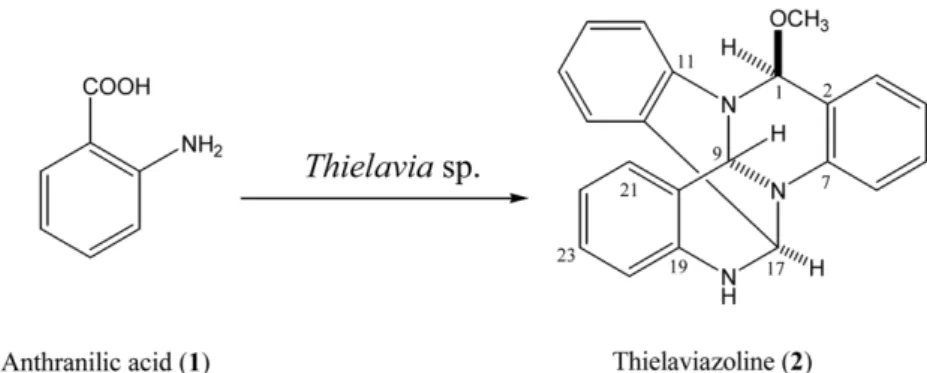
Thielaviazoline (2) was isolated as a colorless amorphous solid, identified as C
22H
19N
3O by HR-EI-MS and
13C- NMR (Table 1, experimental, and Figures S2 and S4 in the supplementary material). The IR spectrum of 2 showed bands characteristic of amine (3444, 1491, 755 cm
−1) and aromatic (1697, 1650, 1610 cm
–1) functio- nalities. The amine bands in the IR spectrum and the UV absorption at 281 (3.3) and 296 (sh) (3.1) nm indicate the presence of a quinazoline moiety
14in compound 2.
Detailed analysis of the
1H-,
13C-NMR, and DEPT spectra of 2, including 2D-NMR (COSY, HMQC, HMBC, and NOESY) experiments, revealed diagnostic signals for one methoxyl, three 1,2-disubstituted benzenes, one 1,4- dihydro-2,3,4-trisubstituted quinazoline, and two 2,4- dihyhydro-1,2,3,4-tetrasubstituted quinazolines (Table 1, Fig. 1). The fragment ions, m/z 76 [C
6H
4]
+and 77 [C
6H
4+ H]
+, in the fragmentation pattern of 2 also indicated the presence of four 1,2-disubstituted benzene moieties (Fig.
2 and Fig. S1 in the supplementary material). The fragment ions m/z 326 [M – CH
3]
+and 310 [M – OCH
3]
+indicated the presence of a methoxyl and a polycyclic quinazoline moiety, and m/z180 [310 – 130 (C
8H
6N
2)]
+, 179 [310 – 131(C
8H
7N
2)]
+, and 131 [C
8H
7N
2]
+were con- sistent with the 1,4-dihydro-2,3,4-trisubstituted quina- zoline and 2,4-dihyhydro-1,2,3,4-tetrasubstituted quinazoline groups (Fig. 2 and Fig. S1 in the supplementary material).
The connections and positions of the functional groups in
2 were determined based on HMBC spectral data (Table
1). The HMBC correlations from H-1 to 1-OCH
3showed
218 Natural Product Sciences
the connection (C-1–1-OCH
3) between the methoxyl moiety and the condensed quinazoline moiety. The HMBC correlations (H-1 →C-3, C-7, and C-9; H-9→C-1, C-7, C- 11, C-17, C-19, and C-21; H-17 → C-7, C-9, C-11, C-15, and C-19; and NH-18 → C-16, C-20, and C-24) indicated the presence of a quinazoline bis-anhydrotrimer moiety, which was further supported by the chemical shift of the azaacetal protons at δ 5.23 (1H, s, H-9) and 5.36 (1H, d, J = 4.3 Hz, H-17)
15(Table 1). Thus, thielaviazoline (2) was characterized as an N-(9,18-dihydro-1H-10,17-ortho- benzeno-17H-quinazolino[3,4-a]quinazolin-1-yl)methyl ether. The structure of 2, including stereochemistry, was supported by comparing the NMR data (
1H and
13C in the CDCl
3) with the reported NMR data and X-ray structure for the methanol adduct of a 2-aminobenzaldehyde trimer, which was obtained as a side-product during the synthesis of 2-amino-1,4-benzodiazepin-5-ones.
16Therefore, the relative configurations at C-1, C-9, and C-17 in 2 were assigned as 1S*, 9R*, and 17S*, respectively (Fig . 1).
We examined compound 2 for antibacterial activity against Staphylococcus aureus, MRSA, and MDRSA, and for radical scavenging activity against DPPH. Com- pound 2 displayed moderate antibacterial activity against MRSA and MDRSA, with MICs of 6.25 and 12.5 μg/mL, respectively. Compound 2 also exhibited a potent radical scavenging activity against DPPH, with IC
50value of 10 μM, and 2 was more active than the positive control, ascorbic acid (IC
50, 20 μM).
Polycyclic quinazoline alkaloid derivatives such as compound 2 have been reported as synthetic intermediates in the development of tribenzo[b,f,j][1,5,9]triazacycloduo- decine (TRI) complexes and tetrabenzo[b,f,j,n][l,5,9,13]
tetraazacyclohexadecine (TAAB) complexes containing various metals. These complexes have interesting biological activities, including nuclease and superoxide dismutase activities, and antineoplastic activity.
15Based on the biological activity of the TRI and TAAB complexes derived from the polycyclic quinazoline alkaloid reported
Table 1. NMR spectra data for thielaviazoline (2) athielaviazoline(2)
Position δH (mult, J) δC (mult) HMBC (H to C)
1 5.09 (s) 693.1 (d) C-2, -3, -7, -9, -11, 1-OMe
2 126.7 (s)
3 7.23 (m)b 129.7 (d) C-1, -2, -5, -7
4 7.02 (m)c 123.7 (d)α C-2, -6
5 7.21 (m)b 123.5 (d) C-3, -7
6 7.14 (m)d 128.0 (d) C-2, -4
7 144.9 (s)
8-N
9 5.23 (s) 662.7 (d) C-1, -7, -11, -17, -19, -20, -21
10-N
11 142.3 (s)
12 7.03 (m)c 128.5 (d)β C-14, -16
13 7.09 (m) 128.4 (d)β
14 7.02 (m)c 123.8 (d)α
15 7.12 (m)d 128.8 (d)γ C-11, -13, -17
16 130.0 (s)
17 5.36 (d,4.3) 668.3 (d) C-7, -9, -11, -19
18-NH 19 20 21 22 23 24 1-OMe
7.05 (m)c
7.25 (m)b 6.69 (dd,7.5, 7.3) 6.94 (dd,7.5, 7.3) 6.64 (d,8.0) 3.82 (s)
142.0 (s) 120.6 (s) 128.9 (d)γ 121.2 (d) 123.9 (d) 115.6 (d) 654.9 (q)
C-16, -17, -19, -20, -24
C-9, -19, -23
C-19, -20, -22 C-1
aRecorded in DMSO-d6 at 400 MHz (1H) and 100 MHz (13C).
b~d and α~γ Exchangeable, respectively.
Vol. 22, No. 3, 2016 219
above, compound 2 warrants further study for development of potential chemotherapeutic compounds against cancer and diseases related to nucleases and superoxide dismutase.
Acknowledgments
This work was supported by a Research Grant of Pukyong National University (2016 year).
References
(1) Lee, I. -S.; ElSohly, H. N.; Hufford, C. D. Pharm. Res. 1990, 7, 199- 203.
(2) El Sayed, K. A.; Hamann, M. T.; Waddling, C. A.; Jensen, C.; Lee, S. K.; Dunstan, C. A.; Pezzuto, J. M. J. Org. Chem. 1998, 63, 7449-7455.
(3) Li, X.; Lee, S. M.; Choi, H. D.; Kang, J. S.; Son, B. W. Chem.
Pharm. Bull. 2003, 51, 1458-1459.
(4) Li, X.; Kim, S. -K.; Jung, J. H.; Kang, J. S.; Choi, H. D.; Son, B. W.
Bull. Korean Chem. Soc. 2005, 26, 1889-1890.
(5) Li, X.; Kim, Y. H.; Jung, J. H.; Kang, J. S.; Kim, D. -K.; Choi, H.
D.; Son, B. W. Enz. Microbial Technol. 2007, 40, 1188-1192.
(6) Leutou, A. S.; Yang, G.; Nenkep, V. N.; Siwe, X. N.; Feng, Z.;
Khong, T. T.; Choi, H. D.; Kang, J. S.; Son, B. W. J. Microbiol.
Biotechnol. 2009, 19, 1150-1152.
(7) Feng, Z.; Nenkep, V.; Yun, K.; Zhang, D.; Choi, H. D.; Kang, J. S.;
Son, B. W. J. Microbiol. Biotechnol. 2010, 20, 985-987.
(8) Yun, K.; Kondempudi, C. M.; Choi, H. D.; Kang, J. S.; Son, B. W.
Chem. Pharm. Bull. 2011, 59, 499-501.
(9) Leutou, A. S.; Yun, K.; Son, B. W. Bull. Korean Chem. Soc. 2014, 35, 2870-2872.
(10) Yun, K.; Kondempudi, C. M.; Leutou, A. S.; Son, B. W. Bull.
Korean Chem. Soc. 2015, 36, 2391-2393.
(11) The Chemical Daily Co. 10,889 of Chemical Products. The Chemical Daily Co., Ltd.: Japan, 1989, pp 499-500.
(12) Li, Y.; Li, X.; Son, B. W. Nat. Prod. Sci. 2005, 11, 136-138.
(13) Smith, R. V.; Rosazza, J. P. J. Pharm. Sci. 1975, 64, 1737-1759.
(14) Manske, R. H. F.; Holmes, H. L. The Alkaloids – Chemistry and Pharmacology. Vol. III; Academic Press: USA, 1953, pp 101-111.
(15) Xiao, X.; Fanwick, P. E.; Cushman, M. Synth. Commun. 2004, 34, 3901-3907.
(16) Younes, E. A.; Hussein, A. Q.; May, M. A.; Fronczek, F. R.
ARKIVOC 2011, (2), 323-330.
Received March 7, 2016 Revised April 8, 2016 Accepted April 11, 2016 Fig 1. Microbial synthesis of thielaviazoline (2) from anthranilicacid (1) by the marine-mudflat-derived fungus Thielavia sp.
Fig. 2. EI-MS fragmentation for thielaviazoline (2).