http://e-nrp.org
Effects of enzymatic hydrolysis of buckwheat protein on antigenicity and allergenicity
Dong-Eun Sung
1, Jeongok Lee
2, Youngshin Han
2, Dong-Hwa Shon
3, Kangmo Ahn
2, Sangsuk Oh
1§and Jeong-Ryong Do
3§1Department of Food Science and Technology, 52, Ewhayeodae-gil, Seodaemun-gu, Seoul 120-750, Korea
2Environmental Health Center for Atopic Diseases, Samsung Medical Center, Seoul 135-710, Korea
3Korea Food Research Institute, Gyeonggi 463-746, Korea
BACKGROUND/OBJECTIVES: Due to its beneficial health effects, use of buckwheat has shown a continuous increase, and concerns regarding the allergic property of buckwheat have also increased. This study was conducted for evaluation of the hydrolytic effects of seven commercial proteases on buckwheat allergens and its allergenicity.
MATERIALS/METHODS: Extracted buckwheat protein was hydrolyzed by seven proteolytic enzymes at individual optimum temperature and pH for four hours. Analysis was then performed using SDS-PAGE, immunoblotting, and competitive inhibition ELISA (ciELISA) with rabbit antiserum to buckwheat protein, and direct ELISA with pooled serum of 21 buckwheat-sensitive patients.
RESULTS: Alkaline protease, classified as serine peptidase, was most effective in reducing allergenicity of buckwheat protein.
It caused decomposition of the whole buckwheat protein, as shown on SDS-PAGE, and results of immunoblotting showed that the rabbit antiserum to buckwheat protein no longer recognized it as an antigen. Allergenicity showed a decrease of more than 50% when pooled serum of patients was used in ELISA. Two proteolytic enzymes from Aspergillus sp. could not hydrolyze buckwheat allergens effectively, and the allergenicity even appeared to increase.
CONCLUSIONS: Serine-type peptidases appeared to show a relatively effective reduction of buckwheat allergenicity. However, the antigenicity measured using rabbit antiserum did not correspond to the allergenicity measured using sera from human patients. Production of less allergenic buckwheat protein may be possible using enzymatic hydrolysis.
Nutrition Research and Practice 2014;8(3):278-283; doi:10.4162/nrp.2014.8.3.278; pISSN 1976-1457 eISSN 2005-6168
Keywords: Buckwheat, allergy, enzymatic hydrolysis
INTRODUCTION
7)Buckwheat has traditionally been used as a food source in Asian countries, including Korea, Japan, and China. Although buckwheat has been used more frequently in Asian countries than in Western countries, the use of buckwheat has increased globally because of its health functional effects. The known beneficial effects include abundant flavonoids, phytosterols, dietary fiber, vitamins, minerals, and antioxidants. It also showed cholesterol-lowering effects [1]. In addition, due to its gluten- free characteristics, buckwheat could even be offered to patients with celiac disease as an alternative to wheat [2].
However, buckwheat can cause an immediate and IgE- mediated type food allergy, and sometimes only a tiny amount of buckwheat can induce a very severe reaction, such as anaphylaxis [3]. One study demonstrated that scrubbing a small quantity of buckwheat on lips or licking it by tongue (< 1 g) could induce allergic symptoms [4]. Approximately 0.22% of
Japanese school children (194/92,680) had buckwheat allergy [5], and approximately 10% of patients with buckwheat allergy experienced anaphylaxis after ingestion of buckwheat [6]. In Korea, 0.1% (44/42,202) of school age children have buckwheat allergy [7]. Recently, buckwheat allergy has often been reported even in western countries, including the UK [8], Germany [9], and the United States [2]. Presence of buckwheat as a hidden allergen in most common Italian foods, such as pizza and pasta, has also been reported [10].
Development of hypoallergenic food may be helpful in improvement of the quality of life for patients and reduce the occurrence of dangerous allergic reactions. A number of studies have been conducted in an effort to reduce allergenicity of buckwheat. Use of Maillard-type glycosylation [11], buckwheat seed fraction [12], and salting method [13,14] resulted in partial reduction of the allergenicity. In addition, treatment with heat, acid, alkali, and reduced carboxymethylation had positive effects on reduction of allergenicity [15]. Handoyo et al. [16]
This work was supported by a grant from the Korea Food Research Institute, National Research Foundation of Korea (2011-1644-1) and the “Cooperative Research Program for Agriculture Science & Technology Development (PJ009512)” Rural Development Administration, Republic of Korea.
§Corresponding Author: Jeong-Ryong Do and Sangsuk Oh, Tel. 82-2-3277-3558, Fax. 82-2-3277-4213, Email. [email protected] Received: September 30, 2013, Revised: November 22, 2013, Accepted: December 9, 2013
This is an Open Access article distributed under the terms of the Creative Commons Attribution Non-Commercial License (http://creativecommons.org/licenses/by-nc/3.0/) which permits unrestricted non-commercial use, distribution, and reproduction in any medium, provided the original work is properly cited.
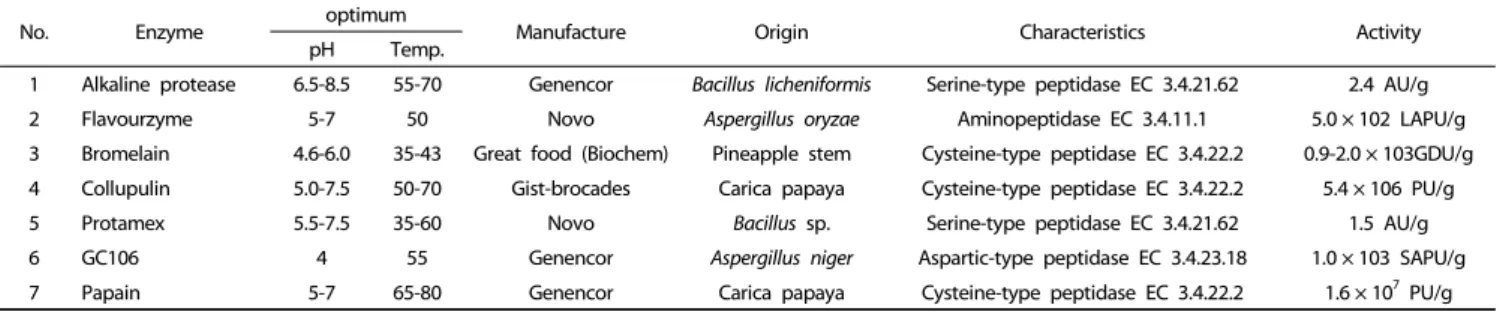
No. Enzyme optimum
Manufacture Origin Characteristics Activity
pH Temp.
1 Alkaline protease 6.5-8.5 55-70 Genencor Bacillus licheniformis Serine-type peptidase EC 3.4.21.62 2.4 AU/g
2 Flavourzyme 5-7 50 Novo Aspergillus oryzae Aminopeptidase EC 3.4.11.1 5.0 × 10² LAPU/g
3 Bromelain 4.6-6.0 35-43 Great food (Biochem) Pineapple stem Cysteine-type peptidase EC 3.4.22.2 0.9-2.0 × 10³GDU/g 4 Collupulin 5.0-7.5 50-70 Gist-brocades Carica papaya Cysteine-type peptidase EC 3.4.22.2 5.4 × 10⁶ PU/g
5 Protamex 5.5-7.5 35-60 Novo Bacillus sp. Serine-type peptidase EC 3.4.21.62 1.5 AU/g
6 GC106 4 55 Genencor Aspergillus niger Aspartic-type peptidase EC 3.4.23.18 1.0 × 10³ SAPU/g
7 Papain 5-7 65-80 Genencor Carica papaya Cysteine-type peptidase EC 3.4.22.2 1.6 × 10⁷ PU/g
LAPU: One LAPU (leucine aminopeptidase unit) is the amount of enzyme that will hydrolyze 1mmol leucine-p-nitroanilide per minute.
GDU: One unit will hydrolyze 1.0 mg of amino nitrogen from gelatin in 20 minutes at pH 4.5 at 45℃.
AU: One AU (Anson unit) is the amount of enzyme that will digest hemoglobin under standard conditions at an initial rate that produces an amount of a trichloroacetic acid-soluble product that produces the same color with the Folin reagent as 1mEq of tyrosine released per min.
SAPU: One SAPU (spectrophotometric acid protease unit) is the amount of enzyme activity that liberates one micromole of tyrosine per minute from a casein substrate under conditions of the assay.
PU: One PU (papain unit) is that activity that will liberate the equivalent of one microgram of tyrosine per hour under the conditions of the assay.
Table 2. Characteristics of the commercial proteases
Patient number Age
(y) Sex Total IgE
(kUA/L)
Buckwheat specific IgE (kUA/L)
1 3 F 1249 10.5
2 4 M 5001 57.6
3 16 F 646 41
4 3 M 2151 13
5 12 M 558 58.2
6 1 M 2036 33.0
7 7 M 1518 16.4
8 2 M 1582 51.7
9 4 F 483 47.2
10 16 F 646 41.0
11 5 M 190 1.11
12 19 M 150 9.8
13 4 M 902 2.47
14 6 M 1632 1.58
15 3 M 964 51.4
16 2 M 5001 55
17 2 F 3882 24.6
18 3 M 1530 4.18
19 10 M 1677 7.59
20 2 M 656 1.95
21 1 M 777 5.54
Table 1. Biological characteristics of serum samples from 21 buckwheat-sensitive patients
reported that allergenic 22 kDa buckwheat protein was completely degraded after fermentation with Rhizopus oligosporus, although it was limited to only part of allergens. According to Satoh et al. [17], buckwheat has sequential epitopes, which are resistant to heat and acid. Enzymatic hydrolysis is associated with a greater chance of breaking sequential epitopes [18], and Terracciano et al. [19] demonstrated that the total and allergenic proteins were significantly degraded after treatment with enzymatic hydrolysis. Hydrolyzed cow’s milk has already been used as a hypoallergenic food [20]. Previous studies found that buckwheat allergens cannot be completely hydrolyzed by pepsin or chymotrypsin through immunoassay with sera of buckwheat-sensitive patients [21]. Hence, in the current study, after enzymatic hydrolysis using seven commercial proteases, analysis of the hydrolysates was performed using SDS-PAGE, competitive inhibition ELISA, immunoblotting with rabbit antiserum developed against buckwheat protein, and direct ELISA with pooled serum of buckwheat-sensitive patients.
MATERIALS AND METHODS Patients’ sera
Twenty one sera samples were obtained from buckwheat- sensitive patients (five females and 16 males ranging in age from one to 19 years old) with atopic dermatitis who were treated at Samsung Medical Center (Korea). Specific IgE levels measured using the Phadia UniCAP-system (Sweden) ranged from 1.11 to 58.2 kUA/L (Table 1). Sera from healthy and non-atopic individuals who had never shown allergic symptoms were used as negative control. The serum samples were stored at -80 ℃ until use. This study was approved by the Samsung Medical Center Institutional Review Board (SMC 2012-06-047).
Extraction of buckwheat protein
Buckwheat protein was extracted from buckwheat powder purchased from the National Agricultural Cooperative Federation (Fagopyrum esculentum, Korea) with minor modifications of the method of Tanaka et al [22]. Buckwheat powder (5 g) was mixed in 50 ml of 0.086 M NaCl (Showa, Japan) solution containing 0.033M NaHCO₃(Duksan, Korea) and placed overnight at 4℃
with stirring. After centrifugation at 12,000 × g for 30 min, the
supernatant was lyophilized at -80℃, and stored at -70℃ until use. Protein concentration was determined using the BCA protein assay kit (Pierce, U.S.A.) with bovine serum albumin as the standard.
Hydrolysis of buckwheat protein
Alkaline protease (Genencor, Finland), GC106 (Genencor, Japan), papain (Enzyme Solutions, Australia), bromelain (Great Food, Thailand), collupulin (Gist-brocades, France), Flavourzyme, and Protamex (Novo, Denmark) were used as proteolytic enzymes.
The characteristics and test conditions of each enzyme are described in Table 2. The extracted buckwheat protein was hydrolyzed according to the method of Clemente et al. [23]
with minor modification of digestion time using seven enzymes
(A)
(B)
Fig. 1. SDS-PAGE analysis of enzymatic hydrolyzed buckwheat protein (A) and immunoblotting of the hydrolyzed samples with rabbit antiserum (B). M:
Molecular weight marker, BW: buckwheat protein, AK: Alkaline protease, FLA:
Flavourzyme, BRO: Bromelain, COL: Collupulin, PRO: Protamex, GC: GC106, PAP:
Papain
(an enzyme-to-buckwheat protein ratio of 10%) with 10 mM PBS (phosphate buffered saline) at individual optimum pH and temperature for four hours.
SDS-PAGE and Immunoblotting analysis
SDS-PAGE was performed according to the method of Laemmli [24]. The protein was denatured with the sample buffer containing reducing agent for 5 min at 95℃, followed by analysis on 4-12% Bis-Tris gradient gels (NuPAGE, Invitrogen, U.S.A.) for 35 min at 200 V, and then visualized by staining with Coomassie Brilliant Blue (Bio-Rad, UK). Precision plus protein standards (product No. 161-0374, Bio-Rad, UK) were used as molecular weight markers. Buckwheat protein was transferred from the SDS-PAGE gel to a polyvinylidenedifluoride (PVDF) membrane using the iBlot Dry Blotting System (Invitrogen, Israel). After blocking with 2% nonfat dried milk for one hour at room temperature, the membrane was incubated with rabbit antiserum diluted 1:1,000 in 2% nonfat dried milk overnight at room temperature. The membrane was then washed three times with 0.03% PBST for 10 minutes each and incubated with goat anti-rabbit IgG-HRP (Thermo, U.S.A.) diluted 1:10,000 in 2%
nonfat dried milk for one hour at room temperature. After washing three times again, the membrane was reacted with Amersham ECL reagent (GE Healthcare, Sweden) for two minutes.
The blotted membrane was then exposed to high-performance chemiluminescence film (GE Healthcare, UK), after which the film was developed.
Enzyme-linked immunosorbent assay (ELISA)
In order to evaluate the reduction of buckwheat allergenicity, a direct ELISA was performed with pooled serum of 21 buckwheat-sensitive patients. The plate was coated with 100 μl of each enzymatic hydrolyzed buckwheat protein sample containing 50 μg/ml protein diluted in 50 mM carbonate- bicarbonate buffer (pH 9.6) (Sigma, U.S.A.), and incubated at 4℃ overnight. After washing the plate three times with PBST (Tween20 (Sigma, U.S.A.) diluted 0.05% in PBS (Solon, U.S.A.)), the plate was blocked by addition of 200 μl/well of 2% BSA (Roth Chemical, Germany) in 0.05% PBST and incubated for one hour at room temperature for prevention of unspecific linking.
Pooled serum was diluted 1:40 in 2% BSA-PBST. The plate was washed three times and incubated with 100 μl of diluted pooled serum for two hours at room temperature. After washing three times, adsorbed IgE was detected with 100 μl of goat anti- human IgE-HRP (1 μg/ml) (KPL, U.S.A.) diluted 1:2,500 in 2 % BSA-PBST. The plate was further washed and developed with 100 μl of TMB peroxidase (3,3’5,5’-tetramethylbenzidine) (KPL, U.S.A.). Absorbance was measured using a microplate reader (Bio-Rad, Japan) at 595 nm in duplicate. The allergenicity of hydrolysate was compared with that of buckwheat protein.
Allergenicity (%) =
Absorbance of hydrolyzed sample (IgE reactivity of patient-negative) Absorbance of raw buckwheat (IgE reactivity of patient-negative) To evaluate the reduction of buckwheat antigenicity, a competitive indirect ELISA (ciELISA) was performed with rabbit antiserum to buckwheat protein. A microplate was coated with
100 μl of extracted buckwheat protein (2 μg/ml) and incubated at 4℃ overnight. After washing the plate three times with 0.05%
PBST, rabbit antiserum to buckwheat protein (diluted 1:500 in PBST) and buckwheat protein were mixed at a 1:1 ratio. The mixture (100 μl) was added to each well and the plate was incubated for one hour for induction of competitive binding.
After washing, 100 μl of goat anti-rabbit IgG-HRP (Sigma, U.S.A.) diluted 1:10,000 in PBS as secondary antibody was added, followed by incubation for one hour. The plate was further washed and developed with 100 μl of TMB substrate solution for 30 min, and the reaction was stopped by addition of 50 μl of 2 M H
2SO
4(Sigma, U.S.A.). Absorbance was measured at 450 nm in duplicate. The half maximal inhibitory concentration (IC
50) was used as a measure of the effectiveness of hydrolysis in inhibition of antigen-antibody binding reaction.
RESULTS
SDS-PAGE and Immunoblotting analysis
Analysis of the proteolytic effect of seven enzymes on
buckwheat allergens was performed using SDS-PAGE (Fig. 1 A)
and immunoblotting with rabbit antiserum to buckwheat
protein (Fig. 1 B). The intact buckwheat protein (BW) showed
several bands at 30-50 kDa, a distinct band at 20-25 kDa, and
a smeared band below 15 kDa on SDS-PAGE. All buckwheat
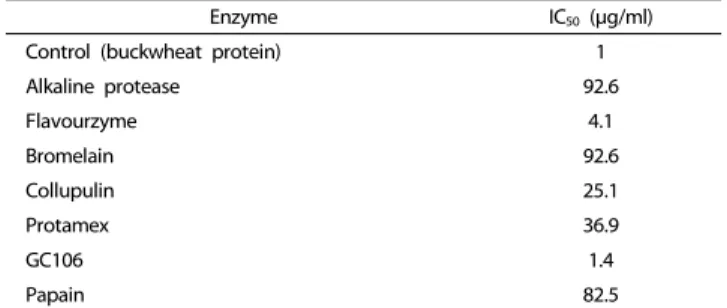
Enzyme IC50 (μg/ml)
Control (buckwheat protein) 1
Alkaline protease 92.6
Flavourzyme 4.1
Bromelain 92.6
Collupulin 25.1
Protamex 36.9
GC106 1.4
Papain 82.5
* IC50 values were calculated for all samples, and the average of two experimental results was presented.
Table 3. Half maximal inhibitory concentration (IC50) after enzymatic hydrolysis of buckwheat protein
Fig. 2. Allergenicity of enzymatic hydrolyzed buckwheat protein measured with pooled serum of buckwheat-sensitive patients. Patient indicates pooled serum of buckwheat-sensitive patients, and negative indicates sera from healthy and non-atopic individuals. BW: buckwheat native protein, AK: Alkaline protease, FLA:
Flavourzyme, BRO: Bromelain, COL: Collupulin, PRO: Protamex, GC: GC106, PAP:
Papain. Error bars indicate standard deviation.
protein bands were recognized as antigens by rabbit antiserum.
After hydrolysis with alkaline protease (AK), all buckwheat protein bands of the intact buckwheat sample were no longer observed on SDS-PAGE, and they were no longer recognized as antigens by the antiserum. Bromelain (BRO), collupulin (COL), papain (PAP), and Protamex (PRO) partially hydrolyzed buckwheat proteins, and proteins less than 25 kDa remained. Flavourzyme (FLA) and GC106 (GC) barely digested buckwheat protein, and they were fully recognized as antigen by the antiserum.
Change of antigenicity and allergenicity after hydrolysis Competitive Inhibition ELISA (ciELISA) was performed for evaluation of the change of antigenicity after hydrolysis with seven commercial proteolytic enzymes (Table 3). The antigenicity showed a significant decrease, to 1/92.6, 1/92.6, and 1/82.5 when measured as IC
50after hydrolysis with alkaline protease, bromelain, and papain, respectively. Hydrolysis of buckwheat protein with Flavourzyme and GC106 barely changed its antigenicity. Hydrolysis with Protamex and collupulin resulted in a moderate change in antigenicity.
Direct ELISA was performed with pooled serum of buckwheat- sensitive patients for evaluation of its allergenicity (Fig. 2).
Hydrolysis of buckwheat protein with alkaline protease resulted in decreased IgE reactivity to 41% of unhydrolyzed buckwheat protein. The allergenicity of hydrolyzed buckwheat protein with Protamex also fell to 51.6% of the unhydrolyzed protein, and approximately 40% reduction of allergenicity was observed
when buckwheat protein was hydrolyzed with collupulin or papain. After hydrolysis with bromelain, the allergenicity of hydrolysates showed a slight decrease. The allergenicity even showed a slight increase after hydrolysis of buckwheat protein with Flavourzyme and GC106.
DISCUSSION
Seven commercial proteases were examined in order to determine the effect of hydrolysis of buckwheat protein on changes of antigenicity and allergenicity of buckwheat allergens.
Enzymes examined could be grouped based on its characte- ristics as serine-type peptidases, cysteine-type peptidases, aminopeptidase, and aspartic-type peptidase.
Enzymatic hydrolysis has generally been known to reduce the antigenicity of proteins. Traditional fermented soybean products have shown less antigenicity than raw soybean, and hydrolyzed infant formulas have already been used for children with allergy to cow milk protein [19,25]. Both alkaline protease and Protamex, classified as serine peptidases (EC 3.4.21.62), particularly subtilisin- like type, appeared to be relatively effective in reduction of buckwheat allergenicity. Food allergens are water-soluble glycoproteins, 10-70 kDa in size, and, in general, it should be more than 10 kDa for binding of IgE [18,26]. Alkaline protease degraded all of the buckwheat proteins to low molecular proteins below 10 kDa, and showed the most effective result in reducing IgE-binding. Subtilisin-like type serine proteases such as alkaline protease and Protamex are broadly specific for aromatic or hydrophobic residues, and have generally been used in traditional fermented soybean products [27]. One study reported that proteases from Bacillus subtilis, such as Protease N and Proleather, destroyed most soybean proteins, and reduced the allergenicity [28]. Major soybean allergens were selectively hydrolyzed with Proleather, and the hydrolysate showed reduced allergenicity without a decline in gel forming ability [29]. Soybean allergens were significantly reduced and no longer recognized by soybean-sensitive patients after ferme- ntation with protease from B. subtilis [30]. Frias et al. [31] also reported a decrease in immunoreactivity of soybean samples evaluated with human plasma of more than 80% after ferme- ntation with B. subtilis.
Papain, collupulin, and bromelain, classified as cysteine-type peptidases (EC 3.4.22.2), also caused a partial decrease in the allergenicity of buckwheat. The band at 20-25 kDa that remained after papain hydrolysis appeared to be Fag e 1 (22-24 kDa) because it was reported to show resistance to papain [32].
Hydrolysis with papain reduced the antigenicity, similar to the
level hydrolyzed with alkaline protease, and the allergenicity
of the hydrolysate with papain did not fall as much as when
hydrolyzed with alkaline protease. The hydrolytic effects of
hydrolysis with collupulin on buckwheat allergens were similar
to those with papain, although the antigenicity was decreased
more effectively with papain. Bromelain showed an effective
decrease in antigenicity, however, allergenicity decreased by
only 12%. As shown in these results, it appeared that the change
of allergenicity evaluated with human sera did not match the
change of antigenicity evaluated with rabbit antisera (Table 3
and Fig. 2). In general, antigenicity has been evaluated with
rabbit antisera in order to determine the allergenicity of proteins because it has many limitations in evaluation of allergenicity with human sera, such as ethical issues and lack of quantity.
However, similar to this result, Mine and Zhang [33] reported that human and rabbit antibodies recognized egg white proteins differently, and strong correlation was observed between antibody recognition and antigen structure when sensitized. It is considered that the differences were caused by the fact that the rabbit antisera was produced by injection of purified and emulsified buckwheat allergens, while patients were sensitized when the antigens were absorbed through the gastrointestinal tract in type of processed foods. It is suggested that the aller- genicity of the proteins should be confirmed by measurement of human IgE.
Flavourzyme and GC 106 barely affected the change of buckwheat allergens. Flavourzyme is classified as an aminopep- tidase (EC 3.4.11.1), and GC106 is included in aspartic-type peptidase (EC 3.4.23.18). Both enzymes are derived from Aspergillus spp., although they are included in different classifications. A previous study reported that hydrolysis with Flavourzyme somewhat increased the allergenicity. The IgE reactivity of patients with peanut allergy showed an increase within the first 30 min after treatment with Flavourzyme [34], and another study also showed an increment in allergenicity when chickpea was hydrolyzed with Flavourzyme [23]. It could be assumed that enzymatic hydrolysis might be helpful in exposure of the interior hidden epitopes of buckwheat, resulting in slightly increased allergenicity (Fig. 2). Treatments such as heating and proteolysis may result in formation of new epitopes, and may promote the interaction of IgE with the immune system in the intestine and lead to a potential increase in protein allergenicity [35].
None of the enzymes could completely eliminate the allergenicity, although the antigenicity appeared to have decreased. Serine-peptidases such as alkaline protease and Protamex appeared to be relatively effective in hydrolysis of buckwheat allergens, and, in particular, alkaline protease decreased the allergenicity by more than 50%. This reducing effect is similar to that of soybean allergens degraded by fermentation with subtilisin. In this study, the antigenicity measured using rabbit antiserum did not correspond well to the allergenicity measured using human sera when buckwheat protein was hydrolyzed with various proteolytic enzymes. This result indicates that the allergenicity may remain unchanged, even though the antigenicity appeared to have decreased significantly. Measure- ment of IgE reactivity of human sera may be required for evaluation of the hypoallergenic characteristics of buckwheat allergens. There is a lack of information on buckwheat allergens, and studies for characterization of enzymatic hydrolysis of buckwheat appear to be prerequisite to reduction of buckwheat allergenicity.
REFERENCES
1. Ahmed A, Khalid N, Ahmad A, Abbasi NA, Latif MS, Randhawa MA.
Phytochemicals and biofunctional properties of buckwheat: a review. J Agric Sci 2013;FirstView:1-21.
2. Chandrupatla CV, Kundu RV, Aronson IK. Buckwheat allergy and atopic dermatitis. J Am Acad Dermatol 2005;53:356-7.
3. Wieslander G, Norbäck D. Buckwheat allergy. Allergy 2001;56:703-4.
4. Park KH, Park SM, Lee HH, Kim HY, Jeoung BJ, Kim KE, Lee KY.
A clinical study on oral buckwheat provocation test. Pediatr Allergy Respir Dis 1998;8:30-6.
5. Takahashi Y, Ichikawa S, Aihara Y, Yokota S. Buckwheat allergy in 90,000 school children in Yokohama. Arerugi 1998;47:26-33.
6. Nakamura S, Yamaguchi MY. Studies on the buckwheat allergose report 2: clinical investigation on 169 cases with the buckwheat allergose gathered from the whole country of Japan. Allerg Immunol (Leipz) 1974;20-21:457-65.
7. Oh JW, Pyun BY, Choung JT, Ahn KM, Kim CH, Song SW, Son JA, Lee SY, Lee SI. Epidemiological change of atopic dermatitis and food allergy in school-aged children in Korea between 1995 and 2000. J Korean Med Sci 2004;19:716-23.
8. Sammut D, Dennison P, Venter C, Kurukulaaratchy RJ. Buckwheat allergy: a potential problem in 21st century Britain. BMJ Case Rep 2011;2011.
9. Schiffner R, Przybilla B, Burgdorff T, Landthaler M, Stolz W.
Anaphylaxis to buckwheat. Allergy 2001;56:1020-1.
10. Heffler E, Nebiolo F, Asero R, Guida G, Badiu I, Pizzimenti S, Marchese C, Amato S, Mistrello G, Canaletti F, Rolla G. Clinical manifestations, co-sensitizations, and immunoblotting profiles of buckwheat-allergic patients. Allergy 2011;66:264-70.
11. Nakamura S, Suzuki Y, Ishikawa E, Yakushi T, Jing H, Miyamoto T, Hashizume K. Reduction of in vitro allergenicity of buckwheat Fage 1 through the Maillard-type glycosylation with polysaccharides.
Food Chem 2008;109:538-45.
12. Morita N, Maeda T, Sai R, Miyake K, Yoshioka H, Urisu A, Adachi T. Studies on distribution of protein and allergen in graded flours prepared from whole buckwheat grains. Food Res Int 2006;39:
782-90.
13. Lee KY, Lee HH, Kim KE, Park KH, Kim YK, Kong BJ. A comparative study on allergenicity of raw and hypoallergenic buckwheat flour.
Pediatr Allergy Respir Dis 1997;7:13-22.
14. Yum HY, Ryu JW, Kim KE, Lee KY. Immunoblot analysis of hypoallergenic buckwheat with monoclonal antibodies to raw buckwheat. Pediatr Allergy Respir Dis 2000;10:34-40.
15. Yoshimasu MA, Zhang JW, Hayakawa S, Mine Y. Electrophoretic and immunochemical characterization of allergenic proteins in buckwheat.
Int Arch Allergy Immunol 2000;123:130-6.
16. Handoyo T, Maeda T, Urisu A, Adachi T, Morita N. Hypoallergenic buckwheat flour preparation by Rhizopus oligosporus and its application to soba noodle. Food Res Int 2006;39:598-605.
17. Satoh R, Koyano S, Takagi K, Nakamura R, Teshima R. Identification of an IgE-binding epitope of a major buckwheat allergen, BWp16, by SPOTs assay and mimotope screening. Int Arch Allergy Immunol 2010;153:133-40.
18. Sampson HA. Update on food allergy. J Allergy Clin Immunol 2004;113:805-19.
19. Terracciano L, Isoardi P, Arrigoni S, Zoja A, Martelli A. Use of hydrolysates in the treatment of cow's milk allergy. Ann Allergy Asthma Immunol 2002;89:86-90.
20. Høst A, Halken S. Hypoallergenic formulas--when, to whom and how long: after more than 15 years we know the right indication!
Allergy 2004;59 Suppl 78:45-52.
21. Lee S, Han Y, Do JR, Oh S. Allergenic potential and enzymatic resistance of buckwheat. Nutr Res Pract 2013;7:3-8.
22. Tanaka K, Matsumoto K, Akasawa A, Nakajima T, Nagasu T, Iikura
Y, Saito H. Pepsin-resistant 16-kD buckwheat protein is associated with immediate hypersensitivity reaction in patients with buckwheat allergy. Int Arch Allergy Immunol 2002;129:49-56.
23. Clemente A, Vioque J, Sanchez-Vioque R, Pedroche J, Millán F.
Production of extensive chickpea (Cicer arietinum L.) protein hydrolysates with reduced antigenic activity. J Agric Food Chem 1999;47:3776-81.
24. Laemmli UK. Cleavage of structural proteins during the assembly of the head of bacteriophage T4. Nature 1970;227:680-5.
25. Herian AM, Taylor SL, Bush RK. Allergenic reactivity of various soybean products as determined by RAST inhibition. J Food Sci 1993;58:385-8.
26. Lee SW, Ha WK, Juhn SL, Kim JW, Shon DH, Lee JY. Antigenicity of whey protein hydrolysates against rabbit anti β-Lactoglobulin antiserum. Korean J Food Sci Technol 1994;26:532-8.
27. Gupta R, Beg QK, Lorenz P. Bacterial alkaline proteases: molecular approaches and industrial applications. Appl Microbiol Biotechnol 2002;59:15-32.
28. Yamanishi R, Tsuji H, Bando N, Yamada Y, Nadaoka Y, Huang T, Nishikawa K, Emoto S, Ogawa T. Reduction of the allergenicity of soybean by treatment with proteases. J Nutr Sci Vitaminol (Tokyo) 1996;42:581-7.
29. Tsumura K, Kugimiya W, Bando N, Hiemori M, Ogawa T. Preparation
of hypoallergenic soybean protein with processing functionality by selective enzymatic hydrolysis. Food Sci Technol Res 1999;5:171-5.
30. Chung YH, Kwon JH, Jung JA, Lee JO, Lee KS, Kim JY, Ahn KM, Lee SI, Ryu CH. Evaluating the allergenicity of soybean by the fermentation. Pediatr Allergy Respir Dis 2008;18:37-45.
31. Frias J, Song YS, Martínez-Villaluenga C, González de Mejia E, Vidal-Valverde C. Immunoreactivity and amino acid content of fermented soybean products. J Agric Food Chem 2008;56:99-105.
32. Kondo Y, Urisu A, Tokuda R, Ishida N, Yasuda T. Molecular characterization of a 24-kDa buckwheat protein, one of the major allergens of buckwheat seed. Fagopyrum 2001;18:21-5.
33. Mine Y, Zhang JW. Comparative studies on antigenicity and allergenicity of native and denatured egg white proteins. J Agric Food Chem 2002;50:2679-83.
34. Cabanillas B, Pedrosa MM, Rodríguez J, Muzquiz M, Maleki SJ, Cuadrado C, Burbano C, Crespo JF. Influence of enzymatic hydrolysis on the allergenicity of roasted peanut protein extract. Int Arch Allergy Immunol 2012;157:41-50.
35. Nowak-Wegrzyn A, Fiocchi A. Rare, medium, or well done? The effect of heating and food matrix on food protein allergenicity. Curr Opin Allergy Clin Immunol 2009;9:234-7.