• 검색 결과가 없습니다.

Determinants of Bone Mass and Insulin Resistance in Korean Postmenopausal Women: Muscle Area, Strength, or Composition?

N/A
N/A
Protected

Academic year: 2022

Share "Determinants of Bone Mass and Insulin Resistance in Korean Postmenopausal Women: Muscle Area, Strength, or Composition?"

Copied!
9
0
0

로드 중.... (전체 텍스트 보기)

전체 글

(1)

INTRODUCTION

Skeletal muscle is an important tissue that supports body pos-

ture and internal organs. Most skeletal muscles are attached to their adjacent bones, and they interact with each other by releasing myokines and osteokines.

1

This interaction has been described by many clinical studies, reporting that people with less muscle mass have lower bone mineral density (BMD) and face a higher risk of fracture.

2

In addition, muscle is the primary site of glucose uptake after meal intake, and sarcope- nia is highly associated with insulin resistance.

3

According to one study, inflammatory responses from muscles may under- lie the development of insulin resistance: when the inflamma- tory response is inadequate as with aging muscle, acellular lipid droplets and adipocytes can accumulate.

4

Accumulated adipocytes and lipid droplets, in turn, are presumed to affect

Determinants of Bone Mass and Insulin Resistance in Korean Postmenopausal Women:

Muscle Area, Strength, or Composition?

Hye-Sun Park

1

, Jung Soo Lim

2

, and Sung-Kil Lim

3

1

Department of Endocrinology, H Plus Yangji Hospital, Seoul;

2

Division of Endocrinology and Metabolism, Department of Internal Medicine, Institute of Evidence-based Medicine, Yonsei University Wonju College of Medicine, Wonju;

3
Division of Endocrinology and Metabolism, Department of Internal Medicine, Yonsei University College of Medicine, Seoul, Korea.

Purpose: Muscle mass, strength, and composition determine muscle quantity and quality. However, data on muscle properties in relation to bone mass or insulin resistance are limited in Asian populations. This study aimed to investigate the relative impor- tance of muscle measurements in regards to their relationship with lower bone mass and insulin resistance.

Materials and Methods: In this study, 192 postmenopausal women (age, 72.39±6.07 years) were enrolled. We measured muscle cross-sectional area (CSA) and attenuation at the gluteus maximus and quadriceps muscles through quantitative computed to- mography. Muscle strength and physical performance were evaluated with the hand grip test and Short Physical Performance Battery (SPPB). Pearson correlation analysis and linear regression were performed to evaluate the relationship between muscle properties and homeostatic model assessment-insulin resistance (HOMA-IR) or bone mineral density (BMD).

Results: Muscle CSA, hand grip strength, and SPPB score held positive correlations with spine and hip BMDs, but not with insu- lin resistance. In contrast, muscle attenuation of the gluteus maximus or quadriceps was inversely related to HOMA-IR (r=-0.194, p=0.018 and r=-0.292, p<0.001, respectively), but not BMD. Compared with the control group, muscle CSA was significantly de- creased in patients with osteoporosis; however, decreased muscle attenuation, indicating high fat infiltration, was found only in patients with diabetes.

Conclusion: Muscle mass, strength, and physical performance were associated with low bone mass, and accumulation of intra- muscular fat, a histological hallmark of persistently damaged muscles, may play a major role in the development of insulin resis- tance in Korean postmenopausal women.

Key Words: Muscle, sarcopenia, bone mass, insulin resistance

pISSN: 0513-5796 · eISSN: 1976-2437

Received: February 7, 2019 Revised: June 14, 2019 Accepted: June 18, 2019

Corresponding author: Sung-Kil Lim, MD, PhD, Division of Endocrinology and Metabolism, Department of Internal Medicine, Yonsei University College of Medi- cine, 50-1 Yonsei-ro, Seodaemun-gu, Seoul 03722, Korea.

Tel: 82-2-2228-0838, Fax: 82-2-393-6884, E-mail: [email protected]

•The authors have no potential conflicts of interest to disclose.

© Copyright: Yonsei University College of Medicine 2019

This is an Open Access article distributed under the terms of the Creative Com- mons Attribution Non-Commercial License (https://creativecommons.org/licenses/

by-nc/4.0) which permits unrestricted non-commercial use, distribution, and repro- duction in any medium, provided the original work is properly cited.

Yonsei Med J 2019 Aug;60(8):742-750

https://doi.org/10.3349/ymj.2019.60.8.742

(2)

the development of insulin resistance, type 2 diabetes, and metabolic syndrome by secreting various adipokines, chemo- kines, and cytokines.

Although it has been speculated that muscle is closely relat- ed to osteoporosis and metabolic abnormalities, there is lack of data on associations among muscle properties and bone mass or insulin resistance in the Asian population. Muscle mass and strength are widely used as indicators of muscle quantity and quality, respectively. Furthermore, it is a com- mon belief that muscle mass and strength are correlated with each other.

5

However, Hughes, et al.

6

demonstrated that less than 5% of changes in muscle strength are attributable to changes in muscle size. Similarly, Barbat-Artigas, et al.

7

report- ed that women with sarcopenia who were 75 years of age and older showed better muscle quality than women without sar- copenia, indicating a discordance between muscle quality and mass. Therefore, in addition to muscle quantity, muscle quality should be evaluated independently. Although muscle quality is usually measured by muscle strength, muscle com- position (e.g., fiber type or lipid content) should also be taken into account, as different muscle compositions might explain why individuals with the same muscle mass do not necessari- ly have the same muscle strength.

7

In this study, we aimed to investigate which muscle proper- ties, among muscle mass, muscle strength, physical perfor- mance, or muscle composition, are associated with bone mass and insulin resistance in Korean postmenopausal women.

MATERIALS AND METHODS

Study subjects and anthropometry

A total of 192 postmenopausal women aged 60 years and old- er were enrolled. The participants visited Severance Hospital in Seoul, Korea for a routine health check up from April 2016 to September 2016. We excluded subjects who had been diag- nosed with severe hepatic impairment [aspartate transami- nase (AST) or alanine transaminase (ALT) levels higher than three times the upper limit of the normal range within the last 3 months] or malignancy and those who had been treated with a glucocorticoid or levothyroxine. Subjects who were treated with menopausal hormone therapy within 3 years were also excluded. Subjects whose glycosylated hemoglobin was ≥6.5% at baseline screening and who had been treated with oral hypoglycemic agents or insulin were defined to have diabetes mellitus. Medication history, including use of bisphosphonates, selective estrogen receptor modulators (SERM), oral hypoglycemic agents, and insulin, was collected from the electronic medical records system of Severance Hos- pital. The subjects completed a simple questionnaire con- cerning their age at menopause, osteoporotic fracture history, smoking history, and times of regular exercise per week.

Height and body weight were measured using a calibrated

digital scale after all outer clothing and shoes were removed, and body mass index (BMI) was calculated as weight in kilo- grams divided by height in meters squared (kg/m

2

). Moreover, waist circumference was measured as the minimum circum- ference between the inferior border of the rib cage and the su- perior aspect of the iliac crest using an inelastic measuring tape. Hip circumference was measured as the maximum cir- cumference at the level of the buttocks. All anthropometric measurements were performed by the same evaluator. Using quantitative computed tomography (QCT), osteoporosis was defined as an L1–L4 average spine BMD value of <80 mg/cm

3

or a T-score at the hip of <-2.5, based on the American College of Radiology guidelines.

8

The Severance Hospital Institutional Review Board approved the study protocol (IRB No. 4-2016- 0126), and informed consent was obtained from all subjects.

In addition, all investigations were performed in accordance with the principles of the Declaration of Helsinki.

Biochemical measurements

Serum fasting glucose, fasting insulin, blood urea nitrogen, se- rum creatinine, AST, ALT, total cholesterol, and 25-hydroxyvita- min D were measured. Serum 25-hydroxyvitamin D levels were measured using a radioimmunoassay [RIA: INCSTAR Corp., Stillwater, MN, USA; intraassay coefficient of variation (CV) <4.1% and interassay CV <7.0%]. Homeostatic model as- sessment-insulin resistance (HOMA-IR), which is an index of insulin resistance, was calculated using the following equa- tion, as described by Matthews, et al.

9

:

HOMA-IR=[glucose (mg/dL)×insulin (µU/mL)]/405.

QCT scanning

The subjects were scanned on a multidetector CT scanner (Light Speed QX-I scanner, GE Medical Systems, Waukesha, WI, USA) at 120 kVp and 120 mAs, with a 2.5-mm slice thick- ness, as previously described.

10-12

Volumetric BMD in mg/cm

3

was calculated at the spine and hip, and all scanned data were analyzed using QCT PRO software (Mindways Software, Aus- tin, TX, USA).

Measurement of muscle mass and composition

The cross-sectional area (CSA) of the gluteus maximus and

quadriceps muscles was used as an index of muscle mass.

13,14

Axial images were obtained using QCT, and CSA was mea-

sured using freehand-drawn regions of interest (ROIs) (Sup-

plementary Fig. 1, only online). Gluteus maximus and quadri-

ceps muscle area was measured at the level of the symphysis

pubis and at the level 7 cm from the lesser trochanter, respec-

tively. At each level, the mean value of right and left area was

calculated and used for analysis. As an index of muscle com-

position, we used the mean attenuation of coefficient, mea-

sured in Hounsfield units (HU).

15

The mean HU was mea-

sured at the same ROIs where muscle CSA was measured. All

(3)

images were analyzed by a single investigator.

Measurement of muscle strength and physical performance

To estimate muscle strength and physical performance, the hand grip test (HGT) and Short Physical Performance Battery (SPPB) were performed. Hand grip strength was evaluated using a digital dynamometer (Grip Strength Dynamometer T.K.K.5401; Takei Co., Tokyo, Japan). The subjects were asked to stand straight with their arms resting in a neutral position, and grip strength was measured three times with each hand.

16

The maximum score was recorded and used for analysis. The SPPB score was based on three tests, as follows: balance test, gait speed test, and chair stand test. For the balance test, the subjects were asked to hold challenging standing positions for 10 s each: 1) side-by-side position, feet together side-by-side;

2) semi-tandem position, heel of one foot against the side of the big toe of the other foot; and 3) tandem position, feet aligned heel to toe. Moreover, the time to walk 4 m at the sub- ject’s usual pace was measured to evaluate gait speed. For the chair stand test, the subjects were asked to sit down and stand up from a chair five times without using their arms, and the total time was measured. Each test was scored between 0 and 4; a total score of 12 was the maximum score.

17

These tests were conducted only for subjects who agreed to perform them.

Among the 192 enrolled subjects, 173 completed HGT and 83 performed the SPPB test. Seventy-two subjects completed both tests.

Statistical analysis

Descriptive statistics were performed for the analysis of base- line characteristics. To evaluate the relationship between mus- cle properties and BMD or HOMA-IR, Pearson correlation analysis and linear regression test were performed. Analysis of covariance was used to evaluate significant differences in muscle properties between osteoporotic and non-osteoporot- ic groups or between diabetic and non-diabetic groups. Val- ues are expressed as means±standard deviations. p-values

<0.05 were considered statistically significant. All statistical analyses were performed with the Statistical Package for So- cial Sciences for Windows, version 23.0 (IBM Corp., Armonk, NY, USA) and GraphPad Prism 5 (GraphPad Software Inc., San Diego, CA, USA).

RESULTS

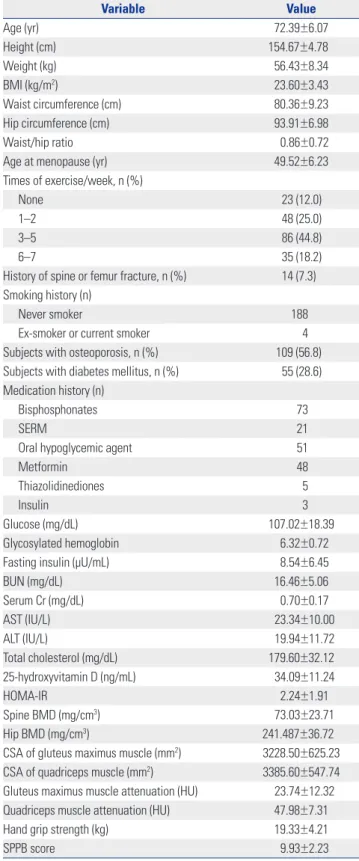
The baseline characteristics are shown in Table 1. The mean age of the subjects was 72.39±6.07 years, and their mean BMI was 23.6±3.43 kg/m

2

. According to the World Health Organi- zation criteria,

18,19

57 subjects (29.7%) were obese (BMI >25 kg/m

2

) and 89 (46.4%) had abdominal obesity (waist-hip ratio

>0.85). One hundred and nine subjects (56.8%) had osteopo-

Table 1. Baseline Characteristics of the Subjects

Variable Value

Age (yr) 72.39±6.07

Height (cm) 154.67±4.78

Weight (kg) 56.43±8.34

BMI (kg/m

2

) 23.60±3.43

Waist circumference (cm) 80.36±9.23

Hip circumference (cm) 93.91±6.98

Waist/hip ratio 0.86±0.72

Age at menopause (yr) 49.52±6.23

Times of exercise/week, n (%)

None 23 (12.0)

1–2 48 (25.0)

3–5 86 (44.8)

6–7 35 (18.2)

History of spine or femur fracture, n (%) 14 (7.3) Smoking history (n)

Never smoker 188

Ex-smoker or current smoker 4

Subjects with osteoporosis, n (%) 109 (56.8) Subjects with diabetes mellitus, n (%) 55 (28.6) Medication history (n)

Bisphosphonates 73

SERM 21

Oral hypoglycemic agent 51

Metformin 48

Thiazolidinediones 5

Insulin 3

Glucose (mg/dL) 107.02±18.39

Glycosylated hemoglobin 6.32±0.72

Fasting insulin (µU/mL) 8.54±6.45

BUN (mg/dL) 16.46±5.06

Serum Cr (mg/dL) 0.70±0.17

AST (IU/L) 23.34±10.00

ALT (IU/L) 19.94±11.72

Total cholesterol (mg/dL) 179.60±32.12

25-hydroxyvitamin D (ng/mL) 34.09±11.24

HOMA-IR 2.24±1.91

Spine BMD (mg/cm

3

) 73.03±23.71

Hip BMD (mg/cm

3

) 241.487±36.72

CSA of gluteus maximus muscle (mm

2

) 3228.50±625.23 CSA of quadriceps muscle (mm

2

) 3385.60±547.74 Gluteus maximus muscle attenuation (HU) 23.74±12.32 Quadriceps muscle attenuation (HU) 47.98±7.31

Hand grip strength (kg) 19.33±4.21

SPPB score 9.93±2.23

BMI, body mass index; SERM, selective estrogen receptor modulators; BUN, blood urea nitrogen; Cr, creatinine; AST, aspartate transaminase; ALT, alanine transaminase; HOMA-IR, homeostatic model assessment-insulin resistance;

BMD, bone mineral density; CSA, cross-sectional area; SPPB, Short Physical Performance Battery.

Values are expressed as means±standard deviations unless otherwise no-

ticed.

(4)

400

300

200

100

Fig. 1. Scatterplot analysis of BMD with muscle CSA (A and B), hand grip strength (C), SPPB score (D), and muscle attenuation (E and F). Spine BMD and hip BMD according to SPPB score (G and H). BMD, bone mineral density; CSA, cross-sectional area; SPPB, Short Physical Performance Battery.

400

300

200

100

0

400

300

200

100

0

120 100 80 60 40 20 0

400

300

200

100

0

400

300

200

100

0

300

250

200

150

BMD (mg/cm

3

) BMD (mg/cm

3

) Spine BMD (mg/cm

3

) BMD (mg/cm

3

) BMD (mg/cm

3

) BMD (mg/cm

3

) Hip BMD (mg/cm

3

) BMD (mg/cm

3

)

1000 2000 3000 4000 5000 6000

0 10 20 30 40

<10 ≥10

0 20 40 60

2000 3000 4000 5000

0 5 10 15

<10 ≥10

0 20 40 60 r=0.275, p<0.001

r=0.268, p=0.001

r=0.095, p=0.242

r=0.273, p=0.001

r=0.332, p=0.004

r=0.016, p=0.843 r=0.218, p=0.006

r=0.263, p=0.001

r=0.063, p=0.436

r=0.259, p=0.001

r=0.415, p<0.001

r=0.035, p=0.673 CSA of gluteus maximus (mm

2

)

Hand grip strength (kg)

SPPB score

p=0.004 p=0.048

Gluteus maximus muscle attenuation (HU)

CSA of quadriceps (mm

2

)

SPPB score

SPPB score

Quadriceps muscle attenuation (HU) Spine Hip

Spine Hip

Spine Hip

Spine Hip

Spine Hip

Spine Hip A

C

G E

B

D

H F

400

300

200

100

(5)

rosis, among whom 94 had been treated with bisphospho- nates (n=73) or SERM (n=21). Fifty-five subjects (28.6%) were diagnosed with diabetes mellitus, and 51 subjects (26.6%) had been taking oral hypoglycemic agents and/or receiving insu- lin treatment. The numbers of subjects who were treated with metformin or thiazolidinediones, which can affect lipid accu- mulation in muscle or bone loss, were 48 and 5, respectively.

There were no significant differences in clinical parameters, including age, BMI, glycosylated hemoglobin, BMD, CSA of muscle, and muscle HU value, between the subjects who opt- ed to participate in performance tests (e.g., HGT, SPPB, or both) and those who opted not to participate.

Muscle measurements and their association with BMI The mean CSA values of the gluteus maximus and quadriceps muscles were 3228.50±625.23 mm

2

and 3385.60±547.74 mm

2

, respectively. The muscle attenuation (HU) of the gluteus maximus and quadriceps was 23.74±12.32 HU and 47.98±7.31 HU, respectively. The muscle area of the gluteus maximus and quadriceps was positively correlated with BMI (r=0.376, p<0.001 and r=0.214, p=0.009, respectively), whereas muscle attenuation (HU) of the gluteus maximus and quadriceps was inversely correlated with BMI (r=-0.440, p<0.001 and r=-0.347, p<0.001, respectively).

Association between muscle properties and BMD As shown in Fig. 1A and B, the CSA of the gluteus maximus muscle was positively correlated with spine and hip BMD (r=

0.218, p=0.006 and r=0.275, p<0.001, respectively). Moreover,

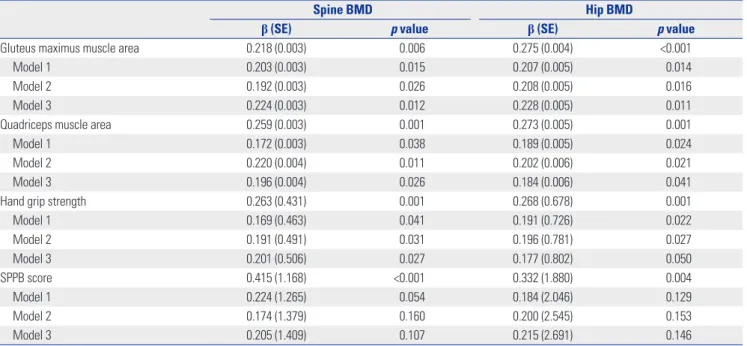
the CSA of the quadriceps also showed a positive correlation with the spine and hip BMDs (r=0.259, p=0.001 and r=0.273, p=0.001, respectively). These associations remained signifi- cant after adjusting for covariates (Table 2). Furthermore, muscle strength and physical performance, as well as muscle CSA, had a positive correlation with BMD. Both hand grip strength and SPPB score were positively correlated with BMD (Fig. 1C and D). Although the association between SPPB score and BMD was not significant after adjusting for covariates, the association between hand grip strength and BMD remained significant after adjusting for multiple confounding factors (Table 2). However, the HU value of the gluteus maximus or quadriceps muscles was not related to BMD (Fig. 1E and F), suggesting that muscle composition was not associated with BMD, unlike muscle area, strength, and physical perfor- mance. As SPPB score did not have Gaussian distribution, we performed further analysis for classes according to SPPB score (Fig. 1G and H). Subjects whose SPPB score was 10 or more showed statistically significant higher spine BMD and hip BMD, compared to those with a SPPB score of less than 10.

Association between muscle properties and insulin resistance

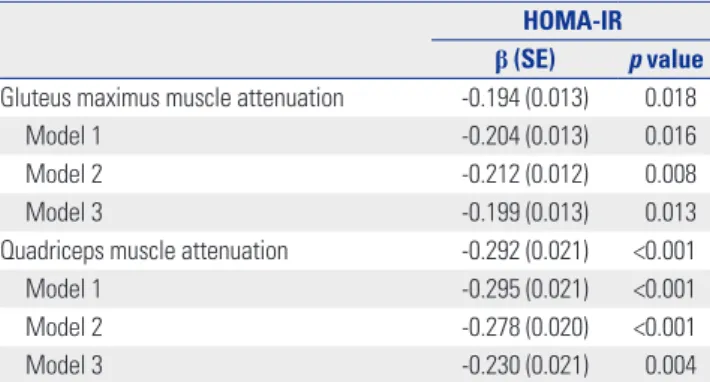
As shown in Fig. 2A-D, muscle CSA, strength, and physical performance were not correlated with insulin resistance, whereas muscle attenuation (HU) of the gluteus maximus and quadriceps was inversely related to HOMA-IR, as shown in Fig. 2E and F (r=-0.194, p=0.018 and r=-0.292, p<0.001, re- spectively). This association remained significant after adjust- ing for confounding factors (Table 3).

Table 2. Correlation between BMD and Muscle Parameters

Spine BMD Hip BMD

β (SE) p value β (SE) p value

Gluteus maximus muscle area 0.218 (0.003) 0.006 0.275 (0.004) <0.001

Model 1 0.203 (0.003) 0.015 0.207 (0.005) 0.014

Model 2 0.192 (0.003) 0.026 0.208 (0.005) 0.016

Model 3 0.224 (0.003) 0.012 0.228 (0.005) 0.011

Quadriceps muscle area 0.259 (0.003) 0.001 0.273 (0.005) 0.001

Model 1 0.172 (0.003) 0.038 0.189 (0.005) 0.024

Model 2 0.220 (0.004) 0.011 0.202 (0.006) 0.021

Model 3 0.196 (0.004) 0.026 0.184 (0.006) 0.041

Hand grip strength 0.263 (0.431) 0.001 0.268 (0.678) 0.001

Model 1 0.169 (0.463) 0.041 0.191 (0.726) 0.022

Model 2 0.191 (0.491) 0.031 0.196 (0.781) 0.027

Model 3 0.201 (0.506) 0.027 0.177 (0.802) 0.050

SPPB score 0.415 (1.168) <0.001 0.332 (1.880) 0.004

Model 1 0.224 (1.265) 0.054 0.184 (2.046) 0.129

Model 2 0.174 (1.379) 0.160 0.200 (2.545) 0.153

Model 3 0.205 (1.409) 0.107 0.215 (2.691) 0.146

BMD, bone mineral density; SPPB, Short Physical Performance Battery; BMI, body mass index; eGFR, estimated glomerular filtration rate; SERM, selective estro- gen receptor modulators; AST, aspartate transaminase; ALT, alanine transaminase; HOMA-IR, homeostatic model assessment-insulin resistance.

Model 1 adjusted for age and BMI; model 2 adjusted for model 1 parameters+eGFR, HOMA-IR, AST, ALT, total cholesterol and 25-hydroxyvitamin D; model 3 ad-

justed for model 2 parameters+physical activity (exercise/week), medication history (SERM, metformin or thiazolidinediones) and smoking history.

(6)

Muscle properties according to the presence of osteoporosis or diabetes mellitus

We further analyzed muscle properties depending on the presence of osteoporosis (Fig. 3A, B, and C). We investigated statistical differences between the two groups after adjusting for age. As shown in Fig. 3A, subjects with osteoporosis showed significantly smaller gluteus maximus and quadriceps muscle area than the control group. However, muscle strength, physi- cal performance, and muscle attenuation measured as HU were not different between the two groups (Fig. 3B and C). In addition, muscle properties according to the presence of dia- betes were also analyzed after adjusting for age. Subjects with diabetes had significantly higher gluteus maximus muscle area; however, there were no differences in quadriceps area, muscle strength, and physical performance (Fig. 3D and E).

Moreover, the muscle attenuation (HU) of subjects with dia- betes was significantly lower than that of subjects without dia- betes (Fig. 3F).

DISCUSSION

In this study, associations between muscle properties and BMD or insulin resistance were assessed by measuring mus- cle parameters, including CSA, strength, attenuation (HU) of lean tissue, and physical performance in Korean postmeno- pausal women. Here, we provide clinical evidence that mus- cle mass, strength, and physical performance are associated primarily with low bone mass. Furthermore, we also recon- firmed that persistently damaged muscles, represented by ac- Fig. 2. Scatterplot analysis of HOMA-IR with muscle CSA (A and B), hand grip strength (C), SPPB score (D), and muscle attenuation (E and F). HOMA-IR, homeostatic model assessment-insulin resistance; CSA, cross-sectional area; SPPB, Short Physical Performance Battery.

15

10

5

0

15

10

5

0

15

10

5

15

10

5 15

10

5

0

15

10

5

0

HOMA-IR HOMA-IR HOMA-IR HOMA-IR HOMA-IR HOMA-IR

1000 2000 3000 4000 5000 6000

0 10 20 30 40

-10 0 10 20 30 40 50 60 -10 0 10 20 30 40 50 60

2000 3000 4000 5000

0 5 10 15 r=0.025, p=0.760

r=-0.032, p=0.683

r=-0.194, p=0.018

r=0.020, p=0.811

r=-0.083, p=0.467

r=-0.292, p<0.001 CSA of gluteus maximus (mm

2

)

Hand grip stength (kg)

Gluteus maximus muscle attenuation (HU)

CSA of quadriceps (mm

2

)

SPPB score

Quadriceps muscle attenuation (HU) A

C

E

B

D

F

(7)

cumulated adipocytes and lipid droplets, not simply low mus- cle mass or strength, are closely related to insulin resistance.

In our study, QCT was used to measure muscle CSA and composition. Compared to dual-energy X-ray absorptiome- try, QCT can evaluate muscle composition and is less affected by degenerative bone changes and vascular calcifications.

Muscle area and strength showed significant positive correla- tions with BMD after adjusting for confounding factors, such as age and body weight, which is consistent with the results of previous studies.

20-22

However, SPPB score, which was used to measure physical performance, was not significant after ad-

justing for confounding factors. Furthermore, when the sub- jects were divided into two groups according to the presence of osteoporosis, hand grip strength and SPPB score were not significantly different between the two groups. Previous stud- ies reported that quadriceps strength and physical perfor- mance measurements, such as gait speed and brisk step length, are associated with BMD.

23,24

There is a possibility that hand grip strength in our study could not reflect thigh muscle strength well enough, as it simply assesses the strength of the forearm muscles. In addition, the number of subjects who completed SPPB was relatively small. This may also contrib- ute to the insignificant relationship between SPPB score and BMD after adjusting for confounding factors.

Lang, et al.

25

previously reported that only muscle HU value had a significant association with increased risk of hip fracture after adjusting for covariates, such as age, race, sex, and BMI.

However, we could not find any association between muscle HU values and BMD. These somewhat discordant findings might be due to the different baseline characteristics of the study population. The subjects enrolled in the study of Lang, et al.

25

had higher BMI (26.0–29.5 kg/m

2

depending on ethnicity and sex) and lower thigh muscle HU value (32.6–37.5 HU de- pending on ethnicity and sex) compared with the subjects in our study (BMI of 23.60 kg/m

2

and quadriceps HU of 47.98).

Therefore, it can be speculated that large accumulation of muscle fat accompanied by aggravated myositis could de- crease muscle HU value and further lead to osteoporosis, fol- lowed by an increased risk of fracture.

Sarcopenia is known to be significantly associated with in- sulin resistance and diabetes.

26,27

In previous studies, sarcope- nia was defined using a lean mass index (appendicular lean Table 3. Correlation between HOMA-IR and Muscle Attenuation

HOMA-IR β (SE) p value Gluteus maximus muscle attenuation -0.194 (0.013) 0.018

Model 1 -0.204 (0.013) 0.016

Model 2 -0.212 (0.012) 0.008

Model 3 -0.199 (0.013) 0.013

Quadriceps muscle attenuation -0.292 (0.021) <0.001

Model 1 -0.295 (0.021) <0.001

Model 2 -0.278 (0.020) <0.001

Model 3 -0.230 (0.021) 0.004

HOMA-IR, homeostatic model assessment-insulin resistance; BMI, body mass index; eGFR, estimated glomerular filtration rate; SERM, selective es- trogen receptor modulators; AST, aspartate transaminase; ALT, alanine trans- aminase; BMD, bone mineral density.

Model 1 adjusted for age and BMI; model 2 adjusted for model 1 parameters+eGFR, AST, ALT and total cholesterol; model 3 adjusted for mod- el 2 parameters+hip BMD, physical activity (exercise/week), medication his- tory (SERM, metformin or thiazolidinediones), smoking history and fracture history.

A

D

B

E

C

F

Fig. 3. Muscle parameters in subjects with osteoporosis (A, B, and C) and diabetes (E, E, and F). Muscle CSA is shown in (A) and (D), physical perfor- mance in (B) and (E), and muscle composition in (C) and (F). *p≤0.05 versus non-osteoporotic (A, B, and C) or non-diabetic group (D, E, and F). CSA, cross- sectional area; HGT, hand grip test; SPPB, Short Physical Performance Battery.

4500 4000 3500 3000 2500 2000

4500 4000 3500 3000 2500 2000

30

20

10

0

30

20

10

0

15

10

5

0

15

10

5

0

60

40

20

0

60

40

20

0 Gluteus maximus

Gluteus maximus

HGT

HGT

Gluteus maximus

Gluteus maximus Quadriceps

Quadriceps

* *

*

*

* SPPB

SPPB

Quadriceps

Quadriceps

Muscle CSA (mm

2

) Muscle CSA (mm

2

) Hand grip strength (kg) Hand grip strength (kg) Muscle CSA (mm

2

) Muscle CSA (mm

2

)

SPPB score SPPB score

Non-osteoporotic Osteoporotic

Non-diabetic Diabetic

Non-osteoporotic Osteoporotic

Non-diabetic Diabetic

Non-osteoporotic Osteoporotic

Non-diabetic

Diabetic

(8)

mass in kg/height in meter squared).

28

However, this approach is limited in that it cannot evaluate the association of each muscle property with diabetes or osteoporosis. In the present study, we used QCT and performance tests to analyze not only muscle CSA but also muscle composition and perfor- mance, which are closely related to functional impairment and disability. According to our study, muscle CSA, strength, and physical performance were not associated with insulin resis- tance, whereas muscle HU value was significantly associated with insulin resistance: subjects with lower HU value in mus- cle, which means more fat infiltration, showed higher insulin resistance. Therefore, our present findings implicate persis- tently damaged muscles accompanied by fatty infiltration in the development of insulin resistance. Several studies have explored the association of sarcopenia with muscle adiposity and insulin resistance.

29-31

Cell death processes occur in re- sponse to muscle disuse or age-associated sarcopenia.

29

When apoptotic cells accumulate and their clearance is im- paired, maladaptive muscle remodeling occurs with fatty infil- tration within the muscle.

4

Meanwhile, inflammatory cyto- kines and adipokines are released, which might lead to the development of insulin resistance. Therefore, this gave rise to the idea that the presence of local inflammation in muscle, followed by fat accumulation and secretion of dysregulated adipokines and cytokines, rather than decreased muscle mass or strength alone, may play a more important role in insulin resistance development. In this regard, our results can provide clinical evidence that supports the results of other studies.

32-34

Racial differences in bone mass, body composition, and in- sulin resistance have been reported in previous studies.

35-37

However, most studies regarding the relationships between muscle, bone, and fat have only included non-Hispanic white, black, and Hispanic subjects. In this study, we focused on the Korean population. The prevalence of obesity in Korean adults (31%) is reported to be lower than in the general population of the United States (35%).

38,39

In this study, the percentage of sub- jects with obesity was 29.7%, which was even lower than that of the general Korean population. Although fatty infiltration within the muscle in our subjects was not severe, we found a clear negative association between muscle HU value and in- sulin resistance. Therefore, it could be speculated that fat de- position indeed has a close positive relationship with insulin resistance. In contrast, there was no association between muscle HU value and BMD.

To the best of our knowledge, this is the first study to focus on individual muscle properties and their associations with BMD and insulin resistance in Korean postmenopausal wom- en. However, this study has several limitations. First, as the current study only included postmenopausal women who were ≥60 years old, the results cannot be applied to men and premenopausal women who may have different body com- position and metabolic conditions than postmenopausal women. Second, we did not perform muscle biopsy, which can

directly evaluate muscle composition, and muscle attenua- tion values were used as an alternative method. However, a previous study showed that muscle attenuation can actually reflect skeletal muscle lipid content.

40

Therefore, we believe that muscle attenuation could be used as a non-invasive and reliable method to evaluate muscle composition, although it is not as accurate as muscle biopsy. Third, since this was a cross-sectional study, we could not investigate the causative effect or influence of muscle properties on BMD and insulin resistance. Lastly, calcium and vitamin D intake from diet and supplements was not assessed, and although the use of medi- cations, such as bisphosphonates, SERM, metformin, and thi- azolidinediones, was adjusted for, we cannot exclude the pos- sibility that the use of these medications influenced the results.

In conclusion, we found that each muscle property plays a different role in balancing bone metabolism and insulin sen- sitivity in Korean postmenopausal women. That is, the prop- erties associated with osteoporosis are muscle area, strength, and physical performance, whereas the muscle feature related to insulin resistance is muscle composition, including fat ac- cumulation. Further studies are needed to investigate how dif- ferent muscle features are distinctively associated with bone mass and insulin resistance.

AUTHOR CONTRIBUTIONS

Hye-Sun Park and Sung-Kil Lim contributed the study design, data analysis, and interpretation and drafted the manuscript. Jung Soo Lim contributed to data analysis and edited the manuscript. Sung-Kil Lim is the guarantor of this work and, as such, had full access to all of the data in the study and takes responsibility for the integrity of the data and the accuracy of the data analysis.

ORCID iDs

Hye-Sun Park https://orcid.org/0000-0002-5757-6233 Jung Soo Lim https://orcid.org/0000-0003-4856-3462 Sung-Kil Lim https://orcid.org/0000-0002-2734-7341

REFERENCES

1. Hamrick MW. The skeletal muscle secretome: an emerging player in muscle-bone crosstalk. Bonekey Rep 2012;1:60.

2. Di Monaco M, Vallero F, Di Monaco R, Tappero R. Prevalence of sarcopenia and its association with osteoporosis in 313 older wom- en following a hip fracture. Arch Gerontol Geriatr 2011;52:71-4.

3. DeFronzo RA, Tripathy D. Skeletal muscle insulin resistance is the primary defect in type 2 diabetes. Diabetes Care 2009;32 Suppl 2:S157-63.

4. Sciorati C, Rigamonti E, Manfredi AA, Rovere-Querini P. Cell death, clearance and immunity in the skeletal muscle. Cell Death Differ 2016;23:927-37.

5. Janssen I. Evolution of sarcopenia research. Appl Physiol Nutr Metab 2010;35:707-12.

6. Hughes VA, Frontera WR, Wood M, Evans WJ, Dallal GE, Rouben- off R, et al. Longitudinal muscle strength changes in older adults:

influence of muscle mass, physical activity, and health. J Gerontol

(9)

A Biol Sci Med Sci 2001;56:B209-17.

7. Barbat-Artigas S, Rolland Y, Vellas B, Aubertin-Leheudre M. Mus- cle quantity is not synonymous with muscle quality. J Am Med Dir Assoc 2013;14:852.

8. American College of Radiology. ACR-SPR-SSR practive parameter for the performance of musculoskeletal quantitative computed tomography (QCT) [accessed on 2019 March 27]. Available at:

https://www.acr.org/-/media/ACR/Files/Practice-Parameters/

QCT.pdf.

9. Matthews DR, Hosker JP, Rudenski AS, Naylor BA, Treacher DF, Turner RC. Homeostasis model assessment: insulin resistance and beta-cell function from fasting plasma glucose and insulin concentrations in man. Diabetologia 1985;28:412-9.

10. Adams JE. Quantitative computed tomography. Eur J Radiol 2009;71:415-24.

11. Kim KJ, Kim KM, Park KH, Choi HS, Rhee Y, Lee YH, et al. Aortic calcification and bone metabolism: the relationship between aortic calcification, BMD, vertebral fracture, 25-hydroxyvitamin D, and osteocalcin. Calcif Tissue Int 2012;91:370-8.

12. Lang TF, Guglielmi G, van Kuijk C, De Serio A, Cammisa M, Genant HK. Measurement of bone mineral density at the spine and proximal femur by volumetric quantitative computed tomog- raphy and dual-energy X-ray absorptiometry in elderly women with and without vertebral fractures. Bone 2002;30:247-50.

13. Ochi M, Tabara Y, Kido T, Uetani E, Ochi N, Igase M, et al. Quadri- ceps sarcopenia and visceral obesity are risk factors for postural instability in the middle-aged to elderly population. Geriatr Gerontol Int 2010;10:233-43.

14. Kim TN, Park MS, Yang SJ, Yoo HJ, Kang HJ, Song W, et al. Body size phenotypes and low muscle mass: the Korean Sarcopenic Obesity Study (KSOS). J Clin Endocrinol Metab 2013;98:811-7.

15. Lim S. Ectopic fat assessment focusing on cardiometabolic and renal risk. Endocrinol Metab (Seoul) 2014;29:1-4.

16. Watanabe T, Owashi K, Kanauchi Y, Mura N, Takahara M, Ogino T.

The short-term reliability of grip strength measurement and the effects of posture and grip span. J Hand Surg Am 2005;30:603-9.

17. Guralnik JM, Simonsick EM, Ferrucci L, Glynn RJ, Berkman LF, Blazer DG, et al. A short physical performance battery assessing lower extremity function: association with self-reported disability and prediction of mortality and nursing home admission. J Gerontol 1994;49:M85-94.

18. WHO Expert Consultation. Appropriate body-mass index for Asian populations and its implications for policy and interven- tion strategies. Lancet 2004;363:157-63.

19. WHO Expert Consultation. Waist circumference and waist-hip ratio. Report of a WHO Expert Consultation. Geneva: World Health Organization; 2008.

20. Lima RM, Bezerra LM, Rabelo HT, Silva MA, Silva AJ, Bottaro M, et al. Fat-free mass, strength, and sarcopenia are related to bone mineral density in older women. J Clin Densitom 2009;12:35-41.

21. Huh JH, Song MK, Park KH, Kim KJ, Kim JE, Rhee YM, et al. Gen- der-specific pleiotropic bone-muscle relationship in the elderly from a nationwide survey (KNHANES IV). Osteoporos Int 2014;

25:1053-61.

22. Kim JE, Lee YH, Huh JH, Kang DR, Rhee Y, Lim SK. Early-stage chronic kidney disease, insulin resistance, and osteoporosis as risk factors of sarcopenia in aged population: the fourth Korea National Health and Nutrition Examination Survey (KNHANES IV), 2008- 2009. Osteoporos Int 2014;25:2189-98.

23. Lindsey C, Brownbill RA, Bohannon RA, Ilich JZ. Association of physical performance measures with bone mineral density in post-

menopausal women. Arch Phys Med Rehabil 2005;86:1102-7.

24. Blain H, Vuillemin A, Teissier A, Hanesse B, Guillemin F, Jeandel C. Influence of muscle strength and body weight and composi- tion on regional bone mineral density in healthy women aged 60 years and over. Gerontology 2001;47:207-12.

25. Lang T, Cauley JA, Tylavsky F, Bauer D, Cummings S, Harris TB;

Health ABC Study. Computed tomographic measurements of thigh muscle cross-sectional area and attenuation coefficient pre- dict hip fracture: the health, aging, and body composition study. J Bone Miner Res 2010;25:513-9.

26. Srikanthan P, Hevener AL, Karlamangla AS. Sarcopenia exacer- bates obesity-associated insulin resistance and dysglycemia: find- ings from the National Health and Nutrition Examination Survey III. PLoS One 2010;5:e10805.

27. Moon SS. Low skeletal muscle mass is associated with insulin re- sistance, diabetes, and metabolic syndrome in the Korean popu- lation: the Korea National Health and Nutrition Examination Sur- vey (KNHANES) 2009-2010. Endocr J 2014;61:61-70.

28. Baumgartner RN, Koehler KM, Gallagher D, Romero L, Heyms- field SB, Ross RR, et al. Epidemiology of sarcopenia among the el- derly in New Mexico. Am J Epidemiol 1998;147:755-63.

29. Siu PM, Pistilli EE, Butler DC, Alway SE. Aging influences cellular and molecular responses of apoptosis to skeletal muscle unload- ing. Am J Physiol Cell Physiol 2005;288:C338-49.

30. Mauro C, Smith J, Cucchi D, Coe D, Fu H, Bonacina F, et al. Obesi- ty-induced metabolic stress leads to biased effector memory CD4+ T cell differentiation via PI3K p110δ-Akt-mediated signals.

Cell Metab 2017;25:593-609.

31. Chapman NM, Chi H. Dietary fat inflames CD4+ T cell memory in obesity. Cell Metab 2017;25:490-2.

32. Bruce CR, Dyck DJ. Cytokine regulation of skeletal muscle fatty acid metabolism: effect of interleukin-6 and tumor necrosis fac- tor-alpha. Am J Physiol Endocrinol Metab 2004;287:E616-21.

33. Youd JM, Rattigan S, Clark MG. Acute impairment of insulin-me- diated capillary recruitment and glucose uptake in rat skeletal muscle in vivo by TNF-alpha. Diabetes 2000;49:1904-9.

34. Debard C, Laville M, Berbe V, Loizon E, Guillet C, Morio-Liondore B, et al. Expression of key genes of fatty acid oxidation, including adiponectin receptors, in skeletal muscle of Type 2 diabetic pa- tients. Diabetologia 2004;47:917-25.

35. Araujo AB, Travison TG, Harris SS, Holick MF, Turner AK, McKin- lay JB. Race/ethnic differences in bone mineral density in men.

Osteoporos Int 2007;18:943-53.

36. Kodama K, Tojjar D, Yamada S, Toda K, Patel CJ, Butte AJ. Ethnic differences in the relationship between insulin sensitivity and in- sulin response: a systematic review and meta-analysis. Diabetes Care 2013;36:1789-96.

37. Deurenberg P, Yap M, van Staveren WA. Body mass index and percent body fat: a meta analysis among different ethnic groups.

Int J Obes Relat Metab Disord 1998;22:1164-71.

38. Rhee SY, Park SW, Kim DJ, Woo J. Gender disparity in the secular trends for obesity prevalence in Korea: analyses based on the KNHANES 1998-2009. Korean J Intern Med 2013;28:29-34.

39. Flegal KM, Carroll MD, Kit BK, Ogden CL. Prevalence of obesity and trends in the distribution of body mass index among US adults, 1999-2010. JAMA 2012;307:491-7.

40. Goodpaster BH, Kelley DE, Thaete FL, He J, Ross R. Skeletal mus- cle attenuation determined by computed tomography is associated with skeletal muscle lipid content. J Appl Physiol (1985) 2000;89:

104-10.

수치

Table 1. Baseline Characteristics of the Subjects
Table 2. Correlation between BMD and Muscle Parameters
Fig. 3. Muscle parameters in subjects with osteoporosis (A, B, and C) and diabetes (E, E, and F)

참조

관련 문서

In exercise group, change in physical strength after measurement showed significant increase in muscular strength, muscle endurance, cardiovascular endurance, agility,

In conclusion, Pilates chair exercise is a positive factor in improving skeletal muscle mass among menopausal women's body composition and lower muscles EMG

Greco-Roman wrestlers of high school, college, and the professionals players showed significant differences depending on their performance when measuring the maximum muscle

The purpose of this study was to investigate the lower extremity muscle strength and student health of male middle school students. Twenty middle school

In the change of functional fitness, muscle strength and endurance, cardiopulmonary endurance, wits, and flexibility showed significantly increased results,

The improvement factors of the performance showed significant increase in muscle strength, muscle endurance, cardiovascular endurance, power, agility and

Physical fitness changes on college students who played ultimate frisbee showed increases in muscular strength, muscle endurance(, cardiopulmonary endurance,

In the health fitness category of the adult women who underwent instrument pilates exercise, they were statistically significant in muscle strength,