대추 및 포도 발효물의 생리활성 효과에 관한 연구
박태순1, 김동희1, 권오준2, 손준호1*
1
(
재)
한국한방산업진흥원한방화장품개발팀2
(
재)
대경지역산업평가원Received: December 11, 2013 / Revised: March 18, 2014 / Accepted: March 24, 2014
서 론
최근건강에대한지대한관심과함께각종기능성식품 과원료등에대한연구가활발히진행되고있다
.
이러한원 인들로소득증가와함께식생활등의생활환경의변화와공 업화에의한환경오염들을들수있으며결국이러한환경 변화와오염으로인한질병들은과거와는다른양상을나타 내어현대인들에게건강에대한다양한요구사항을만들게 하였다.
그에따라많은연구자들이약용및식용작물들이 발현하는다양한생리활성에대한연구를진행하고있다[14].
특히전통적으로이용되어온발효는최근상당한관심을모 으고있는데
,
그이유는일부또는다수의유효성분이대부분당이붙은고분자로구성되어있는경우가많아그럴경 우에는체내흡수에지장이있어발효를하면당이떨어져 나가면서저분자화되어체내흡수율이증가되고
,
새로운활 성성분의생성,
독성의감소,
풍미의향상및저장성향상,
식물섬유소의활성증진등많은장점을가지기때문이다[17, 23, 29].
식품과한방재료로서널리사용되어온대추는갈매나무과
(Rhamnaceae)
에속하는낙엽활엽교목의열매로서약용성분은각종
sterol, alkaloid, saponin, vitamin, serotonin, organic acid, fatty acid, polyphenol, flavonoid
및amino acid
등이보고되고있으며
[2, 19, 34],
약리작용으로는항알레르기작용
,
근수축력증강작용,
간보호작용과빈혈증,
결핵,
기관지 염및신경쇠약,
조직손상치료에유효한것으로알려져있다
[17, 24].
최근성숙도에따른대추추출물의항산화활성검증결과미숙
,
완숙,
건조대추모두폴리페놀물질도다량 함유되어있으며,
항산화활성도우수한것으로나타낸다고A Study on Biological Activities of Fermented Jujube and Grape
Tae-Soon Park
1, Dong-Hee Kim
1, O-Jun Kwon
2, and Jun-Ho Son
1*
1
Herbal Cosmetic Team, Korea Promotion Institute for Traditional Medicine Industry, Gyeongsan 710-260, Republic of Korea
2
Daegyeong Institute for Regional Program Evaluation, Gyeongsan 712-210, Republic of Korea
For the development of high value consumables utilizing jujube and grape, we investigated the biological activities of a variety of existing fermentation products of jujube and grape. The results revealed that ethanol fermentation products of jujube and grape had a higher antioxidative activity than acetic acid fermentation products. In addition, the ethanol fermentation products of jujube (JEF) had the highest antioxidative activity, with it being greater than that of the ethanol fermentation products of grape (GEF), the acetic acid fermentation products of jujube (JAF) and the acetic acid fermentation products of grape (GAF). As regards tests on whitening effects, JEF exhibited the highest tyrosinase inhibition effects amongst the test groups. However, when immunofluorecence was employed, JAF was seen to inhibit the expression of proteins related to the whitening effect. In the lipopolysaccharide-stimulated mode peritoneal macrophage model, all tested groups of fermentation products (JEF, GEF, JAF and GAF) suppressed nitric oxide production dose-dependently, with ethanol fermentation products demonstrating a higher nitric oxide expression inhibition effect than acetic acid fermentation products. When subjected to antibacterial activity tests, GAF exhibited antibacterial activity against all tested strains except Propionibacterium acnes. Both GAF and JEF revealed high antibacterial activity against Escherichia coli.
Keywords: Jujube, grape, fermentation, biological activities, antimicrobial activity
*Corresponding author
Tel: +82-53-810-0320, Fax: +82-53-810-0399 E-mail: [email protected]
© 2014, The Korean Society for Microbiology and Biotechnology
보고된바있다
[8].
포도는갈매나무목
(Rhamnales)
포도나무과(Vitaceae)
에 속하는나엽성덩굴식물로,
포도나무과에는11
속, 700
여종의포도가있다
[12].
포도에함유되어있는페놀성화합물의천연항산화제로서가치에대하여많은연구가진행되고있 다
. (+)-catechin, (
−)-epicatechin, procyanidin, viviferin
및resveratrol
등의polyphenol
물질들이포도의주요생리활성물질로알려져있으며
,
포도과피와종자추출물의oral
tumor cell
에 대한 세포독성, proanthocyanidin
의free radical
소거능,
포도 종자로부터 분리한polyphenolic fraction
의antitumor
촉진활성,
그리고resveratrol
의암세 포성장억제등의생리활성연구가진행되었다[1, 20, 22, 28,
33].
그러나대추및포도는이들을이용한발효물에대한생리활성에관한 연구는아직 이루어지지않고있는실정이 다
.
따라서이러한이유로본연구에서는대추및포도를이 용하여알코올발효와초산발효를하여생리활성탐색을통 해대추및포도의고부가가치성소재개발및특화작물로 서개발하기위하여본실험을수행하였다.
재료 및 방법
알코올 발효 및 초산 발효 방법
본실험에사용된 대추
(Zizyphus jujuba Miller)
와포도(Vitis vinifera L.)
는경상북도경산시자인면에서생산되는 품종을이용하였다.
이를이용한알코올발효의경우전배양 과본배양을거쳐활성화된Saccharomyces klutveri DJ97 (KCTC 8842P)
를대추및포도의착즙액(18
obrix)
에5%
용 량이되도록접종하여30
oC
에서4
일간정치배양하면서알코올발효를수행하여알코올발효액이알코올도수가
3-4%
및
8-9
obrix
를나타내었을때이를농축및동결건조하여시 험재료로사용하였다.
또한초산발효의경우상기에기술한 알코올 발효액을 살균처리하여 활성화된Acetobacter pasteurianus KFC 819 (KCTC 10173BP)
를접종하여30
oC
에서10
일간정치배양하여초산의함량이3-4%
및7-8
obrix
를나타내는것을이용하여농축및동결건조하여시험재료 로사용하였다.
재료 및 시약
생리활성 측정 실험에 사용된 시약인
1-1-diphenyl-2-
picryl-hydrazyl (DPPH), xanthine, xanthine oxidase, nitro blue tetrazolium (NBT), mushroom tyrosinase, tyrosine
과L-3,4-dihydroxyphenyl-alanine (L-DOPA)
및griess reagent
등은Sigma Chemical Co. (St. Louis, MO, USA)
에서구입하여사용하였으며,
세포독성에측정에사용된세 포주는대식세포인RAW 264.7
와멜라노마세포는B16F10
을
Korean Cell Line Bank (KCLB)
에서구입하여사용하였 다.
세포독성측정시약은Dulbecco's Modified Eagle Medium (DMEM), fetal bovine serum, penicillin/streptomycin, trypsin 250, 0.4% trypan blue stain
은Gibco BRL Co.
(Grand Island, USA)
에서 구입하여사용하였으며, 3-[4,5- dimethylthiazol-2-yl]-2,5-diphenyl-tetrazolium-bromide (MTT)
는Sigma Chemical Co. (St. Louis, MO, USA)
에서 구입하여사용하였다.
항균력실험에서사용한공시균주는 피부상재균으로서Staphylococcus aureus KCTC 1621, Staphylococcus epidermidis KCTC 1917, Escherichia coli KCTC 1039
및 여드름유발균으로서Propionibacterium acnes KCTC 3314
를계대배양하여사용하였다.
전배양및 본 배양을 위한 액체 배지는nutrient broth, tryptic soy broth
를Difco Lab. (Sparks, MD., USA)
및Gifu anaerobic medium (GAM, Nissui Co. Japan)
를구입하여사용하였으 며,
생육저해환측정을위한고체배지는상기액체배지에agar
를첨가하여본실험에사용하였다.
항균효과 측정
항균효과측정은
paper disc
법을이용하여측정하였다[6].
즉
,
평판배지에배양된각균주를1
백금이취해서액체배 지10 ml
에서18-24
시간배양하여활성화시킨후다시액체 배지10 ml
에균액을0.1 ml
접종하여3-6
시간본배양한후 평판배지1
개당균수가약1 × 10
7cells
이되게접종하여멸 균면봉으로균일하게도말하였다.
멸균된filter paper disc (8 mm, Tokyo, Japan)
를고체평판배지에 올려놓은다음0.05 ml/disc
가되도록시료를농도별로흡수시켜37
oC
에서18-24
시간배양하여disc
주위의clear zone (cm)
의직경을 측정하였다.
세포 생존율 측정
대식세포
(RAW 264.7)
및멜라노마세포(B16F10)
는한국 세포주은행(KCLB)
에서분양받았으며,
세포배양을위해10%
fetal bovine serum
과1% penicillin-streptomycin
을포함하 는DMEM
배지를사용하였다.
세포는37
oC, 5% CO
2조건 에서배양하였으며,
세포독성측정은Carmichael
등[5]
의 방법에따라측정하였다.
이방법은MTT
가formazan
으로전환되는 것을 측정하는 것으로
, RAW 264.7
세포와B16F10
세포0.6~0.8 × 10
3cells/ml
를96 well plate
에 분주하고대추및포도의 발효물을농도별
(0.01-5 mg/ml)
로24
시간동안처리하였다. Well
당20
µl
의MTT
용액을첨가 하여37
oC, 5% CO
2incubator
에서4
시간동안반응시킨후,
microplate reader
를이용하여540 nm
에서흡광도의변화 를측정하여대조군에대한세포생존율을 백분율로표시하 였다.
항산화 효과 측정
대추및포도의발효물들의항산화활성은
DPPH anion scavenging activity, superoxide anion radical scavenging activity, ABTS
+· cation scavenging activity
를 측정하여평 가하였다.
먼저DPPH anion scavenging activity
에대한실 험은기존에보고된방법을변형하여96 well plate
에맞게 수정하여측정하였다[3].
각시료용액800
µl
에0.15 mM
의DPPH
용액200
µl
를넣고교반한후30
분간방치한다음517 nm
에서흡광도를측정하였으며,
시료용액의첨가군과무첨가군의흡광도감소율로나타내었다
. Superoxide anion radical scavenging activity
의경우, NBT
환원방법에의해 측정하였다[15].
각 시료 용액100
µl
와0.1 M potassium phosphate buffer (pH 7.5) 400
µl
에xanthine (0.4 mM)
을 녹인기질액400
µl
와NBT (0.24 mM)
를첨가하고xanthine oxidase (0.2 U/ml) 100
µl
를가하여37
oC
에서15
분간반응 시킨후1 N HCl 1 ml
를가하여반응을종료시킨다음,
반 응액중에생성된superoxide anion radical
의양을560 nm
에서흡광도를측정하였다.
또한, ABTS
+· cation scavenging activity
측정은7 mM 2,2-azino-bis (3-ethyl-benthiazoline-6- sulfonic acid)
와2.4 mM potassium persulfate
를혼합하여실온에서
24
시간 동안 방치하여ABTS
+·
를 형성시킨 후ethanol
로희석하여ABTS
+· 100
µl
에시료100
µl
를가하여1
분동안방치한후732 nm
에서흡광도를측정하였다[25].
미백효과 측정
Tyrosinase
저해활성측정은Yagi
등[31]
의방법에따라 측정하였다.
반응구는0.175 M sodium phosphate buffer (pH 6.8) 500
µl
에10 mM L-DOPA
를녹인 기질액200
µl
및시료용액100
µl
의혼합액에mushroom tyrosinase (110 U/ml) 200
µl
를첨가하여25
oC
에서2
분간반응시켜반응액 중에 생성된DOPA chrome
을475 nm
에서 측정하였다.
Tyrosinase
저해활성은시료용액의첨가구와무첨가구의흡광도감소율로나타내었다
.
한편, immnunoflurecence
를이 용한 미백효과 측정은B16F10
세포를Lab-tek chamber
8 well
에세포를1 × 10
6개로분주하여24
시간안정시킨뒤,
시료를 농도별로 처리한다
. 24-48
시간이 지난 뒤차가운phosphate buffer saline (PBS)
완충용액으로3
회세척한뒤0.5% triton X-100
을10
분간가하여세포를투과하였다.
다 시PBS
완충용액으로3
회 세척한 뒤1
%bovine serum albumin
을넣어1
시간동안방치하였다. Primary anti-body (tyroisnase 1:100, microphthalmia-associated transcription factor (MITF) 1:100)
를4
oC
에서over night
하였다. 1
차반 응이끝나면PBS
로3
차세척후alexa flour 568 goat anti- mouse IgG (1:1,000)
을첨가하고차광하여1
시간동안반응 시켰다. 40
분 후에DAPI
를200
µl
씩well
에 첨가하였다. PBS
완충용액으로4
회세척후chamber
를제거한후slide
에mounting solution
을첨가하여커버슬립으로고정하여 관찰을하였다.
항염증 효과 측정
항염증효과측정은
nitric oxide (NO)
의농도를측정하는 방법으로NO
의농도는배양액내의nitrite
농도를griess reagent
를이용하여측정하였다. RAW 264.7
세포를DMEM
배지를이용하여5 × 10
4cells/ml
로조절한후12 well plate
에접종하고, 5% CO
2incubator
에서24
시간전배양하였 다.
세포에1
µg/ml
의lipopolysaccharide (LPS)
를처리하고1
시간뒤에0.01-1 mg/ml
의대추및포도발효물을처리하 여24
시간배양하였다.
배양액의상층액을얻은후griess
시 약과반응시킨후ELISA reader
로540 nm
에서흡광도를측 정하여NO
생성율을백분율로표시하였다.
결과 및 고찰
항균효과 측정 결과
대추알코올및초산발효물과포도의알코올및초산발 효물의항균력을검토하기위하여피부상재균인
S. aureus, E. coli
및S. epidermidis
와여드름유발균인P. acnes
에대 한clear zone
형성을관찰한결과Table 1
과같이나타내었Table 1. Antimicrobial activity of various fermentation products on several microorganisms.
Strains JEF (mg/disc) GEF (mg/disc) JAF (mg/disc) GAF (mg/disc)
1.5 2.5 5 1.5 2.5 5 1.5 2.5 5 1.5 2.5 5
S. epidermidis -
a- - - - - - - - - - 1.1 ± 0.21
bS. aureus - - - - - - - - - - - 1.2 ± 0.10
E. coli - - - - - 1.3 ± 0.55 - 1.2 ± 0.07 1.7 ± 0.55 - 1.1 ± 0.06 1.5 ± 0.15
P. acnes - - - - - - - - - - - -
a
No inhibition.
b
Inbition zone diameter (cm), JEF: ethanol fermentation of jujube, GEF: ethanol fermentation of grape, JAF: acetic acid
fermentation of jujube, GAF: acetic acid fermentation of grape.
다
.
포도의초산발효물이P. acnes
를제외한모든균주에대 해서항균효과가나타났으며,
대추의초산발효물의경우E.
coli
에대해서항균효과가나타났다.
즉, E. coli
에대해서는 포도알코올발효물과초산발효물이5 mg/disc
에서1.3 cm, 1.5 cm
를나타내었으며,
대추초산발효물의경우2.5 mg/
disc
과5 mg/disc
에서각각1.2 cm, 1.7 cm
의저해환을나타 내었다.
이와같은결과로보아알코올발효보다초산발효 가항균효과가높음을알수있었으며,
또한대추의발효물 보다는포도의발효물이다양한균주에서생육저해환을나 타내는것으로조사되었다.
세포 생존율 측정 결과
세포 생존율을 확인하기 위한
MTT
검색법은96 well
plate
를사용하였으며,
검사결과를ELISA reader (multiwell microplate reader)
를이용하여많은시료를간단하게판독 할수있어세포독성및세포증식검색법으로서널리사용되고있는방법중의한방법이다
[21].
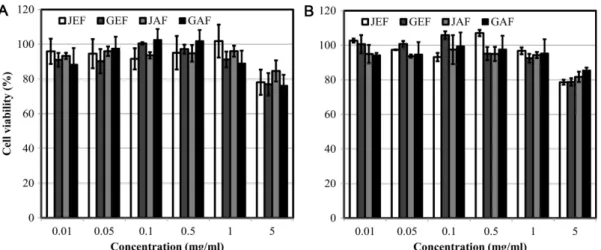
대추및포도발효물들이세포의증식에미치는영향에대해알아보기하여
0.01-
5 mg/ml
으로48
시간동안처리한결과발효물모두1 mg/
ml
에서는90%
이상의세포생존율을나타내었으며, 5 mg/
ml
에서는발효물모두세포독성을나타내었다(Fig. 1).
이와 같은결과로NO
측정과immunofluorecence
측정은1 mg/
ml
이하의농도에서실험하였다.
항산화 효과 측정 결과대추및포도발효물들의항산화효과를측정한결과를
Table 2
와같이나타내었다.
먼저, DPPH anion scavenging activity (
전자공여능)
측정결과대추의알코올발효는5 mg/
ml
에서59%
를나타내어발효물중가장높은DPPH
소거능을나타내었으며
,
대추의초산발효의경우53%,
포도의알코올발효물은
37%,
포도의초산발효물은32%
의소거능을나타내어알코올발효물과초산발효물비교시알코올발 효물이높은
DPPH
소거능을나타내었다.
이는Hong
등[8]
의건대추의전자공여능측정결과
5 mg/ml
에서53.8%
의효 능을나타내어대추의초산발효물과유사한효과를나타내 었다.
또한, Krigaya [13]
와Yamaguchi [32]
의전자공여작 용이페놀산화합물과높은상관관계가있다는보고를참조 시발효과정에서포도의페놀산화합물이분해되는것으로Fig. 1. Cell viability of various fermentation poducts. (A) macrophage (RAW 264.7), (B) melanoma cell (B16F10), JEF : ethanol fermentation of jujube, GEF : ethanol fermentation of grape, JAF : acetic acid fermentation of jujube, GAF : acetic acid fer- mentation of grape. Result are means ± S.D. of triplicate data.
Table 2. Antioxidant activity of various fermentation products.
Samples (mg/ml)
Antioxidant activity (%) DPPH
scavenging activity
Superoxide anion radical
scavenging activity
ABTS scavenging
activity JEF 1 33.8 ± 1.2 36.9 ± 1.9 58.1 ± 4.9
5 58.7 ± 2.4 76.4 ± 0.8 95.6 ± 1.6 GEF 1 29.6 ± 4.1 19.5 ± 3.9 23.8 ± 1.6 5 36.9 ± 1.7 61.5 ± 2.2 60.7 ± 5.0 JAF 1 24.1 ± 1.5 41.6 ± 6.7 38.6 ± 2.8 5 53.2 ± 0.4 69.9 ± 2.8 73.7 ± 1.9 GAF 1 9.5 ± 1.2 21.3 ± 4.1 18.5 ± 1.5 5 32.1 ± 0.4 57.8 ± 3.9 55.5 ± 1.4 Vit. C 1 83.8 ± 0.2 85.6 ± 7.2 98.8 ± 2.8 5 86.9 ± 0.1 96.2 ± 5.2 100 ± 1.2 JEF: ethanol fermentation of jujube, GEF: ethanol fermenta- tion of grape, JAF: acetic acid fermentation of jujube, GAF:
acetic acid fermentation of grape, Vit. C: ascorbic acid.
Result are means ± S.D. of triplicate data.
사료되며
,
이를규명하기위한향후연구가필요하다고생각 된다.
두번째로, superoxide anion radical scavenging activity
측정결과는대추의알코올발효물이5 mg/ml
에서70%,
초산발효물이69%
로높은소거능을나타내었으며,
포도의알코올및초산발효물은각각
62%, 58%
의소거능을나타내어대추의알코올발효물이가장높은소거능을나타 내었다
.
이는Hong
등[8]
의미숙,
완숙,
건대추의열수및에 탄올추출물에대한xantnin oxidase
저해능을측정한결과모든추출물
5 mg/ml
에서대추및포도의발효물보다낮은저해능을나타내어발효물들이우수함을나타내었다
.
마지 막으로, ABTS
+· cation scavenging activity
는ABTS
와potassium persulfate
와의반응으로ABTS
+· radical
이생성 되면특유의색인청록색을띄게되는데,
시료를첨가함에 따라연한녹색으로decolorization
되는것을측정하는방법 이며, hydrogen donating antioxidant
와chain breaking antioxidant
모두를측정할수있다[30].
이러한ABTS
소거 능을 측정한 결과 포도의 알코올 및초산 발효물의경우5 mg/ml
에서61%, 56%
의ABTS
소거능을나타낸반면,
대추의 발효물중알코올 발효의경우
5 mg/ml
의농도에서vitamin C
에필적하는활성을나타내어발효물중가장높은소거능을나타내었다
.
미백효과 측정 결과
Melanin
생성은tyrosinase, tyrosinase related protein 1, tyrosinase related protein 2
와같은3
종의효소에의해 조절된다[11].
이러한효소들은세포내에서cyclic adenosine monophosphate / protein kinase A
경로를통해melanin
을합성한다
.
즉,
자외선에피부가노출되면피부의keratinocyte
가자극을받게 되어 α-melanocyte stimulating hormone, adrenocorticotropic hormone
등의신호전달물질을melanocyte
로분비하게되어세포내cyclic adenosine monophosphate
가증가하게되며, protein kinase A
를활성화시켜MITF
발 현을 증가시킨다[4, 27].
이렇게 발현이 증가된MITF
는tyrosinase, tyrosinase related protein 1, tyrosinase related protein 2
의생합성을촉진시켜melanin
이증가하게된다[26]. 3
종의효소중tyrosinase
는tyrosin
으로부터DOPA
와DOPA-quinone
을거쳐최종적으로흑갈색의melanin
색소생성에관여하는효소로자외선에의하여
melanocyte
의유사분열이일어나고이어서
melanocyte
가활성화된다[7].
활 성화 된melanocyte
에서는tyrosinase
합성이 촉진되고melanin
의생성이항지되어이를표피밖으로운반배출하게되어기미
,
주근깨와같은색소침착이일어나게된다.
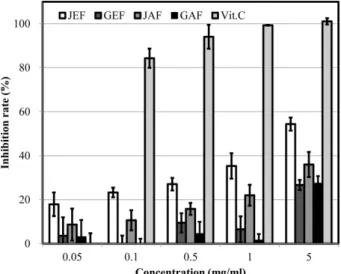
이Fig. 2. Tyrosinase inhibition rate of various fermentation products. JEF: ethanol fermentation of jujube, GEF: eth- anol fermentation of grape, JAF: acetic acid fermentation of jujube, GAF: acetic acid fermentation of grape, Vit. C:
ascorbic acid. Result are means ± S.D. of triplicate data.
Fig. 3. Reduced cellular expression of tyrosinase and
MITF using immunofluorescence assay. (A) control, (B) etha-
nol fermentation of jujube, (C) ethanol fermentation of grape, (D)
acetic acid fermentation of jujube, (E) acetic acid fermentation of
grape. B16F10 cells (1 × 10
6cells) were seeded in serum free
medium for 1 h at room temperature. The cells were treated with
1 mg/ml of various fermentation products for 48 h.
는따라서
tyrosinase
활성억제제는피부내에서의melanin
polymer
합성을효과적으로저해할수있어피부미백제의개발에있어서
tyrosinase
활성억제실험은유용한평가법으로인정되고있다
[9, 10].
대추및포도발효물들의tyrosinase
저해활성을측정한결과대추의알코올발효의경우5 mg/
ml
에서54%
의저해능을나타내어발효물중에서가장높은저해활성을나타내었으며
,
초산발효는5 mg/ml
에서36%
의tyrosinase
저해능을나타내었다.
포도의알코올및초산발효물은
5 mg/ml
에서각각26%
이상의저해능을나타내었다
(Fig. 2).
세포내에서의melanin
의합성기전및미백기전 의상관관계를알아보기위하여MITF
및tyrosinase
의발현 정도를면역형광염색법(immunofluorescence)
을실시한결 과Fig. 3
과같이나타내었다. MITF
발현은대추초산발효 물이대조군과비교시형광발현이줄어드는것을확인하였 으며, tyrosinase
단백질발현의경우대추및포도의발효물을
1 mg/ml
의농도로처리한결과대추와포도의초산발효물은대조군과비교시형광발현이줄어드는것을확인하 였다
.
또한,
포도의알코올발효물은형광발현이미미하게 줄어드는것을확인하였다.
이는tyrosinase
활성저해실 험과상반된효능을나타내어좀더정확한미백기전의규 명을위한실험이향후수행되어야할것이다.
항염증효과 측정 결과
NO
는NO
합성효소에의해L-arginie
으로부터생성되는 무기유리체로면역반응,
세포독성,
신경전달계및혈관이완등여러가지생물학적인과정에관여하는것으로알려져있 으며농도에따라세포기능유지에중요한작용을하기도하 고세포독성을일으키기도한다
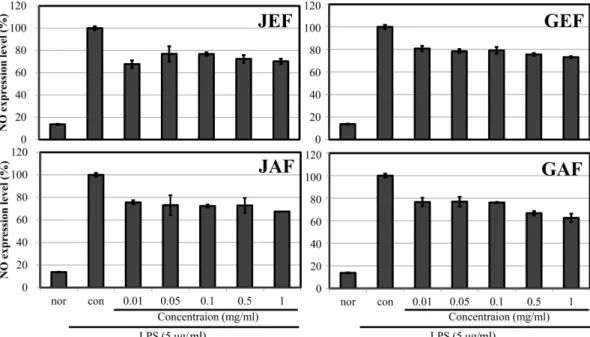
[16, 18]. RAW 264.7 cell
의NO
생성억제정도를측정하기위하여세포에10
µg/ml
의LPS
를처리후대추및포도의발효물을농도별로처리하여생성되는
NO
량을측정한결과Fig. 4
와같이나타내었다.
LPS
처리군은LPS
무처리군에비하여높은NO
발현양을나타내었으며
,
각발효물마다NO
발현을감소시키는것을 확인할수있었다.
즉,
포도의초산발효물의경우1 mg/ml
의농도에서37%
의NO
발현억제효과를나타내었으며,
대 추및포도알코올발효물의경우같은농도에서35%
에가 까운NO
발현억제효과를나타내었다.
이와같은상기의결과를종합해보면초산발효물보다알 코올발효물이우수한활성을나타내었으며
,
대추의알코올 발효물이항산화,
미백,
항염증및항균효과를보유하는것 으로확인되었다.
이러한결과는향후기능성식품및피부 미용소재로서의활용을위한근거자료로활용될수있을 것으로판단된다.
요 약
대추및포도를이용하여고부가가치성소재개발및특 화작물로서개발하기위하여이들을이용한알코올발효와 초산발효를한후발효물들의생리활성을검증하였다
.
항산 화활성을측정결과초산발효물보다알코올발효물이우수Fig. 4. Effects of various fermentation products on the production of nitric oxide in macrophage cell (RAW 264.7). nor: LPS not
induced group, con: LPS induced group, JEF: ethanol fermentation of jujube, GEF: ethanol fermentation of grape, JAF: acetic acid fer-
mentation of jujube, GAF: acetic acid fermentation of grape. Result are means ± S.D. of triplicate data.
한활성을나타내었으며
,
그중대추의알코올발효물이다 른발효물보다높은항산화활성을나타내었다.
미백효과측 정결과또한대추의알코올발효물이우수한효능을나타내 었으나, immunofluorecence
를이용한미백효과측정결과대 추의초산발효물이미백에관련된단백질발현을저해하는 것으로나타내었다.
대추및포도의발효물들은대식세포에 서lipopolysaccharide
에의해생성된nitric oxide
를농도의 존적으로감소시켰으며,
알코올발효물이초산발효물보다 우수한효능을나타내었다.
발효물들의항균력을측정한결 과포도의초산발효물이Propionibacterium acnes
를제외 한모든균주에항균력을나타내었으며, Escherichia coli
에 대해서는포도의알코올발효물과대추의알코올발효물이 높은항균력을나타내었다.
References