천문동 추출물의 호흡기 세균에 대한 항균활성 및 항산화
정민기1, 김수인1, 정해진1, 이충렬2, 손홍주1, 황대연1, 이희섭1, 김동섭1*
1부산대학교식품공학과
2
(
주)
강림오가닉Received: November 13, 2015 / Revised: December 9, 2015 / Accepted: December 10, 2015
서 론
세계보건기구는 매년 대기오염으로 인하여 사망자가
140
만−600
만명에이를것으로추정하며이수치는매년발생하는사망자의약
5%
에달하는수치라고밝혔다[31].
대기오염물질중미세먼지가인체에미치는영향이가장큰
것으로알려져있으며
[28]
호흡기,
심혈관계질환발생은미세먼지의노출과관련이있다고보고되고있다
[8, 15, 26].
미 세먼지의흡입은상·
하부기도의염증반응을유발하고활성 산소와산화스트레스가증가되어바이러스나세균감염에취약하게만든다
.
이로인해천식,
기관지염,
만성폐쇄성질환등의호흡기질환이발생한다
[28].
우리나라는도시화,
산업화
,
중국발미세먼지등으로인해전국각도시의미세먼 지농도가꾸준히증가하고있으며이로인해국민들의건 강이위협받고있다[28].
통계청의‘
사망원인통계’
에따르면10
대사인중만성하기도질환,
폐렴이포함되어있으며폐 렴으로인한사망원인순위가2004
년10
위에서2014
년5
위까지 상승하였고 사망률 또한2004
년7.1%, 2013
년21.4%, 2014
년에는23.7%
로꾸준히증가하고있다고보고 하였다[29].
한편
,
천문동(Asparagus cochinchinensis)
은백합과에속 하는다년생초본식물로우리나라남부해안지방에서많이 자라며한방에서는뿌리를약재로사용하며천문,
지동,
만 년송의이명이있다[12].
천문동의맛은달고쓰며자음(
滋陰), Antimicrobial Activity against Respiratory Bacteria by Asparagus Cochinchinensis Extracts and its Antioxidant
Capacity
Min-Gi Jung
1, Su-In Kim
1, Hae-Jin Jeong
1, Chung-Yeol Lee
2, Hong-Joo Son
1, Dae-Youn Hwang
1, Hee-sup Lee
1, and Dong-Seob Kim
1*
1
Department of Food Science & Technology, Pusan National University, Miryang 627-706, Republic of Korea
2
Kanglim Organic Co., Ltd., Miryang 627-881, Republic of Korea
This study was aimed at determining the antioxidant and antimicrobial effects of solvent extracts from Asparagus cochinchinensis.
The Asparagus cochinchinensis was extracted with water, methanol, ethanol, n-hexane, dichloromethane, ethyl acetate, and ether. The antimicrobial activity of these extracts was determined by modified well diffusion methods against 4 species of respi- ratory disease bacteria (Staphylococcus aureus, Escherichia coli, Staphylococcus epidermidis, and Pseudomonas aerugi- nosa). In addition, the amount of total polyphenol and flavonoid content, and antioxidant activity was evaluated. Ethyl acetate extract of A. cochinchinensis exhibited higher antimicrobial activity against tested microorganisms than water, methanol, etha- nol, n-hexane, dichloromethane, and ether extracts. For antioxidant activity, the ethyl acetate extract of A. cochinchinensis exhibited a notable effect on the scavenging of superoxide against DPPH (IC
50= 3.81 mg/ml). Finally, the total polyphenol and flavonoid contents were 14 ± 0.7 mg/g, and 0.50 ± 0.13 mg/g, respectively. These results can be regarded as basic research into A. cochinchinensis for the prevention of respiratory diseases. The results indicate that A. cochinchinensis may be utilized as a nutraceutical for respiratory diseases when the physiologically active substances of A. cochinchinensis are increased by further study.
Keywords: Antimicrobial acitivity, respiratory disease, antioxidant activity, Asparagus cochinchinensis, Pseudomonas aeruginosa, well diffusion methods
*Corresponding author
Tel: +82-55-350-5359, Fax: +82-55-350-5359 E-mail: [email protected]
© 2015, The Korean Society for Microbiology and Biotechnology
윤조
(
潤燥),
생진(
生津),
청폐(
淸肺),
진해,
거담등에효능이 있다고알려져있으며[7] asparagine, steroidal saponin,
β- sitosterol
등의기능성성분을함유하고있다[4].
이러한천 문동은민간에서천식,
호흡기질환등에효능이있다고알려 져있으나이에대한과학적이고체계적인연구는거의전 무한실정이다.
한편항산화물질은생체대사과정중에생성되는각종 활성산소종에의한산화반응을억제하여여러질환들을예 방해주는생리활성물질이다
.
생체대사과정중에산소의불 완전한환원으로superoxide radical
등의활성산소가생성 되어산화적스트레스를유발한다.
이들이증가시폐손상등 임상적으로중요한독성을일으킬수있다는보고[10, 11]
가 있으며증가된산화물이여러형태로폐질환발생에관여한 다는보고가있다[18].
따라서본연구에서는천문동의호흡기질환의효능을알 아보기위해서추출용매를각각달리한천문동추출물로만 성 부비동염과 관련된 균주
Staphylococcus epidermidis [24]
와병원내감염폐렴에서발견되어지는Escherichia coli
[13],
만성폐쇄성질환 세균성 감염 균주인Pseudomonas
aeruginosa[30]
그리고Staphylococcus aureus[9, 22]
의호 흡기질환관련세균성균주에대한항균활성및항산화를 살펴보았다.
재료 및 방법
재료
전라북도고창군고창읍에있는고창천문농원에서재배 된
17
년산천문동의뿌리를동결건조(FD5510S-FD5520S, Ilshinbiobase Co., Dongducheon, Korea)
하여 분쇄기(MF- 3100S, Hanil Electric Co., Seoul, Korea)
로50 mesh
이하 로균질화하여재료로사용하였다.
사용균주 및 배지
추출물의항균력실험에사용된균주는한국미생물보존센 터
(KCCM)
에서 분양받았다.
그람양성균으로는S. aureus KCCM 40881, S. epidermidis KCCM 35494
와 그람음성균E. coli KCCM 11234, P. aeruginosa KCCM 11328
사용하 였다.
미생물의배양에사용된배지는모두Dicfco(San Jose,
CA, USA)
제품을사용하였으며세균의배양및항균력측정에는
Tripticase Soy Broth(TSB, Dicfo)
와Muller Hinton broth(MHA, Dicfo)
를각각사용하였다.
추출물 제조
용매로는물
,
메탄올(MeOH),
에탄올(EtOH),
노르말헥산(n-hexane),
에틸아세테이트(EtOAc),
에테르(Ether)
를사용하였다
.
에탄올와메탄올추출은각각60
oC, 70
oC
에서환류 냉각하여24
시간3
회추출하였으며노르말헥산,
에틸아세 테이트추출은시료50 g
에각각의용매500 ml
을진탕항온 수조(SHWB-30/45, Woori science Instrument Co., Pocheon, Korea)
에50
oC
에서110 rpm
으로24
시간3
회반복추출하였 다. Ether
추출은시료50 g
에에테르500 ml
을상온에서190 rpm
진탕(VS-202D, Vision scientific, Daejeon, Korea)
하 여24
시간3
회추출하였다.
추출된시료들은모두농축시키 고일정량을농도로희석한후실험에사용하였다.
물추출물은천문동
75 g
에증류수500 ml
을넣고추출기(Dongnam Co., Daejeon, Korea)
를이용하여121
oC
에서45
분 간이행하였다.
여과지(Whatsman No. 2)
를사용하여감압 여과후여과액을동결건조하여사용했으며,
용매극성에따 라헥산,
디클로로메탄,
에틸아세테이트,
부탄올순으로분 획하여농축시킨후실험에사용하였다.
항균력 측정
천문동추출물의항균활성검사를위하여
well diffusion
methods
법[20]
을변형하여실험하였다.
각균주들은37
oC
에서TSB
액체배지에2
회계대배양하였으며UV-spetrophotometer (Optizen POP, Mecasys Co., Ltd., Daejeon, Korea)
를 이 용하여O.D.
650nm= 0.4
농도로일정하게조정한후항균실 험에사용하였다.
일정한농도로조정한균을MHA
배지에(0.8% agar) 1%
접종 후 균일하게 섞은 후petri dish
에20 ml
분주하였다.
실온에서응고시킨후pateur pipette
을 이용하여직경6 mm well
을만들어각각의추출물70
μl
를 주입하였고negative control
로는각각의추출용매를주입하 였다. 37
oC
배양기에서일정시간배양후well
주위의생장 저해환직경(mm)
을측정하였다.
최소저해농도 측정
항균활성이 나타난 추출물의 최소저해농도
(minimum inhibitory concentration, MIC)
을측정하기위해항균력측정과동일한방법으로실행하여생장저해환이
8 mm
이상을나타내것을최소저해농도로정하였다
[3, 17, 33].
DPPH radical 소거활성
천문동추출물의항산화효과는
Sanchez-Moreno C[25]
의 방법으로측정하였다. 0.1 mM DPPH 1 ml
와농도별추출 물1 ml
를가하여잘섞고, 30
분간암실에서방치한다음517 nm
에서흡광도를측정하였다.
이때추출물대신메탄올을 가하여대조구로하였고시료와흡광도의차이를백분율로하여
radical
소거능을나타내었으며,
직선회귀식을구한후50%
소거능을나타내는시료농도를IC
50으로결과를나타내었다
.
양성대조구로는L-ascorbic acid
를사용하여활성을비교하였다
.
Radical-scavenging activity(%) = [(ADPPH-AExtr) / ADPPH]
×
100A
DPPH: Control absorbance at 517 nm
A
Extr: Sample absorbance at 517 nm
총 폴리페놀 및 플라보노이드 함량 측정
추출물의폴리페놀함량은
Folin-Denis
법[1]
에의해측정 하였다.
추출물을농도별로제조한후,
농도별추출물0.2 ml,
증류수1.8 ml, Folin-Ciocaltue's phenol
시약0.2 ml
을섞 은후3
분간반응시켰다.
반응시킨용액을0.4 ml Na
2CO
3포 화용액과증류수1.4 ml
을첨가하고1
시간동안암실에서반응후
725 nm
에서흡광도를측정하였다.
폴리페놀화합물은 표준물질
tannic acid(TA, Sigma Co., St. Louis, Mo, USA)
를0, 25, 50, 100, 250, 500
μg/ml
농도로조정한 후 흡광도를측정하여작성한표준곡선으로부터총폴리페놀 함량을구하였다.
플라보노이드의함량은
Nieva Moreno
법[21]
을변형하여 측정하였다.
각 농도별 추출액0.1 ml
에80% ethanol
을0.4 ml
을 혼합한 후10% aluminum nitrate 0.1 ml, 1 M potassium acetate 0.1 ml, 80% ethanol 4.3 ml
을첨가하였 다.
혼합액은상온에서40
분간반응시킨후415 nm
에서흡 광도를측정하였다.
플라보노이드함량의표준곡선은quercetin (Sigma Co.)
을0, 25, 50, 100, 250, 500
μg/ml
농도로조정 한후흡광도를측정하여작성하였다.
결과 및 고찰
천문동 추출물의 항균활성
추출용매를달리한천문동뿌리추출물로
4
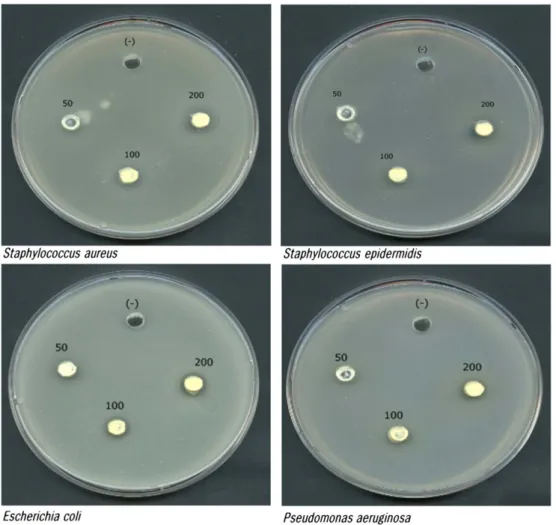
종의호흡기세 균에대한항균활성을확인하였다(Table 1).
추출물을25, 50, 100, 200 mg/ml
농도로항균활성을살펴본결과물,
메탄올,
에탄올,
헥산,
에테르추출물과물추출물의분획물에서는항균활성을확인할수없었으나에틸아세테이트추출물에서
S. aureus
는8.1 mm, P. aeruginosa 9.3 mm, E. coli 8 mm, S.
epidermidis 8 mm
로4
종의호흡기세균모두항균활성이나 타났다(Fig. 1).
β-sitosterol
은 β-sitosterol glucoside
와함께anti-tumor, anti-microbial, immunomodulatory activities
등에 서활성을나타낸다고보고[34]
가있으며에틸아세테이트의추출물의β
-sitosterol
과같은물질이호흡기세균에서항균활성을나타내는것으로사료된다
.
최소저해농도(MIC) 측정항균활성을나타낸에틸아세테이트추출물의최소저해농 도
(MIC)
를측정한결과는Table 2
에나타내었다. S. aureus
와E. coli
는100 mg/ml, S. epidermidis
는75 mg/ml, P.
aeruginosa
는25 mg/ml
에서각각최소저해농도(MIC)
로측 정되어P. aeruginosa
에대한항균활성이가장높게나타냈 다..
같은백합과에속하며천문동과효능이비슷하다고알 려진 맥문동의경우,
맥문동 물추출물에서S. aureus, E.
coli,
메탄올,
에탄올추출물에서S. aureus
과메탄올추출물 의P. aeruginosa, S. aureus
에대해항균활성이 나타나지 않았다는연구결과[5, 16, 23]
미루어볼때4
종의호흡기세 균에대한항균력이미약하거나없는것으로판단된다.
이 는본실험에서천문동의물,
메탄올,
에탄올추출물에서항 균활성이나타나지않았다는결과와일치하나맥문동의다 른용매추출물에대한보고가없어정확한비교를할수없 었다.
한편
Yuk[34]
등은lactose-
β-sitosterol
과 β-sitosterol
이ovalbumin
으로유도된폐렴에효과가있다고보고하고있다
.
또한,
β-sitosterol
은폐의조직병리학에서기도염증으로 부터세포를보호하는작용과알레르기성천식에대한치료 가능성을가진물질이라고알려져있다[19].
이와같은선행 연구로부터천문동에포함되어있는생리활성물질은호흡기 질환에영향을줄수있을것이라예측되며향후가공·
발효 등의연구를통하여생리활성물질을더높인다면건강기능Table 1. Antimicrobial activity of Asparagus cochinchinensis extracts against respiratory microbial.
Strains Inhibition zone (mm)
Water Methanol Ethanol n-hexane Ethyl acetate Ether
S.aureus - - - - +++ -
E.coli - - - - +++ -
S.epidermidis - + + - +++ -
P.aeruginosa - ++ + - +++ -
The data represent the mean ± SD of triplicate experiments
-; not detected, +; 0.6 −0.7 mm, ++; 0.7−0.8 mm, +++; 0.8−0.9 mm
Concentration of 200 mg/ml
식품소재로서가능성이있을것으로사료된다
.
총 폴리페놀 및 플라보노이드 함량식물계에존재하는플라보노이드등의페놀류들은
phenolic
hydroxyl
그룹때문에라디칼들과쉽게공명하고거대분자들과쉽게결합하며
,
항산화및항균등여러가지생리활성을가진다
[5, 6].
본실험에서천문동에틸아세테이트추출물의총폴리페놀및플라보노이드함량을측정한결과각각
14
±0.7, 0.50
±0.13 mg/g
을나타났다.
맥문동뿌리의경우 플라보노이드함량은메탄올추출물3.31 mg/g,
물추출물 은2.36 mg/g,
폴리페놀함량은메탄올추출물7.09 mg/g,
물 추출물3.90 mg/g
라고보고[27]
되어폴리페놀의경우맥문Table 2. Minimum inhibitory concentrations (MIC) of the ethyl acetate extract of from Asparagus cochinchinensis against micro- organisms.
Strains Inhibition zone (mm) MIC
(mg/ml) 6.25 mg/ml 12.5 mg/ml 25 mg/ml 50 mg/ml 75 mg/ml 100 mg/ml
S. aureus - - - ++ ++ +++ 100
E. coli - - - ++ ++ +++ 100
S. epidermidis - - - - +++ +++ 75
P. aeruginosa - - +++ +++ +++ +++ 25
The data represent the mean ± SD of triplicate experiments -; not detected, +; 0.6 −0.7 mm, ++; 0.7−0.8 mm, +++; 0.8−0.9 mm
Fig. 1. Antimicrobial activity of ethyl acetate extract of Asparagus cochinchinensis by using well diffusion methods. Concentra-
tion of the 50, 100, and 200 mg/ml.
동의물추출물보다는
3.5
배,
에탄올추출물보다는약2
배높은함량을나타냈으나플라보노이드같은경우에는낮 은함량을나타났다.
DPPH radical 소거활성에 의한 항산화 활성
항균활성을나타낸에틸아세테이트추출물의항산화활 성을알아보기위해
L-ascorbic acid
를양성대조구로하고추 출물과DPPH radical
소거활성을측정한결과추출물의1
−10 mg/ml
농도에서32.5
−88% radical
소거활성을나타내어 농도가 높을수록 높은 소거활성을 나타내었다. IC
50은Radical
을50%
소거하는 농도를 말하는 것으로써, L-
ascorbic acid
와에틸아세테이트추출물의IC
50은각각0.17, 3.83 mg/ml
를나타내어대조구의4.4
×10
-2배정도의효능 을나타내었다. Bae
등[2]
은볶음처리하지않은맥문동뿌 리물추출물1 mg/ml
과60
μM DPPH
를1:1
반응시켰을때 약10%
의소거능을나타냈으며190
oC
로볶음처리한맥문 동뿌리추출물1 mg/ml
에서50%
의소거능을보였으며,
또 한Seo [21]
는맥문동뿌리의물,
메탄올추출물1 mg/ml
농 도에서시료와0.2 mM DPPH
와2:1
반응시켰을때각각약12.78. 28%
의소거활성을보였다고기술하였다.
요 약
본연구에서는민간에서호흡기질환에효능이있다고알 려진천문동뿌리를재료로하고추출물을각각달리하여호 흡기세균에대한항균작용및항산화를살펴보았다
.
여러 가지추출용매중에틸아세테이트추출물에서만호흡기세 균에 대한 항균활성이 나타났으며 최소저해농도(MIC)
는S. aureus
와E. coli
는100 mg/ml, S. epidermidis
는75 mg/
ml, P. aeruginosa
는25 mg/ml
로각각측정되어P. aeruginosa
에대한항균활성이가장높았다.
항균활성을나타낸에틸 아세테이트 추출물의 항산화 활성을 알아보기 위해L- ascorbic acid
를대조구로하여DPPH radical
소거활성을측 정한결과는IC
50은각각0.17, 3.83 mg/ml
로나타났다.
또 한총폴리페놀및플라보노이드함량은측정한결과각각14
±0.7, 0.50
±0.13 mg/g
을나타내었다.
본연구는천문동 연구의초석으로서향후에생리활성효과를증진시킬수있 는연구가더진행된다면건강기능식품소재로서가능성이 있다고생각된다.
Acknowledgments
This research was supported by the Korea Institute of Planning and Evaluation for Technology in Food, Agriculture, Forestry and Fisheries (No. 114034-03).
References
1. Amerinem MA, Ough CS. 1958. Method for Analysis of Musts and Win. Wiley & Sons. 176−180.
2. Bae KM, Park SH, Jung KH, Kim MJ, Hong SH, Song YO, et al. 2010. Effects of roasting conditions on physicochemical properties and sensory properties of Liriopis tuber. Prev. Nutr.
Food Sci. 39: 1503-1508.
3. Choe S-B, Kang S-T 2014. Investigation of antimicrobial activ- ity and stability of Orixa japonica Thunb. leaf extract. Korean J. Food Sci. Technol. 46: 39−43.
4. Choi O-J. 1991. Component and the use of herbs. Ilwolbooks p.672.
5. Choi SY, Kim SY, Hur JM, Choi HG, Sung NJ. 2006. Antioxi- dant activity of solvent extracts from Sargassum thunbergii.
Prev. Nutr. Food Sci. 35: 139−144.
6. Chung JK, Lee JC, Ha DR. 2014. Antimicrobial activities of sword bean (Canavalia gladiata) extracts against food poison- ing bacteria. J. Fd Hyg. Safety 29: 376−382.
7. Cooperation teaching materials compilation committee of ori- ental medicine college in Korea. 2005. Herbal medicine.
Younglimsa Press. Seoul, Korea. pp.647−648.
8. Dockery DW, Pope CA. 1994. Acute respiratory effects of par- ticulate air pollution. Annu. Rev. Pub. Health. 15: 107−132.
9. Doh ES. 2010. Antibacterial activity of medicinal plant extracts to S. aureus KCCM12256 and V. parahaemolyticus KCCM11965.
J. East Asian Soc. Dietary Life. 20: 881−887.
10. Freeman BA, Crapo JD. 1982. Biology of disease: free radi- cals and tissue injury. Lab. Invest. 47: 412.
11. Freeman BA, Topolosky MK, Crapo JD. 1982. Hyperoxia increases oxygen radical production in rat lung homogenates.
Arch. Biochem. Biophys. 216: 477−484.
12. Hwang D-Y. 1978. Bangyakapyeon. Namsandang, pp.178, 205.
13. Igusa R, Narumi S, Murakami K, Kitawaki Y, Tamii T, Kato M, et al. 2012. Escherichia coli pneumonia in combination with fungal sinusitis and meningitis in a tsunami survivor after the Great East Japan Earthquake. Tohoku J. Exp. Med. 227: 179−
184.
14. Joo SK, Koo SW, Kim M, Cho YH, Cha ST, Hong GY, et al.
2009. Bacterial etiology in hospitalized patients with acute exacerbations of chronic obstructive pulmonary disease.
Korean J. Med. 77: 309−314.
15. Katsouyanni K, Touloumi G, Spix C, Schwartz J, Balducci F, Medina S, et al. 1997. Short term effects of ambient sulphur dioxide and particulate matter on mortality in 12 European cit- ies: results from time series data from the APHEA project.
Bmj. 314: 1658.
16. Lee SK, Park JH, Kim YT. 2009. A study on the antioxidation and antimicrobial effect. Prev. Nutr. Food Sci. 22: 279−285.
17. Lee SO, Lee HJ, Yu MH, Im HG, Lee IS. 2005. Total polyphe- nol contents and antioxidant activities of methanol extracts from vegetables produced in Ullung island. Korean J. Food
Sci. Technol. 37: 233−240.
18. Lee SI. 1997. The level of antioxidant enzymes in red blood cells of patients with chronic obstructive pulmonary disease.
Tuberc Respir Dis. 44: 104−113.
19. Mahajan SG, Mehta AA. 2011. Suppression of ovalbumin- induced Th2-driven airway inflammation by β-sitosterol in a guinea pig model of asthma. Eur. J. Pharmacol. 650: 458−
464.
20. Nathan P, Law EJ, Murphy DF, MacMillan BC. 1978. A labora- tory method for selection of topical antimicrobial agents to treat infected burn wounds. Burns 4: 177−187.
21. Nieva Moreno MI, Isla MI, Sampietro AR, Vattuone MA. 2000.
Comparison of the free radical-scavenging activity of propolis from several regions of Argentina. J. Ethnopharmacol. 71:
109−114.
22. Pandak N, Pajić-Penavić I, Sekelj A, Tomić-Paradžik M, Čab- raja I, Miklaušić B. 2011. Bacterial colonization or infection in chronic sinusitis. Wien. Klin. Wochenschr. 123: 710−713.
23. Ryu YH, Kim DG, Yeon KI, Huh CS, Ryu JA, Jo WS, et al.
2015. Screening for inhibition activity of plant extracts on microorganism contaminating in cosmetics. Korean J. Med.
Crop. Sci. 23: 57−76.
24. Sachse F, Von Eiff C, Becker K, Steinhoff M, Rudack C. 2008.
Proinflammatory impact of Staphylococcus epidermidis on the nasal epithelium quantified by IL-8 and GRO-α responses in primary human nasal epithelial cells. Int. Arch. Allergy Immunol.
145: 24−32.
25. Sanchez-Moreno C. 2002. Methods used to evaluate the free
radical scavenging activity in foods and biological systems.
Food Sci. Technol. Int. 8: 121−137.
26. Schwartz J. 1994. What are people dying of on high air pollu- tion days?. Environ. Res. 64: 26−35.
27. Seo SJ, Kim NW. 2010. Physiological activities of leaf and root extracts from Liriope platyphylla. Korean J. Food Preserv.
17: 123−130.
28. Shin DC. 2007. Health effects of ambient particulate matter. J.
Korean Med. Assoc. 50: 175−182.
29. Statistics Korea. 2014. statistics of death cause. http://kostat.
go.kr. Accessed Sep. 23, 2015.
30. Valderrey AD, Pozuelo MJ, Jiménez PA, Maciá MD, Oliver A, Rotger R. 2010. Chronic colonization by Pseudomonas aeru- ginosa of patients with obstructive lung diseases: cystic fibro- sis, bronchiectasis, and chronic obstructive pulmonary disease. Diagn. Microbiol. Infect. Dis. 68: 20−27.
31. WHO (World Health Organization). Air Pollution including WHO's 1999 Guidelines for Air Pollution Control. Geneva, Switzerland.
32. Woo J, Lee JS, Kwon KH, Kim KH, Choi CH, Park C, et al.
1995. Etiologies of bacterial pneumonia with implications for therapy. Tuberc Respir Dis. (Seoul). 42: 67−75.
33. Yoo MY, Jung YJ, Yang JY. 2005. Antimicrobial activity of herb extracts. Prev. Nutr. Food Sci. 34: 1130−1135.
34. Yuk JE, Woo JS, Yun CY, Lee JS, Kim JH, Song GY, et al.
2007. Effects of lactose-β-sitosterol and β-sitosterol on oval- bumin-induced lung inflammation in actively sensitized mice.
Int. Immunopharmacol. 12: 1517−1527.