• 검색 결과가 없습니다.

Isolation of Lactic Acid Bacteria with Anti-MRSA Bacteriocin Activity and Characterization of the Bacteriocin Product

N/A
N/A
Protected

Academic year: 2021

Share "Isolation of Lactic Acid Bacteria with Anti-MRSA Bacteriocin Activity and Characterization of the Bacteriocin Product"

Copied!
7
0
0

로드 중.... (전체 텍스트 보기)

전체 글

(1)

Isolation of Lactic Acid Bacteria with Anti-MRSA Bacteriocin Activity and Characterization of the Bacteriocin Product

Byeong-Ki Ahn

1

, Kyung-Cheol Min

2

, Sang-Hyun Cho

2

, Dong-Geun Lee

2

, Andre Kim

2

, and Sang-Hyeon Lee

1,2

*

1

Department of Green-Chemistry Convergence Engineering, Graduate School, Silla University, Busan 46958, Republic of Korea

2

Department of Pharmaceutical Engineering, College of Medical and Life Sciences, Silla University, Busan 46958, Republic of Korea

Received: December 29, 2020 / Revised: January 6, 2021 / Accepted: January 14, 2021

Introduction

Staphylococcus aureus is a Gram-positive spherical bacterium that is commonly found on the skin and in the noses of healthy people. S. aureus is the bacterium that most commonly causes skin disease and food poisoning [1]. However, as a result of the abuse and overuse of antibiotics to treat diseases caused by S. aureus, a bacterium resistant to an entire group of antibiotics, including methicillin, has appeared; this bacterium is

known as methicillin resistant S. aureus (MRSA) [1, 2].

When MRSA was first reported, it seemed unlikely to become widespread; however, now it has spread all over the world [1, 2]. MRSA is difficult to treat because of general antibiotic resistance as well as due to the fact that it spreads easily between patients within a medical institution. MRSA has been discovered as a form of com- munity infection in adults and children [1, 3]. Research on the development of therapeutic agents for MRSA has mainly focused on the development of new antimicrobial substances and the combined administration of existing antimicrobial agents; however, this has not yet been suc- cessful. Therefore, it can be said that there is an urgent need to develop an antibacterial substance with antimi- This study aimed at isolating lactic acid bacteria with anti-MRSA (methicillin-resistant Staphylococcus aureus) bacteriocin activity from fermented shrimp. We selected three strains, named Weissella sp. S1, S2, and S3, using analysis based on 16S rRNA gene sequences. All strains showed appropriate growth in an MRS medium containing 5% (w/v) NaCl and showed antibacterial activities against Bacillus cereus, Escherichia coli, Staphylococcus aureus, and MRSA. The strains exhibited similar growth rates at 0-5%

NaCl, with approximate reduction in growth rate observed at 9% NaCl. Weissella sp. S1, S2, and S3 exhibited maximum growth rates at pH 7, 9, and 8, respectively. The crude bacteriocin was prepared from Weissella sp. S3 and subjected to characterization. The remaining activities after 30 min of exposure at each tempera- ture were 100%, beyond 75%, and 49% at 4 ℃ and 37℃, 50℃ and 70℃, and 100℃, respectively. The remaining activities after 24 h of exposure at each pH were 100%, 75%, and 49% at pH 3 and 5, 7 and 9, and 10, respec- tively. Use of 50% (v/v) ethanol or isopropanol treatment did not diminish the antibacterial activity of the bacteriocin, while the 50% (v/v) hexane treatment reduced the activity by 51%. The molecular weight of the bacteriocin was nearly 6 kDa that was quantified using tricine-SDS-PAGE. Our findings suggest that Weissella sp. S3 may be considered a probiotic and useful source of antimicrobial substances in the devel- opment of bio-preservatives for food or in MRSA treatment.

Keywords: Antibacterial activity, bacteriocin, fermented shrimp, MRSA, Weissella sp.

*Corresponding author

Tel: +82-51-999-5624, Fax: +82-51-999-5628

E-mail: [email protected]

(2)

crobial activity against MRSA.

Bacteriocins are antibacterial peptides/proteins that kill the closely related bacteria or inhibit the growth of closely related bacteria. Antibiotics are usually second- ary metabolite and can be administered to humans and accumulate in the body [4], causing side effects. Bacte- riocins are primary metabolite and cause no bioaccumu- lation. Heat stability and safety are essential to the use of bacteriocins as food preservation agents. Bacteriocins do not form tertiary structures and have a low molecular weight [5, 6], making them stable to heat [7]. As bacte- riocins are natural proteins, they are easily decomposed by proteinases after ingestion, hence they could be safe [8, 9].

Many lactic acid bacteria, which are known to have antibacterial activity against pathogenic bacteria, pro- duce bacteriocins [10] and could be a member of probiot- ics. Koreans have traditionally fermented salted fish [12]; lactic acid bacteria can easily be found in such fer- mented seafood [11]. Lactic acid bacteria exhibit various functions such as stabilization of intestinal microbial flora, hyperplasia syndrome, lactose intolerance, remis- sion of non-specific immune specifications and vitamin production [13].

Therefore, it is worth screening for bacteriocin-producing lactic acid bacteria that can be probiotics, and is useful in the development of a safe bio-preservative or MRSA therapeutics. In this study, we isolated three lactic acid bacteria showing antimicrobial activity against MRSA from Korean traditional fermented seafood and the bac- teriocin of one prominent strain was purified and char- acterized.

Materials and Methods

Isolation and identification of lactic acid bacteria

To isolate lactic acid bacteria with antimicrobial activity against MRSA, 10 g of fermented shrimp were added to 10 ml of 1.0% (w/v) peptone-added, sterilized distilled water, suspended well, and then cultured in de Man, Rogosa and Sharpe (MRS) (Difco, USA) agar plates containing 5% (w/v) NaCl, 0.1% (w/v) nystatin (Merck, USA) and 0.1% (w/v) polymyxin B (Duchefa, Netherlands) at 30 ℃ for one day. Genomic DNAs were purified from isolated and cultured cells using a Wizard Genomic DNA Isolation Kit (Promega, USA). The 16S rRNA gene

of isolates was amplified using 27F (5'-AGA GTT TGA TCM TGG CTC AG-3') and 1492R (5'-TAC GGH TAC CTT GTT ACG ACT T-3'), and sequenced for identifica- tion with the GenBank database using the BLAST pro- gram (http://www.ncbi.nlm.nih.gov/).

Growth characterization of lactic acid bacteria

In order to determine the optimal pH level and NaCl concentration for the growth of the isolated lactic acid bacteria, S1, S2 and S3 strains were cultured in 100 ml of an MRS broth medium (Difco) at various pH levels or at various NaCl concentrations. The pH levels of the media were adjusted with 1 N HCl or 1 N NaOH. After overnight culture, optical densities of strains S1, S2 and S3 were measured using a spectrophotometer (Model:

X-ma 3000, Human Corporation, Korea) at 600 nm.

Antibacterial activities of the isolated lactic acid bacteria The antibacterial activities of strains S1, S2 and S3 against MRSA, S. aureus, Bacillus cereus and Escherichia coli were confirmed by the paper disc method. All four strains were grown at 37 ℃ in 4 ml of tryptic soy (TS) broth media (Difco). After overnight culture, each strain was smeared on TS agar plates, and paper discs (6 mm) were placed on the plates, and then 10 µl of over- night-cultured broths of strains S1, S2 and S3 in 4 ml of an MRS broth media containing 5% (w/v) NaCl were added onto the discs. Ampicillin (10 mg/ml) and kanamycin (30 mg/ml) were used for positive controls and an MRS broth medium containing 5% (w/v) NaCl was used for a negative control.

Preparation and characterization of the bacteriocin In order to prepare the bacteriocin sample produced by Weissella sp. S3 that showed the strongest antibacterial activity against MRSA, strain S3 was cultured in 200 ml of an MRS broth medium at 30 ℃ and 250 rpm for 24 h.

Centrifugation of the culture fluid at 3,000 ×g and 4 ℃ for 15 min was performed to recover the supernatant.

Six hundred ml of acetone was added to 200 ml of cul- ture supernatant, cooled to 4 ℃, and then left at -20℃ for 24 h. Precipitated proteins were collected by centrifuga- tion at 3,000 ×g and 4 ℃ for 15 min, and then lyophilized.

The lyophilized sample was dissolved in an MRS broth medium and used.

To investigate the stabilities of the bacteriocin sample

(3)

produced by Weissella sp. S3 against heat treatments, the antibacterial activities of the solutions heat-treated for 30 min at 20°, 40°, 60°, 80° and 100 ℃ were measured by the disc diffusion method against MRSA and compared with no treatment.

To figure out the stabilities of the bacteriocin sample produced by Weissella sp. S3 against pH changes, the bacteriocin solutions were mixed with the same amounts of buffer solutions at pH 3 −5 (20 mM sodium acetate), pH 7 (20 mM Tris-HCl), and pH 9 −11 (20 mM GTA).

After being placed at room temperature for 24 h, anti- bacterial activities were measured by the disc diffu- sion method against MRSA and compared with no treatment.

To determine the stabilities of the bacteriocin sample produced by Weissella sp. S3 against organic solvent treatments, the bacteriocin solutions were mixed with the same amounts of organic solvents, such as acetone, chloroform, hexane, ethanol, isopropanol, and methanol.

After being placed at 30 ℃ for one hour, antibacterial activities were measured by the disc diffusion method against MRSA and compared with no treatment.

Tricine SDS-PAGE was performed according to Schägger's method [14] to estimate the molecular weight of the bacteriocin produced by Weissella sp. S3.

The bacteriocin solution was mixed with the same vol- ume of a tricine sample buffer and then heated at 80 ℃ for three minutes. Electrophoresis was performed in 10%

(w/v) polyacrylamide gel. After the electrophoresis was completed, the gel was stained for one hour using a Gel- Code Blue Stain Reagent (Thermo Scientific, USA). A

Dokdo-Mark Protein Size Marker (ELPIS Biotech, Korea) was used for the protein size marker.

Results and Discussion

Isolation and identification of lactic acid bacteria

Initially, many salted or Korean traditional fermented foods were used to screen for the antibacterial activity of lactic acid bacteria; however, only fermented shrimp harbored those bacteria in this study. Many bacterial colonies were obtained from the fermented shrimp on MRS agar plates containing 5% (w/v) NaCl, 0.1% (w/v) nystatin and 0.1% (w/v) polymyxin B. Nystatin is an antifungal agent and polymyxin B is an antibacterial agent against Gram-negative bacteria. So, we could selectively cultivate Gram-positive bacteria, including lactic acid bacteria, from the fermented shrimp using a selective medium. Since the culture plates contained 5%

(w/v) NaCl, we can also selectively cultivate halophilic or halotolerant bacteria from the fermented shrimp.

Finally, three strains were selected after measuring their antibacterial activity against MRSA. The 16S rRNA gene of strains S1, S2, and S3 were amplified by PCR and about 1.5 kb fragments were sequenced.

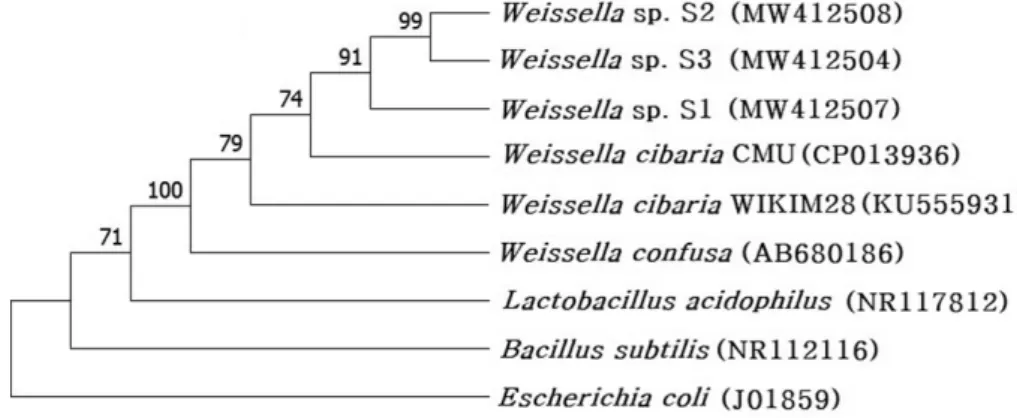
BLAST was used to search for the sequencing results of 16S rRNA gene of strains S1, S2 and S3 and all three strains were found to be most similar to Weissella cibaria with 97% similarity or higher. Therefore, the isolated strains were named as Weissella sp. S1, S2, and S3. Phylogenetic trees are shown in Fig. 1. Weissella cibaria CMU strain has been commercially used as oral

Fig. 1. Neighbor-Joining phylogenetic tree based on almost complete 16S rRNA gene sequences comparing isolated lactic

acid bacteria S1, S2 and S3 with other bacteria. The numbers at the branch nodes are percentages of bootstrap values (n = 1,000)

and numbers in parenthesis are accession numbers in GenBank.

(4)

care probiotics [15], hence the isolated Weissella strains could have the potential to become a probiotic.

Growth characterization of lactic acid bacteria

Each of Weissella sp. S1, S2, and S3 grew well between pH 5 and pH 9 (Fig. 2). Rather low growth was shown at pH 4, 10, and 11. Weissella sp. S1, S2 and S3 showed optimal growths at pH 7, 9 and 8, respectively. None of the three bacteria was able to grow at pH 3. At pH 10 and 11, Weissella sp. S3 showed lower growth rates than those of Weissella sp. S1 and S2. These results were the same as the results of the previous study of lactic acid bacteria from kimchi showing highest growth at pH 7 and no growth at pH 3 [12].

All three Weissella sp. grew well at 5% (w/v) NaCl (Fig.

3). Moderate growth inhibitions were shown in all three Weissella sp. at 7% (w/v) NaCl and strong growth inhibi- tions were shown at 9% (w/v) NaCl. No growth was exhibited at 11% (w/v) NaCl. These data suggest that

Weissella sp. S1, S2 and S3 can be regarded as halotoler- ant bacteria [12] as bacteriocins producing Pediococcus pentosaceus [7].

Antibacterial activities of Weissella sp. strains against sev- eral bacterial strains

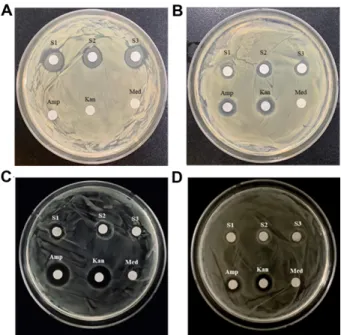
It is known that lactic acid bacteria inhibit the growth of pathogenic bacteria by producing lactic acid, bacterio- cin, and hydrogen peroxide [12, 13, 16 −18]. The antibac- terial activities of Weissella sp. S1, S2, and S3 against pathogenic bacteria are shown in Fig. 4. Weissella sp. S1, S2, and S3 showed 4.0, 3.5, and 6.5 mm of antibacterial activities against MRSA, respectively. Weissella sp. S1, S2, and S3 showed 2.0, 3.0, and 3.5 mm of antibacterial activities against S. aureus, respectively (Fig. 4B).

Weissella sp. S1, S2, and S3 showed 2.0, 1.0 and 2.0 mm of antibacterial activities against B. cereus, respectively (Fig. 4C). Weissella sp. S1, S2, and S3 showed 0.5, 0.5, and 0.5 mm of antibacterial activities against E. coli, respectively (Fig. 4D). Namely each of the three Weissella strains showed antibacterial activity to Gram-positive and Gram-negative bacteria, and more actively inhibited the Gram-positive bacteria. Ampicillin (10 mg/ml) and kanamycin (30 mg/ml) each exhibited 4.0 mm of clear

Fig. 2. Effects of pHs on growths of Weissella sp. S1 (

), S2 (

) and S3 (

).

Fig. 3. Effects of NaCl concentrations on growths of Weissella sp. S1 (

), S2 (

) and S3 (

).

Fig. 4. Antibacterial activities of Weissella sp. S1, S2 and S3 against pathogenic bacteria. (A) MRSA, (B) S. aureus, (C) B.

cereus, (D) E. coli. (Amp: ampicillin 10 mg/ml, Kan: kanamycin

30 mg/ml, Med: an MRS broth medium containing 5% (w/v)

NaCl).

(5)

zones against S. aureus (Fig. 4B), but showed no clear zones against MRSA (Fig. 4A). Nonetheless, each of Weissella sp. S1, S2, and S3 showed antibacterial activi- ties against MRSA, and Weissella sp. S3 exhibited the strongest antimicrobial activity (6.5 mm of the clear zone) (Fig. 4A). Therefore, in this study, the bacteriocin produced by Weissella sp. S3 was prepared for and used in further experiments.

Preparation and characterization of the bacteriocin The antimicrobial activities of the bacteriocin pro- duced by Weissella sp. S3 after heat treatment against MRSA are shown in Table 1. No dramatic decrease in antimicrobial activity was shown after heat treatments of the bacteriocin at all temperatures tested (Table 1). A heat-treated sample at 100 ℃ exhibited the lowest anti- microbial activity, but still showed antimicrobial activity (49%) (Table 1). Many antibiotics are sensitive to heat, but the bacteriocin produced by Weissella sp. S3 is stable to heat. In general, it is known that bacteriocins have a low molecular weight and thus show high stability against heat treatment [19]. It has been reported that the bacteriocin produced by Lactococcus lactis YH-10 exhibits remaining antibacterial activity of about 50%

when heat treated at 100 ℃ for 60 min [20].

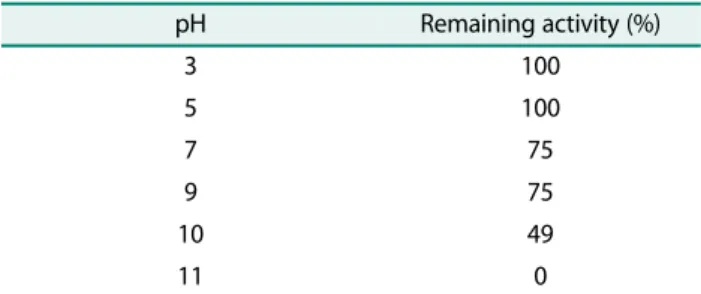
The antimicrobial activities against MRSA of the bac- teriocin produced by Weissella sp. S3 after exposure at various pH levels are shown in Table 2. No dramatic decrease of antimicrobial activity was shown after changes to the pH level of the bacteriocin from pH 3 to 10 (Table 2). This result is similar to that of the bacterio- cin Weissellin A produced by Weissella paramesenteroi- des DX [21]. However, no antimicrobial activity was observed in the sample at pH 11. It has been reported that nucleophiles such as hydroxide ions, deprotonated amines and deprotonated hydroxyl groups react with

dehydro residues at high pH to form cross-linkages between molecules or cause chemical transformation [7].

These data indicate that the bacteriocin produced by Weissella sp. S3 is stable at a relatively wide range of pH levels.

The antimicrobial activities against MRSA of the bacteriocin produced by Weissella sp. S3 after organic solvent treatments are shown in Table 3. The antibacte- rial activity of bacteriocin was not diminished after treatment with ethanol or isopropanol, while hexane treatment dropped by 51% (Table 3). The bacteriocin produced by Lactococcus sp. KD 28 [22], Pediococcus pentosaceus KC-007 [7] does not show any decrease in activity in organic solvents, but the bacteriocin produced by Weissella sp. S3 decreases slightly in hexane, so it is necessary to be careful with hexane when future research and the development of therapeutic agents is conducted. However, it has been confirmed that ethanol and isopropanol do not affect bacteriocin stability.

Tricine SDS-PAGE electrophoresis was performed to determine the molecular weight of the bacteriocin produced by Weissella sp. S3. The bacteriocin exhibited a single band with a molecular weight of about 6 kDa (Fig.

5). The molecular weights of bacteriocins produced by

Table 1. Effects of the bacteriocin produced by Weissella sp. S3 against heat treatments on antimicrobial activities against with MRSA.

Heat treatment ( ℃ ) Remaining activity (%)

4 100

37 100

50 75

70 75

100 49

Table 2. Effects of the bacteriocin produced by Weissella sp. S3 against pH changes on antimicrobial activities against MRSA.

pH Remaining activity (%)

3 100

5 100

7 75

9 75

10 49

11 0

Table 3. Effects of the bacteriocin produced by Weissella sp. S3 on the against organic solvent treatments on antimi- crobial activities against MRSA.

Organic solvent Remaining activity (%)

Acetone 75

Chloroform 75

Ethanol 100

Hexane 49

Isopropanol 100

Methanol 75

(6)

Weissella sp. varied, with the molecular weight of a bac- teriocin of Weissella sp. being 6 kDa for W. cibaria KMITL-QU21 [23], 62 kDa for W. hellenica D1501 [24], 2.7 kDa for W. confusa A3 [25], and 4.5 kDa for W.

paramesenteroides DX [21]. The Weissella sp. S3 strain showed the most similar rRNA sequence to that of W.

cibaria and the molecular weight of the bacteriocin of Weissella sp. S3 was 6 kDa, the same as that of W.

cibaria KMITL-QU21 [23]. However, the bacteriocin of Weissella sp. S3 showed antibacterial activity against E. coli while W. cibaria KMITL-QU21 did not. Hence, Weissella sp. S3 would be a novel strain and its antibac- terial activity could be used as a biopreservative etc.

We isolated three lactic acid bacteria, which possess antibacterial activity against MRSA (Methicillin Resis- tant S. aureus), from Korean traditional fermented shrimp. The isolated strains were identified as Weissella sp. S1, S2 and S3 by 16S rRNA gene sequencing. All strains showed antibacterial activities against food- poisoning bacteria (Bacillus cereus, S. aureus), E. coli and MRSA. Their optimal pH for growth was pH 7.0, 9.0, and 8.0 for Weissella sp. S1, S2 and S3, respectively (Fig.

2). Their growth was similar at 0 −5% (w/v) NaCl and inversely proportional to 7 −11% (w/v) NaCl (Fig. 3).

Weissella sp. S3 showed the highest antibacterial activi- ties. The bacteriocin produced by Weissella sp. S3 was

prepared and characterized. Remaining antibacterial activities were measured after heat treatment and expo- sure to various pHs and organic solvents. Remaining antibacterial activities were 100% at 4 ℃ and 37℃, 75%

at 50 ℃ and 70℃, and 49% at 100℃ (Table 1). Remaining antibacterial activities were 100% at pH 3 and 5, 75% at pH 7 and 9, and 49% pH 10 (Table 2). Ethanol and iso- propanol did not decrease the antibacterial activity of bacteriocin while acetone, chloroform and methanol decreased 25% of antibacterial activity (Table 3). The molecular weight of the bacteriocin was about 6 kDa by tricine-SDS-PAGE (Fig. 5). These results suggest that Weissella sp. S3 could be a probiotic and its bacteriocin could be useful in the development of safe biopreserva- tives for food or the treatment of MRSA.

Acknowledgments

This work was supported by the BB21+ Project in 2020.

Conflict of Interest

The authors have no financial conflicts of interest to declare.

References

1. Miller LG, Remington FP, Rieg G, Mehdi S, Perlroth J, Bayer AS, et al. 2005. Necrotizing fasciitis caused by community-associated Methicillin-Resistant Staphylococcus aureus in Los Angeles. N.

Engl. J. Med. 352: 1445-1453.

2. Kim CH, Lee JY, Kim MK, Kim SH, Park GY, Bae SY, et al. 2012. Isola- tion rate of Methicillin-Resistant Staphylococcus aureus (MRSA) from nasal cavity inferior regions and cellular phones. Korean J.

Clin. Lab. Sci. 44: 118-123.

3. Voss A, Milatovic D, Wallrauch-Schwarz C, Rosdah VT, Braveny I.

1994. Methicillin-resistant Staphylococcus aureus in Europe. Eur. J.

Clin. Microbiol. Infect. Dis. 13: 50-55.

4. Falagas ME, Makris GC. 2009. Probiotic bacteria and biosurfac- tants for nosocomial infection control: a hypothesis. J. Hosp.

Infect. 71: 301-306.

5. Sankar NR, Priyanka VD, Reddy PS, Rajanikanth P, Kumar VK, Indira M. 2012. Purification and characterization of bacteriocin produced by Lactobacillus plantarum isolated from cow milk. Int.

J. Microbiol. Res. 3: 133-137.

6. Stykova E, Valocky I, Novotny F, Guba P. 2012. Probiotic proper- ties of vaginal lactic acid bacteria selected for harmonization of microenvironment of reproductive apparatus. J. Microbiol. Bio- technol. Food Sci. 2: 395-405.

7. Park GG, Gang JB, Park YS, Park YS. 2013. Characterization of bac- teriocin produced from Pediococcus pentosaceus KC-007 isolated Fig. 5. Tricine-SDS-PAGE analysis of the bacteriocin sample

produced by Weissella sp. S3. (size marker; lane M, the bacte-

riocin sample; lane B)

(7)

from onion. J. Food Eng. Prog. 17: 412-417.

8. Gudina EJ, Rocha V, Teixeira JA, Rodrigues LR. 2010. Antimicrobial and antiadhesive properties of a biosurfactant isolated from Lac- tobacillus paracasei ssp. Paracasei A20. Lett. Appl. Microbiol. 50:

419-424.

9. Sirinat S, Fujitoshi Y, Li-Hsiu L, Kuang-Nan H, Yi-sheng C. 2007.

Weissellicin 110, a newly discovered bacteriocin form Weissella cibaria 110, isolated from Plaa-Som, a fermented fish product form Thailand. Appl. Environ. Microbiol. 73: 2247-2250.

10. Fazeli MR, Toliyat T, Samadi N, Hajjaran S, Jamalifar H. 2006. Via- bility of Lactobacillus acidophilus in various vaginal tablet formu- lations. DARU J. Pharm. Sci. 14: 172-178.

11. Gaggia F, Gioia DD, Baffoni L, Biavati B. 2011. The role of protec- tive and probiotic cultures in food and feed and their impact in food safety. Trends Food Sci. Technol. 22: 58-66.

12. Park YJ. 2017. Isolation and characterization of kimchi lactic acid showing antibacterial activity. KJHE 26: 547-558.

13. Kang CH, Han SH, Kim YG, Jeong YL, Paek NS. 2017. Antibacterial activity and probiotic properties of lactic acid bacteria isolated from traditional fermented foods. KSBB J. 32: 199-205.

14. Schägger H. 2006. Tricine-SDS-PAGE. Nat. Protoc. 1: 16-22.

15. Kang MS, Lee DS, Lee SA. 2020. Effects of probiotic bacterium Weissella cibaria CMU on periodontal health and microbiota: a randomised, double-blind, placebo-controlled trial. BMC Oral Health 20: 243.

16. Ali OA. 2012. Inhibition of uropathogenic Citrobacter adhesion by biosurfactants extracted from vaginal Lactobacillus acidophilus.

J. Anb. Med. 10: 59-67.

17. Sophia E, Katalin D, Eva R, Carolina S, Ulrika J, Bo A, et al. 2010.

Lactic acid bacteria colonization and clinical outcome after pro- biotic supplementation in conventionally treated bacterial vagi-

nosis and vulvovaginal candidiasis. Microbes Infect. 12: 691-699.

18. Subramanyam D, Raju NDS, Wudayagiri R, Lokanatha V. 2014.

Antimicrobial activity of Lactobacillus against microbial flora of cervicovaginal infections. Asian. Pac. J. Trop. Dis. 4: 18-24.

19. Kawai Y, Sato T, Toba T, Samant SK, Itoh T. 1994. Isolation and characterization of a highly hydrophobic new bacteriocin (gas- sericin A) from Lactobacillus gasseri LA39. Biosci. Biotechnol. Biochem.

58: 1218-1221.

20. Choi EM, Kim YH, Park SJ, Kim YI, Ha YM, Kim SK. 2004. Character- ization of bacteriocin, lacticin YH-10, produced by Lactococcus lactis subsp. Lactis YH-10 isolated from Kimchi. J. Life Sci. 14: 683- 688.

21. Papagianni M, Papamichael EM. 2011. Purification, amino acid sequence and characterization of the class IIa bacteriocin Weissellin A, produced by Weissella paramesenteroides DX. Bioresour. Techol.

102: 6730-6734.

22. Lee JY, Choi NS, Chun SS, Moon JY, Kang DO. 2015. Purification and characterization of the bacteriocin produced by Lactococcus sp. KD 28 isolated from Kimchi. J. Life Sci. 25: 180-188.

23. Swetwiwathana A, Sawa N, Zendo T, Nakayama J, Sonomoto K.

2008. A newly discovered bacteriocin from Weissella cibaria KMITL-QU 21 associated in traditional thai fermented meat-rice sausage. Available from https://www.researchgate.net/profile/

Adisorn_Swetwiwathana. Accessed Dec. 12, 2020.

24. Chen C, Chen X, Jiang M, Rui X, Li W, Don M. 2014. A newly dis- covered bacteriocin from Weissella hellenica D1501 associated with Chinese Dong fermented meat (Nanx Wudl). Food Control 42: 116-124.

25. Goh HF, Philip K. 2015. Purification and characterization of bacte-

riocin produced by Weissllea confusa A3 of dairy origin. PLoS One

10: 1371.

수치

Fig. 1. Neighbor-Joining phylogenetic tree based on almost complete 16S rRNA gene sequences comparing isolated lactic acid bacteria S1, S2 and S3 with other bacteria
Fig. 3. Effects of NaCl concentrations on growths of  Weissella sp. S1 ( □ ), S2 ( ○ ) and S3 ( ● )
Table 1. Effects of the bacteriocin produced by  Weissella sp. S3 against heat treatments on antimicrobial activities against with MRSA.

참조

관련 문서

Spoilage potential of psychrotrophic lactic acid bacteria (LAB) species: Leuconostoc gelidum subsp. gasicomitatum and Lactococcus piscium , on sweet bell

In this study, we found that Pin1 plays a pivotal role in insulin- induced AP-1 activation through its interaction with p70S6K and prolongs activity of

This study derives the attributes of 'product design identity' from the consumer's point of view, and verified whether the 'product design identity'

The purpose and necessity of this study was to investigate the effects of lactic acid fatigue and body oxidation through myofascial relaxation exercise using small tools

In paragraph 2, this study defined the concept, meaning, and educational significance of art education using play activity, defined games in creativity

Probiotic properties of lactic acid bacteria isolated from mukeunji, a long-term ripened kimchi. Journal of Food

The object of this study is to analyse the bacteria of periapical bascess and fascial space abscess using multiplex real-time polymerase chain reaction (MRT-PCR) before

The obligate methanotrophic bacteria Methylococcus, Methylomonas, Methylosinus and related bacteria. Schleifer