INTRODUCTION
Cardiovascular disease (CVD) is the leading cause of death in the United States and other developed countries. Racial/ethnic minority groups in the U.S. have the highest prevalence of CVD risk factors and CVD mortality [1]. Elderly Korean immigrants (EKIs) are one of the fastest growing minority groups in the U.S. [2]. EKIs have a high preva- lence of CVD risk factors such as physical inactivity and depression [3-5].
Depression is particularly prevalent in this population, which is im- portant because depression accentuates the inflammatory responses such as serum high sensitivity C-reactive protein (hs-CRP) and fibrino-
gen, precipitating CVD events [6,7]. EKIs seem to have elevated stress due to socio-environmental changes (e.g., language barriers, changes in socioeconomic status, feelings of loneliness and a sense of not belong- ing) and social isolation from immigration, which appear to influence the high prevalence of depression in this minority population [4,8].
With increasing immigration and higher numbers of aging Korean immigrants, the prevalence of CVD is expected to increase among EKIs.
Regular physical activity has a significant influence on CVD risk factors [9-11]. A study reported that minority individuals tend to be less physi- cally active than the national recommendations suggest [12]. Walking is a commonly used exercise among Koreans and is accessible to most in-
Effect of a Randomized Controlled Trial Walking Program on Walking, Stress, Depressive Symptoms and
Cardiovascular Biomarkers in Elderly Korean Immigrants
Mo‒Kyung Sin
1, Brandon Ibarra
2, Thomas Tae
1, Patrick J.M. Murphy
31College of Nursing, Seattle University, Seattle, WA; 2Harborview Medical Center, Seattle, WA; 3College of Nursing, Interdisciplinary Life Sciences Research Laboratory, Seattle University, Seattle, WA, USA
Purpose: Despite well-known benefits of walking on cardiovascular health, no structured walking exercise program has been for-
mally tested on elderly Korean immigrants (EKIs). This pilot randomized controlled trial study assessed the effect of a walking pro- gram on walking behavior (pedometer steps count), stress (cortisol), depressive symptoms (CESD-10), and cardiovascular disease biomarkers (hs-CRP and fibrinogen) via venipuncture in EKIs. Methods: Seventy EKIs recruited from a Korean community were ran- domly assigned to a 12-week walking group or control group in a 3:2 ratio. The working program included a pedometer, buddy, monthly coffee card, weekly call for goal setting, and physical activity consultation. Walking group EKIs maintained the Centers for Disease Control and Prevention recommended exercise guidelines and good mental health status over 12 weeks. Results: There was no significant difference in the outcomes between control and walking groups. Conclusion: Social networking with Koreans in the senior center and church from a well-established Korean community might have positive effects on mental health.
Key Words: Depression; Older adults; Serum biomarkers; Stress; Walking
Corresponding author: Mo-Kyung Sin
College of Nursing, Seattle University, 901 12th Ave P.O. Box 222000, Seattle, WA 98122-1090, USA Tel: +1-206-296-5667 Fax: +1-206-296-5544 E-mail: [email protected]
* This study was supported by Seattle University College of Nursing Sinegal Faculty Development grant.
Received: April 22, 2015 Revised: May 12, 2015 Accepted: May 12, 2015
This is an Open Access article distributed under the terms of the Creative Commons Attribution Non-Commercial License (http://creativecommons.org/licenses/by-nc/3.0) which permits unrestricted non-commercial use, distribution, and reproduction in any medium, provided the original work is properly cited.
dividuals with little risk of injury [3]. Regular walking is associated with lower levels of hemostatic and inflammatory markers [13,14]. Despite its proven benefits, physical activity is uncommon among EKIs which is surprising because walking is part of daily life in Korea [4,15]. However, after immigration, EKIs typically become sedentary because automo- biles replace walking for the majority of daily activities. Immigration-ac- quired sedentary western lifestyle is one important and treatable factor contributing to the high prevalence of CVD risk factors among EKIs [5].
According to the Theory of Reasoned Action, written and verbal messages about the benefits of walking and its effect on health outcomes have beneficial influence on one’s attitude toward walking and subjec- tive perception on the behavior [16]. The Theory of Reasoned Action and other research findings have confirmed a link between social sup- port and positive health outcomes [16-18]. Adults with larger social sup- port systems had higher levels of self-esteem and exercise behavior than those with lower social support [19]. Pedometers have been found to be effective instruments to promote physical activity [20-22]. We imple- mented a culturally-appropriate program (use of culturally-appropriate exercise: walking, walking with a buddy, pedometer recording, physical activity education and counseling by a Korean) to promote cardiovascu- lar health among EKIs. Despite well-known benefits of walking to im- prove cardiovascular health, no structured walking exercise program has been formally tested in EKIs. The purpose of this pilot study was to assess the effect of a walking program on walking behavior (steps count), stress (cortisol) and depressive symptoms as well as CVD biomarkers (hs-CRP, fibrinogen). We hypothesized that the walking exercise pro- gram would result in (a) increased steps count, (b) decreased stress (cor- tisol) level, (c) decreased depressive symptoms (Center for Epidemiologi- cal Studies Depression Scale-10 [CESD-10]) and (d) decreased CVD bio- markers (serum hs-CRP, fibrinogen).
METHODS
1. Sample and data collection
In this pilot randomized controlled walking intervention study, a sample of 70 EKIs were recruited from locations that are likely to have a substantial percentage of EKIs such as a Korean senior center and a Ko- rean church via assistance of the senior center and Korean church key personnel. Korean senior centers, which are Korean communities for el- ders, provide elders with a Congregate Meal Program and a place for so-
cial gathering twice per week. Korean churches also play an important role for social networking. Inclusion criteria for subjects include: (1) age
≥60 years old, (2) capacity to ambulate independently (do not use other’
s assistance or walking assistance devices when walking), (3) having somebody to walk with as a buddy when assigned in an experimental group. People with chronic disease or disability that may limit their physical activity level, taking immunosuppressants or blood thinners such as Heparin, Coumadin, Lovenox and Plavix, and having severe needle phobia and/or a known bleeding disorder were excluded from this study.
Data collection was done at the Korean senior center and a Korean church and the investigator met with key personnel prior to the study.
The key personnel announced the study and asked interested people to come forward or contact via email or call later for participation. Recruit- ment was also done via word of mouth from the signed participant to his (her) friend. Data were collected from June, 2011 to September, 2011 by the research team. When we reached the target number of voluntary participants (70), we stopped recruitment. This study was approved by a University Human Subjects Review Committee. Informed consent in the Korean language was obtained from each participant and partici- pants were randomly allocated into an experimental and a control group in a 3:2 ratio. Considering the well-known benefits of walking, partici- pants were divided into a 3:2 ratio to benefit more participants from walking.
2. Exercise intervention
Each participant in the experimental group was given a pedometer with a handout on the benefits of physical activity to positively influence their attitudes and perceptions toward walking behavior and was in- structed to wear the pedometer from morning to bedtime. Instructions on how to use a pedometer, goal setting (10,000 steps per day), and walk- ing with a buddy were given. Use of a buddy system addressed the issue of social isolation previously identified in EKIs. The research team gave a bi-weekly call to experimental group regarding goal setting for steps and daily step recording on a log as a reminder. A coupon for coffee/tea with buddy ($6) was mailed out monthly to each participant in the ex- perimental group. The walking program lasted for 12 weeks.
People in the control group were asked to walk on their own from
baseline to 12 weeks after giving instructions on the benefits of physical
activity. All outcome data were collected before and after 12-weeks of
walking in both groups.
3. Instruments
Instruments used to collect data in this study included demographic questionnaire, daily step log, Center for Epidemiological Studies De- pression Scale-10 (CESD-10), blood samples for stress hormone (cortisol) and cardiovascular biomarkers (serum high sensitivity c-reactive protein [hs-CRP], fibrinogen). Demographic characteristics of the participants were assessed with commonly used self-reported questions (i.e., age, gender, education, marital status, health status).
4. Daily step log
Walking was measured with daily steps count on a pedometer (Ac- cusplit AE120). The Accusplit AE 120 pedometer has been shown to be a valid and reliable step count measure [21,23]. Participants in an exer- cise group were instructed to wear the pedometer snugly to the body and to keep it upright in a vertical plane, perpendicular to the ground to accurately assess physical activity from waking up to before going to bed. They were asked to record the number of steps taken each day on a provided calendar.
5. Center for Epidemiological Studies Depression Scale-10 (CESD-10)
Depression was measured with the 10-item CESD-10 [24]. The CESD- 10 showed good predictive validity when compared to the full-length 20-item version of the CESD (kappa=.97, p<.001) [25]. The Korean ver- sion of CESD-10, which showed good reliability with Cronbach alpha of 0.80, was used in a self-report format in this study [26]. The CESD-10 has four possible responses in a Likert format, where “0” is “rarely or none of the time (<1 day)”, and “3” is “almost or all of the time (5-7 days)”. Scores range from 0 to 30 with higher scores reflecting greater levels of depressive symptoms. A cut point of 10 or higher was consid- ered having depressive symptoms [25]. The CESD-10 has four separate factors: depressive affect, somatic symptoms, positive affect, and inter- personal relations [27].
6. Blood samples: serum biomarkers
Blood samples from all participants were collected in sodium citrate Vacutainers (Becton Dickinson) and immediately refrigerated. Serum was separated from whole blood by centrifugation, flash frozen, and
stored at -70°C within 4 hours of collection. Commercially available en- zyme linked immunosorbent assay (ELISA) kits were used to measure serum concentrations of C-reactive protein (CRP), fibrinogen, and cor- tisol. CRP and fibrinogen were measured using two-antibody sandwich ELISAs from GenWay (San Diego, CA). Cortisol was assayed using a competition ELISA from Enzo Life Sciences (Plymouth Meeting, PA).
Reagent and microtiter plate preparations were completed according to manufacturers’ instructions included in the respective kits. For CRP, se- rum samples were diluted 1:100 prior to analysis. Assays were completed in duplicate or triplicate, normalized to total serum protein concentra- tion by Bradford analysis, and reported as serum average±SEM.
7. Data analysis
The IBM Statistical Package for Social Sciences version 19 (SPSS, Chi- cago, IL) was used for data analysis. Descriptive statistics were performed to assess demographic characteristics of the participants and steps count.
Paired t-tests were used to assess within-group differences on steps count, stress, depressive symptoms, and CVD biomarkers from baseline to 12 weeks of walking exercise program. Independent t-tests were used to assess between group differences of stress, depressive symptoms and CVD biomarkers at baseline and end of 12 weeks of walking program.
In terms of steps counted, further analysis was done dividing the mean scores of the total 12 weeks steps into two groups (<7,000 steps/day, ≥ 7,000 steps/day) based on the Tudor-Locke et al. [28]’s guidelines (7,000 to 10,000 steps/day=30 minutes/day of moderate-to-vigorous physical activity).
RESULTS
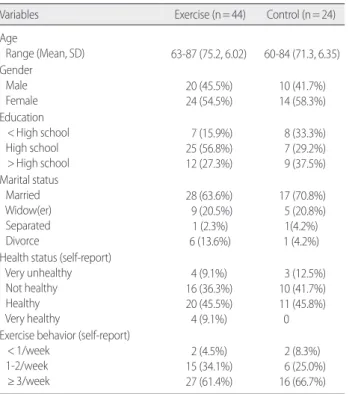
The dominant participants of both walking and control groups were female, married, and reported exercising ≥3/week in the past week prior to study. More EKIs in the walking exercise group reported to be healthy in general compared to those in control group (54.6% vs. 45.8%)(Table 1).
Two participants in walking exercise program dropped out: one had a health issue and the other did not want to commit to daily wearing of pedometer and recording of step counts.
1. Steps count
There was a significant difference in the steps count of walking group
from week 1 (Mean= 40,527, SD =20,948) to week 12 (Mean=53,731,
SD =20,369), supporting the hypothesis (a), increased steps count (t=- 4.24, p = <.01). Weekly mean steps were between 50,000 (7,143 steps/
day) to 60,000 (8,571 steps/day) steps for 10 weeks from week 2 to week 12 (Figure 1). When the mean scores of the total 12 weeks steps count (range: 20,345-85,370) were divided into two groups (≥7,000 steps vs
<7,000 steps), EKIs who had ≥7,000 steps/day (n=20, 52.6%) were younger in age (69.8 [2.19]), healthier (60% vs. 55.5%) and had fewer health burdens in their daily lives (41.2% vs. 35.3%) than those with
<7,000 steps/day (n=18 [47.4%]).
2. Stress (cortisol) and depressive symptoms (CESD-10)
There were no significant differences in mean scores of cortisol and depressive symptoms from baseline to end of week 12 in both walking group and control group and thus hypotheses (b) and (c) were not sup- ported. There were no significant differences in between-group com- parisons of both cortisol and depressive symptoms at baseline and 12 week (Table 2). Mean stress and depressive symptom scores were in a normal range in both walking and control groups.
70,000 60,000 50,000 40,000 30,000 20,000 10,000 0
Steps
Week
1 2 3 4 5 6 7 8 9 10 11 12
Figure 1. Steps count of a walking group.
Table 1. Demographic Characteristics of Elderly Korean Immigrants (n= 68)
Variables Exercise (n= 44) Control (n= 24)
Age
Range (Mean, SD)
63-87 (75.2, 6.02)
60-84 (71.3, 6.35) Gender
Male Female
20 (45.5%) 24 (54.5%)
10 (41.7%) 14 (58.3%) Education
< High school High school > High school
7 (15.9%) 25 (56.8%) 12 (27.3%)
8 (33.3%) 7 (29.2%) 9 (37.5%) Marital status
Married Widow(er) Separated Divorce
28 (63.6%)
9 (20.5%) 1 (2.3%) 6 (13.6%)
17 (70.8%)
5 (20.8%) 1(4.2%) 1 (4.2%) Health status (self-report)
Very unhealthy Not healthy Healthy Very healthy
4 (9.1%) 16 (36.3%) 20 (45.5%) 4 (9.1%)
3 (12.5%) 10 (41.7%) 11 (45.8%)
0 Exercise behavior (self-report)
< 1/week 1-2/week ≥ 3/week
2 (4.5%) 15 (34.1%) 27 (61.4%)
2 (8.3%) 6 (25.0%) 16 (66.7%)
Table 2. Between- and Within-group Comparisons of Depressive Symptoms, Stress, and CVD Biomarkers (hs-CRP, fibrinogen)
Variables Walking mean (SD) Control mean (SD) Between-group (walking-control) comparison (t, p)
Depression (CESD-10) Baseline
12-week
8.65 (4.96) 7.84 (4.79)
8.32 (4.04) 7.90 (4.78)
(t= 0.27, p= .79) (t= -0.05, p= .96)
Within-group (baseline -12 week) comparison (t, p) (t= 1.06, p= .30) (t= 0.49, p= .63) -
Stress (cortisol) Baseline 12- week
3.53 (3.74) 3.94 (2.91)
4.90 (5.04) 3.86 (2.99)
(t= -1.22, p= .23) (t= 0.10, p= .92)
Within-group (baseline -12 week) comparison (t, p) (t= -0.34, p= .74) (t= 0.94, p= .36) -
hs-CRP Baseline 12-week
1.73 (1.82) 1.22 (1.19)
1.73 (3.43) 1.75 (3.03)
(t= < 0.01, p= .99) (t= -0.78, p= .44)
Within-group (baseline -12 week) comparison (t, p) (t= 2.09, p= .05) (t= -0.01, p= .99) -
Fibrinogen Baseline 12-week
325.85 (181.34) 367.85 (181.34)
215.50 (69.32) 196.05 (68.99)
(t= 0.34, p< .01) (t= 4.07, p< .01)
Within-group (baseline -12 week) comparison (t, p) (t= -0.70, p= .49) (t= 1.36, p= .19) -
CVD= Cardiovascular disease; hs-CRP= high sensitivity C-reactive protein; CESD-10= Center for Epidemiological Studies Depression Scale-10.
normal range of CESD: 0-9, cortisol: 3-15 mcg/dL, hs-CRP: 0.07-5.25mg/L, fibrinogen: 200-400 mg/dL.
3. CVD biomarkers (hs-CRP, fibrinogen)
There were no significant differences in mean scores of hs-CRP and fibrinogen from baseline to end of week 12, and thus hypothesis (d) was not supported. In between-group comparisons, both walking and con- trol groups had significantly different mean scores in fibrinogen at base- line and end of week 12 (both p<.01). However, there was no significant difference in between-group comparisons of hs-CRP (Table 2). Mean scores of CVD biomarkers were in a normal range in both walking and control groups.
DISCUSSION
The majority of EKIs in this study appeared to be in good health, which might have influenced the study outcomes in this study. More than 60% of EKIs in both walking and control groups reported to be ex- ercising ≥3/week prior to joining this walking exercise program.
1. Walking
The walking program seemed to have a significant effect on improv- ing walking behavior of walking group from week 1 to week 12. EKIs had a steady walking behavior in steps count from week 2 to week 12, reporting steps between 50,000-60,000 per week (7,143-8,571 steps/day).
The steps count is higher than other U.S. adult population age ≥18 (5,117 steps/day) [29,30]. According to the Centers for Disease Control and Prevention (CDC) guideline [29], older adults are recommended to have at least 2 hours and 30 minutes of moderate-intensity aerobic exer- cise every week and muscle-strengthening activities on two or more days a week. A review study indicates that 7,000 to 10,000 steps/day is equiva- lent to accumulating 30 minutes/day of moderate-to-vigorous physical activity in healthy older adults [28].
Unlike other study findings on physical inactivity in EKIs [3-5,15], many participants in this study were physically active. The steps count reveals that EKIs in this study meet the CDC recommendations of 2 hours and 30 minutes of moderate-intensity aerobic exercise every week.
Although many people responded to exercising more than ≥3 in the past week, this walking program seems to be well-accepted by EKIs. In fact, the two groups (exercising ≥3/week, <3/week in the past week) had no difference in the amount of walking.
Participants recruited from two Korean community sites as well as knowing who are in the walking groups seemed to have a synergistic ef-
fect by encouraging walking with each other after senior center meet- ings or church activities. This research supports the link between social support and positive health outcomes proposed by the Theory of Rea- soned Action and other researchers [16-18]. Long-term follow-up of walking behavior after the structured walking exercise might be consid- ered in future studies. More comprehensive baseline physical activity measurement including type of physical activity and duration besides frequency might be useful to see the intervention effect.
When the mean scores of the total 12 weeks steps count were divided into two groups, EKIs who had ≥7,000 steps/day (n=20, 52.6%, range:
7,196-12,196 steps/day) were younger in age (69.8 [2.19]) and healthier (60% vs. 55.5%) than those with <7,000 steps/day (n=18, 47.4%, range:
2,906-6,918 steps/day). Other researchers also reported a positive effect of feeling to be younger and better health status on physical activity [29,31]. Although a pedometer itself can be an intervention, no steps count in control group limits assessment of the intervention effect. Fu- ture studies might consider incorporating muscle strengthening exercise to walking and steps count in control group.
Major barriers encountered during walking intervention included the pedometer not working and health issues. Although studies reported good reliability of the pedometer [21,23], five people in this study report- ed a mal-functioning pedometer. Health status was another major bar- rier for walking. Some EKIs had to slow down the pace of walking be- cause of knee joint pain, shingles and general sickness. Although the majority of participants reported to be healthy in general, aging itself seemed to make them vulnerable for health issues.
2. Stress and depressive symptoms
Although the walking program had no reported effect on monitored
stress level or depressive symptoms in this study, these were not signifi-
cant issues in the participating EKIs. Unlike other findings of high prev-
alence of depression in EKIs in previous studies by the corresponding
author and other researchers [4,8,32], the mean scores of both stress and
depressive symptoms were within normal range. EKIs in this study were
regular participants of a Korean senior center and a Korean catholic
church (Silver College for seniors), and so were functionally independent
and motivated. The Korean senior center has a meal program twice a
week and Korean elders can enjoy several fun activities such as chess, ta-
ble tennis, Karaoke, dancing, and education sessions in Korean along
with a lunch with other Korean seniors. The Silver College is the church’
s program for seniors to get life-long education through several diverse classes, for example, dancing, calligraphy, singing, health education, painting and English conversation. Those who obtained certain credits will graduate with a certificate given by a pastor of the church.
It is well known that depression is prevalent in people with loneliness and social isolation [5,33]. Depression was highly prevalent in EKIs be- cause of social isolation from language barriers and loneliness [4,32]. So- cial networking with Koreans in the Senior Center and church from a well-established Korean community might have positive effects on men- tal health, as supported by serum cortisol level. Researchers reported that people with a positive affect and optimism had lower cortisol levels in the awaking period [34,35]. Those who are regular participants of the organization with regular exercise may not have as much stress or have been able to relieve experienced stress through networking and exercise.
According to the successful aging theory [36], social engagement and regular physical activity are important components of a successful aging process.
3. CVD biomarkers
Like stress and depressive symptoms outcomes, serum hs-CRP and fibrinogen were not significant issues in this study. Although walking had no significant effect on decreasing CVD biomarkers, EKIs in this study had a normal range of CVD biomarkers from the beginning. Fi- brinogen level was statistically different in both walking and control groups at baseline and end of week 12 but that was not clinically signifi- cant. This study supports other study findings on the positive relation- ships between depression and elevated hs-CRP and fibrinogen levels [6, 7]. Social isolation and loneliness were positively associated with hs-CRP and fibrinogen levels in older adults [37]. Since depression was not a sig- nificant issue, CVD biomarkers were not significant. Studies indicated active social engagement as a consistent predictor of low CVD risk fac- tors such as hs-CRP and fibrinogen levels and decreased CVD mortality risk in older adults [38,39]. In a longitudinal study of a 5,925 cohort of people ages from 52-74 years from British towns followed - up for 13.7 years (1992-2006), social engagement had a protective effect on CVD mortality independent of known cardiovascular risk factors, disease, disability, and socioeconomic conditions [39].
Regular physical activity decreases CVD risk by mediating anti-in- flammatory effects [40,41]. For example, in the Third National Health and Nutrition Examination Survey with 3,638 apparently healthy people
age ≥40, people with more frequent physical activity had a lower odds of having an elevated C-reactive protein and fibrinogen level [40]. The ma- jority of findings are based on Caucasian populations and this study is a good supplement for the findings in EKIs.
Although several studies indicated that CVD risk factors are highly prevalent in EKIs [3-5,15], participants in this study had relatively good mental, physical activity behavior, and CVD biomarkers. Regular physi- cal activity and active social engagement seem to have significant influ- ence on depressive symptoms and CVD risk factors in EKIs, like in oth- er study findings [9,11]. However, caution needs to be taken when inter- preting the current study findings because of the limitations in study methodology such as convenient sampling, no comparison of steps measures in control group, and inaccurate pedometer.
CONCLUSION
Regular physical activity and active social engagement seems to be critical for mental and cardiovascular health, which are major compo- nents of successful aging and also important components for public health nurses to encourage and educate older adults. Although some participants were well aware of the benefits of exercise, as well as partici- pating in some exercise prior to joining this exercise program, they seemed to have benefited from this structured walking program. Over- all, this walking program was well-accepted by EKIs. For example, EKIs maintained the CDC recommended walking guideline from week 2 to the end of the intervention. Some participants asked the investigator to lead a walking group after the program ended, and those who did not participate this time asked to open another program next year. Future studies might consider incorporating long-term follow-up, strength ex- ercise, step measures in control group, and expansion of selection sites.
REFERENCES
1. Liao Y, Bang D, Cosgrove S, Dulin R, Harris Z, Stewart A, et al. Surveillance of health status in minority communities - racial and ethnic approaches to com- munity health across the U.S. (REACH U.S.) Risk factor survey, United States, 2009. Morbidity and Mortality Weekly Report. Surveillance Summaries.
2011;60(6):1-44.
2. U.S. Census. Place of birth of the foreign-born population; 2009 [cited 2015 Mar 14]. Available from: http://www.census.gov/prod/2010pubs/acsbr09-15.
pdf.
3. Sin MK, Choe MA, Kim J, Chae YR, Jeon MY, Vezeau T. Comparison of body
composition, handgrip strength, functional capacity, and physical activity in el- derly Koreans and Korean immigrants. Research in Gerontological Nursing.
2009;2(1):20-29.
4. Sin MK, Choe MA, Kim J, Chae YR, Jeon MY. Depressive symptoms in com- munity-dwelling elderly Korean immigrants and elderly Koreans: cross-cultur- al comparison. Research in Gerontological Nursing. 2010;3(4):262-269.
5. Sin MK, Chae YR, Murphy P, Kim J, Jeon MY. Perceived health, life satisfaction, and cardiovascular risk factors among elderly Korean immigrants and elderly Koreans. Journal of Gerontological Nursing. 2011;37(3):43-52.
6. Brummett BH, Boyle SH, Ortel TL, Becker RC, Siegler IC, Williams RB. Asso- ciations of depressive symptoms, trait hostility, and gender with C-reactive pro- tein and interleukin-6 response after emotion recall. Psychosomatic Medicine.
2010;72(4):333-339.
7. Ranjit N, Diez-Roux AV, Shea S, Cushman M, Seeman T, Jackson SA, et al.
Psychosocial factors and inflammation in the multi-ethnic study of atheroscle- rosis. Archives of Internal Medicine. 2007;167(2):174-181.
8. Sin MK. A qualitative analysis of stress and coping in Korean immigrant wom- en in middle-age and older-adulthood. Issues in Mental Health Nursing.
2015;36(1):52-59.
9. Ofori SN, Kotseva K. Comparison of treatment outcomes in patients with and without diabetes mellitus attending multidisciplinary cardiovascular preven- tion programme (a retrospective analysis of the EUROACTION trial). BMC Cardiovascular Disorders. 2015;15(1):11.
10. Roussel M, Garnier S, Lemoine S, Gaubert I, Charbonnier L, Auneau G, et al.
Influence of a walking program on the metabolic risk profile of obese post- menopausal women. Menopause. 2009;16(3):566-575.
11. Sisson SB, Camhi SM, Church TS, Tudor-Locke C, Johnson WD, Katzmarzyk PT. Accelerometer-determined steps/day and metabolic syndrome. American Journal of Preventive Medicine. 2010;38(6):575-582.
12. Hofstetter CR, Irvin V, Schmitz K, Hovell MF, Nichols J, Kim HR, et al. De- mography of exercise among Californians of Korean descent: a cross-sectional telephone survey. Journal of Immigrant and Minority Health. 2008;10(1):53- 65.
13. Peterson MJ, Morey MC, Giuliani C, Pieper CF, Evenson KR, Mercer V, et al.
Health ABC Study. Walking in old age and development of metabolic syn- drome: the health, aging, and body composition study. Metabolic Syndrome and Related Disorders. 2010;8(4):317-322.
14. Underwood M, Eldridge S, Lamb S, Potter R, Sheehan B, Slowther AM, et al.
The OPERA trial: protocol for a randomised trial of an exercise intervention for older people in residential and nursing accommodation. Trials. 2011;12:27.
15. Choi J, Wilbur J, Kim MJ. Patterns of leisure time and non-leisure time physical activity of Korean immigrant women. Health Care for Women International.
2011;32(2):140-153.
16. Ajen I, Fishbein M. Understanding Attitudes and Predicting Social Behavior.
New Jersey: Prentice-Hall; 1980.
17. Saito T, Kai I, Takizawa A. Effects of a program to prevent social isolation on loneliness, depression, and subjective well-being of older adults: a randomized trial among older migrants in Japan. Archives of Gerontology and Geriatrics.
2012;55(3):539-547.
18. Segrin C, Domschke T. Social support, loneliness, recuperative processes, and their direct and indirect effects on health. Health Communication. 2011;26(3):221-232.
19. Hall KS, McAuley E. Individual, social environmental and physical environ- mental barriers to achieving 10,000 steps per day among older women. Health
Education Research. 2010;25(3):478-488.
20. Baker G, Gray SR, Wright A, Fitzsimons C, Nimmo M, Lowry R, et al. The ef- fect of a pedometer-based community walking intervention “Walking for Wellbeing in the West” on physical activity levels and health outcomes: a 12- week randomized controlled trial. International Journal of Behavioral Nutri- tion and Physical Activity. 2008;5:44-59.
21. Crouter SE, Schneider PL, Karabulut M, Bassett DR. Validity of 10 electronic pedometers for measuring steps, distance, and energy cost. Medicine and Sci- ence in Sports and Exercise. 2003;35(8):1455-1460.
22. Pal S, Cheng C, Egger G, Binns C, Donovan R. Using pedometers to increase physical activity in overweight and obese women: a pilot study. BMC Public Health. 2009;9:309-318.
23. Leenders NY, Nelson TE, Sherman WM. Ability of different physical activity monitors to detect movement during treadmill walking. International Journal of Sports Medicine. 2003;24(1):43-50.
24. Kohout FJ, Berkman LF, Evans DA, Cornoni-Huntley J. Two shorter forms of the CES-D (Center for Epidemiological Studies Depression) depression symp- toms index. Journal of Aging and Health. 1993;5(2):179-193.
25. Andresen EM, Malmgren JA, Carter WB, Patrick DL. Screening for depression in well older adults: evaluation of a short form of the CES-D (Center for Epide- miologic Studies Depression Scale). American Journal of Preventive Medicine.
1994;10(2):77-84.
26. Jang Y, Kim G, Chiriboga D. Acculturation and manifestation of depressive symptoms among Korean-American older adults. Aging and Mental Health.
2005;9(6):500-507.
27. Radloff LS. The CES-D scale: a self-report depression scale for research in the general population. Applied psychological measurement. 1997;1(4):385-401.
28. Tudor-Locke C, Brashear MM, Katzmarzyk PT, Johnson WD. Peak stepping cadence in free-living adults: 2005-2006 NHANES. Journal of Physical Activity
& Health. 2012;9(8):1125-1129.
29. Bassett DR, Wyatt HR, Thompson H, Peters JC, Hill JO. Pedometer-measured physical activity and health behaviors in U.S. adults. Medical Science & Sports Exercise. 2010;42(10):1819-1825.
30. CDC (Centers for Disease Control and Prevention). How much physical activ- ity do older adults need?; 2014 June 17 [cited 2015 April 20]. Available from:
http://www.cdc.gov/physicalactivity/everyone/guidelines/olderadults.html.
31. Lim K, Taylor L. Factors associated with physical activity among older people- -a population-based study. Preventive Medicine. 2005;40(1):33-40.
32. Jang Y, Chiriboga DA. Social activity and depressive symptoms in Korean American older adults: the conditioning role of acculturation. Journal of Aging and Health. 2011;23(5):767-781.
33. Victor CR, Yang K. The prevalence of loneliness among adults: a case study of the United Kingdom. Journal of Psychology. 2012;146(1-2):85-104.
34. Evans P, Forte D, Jacobs C, Fredhoic C, Aitchison E, Hucklebridge F, et al. Cor- tisol secretory activity in older people in relation to positive and negative well- being. Psychoneuroendocrinology. 2007;32(8-10):922-930.
35. Lai JC, Evans PD, Ng SH, Chong AM, Siu OT, Chan CL, et al. Optimism, posi- tive affectivity, and salivary cortisol. British Journal of Health Psychology.
2005;10(Pt 4):467-484.
36. Rowe JW, Kahn RL. Successful aging. Gerontologist. 1997;37(4):433-440.
37. Shankar A, McMunn A, Banks J, Steptoe A. Loneliness, social isolation, and behavioral and biological health indicators in older adults. Health Psychology.
2011;30(4):377-385.
38. Kamiya Y, Whelan B, Timonen V, Kenny RA. The differential impact of subjec- tive and objective aspects of social engagement on cardiovascular risk factors.
BMC Geriatrics. 2010;10:81-90.
39. Ramsay S, Ebrahim S, Whincup P, Kenny RA. Social engagement and the risk of cardiovascular disease mortality: results of a prospective population-based study of older men. Annals of Epidemiology. 2008;18(6):476-483.
40. Abramson JL, Vaccarino V. Relationship between physical activity and inflam-
mation among apparently healthy middle-aged and older US adults. Archives of Internal Medicine. 2002;162(11):1286-1292.
41. Hamer M, Molloy GJ, de Oliveira C, Demakakos P. Leisure time physical activ- ity, risk of depressive symptoms, and inflammatory mediators: the English Longitudinal Study of Ageing. Psychoneuroendocrinology. 2009;34(7):1050- 1055.