RESEARCH ARTICLE
Received: July 6, 2018, Revised: August 2, 2018, Accepted: August 2, 2018 ISSN 2233-7679 (Online)
†
Correspondence to: Su-Young Lee
Department of Dental Hygiene, The Graduate School of Namseoul University, 91 Daehak-ro, Seonghwan-eup, Seobuk-gu, Cheonan 31020, Korea Tel: +82-41-580-2560, Fax: +82-41-580-2927, E-mail: [email protected], ORCID: https://orcid.org/0000-0002-5502-3037
Copyright © 2018 by Journal of Dental Hygiene Science
Borich 요구도와 The Locus for Focus Model을 활용한 교사와 학부모의 구강보건교육 내용 우선순위 요구분석
김지수
1
ㆍ강유민1
ㆍ이수영1,2,†
1
남서울대학교 일반대학원 치위생학과,2
남서울대학교 치위생학과A Needs Analysis Oral Health Education Contents for Teachers and Parents Using Borich Priority Formula and The Locus for Focus Model
Ji-Su Kim 1 , Yu-Min Kang 1 , and Su-Young Lee 1,2,†
1
Department of Dental Hygiene, The Graduate School of Namseoul University, Cheonan 31020,
2
Department of Dental Hygiene, Namseoul University, Cheonan 31020, Korea
The purpose of this study was to analyze the priorities of oral health education contents for preschool children by targeting teachers and parents using the Borich priority formula and The Locus for Focus Model. The survey was conducted in 212 teachers and 215 parents from December 26, 2017 to January 21, 2018. The priorities of oral health education contents were based on a 3-step analysis method, including the paired sample t-test, Borich priority formula, and The Locus for Focus Model. As a result of this study, the number of items about oral health education for preschool children that were prioritized by teachers was 7, while that by parents was 9. The top priorities that teachers and parents had in common were the following 5 items; “The progression of dental caries,” “Symptoms of dental caries,” “How to prevent dental caries,” “Eruption sequence of permanent teeth,” and “Method for emergency management of avulsed teeth.” The teachers’ priorities of the oral health education contents were the same between teachers and parents; “Eruption sequence of deciduous teeth” and “The function of the permanent teeth” were added. The parents’ priorities of the oral health education contents were the same between teachers and parents; “The effect of fluoride application,” “The number of permanent teeth,” “How to prevent malocclusion,” and “The appropriate timing of malocclusion treatment” were added. Based on the results of this study, when developing oral health education programs for teachers and parents, oral health education for teachers should include 7 items and oral health education for parents should include 9 items.
Key Words: Dental education, Needs, Parents, Preschool children
서 론
영유아의 대표적인 구강질환은 치아우식증으로 유치는 영구치에 비해 치아우식증이 이환되기 쉽고 치료시기가 늦 어지면 영구치 발육에 장애가 되기도 한다. 그리고 유치우 식증을 경험한 어린이는 영구치 우식증의 발생 가능성이 높 다고 보고되었다 1) . 이 시기 영유아는 스스로 구강관리 능력
이 부족하여 양육자의 도움을 받아 구강관리가 이루어지며 2)
양육자로부터 어떠한 돌봄을 경험하며 성장하느냐에 따라
구강건강생활습관에 중요한 영향을 미칠 수 있다 3) . 선행연
구에서도 아동의 구강건강생활 습관은 어머니의 교육수준
과 구강건강관리에 영향을 받는다고 보고되었다 4) . 따라서
영유아의 올바른 구강건강 유지 및 증진을 위해 양육자의
구강건강에 대한 관심, 태도, 지식 향상이 필요하다.
고학력 여성과 기혼여성의 사회참여가 증가하면서 다양 한 아동 복지정책으로 영유아들은 이른 시기에 보육·교육기 관에서 많은 시간을 보내고 있다 5) . 보육·교육기관의 교사는 식사 후 양치시간을 통해 자연스럽게 영유아의 구강을 관찰 6) 하게 되는 인력으로 양육자뿐만 아니라 보육·교육기관의 교 사에게도 영유아의 올바른 구강생활습관이 형성될 수 있도 록 기대하게 되었다. 선행연구에서 보육교사의 구강건강 행 위와 인지도가 높을수록 유아 구강건강관리행위가 높았으 며 7) 올바른 구강관리 지식을 가지고 있는 교사가 담당하는 영유아 치아우식증 수가 그렇지 못한 교사보다 낮게 나타났 다 8) . 그리고 칫솔질 교육 후 유아의 구강환경관리능력지수 (PHP index)가 감소하는 결과 9) 를 통해 교사와 학부모의 전 반적인 구강보건 지식의 중요성을 보고하였다. 따라서 보 육·교육기관의 교사와 학부모에게 올바른 구강보건지식을 제공하기 위해서는 보육·교육기관의 교사와 학부모 대상으 로 구강보건교육이 반드시 필요하다. 하지만 보육·교육기관 의 교사들은 보수교육이나 대중매체를 통해 일회성의 구강 보건교육을 받았을 뿐 10) 체계적이고 전문적인 구강보건교 육은 받지 못하고 있다. 또한 구강보건교육의 필요성이 강 조되어 다양한 구강보건교육프로그램이 개발되었음에도 불구하고 현실적으로 영유아 보육·교육기관에서 구강보건 교육이 이루어지지 않고 있다 11) .
구강보건교육 프로그램을 개발하기 위해서는 교육대상자 의 요구도 파악이 우선되어야 한다. 일반적인 교육 요구 분석 에서 ‘요구’란 현재수준과 필요수준의 차이를 의미하며, 현 재수준과 필요수준이 모두 측정 가능해야 하고 그 차이는 ‘가 치’를 가지고 있어야 한다 12) . 연구대상자의 의견을 단순히 조 사하는 차원에서 그치는 것이 아니라 대상자의 요구를 체계 적으로 반영하기 위해 교육내용의 우선순위를 정하는 방향 으로 접근할 필요가 있다. 선행연구의 요구도 분석에서는 우 선순위 결정을 위해 Borich 요구도 13) 를 활용하였다. 그러나 Borich 요구도 분석은 현재수준과 필요수준의 차이를 우선 순위로 제시하였지만 어느 순위까지 결정해야 하는지 명확 하지 않다. 반면 The Locus for Focus 모델 14) 은 좌표 평면에 필요수준의 평균값과 필요수준과 현재수준의 차이에 대한 평균값을 축으로 하여 네 개의 사분면으로 나누어 우선 순위 군을 시각화하는 방법으로 Borich 요구도 분석의 단점을 보 완한 연구방법이다. Borich 요구도 분석과 The Locus for Focus 분석을 활용한 교육요구도 방법은 교육분야에서 학교 장의 직무역량에 대한 요구분석 15) , 여성결혼이민자의 평생 교육 요구에 관한 연구 16) 등 최근 다양한 분야에서 학습자의 요구를 체계적으로 분석하기 위한 방법으로 연구되고 있다.
이에 본 연구에서는 영유아 구강보건교육 프로그램 개발을 위
해 Borich 요구도 분석과 The Locus for Focus 모델을 활용하여 보육·교육기관 교사와 학부모의 구강보건교육 요구와 구강보건 교육 내용의 우선순위를 파악하고 이를 통해 영유아 구강보건교 육 프로그램을 개발하는 데 기초자료를 제공하고자 한다.
연구대상 및 방법
1. 연구대상
2017년 12월 26일부터 2018년 1월 21일까지 서울, 경기, 인천, 충청, 경상, 세종, 부산 지역을 편의표집추출방법으로 영유아 보육·교육기관의 교사와 학부모를 대상으로 집단별 230부씩 총 460부를 자기기입식 설문조사와 온라인을 통하 여 실시하였다. 연구대상자 수는 G*Power 3.0 프로그램을 활용하여 산출하였고, 표본 수는 유의수준 0.05, 효과크기 0.15, 검정력 0.95를 적용하여 분석결과 128부를 근거로 하 였다. 중도탈락을 고려하여 교사와 학부모 각 230부씩 배포 하였고, 회수된 설문지 중 무응답과 불성실한 응답을 제외 한 교사 212부, 학부모 215부 총 427부를 최종 분석에 사용 하였다. 본 연구는 남서울대학교 생명윤리위원회 심의 (NSUIRB-201712-002)를 거쳐 승인을 받아 진행하였다.
2. 연구방법
1) 연구도구
연구도구는 일반적 특성, 구강보건교육 요구도, 구강보건 교육 내용 요구도로 구성되었다. 구강보건교육 요구도, 구 강보건교육 내용 요구도는 선행연구의 내용타당도가 검증 되지 않아 어린이집·유치원 원장 5명, 교사 경력 5년 이상 5 명, 대학원 석사 이상의 치과위생사 11명, 총 21명에게 예비 조사를 실시하여 설문지 문항의 내용 타당도, 문제점을 파 악하였다. 문항별 내용 타당도는 중간 점수를 피하기 위하 여 Likert 4점 척도로 구성하였다. 이 과정에서 문항을 추가 하거나 삭제되는 내용은 없었으며 이해하기 쉽도록 용어를 수정하였고, 최종설문지를 구성하였다.
(1) 일반적 특성
본 연구에서는 연구대상자의 일반적 특성은 Han 17) 이 사
용한 설문 문항에서 일반적 사항을 수정 보완하였다. 교사
의 일반적 특성으로는 성별, 연령, 학력, 자격증, 담당하는
영유아 연령, 근속연수로 구성하였다. 성별은 남자, 여자로
구분하였고, 연령은 20대, 30대, 40대 이상으로 하였다. 학
력은 고졸, 전문대졸, 대졸, 대학원 이상으로 구분하였고, 자
격증은 보육교사 1급, 보육교사 2급, 유치원 정교사 1급, 유
치원 정교사 2급, 시설장으로 구분하였다. 담당하는 영유아
Fig. 2. The Locus for focus model.
Fig. 1. The formula for the priority decision of Borich.
의 연령은 만 0세, 만 1세, 만 2세, 만 3세, 만 4세, 만 5세로 구분하였고, 근속연수는 3년 미만, 3∼5년, 6∼10년, 10년 초과로 구분하였다. 학부모의 일반적 특성은 성별, 연령, 학 력, 영유아 연령, 직업으로 구성하였다. 성별은 남자, 여자로 구분하였고, 연령은 20대, 30대, 40대 이상으로 하였다. 학 력은 고졸 이하, 전문대졸, 대졸, 대학원 이상으로 구분하였 고, 영유아 연령은 만 0세, 만 1세, 만 2세, 만 3세, 만 4세, 만 5세로 구분하였다. 직업은 전업주부, 회사원, 전문직, 자영 업, 기타로 구분하였다.
(2) 구강보건교육 요구도
구강보건교육 요구도는 Yu 18) 가 사용한 설문 문항에서 교 육 요구, 교육 계획 및 운영, 교육 방법 부분을 수정 보완하 였고, 영유아에게 구강보건교육의 필요도(매우 필요하다, 필 요하다, 보통이다, 필요하지 않다, 매우 필요하지 않다), 교 육 담당자(치과의사, 치과위생사, 교사, 보건소직원, 영유아 전담 치과위생사, 기타, 필요하지 않다), 교육 횟수(연 1회, 연 2회, 연 3회, 연 4회, 연 5회 이상, 필요하지 않다), 교육 시 간(30분 미만, 30분 이상∼1시간 미만, 1시간 이상, 필요하 지 않다), 기관 내 영유아 구강관리 전문가 필요도(매우 필 요하다, 필요하다, 보통이다, 필요하지 않다, 필요하지 않 다)로 구성하였다. 보육·교육기관의 교사에게는 교사의 구 강보건교육 필요 유무(필요하다, 필요하지 않다), 교육 형태 (체계적인 교육, 정기적인 교육, 일회성 교육, 필요하지 않 다)를 추가로 구성하였고, 학부모에게는 기관 내 치아우식 위험정도에 따른 체계적 관리 필요도(매우 필요하다, 필요 하다, 보통이다, 필요하지 않다, 매우 필요하지 않다), 치아 우식예방에 대한 교육과 우식관리 내용에 대한 통보방법(서 면, 1:1면담, e-mail, 전화, 모바일 어플리케이션)을 추가로 구성하였다. 신뢰도 분석결과는 구강보건요구도 교사 Cronbach’s =0.694, 학부모 Cronbach’s =0.796이었다.
(3) 구강보건교육 내용 요구도
구강보건교육 내용의 항목은 Lee 19) 가 제시한 유아 구강 보건교육의 핵심목표 영역을 수정 보완하여 설문지항목을 칫솔질 영역(6문항), 식이지도(4문항), 치면세균막(2문항), 치아우식증(4문항), 불소(4문항), 치과와 구강(11문항), 구 강환경관리용품(5문항), 부정교합(4문항)으로 8개의 영역 총 40문항으로 구성하였다. 문항은 Likert 5점 척도를 이용 하여 구강보건교육의 내용에 대해 현재수준(필요수준)은 연구대상자의 견해와 가장 가까운 답을 골라 1번에 가까울 수록 매우 부족하다(전혀 필요하지 않다)를, 5번에 가까울 수록 매우 양호하다(매우 필요하다)를 선택하게 하였다.
구강보건교육 내용의 신뢰도 분석결과는 현재 수준에서 Cronbach’s =0.973이고, 필요 수준에서 Cronbach’s
=0.984였다.
2) 분석방법
수집된 자료 분석은 IBM SPSS Statistics ver. 20.0 (IBM Co., Armonk, NY, USA) 프로그램을 사용하여 분석하였다.
연구대상자의 인구통계학적 특성과 교사·학부모가 선호하는 구강보건교육프로그램의 형태, 교수방법, 교육자, 시간 등을 살펴보기 위해서 빈도분석을 실시하였다. 교사·학부모의 구강 보건교육 내용요구도의 우선순위를 결정하기 위해 Jho 12) 가 제 안한 교육요구도의 3단계로 분석하였다. 첫째, 구강보건교육 내용에 대한 요구를 분석하기 위해 필요로 하는 수준과 현재 수준 간에 차이가 있는지 대응표본 t-검증을 실시하였다. 둘째, 교육요구가 있는 것으로 나타난 구강보건교육 내용의 우선순 위를 정하기 위해 Borich 요구도 13) 를 산출하였다. Borich 요구 도 공식은 Fig. 1과 같다. 셋째, The Locus for Focus 모델 14) 을 활용하여 우선순위를 시각화하였고, 필요 수준과 현재 수준의 평균값보다 높은 제1사분면(HH)에 속한 항목들을 우선순위 로 결정하였다. The Locus for Focus 모델은 Fig. 2와 같다. 마 지막으로 The Locus for Focus 모델의 제1사분면(HH)에 포 함된 개수만큼 Borich 요구도 상위순위를 결정하였다.
결 과
1. 연구대상자의 일반적 특성
보육·교육기관의 교사의 일반적 특성은 여성 99.5%로 대
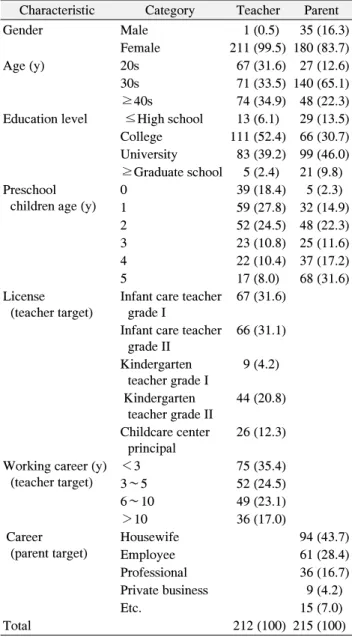
Table 1. Characteristics of Subjects
Characteristic Category Teacher Parent
Gender Male 1 (0.5) 35 (16.3)
Female 211 (99.5) 180 (83.7)
Age (y) 20s 67 (31.6) 27 (12.6)
30s 71 (33.5) 140 (65.1)
≥40s 74 (34.9) 48 (22.3)
Education level ≤High school 13 (6.1) 29 (13.5) College 111 (52.4) 66 (30.7) University 83 (39.2) 99 (46.0)
≥Graduate school 5 (2.4) 21 (9.8) Preschool
children age (y)
0 39 (18.4) 5 (2.3)
1 59 (27.8) 32 (14.9)
2 52 (24.5) 48 (22.3)
3 23 (10.8) 25 (11.6)
4 22 (10.4) 37 (17.2)
5 17 (8.0) 68 (31.6)
License (teacher target)
Infant care teacher grade I
67 (31.6)
Infant care teacher grade II
66 (31.1)
Kindergarten teacher grade I
9 (4.2)
Kindergarten teacher grade II
44 (20.8)
Childcare center principal
26 (12.3)
Working career (y) (teacher target)
<3 75 (35.4)
3∼5 52 (24.5)
6∼10 49 (23.1)
>10 36 (17.0)
Career (parent target)
Housewife 94 (43.7)
Employee 61 (28.4)
Professional 36 (16.7)
Private business 9 (4.2)
Etc. 15 (7.0)
Total 212 (100) 215 (100)
Values are presented as n (%).
다수였고, 나이는 40대 이상 34.9%, 학력은 전문대 졸업 52.4%, 담당하는 영유아의 나이는 만 1세가 27.8%로 가장 많았다. 또한 보유한 자격증은 보육교사 1급과 2급이 가장 많았고, 경력은 3년 미만이 35.4%로 가장 높았다.
학부모의 일반적 특성은 여성 83.7%, 나이는 30대가 65.1%, 학력은 4년제 대학교 졸업이 46.0%, 양육하는 영유 아의 나이는 만 5세가 31.6%, 직업은 전업주부가 43.7%로 가장 많았다(Table 1).
2. 구강보건교육에 대한 요구도
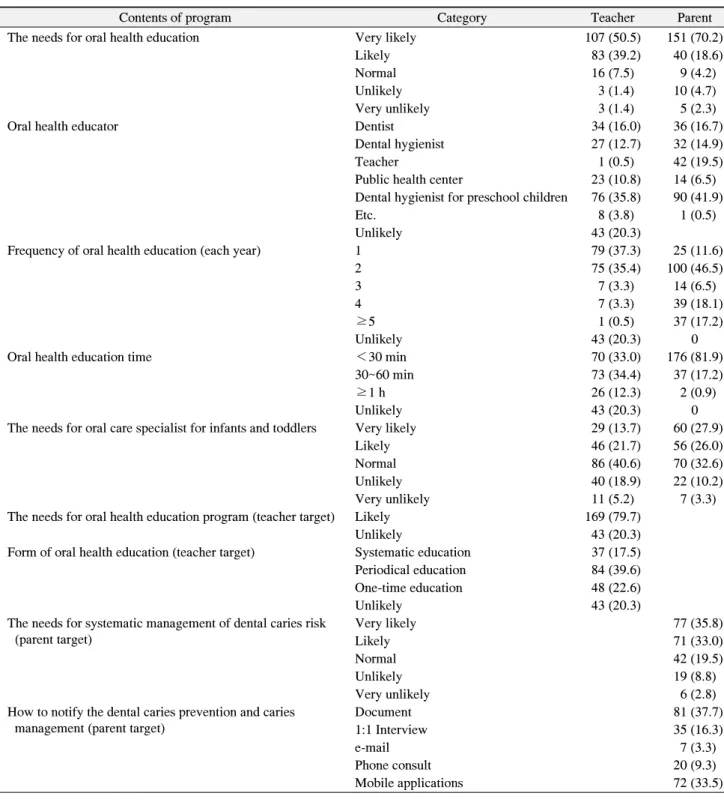
영유아 대상 구강보건교육 필요 유무에 대해 보육·교육기
관의 교사 50.5%, 학부모 70.2%로 매우 필요함을 나타냈 고, 교육 담당자로는 교사 35.8%와 학부모 41.9%가 영유아 전담 치과위생사를 가장 선호하였다.
구강보건교육의 횟수는 교사 37.3%는 연 1회, 학부모는 46.5%가 연 2회로 학부모의 교육 요구 횟수가 더 높았고, 교 육 시간은 교사(34.4%)는 30분 이상 1시간 미만, 학부모 (81.9%)는 30분 미만을 응답하였다. 기관 내 영유아 구강관 리 전문가의 필요도에 대한 문항은 ‘보통이다’가 교사는 40.6%, 학부모는 32.6%로 응답이 가장 많았다.
보육·교육기관의 교사에게 교사의 구강보건교육의 필요 유무는 ‘필요하다(79.7%)’로 높은 수치를 나타냈다. 학부모 에게 보육·교육기관에서 치아우식 위험정도에 따른 체계적 관리의 필요성에 대해서는 ‘매우 그렇다(35.8%)’가 가장 많 았고, 치아우식 예방에 대한 교육과 우식관리 내용에 대한 통보 방법은 ‘서면(37.7%)’, ‘모바일 어플리케이션(33.5%)’,
‘1:1면담(16.3%)’의 순서로 나타났다(Table 2).
3. 보육·교육기관의 교사의 구강보건교육 내용 요구 도 및 우선순위 분석
보육·교육기관의 교사의 구강보건교육 내용에 대한 요구 를 알아보기 위해 대응표본 t-검증과 Borich 요구도를 산출 하였으며, 그 결과는 Table 3과 같다. 교사의 구강보건교육 내용에 대한 요구를 살펴보면, 모든 내용에 대해 현재 수준 과 필요수준에서 통계적으로 유의미한 차이가 나타났고, 구 강보건교육 내용의 우선순위를 도출하기 위해 Borich 요구 도를 활용하여 우선순위를 결정하였다. Borich 요구도를 활 용한 교사의 구강보건교육 내용에 대한 결과, ‘치아 탈구 시 응급처치 방법’이 요구도 6.877로 가장 높았다. 이어서 ‘영 구치 맹출 순서’, ‘부정교합의 치료시기’ 순으로 요구도는 각각 6.308, 5.993이었다.
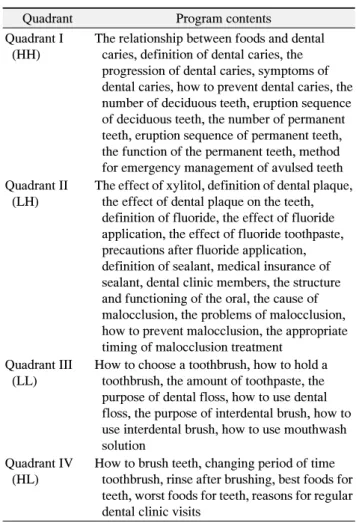
The Locus for Focus 모델을 활용하여 우선순위를 시각 화하였고 결과는 Fig. 3과 같다. The Locus for Focus 모델 로 분석한 결과, 구강보건교육 내용에 대한 필요수준의 평 균은 4.082이고, 필요수준과 현재수준의 차이의 평균값은 1.068로 나타났다. 필요수준과 현재수준의 차이 값이 평균 보다 높고 필요수준 역시 평균보다 높은 제1사분면(HH)에 해당하는 구강보건교육 내용은 ‘음식과 치아우식증과의 관 계’, ‘치아우식증의 정의’, ‘치아우식증의 진행과정’, ‘치아 우식증의 증상’, ‘치아우식증을 예방하는 방법’, ‘유치의 수’, ‘유치의 맹출 순서’, ‘영구치의 수’, ‘영구치의 맹출 순 서’, ‘영구치의 기능’, ‘치아 탈구 시 응급처치 방법’으로 총 11개의 구강보건교육 내용이었다(Table 4).
The Locus for Focus 모델을 활용한 제1사분면(HH)의
Table 2. The Needs Analysis for Oral Health Education
Contents of program Category Teacher Parent
The needs for oral health education Very likely 107 (50.5) 151 (70.2)
Likely 83 (39.2) 40 (18.6)
Normal 16 (7.5) 9 (4.2)
Unlikely 3 (1.4) 10 (4.7)
Very unlikely 3 (1.4) 5 (2.3)
Oral health educator Dentist 34 (16.0) 36 (16.7)
Dental hygienist 27 (12.7) 32 (14.9)
Teacher 1 (0.5) 42 (19.5)
Public health center 23 (10.8) 14 (6.5)
Dental hygienist for preschool children 76 (35.8) 90 (41.9)
Etc. 8 (3.8) 1 (0.5)
Unlikely 43 (20.3)
Frequency of oral health education (each year) 1 79 (37.3) 25 (11.6)
2 75 (35.4) 100 (46.5)
3 7 (3.3) 14 (6.5)
4 7 (3.3) 39 (18.1)
≥5 1 (0.5) 37 (17.2)
Unlikely 43 (20.3) 0
Oral health education time <30 min 70 (33.0) 176 (81.9)
30~60 min 73 (34.4) 37 (17.2)
≥1 h 26 (12.3) 2 (0.9)
Unlikely 43 (20.3) 0
The needs for oral care specialist for infants and toddlers Very likely 29 (13.7) 60 (27.9)
Likely 46 (21.7) 56 (26.0)
Normal 86 (40.6) 70 (32.6)
Unlikely 40 (18.9) 22 (10.2)
Very unlikely 11 (5.2) 7 (3.3)
The needs for oral health education program (teacher target) Likely 169 (79.7)
Unlikely 43 (20.3)
Form of oral health education (teacher target) Systematic education 37 (17.5)
Periodical education 84 (39.6)
One-time education 48 (22.6)
Unlikely 43 (20.3)
The needs for systematic management of dental caries risk (parent target)
Very likely 77 (35.8)
Likely 71 (33.0)
Normal 42 (19.5)
Unlikely 19 (8.8)
Very unlikely 6 (2.8)
How to notify the dental caries prevention and caries management (parent target)
Document 81 (37.7)
1:1 Interview 35 (16.3)
e-mail 7 (3.3)
Phone consult 20 (9.3)
Mobile applications 72 (33.5)
Values are presented as n (%).
11개 항목 수만큼 Borich 요구도 우선순위의 11개 항목까 지 선택하였다. Borich 요구도 값과 The Locus for Focus 모 델 분석결과에 의해 중복된 최우선 구강보건교육 내용은 Table 5와 같다.
Borich 요구도와 The Locus for Focus 모델의 우선순위
를 통해 공통적으로 요구가 높게 나타난 영역은 ‘치아우식
증의 진행과정’, ‘치아우식증의 증상’, ‘치아우식증을 예방
하는 방법’, ‘유치의 맹출 순서’, ‘영구치의 맹출 순서’, ‘영
Table 3. The Borich Priority Formula of Oral Health Education Contents by Teachers
Program contents Difference p-value Borich priority Rank
Brushing
How to choose a toothbrush 0.88 <0.01 3.572 27
How to hold a toothbrush 0.82 <0.01 3.341 32
How to brush teeth 0.81 <0.01 3.467 28
Changing period of time toothbrush 0.67 <0.01 2.784 35
The amount of toothpaste 0.82 <0.01 3.36 30
Rinse after brushing 0.79 <0.01 3.35 31
Diet
Best foods for teeth 0.65 <0.01 2.819 34
Worst foods for teeth 0.56 <0.01 2.432 38
The relationship between foods and dental caries 1.09 <0.01 4.744 21
The effect of xylitol 1.13 <0.01 4.566 23
Dental plaque
Definition of dental plaque 1.37 <0.01 5.485 9
The effect of dental plaque on the teeth 1.28 <0.01 5.108 15
Dental caries
Definition of dental caries 1.25 <0.01 5.271 10
The progression of dental caries 1.38 <0.01 5.822 6
Symptoms of dental caries 1.32 <0.01 5.539 8
How to prevent dental caries 1.38 <0.01 5.992 4
Fluoride
Definition of Fluoride 1.27 <0.01 5.155 14
The effect of fluoride application 1.25 <0.01 5.060 16
The effect of fluoride toothpaste 1.14 <0.01 4.504 24
Precautions after fluoride application 1.25 <0.01 5.038 17
Common sense of dentistry
Reasons for regular dental clinic visits 0.81 <0.01 3.364 29
Definition of sealant 1.11 <0.01 4.345 25
Medical insurance of sealant 1.31 <0.01 5.022 19
Dental clinic members 1.08 <0.01 4.173 26
The number of deciduous teeth 1.26 <0.01 5.189 13
Eruption sequence of deciduous teeth 1.43 <0.01 5.905 5
The number of permanent teeth 1.21 <0.01 5.023 18
Eruption sequence of permanent teeth 1.54 <0.01 6.308 2
The function of the permanent teeth 1.26 <0.01 5.235 11
The structure and functioning of the oral 1.28 <0.01 5.193 12
Method for emergency management of avulsed teeth 1.60 <0.01 6.877 1
Oral hygiene products
The purpose of dental floss 0.47 <0.01 1.882 40
How to use dental floss 0.60 <0.01 2.421 39
The purpose of interdental brush 0.63 <0.01 2.540 36
How to use interdental brush 0.73 <0.01 2.931 33
How to use mouthwash solution 0.63 <0.01 2.526 37
Malocclusion
The cause of malocclusion 1.25 <0.01 4.889 20
The problems of malocclusion 1.20 <0.01 4.675 22
How to prevent malocclusion 1.44 <0.01 5.726 7
The appropriate timing of malocclusion treatment 1.50 <0.01 5.993 3
The data was analysis by paired t-test.
Fig. 3. Oral health education contents priority using The Locus for Focus Model by teachers.
Table 4. Oral Health Education Contents Priority Using The Locus for Focus Model by Teachers
Quadrant Program contents
Quadrant I (HH)
The relationship between foods and dental caries, definition of dental caries, the progression of dental caries, symptoms of dental caries, how to prevent dental caries, the number of deciduous teeth, eruption sequence of deciduous teeth, the number of permanent teeth, eruption sequence of permanent teeth, the function of the permanent teeth, method for emergency management of avulsed teeth Quadrant II
(LH)
The effect of xylitol, definition of dental plaque, the effect of dental plaque on the teeth, definition of fluoride, the effect of fluoride application, the effect of fluoride toothpaste, precautions after fluoride application, definition of sealant, medical insurance of sealant, dental clinic members, the structure and functioning of the oral, the cause of malocclusion, the problems of malocclusion, how to prevent malocclusion, the appropriate timing of malocclusion treatment
Quadrant III (LL)
How to choose a toothbrush, how to hold a toothbrush, the amount of toothpaste, the purpose of dental floss, how to use dental floss, the purpose of interdental brush, how to use interdental brush, how to use mouthwash solution
Quadrant IV (HL)
How to brush teeth, changing period of time toothbrush, rinse after brushing, best foods for teeth, worst foods for teeth, reasons for regular dental clinic visits
구치의 기능’, ‘치아 탈구 시 응급처치 방법’으로 총 7개의 구강보건교육 내용이었다(Table 5). 이는 40개의 구강보건 교육 내용 중 우선적으로 고려해야 할 요구라고 볼 수 있으 며, Borich 요구도에서 3순위, 7순위, 9순위였던 ‘부정교합 의 치료시기’, ‘부정교합의 예방법’, ‘치면세균막의 정의’는 최우선순위 내용에서 제외된 내용은 차순위 요구 내용으로 분석되었다.
4. 학부모의 구강보건교육 내용 요구도 및 우선순위 분석 학부모의 구강보건교육 내용에 대한 요구를 알아보기 위 해 대응표본 t-검증과 Borich 요구도를 산출하였으며, 그 결 과는 Table 6과 같다. 학부모의 구강보건교육 내용에 대한 요구를 살펴보면, 모든 내용에 대해 현재 수준과 필요수준 에서 통계적으로 유의미한 차이가 나타났고, 구강보건교육 내용의 우선순위를 도출하기 위해 Borich 요구도를 활용하 여 우선순위를 결정하였다. Borich 요구도를 활용한 학부모 의 구강보건교육 내용에 대한 결과, ‘부정교합의 치료시기’
가 요구도 8.990으로 가장 높았다. 이어서 ‘부정교합의 예방 법’, ‘치아 탈구 시 응급처치 방법’ 순으로 요구도는 각각 8.185, 7.625였다.
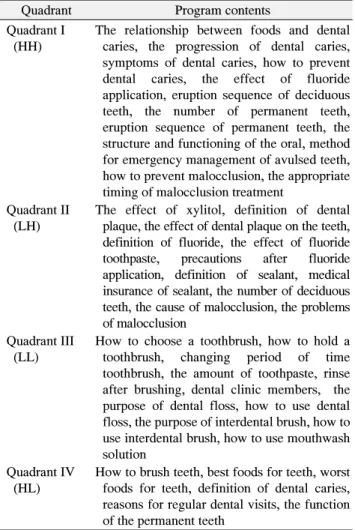
The Locus for Focus 모델을 활용하여 우선순위를 시각 화하였고 결과는 Fig. 4와 같다. The Locus for Focus 모델 을 이용하여 분석한 결과, 구강보건교육 내용에 대한 필요 수준의 평균은 4.203이고, 필요수준과 현재수준의 차이의 평균값은 1.380으로 나타났다. 필요수준과 현재수준의 차 이 값이 평균보다 높고 필요수준 역시 평균보다 높은 제1사 분면(HH)에 해당하는 구강보건교육 내용은 ‘음식과 치아 우식증과의 관계’, ‘치아우식증의 진행과정’, ‘치아우식증 의 증상’, ‘치아우식증을 예방하는 방법’, ‘불소도포의 효
과’, ‘유치의 맹출 순서’, ‘영구치의 개수’, ‘영구치의 맹출 순서’, ‘구강의 구조와 기능’, ‘치아 탈구 시 응급처치 방법’,
‘부정교합의 예방법’, ‘부정교합의 치료시기’로 총 12개의 구강보건교육 내용이었다(Table 7).
The Locus for Focus 모델을 활용한 제1사분면(HH)의 12개 항목 수만큼 Borich 요구도 우선순위의 12개 항목까 지 선택하였다. Borich 요구도 값과 The Locus for Focus 모 델 분석결과에 의해 중복된 최우선 구강보건교육 내용은 Table 5와 같다.
Borich 요구도와 The Locus for Focus 모델의 우선순위
를 통해 공통적으로 요구가 높게 나타난 영역은 ‘치아우식
증의 진행과정’, ‘치아우식증의 증상’, ‘치아우식증을 예방
하는 방법’, ‘불소도포의 효과’, ‘영구치의 개수’, ‘영구치의
맹출 순서’, ‘치아 탈구 시 응급처치 방법’, ‘부정교합의 예
방법’, ‘부정교합의 치료시기’로 총 9개의 구강보건교육 내
용이었다(Table 5). 이는 40개의 구강보건교육 내용 중 우선
적으로 반영해야 될 요구라고 볼 수 있으며, Borich 요구도
Table 5. Common Priorities for Teachers and Parents in Oral Health Education
Program contents
Teacher's priority Parent’s priority
Borich priority The Locus for
Focus Model Borich priority The Locus for Focus Model Brushing
How to choose a toothbrush How to hold a toothbrush How to brush teeth
Changing period of time toothbrush The amount of toothpaste
Rinse after brushing Diet
Best foods for teeth Worst foods for teeth
The relationship between foods and dental caries ○ ○
The effect of xylitol Dental plaque
Definition of dental plaque ○
The effect of dental plaque on the teeth Dental caries
Definition of dental caries ○
The progression of dental caries ○ ○ ○ ○
Symptoms of dental caries ○ ○ ○ ○
How to prevent dental caries ○ ○ ○ ○
Fluoride
Definition of fluoride ○
The effect of fluoride application ○ ○
The effect of fluoride toothpaste Precautions after fluoride application Dental and oral
Reasons for regular dental clinic visits Definition of sealant
Medical insurance of sealant Dental clinic members
The number of deciduous teeth ○
Eruption sequence of deciduous teeth ○ ○ ○
The number of permanent teeth ○ ○ ○
Eruption sequence of permanent teeth ○ ○ ○ ○
The function of the permanent teeth ○ ○
The structure and functioning of the oral ○
Method for emergency management of avulsed teeth ○ ○ ○ ○
Oral hygiene products The purpose of dental floss How to use dental floss The purpose of interdental brush How to use interdental brush How to use mouthwash solution Malocclusion
The cause of malocclusion ○
The problems of malocclusion ○
How to prevent malocclusion ○ ○ ○
The appropriate timing of malocclusion treatment ○ ○ ○
Table 6. The Borich’s Priority Formula of Oral Health Education Contents by Parents
Program contents Difference p-value Borich priority Rank
Brushing
How to choose a toothbrush 1.17 <0.01 4.917 28
How to hold a toothbrush 1.18 <0.01 4.832 29
How to brush teeth 1.25 <0.01 5.598 27
Changing period of time toothbrush 0.93 <0.01 3.830 40
The amount of toothpaste 1.13 <0.01 4.557 36
Rinse after brushing 1.15 <0.01 4.705 34
Diet
Best foods for teeth 1.29 <0.01 5.821 23
Worst foods for teeth 1.07 <0.01 4.828 30
The relationship between foods and dental caries 1.38 <0.01 6.071 16
The effect of xylitol 1.43 <0.01 5.856 22
Dental plaque
Definition of dental plaque 1.56 <0.01 6.178 14
The effect of dental plaque on the teeth 1.53 <0.01 6.021 18
Dental caries
Definition of dental caries 1.29 <0.01 5.685 26
The progression of dental caries 1.63 <0.01 7.023 6
Symptoms of dental caries 1.47 <0.01 6.329 12
How to prevent dental caries 1.57 <0.01 7.048 5
Fluoride
Definition of fluoride 1.53 <0.01 6.426 10
The effect of fluoride application 1.53 <0.01 6.525 9
The effect of fluoride toothpaste 1.50 <0.01 6.147 15
Precautions after fluoride application 1.44 <0.01 5.774 25
Dental and oral
Reasons for regular dental clinic visits 1.06 <0.01 4.616 35
Definition of sealant 1.44 <0.01 5.800 24
Medical insurance of sealant 1.55 <0.01 6.040 17
Dental clinic members 1.15 <0.01 4.756 32
The number of deciduous teeth 1.42 <0.01 5.957 21
Eruption sequence of deciduous teeth 1.47 <0.01 6.213 13
The number of permanent teeth 1.48 <0.01 6.548 8
Eruption sequence of permanent teeth 1.64 <0.01 7.137 4
The function of the permanent teeth 1.36 <0.01 6.004 20
The structure and functioning of the oral 1.41 <0.01 6.017 19
Method for emergency management of avulsed teeth 1.73 <0.01 7.625 3
Oral hygiene products
The purpose of dental floss 1.00 <0.01 4.191 38
How to use dental floss 0.99 <0.01 4.152 39
The purpose of interdental brush 1.13 <0.01 4.711 33
How to use interdental brush 1.15 <0.01 4.794 31
How to use mouthwash solution 1.06 <0.01 4.365 37
Malocclusion
The cause of malocclusion 1.60 <0.01 6.605 7
The problems of malocclusion 1.56 <0.01 6.400 11
How to prevent malocclusion 1.92 <0.01 8.185 2
The appropriate timing of malocclusion treatment 2.06 <0.01 8.990 1
The data was analysis by paired t-test.
Fig. 4. Oral health education contents priority using The Locus for Focus Model by parents.
Table 7. Oral Health Education Contents Priority Using The Locus for Focus Model by Parents
Quadrant Program contents
Quadrant I (HH)
The relationship between foods and dental caries, the progression of dental caries, symptoms of dental caries, how to prevent dental caries, the effect of fluoride application, eruption sequence of deciduous teeth, the number of permanent teeth, eruption sequence of permanent teeth, the structure and functioning of the oral, method for emergency management of avulsed teeth, how to prevent malocclusion, the appropriate timing of malocclusion treatment
Quadrant II (LH)
The effect of xylitol, definition of dental plaque, the effect of dental plaque on the teeth, definition of fluoride, the effect of fluoride toothpaste, precautions after fluoride application, definition of sealant, medical insurance of sealant, the number of deciduous teeth, the cause of malocclusion, the problems of malocclusion
Quadrant III (LL)
How to choose a toothbrush, how to hold a toothbrush, changing period of time toothbrush, the amount of toothpaste, rinse after brushing, dental clinic members, the purpose of dental floss, how to use dental floss, the purpose of interdental brush, how to use interdental brush, how to use mouthwash solution
Quadrant IV (HL)
How to brush teeth, best foods for teeth, worst foods for teeth, definition of dental caries, reasons for regular dental visits, the function of the permanent teeth
에서 7순위, 10순위, 11순위였던 ‘부정교합의 원인’, ‘불소 의 정의’, ‘부정교합의 문제점’은 최우선순위 내용에서 제외 된 내용은 차순위 요구 내용으로 분석되었다.
교육요구도 3단계에 의한 보육·교육기관의 교사와 학부 모의 공통적인 최우선순위 구강보건교육 내용을 살펴보면
‘치아우식증의 진행과정’, ‘치아우식증의 증상’, ‘치아우식 증을 예방하는 방법’, ‘영구치의 맹출 순서’, ‘치아 탈구 시 응급처치 방법’으로 총 5개의 내용이었다(Table 5).
고 찰
본 연구는 보육·교육기관 교사와 학부모를 대상으로 영유 아 구강보건교육에 대한 요구도를 파악하고 실제 영유아 구 강보건교육 프로그램에 활용될 교육 내용의 우선순위를 제 시하고자 하였다. 대부분의 선행연구에서는 구강보건교육 요구분석 방법을 설문조사를 통해 빈도와 백분율로 선호도 를 제시하지만 이는 선호도에 따른 교육내용을 정하는 데 어려움이 있다 20) . 따라서 최적의 구강보건교육 내용을 구성 하기 위해 현재 수준과 필요 수준의 차이로 교육 요구도 우 선순위를 결정하고, 그에 따라 교육내용을 개발하하는 것이 중요하므로 본 연구에서는 교육요구도 3단계 분석과정에 따라 대응표본 t-검증, Borich 요구도 분석, The Locus for Focus 모델의 방법을 활용하여 평가하였다.
영유아 구강보건교육 필요 유무에 대해 보육·교육기관의 교사 89.7%, 학부모 88.8%로 필요함을 나타났고, 이는 Kim 등 21) 의 유아대상 구강보건교육 필요성에 대한 교사의 응답률이 89.4%로 비슷한 수치였다. 또한 구강보건교육 담 당자로 보육·교육기관의 교사와 학부모는 영유아 전담 치과 위생사를 각각 35.8%, 41.9%로 선호하였다. Lee와 Shim 22)
은 영유아기 구강관리를 위한 인력 등이 거의 갖추어져 있
지 않다고 했으며, 2005년 영유아의 구강건강 수준 향상을
위한 구강보건교육자 양성을 제시 23) 하였으나 아직까지 영
유아를 위한 전문적인 구강보건교육자는 마련되어 있지 않
다. 이에 영유아 전담 구강보건교육자 필요성을 알아보고자
응답항목에 ‘영유아 전담 치과위생사’를 포함시킨 결과, 보
육·교육기관의 교사와 학부모는 치과위생사보다 영유아 전
담 치과위생사를 선호하였다. 이를 통해 영유아 구강보건교
육을 위한 전문적인 인력이 양성되어 질 높은 교육과 관리
가 제공되어야 할 것으로 생각된다. 구강보건교육 내용 통
보에 대한 방법으로 학부모는 서면, 모바일 어플리케이션
37.7%, 33.5%의 응답률을 보였다. 최근 보육·교육기관에
서 영유아의 일상생활에 대한 정보를 학부모에게 전달하는
알림장 방식이 스마트폰 어플리케이션을 사용하는 추세로
변하고 있다. 어플리케이션을 통해 보육·교육기관의 교사는
자필로 알림장을 작성하는 시간 등의 번거로움을 줄이고,
학부모는 실시간으로 영유아의 일상으로 확인할 수 있고 보 육·교육기관의 교사와 원활한 소통이 가능하게 되었다. 이 렇듯 편리하고 효율적인 어플리케이션을 통한 구강보건교 육이 개발되어 영유아에게 건강한 구강관리 습관이 형성되 길 기대해 본다.
구강보건교육 요구에 대한 선행연구는 구강보건인력의 예방진료에 해당하는 항목의 중요도와 교육 요구에 대해 치 과의사와 치과위생사의 인식 차이를 분석 24) 하거나 연구대 상자의 구강보건 지식수준과 구강보건교육 요구도에 대한 분석 25) 을 하였다. 선행연구의 구강보건교육 요구도는 구강 보건교육의 필요 유무, 필요 정도, 교육방법, 교육시간 등의 문항을 설문조사를 통해 빈도와 백분율로 주로 분석하였다.
이러한 분석 방법은 학습자가 요구하는 구강보건교육 내용 에 대한 우선순위를 정하는 데 미흡하다. 따라서 영유아 구 강보건교육 프로그램 개발을 위해 교육요구도 3단계 분석 방법을 활용하여 보육·교육기관의 교사가 영유아 구강보건 교육에서 요구하는 최우선순위 내용을 분석한 결과, 총 8개 영역의 40개 내용 중 ‘치아우식증의 진행과정’, ‘치아우식 증의 증상’, ‘치아우식증을 예방하는 방법’, ‘유치의 맹출 순 서’, ‘영구치의 맹출 순서’, ‘영구치의 기능’, ‘치아 탈구 시 응급처치 방법’으로 7개의 내용이 조사되었다. Kim 등 21) 의 연구에서 아동 구강보건교육의 주제 선호도 조사 결과 ‘구 강위생관리법’, ‘우식예방법’, ‘치아우식의 원인과 진행과 정’ 순이었고, Jung 등 11) 의 연구에서는 구강보건교육 내용 선호도의 결과 ‘우식발생 원인과 진행과정’, ‘식이지도’, ‘잇 솔질과 우식관계’에 대해 선호도와 비슷하게 결과를 나타냈 지만 ‘치아 탈구 시 응급처치 방법’이라는 항목은 선행연구 와 다른 결과를 보여 주었다. Yang 등 26) 의 연구에서 보건교 사는 치아외상에 대한 예방 교육 요구에 대해 ‘필요하다’는 응답이 98.5%였고, 치아 탈구 시 처치방법에 대한 대해 교 육 전 57.1%의 절반가량만 옳은 응답으로 치아 외상 후 응 급처치에 대해 많이 미흡함을 보고하였다. 그리고 Choi 등 27) 의 치아외상 발생장소에 관한 연구에서 대부분 외상이 실내 와 보육·교육기관에서 각각 48.0%, 9.2%라고 보고하였다.
이를 통해 보육·교육기관의 교사에게 외상 후 치아관리에 대한 전문적인 교육을 통하여 예방이 이루어져야 한다고 보 여진다. 따라서 Lee 19) 가 제안한 유아구강보건교육 프로그 램의 ‘치아외상’이라는 일반 목표와 하위 상세 목표 중 ‘치 아 응급 처치 방법을 설명한다’를 참고하여 교사대상 구강 보건교육 내용으로 포함되어야 할 것이다.
반면, 학부모가 요구하는 영유아 구강보건교육의 최우선 순위 내용은 총 8개 영역의 40개 내용 중 ‘치아우식증의 진 행과정’, ‘치아우식증의 증상’, ‘치아우식증을 예방하는 방
법’, ‘불소도포의 효과’, ‘영구치의 개수’, ‘영구치의 맹출 순 서’, ‘치아 탈구 시 응급처치 방법’, ‘부정교합의 예방법’,
‘부정교합의 치료시기’로 9개의 내용이 조사되었다. 교사와 거의 중복되는 항목이었으나 부정교합에 대한 내용이 추가 되는 결과를 보여 주었다. 치아는 음식을 씹는 기능적인 역 할뿐만 아니라 대화를 하거나 미소를 지을 때 얼굴 표정으 로 드러나 외모에 많은 영향을 준다 28) . 부정교합이 발생하면 치아우식증, 발음 장애, 안모 비대칭이 나타날 수 있으며 안 모와 관련지어 자신감이 결여되고 자신에 대한 부정적인 자 아를 가질 수 있게 된다 29) . 그러므로 학부모는 자녀들이 정 상적인 치아의 기능과 가지런한 치아를 통해 아름답고 자신 있는 미소로 긍정적인 자아를 가지길 희망하는 마음에서 교 사와 다르게 부정교합의 항목이 우선순위에 포함되었다고 판단된다. Lee 19) 가 제안한 유아 구강보건교육 프로그램의
‘부정교합’이라는 일반 목표와 하위 상세 목표 중 ‘부정교합 의 원인을 설명한다’, ‘부정교합의 예방법을 설명한다’를 참 고하여 학부모대상 구강보건교육 내용으로 포함되어야 할 것이다.
본 연구는 보육·교육기관 교사와 학부모의 구강보건교육 요구를 바탕으로 교육요구도 3단계 분석방법을 활용하여 영유아 구강보건교육에 있어서 중점적으로 다루어야하는 교육 내용의 최우선순위를 결정하였다. 보육·교육기관의 교 사와 학부모가 공통적으로 요구하는 영유아 구강보건교육 내용은 ‘치아우식증의 진행과정’, ‘치아우식증의 증상’, ‘치 아우식증을 예방하는 방법’, ‘영구치의 맹출 순서’, ‘치아 탈 구 시 응급처치 방법’으로 5개 내용이 조사되었다. 이는 영 유아 구강보건교육 프로그램을 개발하는 데 기초자료로 활 용될 수 있을 것이다. 본 연구는 단순히 요구만을 파악하는 것이 아니라 구강보건교육 내용의 우선순위를 밝힌 것은 큰 의의가 있다. 또한 교육학 등 다양한 분야에서 학습자의 요 구를 분석할 때 체계적인 분석방법이 활용되는 최근 연구 추세를 볼 때, 구강보건교육 프로그램 개발에서 최우선순위 교육내용을 결정하는 데 기여할 것으로 기대된다. 향후 학 습대상자별 전문적인 구강보건교육 프로그램 개발을 위해 구강보건교육 내용의 우선순위를 체계적으로 도출하여 프 로그램을 개발하고 운영되어야 할 것이다.
그럼에도 불구하고 본 연구의 제한점으로는 연구자의 편
의를 바탕으로 연구대상자가 일부 지역에 국한되어 있기 때
문에 전체 보육·교육기관의 교사와 학부모의 경우로 일반화
하여 해석하기에는 한계가 있다. 그리고 연구에 참여한 영
유아 보육·교육기관 교사를 한 집단으로 하여 연구가 이루
어졌는데 현재 우리나라의 보육·교육기관의 교사는 교육기
관의 유치원 정교사, 보육기관의 보육교사로 영아교사와 유
아교사로 구분된다. 유치원 정교사와 보육교사 취득을 위한 이수 학점에서 취득 기관, 과목의 내용 등 상당한 차이가 있 는데 30) 이는 보육·교육기관의 교사의 일반적 특성에 따라 교육 요구도의 차이가 있을 것이라 생각된다. 또한 보육·교 육기관의 유아교사와 영아교사가 담당하고 있는 영유아의 나이에 따른 유치 맹출 개수, 시기 등을 고려하여 구강보건 교육 내용 요구도 차이가 있을 것으로 생각된다. 따라서 향 후 연구에서는 기관별 혹은 영유아의 연령별 구강보건교육 요구 분석이 시행되어야 한다고 판단된다.
요 약
본 연구는 보육·교육기관 교사와 학부모를 대상으로 영유 아 구강보건교육 프로그램 개발을 위해 구강보건교육 요구 를 바탕으로 구강보건교육 내용의 우선순위를 분석하였다.
이를 위해 2017년 12월 26일부터 2018년 1월 21일까지 서 울, 경기, 인천, 충청, 경상, 세종, 부산 지역의 보육·교육기 관 교사 212명과 학부모 215명 대상으로 설문조사를 실시 하였다. 영유아 구강보건교육의 요구는 교사와 학부모가 각 각 89.7%, 88.8%로 높게 나타났고, 구강보건교육 담당자로 보육·교육기관의 교사와 학부모는 ‘영유아전담 치과위생 사’를 가장 많이 선호하였다. 구강보건교육 내용의 우선순 위 결정을 위해 대응표본 t-검증과 Borich 교육요구도, The Locus for Focus 모델 등의 3단계 분석방법을 활용하였다.
연구 결과, 구강보건교육 8개 영역의 40개 내용 모두 현재수 준과 필요수준 간에 유의미한 차이가 있는 것으로 나타났 고, 구강보건교육 내용에 대한 보육·교육기관의 교사의 최 우선 순위는 7개 항목, 학부모의 최우선 순위는 9개 항목으 로 두 집단의 최우선 순위를 확인할 수 있었다. 보육·교육기 관의 교사와 학부모가 구강보건교육의 최우선 우선순위 내 용은 5개 항목으로 ‘치아우식증의 진행과정’, ‘치아우식증 의 증상’, ‘치아우식증을 예방하는 방법’, ‘영구치의 맹출 순 서’, ‘치아 탈구 시 응급처치 방법’이었다. 보육·교육기관의 교사가 최우선으로 요구하는 구강보건교육 내용은 ‘유치의 맹출 순서’, ‘영구치의 기능’이 추가되었고, 학부모가 최우 선으로 요구하는 구강보건교육 내용은 ‘불소도포의 효과’,
‘영구치의 개수’, ‘부정교합의 예방법’, ‘부정교합의 치료시 기’가 추가되었다. 향후 영유아 구강보건교육 프로그램을 개발할 때에는 본 연구의 결과를 토대로 보육·교육기관의 교사와 학부모가 공통적으로 요구하는 최우선순위 구강보 건 교육 내용 5개 항목을 포함하고, 보육·교육기관의 교사 대상 구강보건교육에서는 7개 교육 내용, 학부모대상 구강 보건교육에는 9개의 교육 내용이 우선적으로 반영된 피교
육자 요구도 중심으로 영유아 구강보건교육이 개발되어야 할 것이다.
References