Received: August 16, 2016 Revised: September 5, 2016 Accepted: September 5, 2016.
Corresponding author: Seol-Heui Han
Department of Neurology, Konkuk University Medical Center, 120-1 Neungdong-ro, Gwangjin-gu, Seoul 05030, Korea Tel: +82-2-2030-7561, Fax: +82-2-2030-7029, E-mail: [email protected]
본 연구는 보건복지부의 재원으로 한국보건산업진흥원의 보건의료기술연구개발사업 지원에 의하여 이루어진 것임(과제고유번호: HI16C0526).
시니어친화병원 구축과정에서 도움을 주신 대만의 Dr. Chiou, Shu-Ti와 캐나다의 Ken S Wong께 감사드립니다.
Copyright Ⓒ 2017 The Korean Academy of Clinical Geriatrics
This is an open access article distributed under the term s of the Creative Com m ons Attribution Non-Com m ercial License (http://creativecom m ons.org/ licenses/by-nc/4.0) which perm its unrestricted non-com m ercial use, distribution, and reproduction in any m edium , provided the original work is properly cited.
시니어친화병원: 노인의료서비스의 새로운 패러다임
김윤숙
1
, 한설희2
, 이종민3
, 신정은4
, 최재경5
, 박재민5
건국대학교병원
1
적정진료팀,2
신경과,3
재활의학과,4
이비인후ㆍ두경부외과,5
가정의학과Senior Friendly Hospital: A New Paradigm for the Hospital-based Care of the Elderly
Yoon-Sook Kim 1 , Seol-Heui Han 2 , Jong-Min Lee 3 , Grace Jung-Eun Shin 4 , Jae-Kyung Choi 5 , Jae-Min Park 5
Departments of
1Quality Improvement,
2Neurology,
3Rehabilitation Medicines,
4Otorhinolaryngology-Head and Neck Surgery,
5
Family Medicine, Konkuk University Medical Center, Seoul, Korea
Senior friendly hospital, which is a new paradigm of elderly medical service, is a future-oriented elderly medical management system that can improve the quality of life, health and safety by offering a safe medical treatment system to optimize the participation for self-oriented health management and to respect individuals’ decision making, when it comes to ther- apeutic intervention. Seeing some cases of a few advanced countries which has already implemented senior friendly hospital system, not only is it an evidence-based medical system, which focuses on applying the general system and culture of the acute phase hospital, but also it has experienced the physical environmental change. Its therapeutic excellence for the elderly has been demonstrated by emphasizing the strengthening of ability through education and training of participating employees. Therefore, in order to establish the senior friendly hospital voluntarily, and recognize the significance of elderly medical service in the medical institution in Korea, active consideration of introducing the senior friendly hospital accreditation system under the support of Ministry of Health and Welfare is necessary, as in the case of Taiwan.
Key Words: Senior friendly hospital, Elderly, Acute hospital, Paradigm, Accreditation
서 론
세계보건기구(WHO)는 고령화를 ‘조용하게, 거의 눈 에 띄지 않게 진행되지만 점차 속도가 붙어 앞으로 25년 이 지나면 그 윤곽이 분명해질 사회혁명’으로 정의했다.
유엔은『세계인구 고령화 1950∼2050 보고서』에서 2050
년이 되면 60세 이상 노인 인구가 14세 이하의 아동인구 를 추월하는 ‘인구의 대역전’ 현상이 발생할 것이라고 전망하고 있다.
1)
그 중에서 대한민국은 사상 유례없이 초고속으로 고 령사회로 진행 중이며, 고령화가 시작된 2000년 이후로 2017년 고령사회, 2026년 초고령 사회로 진입이 예상되
고 있다.
2)
노인 인구가 증가함에 따라 의료기관 이용 및 노인환 자 진료에 소요되는 의료비도 기하급수적으로 늘어가고 있다. 2015년 건강보험 주요 통계에 따르면, 65세 이상 입내원일수는 313,820,000일로 전체의 31.7%, 노인진료 비는 21조 9,210억원으로 전체의 37.8%이다.
3)
이런 양상은 급성기 의료기관의 변화를 요구하고 있 다. 급성기 의료기관 환경은 단일 질병으로 빠른 진단과 내ㆍ외과적 치료가 요구되는 젊은 성인들에게 최적화되 어 있어 다양한 동반질환을 가진 허약 노인에게는 적절 하지 않다. 노인환자는 그 특성상 입원기간동안 의료기 관획득 섬망, 기능감소, 낙상, 욕창 등과 같은 안전과 관 련된 문제 발생이 젊은 사람에 비해 2배 이상 높다.
4)
또 한 노인은 노화로 인한 시각, 청각, 인지, 근ㆍ골격계 등 의 기능 변화로 인해 입원기간동안 의학적 문제가 발생 할 수 있고 기저질환이나 저하된 기능이 더 악화되어 일 상생활로의 정상적인 복귀가 어려워질 수 있다.5)
캐나다 에서는 노인환자의 1/3 이상에서 입원기간 중에 기능감 소(functional decline)가 일어나고, 이는 낙상(fall), 내과적ㆍ 외과적 합병증(medical and surgical complication), 약화사 고(medication error) 등과 같은 위험노출을 증가시킨다고 보고하였다.6)
우리나라에서도 65세 이상 입원환자의 섬망 유병률은 5.4%∼19.2%,7)
약물유해반응 발생률은 20.2%,8)
낙상발생보고율은 42%9)
이다.최근 노인의 건강과 관련된 문제를 모든 악재가 겹치 는 최악의 상황을 의미하는 퍼펙트 스톰(perfect Storm)이 라고 표현할 정도로 노인의 건강 문제는 의료환경과 사 회 변화의 필요성을 요구하고 있다.
10)
대부분의 급성기 의료기관은 환자의 빠른 치료에만 초점을 맞추고 있어, 새로운 환경에 적응하는 것이 쉽지 않는 노인에게 예상치 못한 안전사고뿐만 아니라 입원 으로 인한 기능감소와 합병증으로 치료의 지연 및 재원 기간 증가를 가져오게 한다. 이러한 경험은 의학적 지식 만으로는 노인환자들이 일상생활 복귀가 가능한 건강상 태로 회복시킬 수 없다는 것을 깨닫게 했다.
노인환자의 적절한 치료를 위해서는 치료과정뿐만 아 니라 의료기관의 조직부터 환경까지 모든 시스템이 유 기적 관계에 의해 환자 치료에 투입이 되어야 된다는 패 러다임으로의 변화가 필요하며 우리나라에 적용될 수 있는 시니어친화병원에 대한 개념 정립이 요구된다.
노화는 거부할 수 없는 생의 과정이지만 급성기 의료
기관에 입원하는 동안 기능 저하를 최소화하고, 잔존 기 능을 강화하여, 기능 회복을 최대화할 수 있다면, 퇴원 후에도 건강하고 안녕한 상태를 유지할 수 있을 것이다.
노인환자 치료에 의학적 접근만으로는 더 이상 문제를 완벽하게 해결할 수 없다는 것은 명약관화한 일이다. 노 인인구가 급격히 증가해 가고 있는 우리의 상황에서 노 인환자 치료에 발상의 전환(paradigm shift)이 절실히 요 구되고 있다.
이에 본 연구에서는 국외에서 개발 및 적용하고 있는 시니어친화병원의 운영 전반을 고찰함으로써 그 개념에 대한 이해를 돕고자 한다.
본 론
1. 시니어친화병원이 대두된 배경
1980년대 세계 경제의 장기적인 불황은 국가의 개입 을 축소하는 신자유주의를 경제적 대안으로 제시했고, 그에 따라 시행된 전면적인 복지와 세금 감축은 ‘평균수 명 연장’과 정확하게 대치되면서 고령화가 문제 되기 시 작됐다.
11)
1982년 고령화 이슈의 선제적 대응을 위해 제 1차 세계고령화 회의(The World Assembly on Ageing)를 개최하여 ‘노인을 위한 유엔원칙(UN Principles for Older Persons)’을 채택하였고, 이 원칙은 다양한 고령화 대응방 안을 제시하였다. 2002년 제2차 세계고령화 회의 때 ‘노 인을 위한 유엔원칙’을 보완하여 21세기 인구 고령화 현 상에 따른 기회와 도전에 대응하고 모든 세대를 위한 사 회를 만들기 위해 ‘마드리드 고령화 국제행동계획(The Madrid International Plan of Action on Ageing)’을 발표하 였다. 이 계획에는 고령화 사회에서 노인이 건강과 독립 을 유지하고 사회에 적극적으로 참여하며 살아갈 수 있 도록 정부와 민간이 해야 할 행동지침들이 총망라되어 있다. 특히 노년까지 건강과 안녕을 증진하기 위한 질병 의 위험요소 감축, 노인질병 예방정책 개발, 평등한 의 료접근을 위한 방안, 허약노인의 기능상태유지 및 참여 증진을 위한 방안, 노인환자 치료를 위한 전문가 양성 방안 등을 포함하고 있다. 마드리드 고령화 국제행동계 획은 노인들이 건강하고 활동적이고 생산적인 상태를 유지할 수 있도록 모든 영역에서 태도, 정책과 실무가 단계적으로 변화해야 한다고 제시하였다.11)
세계보건기구는 노화과정에 있는 고유한 상황, 특수 한 환경에 대한 인식, 노인들에게 직접 영향을 미치는
의사결정에 스스로 목소리를 효과적으로 낼 수 있는 방 법을 모색할 필요성이 대두되어 2004년 일차의료에서 고령친화원칙(Age-Friendly Principles)을 제시하였다.
12)
이 원칙은 시니어친화병원체계를 구축하는 바탕이 되 었으며, 이후 의료기관의 전반적 시스템에 적용함으로써 근거기반의 의료시스템뿐만 아니라 물리적 환경 변화를 가져왔고, 교육 및 훈련을 통해 직원의 역량이 강화되고, 노인의 요구에 맞는 진료 서비스를 제공하게 되어 시니 어친화병원의 우수성이 입증되었다.
6)
2. 시니어친화병원의 개념
시니어친화병원은 세계보건기구의 고령친화원칙을 바 탕으로 캐나다, 대만, 미국 등에서 “Age-friendly Hospital”,
“Elder-friendly Hospital”, “Senior-friendly Hospital”로 사용 하였다. 한국에서는 시니어친화병원에 대한 개념이 명문 화되어 공식적으로 사용되고 있지 않아 본 연구에서는
‘노인’의 명칭을 우선 정리하고자 한다. 과거 노인은 평 생동안의 경험으로 얻게 되는 권위, 지혜, 위엄 등이 존 경의 대상으로 거부감이 없었던 것이 최근 노인이 ‘늙은 이’라는 뜻으로 낡고 해어진다는 의미를 내포하여 부정 적 의미를 주면서 어르신, 실버, 시니어라는 용어를 사 용하고 있다. 본 연구에서는 해외 age, elder인 노인, 고 령 대신에 손위, 상위, 윗사람의 의미가 담겨 있는 시니 어(senior)라는 용어를 사용하였다.
Parke와 Chappell
13)
은 의학적 치료에 노인의 요구를 접 목하여 전인적 치료가 제공될 수 있는 가족중심의 병원 을 노인친화병원(elder friendly hospital)이라고 하였고, Huang 등10)
이환율과 사망률을 높일 수 있는 노인환자 에게 부적합한 진료과정과 의료 환경을 개선하는 것을 노인친화병원(age-friendly hospital)이라고 하였다. Choiu와 Chen14)
은 노인친화병원을 노인의 존엄성을 지키면서 참 여도를 높이고 건강을 증진시키는 병원이라고 하였고, 캐나다에서는 병원조직문화를 포함한 환경과 편의, 노인 의 신체적ㆍ인지적 요구에 반응하는 것으로 가족 및 보 호자 등을 포함한 환자 치료에 참여하는 사람들이 노인 환자의 건강 증진 및 안전에 관한 모든 것을 지원하는 것을 시니어친화병원(senior friendly hospital)이라고 한 다.15)
세계보건기구는 노인이 건강한 고령화(healthy ageing) 를 맞이할 수 있도록 2004년『Towards age-friendly pri- mary health care』통해 고령친화원칙을 제시하였다. 건
강한 고령화란 나이에 따른 삶의 질을 제고하기 위해 건 강(health), 참여(participation), 안전(security) 기회를 최적 화하는 프로세스를 의미하며, 필요할 때 적절한 보호, 안전, 돌봄을 제공함으로써 평생 동안 신체적ㆍ사회적ㆍ 정신적 건강의 잠재력 실현과 사회 참여가 가능한 것이 다. 고령친화원칙은 환자, 보호자, 직원을 위해 일차진료 센터 또는 클리닉에서 개발 및 적용해야 되는 1) 정보 (information), 교육(education), 의사소통(communication)과 훈 련(training), 2) 건강관리시스템(health care management sys- tems), 3) 물리적 환경(the physical environment) 등 3가지 영 역에 대한 구체적인 가이드라인을 제시하였다(Table 1).
8)
본 연구에서는 ‘시니어친화병원(Senior Friendly Hospital) 이란 치료적 개입에 있어 노인환자 개인의 의사결정이 존 중되고 자기주도적 건강관리를 위해 참여를 최적화하는 안전한 진료시스템과 환경을 제공함으로써 삶의 질 (well-being), 건강(wellness)과 안전(well dying)을 향상시킬 수 있는 미래 지향적인 노인의료관리 시스템’으로 정의 하였다.
3. 시니어친화병원 해외 사례
1) 캐나다
캐나다 온타리오 주의 시니어친화병원체계(Ontario Senior-Friendly Hospital Framework)는 노인이 입원하는 동안 최적의 건강과 기능을 유지하여 퇴원 후 집 또는 다른 기관에서 지속적으로 진료가 가능하도록 하는 것 이다. 또한 노인의 건강증진, 안전, 환자와 가족 관계성, 만족도 향상을 위해 신체적, 인지적, 정신사회적 요구를 파악하여 병원 시스템 및 환경 개선에 초점을 두었다.
시니어친화병원체계는 1) 의료기관의 지원(organizational support), 2) 진료과정(processes of care), 3) 정서 및 행위를 유발할 수 있는 환경(emotional and behavioral environ- ment), 4) 생명존엄성 및 임상연구관련 윤리(ethics in clinical care and research), 5) 물리적 환경(physical environ- ment) 등 상호 연관성 있는 내용으로 병원 서비스 전반 에 걸쳐 개선하도록 구성되어 있다. 의료기관의 지원에 는 전략적 계획 수립, 위원회 구성과 권한부여, 인력 및 예산지원 등이 있다. 진료과정에는 노인의 신체적, 인지 적, 정신적, 사회적 기능을 최적화하기 위해 프로토콜을 만들고, 조기 스크리닝과 치료가 가능한 도구를 개발하 고, 다학제간 평가 및 치료팀을 구성하고, 환자 의뢰 및
Table 1. WHO guidelines for age-friendly primary care (WHO, 2004) 1. In the areas of information, education, and training:
1.1 All health care center staff should receive basic training in age, gender, and culturally sensitive practices that address knowledge, attitude and skills
1.2 All clinical staff in the health care center should receive basic training in core competencies of elder care
1.3 Health care centers should provide age, gender and culturally appropriate education and information on health promotion, disease managementand medications for older persons as well as their informal careers in older to promote empowerment for health 1.4 Healthcare center staff should review regularly the use of all medications, including complementary therapies such as traditional
medicines and practices
2. In the area of community-based health care management systems:
2.1 Health care centers should make every effort to adapt their administrative procedures to the special needs of older persons, including older persons with low educational levels or with cognitive impairments
2.2 Health care center systems should be cost sensitive in order to facilitate access to needed care by low-income persons 2.3 Health care centers should adopt systems that support a continuum of care both within the community level and between
the community and secondary and tertiary care levels
2.4 Health centers should put into place mechanisms that facilitate and coordinate access to social and domiciliary care services 2.5 All record keeping systems in healthcare centers should support continuity of care by keeping records on community-based,
secondary and tertiary care as well as on the provision of social services for their clients
2.6 All relevant stakeholders, including older persons, should be part of participatory decision-making mechanisms regarding the organization of the community-based care services
2.7 Information on the operation of the health care center, such as opening hours, fee schedules, medication and investigation charges, and registration procedures should be provided in an age-appropriate way
3. In the area of the physical environment:
3.1 The common principles of Universal Design should be applied to the physical environment of the health care facility whenever practical, affordable and possible
3.2 Safe and affordable transport to the health care center should be available for all, including older persons, whenever possible, by using a variety of community-based resources, including volunteers
3.3 Simple and easily readable signage should be posted throughout the health care center to facilitate orientation and personalize providers and services
3.4 Key health care staff should be easily identifiable using name badges and name boards
3.5 The health care facility should be equipped with good lighting, non-slip floor surfaces, stable furniture and clear walkways 3.6 The health care center facilities, including waiting areas, should be clean and comfortable throughout
회송을 위한 지역사회 자원 간 협력체계 구축 등이 있 다. 정서 및 행위를 유발할 수 있는 환경에는 모든 직원 에게 노인 맞춤형 교육 및 훈련을 제공하고, 노인친화병 원을 만들기 위한 문화를 형성하고, 노인에게 필요한 자 원을 제공하고, 입원 시부터 환자 및 가족과 함께 치료 목표를 설정하여 적극적으로 참여를 유도하는 것 등이 있다. 생명존엄성 및 임상연구관련 윤리에는 노인 환자 의 의사결정권과 동의를 명시할 수 있는 정책과 절차를 만들고, 정기적인 직원 교육을 통해 윤리적 딜레마에 직 면했을 때 대처할 수 있도록 하며, 직원, 환자 및 가족들 을 도와줄 수 있는 팀을 운영하는 것 등이 있다. 물리적 환경에는 환자의 안전을 위해 노인 친화적인 시설, 설비, 환경에 관한 가이드라인 활용하여 주기적으로 환경 감 시를 시행하고, 단계적인 환경 개선에 대한 내용이 포함 되어 있다(Figure 1).
15)
2) 대만
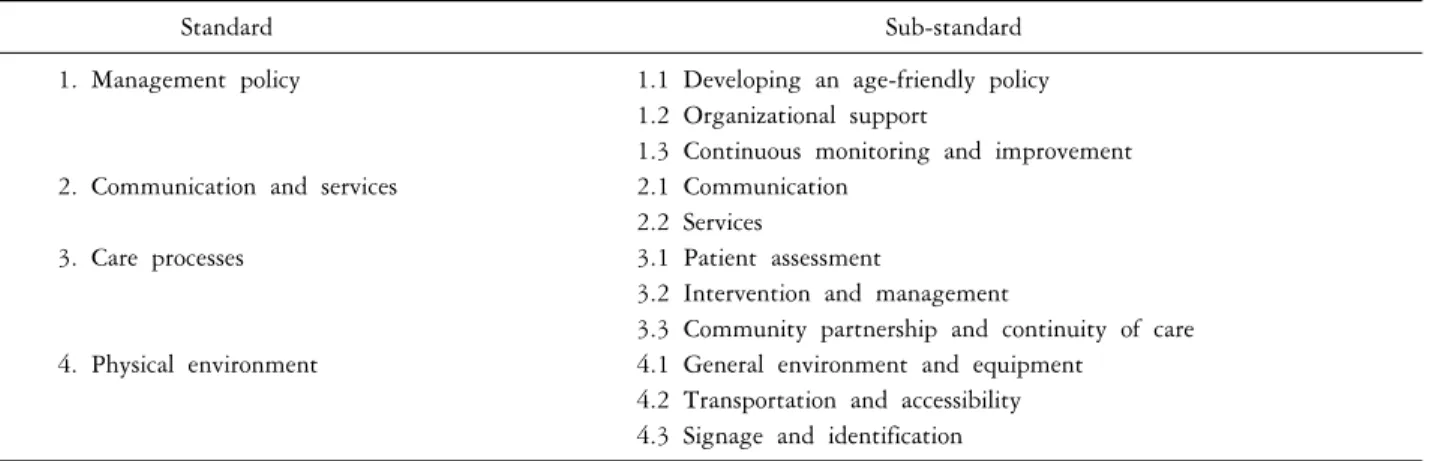
대만의 노인친화병원체계(Age-Friendly Hospital in Taiwan Framework)는 세계보건기구의 고령친화원칙과 건 강증진병원 기준(WHO Standards of Health Promoting Hospitals)를 근거로 정부 주도하에 범국민적인 노인을 위 한 병원과 의료 서비스 인식 고찰을 위해 2011년 개발되 었다. 대만은 건강(health), 인류(humanity), 인권(human rights)의 핵심가치를 바탕으로 노인에게 건강, 존중 및 참여에 대한 비전을 제공하고 정책(management policy), 의사소통과 서비스(communication and service), 물리적 환 경(physical environment)과 진료과정(care process) 등 4개의 기준을 노인친화병원체계에 도입했다. 대만의 노인친화 병원체계는 비전, 가치, 미션을 포함한 4개의 기준 (standard), 11개의 하부기준(sub-standard), 60개의 조사항 목(measurable item)으로 구성되어 있다(Table 2).
14,16)
대만 은 노인친화병원체계가 노인환자를 안전하게 건강을 증Figure 1. Ontario senior friendly hospital framework (http://senior friendlyhospitals.ca)
Table 2. Age-friendly hospital in Taiwan framework: 4 standards, 11 sub-standards
14)Standard Sub-standard
1. Management policy 1.1 Developing an age-friendly policy
1.2 Organizational support
1.3 Continuous monitoring and improvement
2. Communication and services 2.1 Communication
2.2 Services
3. Care processes 3.1 Patient assessment
3.2 Intervention and management
3.3 Community partnership and continuity of care
4. Physical environment 4.1 General environment and equipment
4.2 Transportation and accessibility 4.3 Signage and identification
진시키고 효과적이면서 환자 중심적인 협업 치료 시스 템과 환경을 통해 노인과 그들의 가족 스스로가 건강관 리를 할 수 있는 능력을 향상시켜 노인의 의료기관 이용 과 진료비 지출을 줄일 수 있을 것이라고 기대하였다.
이에 따라 대만은 노인친화병원체계를 병원(hospital), 지 역건강센터(local health center), 클리닉(clinic), 정신보건센 터(mental health center), 장기요양센터(long-term care cen- ter) 등 모든 병원에 적용하도록 하였고, 매년 챔피언 병
원을 선정하여 적절하게 보상을 함으로써 노인친화병원 체계가 잘 유지될 수 있도록 지원하고 있다.
14)
3) 미국
미국은 급성기 의료기관에 입원한 환자를 위해 노인 의 급성기 케어모델(Geriatric Acute Care Models)을 제시 하였고, 이 모델은 리더십, 조직구성, 가이드라인 원칙, 다학제 간 진료 서비스, 환자 및 가족 중심의 접근, 노인
맞춤형 임상실무, 직원의 역량강화 등으로 구성되어 있 다.
17)
또한 노인을 위한 급성기 병동(ACE unit), HELP (Hospital Elder Life Program), NICHE (Nurses Improving Care to Healthsystem Elders) 등이 있으며, 이러한 프로그 램을 적용한 의료기관은 직원의 역량이 강화될 뿐만아 니라 노인환자의 재원기간과 의료비 지출을 증가시키는 환자안전과 관련된 섬망, 낙상, 욕창, 폐렴, 요로감염, 억 제대 사용 등을 감소시키고, 기능상태와 치료 순응도를 향상시켜 재원일수 및 재입원율을 감소시켰다.18)
결 론
21세기 전반에 빠르게 인구 고령화가 진행되면서 노 인에게 있어 건강한 고령화가 점차 중요한 과제로 인식 되고 있다. 건강한 고령화는 생애에 걸친 건강증진활동 과 질병예방을 통해 가능하다. 하지만 건강한 노인조차 의료기관에 입원하게 되면, 새로운 환경 적응부터 독립 적 활동을 제한 받은 시스템 속에서 심리적ㆍ신체적 상 태가 회복되지 않거나 더 나빠진 상태가 된다. 약 30∼
40%의 노인환자에서 입원 2일 이내에 적어도 한가지 이 상의 새로운 일상생활 수행 능력의 상실을 경험하고,
19)
병원퇴원 후 1년 안에 약 13%가 사망한 것으로 보고되 었다.20)
따라서 급성기 의료기관에 입원하는 동안 노인의 기 능상태에 부정적 영향을 줄 수 있는 요인들을 찾아내고 개선하는 것이 필요하다.
노인의료서비스의 새로운 패러다임인 시니어친화병원 은 노인 개인의 의사결정이 존중되고 자기주도적 건강 관리를 위해 참여를 최적화하는 안전한 진료시스템과 환경을 제공함으로써 삶의 질, 건강과 안전을 향상시킬 수 있다. 이러한 시니어친화병원을 구축하기 위해서는 의료기관 전체가 움직일 수 있는 리더십이 매우 중요하 며, 노인 환자를 치료할 수 있도록 교육과 훈련을 제공 하여야 한다. 노인환자의 건강증진, 질병관리, 안전한 치 료를 위해서는 진료시스템 및 환경 개선은 근거기반으 로 이루어져야 치료결과를 향상시킬 수 있다.
시니어친화병원의 정립은 예측 가능하고 형평성 있는 건강증진, 질병관리, 안전한 치료를 위해 주도적이고, 다 학제간 협조가 원활하며, 잘 구축된 방식으로 의료 시스 템 및 환경이 재정비 될 때에만 가능하다. 하지만 우리 나라에서는 정부가 보건의료제공의 책임을 맡고 있는
캐나다와 대만의 보건의료체계와는 달리 급성기 의료기 관에서 필요에 따라 입원환자의 재원일수, 진료과정이나 결과관련 지표들을 관리하고 있다. 특히 급성기 의료기 관은 투자대비 수입이 적은 노인보다는 단시간에 치료 결과 성과가 좋은 젊은 사람 위주로 이루어지는 현재 진 료시스템을 변경하는 것에 대한 부담을 느낄 것으로 생 각한다.
따라서 노인의료서비스의 중요성을 인식하게 하고 의 료기관에서 자발적으로 시니어친화병원시스템을 구축하 기 위해서는 대만의 예처럼 보건복지부 지원 하에 시니어 친화병원 인증시스템 도입의 적극적인 검토가 필요하다.
REFERENCES