This review examined recently published (July 2014 to June 2017), randomized controlled trials (RCTs) which investigated the safety and effectiveness of combined Korean medicine/complementary alternative medicine (CAM) and Western medicine, to indicate the direction for integrative medical practice. The Korean Medicine Convergence Research Information Center evidence-based medicine database (KMCRIC EBM DB) was used to retrieve relevant RCTs indexed in the last 3 years. Study design, country, sample size, disease/condition with the Korean Standard Classification of Diseases code, interventions, direction of outcomes, and adverse events were extracted and summarized. A total of 93 RCTs were included in this review. Acupuncture/moxibustion was the most commonly used intervention (n = 47; 51%), and 19% (n = 18) of the studies treated musculoskeletal disorders, followed by circulatory disorders (n = 16; 17%), and mental and behavioral disorders (n = 9; 10%). Integrative treatment was reported as more effective than monotherapy in approximately 83% of these studies. Adverse events were poorly reported in most studies.
This review suggests that integrative treatments are feasible, effective, and safe for various diseases/conditions, based on the evidence from recently published RCTs. Future studies on integrative healthcare are warranted.
©2020 Korean Acupuncture & Moxibustion Medicine Society. This is an open access article under the CC BY- NC-ND license (http://creativecommons.org/licenses/by-nc-nd/4.0/).
Article history:
Submitted: October 25, 2019 Revised: November 4, 2019 Accepted: November 11, 2019 Keywords:
acupuncture, healthcare, randomized controlled trial
https://doi.org/10.13045/jar.2019.00318 pISSN 2586-288X eISSN 2586-2898
Review Article
Current Research Trends in Randomized Controlled Trials Investigating the Combined Effect of Korean Medicine and Western Medicine Treatment
Dohyung Ha 1, Seoyeon Kim 2, 3, Yong Hyeon Baek 4, Jiyoon Won 2, 3, Seri Nam 5, Jeeyoung Shin 5, Oh-Hoon Kwon 6, Soo-Yeon Kim 7, Hyangsook Lee 2, 3, *
1 Department of Medical Science of Meridian, Graduate School, Kyung Hee University, Seoul, Korea 2 Department of Korean Medical Science, Graduate School, Kyung Hee University, Seoul, Korea
3 Acupuncture and Meridian Science Research Centre, College of Korean Medicine, Kyung Hee University, Seoul, Korea 4 Department of Acupuncture and Moxibustion, Kyung Hee University Hospital at Gangdong, Seoul, Korea
5 Korean Medicine Convergence Research Information Center, Kyung Hee University, Seoul, Korea 6 Haeundae Jaseng Hospital of Korean Medicine, Pusan, Korea
7 Bundang Jaseng Oriental Hospital, Bundang, Korea
ABSTRACT
Journal of Acupuncture Research
Journal homepage: http://www.e-jar.org
Introduction
Following the amendment of the Medical Law on January 8, 2009, which enabled the consultation between doctors, dentists, and Korean medicine doctors within hospital-level medical institutions from January 31, 2010 (Medical Law Article 43), the proportion of, and needs for combined Korean medicine/
complementary alternative medicine (CAM) and Western medicine treatment, has greatly increased [1]. According to a recent government report [2], most Korean patients answered
that they strongly support the introduction of combined medical treatment. In addition, the government has been running a pilot project [3] from 2016, which supports an extra medical fee equivalent to 10,000–20,000 Korean Won, for the combined medical treatment.
Nevertheless, there is a widespread negative perception, or bias, in the medical community that combined Korean medicine/
CAM and Western medicine treatment is not feasible or practical.
According to a survey in 2012 on integrative medical practice [2], most doctors who practice Western medicine in Korea expressed
*Corresponding author. Hyangsook Lee
Acupuncture and Meridian Science Research Centre, College of Korean Medicine, Kyung Hee University, Seoul, Korea E-mail: [email protected]
ORCID: Dohyung Ha https://orcid.org/0000-0002-8729-2143, Hyangsook Lee https://orcid.org/0000-0002-1107-9389, Seoyeon Kim https://orcid.org/30000-0002-2213-4136, Yong Hyeon Baek https://orcid.org/0000-0002-3389-3269, Jiyoon Won https://orcid.org/0000-0002-4759-3865, Seri Nam https://orcid.org/0000-0003-0279-7394, Jeeyoung Shin https://orcid.org/0000-0002-6296-3115, Oh-Hoon Kwon https://orcid.org/0000-0001-9059-0371, Soo-Yeon Kim https://orcid.org/0000-0002-6011-2143
©2020 Korean Acupuncture & Moxibustion Medicine Society. This is an open access article under the CC BY-NC-ND license (http://creativecommons.org/licenses/by-nc- nd/4.0/).
their concern regarding the lack of evidence supporting Korean medicine/CAM treatment, and this was the main obstacle to integrative medical practice.
However, the quantity and quality of studies using combined Korean medicine/CAM and Western medicine treatment leaves much to be desired. Han et al [4] reported that 60% of the 89 Korean clinical research papers that were published on combined medical treatment between 2011 and 2017, were case reports or non-randomized controlled studies (nRCTs). In 93 clinical studies on combined medical treatment, the interventions were limited by inadequate communication between clinical practice physicians administering oral medications and Korean medicine doctors.
This study aimed to review and evaluate the evidence for the safety and effectiveness of combined Korean medicine/CAM and Western medicine from recently published RCTs, to inform integrative medical practice.
Materials and Methods Data source and searching process
The Korean Medicine Convergence Research Information Center evidence-based medicine database (KMCRIC EBM DB) was used to search for all RCTs indexed in the last 3 years from July 2014 to June 2017. The KMCRIC EBM DB [5] is a Korean government- funded database, listing only RCTs and systematic reviews (SRs) on Korean medicine/CAM interventions. The database is regularly updated using PubMed, the Database of Abstracts of Reviews of Effects (DARE), and the Oriental Medicine Advanced Searching Integrated System (OASIS) [6].
Eligibility criteria and study selection
Only RCTs that compared the combined treatment effect for any disease/condition for Korean medicine/CAM and Western medicine interventions, against Western medicine treatment alone, were included. CAM modalities followed the definition established by the National Center for Complementary and Integrative Health [7,8]. If the study did not explicitly state the details of Western medicine treatment and used the term “usual care”, “standard therapy”, or “conventional therapy”, it was excluded.
Data extraction
Each included article was read in full, and the following information was extracted from each study: first author, year of publication, study design, study location (country), sample size, disease/condition, interventions, the direction of outcomes, and adverse events (AEs). The study design was classified as parallel, crossover, or factorial design, and countries were grouped as Australasia, Europe, North America, Africa, or South America.
The disease/condition of the included studies was classified using the Korean Standard Classification of Diseases (KCD)-7, and when 2 or more KCD codes could be designated the code considered closer to the main purpose of the study, was assigned. Details of both Korean medicine/CAM and Western interventions were also extracted and tabulated. An outcome was judged as “effective”
when combined treatment was statistically significantly more effective than Western medicine treatment alone. For AEs, the reporting rate, frequency, and type were extracted.
Data analysis
All extracted data were tabulated in Microsoft Excel (Microsoft
Corporation, Redmond, WA, USA). For descriptive statistics, categorical variables were presented as frequencies and percentages, and continuous variables were presented as mean
± SD or median with interquartile ranges. No statistical pooling was conducted in evaluating the effectiveness of the interventions, as the included trials were too highly heterogeneous to draw any informative and meaningful conclusions.
Results
Of the 1,868 RCTs retrieved, 1,596 did not involve a combination of Korean medicine/CAM and Western medicine interventions and therefore were excluded. Of the remaining 272 studies, 179 were excluded due to no specific mention of the type of intervention (n = 64), 114 studies were excluded if Korean medicine/CAM interventions were used as adjuncts to treatment to minimize the AEs associated with Western medicine treatment, and 1 study did not have a KCD code designation (n = 1), as in the case of acupuncture anesthesia for abdominal surgery. Therefore, there were 93 studies that fulfilled the inclusion criteria and were included in the final analysis for this review (Fig. 1).
Demographic characteristics of the included studies
Among the 93 included RCTs, 90 adopted a parallel design, and 3 had a factorial design. The number of participants per study ranged from 10 to 336, with a median of 68 participants. Of the 93 included studies, 68 studies were conducted in Australasia (73%), 13 in Europe (14%), 6 in Africa (7%), 5 in North America (5%), and 1 in South America (1%). The studies were conducted in 21 countries, and 1 was conducted jointly in South Africa and the US.
The types of diseases/conditions were classified based on the KCD codes, and varied greatly across trials (Table 1).
Fig. 1. Study selection flow chart.
CAM, complementary alternative medicine; KCD, Korean Standard Classification of Diseases; KMCRIC, Korean Medicine Convergence Research Information Center;
RCT, randomized controlled study.
RCTs about a combination of Korean Medicine/
CAM and Western Medicine interventions (n = 272)
RCTs with specified combined interventions (n = 94)
178 articles excluded based on screening - no specific mentioning of the type of
intervention (n = 64) - Korean Medicine/CAM interventions used as adjuncts to treatment to minimize the AEs associated with Western Medicine treatment
(n = 114)
RCTs about specified combined interventions that can be analyzed with KCD code
(n = 93)
1 article excluded based on screening - no KCD code designation available (i.e.
acupuncture-anesthesia for all types of abdominal surgery)
Fig. 1. Study selection flow chart.
CAM, complementary alternative medicine; KCD, Korean Standard Classification of Diseases; KMCRIC, Korean Medicine Convergence Research Information Center; RCT, randomized controlled trial.
RCTs from KMCRIC from July 2014 to June 2017
(n = 1,868)
1,569 articles excluded based on screening - not involving a combination of Korean
Medicine/CAM and Western Medicine interventions
Types of Korean medicine/CAM interventions and Western medi- cine control groups
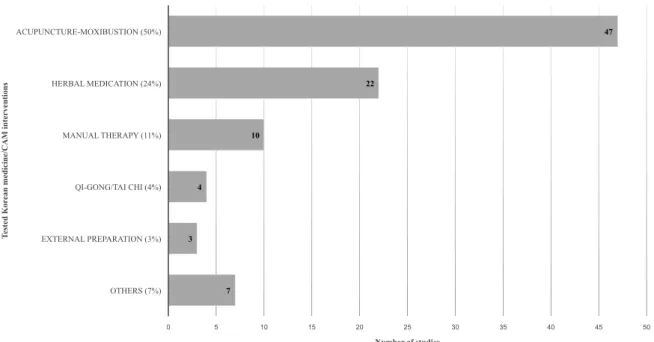
Half of the 93 included studies used acupuncture–moxibustion as the intervention (n = 47): 9 studies used non-penetrating acupuncture, such as laser acupuncture or transcutaneous electrical acupuncture point stimulation, 8 studies used electroacupuncture and manual acupuncture, including dry needling, and 21 studies
performed abdominal acupuncture. There was 1 study each using scalp acupuncture, embedded acupuncture, lidocaine injection at acupoint, auricular acupuncture, and plum blossom needle.
Moxibustion was used in 4 studies. The remaining 46 studies used herbal medication (n = 22), manual therapy, such as massage and Chuna (n = 10), Qi-gong/Tai Chi (n = 4), external preparation (n = 3), and music therapy, taping, and larval (n = 7) as the intervention (Fig. 2).
Demographic characteristics No. of studies %
Design
Parallel 90 97
Factorial 3 3
No. of patients
1-50 31 33
51-100 36 39
101-200 19 20
≥ 201 7 8
Region
Australasia 68 73
Europe 13 14
North America 6 7
Africa 5 5
South America 1 1
Diseases/conditions*
I. Certain infectious and parasitic diseases (A00-B99) 2 2
IV. Endocrine, nutritional, and metabolic diseases (E00-E90) 7 8
V. Mental and behavioral disorders (F00-F99) 9 10
VI. Diseases of the nervous system (G00-G99) 6 7
VIII. Diseases of the ear and mastoid process (H60-H95) 1 1
IX. Diseases of the circulatory system (I00-I99) 16 17
X. Diseases of the respiratory system (J00-J99) 4 4
XI. Diseases of the digestive system (K00-K93) 2 2
XII. Diseases of the skin and subcutaneous tissue (L00-L99) 3 3
XIII. Diseases of the musculoskeletal system and connective tissue (M00-M99) 18 19
XIV. Diseases of the genitourinary system (N00-N99) 3 3
XVIII. Symptoms, signs and abnormal clinical and laboratory findings, NEC (R00-R99) 6 7
XIX. Injury, poisoning and certain other consequences of external causes (S00-T98) 3 3
XXI. Factors influencing health status and contact with health services (Z00-Z99) 12 14
Classification based on the Korean Standard Classification of Diseases.
NEC, not elsewhere classified.
Table 1. Demographic Characteristics of the Studies Included in This Review (n = 93).
Control groups also involved various treatments: oral medication (n = 47), rehabilitation exercise (n = 21), injection (n = 12), external preparation and surgical procedure (n = 4), physiotherapy (n = 8), and compression bandages (n = 1).
Effectiveness of integrative Korean medicine/CAM and Western medicine treatment
A detailed descriptive summary of the included studies, based on the KCD codes [9], is provided as supplementary material (Supplementary Tables 1-5). The direction of outcome
Fig. 2. Types of Korean medicine/CAM interventions.
CAM, complementary alternative medicine.
Fig. 2. Types of Korean medicine/CAM interventions.
CAM, complementary alternative medicine.
7 3
4
10
22
47
0 5 10 15 20 25 30 35 40 45 50
OTHERS (7%) EXTERNAL PREPARATION (3%) QI-GONG/TAI CHI (4%) MANUAL THERAPY (11%) HERBAL MEDICATION (24%) ACUPUNCTURE-MOXIBUSTION (50%)
Number of studies
Tested Korean medicine/CAM interventions
Fig. 3. Frequency and outcomes by the subject of a study.
KCD, Korean Standard Classification of Diseases.
Fig. 3. Frequency and outcomes by the subject of a study.
KCD, Korean Standard Classification of Diseases.
12 3
6 3
18 3
2 4
16 1
6
9 7 2
2 0
2 1
3 2 1 1 1 0
1 2 0 0
0 2 4 6 8 10 12 14 16 18 20
FACTORS INFLUENCING HEALTH STATUS AND CONTACT WITH HEALTH SERVICES (Z00-Z99) INJURY, POISONING AND CERTAIN OTHER CONSEQUENCES OF EXTERNAL CAUSES (S00-T98) SYMPTOMS, SIGNS AND ABNORMAL CLINICAL AND LABORATORY FINDINGS, NEC (R00-R99) DISEASES OF THE GENITOURINARY SYSTEM (N00-N99) DISEASES OF THE MUSCULOSKELETAL SYSTEM AND CONNECTIVE TISSUE (M00-M99) DISEASES OF THE SKIN AND SUBCUTANEOUS TISSUE (L00-L99) DISEASES OF THE DIGESTIVE SYSTEM (K00-K93) DISEASES OF THE RESPIRATORY SYSTEM (J00-J99) DISEASES OF THE CIRCULATORY SYSTEM (I00-I99) DISEASES OF THE EAR AND MASTOID PROCESS (H60-H95) DISEASES OF THE NERVOUS SYSTEM (G00-G99) MENTAL AND BEHAVIORAL DISORDERS (F00-F99) ENDOCRINE, NUTRITIONAL AND METABOLIC DISEASES (E00-E90) CERTAIN INFECTIOUS AND PARASITIC DISEASES (A00-B99)
Number of studies
KCD-7
Failed outcome Total number of studies
was determined from the results of the primary outcome or if unavailable, the most critical clinical outcome of the treatment of the condition/disease. All the included RCTs favored combined treatment of Korean Medicine/CAM–Western medicine treatment against Western medicine treatment only, as determined by the inclusion criteria for this study. Of the included RCTs 17.2%
(n = 16) studies failed to find any advantage of combined treatment over Western medicine treatment alone (Fig. 3).
Safety of Korean medicine/CAM combined with Western medi- cine treatment
Various types of AEs were reported in the 93 studies included in this review. The main AEs reported was when penetrating acupuncture was used as an intervention, and included pain in the acupoints (n = 7), bleeding and hematoma (n = 5), dizziness and nausea (n = 2), dry mouth (n = 1), fatigue (n = 1), and bruising (n = 1). In the non-penetrating acupuncture studies, redness, constipation, and headache were reported. In the herbal medicine studies, 3 cases of gastrointestinal symptoms, 2 each of headache and urination, and 1 each of urination disorder, fever, uterine bleeding, and palpitation were reported. Among studies where external applications were the intervention, acne, and skin dryness were reported.
However, the reporting quality was far from satisfactory. Of the 93 included studies, 57 (61.3%) studies mentioned AEs, while the remaining studies did not report or mention AEs. Among the 57 RCTs, 37 reported AEs, and 20 reported that there were no AEs.
Only 21 studies reported AEs separately for the combined therapy group, and the control group. Furthermore, only 13 out of those 21 studies that reported AEs, differentiated the symptoms and number of cases.
Discussion
Summary of main findings
This review analyzed the safety and effectiveness of combined Korean medicine/CAM and Western medicine treatment in recently published RCTs. Ninety-seven percent of the included studies adopted a parallel design, and the median sample size was 68, with 50–100 patients per study being the most common sample size. Most studies (73%) were published in Australasia, and disease/
conditions of the musculoskeletal system and connective tissue (M code) were the most common. Herbal medicine was the most frequent used intervention, followed by penetrating acupuncture and non-penetrating acupuncture, such as transcutaneous electrical acupoint stimulation. A total of 77 studies (83%) reported that the integrated treatment was more effective than monotherapy, but in 16 studies (17%), integrated therapy was not better than monotherapy. None of the reported AEs were serious or life-threatening. However, of the 93 included studies, only 13 RCTs adequately reported AEs, which is insufficient.
Why this review was performed
The Korean healthcare system has used Korean medicine and Western medicine treatment for a long time. Recently, not only has there been an increasing interest in integrative medicine from patients and the medical community in Korea, but also from around the globe [10-15], and these preferences may reduce the social costs, and complement limitations in both approaches to medicine [2]. An integrative healthcare system can also promote patients’ autonomy in medical decision-making, and improve the
quality and convenience of medical services [1,16]. However, most previous studies have only provided weak evidence on integrated healthcare, mainly from case reports or nRCTs, with little evidence from RCTs [17]. The implications are that the data available is insufficient for practical clinical applications, and this also reflects concerns about the efficiency or strengths of integrated healthcare practice where Western medicine is used [2]. This review sought to provide indications for future research direction of integrative medicine.
Strengths and limitations of this review
Given that many doctors that practice Western medicine are unwilling to work together with Korean medicine doctors (mainly because of concerns regarding the lack of evidence supporting integrative healthcare), this study may be helpful in providing evidence from RCTs [18] which is summarized into the pros and cons of Korean medicine/CAM treatment as well as integrative healthcare with Western medicine. As this review comprehensively covers a range of Korean medicine/CAM interventions for various medical conditions/diseases, this review may serve as a useful basis to further investigate a Korean customized integrative medical system.
It could be argued that this review focuses mainly on the effectiveness of combined interventions. While this is a limitation, it is anticipated that further in-depth analysis will be feasible when comprehensive RCTs are published in the future, and differential effects of various Korean medicine/CAM interventions combined with Western medicine, may propose certain diseases/conditions which are more suitable for integrated healthcare. Finally, the studies reviewed were limited to KMCRIC EBM DB which retrieves studies through PubMed, DARE, and OASIS databases only. As this was not a formal SR examining the effectiveness of a specific intervention for a specific condition, it was a comprehensive narrative review, the KMCRIC EBM DB, which exclusively provides the RCTs and SRs in the Korean medicine/
CAM field, represents an appropriate resource to serve this review’s purpose. If the intention is to conduct a SR, searching the core databases, such as PubMed, EMBASE, and the Cochrane library, should be prioritized.
Implications for research and practice
More studies on various diseases/conditions and integrated interventions should be conducted. Previous reports were mainly concerned with musculoskeletal disorders, and there is a wide gap between the evidence collected through this review, and the needs of the Korean population. A recent survey conducted by the Ministry of Health and Welfare in 2012, reported that Korean medicine doctors, Western medicine physicians, and patients unanimously answered that 1) cancer, 2) cerebrovascular diseases, and 3) atopic dermatitis should be prioritized as appropriate diseases/conditions for integrative healthcare in Korea [2].
In other words, future research on these diseases/conditions is urgent, considering the demand in these clinical fields. In addition, most of the current RCTs in this review were limited to reporting the effectiveness of combined treatment, and there is a lack of economic evaluations of integrated medical care system implementation or health service research. Researchers and research funding bodies should consider these issues when making decisions about research priorities or funding allocations.
Conflicts of Interest
The authors have no conflicts of interest to declare.
Acknowledgment
This work was supported by the National Research Foundation (NRF) of Korea funded by the Korean government (Ministry of Science and ICT, grant no.: NRF-2018R1A6A6031080).
References
[1] Lim SM. An actual utilization and development plan study of interdisciplinary medical care at the national rehabilitation center. The Korea Institute of Oriental Medical Diagnostics 2014;18:25-31. [in Korean].
[2] Kwon YK [Internet]. A research on the discovery of diseases for Korean- Western cooperation considering the effectiveness of treatment. Ministry of Health and Welfare Department of Korean Medicine Policy; 2012. Available from: http://www.prism.go.kr/homepage/theme/retrieveThemeDetail.
do?leftMenuLevel=110&cond_brm_super_id=NB000120061201100060495
&research_id=1351000-201300071. [in Korean].
[3] Health Insurance Review and Assessment Service [Internet]. Health Insurance Review and Assessment Service Publication 2019-247. Health Insurance Review and Assessment Service. [cited 2019 Aug 26]. Available from: http://www.hira.or.kr/bbsDummy.do?brdBltNo=7487&brdScnBltNo=
4&pageIndex=1&pgmid=HIRAA020002000100. [in Korean].
[4] Han KI. Reviewing research of eastern-western integrative medicine studies in Korea. J Korean Med Rehabil 2018;28:53-60. [in Korean].
[5] Korean Medicine Convergence Research Information Center [Internet].
Evidence-based medicine DB. [cited 2017 Jun 30]. Available from: https://
www.kmcric.com/database/ebm_search.
[6] OASIS [Internet]. Introduction of OASIS. [cited 2019 Oct 13]. Available from: https://oasis.kiom.re.kr/contents/c_kiom01.do?srch_menu_
nix=M536r614.
[7] National Institutes of Health [Internet]. Complementary and alternative medicine. [cited 2017 Jun]. Available from: https://www.nlm.nih.gov/tsd/
acquisitions/cdm/subjects24.html.
[8] National Institutes of Health [Internet]. Complementary, alternative, or integrative health: What’s in a name? 2016 Jun [cited 2017 Jun]. Available from: https://nccih.nih.gov/health/integrative-health#types.
[9] Korean Informative Classification of Diseases [Internet]. List of disease classification. [cited 2016 Nov 30]. Available from: http://www.koicd.
kr/2016/kcd/v7.do#0&n. [in Korean].
[10] Herman P. IMPACT - Integrative Medicine Primary Care Trial: Protocol for a comparative effectiveness study of the clinical and cost outcomes of an integrative primary care clinic model. BMC Complement Altern Med 2014;14:132.
[11] Wang J. Systematic reviews/meta-analyses of integrative medicine in Chinese need regulation and monitoring urgently and some suggestions for its solutions. Chin J Integr Med 2018;24:83-86.
[12] Andersson S. Patients’ experiences and perceptions of integrative care for back and neck pain. Altern Ther Health Med 2012;18:25-32.
[13] Kwon NH. Comparative clinical study between oriental medical and oriental-western medical treatment on bell`s palsy. J Korean Acupunct Moxib Soc 2008;25:19-28. [in Korean].
[14] Templeman K. Integrative medicine models in contemporary primary health care. Complement Ther Med 2011;19:84-92.
[15] Park HS. A study on the facial palsy patients’ use of Western-Korean collaborative treatment: Using Health Insurance Review & Assessment Service-National Patients Sample. J Korean Data Info Sci Soc 2017;28:75-86.
[in Korean].
[16] Lee W. The problems of cooperative medical system of oriental and western medicine and their solutions. J Korean Med 1999;20:3-11. [in Korean].
[17] Kim C. A literature review of the east-west medical combined treatment.
Korea J Orient Med 2012;18:101-116. [in Korean].
[18] Burns PB. The levels of evidence and their role in evidence-based medicine.
Plast Reconstr Surg 2011;128:305-310.