Lettuce leaves에 접종된 Foodborne Pathogen에 대한 Aerosolized Peroxyacetic Acid의 살균 효과
오세욱1, 강동현2
1식품안전성연구본부 식품위해제어연구팀
2Washington State University
ABSTRACT
As an alternative to gaseous sanitizer which having penetrating and diffusing capacities, aerosol sanitizer’s effect on killing pathogens was investigated. To test the efficacy of aerosolized sanitizer, peroxyacetic acid was aerosolized(5.42 ∼ 11.42 µm) by nebulizer(Royal-G Enterprise, ShenZhen, China) in a model cabinet against artificially inoculated target microorganisms on lettuce. Lettuce leaves were inoculated with a cocktail of three strains each of Escherichia coli O157:H7, Listeria monocytogenes, and Salmonella Typhimurium and treated with sanitizer aerosol for 10 min, 30 and 60 min in a model aerosol cabinet at room temperature(22 ± 2°C). After treatment, surviving cells including injured cells were enumerated on appropriate selective agar or using the over-lay agar method, respectively. Inoculated lettuce leaves exposed to antimicrobial aerosol for 10 min experienced a 0.8 log reduction in E. coli O157:H7, a 0.3 log reduction in Salmonella Typhimurium and a 2.5 log reduction in L. monocytogenes when compared to the control. After 30 min treatment, the three pathogens were reduced in number of CFU by 2.2, 3.3, and 2.7-log and after 60 min, the reductions were 3.4, 4.5, and 3.8-log, respectively. Aerosolization can be new antimicrobial agents delivery system in food sanitizing.
Key words: sanitizer, aerosol, aerosolization, lettuce, cabinet
Ⅰ. Introduction
식중독을 유발하는 식품위해 미생물은 전 세계 적으로 수많은 질병을 유발하고 있으며 이와 동반 하여 미국의 경우 일 년에 수천 명을 사망케 하고
있다(41). 최소가공 야채, 과일의 섭취가 증가함에 따라 식중독의 발생 빈도가 높아지고 있다(2, 43).
따라서 식품 위생을 확보하기 위해서는 식중독 유 발 가능성을 축소시키는 것이 가장 중요하다고 할 수 있다. 그러나 식중독 유발세균을 제어하는 것
은 식품의 고유 특성과 관련된 다양한 변수가 관 여하므로 결코 단순하다고 할 수 없으며 획일적인 방법으로 적용하기에도 무리가 있다. 항균물질을 식품에 직접 처리하는 것이 가장 보편적으로 활용 되고 있는 기술로서 오래전부터 aqueous sanitizer 를 spraying 방법이나 dipping 방법으로 이용하고 있다. 이러한 방법들은 식품위해 미생물을 저감시 키는데 비교적 효율적인 방법이라고 평가되고 있 지만 식품의 surface phenomena, 즉 surface cracks나 biofilm이 존재할 경우 살균 효과가 감소할 수 있 다. 이는 입체적인 구조특성에 의하여 sanitizer와 pathogen의 접촉이 방해될 수 있기 때문이다.
Charkowski 등(4)은 wrinkled alfalfa seed는 많은 수 의 aerobic bacteria가 wrinkled 표면에 존재하며 이 러한 경우 smooth seed에 비하여 살균하기가 어렵 다고 보고하였으며 Ito 등(19)은 인위적으로 접종 된 seeds에서 자란 radish sprouts에 대한 미생물 분 석 결과 inner tissues와 cotyledons stomata에서 viable E. coliO157:H7을 검출할 수 있었다고 하였 다. Han 등(12)은 green pepper의 injured surface에 서 E. coli O157:H7가 계속적인 성장을 하였다고 보고 하였다. Seo 등(36)은 aqueous sanitizer를 처리 한 후에도 lettuce의 cut edge와 stomata에서 많은 수의 E. coli O157:H7가 생존하였다고 하였다.
Aqueous sanitizers는 pathogen이 이러한 sites에 존재할 경우 수용액의 특성이 표면장력이 크므로 입체적으로 서로간의 접촉이 어렵기 때문에 살균 효과가 떨어지게 된다. 이러한 단점을 해결할 수 있는 가장 효과적인 방법은 gaseous sanitizer를 활 용하는 것으로 알려져 있다. 실제로 gaseous sanitizer의 효과에 대한 많은 보고가 있으며(11, 12, 13, 21), surface hindrance가 존재할 경우 가장 효율 적인 방법으로 평가되고 있다. 그러나 gaseous sanitizer의 경우 몇 가지의 단점이 보고되고 있는 데, 이는 gas 생성을 위하여 복잡한 기계장치를 필
요로 하며 gaseous sanitizer로 활용할 수 있는 항균 제의 수가 제한되어 있다는 것이다.
Aerosolizaton는 액체상태의 물질이 공기 중에서 fine mist의 형태로 부유하여 존재하고 있는 현상 으로 정의할 수 있다. 현재까지는 주로 therapeutic 과 sanitary의 목적으로 사용되고 있는데 respiratory medical treatments(33, 35, 42)나 room disinfection(8, 16)이 주로 이용되고 있는 분야이다. Therapeutic 목적으로는 공기 중으로 전염되는 질병치료에 aerosol therapy(1, 5, 14, 23, 27, 28)가 활용되고 있 다. Pseudomonas aeruginosa(7, 15), Staphylococcus aureus(25), Alcaligenes xylosoxidans(32)와 Aspergillus fumigatus empyema(30)가 target microorganisms이라 고 알려져 있으며 다양한 항균제를 aerosol 형태로 서 전달하여 치료하고 있다(10, 26, 30, 31). Safe room disinfection도 aerosolization을 활용하고 있는 분야인데, antimicrobial aerosol로 축사를 살균하였 을 경우 생산량을 증대시킬 수 있는 효과적인 방 법이라고 하였다(29, 38, 39, 40). Fišer(8)는 양계장 을 lactic acid aerosol을 이용하여 계속적인 살균을 실시한 결과 닭의 건강 상태가 개선되었다고 보고 하였다. 또한, Hiom 등(16)은 병원 무균실 살균시 trigger spray 보다 fine aerosol mists의 경우 penetrating activity가 높았으며 표면살균에 보다 효 과적이었다고 보고하였다.
Aerosol은 높은 penetrating activity가 있을 것으로 기대되고 있으며 또한 therapeutic application과 같이 antimicrobial spectrum이 넓기 때문에 aerosolization 은 sanitizer의 새로운 delivery system 으로 활용될 수 있을 것으로 기대된다. 그러나 아직까지 식품의 살균에 aerosol을 사용한 예는 보고된 바 없으므로, 본 연구에서는 aerosol sanitizer의 pathogen에 대한 살균효과를 검증하여 새로운 delivery system으로서 의 가능성을 타진하고자 하였다.
Ⅱ. Materials and Methods
□ 공시균주 및 배양조건 : E. coli O157:H7 (ATCC 35150, ATCC 43889, ATCC 43890), Salmonella Typhimurium(ATCC 19585, ATCC 43174, ATCC 363755)와 L. monocytogene (ATCC 19114, ATCC 19113, ATCC 7644)의 각 각 3 균주씩은 Washington State University (Pullman, Wash.)의 Food Science and Human Nutrition culture collection에서 수집하였으며 이를 lettuce에 접종하여 실험하였다. 각각의 균주는 Tryptic Soy Broth(TSB: Difco, Becton Dickinson, Sparks, Md.)를 이용하여 37ºC에서 24시간 배양한 후 4ºC에서 4,000 x g의 조건 으로 20 분간 원심분리하여 균을 수거하였으 며 buffered peptone water(Difco)로 3번 washing 하였다. 원심분리 후 cell pellet을 buffered peptone water를 이용하여 희석한 후 108 에서 109 CFU/ml로 조정하여 culture cocktail을 제조 하였으며 이를 실험에 공시하였다.
□ 시료처리 및 접종 : Lettuce는 학교 주변 식료 품점에서 구입하였으며(Pullman, Wash.) 잎을 25 g이 되도록 분리한 후 멸균 aluminum foil에 정치 시켰다. 접종은 100 µl의 pathogen cocktail을 micropipettor를 이용하여 최소한 10 군데 이상 의 잎 위에 점적하였다. 접종된 잎은 fan이 돌 아가는 상태에서 biosafety hood내에서 laminar flow로 30분간 건조시켜 접종된 pathogen을 고 정화하였다.
□ Sanitizer 조제 및 잔존 peroxyacetic acid 측정 : Sanitizer로는 Tsunami 200(EcoLab, St. Paul, Minn.)을 사용하였으며 물에 희석하여 용액 속 잔존 peroxyacetic acid가 40 ppm 이하가 되도록
조정하였다. 즉, 이 농도는 1 liter의 증류수에 Tsunami 200을 0.33g(311 µl) 첨가하여 제조하 였다. 모든 실험은 동일 농도 조건에서 시행되 었으며 잔존 peroxyacetic acid 함량은 Peracid/
Peroxide Test Kit, #311 (EcoLab)를 이용하여 분 석하였다.
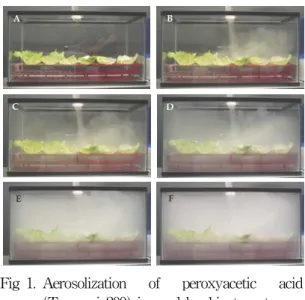
□ Antimicrobial aerosol 처리 : Antimicrobial aerosol 효과 검증을 위한 실험으로서 model cabinet(50 x 25 x 30 cm)을 사용하였다(Fig. 1). Cabinet은 밀봉상태로 유지하였으며 실험용 aerosol generator (Royal-G Enterprise, ShenZhen, China)에서 생성 된 aerosol이 cabinet 상부로 유입되게 하였다.
수용액 peroxyacetic acid(Tsunami 200)는 generator 에 의해 약 5.42 ∼ 11.42 µm 입자로 분산되었 다. Aerosol 처리는 10분, 30분과 60분 처리하 였으며 모든 실험은 실내 온도에서 실시하였다 (22±2ºC).
A
C
F B
D
E
Fig 1. Aerosolization of peroxyacetic acid (Tsunami 200) in model cabinet system.
A: 0 sec, B: 5 sec, C: 10 sec, D: 15 sec, E: 30 sec, and F: 40 sec
Target species Enumeration media
Healthy cells Injured cells E. coli O157:H7 Sorbitol MacConkey agar
(SMAC) Sorbitol phenol red agar base (SPRAB) Salmonella
Typhimurium Xylose Lysine
Desoxycholate Agar (XLD) XLD agar overlay method (OV-XLD) monocytogenesL. Oxford Agar Basea
(OAB) OAB agar overlay
method (OV-OAB)
aOxford antimicrobic supplement was added.
Table 1. Media used for enumeration of healthy and injured cells of Escherichia coli O157:H7, Salmonella Typhimurium, and Listeria monocytogenes on lettuce leaves after antimicrobial aerosol treatment
□ Non-injured cell의 계수 : Aerosol sanitizer 처리가 끝난 후 lettuce leaves(25 g)는 50 ml의 buffered peptone water가 있는 stomacher bag에 넣은 후 Seward stomacher (400 Circulator, Seward, London, UK)를 이용하여 2분간 균질화 하였다. 처리후 시료 1 ml을 취하여 9 ml의 멸균된 buffered peptone water를 이용하여 serial dilution을 하였 으며 0.1 ml을 취하여 각각의 선택배지에 도말 하였다. Sorbitol MacConkey agar (SMAC; Difco), Xylose lysine desoxycholate agar (XLD; Difco)와 antimicrobic supplement (BactoTM Oxford antimicrobic supplement, Difco)를 첨가한 Oxford agar base (OAB; Difco)를 각각 E. coli O157:H7, Salmonella Typhimurium와 L. monocytogenes 선택배지로 사 용하였다(Table 1). 이를 37°C 조건에서 24시 간이나 48 시간 배양한 후 균수를 계수하였다.
□ Injured cells의 계수 : 1% sorbitol을 첨가한 Phenol red agar base(SPRAB; Difco)를 E. coli O157:H7 injured cell 계수에 사용하였다(36).
SPRAB 배지에서 성장한 추정 균주를 분리하여 E. coli O157:H7(RIM, E. coli O157:H7 Latex Agglutination Test; Remel, Lenexa, Kan.)에 대한 serological confirmation을 실시하였다. Salmonella Typhimurium과 L. monocytogenes의 injured cell
은 XLD agar와 OAB를 이용하여 overlay(OV) method를 사용하여 계수하였다. Tryptic soy agar (TSA; Difco)를 이용하여 37°C에서 2시간 배양하여 injured cell을 회복시켰으며 7 ml의 selective medium(XLD or OAB agar)을 Tryptic soy agar에 overlay 한 후 37°C에서 24시간이 나 48시간 배양한 후 특정적인 colony를 계수 하였다.
□ 통계처리 : 모든 실험은 duplicate sample을 이 용하여 3반복 실험 하였다. 데이터는 SAS (SAS Institute, Cary, NC)의 ANOVA procedure 를 이용하여 분석하였다 (treatment, storage time, and treatment storage). 효과가 significant (P <
0.05) 할 경우 평균은 Duncan’s multiple range test를 수행하였다.
Ⅲ. Results and Discussion
Fig. 1은 model cabinet에서 aerosol sanitizer가 분 산되는 동력학적 특성을 보여주고 있다. Cabinet에 서 aerosol이 빠른 속도로 분산되었으며 40초 후에 거의 포화 된 상태를 나타내었다. Peroxyacetic acid(Tsunami 200) aerosol은 model cabinet에서 골고루 분산되었으며 gaseous 한 분산 형태를 나타내었다.
Fig. 2는 Tsunami 200 aerosol로 inoculation된 lettuce leaves에 처리한 후 각각 SMAC과 SPRAB 배지를 이용하여 surviving 한 E. coli O157:H7를 계수한 결과이다. Lettuce leaves에는 g 당 106-7 CFU의 E.
coli O157:H7을 접종하였으며 이는 상온에서 60분 동안 sanitizer를 처리하지 않은 경우 미생물 수의 변화가 없었다(대조구). 그러나 aerosol sanitizer를 처리하였을 경우, 10분, 30분 그리고 60분 처리 후 0.8, 2.2 그리고 3.4 log units 만큼 감소하였다.
SMAC과 SPRAB로 계수한 경우 통계적으로 유의 한 차이가 없었으므로(P > 0.05) Peroxyacetic acid (Tsunami 200) aerosol이 chemically injured cell을 형성하지 않으면서 효율적으로 E. coli O157:H7을 저감화 시킴을 알 수 있었다.
Treatment time (min)
0 10 20 30 40 50 60 70
Log10 CFU/g
0 2 4 6 8
Fig 2. Survival curves for Escherichia coli O157:H7 on lettuce leaves exposed to antimicrobial aerosol at room temperature (22 ± 2ºC). E. coli O157:H7 before and after treatment was enumerated on both MacConkey Sorbitol Agar (SMAC) and Phenol Red Agar Base with 1% sorbitol (SPRAB) for enumeration of normal cells and recovery of injured cells, respectively.
The error bars indicate 95% confidence intervals. ●, SMAC (control); ○, SMAC (aerosol treatment); ▼, SPRAB (control);
▽, SPRAB (aerosol treatment)
Salmonella Typhimurium은 10분, 30분, 60분 처리 한 경우 0.3, 3.3과 4.5 log units 만큼 감소하였으 며 10분 처리한 경우 0.9 log CFU/g 만큼의 chemically injured Salmonella Typhimurium cell을 검 출할 수 있었으며 30분 및 60분 처리한 경우 1.2 log CFU/g의 injured cell이 각각 검출되었다. XLD 와 OV-XLD로 검출한 경우(P > 0.05) 통계적인 유 의한 차이는 없었다(Fig 3). L. monocytogenes는 동 일한 시간처리 시 2.5, 2.7 그리고 3.8 log reduction 을 각각 나타내었다. Healthy cell과 injured cell 사 이에는 역시 통계적으로 유의한 차이가 없었다(P
< 0.05)(Fig. 4).
Treatment time (min)
0 10 20 30 40 50 60 70
Log10 CFU/g
0 2 4 6 8 10
Fig 3. Survival curves for Salmonella Typhimurium on lettuce exposed to antimicrobial aerosol at room temperature (22 ± 2ºC).
Salmonella Typhimurium before and after treatment was enumerated on Xylose Lysine Desoxycholate Agar (XLD) both directly and with the Overlay (OV) method for enumeration of normal cells and recovery of injured cells, respectively.
The error bars indicate 95% confidence intervals. ●, XLD (control); ○, XLD (aerosol treatment); ▼, OV-XLD (control);
▽, OV-XLD (aerosol treatment)
Treatment time (min)
0 10 20 30 40 50 60 70
Log10 CFU/g
0 2 4 6 8
Fig 4. Survival curves for Listeria monocytogenes on lettuce leaves exposed to antimicrobial aerosol at room temperature (22 ± 2ºC).
L. monocytogenes before and after treatment was enumerated on Oxford Agar Base (OAB) both directly and with the Overlay (OV) method for enumeration of normal cells and recovery of injured cells, respectively. The error bars indicate 95% confidence intervals. ●, OAB (control); ○, OAB (aerosol treatment); ▼, OV-OAB (control); ▽, OV-OAB (aerosol treatment)
많은 연구자들이 lettuce나 과일 등의 food products에서 Tsunami가 pathogen을 사멸시키는 효 과에 대하여 보고하고 있다. Lukasik 등(24)은 Tsunami을 peroxyacetic acid의 함량 기준으로 100 ppm 조건으로 처리하였을 경우 E. coli O157:H7을 96.8% 사멸하였다고 하였으며 strawberry에서 Salmonella Montevideo를 97.3% 사멸하는 효과가 있었다고 하였다. 23oC에서 Tsunami 200을 40, 60 ppm 농도 조건으로 10분간 처리하였을 경우 seed 에 접종된 E. coli O157:H7을 1.12와 1.30 log CFU/g 씩 저감화 하였다고 하였다(3). 또한 58oC에 서 40 ppm과 160 ppm을 5분간 처리하였을 경우
2.88과 2.46 log CFU/g에 상당하는 살균효과가 있 었다고 보고하였다(3).
미생물은 과일이나 채소의 표면에 붙어서 존재 할 수 있으며, aqueous sanitizer를 처리할 경우 injured site에 의해 보호되고 있거나 hydrophobic pockets, folds 등에 존재하여 격리될 경우 원활한 사멸효과가 일어나지 않을 수 있다(34). 많은 연구 자들이 위해미생물의 표면 접촉과 sanitizer 처리에 의한 효과에 대하여 보고하고 있으며(9, 22, 37, 45) 위해 미생물이 식품표면의 고유의 특성이라 할 수 있는 여러 가지 물리적인 구조에 의하여 sanitizer에 대한 저항성을 가질 수 있다고 하였다.
한편, 과일이나 야채의 표면에 부착된 위해 미생 물에 대한 살균이 효율적이지 못하였다는 다양한 보고도 있다. Beuchat 등(2)은 iceberg lettuce에 접 종된 Salmonella를 aqueous chlorine으로 처리하였을 경우 1-log reductions 이하의 살균효과가 있었다고 하였으며, Zhang 등(44)은 22ºC 조건에서 aqueous chlorine과 chlorine dioxide를 lettuce에 접종된 L.
monocytogenes에 대하여 처리하였을 경우 각각 1.7 과 0.8 log 만큼의 저감화가 일어났다고 하였다.
이와 같은 대부분의 실험에서 과일과 채소에 대하 여 aqueous sanitizer는 2 log 정도의 저감화 효과가 있었다고 하였다. 이러한 단점을 극복할 수 있는 방법으로는 gaseous sanitizer를 사용하는 것으로서 Han 등(12)은 pepper surface의 uninjured와 injured surfaces에 대한 chlorine dioxide gas를 0.62와 1.24 mg/liter 농도로 처리하였을 경우, 3.3과 6.5 log reduction이 일어났다고 하였으며 또한 0.6과 3.0 mg/liter 농도의 chlorine dioxide gas 처리하였을 경우 uninjured와 injured surface에 접종된 L. monocytogenes 에 대하여 3.5와 6.0 log reduction이 일어났다고 하 였다. Lee 등(20)은 chlorine dioxide gas를 처리하였 을 경우 lettuce에 접종된 S. Typhimurium에 대하여 5.4 log reduction이 발생하였다고 보고하였다.
Gaseous sanitizer는 aqueous sanitizer에 비하여 많 은 장점이 있지만, gas 생성을 위해서 복잡한 기계 장치를 요구하며 또한 sanitizer로 이용할 수 있는 항균제의 수가 제한되어 있는 단점이 있다.
반면에 aerosol은 penetrating activity가 aqueous sanitizer보다 높으며 또한 가용성의 antimicrobial agents는 aerosolization에 의하여 target site에 원활 하게 전달될 수 있다. 따라서 aerosolization은 다양 한 antimicrobials agents의 효율적인 delivery tool이 라고 할 수 있다. 실제로, therapeutic application에 서는 다양한 antibiotics가 aerosol ventilation(6, 10, 25, 26)에 의해서 target site에 전달되고 있으며 또 한 room disinfection application에서도 lactic acid와 acetic acid 등의 유기산이 aerosolization에 의해 살균제 로 이용되고 있다. 따라서 aerosolization은 aqueous sanitizer의 다양한 antimicrobial agents를 활용할 수 있다는 장점과 높은 penetrating activity를 나타내는 gaseous sanitizer의 장점을 모두 가지고 있다고 할 수 있다. 또한 new aerosolization machine(17, 18)의 계속적인 발전에 의하여 향후 더욱 더 작은 입자 의 aerosol 생성이 가능할 경우 보다 penetrating activity와 diffusivity가 향상될 것으로 생각된다. 그 러나, 이러한 aerosol sanitizer의 상업적 활용을 위 해서는 상대습도, 온도 조건, container의 크기 등 다양한 조건과 변수에 대한 정밀한 고찰이 중요하 다고 할 수 있다.
Ⅳ. References
1. Bauldoff, G. S., D. R. Nunley, J. D. Manzetti, J. H. Dauber, and R. J. Keenan. 1997. Use of aerosolized colistin sodium in cystic fibrosis patients awaiting lung transplantation. Transplantation 64:748-752.
2. Beuchat, L. R. 1998. Surface decontamination of fruits and vegetables eaten raw: a review.
WHO/FSF/FOS/98.2, 42 pp. World Health
Organization, Geneva.
3. Beuchat, L. R., and A. J. Scouten. 2002.
Combined effects of water activity, temperature and chemical treatments on the survival of Salmonella and Escherchia coli O157:H7 on alfalfa seeds. J. Appl. Microbiol.
92:382-395.
4. Charkowski, A. O., Sarreal, C. Z., Mandrell, R.
E. 2001. Wrinkled alfalfa seeds harbor more aerobic bacteria and are more difficult to sanitize than smooth seeds. J. Food Prot.
64:1292-1298.
5. Chua, H. L., G. G. Collis, and P. N. L. Souef.
1990. Bronchial response to nebulized antibiotics in children with cystic fibrosis.
Eur. Respir. J. 3:1114-1116.
6. Coates, A. L., C. F. MacNeish, D. Meisner, S.
Meisner, S. Kelemen, R. Thibert, J.
MacDonald, and E. Vadas. 1997. The choice of jet nebulizer, nebulizing flow, and addition of albuterol affects the output of tobramycin aerosols. Chest 111:1206-1206.
7. Diot, P., F. Gagnadoux, C. Martin, H.
Ellataoui, Y. Furet, M. Breteau, E. Boissinot, and E. Lemarie. 1997. Nebulization and anti-Pseudomonas aeruginosa activity of colistin. Eur. Respir. J. 10:1995-1998.
8. Fišer, A. 1978. Disinfection of air and dust in fattening houses for chickens by lactic acid aerosol, Acta. Vet. Brno. 47:173-183
9. Foschino, R., I. Nervegena, A. Motta, and A.
Galli. 1998. Bactricidal activity of chlorine dioxide against Escherchia coli in water and on hard surfaces. J. Food Prot. 61:668-672.
10. Griese, M., A. Schams, and K. P. Lohmeier.
1998. Amphotericin B and pulmonary surfactant.
Eur. J. Med. Res. 3:383-386.
11. Han, Y., A. M. Guentert, R. S. Smith, R. H.
Linton, and R. E. Nelson. 1999. Efficacy of chlorine dioxide gas as a sanitizer for tanks used for aseptic juice storage. Food Mcirobiol. 16: 53-61.
12. Han, Y., R. H. Linton, S. S. Nielsen, and P.
E. Nelson. 2000. Inactivation of Escherichia coli O157:H7 on surface-uninjured and – injured green pepper (Capsicum annuum L.) by chlorine dioxide gas as demonstrated by confocal laser scanning microscopy. Food Microbiol. 17: 643-655.
13. Han, Y., R. H. Linton, S. S. Nielsen, and P.
E. Nelson. 2001. Reduction of Listeria monocytogenes on green peppers (Capsicum annuum L.) by gaseous and aqueous chlorine dioxide and water washing and its growth at 7°C. J. Food Prot. 64: 1730-1738.
14. Harris, C. E., and R. W. Wilmott. 1994.
Inhalation-based therapies in the treatment of cystic fibrosis. Curr. Opin. Pediatr.
6:234-238.
15. Hashimoto, S., E. Wolfe, B. Guglielmo, R.
Shanks, J. Sundelof, J. F. Pittet, E. Thomas, J. Wiener-Kronish. 1996. Aerosolization of imipenem/cilastatin prevents Pseudomonas-induced lung injury. J. Antimicrobial Chemotherapy 38: 809-818.
16. Hiom, S. J., C. Lowe, and M. Oldcorne. 2003.
Assessment of surface bioburden during hospital aseptic processing. The international journal of pharmacy practice, September, R62.
17. Hung, J. C., G. Hambleton, and M. Super.
1994. Evaluation of two commercial jet nebulisers and three compressors for the nebulisation of antibiotics. Arch. Dis. Child.
71:335-338.
18. Hurley, P. K., S. W. Smye, and H. Cunliffe.
1994. Assessment of antibiotic aerosol generation using commercial jet nebulizers. J.
Aerosol Med. 7:217-228.
19. Itoh, Y., Y. Sugita-konishi, F. Kasuga, M.
Iwaki, Y. Hara-kudo, N. Saito, Y. Noguchi, H. Konuma, and S. Kumagai. 1998.
Enterohemorrhagis Escherchia coli O157:H7 present in radish sprouts. Appl. Environ.
Microbiol. 64:1532-1535.
20. Lee, S. Y., Costello, M., and D. H. Kang.
2004. Efficacy of chlorine dioxide gas as a sanitizer of lettuce leaves. J. Food Prot.
67:1371-1376.
21. Lee. S. Y., and D. H. Kang. 2001. Suitability of overlay method for recovery of heat-injured Listeria monocytogens and Salmonella Typhimurium.
Food Sci. Biotechnol. 10:323-326.
22. Lindsay, D., and A. von Holy. 1999. Different responses of planktonic and attached Bacillus subtilis and Pseudomonas fluorescens to sanitizer treatment. J. Food Prot. 62:368-379.
23. Littlewood, J. M., S. W. Smye, H. Cunliffe.
1993. Aerosol antibiotic treatment in cystic fibrosis. Arch. Dis. Child. 68:788-792.
24. Lukasik, J., M. L. Bradley, T. M. Scot, M.
Dea, A. Koo, W. Hsu, J. A. Bartz, and S. R.
Farrah. 2003. Reduction of Poliovirus 1, Bacteriophages, Salmonella Montevideo, and Escherichia coli O157:H7 on strawberries by physical and disinfectant washes. J. Food Prot. 66:188-193.
25. Maiz, L, R. Canton, N. Mir, F. Baquero, H.
Escobar. 1998. Aerosolized vancomycin for the treatment of methicillin-resistant Staphylococcus aureus infection in cystic fibrosis. Pediatr.
Pulmonol. 26:287-289.
26. Melani, A. S., and A. Di Gregorio. 1998.
Acute respiratory failure due to gentamicin
aerosolization. Monaldi Arch. Chest Dis.
53:274-276.
27. Mukhopadhyay, S., G. E. Staddon, C.
Eastman, M. Palmer, E. R. Davies, and F.
Carswell. 1994. The quantitative distribution of nebulized antibiotic in the lung in cystic fibrosis. Respir. Med. 88:203-211.
28. Palmer, L. B., G. C. Smaldone, S. R. Simon, T. G. O’Riordan, A. Cuccia. 1998. Aerosolized antibiotics in mechanically ventilated patients:
delivery and response. Crit. Care Med.
26:31-39.
29. Profe, D. and A. Steiger. 1982. Aerosol distribution in the air on surfaces of the animal house. Taguingsbericht 197:113-120.
30. Purcell, I. F., and P. A. Corris. 1995. Use of nebulised liposomal amphotericin B in the treatment of Aspergillus fumigatus empyema.
Thorax 50:1321-1323.
31. Ramsey, B. W., M. S. Pepe, J. M. Quan, K.
L. Otto, A. B. Montgomery, J. Williams- Warren, M. Vasiljev-K, D. Borowitz, C. M.
Bowman, B. C. Marshall, S. Marshall, and A. L. Smith. 1999. Intermittent administration of inhaled tobramycin in patients with cystic fibrosis. N. Engl. J. Med. 340:23-30.
32. Saiman, L., Y. Chen, S. Tabibi, P.S. Gabriel, J. Zhou, Z. Liu, L. Lai, and S. Whittier. 2001.
Identification and antimicrobial susceptibility of Alcaligenes xylosoxidans isolated from patients with cystic fibrosis. J. Clin.
Microbiol. 39:3942-3945.
33. Saiman, L. 1998. Use of aerosolized antibiotics in patients with cystic fibrosis.
Pediatr. Infect Dis. J. 17:158-159.
34. Sapers, G. M. 2001. Efficacy of washing and sanitizing methods for disinfection of fresh fruit and vegetable products. Food Technol.
Biotechnol. 39:305-311.
35. Schoni, M. H., and W. H. Nikolaizik. 1997.
Aerosol therapy in patients with cystic fibrosis. Schweiz Med. Wochenschr. 127:158-164.
36. Seo, K. H., and J. F. Frank. 1999. Attachment of Escherichia coli O157:H7 to lettuce leaf surface and bacterial viability in response to chlorine treatment as demonstrated by using confocal scanning laser microscopy. J. Food Prot. 62:3-9.
37. Smoot, L. M., and M. D. Pierson. 1998.
Influence of environmental stress of Listeria moncytogenes to Buna-Nrubber and stainless steel. J. Food Prot. 61:1286-1292.
38. Steiger, A. 1982. Importance of free air exchange for the aerosol concentration level in the animal house. Taguingsbericht 197:105-111.
39. Steiger, A., P. Trenner, and D. Profe. 1982.
Technique of aerogenic disinfection during the service period in large animal houses.
Taguingsbericht 197:93-97.
40. Šurkanovic, M. 1983. A study on the possibilities and effects of aerosol disinfection in the prophylaxis of infective disease of poultry in intensive production, Acta. Vererinaria 33:57-68.
41. Tauxe. R.V. 1997. Emerging foodborne disease: an evolving public health challenge.
Emerging Infectious Disease 3:425-434.
42. Wanner A, and A. Rao. 1980. Clinical indications for and effects of bland, mucolytic, and antimicrobial aerosols. Am. Rev. Respir.
Dis. 122:79-87.
43. Weissinger, W. R., W. Chantàrapanont, and L. R. Beuchat. 2000. Survival and growth of Salmonella baildon in shredded lettuce and diced tomatoes, and effectiveness of chlorinated water as a sanitizer. Int. J. Food Microbiol.
62:123-131.
44. Zhang, S. and J. M. Farber. 1996. The effects of various disinfectants against Listeria monocytogenens on fresh-cut
vegetables. Food Microbiol. 13:311-321.
45. Zottola, E. A. 1994. Microbial attachment and biofilm formation: a new problem for the food industry. Food Technol. 48:107-114.