Abstract
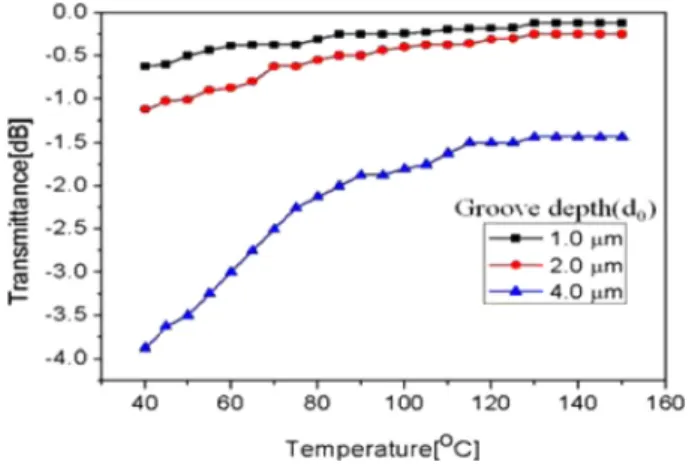
In this study, a V-grooved single-mode fiber along with optical time domain reflectometry (OTDR) as a quasi-distributed temperature sensor was investigated. The external medium used to fill the V-groove affects the optical mode. The V-groove was filled with ethylene vinyl acetate (EVA) because its transmittance was sensitive to temperature. The experimental results showed that the optical loss of the sensor varies with temperature, and the sensitivity depends on the depth of the V-groove.
Keywords: V-grooved single-mode fiber, Distributed temperature sensor, Ethylene vinyl acetate, Optical time domain reflec- tometry
1. INTROUDCTION
Capability of multi-point or distributed sensing is one of the key advantages of optical fiber sensor systems. optical time domain reflectometry (OTDR) techniques based on Raman scattering [1,2] and Brillouin scattering [3,4] are well-known distributed temperature sensing methods. A key advantage of these methods is the ability of the optical fiber to simultaneously operate as a sensor and as a signal path. This enables measurement of highly accurate data, such as, temperatures or strains at any point along the optical fiber.
However, these methods suffer from long time duration for data acquisition and processing because of very weak optical signal, and high installation cost of the sensor system. Furthermore, the sensing range of the these systems is limited to 10 km [1, 3]. Fiber bragg grating (FBG) is often used in fiber optic quasi-distributed sensor systems. However, this method requires an expensive spectrometer or interrogator to interpret the measured data [5,6], in addition to the complicated fabrication process of the FBG
sensor.
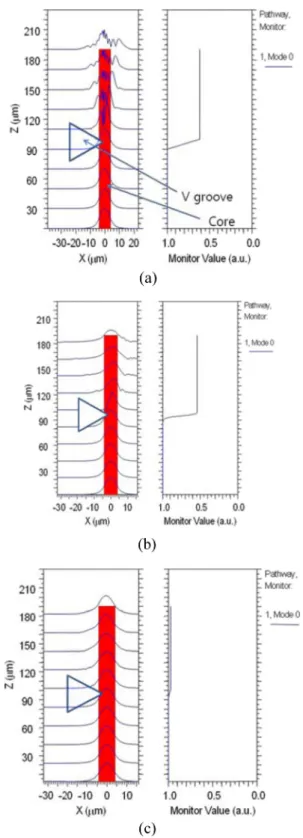
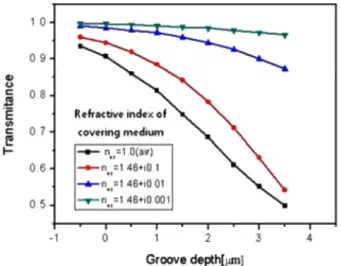
In this paper, we propose a simple V-grooved single-mode fiber as an element of quasi-distributed fiber-optic sensor. The side portion of a single-mode fiber was removed in the V- shaped form, and a small portion of the core was cut along the edge of the V-groove. The V- groove can be inscribed on the optical fiber by a very simple fabrication process by using the general dicing machine used for wafer cutting. In addition, the sensor signal can be detected by general OTDR based on Rayleigh scattering. The V-grooved fiber was applied to the multi-point single-mode fiber sensor using a medium whose transmittance was sensitive to temperature. Ethylene vinyl acetate (EVA), generally used for bonding, was used as the V- groove filling medium. The transmittance of EVA increases with an increase in the surrounding temperature. The filling medium affects the core mode leading to an inherent optical loss in the V-groove. The sensor proposed in this study is based on optical loss modulation due to the temperature variations around the filling medium. The number of sensing points and sensitivity of the sensor can be determined by controlling the specifications of the V-groove. The performance of the proposed sensor was examined by using general OTDR based on Rayleigh scattering. The shortcomings of both the Raman and Brillouin OTDR, including the high cost, long measurement time, and short sensing distance can be overcome by employing the proposed sensor. In addition, the proposed quasi-distributed sensor system based on V-grooved optical fibers is advantageous in terms of implantation cost because of the easy fabrication process of the sensor, and
1
Department of Electronic Engineering, Honam University, 506-714 Seobongdong, Gwang san-gu, Gwangju, Korea
2
Department of Mechatronics, Cheongju Korea polytechnic #54 Sandonro, Heungduk-gu, Cheongju-city, Chungbuk 361-857, Korea
+