• 검색 결과가 없습니다.

Rheological Studies, Physico-Mechanical Properties, Thermal Properties and Morphology of PVC/Waste-Gypsum Composites

N/A
N/A
Protected

Academic year: 2021

Share "Rheological Studies, Physico-Mechanical Properties, Thermal Properties and Morphology of PVC/Waste-Gypsum Composites"

Copied!
7
0
0

로드 중.... (전체 텍스트 보기)

전체 글

(1)

ISSN 2288-2103(Print), ISSN 2288-2111(Online)

Paper

Rheological Studies, Physico-Mechanical Properties, Thermal Properties and Morphology of PVC/Waste-Gypsum Composites

Vu-Giang Nguyen**, Hae-Jun Kang*, Sang-Yong Kang*, Da-Woon Jung*, Jin-Whoan Ko*, Hoang Thai**, Quang-Tham Do**, Myung-Yul Kim*

ABSTRACT: The effect of addition of gypsum on the rheology, physico-mechanical properties, thermal properties and morphology development of polymer composites based on polyvinyl chloride (PVC) and waste-gypsum with and without methylene-butadiene-styrene (MBS) has been studied. It was shown that the replacement of gypsum for methylene-butadiene-styrene (MBS) component in PVC/gypsum polymer composites enhanced the tensile strength and stiffness of composites, but gradually decreased its impact strength. The observation of morphology, the results of the physico-mechanical properties and thermal properties proved simultaneously that PVC/gypsum composite with the waste-gypsum content of 22.56 wt% reached the optimum results among five kinds of PVC/gypsum polymer composite materials investigated.

Key Words: Gypsum, PVC, Polymer composite, Rheology, Physico-mechanical, Morphology

1. INTRODUCTION

Poly (vinyl chloride) (PVC) is extraordinarily useful as a commercial material. Among the thermoplastics, it ranks second only to poly olefins in total worldwide production volume.

Remarkably, it has achieved this status despite its molecular instability towards heat; an instability that is much more pro- nounced than those of its entire major competitors. In a tech- nological sense, this difficulty has overcome a large degree, for otherwise the usage of PVC would never have reached its cur- rent level. Yet further improvements are much to be desired, not only with regard to the property of stability, but also with respect to how this property is achieved; in terms of the req- uisite monetary costs, health and environmental consider- ations, and the effects of thermal stabilization on other useful properties of the resin. Due to its inherent disadvantages, such as low thermal stability and brittleness, PVC and its com- posites are subjected to some limitations in certain applica- tions [1,2]. Consequently, it is necessary to develop new PVC

products with high quality and good properties in order to yield high added values and enlarged PVC applications.

The wet phosphoric acid has obtained by dissolving phos- phate ore into sulfuric acid in an artificial way; Namhae Chemical Company has been obtained the wet phosphoric acid according to this way to produce phosphatic fertilizers. A lot of obsolete gypsum produced in this process has been bur- ied. Gypsum consists of a di hydrate sulphate calcite (CaSO

4

· 2H

2

O), anhydrate sulphate calcite (CaSO

4

·H

2

O), calcite oxide (CaO), phosphate, and with particle size less than 200 nm.

Though, a lot of researches on recycling the abandoned gyp- sum in advanced countries, for example Germany and Japan etc. are being conducted; actually, a small amount of gypsum are used for plaster boards but most are buried in the sea wast- ing tremendous amount of expenses [3]. Especially, there is no example so far that has researched the mechanical and phys- ical properties of a product by using the gypsum onto PVC resins.

Generally, the additives used in the manufacture of PVC

Received 25 February 2014, accepted 29 June 2014

*

*

**

Department of Polymer Science and Engineering, Sunchon National University, Jeonnam 540-742, Korea

Department of Polymer Science and Engineering, Sunchon National University, Jeonnam 540-742, Korea, Corresponding author (E-mail: [email protected])

Vietnamese Academy of Science and Technology (VAST), Institute for Tropical Technology, Hanoi, Vietnam

(2)

pipes include MBS (methylene-butadiene-styrene), which is reinforcement against impact; and CaCO

3

, which is filler and so on, but there are some limitations in their prices and phys- ical properties [3]. Hence, in polyvinyl chloride (PVC)/gypsum polymer composite research, the primary goal is to enhance the strength and toughness of polymer component using rein- forcement gypsum [4]. In addition, it is also found that it has considerablyhigh content of CaO, which is similar to CaCO

3

; this shows a good effect on the scavenge HCl gas liberated from the burning halogenated polymers, thereby reduces the corrosiveness of the generated smoke [6,7]. The interaction between polymer phase as matrix phase of the polymer com- posite material and gypsum phase as distributed phase of the polymer blend has played an important role as the reinforced effects in developing a new polymer blend material.

Therefore, in this paper, we mainly investigated rheology;

the effect of gypsum content with and without the presence of MBS content on the physico-mechanical properties, thermal properties of the PVC/gypsum polymer blend material. Five kinds of rigid PVC/gypsum polymer composite with different gypsum contents were prepared by melt blending method; X- ray spectra; and morphology development of the PVC/gyp- sum polymer composite samples is also discussed in this paper.

2. EXPERIMENTAL

2.1 Materials

Suspension polymerization PVC (PVC LS-100, DP = 1000) was provided by Lucky Co. Ltd, Korea. Gypsum was produced with particle size less than 200 mesh by Namhae Chemical Co, Korea; the composition of gypsum is shown in Table 1.

Methylene-butadiene-styrene (MBS) and lead oxide (PbO) were provided by LG Chemical Co, Korea.

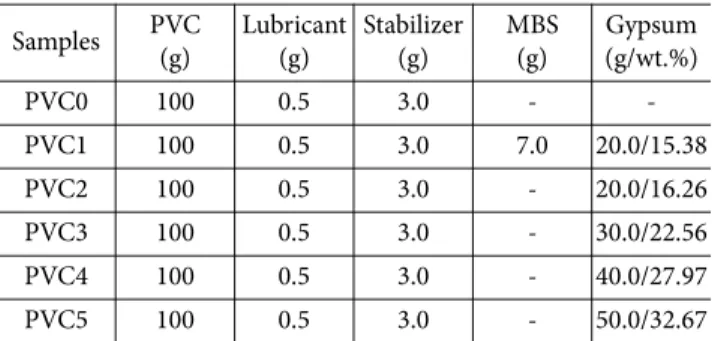
The component ratios of PVC/gypsum and additives used to observe the change of the rheological characteristics and dynamic properties base on the differences of gypsum content is shown in Table 2. For PVC1, the composition used in the manufacture of PVC pipes was used without change, and PVC2~PVC5 are those which eliminates MBS from the com- position of PVC1 and added the gypsum abandoned instead.

2.2 Preparation of PVC/gypsum polymer composites PVC/gypsum polymer composite samples were prepared by melt mixing PVC; gypsum; and processing additives in the roll-mill (Nishimura, KR-250, Japan) at 175

o

C for 5 minutes.

After that, the composites were quickly molded into sheets of 3 mm in thickness by hot pressing machine (Wabash, G302- BCLX, USA) at 175

o

C and 20 MPa for 5 minutes, followed by cooling to room temperature at 5 MPa. The sheets were prepared for the structure characterization and the property measurements.

2.3 Testing of torque rheometer

Determination of torques of melt-mixing of composites (expression of relative melt viscosity) versus time was carried out in Haake Polylab System 600 with the chamber capacity of 69 cm

3

, a couple of Roller rotors at 60 rpm, start temperature at 180

o

C for 10 minutes.

2.4 Testing of the physico-mechanical properties

The tensile strength and the elongation at break were per- formed using a Universal Tensile Tester (Instron, series IX automated materials testing system, USA) according to ASTM D638M-93/89 standard. The tensile test was conducted and obtained the average value by measuring each sample piece five times at a crosshead speed of 10 mm/min, while applying tensile strength to the manufactured sample pieces.

In order to measure the impact strength of the sample pieces, the impact strength test (Izod impact, tinus 01 sen willow, Grove, PA, USA) was conducted according to ASTM D256-97 standard. For impact strength, the results also obtained the average value by measuring each sample piece five times with a hammer speed of 3.5 m/s and pendulum weight of 0.818 kg at room temperature.

2.5 Testing of the thermal properties

Differential scanning calorimeter (DSC) analysis was con- ducted on a DSC2, DuPont 2000; TA Instrument Co, USA, at a heating rate 10

o

C/min in a flowing nitrogen atmosphere.

The temperature scan ranged from room temperature to 300

o

C.

Thermogravimetric analysis (TGA) was conducted on a Table 1. Chemical composition of gypsum (wt %)

COM AVG STD MIN MAX

D- Gypsum

TP- 1.30 0.79 0.32 3.89

WSP- 0.93 0.68 0.19 3.01

CaO 33.70 10.37 29.00 36.30

F-H

2

O 23.00 5.76 10.90 36.70

C-H

2

O 17.60 2.65 9.60 20.40

D: Dry, TP-: Total Phosphate, WSP-: Water Soluble Phosphate, F- H

2

O: Free - H

2

O, C-H

2

O: Combined - H

2

O, COM: Composition, AVG: Average, STD: Standard, MIN: minimum, MAX: Maximum.

Table 2. Sample code and composition of composites Samples PVC

(g)

Lubricant (g)

Stabilizer (g)

MBS (g)

Gypsum (g/wt.%)

PVC0 100 0.5 3.0 - -

PVC1 100 0.5 3.0 7.0 20.0/15.38

PVC2 100 0.5 3.0 - 20.0/16.26

PVC3 100 0.5 3.0 - 30.0/22.56

PVC4 100 0.5 3.0 - 40.0/27.97

PVC5 100 0.5 3.0 - 50.0/32.67

(3)

TGA, DuPont 2000, TA Instrument Co, USA at a heating rate of 10

o

C/min in a flowing nitrogen atmosphere. The tempera- ture scan ranged from room temperature to 600

o

C.

2.6 Scanning electron microscopy

The polymer composites for scanning electron microscopy (SEM) observation were coated with gold-palladium prior to examination. The SEM micrographs were obtained by using Jeol JSM-T330 system.

2.7 X-ray diffraction

X-ray diffraction data from 10

o

to 50

o

were collected at 2

o

/ min on a Brukex axs D8 Discover using Cu Kα radiation at a generator voltage of 40 kV and generator current of 100 mA.

Samples were the flat sheets with smooth surface and dimen- sion of 3 cm × 3 cm × 0.3 cm.

3. RESULTS AND DISCUSSION

3.1 Rheological studies and processing characteristics of PVC/gypsum composites following varying composition

The torque measurements have been successful in obtaining qualitative information concerning relative melt viscosity and mixing processes of the polymer blends and composites [8,9].

In order to investigate the rheological and processing char- acteristics of the composites of PVC/gypsum, we carried out mixing processes for different ratios between PVC and waste gypsum PVC0-PVC4 (as showed in Table 2) in an Haake intermixer at 180

o

C within a couple of Roller rotors at a cycling speed of 60 rpm for 10 minutes. Fig. 1 presents the relationship between torque and time of mixing for PVC0- PVC4 composites.

From Fig. 1, plots of torque of mixing for different ratios of PVC/gypsum composites (or relative melt viscosity of com- posites) distinctly expressed thermo-mechanical mixings as well as cross-linking processes of PVC in those composites.

During the first minute, the intensities of torque depicted peaks of material loaded into the chamber of Haake system, after the time for mixing process, torques gradually decreased until ground value. Probably, the higher the amount of waste gypsum in composites the lower the ground values of torque.

This may be expected due to the higher of ratio of waste gypsum which led to easier slide of particles to each other in the compound while rotors turned. When cross-linking reac- tions of PVC matrix phase took place, the fusion peaks occurred, one interestingly can see, the higher amounts of gypsum also made the slower processes of cross-linking of PVC matrix phase; as showed in Fig. 1, the fusion peaks of PVC0; PVC1; PVC2; PVC3 and PVC4 at around 1.7 min;

2.5 min; 5.1 min; 7.1 min and 9.1 min respectively. Also, the intensities of torque at the fusion peaks are not the same for those composites, and the tendency is lower the torque values with the higher waste gypsum. This can be thought that the increase of waste gypsum contents in compositions which leaded to the time of the temperature transmission process from hot wall of chamber to PVC matrix phase was longer than those of the smaller waste gypsum content in the com- positions. On the other hand, the higher waste gypsum ratios were loaded, the mixing processes became more difficult;

probably, samples may be degraded and pyrolytic before get- ting well melt-mixing. This has significantly been meaning for controlling and setting up the processing parameters such as processing temperature; range of processing time; stabilizers for thermal stability to obtain the good composite products.

3.2 Physico-mechanical properties

The results of the physico-mechanical properties are pre- sented in terms of the tensile strength; elongation at break;

Young’s modulus, and impact strength by comparing the gyp- sum content to the PVC compound samples and are given in Fig. 2(a) to (d) respectively. As shown in Table 2 and Fig. 2(a), upon adding of gypsum to the PVC compound replacing the MBS on PVC2 sample with the content of gypsum of 16.26 wt%, the tensile strength of composite was increased from 43.8 MPa up to 49.6 MPa. The highest tensile strength among five samples was measured on PVC3 sample with the gypsum content of 22.56 wt% which reached a value of 51.3MPa, then gradually decreased to 48.5 MPa and 40.9 MPa as the amount of gypsum phase increased at PVC4 and PVC5 samples, respectively. This was expected that the content of gypsum phase had a critical value on which the gypsum phase was regularly distributed in the bulk polymer, and a good compatible with PVC compound system made a peak of ten- sile strength value as shown in Fig. 2(a). If the content of gyp- sum phase is added over this value, the polymer compound system may be taken the consequence of the coalescence effect due to the increase of gypsum content, this may cause the decrease of the tensile strength of those samples [10].

On observation of the elongation at break of PVC com- Fig. 1. Plots of torque versus time of mixing for PVC/Gypsum

composites

(4)

pound samples in Fig. 2(b), when MBS, as a reinforcement agent, was rejected from PVC compound, the elongation at break drop drastically from 42.9% (PVC1, 15.38 wt% gypsum) to 32.7% (PVC2, 16.26 wt% gypsum), then 16.5% (PVC3, 22.56 wt% gypsum), then gradually decreased to 12.7%

(PVC4, 27.97 wt% gypsum), to 10.85% (PVC5, 32.67 wt%

gypsum). It was revealed that the gypsum phase plays a role as an inorganic distributed phase, which causes a decrease of the flexibility of PVC matrix phase because of the small particle size of gypsum (around 200 meshes), which easily intercalated into the vacancy of the bulk polymer [11].

One of the basic properties of composites is Young’s modulus (E-modulus) which depicts the stiffness of composite, shown in Fig. 2(c). Generally, upon the increase of filling gypsum content this led to the higher Young’s modulus of the com- posites. However, the rate of these increases was disproportional to the amount of gypsum mixed. This nonlinear dependence may indicate that the dispersion of filling gypsum was not per- fectly anisotropic in the bulk of composites. This matter also will be discussed more detail in next morphology part.

From the impact strength observed, Fig. 2(d), comparing between the samples with and without of the presence of the MBS phases impacted the strength of PVC compound sample which dramatically decreased from 6.61 Kgf.m/m to 3.65 Kgf·

m/m. However, after that the impact strength of PVC3, PVC4, and PVC5 samples gradually increased with increasing of gyp- sum content. Thus, it was clearly that the content of the gyp- sum phase distributed in PVC matrix phase has actively affected the impact strength of samples. It revealed that the gypsum phase not only plays a role as good filler, but also is a good interactive inorganic material with PVC matrix phase, which was well dispersed in the polymer system, and hence good impact strength. Although PVC5 sample had highest impact strength, the difference of the impact strength between

PVC3 and PVC5 samples is not much and so it may propose that PVC3 sample had sufficient gypsum content (22.56 wt.%) on which physico-mechanical properties have been optimal values among of the five PVC compound samples.

3.3 Thermal properties

Fig. 3 shows the DSC curves of the PVC/ gypsum blend samples. On the observation of glass transition temperature of five samples; it is realized that the shift of glass transition tem- perature occurred on each sample in comparison with other ones. This implied that the distribution of gypsum particles into PVC phase had an effect upon the matrix phase, through this influence was not the same for all samples. For the case of PVC1 and PVC2 samples, the glass transition temperatures Fig. 2. Physico-mechanical properties of PVC/gypsum Composites (a) Tensile strength, (b) Elongation at break, (c) Young’s modulus,

(d) Impact strength

Fig. 3. DSC diagram of PVC/gypsum composites

(5)

were nearly the same (83.65

o

C and 83.8

o

C, respectively), this may be expected that the contents of gypsum phase of the both were also nearly the same as showed in Table 2 (15.38 wt.% and 16.26 wt.%). However, the glass transition temperatures enhanced (84.75

o

C) with increasing of gypsum content from 16.26% to 22.56% (PVC3), and then gradually decreased if gypsum content was continuously increased up to 27.97%

(PVC4) and 32.67 wt.%. (PVC5) (83.28

o

C and 83.2

o

C, respec- tively). It was obvious that it had existential limitation of the distribution of the gypsum phase over PVC matrix phase at which made a highest shift of the glass transition temperature.

In other words, the content of gypsum phase into PVC matrix phase is too small or too big which leads to poorer interaction between dispersed phase and matrix phase than that of the gypsum content of 22.56 wt.% (PVC3).

It should be noted that highly electronegative chloride atoms of PVC chains endow PVC with strong polarity. At the same time, large quantities of polar hydroxyl group of gypsum (as showed in Table 1) and calcium (Ca

+

) layers existing on the surface of gypsum particles make the layer surface polar too.

In this case, the dipole-dipole interaction between PVC matrix phase and dispersed gypsum phase may act as driving force for gypsum phase to intercalate into PVC phase [12]. More- over, during the melt blending process, the elevated processing temperature and shear stress may facilitate the intercalation of the gypsum particles. Therefore, it is interesting to note that the dispersion and intercalation PVC/gypsum blend can form while melt blending of PVC and gypsum. Correspondingly, it can be concluded that dipolar interactions between the rel- atively polar polymer chains and the surface of gypsum phase is the main driving force for the dispersion and intercalation of gypsum particles into PVC chains.

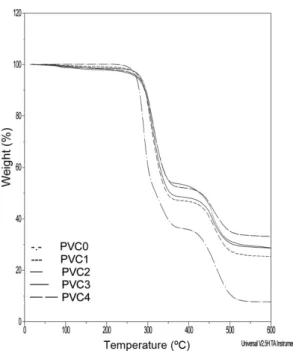
Fig. 4 shows, TGA curves of the PVC/ gypsum composite samples. Gypsum was eliminated from PVC0, and compared with other PVC/ gypsum polymer blend samples (PVC1~

PVC4). It was interesting that for the case of without the pres- ence of gypsum, the decomposed temperature of polymer was about 278

o

C. However, for the other later cases, the decom- posed temperature of polymer blend was about 285

o

C. Thus, the presence of gypsum component in the polymer composite may expend the range of the processing temperature of the material. This might be expected that calcium oxide (CaO) presented in gypsum composition which played a role as a fire resistance, effectively scavenge HCl gas liberated from burning halogenated polymer (PVC):

CaO + 2HCl = CaCl

2

+ H

2

O

Thereby reducing the corrosiveness of the generated smoke, and improving the thermal stability of PVC/gypsum polymer composites [7,13].

Fig. 4. TGA diagram of PVC/gypsum composites Fig. 5. X-ray diffraction spectra of PVC/gypsum composites

(6)

3.4 X-ray spectra studies

X-ray spectra of PVC1-PVC4 composites and pure gypsum shows in Fig. 5. It is apparent that the composition of waste- gypsum included not only of calcium sulfate dehydrate with the peaks at 2θ = 11.6; 14.7; 20.7; 29.1; 31.1; 33.4 degree respectively [14,15], but also of other components as calcium oxide at 2θ = 32.2; 37.3 degree respectively [16-18], etc. One can see, in the cases of PVC1 and PVC2, there are no appear- ance of peaks of calcium oxide, this may indicate that the amounts of calcium oxide component in the PVC1 and PVC2 are small enough to reaction with HCl gas liberated during processing time. However, increase of waste-gypsum content in PVC3 and PVC4 composites, the appearance of these peaks is somewhat distinct due to residual amount of calcium oxide.

A remarkable observation is no peak at 2θ = 11.6 of CaSO

4

· 2H

2

O in all PVC/gypsum composites. Thus, it may be expected that under various processing conditions such as mechanical force; temperature; interaction effects, which strongly influenced on crystal structure of calcium sulfate dehydrate as well as dispersion of filling gypsum in the bulk polymer.

3.5 Morphology of PVC/Gypsum blend materials Fig. 6 shows the SEM micrographs of the PVC/ gypsum composites, in which, the white dots would exhibit the dis- persed gypsum phase onto PVC matrix phase. On observation of the distribution of gypsum phase, it obviously had the changes of the morphology to each other. As shown in Fig.

6(a) and 6(b), in turn, with and without the presence of the MBS phase seems that it did not affect to the distribution and the intercalation of gypsum phase. It is clearly recognized that for the case PVC3 sample, gypsum phase was best dispersed among the investigation of four given samples; gypsum par-

ticles finely intercalated into PVC matrix phase and made sig- nificantly a change on morphology of sample (Fig. 6(c)).

Nevertheless, if the amount of gypsum phase continuously increased up to 27.97 wt%, the appearance of the coalescence effect of the gypsum phase resulted in the clusters bigger than that of the former micrographs (Fig. 6(d)). This implied that the content of gypsum phase had exceeded a critical value of regular intercalation into PVC phase. This suggested that the physico-mechanical properties vary in accordance with the morphology changes of the polymer blends.

Thus if the gypsum content exceeds 22.56 wt.%, its event will influence no good on the physico-mechanical properties because of the appearance of the coalescence effect [19]. This was correspondent to the conclusion of the tensile strength results.

4. CONCLUSIONS

The PVC/gypsum composite material was obtained via a melt blending process. The physico-mechanical properties were investigated base on the different gypsum content of the composite samples to establish the mechanical strength of this material. The increase of waste-gypsum content made the appearance of fusion peaks slower than that of the smaller waste-gypsum ratios in torque rheometer tests. The elimina- tion of MBS content from PVC/gypsum composite increased its tensile strength, though the impact strength significantly decreased. Young’s modulus was enhanced with the increase of gypsum content in all composites. The highest tensile strength of this material was measured at PVC3 with the content of gypsum component of 22.56 wt%. The elongation at break continuously decreased while increasing of the gypsum con- tent; however, the rate of decrease is not the same among five

Fig. 6. Micrographs PVC/gypsum composites (a) PVC1, (b) PVC2, (c) PVC3, and (d) PVC4

(7)

samples. Inversely, the impact strength of blend material grad- ually enhanced with increasing of the gypsum content.

For the thermal properties, DSC curves proved that the glass transition temperatures strongly shifted with the case of gyp- sum content of 22.56 wt% (PVC3), this indicated that the gyp- sum phase was finely intercalated onto PVC phase and it had a good interaction between two initial phases. TGA curves also indicated the presence of gypsum content increased the ther- mal stability and expended the processing temperature range of the polymer blend material. X-ray studies also indicated the interaction between filling gypsum phase and polymer matrix phase.

On observation of SEM micrographs simultaneously indi- cated that PVC/gypsum blend material had a good distribu- tion of gypsum phase on the case of the gypsum content of 22.56 wt.%.

Finally, as a result of adding gypsum buried in the sea to PVC resin, we cannot only get the polymer blend material that has such superior physico-mechanical properties and thermal stability, but also solves the environmental problems by using waste matters.

ACKNOWLEDGEMENTS

This work was supported by Research Foundation of Engi- neering College, Sunchon National University (2005).

REFERENCES

1. Nadagouda, M.N., Pressman, J., White, C., Speth, T.F., and McCurry, D.L., “Novel Thermally Stable Poly(vinyl chloride) Composites for Sulfate Removal”, Journal of Hazardous Mate- rials, Vol. 188, 2011, pp. 19-25.

2. Etienne, S., Becker, C., Ruch, D., Germain, A., and Calberg, C.,

“Synergetic Effect of Poly(vinyl butyral) and Calcium Carbon- ate on Thermal Stability of Poly(vinyl chloride) Nanocompos- ites Investigated by TG–FTIR–MS”, Journal of Thermal Analysis and Calorimetry, Vol. 100, 2010, pp. 667-677.

3. Kim, M.Y., Ha, D.S., Park, Y.H., Nah, J.W., and Choi, C.Y.,

“Mechanical Properties of PVC Complexes Using Waste-Gyp- sum”, Elastomer(Korea), Vol. 37, 2002, pp. 7-13.

4. Steller, R., Kedziora, G., Trojanowska-Tomczak, M., Ciesla, K., and Skorupski, J., “Polymer Based Composites with Inter-pen- etrating Networks Structure”, Journal Chemistry & Chemicial Technology, Vol. 7, No. 2, 2013, pp. 181-184.

5. Koning, C., van Duin, M., Pagnoulle, C., and Jerome, R.,

“Strategies for Compatibilization of Polymer Blends”, Progress in Polymer Science, Vol. 23, 1998, pp. 707-757.

6. Sadat-Shojai, M., and Gholam-Reza, B., “Recycling of PVC wastes”, Polymer Degradation and Stability, Vol. 96, 2011, pp.

404-415.

7. Deka, B.K., and Maji, T.K., “Study on the Properties of Nano- composite Based on High Density Polyethylene, Polypropylene, Polyvinyl Chloride and Wood”, Compos Part A.: Applied Science and Manufacturing, Vol. 42, 2011, pp. 686-693.

8. Luo, Z., and Jiang, J., “Molecular Dynamics and Dissipative Par- ticle Dynamics Simulations for the Miscibility of Poly(ethylene oxide)/poly(vinyl chloride) Blends”, Polymer, Vol. 51, 2010, pp.

291-299.

9. El-Shekeil, Y.A., Sapuan, S.M., Jawaid, M., and Al-Shuja, O.M.,

“Influence of Fiber Content on Mechanical, Morphological and Thermal Properties of Kenaf Fibers Reinforced Poly(vinyl chlo- ride)/thermoplastic Polyurethane Poly-blend Composites”, Materials & Design, Vol. 58, 2014, pp. 130-135.

10. Pederson, B., Semmingsen, D., and Crystallogr, A., “Neutron Diffraction Refinement of the Structure of Gypsum, CaSO

4

· 2H

2

O”, Acta Crystallographica: Section B, Vol. 38, 1982, pp.

1074-1077.

11. Mcmurdie, H., Morris, M., Evans, E., Paretzkin, B., Wong-Ng, W., and Hubbard, C., “Standard X-ray Diffraction Powder Patterns from the JCPDS Research Associateship”, Powder Diffraction Journal, Vol. 1, 1986, pp. 265-275.

12. Oftedal, I., J. Phys. Chem, Vol. 128, 1972, pp. 154.

13. Martin, K., and McCarthy, G., ICDD Grant-in-Aid, North Dakota State Univ. Press, USA, 1990.

14. Kotaki, M., Kuriyama, T., Narisawa, I., Sakai, M., and Abe, K.,

“Morphology Control of Vinyl Ester/sebs Blends with Ultrafine

Inorganic Particles”, Key Engineering Materials, Trans Tech

Publications, Switzerland, Vol. 137, 1998, pp 9-15.

수치

Table 2. Sample code and composition of composites Samples PVC (g) Lubricant(g) Stabilizer(g) MBS(g) Gypsum(g/wt.%) PVC0 100 0.5 3.0 -  -PVC1 100 0.5 3.0 7.0 20.0/15.38 PVC2 100 0.5 3.0 - 20.0/16.26 PVC3 100 0.5 3.0 - 30.0/22.56 PVC4 100 0.5 3.0 - 40.0/27.
Fig. 3. DSC diagram of PVC/gypsum composites
Fig. 4. TGA diagram of PVC/gypsum composites Fig. 5. X-ray diffraction spectra of PVC/gypsum composites
Fig. 6. Micrographs PVC/gypsum composites (a) PVC1, (b) PVC2, (c) PVC3, and (d) PVC4

참조

관련 문서

2) polymer reactions using a polymer as a carrier or support for some component of a reaction system (polymeric brominating and Wittig reagents, the Merrifield

: Development of Microstructure and Alteration of Mechanical Properties.. 4.6 The homogeneous nucleation rate as a function of undercooling ∆T. ∆T N is the critical

The aim of this work was to prepare tenoxicam-ethanolamine salt with improved physicochemical properties, to compare the flux of tenoxicam and

In this study, a fine Ce 3 Al 11 phase catalyst was synthesized by mechanochemical reaction and the influence of the catalyst on the NaAlH 4 hydrogen storage properties

The mechanical properties of the Ir-based films by the change of the alloy element content show that the hardness value is decreased with Re contents

Summerscales, "An investigation into the effects of fabric architecture on the processing and properties of fibre reinforced composites produced by resin

Effects of vacuum, mold temperature and cooling rate on mechanical properties of press consolidated glass fiber/PET composite , Composites Part A: Applied Science

Psychometric properties of the Intrinsic Motivation Inventory in psychometric properties of the Intrinsic Motivation Inventory in a competitive sport setting: