INTRODUCTION
The increase in geriatric diseases in elderly population is a cause for concern. Among the geriatric diseases, dementia has received particular attention. Dementia refers to a state involving one or more cognitive impairments, such as atten- tion, language ability, visuospatial function, and frontal/exec- utive function, along with memory impairment, resulting in disability in daily life or work/social life.1 Way-finding deficit
(WFD) is a common cognitive symptom in dementia.2-5 WFD refers to the inability to find a way in a familiar or new environ- ment. The person with WFD may wander around in a famil- iar place, may require a long time to learn a new way in a new neighborhood, or in severe cases, may lose the ability to return home. Such difficulties associated with way-finding ability (WFA) may increase the family burden if an accompanying guardian is required to prevent the disappearance or wander- ing of family members.
There are several instruments to evaluate WFA in clinical practice. However, there is no objective tool to directly mea- sure WFA in patients with dementia in Korea. In other coun- tries, tools using map reading or virtual reality have been de- veloped for research or clinical purpose. However, these tools
Development and Validation of the Way-Finding Ability Scale for Middle-Aged and Older Adults
Sujin Kim,1 Yeonwook Kang1,2
1Department of Psychology, Hallym University, Chuncheon, Korea
2Department of Neurology, Hallym University Sacred Heart Hospital, Anyang, Korea
Background and Purpose This study was performed to newly develop the Way-Finding Ability Scale (WFAS) for middle-aged and older adults and validate its clinical utility.
Methods The participants for verifying construct validity included 324 adults aged from 45 to 79 years, and 22 normal old adults without way-finding deficit (WFD), 41 amnestic mild cognitive impairment (aMCI), and 35 patients with Parkinson’s disease (PD-MCI) for verifying discriminant validity. All participants were administered the newly constructed 28-item WFAS.
Results Exploratory factor analysis of the WFAS revealed a four-factor solution (sense of direction and inattention, spatial learning and memory, strategic ability, and cardinal direction). This four-factor structure was confirmed by confirmatory factor analysis. The discriminant validity was examined by administering the WFAS to normal older adults and two patient groups (aMCI & PD-MCI). The results showed that the total scores of two patient groups were lower than that of normal older adults. The patients with WFD had significantly lower total scores than those without WFD. Interestingly, the total scores of patients without WFD were significantly lower than those of normal older adults sug- gesting that the cognitive functions associated with way-finding ability (WFA) were partially impaired in aMCI and PD-MCI patients without apparent WFD. The patients with WFD had consistently lower scores in every four-factor than those without WFD.
Conclusions These results indicated that the WFAS assesses the WFD reliably as well as estimates the degree of decline in WFA.
Key Words way-finding ability, way-finding deficits, amnestic mild cognitive impairment, Parkinson’s disease.
Received: November 19, 2017 Revised: December 21, 2017 Accepted: December 21, 2017
Correspondence: Yeonwook Kang, PhD, Department of Psychology, Hallym University, 1 Hallymdaehak-gil, Chuncheon 24252, Korea Tel: +82-33-248-1724, Fax: +82-33-248-1702, E-mail: [email protected]
cc This is an Open Access article distributed under the terms of the Cre- ative Commons Attribution Non-Commercial License (http://creative- commons.org/licenses/by-nc/4.0) which permits unrestricted non-com- mercial use, distribution, and reproduction in any medium, provided the ori- ginal work is properly cited.
DND
ORIGINAL ARTICLE
Sujin Kim et al.
Development and Validation of the WFAS
contain local geographical information and therefore, cannot be used in other areas including Korea. In addition, the road system in Korea does not present a straight-line format, such as streets or avenues. Moreover, the Korean elderly popula- tion has limited experience using maps. Therefore, it is a chal- lenge to expect map reading skills among older adults in Ko- rea. It is also difficult to implement the tools using virtual reality among older adults in Korea, who are not familiar with the digital environment. Therefore, clinicians should rely on patients’ and caregivers’ self-reports to evaluate WFA among older adults and patients with dementia. However, there are no appropriate scales that are validated and standardized for middle-aged and older adults in Korea.
The WFA is related to a variety of cognitive abilities, such as attention, visuospatial function, learning and memory, ex- ecutive functions, decision-making, map-reading, and moni- toring abilities.6-11 Hegarty et al.12 developed a sense-of-di- rection scale, evaluating the ability in various environmental- spatial tasks for college students. Kato and Takeuchi13 also developed a scale known as the Sense of Direction Question- naire-Short Form to assess factors associated with the aware- ness of orientation and memory for general spatial behavior among college students. In Korea, Kwon and Lee6 developed the Wayfinding Ability Test, which examines diverse cogni- tive functions, such as spatial memory and learning, sense of direction, map usage, and visuospatial perception among college students. Hong and Lim.14 colleagues developed the Way-finding Effectiveness Scale consisting of complex way- finding goals, simple way-finding goals, analytical and global strategies for patients with dementia. Pai et al.15 developed a scale designated as the Questionnaire on Every Navigational Ability for assessing landmark agnosia, egocentric agnosia, inat- tention, and heading disorientation in patients with Alzheimer’s disease dementia.
Those scales for WFA were developed for limited targets such as college students and patients with dementia. Further, the cognitive abilities measured by each of the scales were dif- ferent. Therefore, it is necessary to develop a new scale that evaluates the comprehensive cognitive abilities required for WFA in middle-aged and older adults including patients with dementia. The new scale will be designed to elucidate the de- cline of WFA with normal aging. It will also provide impor- tant information highlighting the differences between the de-
cline in WFA during normal aging and WFD in patients with dementia.
The purposes of this study were to develop a self-report questionnaire, the Way-Finding Ability Scale (WFAS) for mid- dle-aged and older adults and to evaluate the clinical useful- ness of WFAS by examining the ability of the newly developed WFAS to distinguish not only the presence but also the de- gree of WFD in the normal elderly population and in patients with mild cognitive impairment (MCI) with or without WFD.
METHODS
Participants
Normal participants for verifying construct validity of the WFAS
A total of 324 (157 males, 167 females) aged between 45 and 79 years (middle-aged and older adults) who were resi- dents in Seoul, Incheon, or Gyeonggi province, participated in the study. All the subjects meeting the health screening cri- teria proposed by Christensen et al.16 had no history of neuro- logical or psychiatric illnesses affecting cognitive functions (Table 1).
Normal older adults and clinical groups for verification of discriminant validity of the WFAS
The participants included 22 normal old adults without WFD, 41 patients with amnestic mild cognitive impairment (aMCI), and 35 patients with Parkinson’s disease (PD). The normal older adults reporting no cognitive complaints met the health screening criteria proposed by Christensen et al.,16 without a history of neurological or psychiatric illnesses affect- ing cognitive functions. They showed a normal range of per- formance in the Korean-Mini Mental State Examination (K- MMSE),17-19 in which the total score was above the 16 percentile, and in the Korean-Instrumental Activities of Daily Living (K-IADL),20 in which the score was lower than 0.43.
Patients with aMCI and PD were selected from those who visited the Department of Neurology at Hallym University Sacred Heart Hospital. The aMCI met Petersen’s criteria for MCI,21 showing memory impairment with one or more def- icits in other cognitive domains in the comprehensive neuro- psychological test, while the activities of daily living were Table 1. Demographics of middle-aged and older adults for verification of construct validity
45–49 (n=50) 51–59 (n=99) 61–69 (n=92) 71–79 (n=83) Total (n=324)
Mean age (yrs) 46.86±1.52 54.55±2.60 63.85±3.02 74.07±2.78 64.98±9.84
Sex (M/F) 24 / 26 49 / 50 44 / 48 40 / 43 157 / 167
Education (yrs) 14.38±3.05 13.69±3.56 12.39±3.56 9.91±3.87 12.46±3.93
DND
maintained within the normal range. Patients with PD were diagnosed with probable PD based on the UK brain bank stan- dard22 and showed ≤3 on the Hoehn & Yahr staging scale.23 They had MCIs met Petersen’s criteria for MCI (PD-MCI) with <0.43 on the K-IADL. The Clinical Dementia Rating (CDR)24-26 scores of all patients were 0.5.
All participants for verifying discriminant validity were di- vided into two subgroups, with and without WFD, based on the WFD screening questionnaire developed by the Clinical Research Center for Dementia (CRCD).27 All the normal old- er adults reported the absence of WFD. In the aMCI group, 22 reported the absence of WFD (aMCI-N), while 19 report- ed WFD (aMCI-W). In the PD-MCI group, 20 patients re- ported the absence of WFD (PD-N) and 15 reported WFD (PD-W) (Table 2).
Materials and procedure Screening instruments
The Health Screening Questionnaire16 was administered to normal middle-aged and older adults for construct validity.
The K-MMSE and K-IADL as well as the Health Screening Questionnaire were used to screen the normal elderly Kore- ans for discriminant validity. All the patients were subjected to the Seoul Neuropsychological Screening Battery, 2nd edi- tion (SNSB-II)19 including measures of attention, language, visuospatial, memory, and frontal/executive functions as well as the K-MMSE, K-IADL, and CDR.
Screening questions for the WFA
The following four questions developed by CRCD27 were used: 1) Have you ever been unable to find the right direc- tion or the way when you traveled to your destination or re- turn home? 2) Have you ever lost your way to an unfamiliar place (one or two visits last year)? 3) Have you ever been lost in your neighborhood community? Have you ever lost your building or your unit number in your apartment complex?
and 4) Have you ever lost the way to the bathroom in your
house? If one responded “yes” to one or more of these ques- tions, a case of WFD was classified.
Development of the WFAS
The preliminary items were collected from the existing scales of previous studies.6,12-15 One of the investigators (SJK) selected 55 preliminary items appropriate for middle-aged and older adults and that assessed various cognitive func- tions required for WFA such as sense of direction, memory, and executive function. Two clinical psychologists, a profes- sor of clinical neuropsychology (YK) and a licensed clinical psychologist, selected the final 28 items after evaluation of the appropriateness of the 55 items. Among the selected items, the items in Korean were used as indicated on the existing scale. The items in English, however, were first translated by the researchers and back-translated by a native speaker to confirm the accuracy of translation (Table 3). Each item was scored on a 5-point Likert scale (1: strongly disagree, 2: dis- agree, 3: neutral, 4: agree, and 5: strongly agree). Some of the items were reverse-coded. The total score ranged from 28 to 140, with the higher values indicating better performance.
Statistical analysis
ANOVA and Chi-square tests were used to detect group differences for demographic variables such as age, education, and sex. To confirm the reliability of the WFAS, Cronbach’s α and intra-class correlation (ICC) were calculated. Explorato- ry and confirmatory factor analyses were performed to eval- uate construct validity. We performed a multivariate analysis of covariance (MANCOVA) controlling for age on the WFAS total and subscale scores. In addition, we conducted post-hoc contrast analyses for multiple comparisons to analyze group differences. To confirm the sensitivity and specificity of the WFAS, the receiver operating characteristic (ROC) curve was analyzed. All p-values were two-tailed, and statistical signifi- cance was accepted at p<0.05. SPSS version 19.0 (IBM Corp., Armonk, NY, USA) and AMOS version 20.0 (IBM Corp.) were used for data analysis.
Table 2. Demographics of normal older adults and clinical groups for verification of discriminant validity
NCa (n=22) aMCI PD-MCI
F Post-hoc (Tukey) aMCI-Nb (n=22) aMCI-Wc (n=19) PD-Nd (n=20) PD-We (n=15)
Age (yrs) 69.00±6.24 73.50±8.36 78.37±6.41 71.45±5.08 76.47±5.07 6.67* c=e>b=d>a
Sex (M/F) 5/17 10/12 7/12 10/10 9/6 χ2=6.20 ns
Education (yrs) 8.34±4.80 9.48±4.41 10.37±4.73 8.40±3.69 7.90±5.61 0.88 ns
K-MMSE 27.05±1.36 24.45±2.92 22.16±2.29 24.65±2.81 21.33±2.92 15.39* a>d=b>c=e
*p<0.001.
aMCI: amnestic mild cognitive impairment, aMCI-N: aMCI–no way-finding deficit, aMCI-W: aMCI–way-finding deficit, K-MMSE: Korean-Mini Mental State Examination, NC: normal control, PD-MCI: Parkinson’s disease-mild cognitive impairment, PD-N: PD–no way-finding deficit, PD-W:
PD–way-finding deficit.
Sujin Kim et al.
Development and Validation of the WFAS
RESULTS
Reliability of the WFAS
Internal consistency and test-retest reliability analyses were conducted to evaluate the reliability of the WFAS. The Cron- bach’s α was 0.92 for the overall scale, and 0.59–0.90 for the four factors (0.89 for sense of direction and inattention, 0.90 for spatial memory and learning, 0.59 for strategic ability, and 0.75 for cardinal direction). To confirm the test-retest reli- ability, 30 middle-aged and older adults, who were random- ly selected from the total normal participants, were retested at intervals of 5 to 6 weeks. The test-retest reliability (ICC) of
the WFAS total score was r=0.78 (p<0.001) and that of the factors was 0.77–0.90 (p<0.001) (0.90 for sense of direction and inattention, 0.77 for spatial memory and learning, 0.88 for strategic ability, and 0.80 for cardinal direction).
Construct validity of the WFAS
First, Kaiser-Meyer-Olkin (KMO) index for sampling ade- quacy28 and Bartlett’s Test of Spericity29 were inspected to deter- mine whether the data (n=324) for construct validity were appropriate for factor analysis. The KMO value was 0.93 and the sphericity was significant at p<0.001. Therefore, it was confirmed that this data was appropriate for factor analysis, Table 3. The Korean version of Way-Finding Ability Scale
문항
번호 문 항
전혀 그렇지
않다
그렇지 않다
보통
이다 그렇다 매우
그렇다
1 한 번만 가본 곳이라도 대부분 가는 길을 떠올릴 수 있다. 1 2 3 4 5
2 몇 번 가보지 않은 곳이라도 가는 길에 있던 상점이나 건물을 쉽게 기억하는
편이다.
1 2 3 4 5
3 해가 떠있으면, 그것만으로 방향을 추측할 수 있다. 1 2 3 4 5
4 타야 할 방향의 반대편에서 택시나 버스를 잡을 때가 있다. 1 2 3 4 5
5 방향 감각이 좋다. 1 2 3 4 5
6 이전에 한 번 밖에 가지 않았던 곳에서도 새로운 길을 잘 기억 할 수 있다. 1 2 3 4 5
7 지도를 봐도 낯선 장소는 찾아가기 힘들다. 1 2 3 4 5
8 자주 다니는 길의 지름길을 알고 있다. 1 2 3 4 5
9 처음 가본 곳의 주변을 잘 기억하는 편이다. 1 2 3 4 5
10 내가 지금 있는 곳이 지도상에서 어디인지 알 수 있다. 1 2 3 4 5
11 익숙한 길이 낯설게 느껴진 적이 있다. 1 2 3 4 5
12 어디를 갈 때 우회전이나 좌회전을 여러 번 하면, 돌아오는 길이 헷갈린다. 1 2 3 4 5
13 낯선 곳에서도 동서남북을 알 수 있다. 1 2 3 4 5
14 새로운 곳에 가는 길에 대한 정보를 얻을 때, 눈에 띄는 큰 건물을 이용해서
방향이 주어지는 것이 더 좋다.
1 2 3 4 5
15 (승객으로) 차를 타고 갈 때, 가는 길을 기억하지 않는다. 1 2 3 4 5
16 무심하게 길을 가다가 낯선 곳(장소)에 들어설 때가 있다. 1 2 3 4 5
17 집에서 목적지로 향하는 길을 설명하기 어려웠던 적이 있다. 1 2 3 4 5
18 길에서 집의 방향을 가리키지 못할 때가 있다. 1 2 3 4 5
19 교차로에서 다른 방향으로 잘못 간 적이 있다. 1 2 3 4 5
20 출발지에서 목적지가 어느 쪽인지 방향을 가리키지 못할 때가 있다. 1 2 3 4 5
21 길을 가다가 부주의해서 우회전이나 좌회전하는 것을 잊어버린 적이 있다. 1 2 3 4 5
22 길에서 눈에 띄는 큰 건물이나 표지판(간판)을 지나쳐서 길을 잘못 간 적이
있다.
1 2 3 4 5
23 익숙하지 않은 곳에 갈 때 눈에 띄는 큰 건물이나 표지판 같은 주변 단서를
이용해야 한다.
1 2 3 4 5
24 새로운 길에 익숙해지는데 많은 시간이 걸린다. 1 2 3 4 5
25 새로운 곳으로 가는 길에 대한 정보를 얻을 때, 왼쪽이나 오른쪽 등으로
방향이 주어지는 것이 더 좋다.
1 2 3 4 5
26 익숙한 장소에서 길을 잃어버린 적이 있다. 1 2 3 4 5
27 건물 안에서 안내 표지판을 보고 길을 찾는다. 1 2 3 4 5
28 낯선 곳에서 길을 자주 잃어버린다. 1 2 3 4 5
DND
and exploratory factor analysis was performed initially. Prin- cipal axis factoring with oblique rotation was used as the fac- tor extraction method. The number of factors was determined
by examining the cumulative percentage of variance, the scree plot, and the eigenvalues. As a result, the following four factors were extracted: 1) sense of direction and inattention, 2) spatial Table 4. Factor structure and factor loading of the Way-Finding Ability Scale
Item# Question
Factor
1 2 3 4
Sense of direction
and inattention Spatial learning
and memory Strategic ability Cardinal direction 22 Did you go wrong by crossing a big building or sign that stands out
on the street?
0.74 0.10 0.09 -0.05
20 When you were at the start point (e.g., at home), have you ever failed to point out the direction of a destination?
0.74 -0.02 0.03 -0.16
26 Have you ever got lost in a familiar place? 0.72 0.07 -0.21 0.06
19 Have you ever made a wrong turn at a crossroad? 0.71 0.02 0.06 -0.09
21 Have you ever accidently forgotten to make a turn due to inattention? 0.70 0.06 0.13 -0.12 17 Have you ever been unable to describe the route between your home
and a destination?
0.58 -0.06 0.05 -0.13
16 Have you ever accidently ended up in an unfamiliar place due to inattention?
0.56 -0.04 -0.02 0.06
4 Is there a time to catch a taxi or a bus from the other side of the road? 0.53 -0.11 -0.04 0.07 18 When you were on the road, have you ever failed to point out the
direction of your home or destination?
0.53 -0.15 0.00 0.05
11 Have you ever felt unfamiliar with a familiar place? 0.52 -0.18 0.04 -0.02
28 Are you getting lost in an unfamiliar place? 0.51 -0.17 -0.13 0.09
9 Are you good at remembering details of the surrounding new area? 0.08 0.87 0.02 0.01 6 Can you usually remember a new route after traveling through it only
once?
0.07 0.85 -0.05 0.04
1 Can you remember most of the way, even if you only traveled once? 0.08 0.73 0.06 0.05 2 Is it easy to remember a shop or a building on the way, even if you
were not there a few times?
-0.08 0.66 -0.03 0.08
24 Does it take a lot of time to get used to the new road? 0.20 -0.66 -0.03 0.16
5 Are you very good at giving directions? -0.08 0.64 0.12 0.19
15 Do you forget the routes when driving as a passenger in a car. 0.07 -0.46 0.12 0.01 7 Even if you look at the map, is it hard to find a strange place? 0.25 -0.46 0.16 -0.11 12 Are you totally confused as to the correct sequence of the return route
as a consequence of a number of left-right turns in the route?
0.29 -0.45 0.03 -0.02
8 Do you know the shortcut to frequent roads? -0.09 0.43 0.22 0.11
14 When obtaining directions to a new place, is it better to be guided with landmarks such as a big building that stands out?
-0.12 -0.04 0.66 0.04
23 When traveling to an unfamiliar place, do you need to use surrounding signs such as large buildings or signs that stand out?
0.15 -0.03 0.57 -0.01
25 When getting directions to a new place, is it better to be directed to the left or right?
0.07 -0.05 0.50 0.14
27 Can you see the signs in the building and find your way? -0.07 0.09 0.33 -0.08
3 If the sun is up, can you guess the direction? -0.10 0.07 0.18 0.67
13 Can you make correct choices as to cardinal directions in an unfamiliar place?
-0.07 0.32 -0.09 0.52
10 Can you tell where I am right now on the map? -0.20 0.37 -0.01 0.38
Total variance (%) 35.16 7.76 6.63 4.43
Sujin Kim et al.
Development and Validation of the WFAS
learning and memory, 3) strategic ability, and 4) cardinal di- rection. These four factors explained 53.98% of the total vari- ance (35.16, 7.76, 6.63, and 4.43%, respectively) (Table 4).
Moderate-to-strong correlations between factors were found between “sense of direction and inattention” and “spatial learn- ing and memory” (r=0.74), “spatial learning and memory”
and “cardinal direction” (r=0.67), and “sense of direction and inattention” and “cardinal direction” (r=0.63). A moderate correlation was found between “sense of direction and inatten- tion” and “strategic ability” (r=0.44). Relatively weak correla- tions were found between “spatial learning and memory” and
“strategic ability” (r=0.25) and “strategic ability” and “cardinal direction” (r=0.32).
A confirmatory factor analysis was performed using AMOS to confirm whether the factor structure model obtained using exploratory factor analysis was appropriate. The results con- firmed the model obtained by exploratory factor analysis [χ2(344)=700.10, p<0.001, GFI=0.87, TLI=0.90, CFI=0.91, RMSEA=0.06 (0.05–0.06)]. In order to re-verify the validity of the 4-factor structure extracted from 324 normal middle- aged and older adults, the confirmatory factor analysis was conducted again using 98 normal (n=22) and clinical groups (aMCI & PD=76). The result re-confirmed that the model ob- tained by exploratory factor analysis was valid [χ2(344)=544.96, p<0.001, GFI=0.73, TLI=0.85, CFI=0.87, RMSEA=0.07 (0.06–0.09)].
Discriminant validity of the WFAS
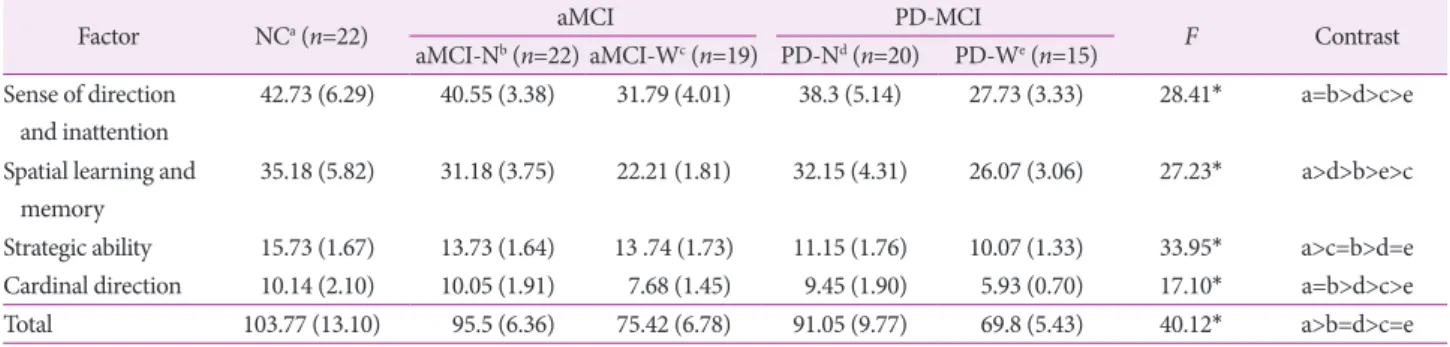
A MANCOVA controlled for age was conducted to com- pare the normal elderly and dementia patients with or without WFD, such as Normal, aMCI-N, aMCI-W, PD-N, and PD-W (Table 5). First, there were significant differences among groups in the total score of WFAS (F=40.12, p<0.001). The normal el- derly group showed the highest total score, followed by aM- CI-N and PD-N. The aMCI-W and PD-W, who reported WFD, showed the lowest total scores. There were no significant dif- ferences in total scores between aMCI-N and PD-N or be- tween aMCI-W and PD-W.
The factor scores of “sense of direction and inattention” and
“cardinal direction” were the highest in the normal and aM- CI-N groups, and were sequentially lowered in PD-N, aMCI- W, and PD-W. The score of “spatial learning and memory” was the highest in the normal group, and declined sequentially in PD-N, aMCI-N, PD-W, and aMCI-W. The normal elderly group showed significantly higher “strategic ability” score than the aMCI, while the aMCI showed significantly higher score than the PD. Among the patient groups of aMCI and PD, there were no significant differences between the groups with and without WFD in “strategic disability.”
ROC curve analyses were performed to examine the sen- sitivity and specificity of the WFAS (Table 6). The WFAS had moderate accuracy30 (AUC=0.80, p<0.001; sensitivity 0.68, specificity 0.91, cut-off score 102) in differentiating the nor-
Table 6. Receiver operating characteristic (ROC) curve analysis
Sensitivity Specificity Cut-off score AUC
NC vs. (aMCI-N & PD-N) 0.68 0.96 102 0.80*
NC vs. (aMCI-W & PD-W) 0.91 0.91 82 0.96*
aMCI-N vs. aMCI-W 0.96 0.95 85 0.98*
PD-N vs. PD-W 0.90 0.93 79 0.97*
(aMCI-N & PD-N) vs. (aMCI-W & PD-W) 0.91 0.91 82 0.96*
*p<0.001.
aMCI-N: amnestic mild cognitive impairment–no way-finding deficit, aMCI-W: aMCI–way-finding deficit, AUC: area under curve, NC: normal Table 5. Total and factor scores of Way-Finding Ability Scale in normal older adults and clinical groups
Factor NCa (n=22) aMCI PD-MCI
F Contrast
aMCI-Nb (n=22) aMCI-Wc (n=19) PD-Nd (n=20) PD-We (n=15) Sense of direction
and inattention
42.73 (6.29) 40.55 (3.38) 31.79 (4.01) 38.3 (5.14) 27.73 (3.33) 28.41* a=b>d>c>e Spatial learning and
memory
35.18 (5.82) 31.18 (3.75) 22.21 (1.81) 32.15 (4.31) 26.07 (3.06) 27.23* a>d>b>e>c Strategic ability 15.73 (1.67) 13.73 (1.64) 13 .74 (1.73) 11.15 (1.76) 10.07 (1.33) 33.95* a>c=b>d=e Cardinal direction 10.14 (2.10) 10.05 (1.91) 7.68 (1.45) 9.45 (1.90) 5.93 (0.70) 17.10* a=b>d>c>e Total 103.77 (13.10) 95.5 (6.36) 75.42 (6.78) 91.05 (9.77) 69.8 (5.43) 40.12* a>b=d>c=e
*p<0.001.
aMCI: amnestic mild cognitive impairment, aMCI-N: aMCI–no way-finding deficit, aMCI-W: aMCI–way-finding deficit, NC: normal control, PD- MCI: Parkinson’s disease–mild cognitive impairment, PD-N: PD–no way-finding deficit, PD-W: PD–way-finding deficit.
DND
mal from the patient groups without WFD (NC vs. aMCI-N &
PD-N). The WFAS total score, however, was found to be highly accurate in differentiating between normal and patient groups with WFD (NC vs. aMCI-W & PD-W, AUC=0.96, p<0.001;
sensitivity 0.91, specificity 0.91, cut-off score 82), between aM- CI-N and aMCI-W (AUC=0.98, p<0.001), between PD-N and PD-W (AUC=0.97, p<0.001), and between patient groups without WFD (aMCI-N & PD-N) and those with WFD (aMCI- W & PD-W) (AUC=0.96, p<0.001).
DISCUSSION
In this study, we developed a self-report questionnaire for the evaluation of WFA. It was confirmed that this scale reli- ably and adequately assessed the degrees of WFD in patients with and without WFD.
The exploratory factor analysis was conducted to examine the construct validity of WFAS. Four sub-factors were ex- tracted, which accounted for 53.98% of the total variance.
Most items of the first factor “sense of direction and inatten- tion.” were similar to the items involving the “inattention” fac- tor (3rd factor) in the scale developed by Pai et al.15 for pa- tients with Alzheimer’s disease. They were also partly similar to the items in the “sense of direction” factor (2nd factor) of the Kwon and Lee’s scale6 developed for college students. The items in the second factor, “spatial learning and memory,”
were similar to those of the first factor (spatial memory and learning) in the Kwon and Lee’s scale.6 The third factor, “stra- tegic ability,” was similar to the “analytical strategy” factor (3rd factor) in the Hong and Lim’s scale14 developed for patients with dementia.
The last factor consisting of 3 items was designated as “car- dinal direction.” These items were extracted as the second fac- tor (sense of direction) with a large explained variance in the Kwon and Lee’s scale,6 which was developed for college stu- dents. However, they were extracted as the fourth factor with relatively small explained variance in the WFAS. In addition, the “map usage” factor in the Kwon and Lee’ scale6 was not an independent factor in the WFAS. These results suggest that middle-aged and older adults in Korea do not use map or car- dinal direction as much as the college students to find their way. They suggest that the WFD in the middle-aged and older adults varied from that of college students and the effect of different cognitive impairments varied with the age cohort.
Therefore, it is necessary to develop novel way-finding ability scales tailored to middle-aged and older adults compared with the scales for younger adults (college students). This four-fac- tor structure revealed in exploratory factor analysis was con- firmed in confirmatory factor analyses.
In order to examine the discriminant validity of the WFAS, we compared the WFAS total scores of normal older adults, aMCI, and PD patients with or without WFD. We found that patients with WFD (aMCI-W and PD-W) had the lowest score, followed by patients without WFD (aMCI-N and PD-N), and the score was the highest in normal older adults. This result suggested that the total WFAS score can be used to diagnose WFD. It was interesting that patients without WFD (aMCI- N and PD-N) showed a significantly lower WFAS total score compared with normal older adults. This finding suggests that the cognitive functions related to WFA were partially impaired in aMCI and PD-MCI patients without apparent WFD. There- fore, WFAS can be used to determine the degree of WFA as well as predict or prevent WFD even in cases without WFD com- plaints.
The variation in scores among factors associated with WFAS was also analyzed. The scores obtained for the following three factors, “sense of direction and inattention,” “spatial learning and memory,” and “cardinal direction,” in patients with WFD (aMCI-W and PD-W) were significantly lower than in those without WFD (aMCI-N and PD-N). This finding suggested that the three factors can be effectively used to differentiate WFD. However, there was no difference in “strategic ability” be- tween patients with and without WFD. Instead, the PD group showed significantly lower scores than the aMCI group, re- gardless of WFD. The items included in the “strategic ability”
factor included questions related to the use of memory strate- gy in relation to way-finding. Therefore, they included items that evaluated frontal/executive functions. The result was at- tributed to greater frontal/executive dysfunction in patients with PD than in those with aMCI with same degree of de- mentia severity (CDR score of 0.5). Therefore, we conclude that compared with previous studies14,15 reporting that the strategic use such as landmarks was critical for WFA, it does not effectively discriminate WFD in patients with aMCI and PD-MCI.
The factor scores including “sense of direction and inatten- tion,” “strategic ability,” and “cardinal direction” were higher in those with aMCI-N compared with PD-N, and in patients with aMCI-W compared with PD-W, respectively. The factor score of “spatial learning and memory” was lower in aMCI-N compared with PD-N, and in aMCI-W compared with PD- W, respectively. The factors of “sense of direction and inatten- tion,” “strategic ability,” and “cardinal direction” comprised sev- eral items that assessed visuospatial dysfunction or frontal/
executive dysfunction starting from the early stage of disease in many patients with PD. On the other hand, “spatial learning and memory” factor consisted of items related to learning and memory impairments that played a major role in patients with
Sujin Kim et al.
Development and Validation of the WFAS
aMCI. Stern et al.31 reported that at similar stages of demen- tia, PD patients with dementia presented worse visuospatial dysfunction compared with AD patients with dementia. How- ever, Huber et al.32 found that the AD patients presented worse memory impairment compared with PD dementia patients.
Our results were consistent with these findings, suggesting that the items and factors of WFAS were appropriate for the evalu- ation of diverse cognitive functions relating to the WFD.
The results of ROC curve analysis confirmed that the WFAS total score represented a robust rate of discrimination. The discriminant accuracy (AUC=0.96) was very high between normal older adults and patients with WFD (aMCI-W, PD- W). The accuracy of discrimination between patients with and without WFD in aMCI (aMCI-N vs. aMCI-W) and PD (PD-N vs. PD-W) groups was also very high at 0.98 and 0.97, respectively. Interestingly, even the discriminant accuracy be- tween normal older adults and patients without WFD [NC vs.
(aMCI-N & PD-N)] was moderate (0.80). As mentioned pre- viously, these results suggest that the aMCI and PD patients without apparent WFD may have minor cognitive impair- ments based on WFAS. Therefore, the WFAS scale can be used for detection and early intervention of WFD as well as predict- ing WFD based on the degree of WFA deterioration.
The newly developed WFAS was verified for reliability and validity in the present study. By contrasting to the existing scales, which were targeted only at young adults (especially university students) or patients with dementia (mainly Al- zheimer’s disease dementia), the WFAS extended the scope of application to middle-aged and older adults. In addition to the aMCI known as the prodromal stage of Alzheimer’s dis- ease dementia, it was also applied for PD to confirm the abil- ity of WFAS for WFD diagnosis in various patient groups. In summary, it can be concluded that the WFAS can be used to not only distinguish normal older adults and MCI patient groups effectively but also significantly differentiate between patients with WFD and those without WFD within the MCI population.
The WFAS is a self-report questionnaire. Therefore, the pres- ent study obtained clinical data only from patients with MCI, and not dementia for collecting reliable data. Whether the WFAS can be answered by caregivers of dementia patients should be considered in further studies. Although the WFAS, which consists of 28 questions, provides rich and reliable in- formation related to WFD, it is a long and tedious tool for clinical use. It is expected that a shorter version of the WFAS will be developed in a future study.
Conflicts of Interest
The authors have no financial conflicts of interest.
REFERENCES
1. American Psychiatric Association. Diagnostic and Statistical Manual of Mental Disorders, Fourth Edition (DSM-IV). Washington, DC:
American Psychiatric Association, 1994.
2. Iachini I, Iavarone A, Senese VP, Ruotolo F, Ruggiero G. Visuospatial memory in healthy elderly, AD and MCI: a review. Curr Aging Sci 2009;2:43-59.
3. Benke T, Karner E, Petermichl S, Prantner V, Kemmler G. Neuropsy- chological deficits associated with route learning in Alzheimer disease, MCI, and normal aging. Alzheimer Dis Assoc Disord 2014;28:162- 167.
4. Allison SL, Fagan AM, Morris JC, Head D. Spatial navigation in preclinical Alzheimer’s disease. J Alzheimers Dis 2016;52:77-90.
5. Davis R, Weisbeck C. Creating a supportive environment using cues for wayfinding in dementia. J Gerontol Nurs 2016;42:36-44.
6. Kwon H, Lee J. A study of development and validation of the Way- finding Ability Test (WAT). Korean J Psychol 2005;24:1-10.
7. Berthoz A, Viaud-Delmon I. Multisensory integration in spatial ori- entation. Current Opinion in Neurobiology 1999;9:708-712.
8. Nadolne MJ, Stringer AY. Ecologic validity in neuropsychological as- sessment: prediction of wayfinding. J Int Neuropsychol Soc 2001;7:
675-682.
9. Corbetta M, Kincade JM, Shulman GL. Neural systems for visual orienting and their relationships to spatial working memory. J Cogn Neurosci 2002;14:508-523.
10. Burgess N. Spatial memory: how egocentric and allocentric combine.
Trends Cogn Sci 2006;10:551-557.
11. Lepsien J, Nobre AC. Cognitive control of attention in the human brain: insights from orienting attention to mental representations. Brain Res 2006;1105:20-31.
12. Hegarty M, Richardson AE, Montello DR, Lovelace K, Subbiah I.
Development of a self-report measure of environmental spatial abili- ty. Intelligence 2002;30:425-447.
13. Kato Y, Takeuchi Y. Individual differences in wayfinding strategies. J Environ Psychol 2003;23;171-188.
14. Hong GRS, Lim Y. Reliability and validity of the Korean version of the way-finding effectiveness scale for persons with dementia. J Clin Nurs 2009;18:1625-1631.
15. Pai MC, Lee CC, Yang YC, Lee YT, Chen KC, Lin SH, et al. Devel- opment of a questionnaire on everyday navigational ability to assess topographical disorientation in Alzheimer’s disease. Am J Alzheimers Dis Other Demen 2012;27:65-72.
16. Christensen KJ, Multhaup KS, Nordstrom S, Voss K. A cognitive battery for dementia: development and measurement characteristics.
J Consult Clin Psychol 1991;3:168-174.
17. Folstein MF, Folstein SE, McHugh PR. “Mini-mental state.” A practi- cal method for grading the cognitive state of patients for the clinician.
J Psychiatr Res 1975;12:189-198.
18. Kang Y. A normative study of the Korean-Mini Mental State Exami- nation (K-MMSE) in the elderly. Korean J Psychol 2006;25:1-12.
19. Kang Y, Jahng S, Na DL. Seoul Neuropsychological Screening Battery, 2nd ed. (SNSB-II). Seoul: Human Brain Research & Consulting Co., 2012.
20. Kang SJ, Choi SH, Lee BH, Kwon JC, Na DL, Han SH, Korean De- mentia Research Group. The reliability and validity of the Korean In- strumental Activities of Daily Living (K-IADL). J Korean Neurol Ac- coc 2002;20:8-14.
21. Petersen RC. Clinical practice. Mild cognitive impairment. N Engl J Med 2011;364:2227-2234.
22. Hughes AJ, Daniel SE, Kilford L, Lees AJ. Accuracy of clinical diag- nosis of idiopathic Parkinson’s disease: a clinico-pathological study of 100 cases. J Neurol Neurosurg Psychiatry 1992;55:181-184.
DND
tality. Neurology 1967;17:427-442.
24. Berg L. Clinical Dementia Rating. Br J Psychiatry 1984;145:339.
25. Morris JC. The Clinical Dementia Rating (CDR): current version and scoring rules. Neurology 1993;43:2412-2414.
26. Choi SH, Na DL, Lee BH, Hahm DS, Jeong JH, Yoon SJ, et al. Esti- mating the validity of the Korean version of expanded Clinical De- mentia Rating (CDR) scale. J Clin Neurol 2001;19:585-591.
27. Moon SY, Park DH, Lee SM, Kim SY. Clinical significance of topo- graphical disorientation in mild cognitive impairment. Dement Neuro- cogn Dis 2009;8:84-87.
28. Kaiser HF. An index of factorial simplicity. Psychometrika 1974;39:
31-36.
29. Tobias S, Carlson JE. Brief report: Bartlett’s test of sphericity and chance findings in factor analysis. Multivariate Behav Res 1969;4:375- 377.
30. Greiner M, Pfeiffer D, Smith RD. Principles and practical application of the receiver-operating characteristic analysis for diagnostic tests.
Prev Vet Med 2000;45(1-2):23-41.
31. Stern Y, Richards M, Sano M, Mayeux R. Comparison of cognitive changes in patients with Alzheimer’s and Parkinson’s disease. Arch Neurol 1993;50:1040-1045.
32. Huber SJ, Shuttleworth EC, Freidenberg DL. Neuropsychological dif- ferences between the dementias of Alzheimer’s and Parkinson’s dis- eases. Arch Neurol 1989;46:1287-1291.