Article
Prevalent Rate of Nonalbuminuric Renal Insufficiency and Its Association with Cardiovascular Disease Event in
Korean Type 2 Diabetes
Hye Won Lee*, A Ra Jo*, Dong Won Yi, Yang Ho Kang, Seok Man Son
Department of Internal Medicine, Pusan National University School of Medicine and Diabetes Center, Pusan National University Yangsan Hospital, Yangsan, Korea
Background: Nonalbuminuric renal insufficiency is a unique category of diabetic kidney diseases. The objectives of the study were to evaluate prevalent rate of nonalbuminuric renal insufficiency and to investigate its relationship with previous cardiovascular dis- ease (CVD) event in Korean patients with type 2 diabetes mellitus (T2DM).
Methods: Laboratory and clinical data of 1,067 subjects with T2DM were obtained and reviewed. Study subjects were allocated into four subgroups according to the CKD classification. Major CVD events were included with coronary, cerebrovascular, and pe- ripheral vascular events.
Results: Nonalbuminuric stage ≥3 CKD group, when compared with albuminuric stage ≥3 CKD group, had shorter diabetic dura- tion, lower concentrations of glycated hemoglobin, high density lipoprotein cholesterol, and high-sensitivity C-reactive protein, low- er prevalent rates of retinopathy and previous CVD, and higher rate of treatment with angiotensin-converting enzyme inhibitors/an- giotensin II receptor blockers. Nonalbuminuric stage ≥3 CKD group showed a greater association with prior CVD events than no CKD group; however, albuminuric stage ≥3 CKD group made addition to increase prevalence of prior CVD events significantly when CKD categories were applied as covariates. Association of prior CVD events, when compared with normal estimated glomeru- lar filtration rate (eGFR) and nonalbuminuria categories, became significant for declined eGFR, which was higher for eGFR of <30 mL/min/1.73 m2, and albuminuria.
Conclusion: The results show that subjects with nonalbuminuric stage ≥3 CKD is significantly interrelated with occurrence of prior CVD events than those with normal eGFR with or without albuminuria. Comparing with normal eGFR and nonalbuminuria catego- ries, the combination of increased degree of albuminuria and declined eGFR is becoming significant for the association of prior CVD events.
Keywords: Nonalbuminuric renal insufficiency; Diabetes mellitus; Cardiovascular diseases
Received: 26 July 2016, Revised: 26 September 2016, Accepted: 10 October 2016
Corresponding author: Seok Man Son
Department of Internal Medicine, Pusan National University Yangsan Hospital, Pusan National University School of Medicine, 20 Geumo-ro, Mulgeum-eup, Yangsan 50612, Korea
Tel: +82-55-360-2354, Fax: +82-55-360-1565, E-mail: [email protected]
*These authors contributed equally to this work.
Copyright © 2016 Korean Endocrine Society
This is an Open Access article distributed under the terms of the Creative Com- mons Attribution Non-Commercial License (http://creativecommons.org/
licenses/by-nc/4.0/) which permits unrestricted non-commercial use, distribu- tion, and reproduction in any medium, provided the original work is properly cited.
pISSN 2093-596X · eISSN 2093-5978
INTRODUCTION
In the current global epidemic, the high incidence of diabetes is dramatically related to an enlarged emerging of cardiovascular diseases (CVD) [1] and end-stage renal disease [2]. Preceding studies showed that both declined estimated glomerular filtra- tion rate (eGFR) and increased degree of albuminuria presup- pose CVD events in nondiabetics and subjects with type 2 dia- betes mellitus (T2DM) [3-5]. Lately, Soveri et al. [6] showed that it may be possible to detect a rise in the risk of CVD devel- opment and cardiovascular death in those with eGFR of <90 mL/min/1.73 m2. On the average, 30% of diabetic patients will develop chronic renal disease [7], and nonalbuminuric form of renal insufficiency is also found [8,9]. The two large-scale clini- cal trials have analyzed and shown the self-determining influ- ences of both increased degree of albuminuria and decreased re- nal function on the development of CVD and cardiovascular death [10,11]. A worsening of kidney function may not always be go together with high excretion rate of urinary albumin [12,13]. Therefore, nonalbuminuric renal insufficiency is a dis- tinctive form of renal diseases in T2DM. But, its clinical pro- gression and pathophysiology are still not conclusive. The re- cent study using meta-analysis showed that albuminuria and de- clined eGFR (<60 mL/min/1.73 m2) have both been con- firmed—without any evidence of interaction—as independent predictors of cardiovascular death [14]. According to some studies in patients with T2DM, albuminuria predicts cardiovas- cular death better than declined eGFR [14,15]. Italian multi- center studies showed that nonalbuminuric renal insufficiency, compared with albuminuric renal insufficiency is significantly related to any CVD events in T2DM [16,17]. Still it is unclear whether nonalbuminuric form of renal insufficiency is linked with developing CVD, especially in Korean patients.
The purposes of the study were to evaluate prevalent rate of nonalbuminuric renal insufficiency in Korean diabetic patients and to investigate association of previous CVD events with nonalbuminuric renal insufficiency compared with albuminuric renal insufficiency or no CKD in the study subjects.
METHODS
Study subjects
The data were obtained for 1,067 patients with T2DM (561 men, 506 women) at the baseline visit attending the Diabetes Center at Pusan National University Yangsan Hospital for man- agement of diabetes, between January 2011 and December
2013. We excluded patients under 18 or over 80 years of age, patients with receiving renal replacement therapy, patients with systemic conditions that may affect vascular glomerulonephritis or vasculitis, patients with other reasons of renal dysfunction, and patients with malignancy. The study was received the ethi- cal approval from the Ethical Review Board of the Clinical Re- search Institute at Pusan National University Yangsan Hospital.
Clinical information and biochemical data analysis
We retrospectively reviewed the records to evaluate patients’
sex, age, body mass index, smoking status, diabetic duration, blood pressure, and previously documented history of major CVD events, including coronary diseases (myocardial infarc- tion and/or coronary artery revascularization), cerebrovascular diseases (cerebral infarction and/or carotid artery revasculariza- tion), and peripheral artery diseases (peripheral artery occlusive disease and/or lower limb revascularization). Occurrence of ret- inopathy was determined by an ophthalmoscope examination by an expert ophthalmologist. Medication histories regarding antihypertensive drugs, including renin-angiotensin system (RAS) inhibitors, and lipid-lowering drugs were also reviewed.
We measured the concentrations of blood urea nitrogen, creati- nine, total cholesterol, triglyceride, high density lipoprotein cholesterol (HDL-C), low density lipoprotein cholesterol (LDL- C), and high-sensitivity C-reactive protein (hsCRP) using an autoanalyzer and an enzymatic colorimetric method (Hitachi 7600, Hitachi Ltd., Tokyo, Japan). Glycated hemoglobin (HbA1c) was measured using high performance liquid chroma- tography (Bio-Rad Laboratories, Hercules, CA, USA).
We calculated eGFR with the Modification of Diet in Renal Disease (MDRD) study equation [eGFR=175×(SCr)−1.154× (age)−0.203×0.742 (if female)×1.212 (if black)] [18], and renal insufficiency was defined as eGFR <60 mL/min/1.73 m2 (i.e., stage ≥3 CKD) according to the guidelines from the National Kidney Foundation (NKF) Kidney Disease Outcomes Quality Initiative (KDOQI) [19]. Moreover, we also measured eGFR using Chronic Kidney Disease-Epidemiology Collaboration (CKD-EPI) equation [GFR=141×minimum (Scr/κ, 1)α×maxi- mum (Scr/κ, 1)–1.209×0.993Age×1.018 (if female)×1.159 (if black), where: Scr is serum creatinine in mg/dL, κ is 0.7 (fe- males) and 0.9 (males), α is –0.329 (females) and –0.411 (males), minimum of Scr/κ or 1, and maximum of Scr/κ or 1], which was recently developed to provide a lower estimate of CKD prevalence than the MDRD study formula [20].
Urinary albumin levels were calculated using Roche/Hitachi MODULAR analyzers (Roche Diagnostic GmbH, Mannheim,
Germany) and urine creatinine concentrations were measured by the Jaffe method (Hitachi 7170, Hitachi, Tokyo, Japan). Albumin excretion rate was recalculated from the albumin-creatinine ratio (ACR) in the single spot urine samples using an adaptation for- mula developed in patients with type 1 diabetes mellitus (T1DM) [19]. Study subjects were then allotted to the subsequent groups according to the NKF KDOQI [19]: group 1 is no CKD (eGFR ≥ 60 mL/min/1.73 m2 and ACR <30 mg/g), group 2 is stages 1 to 2 CKD (eGFR ≥60 mL/min/1.73 m2 and ACR ≥30 mg/g), group 3 is nonalbuminuric stage ≥3 CKD (eGFR <60 mL/min/1.73 m2 and ACR <30 mg/g), and group 4 is albuminuric stage ≥3 CKD (eGFR <60 mL/min/1.73 m2 and ACR ≥30 mg/g).
Statistical analyses
Data were described as the mean±SD and median, or as the percentages and number of cases. The Kruskal-Wallis one-way analysis of variance for continuous variables or Pearson chi- square test for categorical variables were applied.
To detect the factors related to previous CVD events, logistic regression analyses were done. Individual values, deciles, or categories of eGFR and albuminuria or CKD types, such as nonalbuminuric stage ≥3 CKD, albuminuric stage ≥3 CKD, or stages 1 to 2 CKD and no CKD as a reference category, as co- variates were together with age, sex, smoking, duration of dia- betes, HbA1c, levels of triglycerides, HDL-C, LDL-C, and hsCRP, lipid-lowering treatment, antihypertensive medication, and retinopathy. The analyzed results were described as the
odds ratios with their 95% confidence interval. A P<0.05 was considered statistically significant. Statistical analyses were ex- ecuted using SPSS version 21.0 (IBM Co., Armonk, NY, USA).
RESULTS
We enrolled 1,067 study subjects (561 males [52.5%] and 506 females [47.5%]). The mean enrolled patients’ age was 59.5±
15.9 year. Median diabetic duration was 6.2 years, and mean value of eGFR calculated by the CKD-EPI formula was greater than by the MDRD study formula in the study subjects (66.9 mL/min/1.73 m2 vs. 64.9 mL/min/1.73 m2, correspondingly).
Study subjects were allotted to one of the following eGFR classes: class 1 (≥90), class 2 (60 to 89), class 3 (30 to 59), and class 4 (<30). When calculated by the MDRD study equation, prevalent rates of classes 1, 2, 3, and 4 were 37.2%, 23.9%, 24.3%, and 14.5%, respectively. The prevalent rates of classes 1, 2, 3, and 4 were 38.1%, 25.8%, 24.4%, and 11.7%, respectively, when measured by the CKD-EPI formula. Prevalent rates of non-, micro-, and macroalbuminuria were 39.3%, 42.5%, and 18.2%, respectively (Fig. 1). The occurrences of previous CVD events and retinopathy significantly increased according to eGFR classes and degree of albuminuria (Fig. 2). Of the 414 patients with declined eGFR, 98 subjects were nonalbuminuric and 316 subjects were albuminuric. Among those with declined eGFR, 310 subjects did not have any history of CVD events and 384 subjects presented without albuminuria and previous CVD
180 160 140 120 100 80 60 40 20 0
Numbers
eGFR (mL/min/1.73 m2)
MDRD CKD-EPI MDRD CKD-EPI MDRD CKD-EPI MDRD CKD-EPI
Nonalbuminuria Microalbuminuria Macroalbuminuria
<30 30–59 60–89 ≥90
Fig. 1. Prevalence of non-, micro-, and macroalbuminuria according to classes of estimated glomerular filtration rate (eGFR) by the Modifi- cation of Diet in Renal Disease (MDRD) study and the Chronic Kidney Disease-Epidemiology Collaboration (CKD-EPI) formulas.
events, whereas any CVD history were presented in 20 subjects with stages 1 to 2 CKD, 105 subjects having both albuminuria and previous CVD events. Amongst those with declined eGFR, 153 subjects showed retinopathy and the other 261 subjects lacked retinopathy. Additionally, 383 subjects had neither albu- minuria nor retinopathy, and only 149 subjects had both albu- minuria and retinopathy (Table 1).
Nonalbuminuric stage ≥3 CKD group had shorter diabetic duration, lower concentrations of HbA1c, HDL-C, and hsCRP, lower prevalent rates of retinopathy and previous CVD, and higher rate of treatment with angiotensin-converting enzyme in- hibitors/angiotensin II receptor blockers (ACEIs/ARBs), than al- buminuric stage ≥3 CKD group (Table 1). Likewise, when com-
paring no CKD group, nonalbuminuric stage ≥3 CKD group was more nonsmokers and had lower concentration of HDL-C, higher rates of treatment with ACEIs/ARBs and statin, and high- er rates of previous CVD events and retinopathy (Table 1).
Subjects with nonalbuminuria and subnormal eGFR catego- ries (60 to 89 mL/min/1.73 m2), when comparing with normal renal function (≥90 mL/min/1.73 m2), were not significantly related with previous CVD events. However, its relevance was significantly increasing for those with declined renal function (<60 mL/min/1.73 m2), which was greater for eGFR of <30 mL/min/1.73 m2, and albuminuria (Table 2).
According to the logistic regression analyses, there were pos- itive correlations of male sex, diabetic duration, current smok-
100 90 80 70 60 50 40 30 20 10 0
Prevalence (%)
eGFR (mL/min/1.73 m2)
Nonalbuminuria Albuminuria Nonalbuminuria Albuminuria Nonalbuminuria Albuminuria Nonalbuminuria Albuminuria
Previous CVD No CVD
<30 30–59 60–89 ≥90
A
100 90 80 70 60 50 40 30 20 10 0
Prevalence (%)
eGFR (mL/min/1.73 m2)
Nonalbuminuria Albuminuria Nonalbuminuria Albuminuria Nonalbuminuria Albuminuria Nonalbuminuria Albuminuria
Retinopathy No retinopathy
<30 30–59 60–89 ≥90
Fig. 2. Prevalence of (A) previous cardiovascular disease (CVD) and (B) retinopathy according to degree of albuminuria and classes of esti- mated glomerular filtration rate (eGFR) by the Modification of Diet in Renal Disease study equation.
B
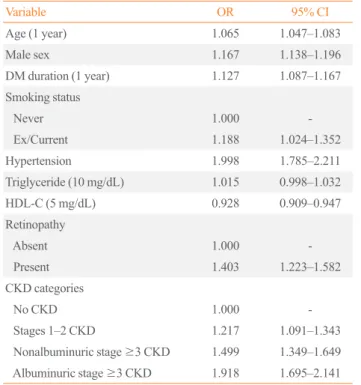
ing, and hypertension with occurrence of any CVD events; con- versely, HDL-C level was negatively correlated (Table 3). Non- albuminuric stage ≥3 CKD group showed a stronger associa- tion with previous CVD events than no CKD group when CKD categories were considered as covariates; however, albuminuric stage ≥3 CKD group showed an augmented increase in the prevalent rate of any CVD events (Table 3).
DISCUSSION
We found that nonalbuminuric stage ≥3 CKD group had lower
prevalent rates of retinopathy and previous CVD than albumin- uric stage ≥3 CKD group. In addition, albuminuric stage ≥3 CKD group showed a stronger association with retinopathy than those with the normal eGFR with or without albuminuria. We also showed that nonalbuminuric stage ≥3 CKD group was sig- nificantly related with the incidence of any CVD events than no CKD. There is a consistency between the higher CVD prevalent rate observed in albuminuric stage ≥3 CKD group and the ad- ditional cardiovascular risk associated with combination of de- clined eGFR and increased degree of albuminuria [14]. There- fore, nonalbuminuric form of renal insufficiency is the clinically Table 1. Clinical Characteristics of Study Subjects with No CKD, Stages 1 to 2 CKD, Nonalbuminuric, and Albuminuric Stage ≥3 CKD
Variable No CKD Stages 1–2
CKD Nonalbuminuric
stage ≥3 CKD Albuminuric
stage ≥3 CKD P value
Number 321 (30) 332 (31) 98 (9) 316 (30)
Age, yr 55.5±11.1 55.3±11.6 66.4±11.4 60.9±12.8 <0.001
Male sex 189 (59) 186 (56) 60 (61) 126 (40) 0.016
DM duration, yr 3.1±2.2 4.6±3.0 6.8 ±4.1 10.5±6.2 <0.001
BMI, kg/m2 24.6±3.8 25.6±4.1 24.1±4.2 24.7±4.7 0.752
SBP, mm Hg 126±17 128±17 134±17 138±25 <0.001
DBP, mm Hg 72±11 72±12 85±14 86±15 <0.001
BUN, mg/dL 15.0±4.1 15.2±4.5 29.4±8.4 32.1±11.9 <0.001
Serum creatinine, mg/dL 0.81±0.18 0.83±0.18 2.12±0.63 2.43±0.85 <0.001
HbA1c, % 7.4±1.1 7.7±1.5 8.1±1.9 8.8±1.1 0.012
Total cholesterol, mg/dL 177±31 179±34 189±25 190±37 0.051
LDL-C, mg/dL 91±19 94±28 110±30 109±28 0.109
Triglyceride, mg/dL 185±99 188±83 192±103 190±93 0.256
HDL-C, mg/dL 49±7 48±6 41±7 43±10 0.010
eGFR, mL/min/1.73 m2 88.4±10.7 90.2±11.3 42.1±10.0 39.1±11.1 <0.001
Urine ACR, mg/g 16.9±4.5 223.2±81.3 18.7±5.9 1,032.5±88.1 <0.001
hsCRP, mg/dL 0.10±0.06 0.10±0.08 0.11±0.35 0.15±0.29 <0.001
Smoking 144 (45) 143 (43) 38 (39) 133 (42) 0.249
Retinopathy 9 (3) 23 (7) 27 (28) 126 (40) <0.001
Previous CVD events 16 (5) 20 (6) 19 (19) 85 (27) 0.002
Coronary artery diseases 9 10 12 65
Cerebrovascular diseases 7 8 7 16
Peripheral vascular diseases 0 2 0 4
Statin 144 (45) 156 (47) 59 (60) 205 (65) <0.001
Antihypertensive drugs 202 (63) 225 (68) 71 (72) 246 (78) <0.001
ACEIs/ARBs 173 (54) 189 (57) 67 (68) 186 (59) <0.001
Values are expressed as number (%) or mean±SD. eGFR was estimated by the Modification of Diet in Renal Disease study equation. Patients who co- use ACEIs/ARBs and other antihypertensive drugs were counted in duplicate.
CKD, chronic kidney disease; DM, diabetes mellitus; BMI, body mass index; SBP, systolic blood pressure; DBP, diastolic blood pressure; BUN, blood urea nitrogen; HbA1c, glycated hemoglobin; LDL-C, low density lipoprotein cholesterol; HDL-C, high density lipoprotein cholesterol; eGFR, estimated glomerular filtration rate; ACR, albumin-creatinine ratio; hsCRP, high-sensitivity C-reactive protein; CVD, cardiovascular disease; ACEI, angiotensin- converting enzyme inhibitor; ARB, angiotensin II receptor blocker.
distinctive entity of renal diseases in T2DM, and it should be considered in the management of these patients. There is a weak association between previous CVD events and patients with al- buminuria alone because patients with increased degree of albu- minuria and normal/subnormal eGFR were assigned to the early stage of CKD than patients with declined eGFR, without regard to albuminuria. But on the other, when compared with nonalbu- minuric stage ≥3 CKD group, the additively higher cardiovas- cular burden associated with the integration of declined eGFR and albuminuria bears out that patients with albuminuric stage
≥3 CKD should be considered at higher cardiovascular risk, which is in line with previous studies [8,10]. Microalbuminuria is a first sign of renal dysfunction based on the clinical progres- sion of diabetic kidney diseases [21]. Thus, in diabetic patients, it is important to measure and monitor excretion of urine albu- min, as a predictive clinical marker of chronic renal complica- tions, for preventing overt diabetic nephropathy [22,23]. Mea- suring excretion of albumin in 24 hours collected urine sample is the standard method [24], although a substitute way is mea- suring excretion of albumin and creatinine in single spot urine sample [25,26]. Ratio of albumin and creatinine excretion was accepted as a reliable screening method for selecting study pop- ulation in many trials [25,27]. However, the early loss of renal function may occur even in the condition without albuminuria in some T1DM with a long duration, and this is more of a com- mon occurrence than in T2DM. The mechanism of this is not clear; however, possible factors of nonalbuminuric form of re- nal insufficiency are renal nephron loss according to aging, in-
terstitial fibrosis, cholesterol emboli, and atherosclerotic chang- es in renal vasculature [28]. To interpret the growing prevalent rate of nonalbuminuric renal insufficiency, the impact of recent treatment trends should be also considered. For example, during the last two decades, there has been an intense rise in hyperten- sion and/or renal insufficiency treated with RAS inhibitors in patients with T2DM [8]. The role of RAS blocking agents have distinct effects on degrees of both GFR and albuminuria [10, 23]. In our study subjects, 72% of patients were used with such a treatment; and a greater proportion has been described previ- ously [8]. Moreover, the rising prevalent rate of nonalbuminuric renal insufficiency may reveal alterations in the fundamental re- nal pathology with macrovascular lesions prevailing against mi- crovascular lesions [24]. Such an alteration may also be attrib- uted to the recent changes in treatment modality, especially to the intensive management of blood pressure, glucose, and lip- ids, which has been achieved in diabetic patients established on results of previous trials [25,27].
Matsushita et al. [28] has proposed that CKD-EPI formula was able to more accurately detect patients in respect to risk of cardiovascular events and death compared to MDRD study Table 2. Logistic Regression Analysis of Previous Cardiovascu-
lar Disease Events with Categories of eGFR and Albuminuria as Covariates
Variable OR 95% CI
Albuminuria categories, mg/g
<30 1.0 -
30–299 1.199 1.126–1.272
≥300 1.329 1.215–1.443
eGFR categories, mL/min/1.73 m2
≥90 1.0 -
60–89 1.085 0.968–1.202
30–59 1.438 1.285–1.591
<30 1.739 1.486–1.992
eGFR was estimated by the Modification of Diet in Renal Disease study equation.
eGFR, estimated glomerular filtration rate; OR, odds ratio; CI, confi- dence interval.
Table 3. Logistic Regression Analysis of Previous CVD Events with Individual Categories as Covariates
Variable OR 95% CI
Age (1 year) 1.065 1.047–1.083
Male sex 1.167 1.138–1.196
DM duration (1 year) 1.127 1.087–1.167
Smoking status
Never 1.000 -
Ex/Current 1.188 1.024–1.352
Hypertension 1.998 1.785–2.211
Triglyceride (10 mg/dL) 1.015 0.998–1.032
HDL-C (5 mg/dL) 0.928 0.909–0.947
Retinopathy
Absent 1.000 -
Present 1.403 1.223–1.582
CKD categories
No CKD 1.000 -
Stages 1–2 CKD 1.217 1.091–1.343
Nonalbuminuric stage ≥3 CKD 1.499 1.349–1.649 Albuminuric stage ≥3 CKD 1.918 1.695–2.141 CVD, cardiovascular disease; OR, odds ratio; CI, confidence interval;
DM, diabetes mellitus; HDL-C, high density lipoprotein cholesterol;
CKD, chronic kidney disease.
equation. When we computed eGFR using CKD-EPI formula in the study, the proportions of patients were nearly equivalent to those calculated using MDRD study equation, and prevalent rate of previous CVD events also did not change significantly.
According to the preceding survey, about 30% of patients with T2DM had stage ≥3 CKD without both retinopathy and albuminuria [29]. In several studies, when compared with the albuminuric renal insufficiency group, nonalbuminuric renal in- sufficiency group was marked by showing a preponderance of female sex, older age, higher HDL-C, and possibly better prog- nosis [7,30,31]. In our study, nonalbuminuric stage ≥3 CKD group had shorter diabetic duration, lower concentrations of HbA1c, HDL-C, and hsCRP, lower prevalent rates of retinopa- thy and previous CVD, and higher rate of treatment with ACEIs/ARBs compared with albuminuric stage ≥3 CKD group. Furthermore, when compared with no CKD group, non- albuminuric stage ≥3 CKD group was more often nonsmokers, and had lower concentration of HDL-C, higher rates of thera- peutic intervention with statin and ACEIs/ARBs, but higher prevalent rates of retinopathy and prior CVD events. Our results are somewhat similar to those from studies of Caucasian popu- lation, but also different in other aspects with respect to non- smoker status and HDL-C level.
When CKD categories were applied to the statistical model as covariates, nonalbuminuric stage ≥3 CKD group has a stronger statistical significance with prior CVD events than no CKD group; however, the prevalent rate of prior CVD events in albu- minuric stage ≥3 CKD group was markedly increased in addi- tional manner than no CKD group. These results show a some- what similar but more powerful relations than those shown in previous report [17]. We also showed that albuminuric stage ≥3 CKD group had the strongest prevalent rate of prior CVD events. This is concomitant with the perception that a high- powered predictor of cardiovascular death in the public and in diabetes is a decreased renal function, irrespective of conven- tional CVD risk factors including albuminuria [10,11]. A more powerful correlation between cardiovascular events and de- clined eGFR than albuminuria can be explained by the distinc- tions in the kidney pathophysiology that underlies the albumin- uric and nonalbuminuric forms of renal insufficiency. Although it may occur even if not have significant renal damages, micro- albuminiuria is considered to be a clinically reliable marker for renal microvascular lesions [32,33]. On the other hand, eGFR had an inverse association with the indicators of both extrarenal and intrarenal atherosclerotic lesions [7,34]. Vascular cell dys- function and resulting atherosclerotic changes are specious
pathophysiologic mechanism for the connection between de- clined renal function with albuminuria and cardiovascular death [25,33]. Therefore, albuminuric renal insufficiency, as a preva- lent feature of renal macrovascular lesions, would be more com- monly related with cardiovascular events.
The limitations of the study are as follows. First, the cross- sectional design and small number of study population limit the inferences of the observed causal relations between relevant factors of nonalbuminuric renal insufficiency and occurrence of any CVD events. Second, this study was conducted at a single- center hospital. Therefore, the making generalization from our results to the entire the Korean patients with T2DM is weak.
Third, the assessment of degree of albuminuria was done with only one spot urine sample. A single urine specimen might not exactly estimate albuminuria compared with 24 hours urine col- lection.
In conclusion, we confirm that nonalbuminuric stage ≥3 CKD group is significantly interrelated with occurrence of prior CVD events than group with normal eGFR with or without al- buminuria. Comparing with normal eGFR and nonalbuminuria categories, the combination of increased degree of albuminuria and declined eGFR is becoming significant for the association of prior CVD events. Additional large prospective studies will be required in order to clear up the relevant causes for the devel- opment of any CVD events in nonalbuminuric renal insufficien- cy in patients with T2DM.
CONFLICTS OF INTEREST
No potential conflict of interest relevant to this article was re- ported.
ACKNOWLEDGMENTS
This study was supported for 2 years by Pusan National Univer- sity Research Grant.
ORCID
Hye Won Lee http://orcid.org/0000-0002-8362-442X A Ra Jo http://orcid.org/0000-0002-9032-0627 Dong Won Yi http://orcid.org/0000-0003-3574-036X Yang Ho Kang http://orcid.org/0000-0002-1215-7975 Seok Man Son http://orcid.org/0000-0002-3878-9030
REFERENCES
1. Huxley R, Barzi F, Woodward M. Excess risk of fatal coro- nary heart disease associated with diabetes in men and wom- en: meta-analysis of 37 prospective cohort studies. BMJ 2006;332:73-8.
2. Brancati FL, Whelton PK, Randall BL, Neaton JD, Stamler J, Klag MJ. Risk of end-stage renal disease in diabetes mel- litus: a prospective cohort study of men screened for MRFIT. Multiple Risk Factor Intervention Trial. JAMA 1997;278:2069-74.
3. Gerstein HC, Mann JF, Yi Q, Zinman B, Dinneen SF, Hoog- werf B, et al. Albuminuria and risk of cardiovascular events, death, and heart failure in diabetic and nondiabetic individu- als. JAMA 2001;286:421-6.
4. Go AS, Chertow GM, Fan D, McCulloch CE, Hsu CY.
Chronic kidney disease and the risks of death, cardiovascu- lar events, and hospitalization. N Engl J Med 2004;351:
1296-305.
5. Anavekar NS, Gans DJ, Berl T, Rohde RD, Cooper W, Bhaumik A, et al. Predictors of cardiovascular events in pa- tients with type 2 diabetic nephropathy and hypertension: a case for albuminuria. Kidney Int Suppl 2004;92:S50-5.
6. Soveri I, Arnlov J, Berglund L, Lind L, Fellstrom B, Sund- strom J. Kidney function and discrimination of cardiovascu- lar risk in middle-aged men. J Intern Med 2009;266:406-13.
7. Thomas MC, Weekes AJ, Broadley OJ, Cooper ME, Mathew TH. The burden of chronic kidney disease in Australian pa- tients with type 2 diabetes (the NEFRON study). Med J Aust 2006;185:140-4.
8. Thomas MC, Macisaac RJ, Jerums G, Weekes A, Moran J, Shaw JE, et al. Nonalbuminuric renal impairment in type 2 diabetic patients and in the general population (national eval- uation of the frequency of renal impairment co-existing with NIDDM [NEFRON] 11). Diabetes Care 2009;32:1497-502.
9. Afghahi H, Cederholm J, Eliasson B, Zethelius B, Gudb- jornsdottir S, Hadimeri H, et al. Risk factors for the develop- ment of albuminuria and renal impairment in type 2 diabe- tes: the Swedish National Diabetes Register (NDR). Nephrol Dial Transplant 2011;26:1236-43.
10. Ninomiya T, Perkovic V, de Galan BE, Zoungas S, Pillai A, Jardine M, et al. Albuminuria and kidney function indepen- dently predict cardiovascular and renal outcomes in diabe- tes. J Am Soc Nephrol 2009;20:1813-21.
11. Drury PL, Ting R, Zannino D, Ehnholm C, Flack J, Whiting M, et al. Estimated glomerular filtration rate and albumin-
uria are independent predictors of cardiovascular events and death in type 2 diabetes mellitus: the Fenofibrate Interven- tion and Event Lowering in Diabetes (FIELD) study. Diabe- tologia 2011;54:32-43.
12. Lane PH, Steffes MW, Mauer SM. Glomerular structure in IDDM women with low glomerular filtration rate and nor- mal urinary albumin excretion. Diabetes 1992;41:581-6.
13. Tsalamandris C, Allen TJ, Gilbert RE, Sinha A, Panagioto- poulos S, Cooper ME, et al. Progressive decline in renal function in diabetic patients with and without albuminuria.
Diabetes 1994;43:649-55.
14. Chronic Kidney Disease Prognosis Consortium, Matsushita K, van der Velde M, Astor BC, Woodward M, Levey AS, et al. Association of estimated glomerular filtration rate and al- buminuria with all-cause and cardiovascular mortality in general population cohorts: a collaborative meta-analysis.
Lancet 2010;375:2073-81.
15. Bruno G, Merletti F, Bargero G, Novelli G, Melis D, Soddu A, et al. Estimated glomerular filtration rate, albuminuria and mortality in type 2 diabetes: the Casale Monferrato study. Diabetologia 2007;50:941-8.
16. Penno G, Solini A, Bonora E, Fondelli C, Orsi E, Zerbini G, et al. Clinical significance of nonalbuminuric renal impair- ment in type 2 diabetes. J Hypertens 2011;29:1802-9.
17. Solini A, Penno G, Bonora E, Fondelli C, Orsi E, Arosio M, et al. Diverging association of reduced glomerular filtration rate and albuminuria with coronary and noncoronary events in patients with type 2 diabetes: the renal insufficiency and cardiovascular events (RIACE) Italian multicenter study.
Diabetes Care 2012;35:143-9.
18. Levey AS, Bosch JP, Lewis JB, Greene T, Rogers N, Roth D.
A more accurate method to estimate glomerular filtration rate from serum creatinine: a new prediction equation. Mod- ification of Diet in Renal Disease Study Group. Ann Intern Med 1999;130:461-70.
19. Levey AS, Coresh J, Balk E, Kausz AT, Levin A, Steffes MW, et al. National Kidney Foundation practice guidelines for chronic kidney disease: evaluation, classification, and stratification. Ann Intern Med 2003;139:137-47.
20. Levey AS, Stevens LA, Schmid CH, Zhang YL, Castro AF 3rd, Feldman HI, et al. A new equation to estimate glomeru- lar filtration rate. Ann Intern Med 2009;150:604-12.
21. Hostetter TH. Prevention of the development and progres- sion of renal disease. J Am Soc Nephrol 2003;14(7 Suppl 2):
S144-7.
22. Heerspink HJ, Holtkamp FA, de Zeeuw D, Ravid M. Moni-
toring kidney function and albuminuria in patients with dia- betes. Diabetes Care 2011;34 Suppl 2:S325-9.
23. de Zeeuw D, Remuzzi G, Parving HH, Keane WF, Zhang Z, Shahinfar S, et al. Proteinuria, a target for renoprotection in patients with type 2 diabetic nephropathy: lessons from RE- NAAL. Kidney Int 2004;65:2309-20.
24. Rowe DJ, Dawnay A, Watts GF. Microalbuminuria in diabe- tes mellitus: review and recommendations for the measure- ment of albumin in urine. Ann Clin Biochem 1990;27(Pt 4):
297-312.
25. Croal BL, Mutch WJ, Clark BM, Dickie A, Church J, Noble D, et al. The clinical application of a urine albumin: creati- nine ratio point-of-care device. Clin Chim Acta 2001;307:15- 21.
26. Marshall SM. Screening for microalbuminuria: which mea- surement? Diabet Med 1991;8:706-11.
27. Rychlik I, Jancova E, Tesar V, Kolsky A, Lacha J, Stejskal J, et al. The Czech registry of renal biopsies. Occurrence of re- nal diseases in the years 1994-2000. Nephrol Dial Trans- plant 2004;19:3040-9.
28. Matsushita K, Mahmoodi BK, Woodward M, Emberson JR, Jafar TH, Jee SH, et al. Comparison of risk prediction using the CKD-EPI equation and the MDRD study equation for estimated glomerular filtration rate. JAMA 2012;307:1941-
51.
29. Kramer HJ, Nguyen QD, Curhan G, Hsu CY. Renal insuffi- ciency in the absence of albuminuria and retinopathy among adults with type 2 diabetes mellitus. JAMA 2003;289:3273- 7.
30. MacIsaac RJ, Panagiotopoulos S, McNeil KJ, Smith TJ, Tsalamandris C, Hao H, et al. Is nonalbuminuric renal insuf- ficiency in type 2 diabetes related to an increase in intrarenal vascular disease? Diabetes Care 2006;29:1560-6.
31. Rigalleau V, Lasseur C, Raffaitin C, Beauvieux MC, Barthe N, Chauveau P, et al. Normoalbuminuric renal-insufficient diabetic patients: a lower-risk group. Diabetes Care 2007;30:
2034-9.
32. Futrakul N, Sridama V, Futrakul P. Microalbuminuria: a bio- marker of renal microvascular disease. Ren Fail 2009;31:
140-3.
33. Fioretto P, Mauer M, Brocco E, Velussi M, Frigato F, Muol- lo B, et al. Patterns of renal injury in NIDDM patients with microalbuminuria. Diabetologia 1996;39:1569-76.
34. Taniwaki H, Nishizawa Y, Kawagishi T, Ishimura E, Emoto M, Okamura T, et al. Decrease in glomerular filtration rate in Japanese patients with type 2 diabetes is linked to athero- sclerosis. Diabetes Care 1998;21:1848-55.