Asan Medical Information System for Healthcare Quality Improvement
Hyeon Jeong Ryu, MS1, Woo Sung Kim, MD, PhD2,3, Jae Ho Lee, MD, MS2,4, Sung Woo Min, BA1,5, Sun Ja Kim, MS6, Yong Su Lee, BA1, Young Ha Lee, BA5, Sang Woo Nam, BA5, Gi Seung Eo, BA5, Sook Gyoung Seo, MS6, Mi Hyun Nam, BA6
1Medical Information-Administration Team; 2Medical Information Office; Deptartments of 3Pulmonology; 4Emergency Medicine; 5Medical Information- Development Team; 6Medical Information-Management Team, Asan Medical Center, University of Ulsan College of Medicine, Seoul, Korea
Objectives: This purpose of this paper is to introduce the status of the Asan Medical Center (AMC) medical information system with respect to healthcare quality improvement. Methods: Asan Medical Information System (AMIS) is projected to become a completely electronic and digital information hospital. AMIS has played a role in improving the health care qual- ity based on the following measures: safety, effectiveness, patient-centeredness, timeliness, efficiency, privacy, and security.
Results: AMIS consisted of several distinctive systems: order communication system, electronic medical record, picture archiving communication system, clinical research information system, data warehouse, enterprise resource planning, IT service management system, and disaster recovery system. The most distinctive features of AMIS were the high alert-medi- cation recognition & management system, the integrated and severity stratified alert system, the integrated patient monitor- ing system, the perioperative diabetic care monitoring and support system, and the clinical indicator management system.
Conclusions: AMIS provides IT services for AMC, 7 affiliated hospitals and over 5,000 partners clinics, and was developed to improve healthcare services. The current challenge of AMIS is standard and interoperability. A global health IT strategy is needed to get through the current challenges and to provide new services as needed.
Keywords: Hospital Information Systems, Quality of Health Care, Clinical Decision Support Systems, Electronic Medical Re- cord
Healthc Inform Res. 2010 September;16(3):191-197.
doi: 10.4258/hir.2010.16.3.191 pISSN 2093-3681 • eISSN 2093-369X
Received for review: September 3, 2010 Accepted for publication: September 20, 2010 Corresponding Author
Jae Ho Lee, MD, MS
Medical Information Office, Asan Medical Center, 388-1 Pungnap- dong, Songpa-gu, Seoul 138-736, Korea. Tel: +82-2-3010-3350, Fax:
+82-2-3010-3360, E-mail: [email protected]
This is an Open Access article distributed under the terms of the Creative Com- mons Attribution Non-Commercial License (http://creativecommons.org/licenses/by- nc/3.0/) which permits unrestricted non-commercial use, distribution, and reproduc- tion in any medium, provided the original work is properly cited.
ⓒ 2010 The Korean Society of Medical Informatics
I. Introduction
Asan Medical Center (AMC) was established by the Asan Foundation. The Asan Foundation has placed special impor- tance on medical welfare projects, including establishment of hospitals with professional medical staff and modern medical treatment facilities in areas with limited access to medical treatment. The Foundation recognized the need for a professional hospital that would offer world-class medical treatment and act as a ‘hub’ for regional hospitals. This rec- ognition the mission led to the opening of AMC on June 23, 1989, with 23 departments and approximately 1,000 beds.
Currently, AMC has 2,700 beds and is the largest medical in- stitution in Korea. AMC has approximately 8,000 employees, attends to 10,000 outpatients per day, has an average of 2,600 inpatients daily, and performs about 200 complex surgical
procedures every day of the year.
The aspiration and determination of AMC to become a ‘pa- tient-oriented hospital’ is the driving force behind progress of AMC. AMC has developed integrated healthcare systems and efficient healthcare support systems for a hospital where patients do not have to wait any longer than is necessary and where the privacy of patients is respected. These achieve- ments are made possible through the Asan Medical Informa- tion System (AMIS). Medical science and technology have advanced at an unprecedented rate during the past half-cen- tury. In tandem has come growing complexity of health care, which today is characterized by more to know, more to do, more to manage, more to watch, and more people involved than ever before. Faced with such rapid changes, health in- formation system has fallen far short in its ability to translate knowledge into practice and to apply new technology safely and appropriately. Health information system is rising as an important tool for improving quality of health care service with unique features [1]. AMIS is also committed to improve quality of health care service, because of our aspiration to be a ‘patient-oriented hospital’.
In this paper, we will describe the role played by AMIS in healthcare quality improvement, and propose its distinct features, as defined in the second report of the Institute of Medicine issued in 2001. Healthcare quality encompassed patient safety, effectiveness, patient-centeredness, timeliness, efficiency, and equity [2]. We chose privacy and security instead of equity as one of quality indicators, and we here review the performance of our system with respect to the above-listed criteria, with identification of healthcare quality applications important to these ends.
II. Case Description
This section mainly describes the characteristics of main ap- plications and configuration of AMIS, and discusses main issues which should be resolved to improve the quality of health care.
1. Characteristics of AMIS
Beginning in 1989, AMC implemented AMIS to become a requisition; slip-less, film-less and paperless hospital, and to efficiently manage hospital. AMIS includes an order commu- nication system (OCS) such like as computerized physician
Table 1. Brief history of Asan Medical Information System (AMIS) Year Key aspects
in AMIS in AMC
1989. 6 First application OCS Opening of AMC (1,000 beds in total)
1995. 7 Full application AMIS Opening of the East building (2,200 beds in total)
2000. 4 Full application PACS
2001. 1 First application DW Opening of the Asan Clinical Research Center
2004. 1 Application ERP
2005. 3 First application EMR
2007. 3 Full application EMR
2008. 5 Application DRS and ITSM Opening of the New building (2,630 beds in total) 2009. 11 First application u-health service Opening of Asan Medical Center Children’s Hospital
OCS: order communication system, AMC: Asan Medical Center, PACS: picture archiving communication system, DW: data ware- house, ERP: enterprise resource planning, EMR: electronic medical record, DRS: disaster recovery system, ITSM: IT service man- agement system.
Figure 1. Diagram of Asan Medical Center (AMC) health IT services.
order entry system (CPOE), a picture archiving communi- cation system (PACS), an electronic medical record system (EMR), a data warehouse (DW) and an enterprise resource planning (ERP), and etc. (Table 1, Figure 1). Also a web- based healthcare service (e-AMIS, Web-PACS) is available to partner hospitals and clinics. AMC is affiliated with seven other Korean hospitals and our information-development team offers medical IT services to all colleagues. Most of AMC health IT services is in house built by our medical information-development team.
Both the computational power and the data capacity of our server have been gradually increased over the past 20 years.
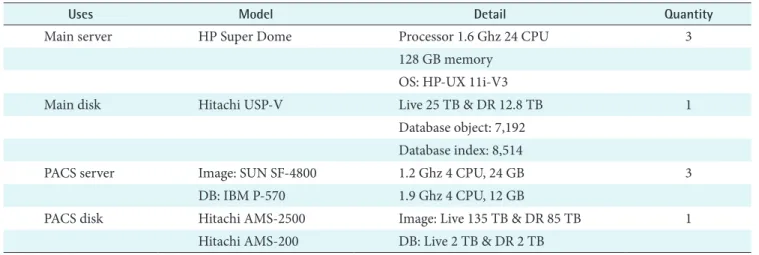
The main server and disk specifications are shown in Table 2.
1) OCS and Clinical Decision Support System (CDSS) AMC OCS has been developed to focus on CDSS based on various references and clinical knowledge. Our clinical deci- sion support areas are well organized; we formally review all antibiotic prescriptions, total parenteral nutrition decisions, chemotherapy calls, identifications of critical pathways, pro- tocol information, and order sets.
Notably, we have used CDSS for more than 10 years to as- sist in medication decisions. For example, an antimicrobials management system was implemented in 1996 to formalize antibiotics prescription and support. A drug interaction alert system was introduced in 2005 to minimize errors in drug combinations, to provide information on dose limits, to warn of drug interactions, and to provide critical allergy in- formation. Our chemotherapy management system is highly organized and is based on clinical knowledge: this greatly assists our physicians in implementation of optimal anti- cancer chemotherapy regimens and improves the efficiency of cancer patient’ care. Recently a pregnancy alert system, termed PLEASE, has also been placed on-line. All of these
systems are harmoniously integrated with in our OCS envi- ronment.
2) EMR
Our EMR holds all ER, OPD, ward and ICU records. Flow charts allow ward EMR doctors to instantly view patient vital signs using a graphical layout, to evaluate laboratory data, and to consider other clinical findings. A clinical sum- mary information window gives all relevant information at a glance; this includes a list of problems, the operation his- tory, medication information, the OPD schedule, consultant memos, full imaging data, and laboratory information; all are available on an EMR viewer. Each physician has a win- dow allowing recording of notes and disease progression.
3) PACS
Our full PACS package consists of PetaVision (PACS viewer for Clinicians and Radiologists), PetaMotion (an acquisi- tion workstation for non-DICOM modalities including en- doscope, and motion frame machines), ROView (a special viewer used by our Department of Radiation Oncology that includes planning information and radiation dose sugges- tions), PetaPET (a PET/CT image viewer, enabling both PET and CT fusion views), PetaGate (an acquisition worksta- tion), and DICOM implemented servers. Our PACS system supports DICOM 3.0 services which include C-STORE, DI- COM worklist and DICOM print.
4) Disaster Recovery System (DRS)
We developed a DRS to ensure continuity of information service even in a disaster situation, to protect medical re- cords from hardware or data server failure, and to provide a seamless information service during server upgrades. Were a disaster to occur, DRS immediately becomes live. After
Table 2. The main server and disk specification of Asan Medical Information System (AMIS)
Uses Model Detail Quantity
Main server HP Super Dome Processor 1.6 Ghz 24 CPU 3
128 GB memory OS: HP-UX 11i-V3
Main disk Hitachi USP-V Live 25 TB & DR 12.8 TB 1
Database object: 7,192 Database index: 8,514
PACS server Image: SUN SF-4800 1.2 Ghz 4 CPU, 24 GB 3
DB: IBM P-570 1.9 Ghz 4 CPU, 12 GB
PACS disk Hitachi AMS-2500 Image: Live 135 TB & DR 85 TB 1
Hitachi AMS-200 DB: Live 2 TB & DR 2 TB
recovery, all data are transferred to the newly recovered sys- tem.
The DRS was developed in 2005, and a software-type DRS running Oracle Data Guard is currently used insulate all AMIS data. The DRS consists of primary database (DB), a logical standby DB, and a physically remote standby DB (the DR DB). The DR DB is synchronized with the primary DB by fast reading of “redo log” data. Each DB is 4 terabytes in capacity. The DR DB is installed on the 8th floor of the Asan Research and Education Building, whereas the primary and standby DBs are located on the 13th floor of the East Build- ing.
5) IT Service Management System (ITSM)
To improve IT service quality and user satisfaction, AMC established an ITSM processes and an effectively automated the ITSM system. This has resulted in cost-effective cus- tomer support, improved use of IT resources, and increased productivity of IT personnel. All IT processes and related systems comply with our Hospital Evaluation Program and HIPAA Standard Operating Procedures.
2. Main Issues of AMIS
AMC was increased almost three times in its size after the opening of the East building in 1994, the New building in 2008, and the number of patients has increased accordingly.
To improve the patient care with large patient population, many specialized divisions of centers and clinics were estab- lished according to newest modalities and with specialized staffs. For these reasons, complexity and complication in medical service environment caused following issues.
• Complicated clinical process such as many steps of patient
confirmation and medication check,
• Delay of decision making from diversified information,
• High level of dependency on information system to process improvement.
Consolidating IT to healthcare, the new understanding has developed followed by whole new patient care procedures.
IT dependency and complexity are increasing continuously in health care [3]. Thus, the provision of stabilized IT service and proactive support are accentuated as first priority. How- ever, in real life it is difficult to operate and evolve IT depart- ments in systematic manner. AMIS has been improved to solve these issues centered on patient safety, business effi- ciency and process integration.
III. Results
1. Safety: High Alert-Medication Recognition and Man- agement System
The Institute for Healthcare Improvement has defined high- alert medications (HAMs) as those that are likely to cause significant harm to a patient, even in intended usage. The Joint Commission International has emphasize that HAM safety muse be improved. However, HAMs are not the only causes of adverse events [4-7]; other problems are also evi- dent. A comprehensive strategy improving medication safety is nonetheless imperative.
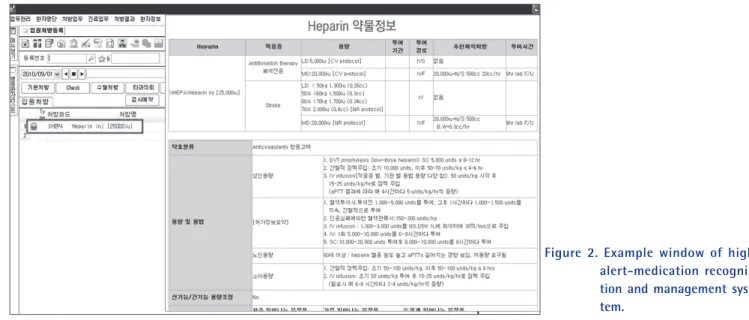
In the interval since February 2008, implementation of the High Alert-Medication Recognition and Management System to Lower Errors and to Secure Safety (HARMLESS) project has effectively reduced the incidence of HAMs- related adverse events at AMC. HARMLESS solution lists were identified by error-type products and contributing fac-
Figure 2. Example window of high alert-medication recogni- tion and management sys- tem.
tors analysis, and clinical process evaluation using activity diagrams relevant to HAMs. All core messages, adverse drug events, drug interactions, post-medication items to be moni- tored, similar drugs information, hospital clinical guidelines, and routine drug data, are entered into the OCS. A distinc- tive red round HAM icon is displayed before the HAM name appears on the OCS screen (Figure 2). The system emphasiz- es core messages, yet detailed information is also displayed, including information on prior adverse drug events (thus, reports from PI; Performance Improvement experts), hospi- tal clinical guidelines including detailed dose protocols, and routine drug information (provided by pharmacists). Alert- trigger and maximum prescription doses are established us- ing real hospital data.
2. Effectiveness: Integrated and Severity-Stratified Alert System
Our integrated and severity-stratified alert system was de- veloped to manage critical patients information effectively, and to alert medical staff to problems needing attention; we did not wish to disturb the flow of clinical decision-making.
Three system input components have been important; Re- porting, Censorship and Warning. Data input uses three types of information; Allergy, Infection and Others. The drug allergy input contains drug details, drug ingredients, and allergy symptoms. Infection data include information on antibiotic-resistance, and precautions taken to prevent infection from blood transfusions, air, contacts, absence of isolation, and droplets. Other information may include data on food, and metal allergies. A warning severity is indicated by color; the colors are red, yellow, green, and purple. Red indicates a major problem; yellow, moderate; green, low; and purple, an infection. Integrated alert information appears as
a pop-up screen during operation of commonly used com- puter programs including EMR, OCS, and electronic nursing records (ENR). It is possible to reduce the number of alert messages featuring a combination of allergy data and infec- tion medication. Thus, medical staff can stratify alert sever- ity.
3. Patient-Centeredness: Integrated Patient Monitoring System
From the patient perspective, what was once a physician- patient relationship is now more akin to a customer-compa- ny interaction. A patient expects his/her hospital to absorb everything relevant to a treatment contract and schedule, and medical history commencing at first contact (possi- bly by telephone) through to completion of care. A high- quality hospital seeks to deal with these issues and focuses on quality of patient care. An improvement in care quality is synonymous with enhanced patient satisfaction, which is thus paramount. A first-rate hospital information system must prioritize patient service [8]. In particular, long waiting times have a major negative impact on customer satisfac- tion. AMC has developed an Integrated Patient Monitoring System to deal with this problem. Four monitoring systems are operative; these allow integration of inpatient bed man- agement, an outpatient wait scheduling system, an operation theatre management process system, and an integrated labo- ratory reservation monitoring system. Not all components are currently operative, but healthcare services will be more efficiently delivered in future (Figure 3).
4. Timeliness: Perioperative Diabetic Care Monitoring and Support System
Our Computerized Perioperative Diabetic Care Monitoring
Figure 3. Example window of inte- grated patient monitoring system.
and Support System involves both promulgation of perioper- ative diabetic blood sugar control guidelines and implemen- tation of a diabetes alert monitoring system. Computerized guidelines for diabetic blood sugar levels are applied to data from diabetics scheduled for operation. A simple text on blood sugar control is offered to all patients and appropriate prescriptions (computer-generated) are listed on a case basis.
Our diabetes alert monitoring system has two input for- mats. First, physicians may enter data from inpatients with diabetes using real-time clinical information (20 criteria are relevant). Briefly, the parameters may be categorized into three groups, exhibited by patient in whom blood sugar lev- els are unstable (thus with hyperglycemia or hypoglycemia), by patients for whom prescription of anti-diabetic agents (insulin, oral hypoglycemic agent) have not been effective, or by post-operative patients. The second mode of database entry is available to nurses in charge of monitored inpatients (thus, these healthcare professionals have preferred access).
The Diabetes Alert Team reviews monitored inpatient lists and offers recommendations to attending doctors if their prescriptions seem inappropriate.
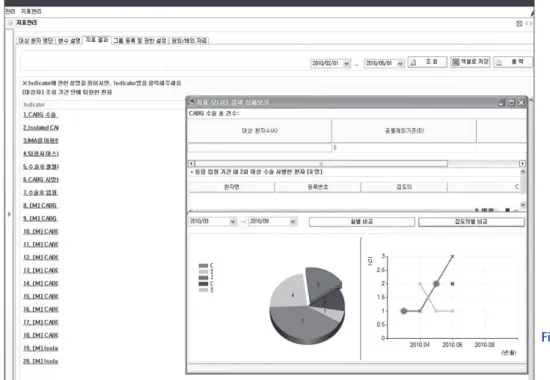
5. Efficiency: Clinical Indicator Management System Our Clinical Indicator Management System gathers raw data from the AMIS environment and summarizes all relevant information compile indicative evidence. Four essential requirements are met. First, system burden is minimized.
Second, data access is rapid. Third, changes to the existing system (with which most users are comfortable) are mini-
mized. Finally, a great deal of diverse data must be handled in an (apparently) effortless manner. All useful information is immediately displayed and can be stored in a variety of user-friendly formats. Indicators for AMI, CABG, stroke, and several other conditions are flagged; these are but a few examples of power of the system (Figure 4).
6. Privacy and Security
In the interval since December 2008, our PROMISE (Pa- tient Right Observance with Medical Information Security Enhancement Campaign) project has aimed to ensure the security of personal health information contained in AMC.
PROMISE involved establishment of an Information Secu- rity Management System (ISMS), to ensure international privacy (with security certification) and to establish a pri- vacy/security culture within our institution. An in-house privacy and security task force team developed AMC policy.
Our reference text has 10 chapters (including 3 verses), and 67 articles. A Medical Information Security Enhancement Campaign is run annually. In August 2010, AMIS was certi- fied as complying with ISO/IEC 27001:2005. “The ISMS at the ASAN Medical Center’s medical information system is certified to comply with Standard ISO 27799”.
IV. Discussion
Any good information system should integrate all units and departments of a hospital. Such communication is critical;
absence of discourse encourages errors affecting patient
Figure 4. Example window of clinical indicator management sys- tem.
health. Communication improvements are always possible and our ultimate aim is to optimize the quality of patient care, affording maximum responsiveness at minimal cost.
AMIS is a successful provider of IT services for all of AMC, 7 affiliated hospitals and more than 5,000 partner clinics.
AMIS has developed near-optimal services addressing pa- tient safety, effectiveness, patient-centeredness, timeliness, efficiency, and privacy and security.
AMIS faces several challenges. Our greatest problem is data standardization; it is imperative to facilitate instant com- munication among professions with different backgrounds and who (sometimes) do not necessarily agree on optimal treatment regimens. IT standards are constantly evolving and changing [9]. Such IT updates as in Operating Systems change due to security and operability functions can affect our AMIS. These factors are beyond our control. However they may affect any and potentially many parts of our com- plex and integrated system. We aspire to constantly update and improve our AMIS in spite of changes in both hardware and software technologies to meet our ultimate goal; patient satisfaction. We anticipate there will be more works and dedicated teams to be trained to meet our future growth to meet our objectives.
In addition, storage/retrieval of critical health information that underpins clinical research and treatment is increasingly important. Provision (to patients) of personal health records and u-Health data is now globally popular (and is sometimes mandated by law). Global Health IT strategy is needed to solve these requirements and for the future of AMC. Any global health IT strategy run by a responsible hospital must directly address and welcome such initiatives; AMC is ready to participate.
Conflict of Interest
No potential conflict of interest relevant to this article was reported.
References
1. Choi IY, Choi R, Lee JH, Choi BG. Implementation of single source based hospital information system for the Catholic Medical Center affiliated hospitals. Healthc In- form Res 2010; 16: 133-139.
2. Institute of Medicine (US) Committee on Quality of Health Care in America. Crossing the quality chasm:
a new health system for the 21st century. Washington, DC: National Academy Press; 2001.
3. Agren M, Winther D. Managing the internal IT func- tion's changing role when outsourcing [Internet]. [cited at 2010 Sep 2]. Available from: http://arc.hhs.se/down- load.aspx?MediumId=291.
4. Federico F. Preventing harm from high-alert medica- tions. Jt Comm J Qual Patient Saf 2007; 33: 537-542.
5. Kohn LT, Corrigan J, Donaldson MS. To err is human:
building a safer health system. Washington, DC: Na- tional Academy Press; 2000. p86-108.
6. Aspden P, Corrigan JM, Wolcott J, Erickson SM. Patient safety: achieving a new standard for care. Washington DC: National Academy Press; 2003. p1-28.
7. Bates DW, Cohen M, Leape LL, Overhage JM, Shabot MM, Sheridan T. Reducing the frequency of errors in medicine using information technology. J Am Med In- form Assoc 2001; 8: 299-308.
8. Freudenheim M. Many hospitals resist computerized patient care [Internet]. The New York Times; 2004 Apr 6. [cited at 2010 Sep 2]. Available from: http://www.ny- times.com/2004/04/06/business/many-hospitals-resist- computerized-patient-care.html.
9. Demski H, Hildebrand C, Brass A, Jedamzik S, Engel- brecht R. Improvement of cross-sector communication in the integrated health environment. Stud Health Tech- nol Inform 2010; 155: 95-100.