서 론
우리나라의 심혈관계 질환은 주요 사망원인으로 2012년 관상동 맥질환 사망률은 남자는 10만 명당 31명, 여자는 10만 명당 27명이었 으며, 뇌혈관질환 사망률은 남자 10만 명당 49명, 여자는 10만 명당 53명이었다. 선진국에서는 아직 중요한 사망원인이기는 하지만 지난 수십 년 동안에 심혈관계 질환에 의한 사망은 감소하고 있다. 하지만 국내에서는 심혈관계 질환에 의한 사망이 급속히 증가하고 있다.1,2)
다른 위험인자는 예전에 비해 감소하거나 잘 조절되고 있으나 식이 나 생활습관의 악화에 따른 혈중 지질의 농도의 증가가 주요 원인이 되고 있다.3)
최근에는 식품의 제 3기능에 주목하여 의약품은 아니지만 건강 유지와 증진을 위한 식품의 기능성에 대한 관심도 함께 증가하고 있 다. 이러한 관심의 증대는 우리나라의 건강 기능성 식품 시장에 긍정 적인 영향을 미치고, 더욱 발전할 가능성을 보이고 있다.4)
우리가 흔히 접하게 되는 기호식품 중 하나인 녹차는 토마토, 브
Received May 29, 2017 Revised September 5, 2017 Accepted September 10, 2017
Corresponding author Mi-Kyeong Oh Tel: +82-33-610-3325, Fax: +82-33-641-8130 E-mail: [email protected]
ORCID: http://orcid.org/0000-0003-3602-9588
Copyright © 2018 The Korean Academy of Family Medicine
This is an open-access article distributed under the terms of the Creative Commons At- tribution Non-Commercial License (http://creativecommons.org/licenses/by-nc/4.0) which permits unrestricted noncommercial use, distribution, and reproduction in any medium, provided the original work is properly cited.
Original Article
https://doi.org/10.21215/kjfp.2018.8.3.406 eISSN 2233-9116
Korean J Fam Pract. 2018;8(3):406-410
Korean Journal of Family Practice
KJFP
건강한 한국인에서 녹차 섭취량과 혈중 지질 농도와의 관계
유승룡, 오미경*, 박우주, 장수은, 김현하, 이형철
강릉아산병원 가정의학과
Relationship between Green Tea Intake and Lipid Profile in Healthy Korean
Seung-Ryong Yoo, Mi-Kyeong Oh*, Woo-Joo Park, Soo-Eun Jang, Hyun-Ha Kim, Hyung-Chul Lee Department of Family Medicine, Gangneung Asan Hospital, Gangneung, Korea
Background: Green tea, which is an easily available product, contains catechin, a substance demonstrating anti-oxidant, and anti-inflammatory properties in addition to reducing serum lipid levels. However, the relationship between green tea intake and serum lipid levels remains unclear. We investigated the relationship between green tea intake and serum lipid levels in healthy adults.
Methods: Among the 23,626 patients who were enrolled in the National Health and Nutrition Examination Survey performed in 2012, 2013, and 2014, a total of 7,456 patients responded to questions related to green tea intake, excluding those with factors that affect serum lipid levels. Based on their daily green tea intake, we classified patients into 4 groups: those drinking 0, 1, 1–2, and ≥2 cups per day. Analysis of covariance was used to determine the relationship between green tea consumption and serum lipid levels.
Results: Among the 2,847 men included in the study, the percentage of men consuming ≥1 cups per day was 7.7%, and among 4,559 women, 5.3%.
Age, body mass index, and smoking habits showed a statistically significant difference between the sexes; however, serum lipid levels were not statistically significantly different. No statistically significant difference was observed in the relationship between green tea intake and serum lipid levels after adjustment for confounders.
Conclusion: In this study, the amount of green tea consumed on a daily basis did not seem to have a significant effect on serum lipid levels.
Keywords: Green Tea; Lipid Profile; Catechin; Low-Density Lipoprotein Cholesterol
유승룡 외. 한국인의 녹차 섭취량과 혈중 지질 농도와의 관계 Korean Journal of Family Practice
KJFP
로콜리, 마늘 등과 함께 <타임>지에서 선정한 세계 10대 건강식품에 속하는 음식으로, 최근에 건강에 대해 관심이 많아지면서 관련 제 품들이 다양하게 나오고 있다. 녹차를 섭취함으로써 생기는 여러 효 능은 카테킨이라는 물질에 의해서 나타나는 것으로 생각된다. 카테 킨은 epigallocatechin gallate (EGCG), epigallocatechin, epicatechin gal- late, 그리고 epicatechin 등으로 구성되어 있는데, 이중에서 EGCG가 가장 많은 양을 차지한다.5)
녹차의 여러 효능에는 항산화 작용, 항암 작용, 항염증 작용, 체지 방 분해 작용, 해독 작용, 항당뇨 효과, 항균 작용, 혈중 지질 농도 감 소 등이 알려져 있다.6) 또한 뇌졸중 및 심근경색 등의 심혈관계 질환 에 의한 사망률 감소에도 관련이 있다고 알려져 있다.7-9)
이에 저자들은 우리나라 건강한 성인을 대상으로 녹차의 섭취 양 상과 혈중 지질 농도에 미치는 영향을 연구하였다.
방 법
1. 연구 대상
보건복지부가 주관하여 2012년도부터 2014년도까지 시행된 국민 건강영양조사 자료를 이용하였다. 연구 대상 총 23,626명 중에서 만 20세 이상의 성인에서 녹차 섭취 여부에 대해 답변한 사람을 대상으 로 하였다. 현재 고지혈증 약을 복용 중인 자, 뇌졸중 및 협심증, 심근 경색의 과거력이 있는 자, 당뇨병 및 갑상선의 질환 치료 중인 자, 활 동 제한이 있는 자, 암환자, 간질환 환자, 만성 신질환 환자는 제외하 였다. 또한 본 논문에서 저밀도지질단백 콜레스테롤(low-density li- poprotein cholesterol)은 Friedewald 공식을 이용하여 측정하였기 때 문에, 중성지방이 400 mg/dL를 초과하는 자를 제외하고 남성 2,847
명, 여성 4,559명을 대상으로 하였다.
2. 조사 내용
나이, 성별, 체질량지수, 고혈압 유무, 음주량, 흡연 여부, 운동, 폐 경 여부를 설문지를 통해 조사하였다. 음주량은 설문지에서 답변한 내용을 토대로 ‘1년간 음주빈도’와 ‘한 번에 마시는 음주량’을 이용하 여 일주일에 마시는 잔 수로 계산하였다. 운동은 일주일 간에 5일 이 상 중강도 혹은 고강도의 육체활동을 한 경우 규칙적 운동을 하였 다고 간주하였다. 흡연은 현재 흡연 중인 사람들만 대상으로 하였다.
녹차 섭취 관련 설문지를 이용하여 ‘녹차의 최근 1년간 평균 섭취 빈도’와 ‘녹차의 1회 평균 섭취량’을 이용하여 평균 하루 먹는 녹차 섭 취량을 환산하였다. 이에 따라 마시지 않는 그룹, 하루 1잔 미만, 하 루 1잔 이상 2잔 미만, 하루 2잔 이상의 4그룹으로 구분하여 연구에 이용하였다.
3. 통계 분석
통계 분석을 위해 IBM SPSS Statistics (version 23.0; IBM Co., Ar- monk, NY, USA) 통계 프로그램을 사용하였으며, 통계적 유의성은 P<0.05로 결정하였다. 녹차 섭취량에 따른 4개 그룹 간의 생활습관 및 지질농도 비교는 one-way ANOVA를 이용하여 분석하였다. 혈중 지질 농도에 영향을 미칠 수 있는 인자들(연령, 흡연, 음주, 운동 여 부, 고혈압 유무, 체질량지수, 폐경 여부, 하루 섭취 칼로리량)을 보정 하고 녹차 섭취량과 지질 농도 간의 관계를 알아보기 위하여 AN- COVA를 통해 분석하였다. 폐경이 혈중 지질 농도에 영향을 미치기 때문에 복합표본 일반선형모형을 이용하여 부모집단을 성별로 구 분하여 분석하였다.
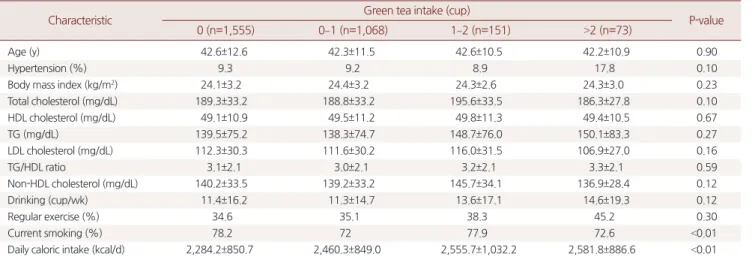
Table 1. Baseline characteristic of men
Characteristic Green tea intake (cup)
P-value
0 (n=1,555) 0–1 (n=1,068) 1–2 (n=151) >2 (n=73)
Age (y) 42.6±12.6 42.3±11.5 42.6±10.5 42.2±10.9 0.90
Hypertension (%) 9.3 9.2 8.9 17.8 0.10
Body mass index (kg/m2) 24.1±3.2 24.4±3.2 24.3±2.6 24.3±3.0 0.23
Total cholesterol (mg/dL) 189.3±33.2 188.8±33.2 195.6±33.5 186.3±27.8 0.10
HDL cholesterol (mg/dL) 49.1±10.9 49.5±11.2 49.8±11.3 49.4±10.5 0.67
TG (mg/dL) 139.5±75.2 138.3±74.7 148.7±76.0 150.1±83.3 0.27
LDL cholesterol (mg/dL) 112.3±30.3 111.6±30.2 116.0±31.5 106.9±27.0 0.16
TG/HDL ratio 3.1±2.1 3.0±2.1 3.2±2.1 3.3±2.1 0.59
Non-HDL cholesterol (mg/dL) 140.2±33.5 139.2±33.2 145.7±34.1 136.9±28.4 0.12
Drinking (cup/wk) 11.4±16.2 11.3±14.7 13.6±17.1 14.6±19.3 0.12
Regular exercise (%) 34.6 35.1 38.3 45.2 0.30
Current smoking (%) 78.2 72 77.9 72.6 <0.01
Daily caloric intake (kcal/d) 2,284.2±850.7 2,460.3±849.0 2,555.7±1,032.2 2,581.8±886.6 <0.01
Values are expressed as mean±standard deviation.
HDL, high-density lipoprotein; TG, triglycerides; LDL, low-density lipoprotein.
Original Article
Korean Journal of Family Practice
Seung-Ryong Yoo, et al. Relationship between Green Tea Intake and Lipid Profile in Korean
Korean Journal of Family Practice
KJFP
결 과
총 2,847명의 남성 중 각 그룹 간의 비율은 마시지 않는 그룹은 54.7%, 하루 1잔 미만 그룹은 37.4%, 1–2잔 그룹은 5.2%, 2잔 이상 그룹 은 2.5%였다. 총 4,559명의 여성 중 각 그룹 간의 비율은 0잔 그룹은 62.6%, 하루 1잔 미만 그룹은 31.9%, 1–2잔 그룹은 3.7%, 2잔 이상 그룹 은 1.6%였다.
남성의 혈중 지질 농도는 1–2잔 마시는 군이 총 콜레스테롤 195.6 mg/dL로 다른 그룹에 비해 약간 높았으나 통계적으로 유의하지는 않았다. 저밀도지질단백 콜레스테롤 및 고밀도지질단백(high-densi- ty lipoprotein) 콜레스테롤은 2잔 이상 마시는 군이 다른 군에 비해 낮았으나 통계적으로 유의한 차이는 없었다. 생활 습관에서 흡연과 하루 섭취 칼로리량이 통계적으로 유의한 차이를 보였다(Table 1).
여성의 경우 체질량지수는 2잔 이상 그룹이 다른 그룹에 비해 높 은 것을 볼 수 있으며, 통계적으로 유의한 차이를 보이고 있다
(P=0.02). 혈중 지질 농도는 모든 변수에 있어 각 군 간에 통계적으로 유의한 차이를 보이지 않았다. 생활 습관에서는 남성과 유사하게 흡 연과 하루 섭취 칼로리량에서 통계적으로 유의한 차이를 보였다 (Table 2).
혈중 지질 농도에 영향을 주는 요인인 나이, 체질량지수, 음주, 운 동, 흡연, 고혈압 유무, 폐경 여부 등을 보정한 후 남성과 여성 모두에 서 녹차 섭취 양상과 혈중 지질 농도 간에 통계적으로 유의한 차이 를 보이는 결과는 없었다(Tables 3, 4).
고 찰
심혈관계 질환의 유병률이 증가하고 있는 가운데 심혈관계 질환 발생의 주요 위험인자인 고지혈증에 대한 예방과 관리의 중요성이 강조되고 있다. 이에 따라 생활습관 개선에 대한 관심이 증가하고 있 으며, 이중에서 식품의 치료적 기능성에 대해서도 주목하고 있다. 특
Table 3. Associations between green tea intake and lipid profile in male
Variable Green tea intake (cup)
P-value
0 (n=1,555) 0–1 (n=1,068) 1–2 (n=151) >2 (n=73)
Total cholesterol (mg/dL) 185.7±1.2 186.4±1.4 192.4±2.7 184.4±3.7 0.08
HDL cholesterol (mg/dL) 50.6±0.3 51.2±0.4 51.3±1.0 51.2±1.3 0.59
TG (mg/dL) 133.5±2.5 131.9±2.8 137.8±6.6 147.6±11.0 0.48
LDL cholesterol (mg/dL) 108.3±1.1 108.8±1.2 113.4±2.4 103.6±3.7 0.09
TG/HDL ratio 2.9±0.0 2.8±0.0 2.9±0.1 3.2±0.3 0.47
Non-HDL cholesterol (mg/dL) 135.0±1.2 135.2±1.3 141.0±2.7 133.2±3.6 0.13
Values are expressed as mean±standard deviation.
HDL, high-density lipoprotein; TG, triglycerides; LDL, low-density lipoprotein.
P-values were derived from ANCOVA with adjustment for age, body mass index, hypertension, drinking, current smoking, regular exercise, and daily caloric intake.
Table 2. Baseline characteristic of women
Characteristic Green tea intake (cup)
P-value
0 (n=2,855) 0–1 (n=1,455) 1–2 (n=173) >2 (n=76)
Age (y) 42.4±11.7 42.2±11.8 40.5±11.5 44.8±10.4 0.05
Hypertension (%) 7.7 7.8 4.5 7.8 0.50
Body mass index (kg/m2) 22.8±3.4 22.9±3.3 23.0±3.2 24.1±3.9 0.02
Total cholesterol (mg/dL) 188.7±34.3 188.0±34.2 186.6±33.9 195.0±36.7 0.29
HDL cholesterol (mg/dL) 56.5±12.4 56.7±12.4 58.7±11.8 55.7±13.4 0.13
TG (mg/dL) 101.3±59.7 99.3±57.9 92.5±52.4 110.3±61.8 0.09
LDL cholesterol (mg/dL) 111.9±30.0 111.4±30.2 109.3±30.0 117.3±33.1 0.27
TG/HDL ratio 1.9±1.5 1.9±1.4 1.7±1.4 2.2±1.5 0.08
Non-HDL cholesterol (mg/dL) 132.1±34.1 131.3±33.9 127.9±34.5 139.3±34.1 0.08
Drinking (cup/wk) 2.4±6.8 2.7±7.1 3.5±9.6 3.2±6.2 0.16
Regular exercise (%) 28.2 28.1 28.1 26.3 0.98
Current smoking (%) 11.5 8.3 14.3 14.4 <0.01
Daily caloric intake (kcal/d) 1,946.0±716.9 2,029.6±679.1 2,035.9±699.0 1,974.9±784.7 <0.01
Menopause (%) 22.5 20.8 16.7 28.9 0.08
Values are expressed as mean±standard deviation.
HDL, high-density lipoprotein; TG, triglycerides; LDL, low-density lipoprotein.
유승룡 외. 한국인의 녹차 섭취량과 혈중 지질 농도와의 관계 Korean Journal of Family Practice
KJFP
히 평소 쉽게 접할 수 있는 녹차가 혈중 지질 농도에 미치는 영향에 대해서는 지속적으로 관심을 받고 있다. 본 연구는 우리나라의 건강 한 성인 남녀를 대상으로 일상적으로 마시는 녹차의 양상이 혈중 지 질 농도에 미치는 영향을 알아보고자 시행하였고, 연구 결과 큰 차 이는 보이지 않았다.
우리나라에서 녹차를 하루 1잔 이상 마시는 인구가 남성은 7.7%, 여성은 5.3%로 녹차를 마시는 비율이 적은 것을 볼 수 있으며, 이는 일본과 비교하였을 때 낮은 수치이다. 두 잔 이상 복용하는 그룹을 하루 0잔 마시는 그룹과 비교를 하였을 때 남성의 경우 저밀도지질 단백 콜레스테롤 수치가 112.4 mg/dL에서 108.5 mg/dL로 감소함을 나타냈으나 통계적 의미는 없었다. 여성의 경우에는 녹차 섭취량과 혈중 지질 농도와의 관계는 통계적으로 유의하지 않았다. 이러한 결 과는 녹차를 마시는 비율이 너무 적고, 마시는 녹차량이 많지 않아 혈중 지질 농도에 큰 영향을 미치지 않는 것으로 생각된다.
Hsu 등10)이 발표한 논문에서는 12주간 녹차 추출물을 복용한 그 룹과 대조군을 비교하였을 때 저밀도지질단백의 감소가 통계적으 로 유의하게 나타났다. 하지만 이 실험은 평상시 마시는 녹차 티 백 을 이용한 결과가 아니라 녹차 추출물을 정제하여 만든 캡슐 약을 복용한 것으로, 일반적인 녹차보다 많은 양의 polyphenol이 들어 있 었다.
일본에서 건강한 노동자들을 대상으로 시행된 연구11)에서는 녹 차 섭취와 관련하여 남성과 여성 모두에서 총 콜레스테롤 수치에 영 향을 주는 것으로 보이며, 고밀도지질단백 콜레스테롤과 triglycer- ides는 영향이 없었다. 이러한 결과는 우리나라에 비해 일본에서는 녹차 섭취 비율이 86.7%에 달하며, 마시는 양도 많았기 때문에 나왔 을 것으로 추정된다.
이 외에도 혈중 지질 농도에 영향을 준다는 결과를 보여주는 여러
연구들12-14)이 있었으며, 메타분석15-18)을 통해서도 녹차가 혈중 지질
농도에 영향을 미친다는 것을 보여주는 결과를 얻었다.
아직 녹차의 성분인 카테킨이 혈중 지질 농도에 어떤 메커니즘으 로 영향을 미치는지는 명확하지 않다. 다만 몇몇 연구에서 지질의 흡수에 영향을 줄 것이라고 주장하고 있다. In vitro 연구 결과에서 녹차의 카테킨이 lipase의 활동성을 억제하여 중성지방의 분해를 감 소한다고 말한다.19) 다른 연구에서는 EGCG가 pancreatic phospholi- pase A2를 억제함으로써 장내 지방 흡수를 하는 과정에 영향을 준다 고 말하고 있다.20)
본 연구는 몇 가지 제한점이 있다. 녹차 섭취 여부 및 운동, 흡연, 음주 등 생활 습관과 관련된 변수와 대상자의 질환 유무를 확인하 는 데 있어서 객관적으로 측정하거나 비교하지 않고 작성된 설문지 를 통한 조사로 시행한 연구설계이기 때문에 조사과정에서 일부 문 항의 누락이나 연구 대상자의 주관적인 견해가 반영될 여지가 있다.
설문지를 통하여 녹차 섭취에 대해 조사하였으나 녹차도 각 제품 마다 포함되어 있는 카테킨 양이 다를 수 있고, 티백으로 먹을 때와 녹차 잎 제제로 먹는 것의 차이, 잎을 우려내는 방식에 따른 성분의 차이 등 여러 변수가 존재하지만 단순히 녹차를 복용하는 빈도와 한 번 복용 시 마시는 양만을 이용하여 연구를 계획하였기 때문에 결과를 도출하는 데에 제한이 있다.
마지막으로 이 연구는 단면 연구로, 녹차 섭취와 혈중 지질 농도 의 관련성은 알아볼 수 있으나 이를 인과관계로 해석할 수는 없다.
최근 우리나라에서 심혈관계 질환으로 인한 사망률이 증가하고 있는 상황에서 일상적으로 마시는 녹차가 혈중 지질 농도를 낮추는 데 도움이 되는지 알아보았으나, 결론적으로 우리나라 건강한 성인 을 대상으로 하였을 때 녹차 섭취와 혈중 지질 농도 사이에 큰 관계 성은 보여주지 못하였다. 본 연구는 단순히 설문지에 의거하여 녹차 섭취량을 계산하였으나, 추후에는 먹는 녹차의 종류에 따른 카테킨 의 양을 정량화하여 혈중 지질 농도에 어떠한 영향이 있는지 연구가 필요할 것으로 생각된다.
Table 4. Associations between green tea intake and lipid profile in female
Variable Green tea intake (cup)
P-value
0 (n=2,855) 0–1 (n=1,455) 1–2 (n=173) >2 (n=76)
Total cholesterol (mg/dL) 191.8±1.4 190.7±1.5 190.0±3.2 194.5±4.3 0.64
HDL cholesterol (mg/dL) 60.0±0.5 60.3±0.5 62.0±1.0 60.3±1.7 0.19
TG (mg/dL) 107.2±2.4 105.3±2.6 97.2±4.9 112.2±8.1 0.15
LDL cholesterol (mg/dL) 110.3±1.3 109.2±1.3 108.5±2.7 111.8±3.8 0.62
TG/HDL ratio 1.9±0.0 1.9±0.0 1.7±0.1 2.1±0.2 0.26
Non-HDL cholesterol (mg/dL) 131.8±1.3 130.3±1.4 127.9±3.1 134.2±4.0 0.29
Values are expressed as mean±standard deviation.
HDL, high-density lipoprotein; TG, triglycerides; LDL, low-density lipoprotein.
P-values were derived from ANCOVA with adjustment for age, body mass index, hypertension, drinking, current smoking, regular exercise, daily caloric intake, and menopause.
Seung-Ryong Yoo, et al. Relationship between Green Tea Intake and Lipid Profile in Korean
Korean Journal of Family Practice
KJFP
요 약
연구배경:
녹차는 우리가 쉽게 접할 수 있는 음료로 카테킨이라는 물질이 포함되어 있는데, 항산화 작용 및 항염증 작용, 혈중 지질 농 도 감소 등의 기능을 한다고 보고된 바 있다. 하지만 아직까지 녹차 섭취와 혈중 지질 농도에 대한 관계가 명확하지 않다. 이에 본 연구 는 우리나라 건강한 성인을 대상으로 녹차 섭취 양상과 혈중 지질 농도와의 관계에 대해 알아보고자 하였다.방법:
2012, 2013, 2014년에 시행된 국민건강영양조사 총 23,626명 중 에서 녹차 섭취에 관련 설문지에 답변하고, 혈중 지질에 영향을 주 는 요인을 가진 사람을 제외하고 7,406명을 대상으로 하였다. 하루 녹차 섭취량을 분류하여 마시지 않는 그룹, 하루 1잔 미만, 1–2잔, 2잔 이상 그룹으로 분류하였고, 녹차 섭취 양상과 혈중 지질 농도와의 관계를 알아보기 위하여 일변량분석을 이용하였다.결과:
남성 2,847명 중 하루 한 잔 이상 마시는 비율이 7.7%, 여성은 4,559명 중 5.3%였다. 남성의 경우 하루 2잔 이상 그룹에서 저밀도지 질단백 콜레스테롤 및 비 고밀도지질단백 콜레스테롤 수치가 낮았 지만 통계적으로 유의하지는 않았다. 여성에서 하루 2잔 이상 그룹 은 체질량지수와 흡연율이 더 높았으며, 통계적으로도 유의한 차이 가 있었다. 혈중 지질은 통계적으로 유의하지 않았다. 나이, 체질량지 수, 성별, 고혈압 유무, 음주량, 흡연 여부, 규칙적 운동, 폐경 여부, 하 루 섭취 칼로리량 변수를 보정한 후 녹차 섭취량과 혈중 지질과의 관 계는 남성과 여성 모두에 있어 통계적으로 유의한 차이가 없었다.결론:
본 연구에서 일상적으로 먹는 녹차의 양으로는 혈중 지질 농 도에 큰 영향을 미치지 않은 것으로 보인다.중심단어:
녹차; 혈중 지질 농도; 카테킨; 저밀도지질단백 콜레스테롤REFERENCES
1. Lee SW, Kim HC, Lee HS, Suh I. Thirty-year trends in mortality from car- diovascular diseases in Korea. Korean Circ J 2015; 45: 202-9.
2. Go AS, Mozaffarian D, Roger VL, Benjamin EJ, Berry JD, Blaha MJ, et al.
Heart disease and stroke statistics--2014 update: a report from the Ameri- can Heart Association. Circulation 2014; 129: e28-292.
3. Committee for the Korean Guidelines for the Management of Dyslipid- emia. 2015 Korean Guidelines for the Management of Dyslipidemia: Exec- utive Summary (English Translation). Korean Circ J 2016; 46: 275-306.
4. Park SC, Oh MY, Kim HS. A study on usage of health improving agents in Seoul & Busan. J Korean Diet Assoc 2005; 11: 440-8.
5. Khan N, Mukhtar H. Tea polyphenols for health promotion. Life Sci 2007;
81: 519-33.
6. Lim KH, Jeon SE, Choi MN. Review of Effectiveness of Green Tea Epigallo- catechin Gallate (EGCG) on the inside and outside of human body. Korean J Aesthet Cosmetol 2015; 13: 701-11.
7. Kawada T. Green tea consumption and risk of cardiovascular disease or stroke. Int J Cardiol 2016; 221: 831.
8. Zhang C, Qin YY, Wei X, Yu FF, Zhou YH, He J. Tea consumption and risk of cardiovascular outcomes and total mortality: a systematic review and meta- analysis of prospective observational studies. Eur J Epidemiol 2015; 30: 103- 13.
9. Mineharu Y, Koizumi A, Wada Y, Iso H, Watanabe Y, Date C, et al. Coffee, green tea, black tea and oolong tea consumption and risk of mortality from cardiovascular disease in Japanese men and women. J Epidemiol Commu- nity Health 2011; 65: 230-40.
10. Hsu CH, Tsai TH, Kao YH, Hwang KC, Tseng TY, Chou P. Effect of green tea extract on obese women: a randomized, double-blind, placebo-con- trolled clinical trial. Clin Nutr 2008; 27: 363-70.
11. Tokunaga S, White IR, Frost C, Tanaka K, Kono S, Tokudome S, et al. Green tea consumption and serum lipids and lipoproteins in a population of healthy workers in Japan. Ann Epidemiol 2002; 12: 157-65.
12. Imai K, Nakachi K. Cross sectional study of effects of drinking green tea on cardiovascular and liver diseases. BMJ 1995; 310: 693-6.
13. Kono S, Shinchi K, Ikeda N, Yanai F, Imanishi K. Green tea consumption and serum lipid profiles: a cross-sectional study in northern Kyushu, Japan.
Prev Med 1992; 21: 526-31.
14. Kono S, Shinchi K, Wakabayashi K, Honjo S, Todoroki I, Sakurai Y, et al. Re- lation of green tea consumption to serum lipids and lipoproteins in Japa- nese men. J Epidemiol 1996; 6: 128-33.
15. Zheng XX, Xu YL, Li SH, Liu XX, Hui R, Huang XH. Green tea intake low- ers fasting serum total and LDL cholesterol in adults: a meta-analysis of 14 randomized controlled trials. Am J Clin Nutr 2011; 94: 601-10.
16. Kim A, Chiu A, Barone MK, Avino D, Wang F, Coleman CI, et al. Green tea catechins decrease total and low-density lipoprotein cholesterol: a systemat- ic review and meta-analysis. J Am Diet Assoc 2011; 111: 1720-9.
17. Onakpoya I, Spencer E, Heneghan C, Thompson M. The effect of green tea on blood pressure and lipid profile: a systematic review and meta-analysis of randomized clinical trials. Nutr Metab Cardiovasc Dis 2014; 24: 823-36.
18. Khalesi S, Sun J, Buys N, Jamshidi A, Nikbakht-Nasrabadi E, Khosravi- Boroujeni H. Green tea catechins and blood pressure: a systematic review and meta-analysis of randomised controlled trials. Eur J Nutr 2014; 53:
1299-311.
19. Juhel C, Armand M, Pafumi Y, Rosier C, Vandermander J, Lairon D. Green tea extract (AR25) inhibits lipolysis of triglycerides in gastric and duodenal medium in vitro. J Nutr Biochem 2000; 11: 45-51.
20. Wang S, Noh SK, Koo SI. Green tea catechins inhibit pancreatic phospholi- pase A2 and intestinal absorption of lipids in ovariectomized rats. J Nutr Biochem 2006; 17: 492-8.