Vol. 18, No. 2 pp. 268-276, 2017
The Relationships between Sports Ability Beliefs, Achievement Goal Orientation, Exercise Flow, and Perceived Performance in College Golf
Athletes
Chul-Ho Bum
Department of Golf Industry, Kyung Hee University
대학 골프선수들의 운동능력믿음, 성취목표성향, 운동몰입 및 인지된 경기력의 관계
범철호
경희대학교 골프산업학과
Abstract The aim of this study was to verify the theoretical relationship between sports ability beliefs, achievement goal orientation, exercise flow, and athletic performance in college golf athletes. The results of the Statistical Package for Social Sciences (SPSS) 18.0 and Analysis of MOment Structures (AMOS) 18.0 performed on the data collected from 211 participants are as follows. First, hypothesis testing showed that college golf athletes with incremental beliefs set task-oriented goals (C.R.=3.780, p<.001). Second, the task-oriented goals (C.R.=4,082, p<.001) and ego-oriented goals (C.R.=3.819, p<.001) in achievement goal orientation raised the level of flow during golf. Third, in achieving goal orientation, only task orientation led to a higher perceived level of golf performance (C.R.=3.020, p<.01). Fourth, a higher level of flow led to higher levels of golf performance (C.R.=4.642, p<.001). Other sub-factors were not statistically significant in the current study. These results could be applied in the field of sports as they show what results can be achieved depending on the athlete's belief in their sports ability.
요 약 본 연구의 목적은 대학 골프선수들을 대상으로 운동능력믿음, 성취목표성향, 운동몰입 및 인지된 경기력의 이론적 관계를 검증하는데 있다. SPSS 18.0과 AMOS 18.0 통계 프로그램을 활용하여 대학교에 재학 중인 211명의 골프선수들로부터 수집한 자료를 분석한 결과는 다음과 같다. 첫째, 대학 골프선수들이 갖고 있는 운동 능력에 대한 믿음의 하위요인에서 증가 된 믿음은 과제성취성향에(C.R.=3.780, p<.001) 영향을 주는 것으로 밝혀졌다. 둘째, 대학 골프선수들의 성취목표성향에서 과제성취성향(C.R.=4.082, p<.001)과 자아성취성향(C.R.=3.819, p<.001)은 골프에 대한 몰입감을 높이는 것으로 나타났다. 셋 째, 대학 골프선수들의 성취목표성향의 하위 요인에서는 과제성취성향(C.R.=3.020, p<.01)만이 인지된 경기력을 향상시키는 것으로 나타났다. 넷째, 대학 골프선수들의 운동몰입이 높을수록 인지된 경기력의 수준도 좋아지는 것으로 나타났다 (C.R.=4.642, p<.001). 다른 하위요인들은 통계적으로 유의한 수준에서 검증되지 못했다. 이러한 연구결과는 선수 자신의 운 동능력에 대한 믿음에 따라 경기력이 변화될 수 있음을 알려주는 것으로서, 다양한 스포츠 분야에 적용이 가능할 것으로 보인다.
Keywords : Achievement goal orientation, college golf athletes, entity beliefs, exercise flow, incremental beliefs, perceived performance
*Corresponding Author : Chul-Ho Bum(Kyung Hee University) Tel: +82-31-201-2740 email: [email protected]
Received November 28, 2016 Accepted February 3, 2017
Revised (1st December 9, 2016, 2nd December 26, 2016, 3rd January 10, 2017) Published February 28, 2017
1. Introduction
The evolution of sports equipment and clothing, together with the advancement of cutting-edge technology, has contributed to both maximizing athletic performance and minimizing the difference in levels of performance[1-3]. For example, the club heads of drivers in golfing were made from wood; however, recent years have seen an introduction of a new material called titanium, contributing greatly to improving performance and driving distances. It is not surprising to find that the psychological aspects of athletes is becoming more important in an environment of decreasing differences in sport performances driven by advances in scientific technology[4]. While the term
“sports ability belief” may not be a common concept in the field of social psychology, the importance of this term has grown owing to several studies conducted in the 2000s[5,6].
Sports ability belief indicates a level of values or faith in one’s exercise ability[7]. There are two kinds of beliefs (e.g., entity belief and incremental belief) that are accepted as the most convincing in academia[8]. Entity belief denotes that the ability is natural and cannot be advanced further despite continued efforts, and incremental belief denotes that the ability can be developed with continued efforts[9].
Individuals with an entity belief have tendencies to interpret the difficulties they encounter negatively and show low levels of motivation[10,11]. In contrast, Wang and Biddle[11] purported that an incremental belief leads to positive perceptions of difficulties that an individual may face, and is associated with investing continuous effort in resolving problems.
Many previous studies have shown that belief in oneself has a significant influence on goal-setting [12-16].
More generally, a goal refers to a specific and clear target that an individual wishes to achieve through a set of conscious actions during a certain period of time[17]. Achievement goal orientation refers to the
setting of individual goals based on subjective decision-making, and determining success by the achievement of such goals[7]. According to Nicholls[18], those with an achievement goal orientation can be classified into two major types, task-oriented individuals and ego-oriented individuals, based on whether the focus of the goal orientation is the self or another individual. Specifically, task-orientated individuals evaluate success based on skillful achievement of a task assigned to the self[19].
Conversely, ego-orientation refers to the feeling of achievement when the individual achievement is greater than that of others[20]. In other words, task-oriented individuals focus on improving their skills through efforts, and ego-oriented individuals emphasize on talent and feel a sense of achievement when one is better than the others by comparison[21].
Goal-setting further awakens individuals and pushes them to become more driven towards achieving their goals[22-24].
Flow is defined as “the state in which people are so involved in an activity that nothing else seems to matter” (p. 4)[25]. In the context of sports, Jackson and Marsh[26] have described the term “exercise flow” as an optimal psychological state that is characterized by freedom from all distracting thoughts, which allows the individual to focus on his/her sports performance.
Many studies have proven that the state of individual flow helps to attain optimal performance[27-30].
Additionally, many previous studies have suggested that individual achievement goals are important factors that impact performance outcomes in the realm of sports[31,32]. Based on the theoretical foundations of such previous studies, it can be assumed that sports ability belief is related to goal-setting, and that goals influence exercise flow and sports performance.
Therefore, the purpose of this study was to verify the theoretical relationships between sports ability belief, achievement goal orientation, exercise flow, and sports performance in college golf athletes, through a structural equation model. The rationale for this study
was as follows. First, the belief in one’s characteristics or actions stemmed from the implicit theory[13], and is receiving spotlight in other realms as well as in the realm of sports[6]. However, there have been very few studies on this topic. Second, while the individual causal relationships between the key variables set in this study have been verified, it is difficult to find previous studies that verify the relationships between them through a single model. Third, there is a lack of empirical studies on sports ability belief in college golf athletes. The following research hypotheses were developed based on the review of the existing literature.
H1: Sports ability belief has a significant influence on achievement goal orientation.
H2: Achievement goal orientation has a significant influence on the level of exercise flow.
H3: Achievement goal orientation has a significant influence on athletic performance.
H4: The level of exercise flow has a significant influence on athletic performance.
Fig. 1. Research model
2. Methods
2.1 Data collection & participants
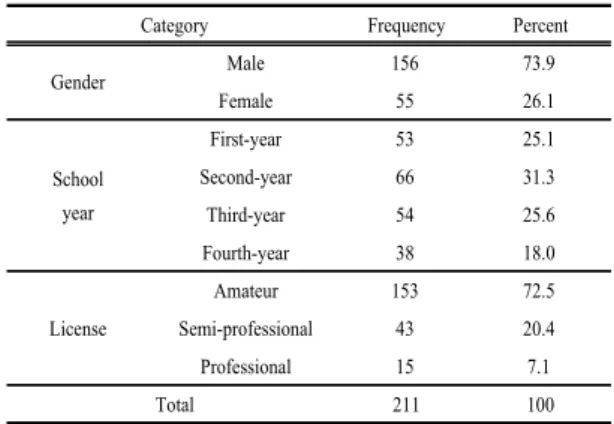
This study was conducted with athlete-students from five colleges during the first semester of 2016 in South Korea. A total of 229 participants were recruited through convenience sampling. We excluded 18 participants whose responses were incomplete or considered insincere. Thus, data from 211 participants were used for the statistical analysis. The participants’
detailed characteristics have been shown in Table 1.
The sample comprised 156 male students and 55 female students. With reference to the school-year distribution, majority of the sample comprised second-year students (31.3%), followed by third-year (25.6%), first-year (25.1%), and fourth-year students (18.0%). In terms of license related golf, majority of the sample comprised amateur athletes (72.5%), followed by semi-professional athletes (20.4%), and professional athletes (7.1%).
Category Frequency Percent
Gender Male 156 73.9
Female 55 26.1
School year
First-year 53 25.1
Second-year 66 31.3
Third-year 54 25.6
Fourth-year 38 18.0
License
Amateur 153 72.5
Semi-professional 43 20.4
Professional 15 7.1
Total 211 100
Table 1. The demographic characteristics of participants
2.2 Instruments
Four survey questionnaires were used in this study, each measuring sports ability belief, achievement goal orientation, exercise flow, and perceived sports performance. All responses were recorded using a 5-point Likert scale, ranging from 1, indicating
“strongly disagree,” to 5, indicating “strongly agree.”
First, the sports ability belief was measured using the Conceptions of the Nature of Athletic Ability Questionnaire-2 (CNAAQ-2), originally developed by Biddle et al[7], and translated by Park and Kim[33].
The CNAAQ-2 comprises 12 items, including 6 items on entity belief (e.g., “it requires innate talent to be good at sports”) and 6 items on incremental belief (e.g., “acquisition of skills and effort are important to be good at sports”). Second, using the Task and Ego Orientation in Sport Questionnaire (TEOSQ), first introduced by Duda and Nicholls[34], achievement
Estimate Standard error Critical ratio Construct
reliability AVE Alpha
Entity belief 1 1.000 - -
.806 .509 .862
Entity belief 2 .978 .090 10.908***
Entity belief 3 1.043 .092 11.368***
Entity belief 4 .972 .897 11.192***
Incremental belief 1 1.000 - -
.810 .516 .871
Incremental belief 2 .980 .085 11.580***
Incremental belief 3 1.017 .083 12.210***
Incremental belief 4 1.000 .078 12.770***
Task orientation 1 1.000 - -
.842 .577 .875
Task orientation 3 1.341 .110 12.205***
Task orientation 4 .909 .103 8.840***
Task orientation 6 1.363 .110 12.205***
Ego orientation 1 1.000 - -
.763 .518 .835
Ego orientation 2 .935 .090 10.347***
Ego orientation 3 1.122 .102 10.865***
Exercise flow 1 1.000 - -
.850. .531 .876
Exercise flow 2 .950 .094 10.100***
Exercise flow 3 1.181 .106 11.105***
Exercise flow 4 .931 .088 10.627***
Exercise flow 5 1.101 .097 11.299***
Perceived performance 2 1.000 - -
.722 .628 .782
Perceived performance 3 1.001 .123 8.165***
***p<.001
Table 2. The results of confirmatory factor analysis and reliability analysis goal orientation was measured. The TEOSQ comprises
7 items on task-orientation (e.g., “I feel as if I am doing well when I am learning something”) and 6 items on ego-orientation (e.g., “I feel as if I am doing well when I am doing better than others”). Third, exercise flow was measured using the Expansion of the Sport Commitment Model (ESCM). This scale was first introduced by Scanlan et al[35] and was translated into Korean by Jung[36]. The scale has 5 items (e.g.,
“how much flow a player feels in sports”). Lastly, perceived sports performance was measured using the 3 items (e.g., “my golf performance is increasing”) used by Kim[37] to measure the efficiency of the softball coaches’ leadership.
2.3 Statistical analysis
Once the questionnaires were collected, data were
analyzed using SPSS 18.0 and AMOS 18.0 statistical programs. First, frequency analyses were conducted to determine the general characteristics of the sample.
Second, a confirmatory factor analysis (CFA) was conducted to verify the relationship among the factors set based on the theoretical foundations. To assess the validity of the model, convergent validity was confirmed based on composite reliability (CR) and average variance extracted (AVE) values, and discriminant validity was analyzed by confirming whether the AVE values were smaller than the square of the correlation coefficient between the variables. To identify the consistency of the measurement items, reliability was analyzed using the Cronbach’s alpha.
Lastly, the hypotheses based on previous studies were verified using structural equation modeling.
The-Goodness of Fit Index (GFI), Comparative Fit
Index (CFI), Tucker Lewis Index (TLI), Root Mean Square Residual (RMR), and Root Mean Square Error of Approximation (RMSEA) were used for the confirmatory factor analysis and a goodness of fit index was used for the structural equation model.
3. Results
3.1 Confirmatory factor analysis
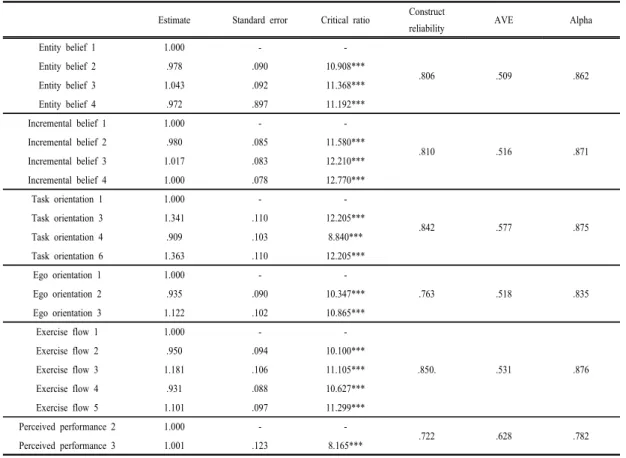
As the latent variables with squared multiple regression (SMC) values of lower than 0.4 indicated lower levels of explaining power, they were removed in the CFA. In the analysis process, the first standard value in the first question was set as 1, and the following numbers were set when this value was removed. The unstandardized regression weights, standard error, and critical ratio are presented, as shown in Table 2. The critical ratio was larger than the absolute value of 1.96, suggesting a level of significance relating to the relevant variable. The model’s goodness of fit was χ2=255.074, p= .002, χ 2/df=1.315, GFI=.903, CFI=.973, TLI=.968, RMR=.068, and RMSEA=.039, indicating that the model fit was within normal standards. To assess the validity of the measurement model, CR and AVE values were calculated to test for convergent validity. Typically, it is recommended that a CR value should be greater than .70 and an AVE value should be greater than .50. As shown in Table 2, all values were above the recommended cutoffs, and thus, it can be interpreted that there were relatively high levels of correlation between the questions that measured the same concept.
In the discriminant validity test, the squared values of the correlation coefficients between variables were found to be lower than the AVE value, demonstrating clear differences between questions that measured different concepts. The reliability analyses showed values between .782 and .876, indicating adequate internal consistency. The results of correlation analysis are as follows (Table 3).
1 2 3 4 5 6
EB 1
IB .015 1
TO .094 .291** 1
EO .055 .051 .161* 1
EF .194** .135 .339** .299** 1
PP -.005 .037 .352** .234** .442** 1
Note. EB=entity belief, IB=incremental belief, TO=task orientation, EO=ego orientation, EF=exercise flow, PP=perceived performance.
*p<.05, **p<.01
Table 3. Correlation analysis among the variables
3.2 Research model analysis
The structural equation modeling’s goodness of fit was χ2=258.754, p=.002, χ2/df = 1.307, GFI =.901, CFI=.974, TLI=.969, RMR=.088, and RMSEA=.045.
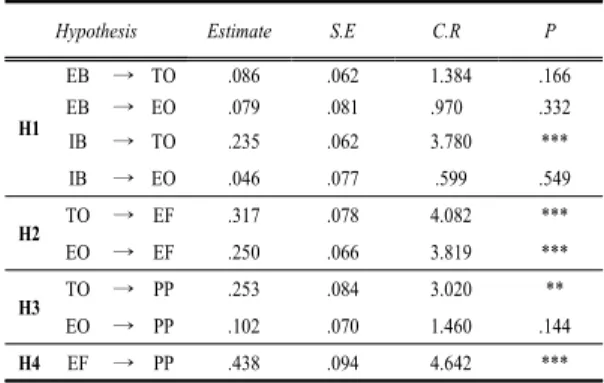
First, the hypothesis testing demonstrated that college golf athletes with incremental beliefs set task-oriented goals (C.R.=3.780, p<.001). Second, it was found that task-oriented goals (C.R.=4.082, p<.001) and ego-oriented goals (C.R.=3.819, p<.001) in achievement goal orientation raised the level of exercise flow during golf.
Third, in achievement goal orientation, only task orientation led to a higher perceived level of perceived golf performance (C.R.=3.020, p<.01). Fourth, a higher level of exercise flow led to higher levels of perceived golf performance in this study (C.R.=4.642, p<.001).
Other sub-variables were not statistically significant. A summary of hypotheses testing is shown Table 4.
Hypothesis Estimate S.E C.R P
H1
EB → TO .086 .062 1.384 .166
EB → EO .079 .081 .970 .332
IB → TO .235 .062 3.780 ***
IB → EO .046 .077 .599 .549
H2 TO → EF .317 .078 4.082 ***
EO → EF .250 .066 3.819 ***
H3 TO → PP .253 .084 3.020 **
EO → PP .102 .070 1.460 .144
H4 EF → PP .438 .094 4.642 ***
**p<.01, ***p<.001
Table 4. The results of research hypothesis testing
4. Discussion
This study verified the relationship between sports ability belief, achievement goal orientation, exercise flow, and sports performance in college golf athletes.
First, as a particular goal in sports is widely used in predicting present and future actions[38], it is certainly important to identify predictive variables that have significant influences on goal-setting[39]. In this study, it was proven that incremental beliefs in college golf athletes led to setting of task-oriented goals, but it was not verified through other sub-factors at a statistically significant level. It has been reported that those with an entity belief in sports set ego-oriented goals, and those with an incremental belief set task-oriented goals[11,12,40]. Those with an incremental belief consider that the continued learning of given tasks leads to improvement in abilities[7,9]. These types of people have strong tendencies to positively interpret difficult situations and to focus on improving their abilities by constantly trying harder[10, 11]. In other words, it has been reported that those with incremental beliefs tend to have more patience and diligence than do those with entity beliefs[41]. As such, it is assumed that college golf athletes who believe that hard work and practice lead to improved skills would have set task-oriented goals.
Second, the present study revealed that college golf athletes’ achievement goal orientation led to higher levels of exercise flow. This result corresponds with those reported in previous studies, which assert that specific goal setting provides guidance for performers when working towards achieving the goals, and supports the increase in the level of flow[22-24]. Locke and Latham[42], reported that goals have a meaningful influence on the formation of individual attitudes and behavior patterns. In particular, goals pertaining to specific activities support the focusing of attention by increasing the level of motivation and efforts[14]. For example, Csikszentmihalyi[43] mentioned that the reason Eskimos, who live along the coast of the North
Sea, hunt for seals while sitting next to a hole in the ice and waiting for hours despite the extreme weather is to feed the whole family. In other words, they fully immerse themselves in the flow of hunting to achieve their own goal of supporting their family. It can be interpreted that both groups of college golf athletes, the task-oriented individuals focusing on “skill improvements,” and the ego-oriented individuals focusing on “winning in the competition with others,”
have been strongly motivated to achieve their respective goals and experienced exercise flow by focusing their attention on sports.
Third, while the task-oriented college golf athletes experienced improvement in the level of golf performance, there was no statistically significant correlation between ego-orientation and golf performance in the present study. According to Nam and Lim[44] people who have a string desire to achieve their goals are likely to elevate sports performance by increasing the level of motivation. In particular, Newton and Duda[31] argued that task-oriented individuals focus on acquisition or improvement of their own skills rather than on competing with others, and are thereby subject to stronger intrinsic motivations and higher levels of effort, thus influencing the improvement of their sports performance. Therefore, setting task-oriented goals is more effective in motivating college golf athletes, and is assessed to have influenced the improvement of golf performance.
Fourth, the present study demonstrated that levels of perceived sports performance vary depending on exercise flow experienced by college golf athletes.
Many researchers report that experiencing a state of flow has a high probability of leading to optimal performance[27-30]. In this regard, a high degree of flow in any activity helps individuals to achieve the optimal psychological state in which to pour all their efforts on the task performed[22]. In particular, Jackson and Marsh[26] suggested that exercise flow in sports frees the individual from all distracting thoughts and
increases one’s concentration on the performance. The concentration of the athletes is regarded as a very important factor as it helps to enhance sports performance[45]. As demonstrated by these results, the development of various new training methods is necessary in accordance with the finding that state of exercise flow is an important predictive factor to improve sports performance.
5. Conclusion & Limitation
In conclusion, this study deduced the relationships between incremental beliefs in college golf athletes, goal setting, exercise flow, and improvements in golf performance. The results of this study could be usefully applied in the field of sports as they show what results can be attained depending on the athlete’s sports ability belief. However, this study was conducted with not only golf athletes but also students who were amateur golfers in department of golf in colleges. In alignment with this, follow-up studies may verify any differences between them. In addition, it would seem meaningful to explore these results in follow-up studies in different sports settings (e.g., different countries and participants of different sports) based on the relationships between the variables.
References
[1] B. Dyer, "The controversy of sports technology: A systematic review", Springerplus, vol. 4, pp. 524, 2015.
DOI: https://doi.org/10.1186/s40064-015-1331-x
[2] S. Loland, "Technology in sport: three ideal-typical views and their implications", European Journal of Sport Science, vol. 2, no. 1, pp. 1-11, 2002.
DOI: https://doi.org/10.1080/17461390200072105 [3] S. Loland, "The ethics of performance enhancing
technology in sport", Journal of the Philosophy of Sport, vol. 36, no. 2, pp. 152-161, 2009.
DOI: https://doi.org/10.1080/00948705.2009.9714754 [4] R. S. Weinberg, D. Gould, Foundations of sport and
exercise psychology (4th ed.). Champaign, IL: Human Kinetics, 2007.
[5] P. N. Lemyre, G. C. Roberts, Y. Ommundsen,
"Achievement goal orientations, perceived ability, and sportspersonship in youth soccer", Journal of Applied Sport Psychology, vol. 14, pp. 120-136, 2002.
DOI: https://doi.org/10.1080/10413200252907789 [6] C. K. J. Wang, T. H. M. Koh, "Sport ability beliefs,
achievement goals, self-determination and beliefs about the purposes of physical education among Singaporean preservice physical education trainees", Asian Journal of Exercise & Sports Science, vol. 3, no. 1, pp. 25-34, 2006.
[7] S. J. H. Biddle, C. K. J. Wang, N. L. D. Chatzisarantis, C. M. Spray, "Motivation for physical activity in young people: Entity and incremental beliefs concerning athletic ability", Sports Sciences, vol. 21, pp. 973-989, 2003.
DOI: https://doi.org/10.1080/02640410310001641377 [8] C. S. Dweck, Self-theories: Their role in motivation,
personality and development. Philadelphia, PA:
Psychology Press, 1999.
[9] J. G. Park, J. H. Jung, "The relationships between students` implicit beliefs and procrastination in physical education classes: The mediated roles of approach-avoidance motivation", Korean Society of Sport Psychology, vol. 22, no. 2, pp. 19-33, 2011.
[10] C. M. Mueller, C. S. Dweck, "Praise for intelligence can undermine children's motivation and performance", Journal of Personality and Social Psychology, vol. 75, no. 1, pp. 33-52, 1998.
DOI: https://doi.org/10.1037/0022-3514.75.1.33
[11] C. K. J. Wang, S. J. H. Biddle, "Young people's motivational profiles in physical activity: A cluster analysis", Journal of Sport and Exercise Psychology, vol. 23, pp. 1-22, 2001.
DOI: https://doi.org/10.1123/jsep.23.1.1
[12] S. J. H. Biddle, C. K. J, Wang, N. L. D., Chatzisarantis, C. M. Spray, "Motivation for physical activity in young people: Entity and incremental beliefs concerning athletic ability", Sports Sciences, vol. 21, pp. 973-989, 2003.
DOI: https://doi.org/10.1080/02640410310001641377 [13] C. S. Dweck, "Motivational processes affecting
learning", American Psychologist, vol. 41, pp.
1040-1048, 1986.
DOI: https://doi.org/10.1037/0003-066X.41.10.1040 [14] G. D. Heyman, C. S. Dweck, "Achievement goals and
intrinsic motivation: Their relation and their role in adaptive motivation", Motivation and Emotion, vol. 6, pp. 231-247, 1992.
DOI: https://doi.org/10.1007/BF00991653
[15] C. K. J. Wang, S. J. H. Biddle, "Intrinsic motivation toward sports in Singaporean students: The role of sport ability beliefs", Journal of Health Psychology, vol. 8, pp.
515-523, 2003.
DOI: https://doi.org/10.1177/13591053030085004 [16] C. K. J. Wang, W. C. Liu, M. R. Lochbaum, S. J.
Stevenson, "Sport ability beliefs, 2×2 achievement goals, and intrinsic motivation: The moderating role of perceived competence in sport and exercise", Research Quarterly for Exercise and Sport, vol. 80, no. 2, pp.
303-312, 2009.
DOI: https://doi.org/10.1080/02701367.2009.10599565
[17] E. A. Locke, K. N. Shaw, L. M. Saari, G. P. Latham,
"Goal setting and task performance: 1969-1980", Psychological Bulletin, vol. 90, pp. 125-152, 1981.
DOI: https://doi.org/10.1037/0033-2909.90.1.125 [18] J. G. Nicholls, The competitive ethos and democratic
education. Cambridge, MA: Harvard University Press, 1989.
[19] S. A. White, J. L. Duda, "The relationship of gender, level of sport involvement, and participation motivation to task and ego orientation", International Journal of Sport Psychology, vol. 25, pp. 4-18, 1994.
[20] A. Papaioannou, A. McDonald, "Goal perspectives and purpose of physical education as perceived by Greek adolescents", Physical Education Review, vol. 16, pp.
41-48, 1993.
[21] P. N. Zahariadis, S. J. H. Biddle, "Goal orientations and participation motives in physical education and sport:
Their relationships in English schoolchildren", The Online Journal of Sport Psychology, vol. 2, no. 1, 1-12, 2000.
[22] M. Csikszentmihalyi, Finding flow: The psychology of engagement with everyday life. New York: Basic Books, 1997.
[23] S. A. Jackson, G. C. Roberts, "Positive performance states of athletes: Toward a conceptual understanding of peak performance", The Sport Psychologist, vol. 6, pp.
156-171, 1992.
DOI: https://doi.org/10.1123/tsp.6.2.156
[24] A. Papaioannou, O, Kouli, "The effect of task structure, perceived motivational climate and goal orientations on students’' task involvement and anxiety", Journal of Applied Sport Psychology, vol. 11, pp. 51-71, 1999.
DOI: https://doi.org/10.1080/10413209908402950 [25] M. Csikszentmihalyi, Flow: The psychology of optimal
experience. New York: Harper & Row Publishers, Inc., 1990.
[26] S. A. Jackson, H. W. Marsh, "Development and validation of a scale to measure optimal experience: The flow state scale. Journal of Sport and Exercise Psychology", vol. 18, pp. 17-35, 1996.
DOI: https://doi.org/10.1123/jsep.18.1.17
[27] S. A. Jackson, P. R. Thomas, H. W. Marsh, C. J, Smethurst, "Relationships between flow, self-concept, psychological skills, and performance", Journal of Applied Sport Psychology, vol. 13, pp. 129-153, 2001.
DOI: https://doi.org/10.1080/104132001753149865 [28] S. M. Lazarovitz, Team and individual flow in female
ice hockey players: The relationships between flow, group cohesion, and athletic performance. Doctoral dissertation, University of Calgary, Canada; 2003.
[29] J. Pates, A, Cummings, I. Maynard, I, "The effects of hypnosis on flow states and three-point shooting performance in basketball players", The Sport Psychologist, vol. 16, pp. 34-47, 2002.
DOI: https://doi.org/10.1123/tsp.16.1.34
[30] J. Pates, R. Oliver, I. Maynard, "The effects of hypnosis on flow states and golf-putting performance", Journal of Applied Sport Psychology, vol. 13, pp. 341-354, 2001.
DOI: https://doi.org/10.1080/104132001753226238
[31] M. Newton, J. L. Duda, "Elite adolescent athletes' achievement goals and beliefs concerning success in tennis", Journal of Sports & Exercise Psychology, vol.
15, no. 4, pp. 437-448, 1993.
DOI: https://doi.org/10.1123/jsep.15.4.437
[32] C. P. Stuntz, M. R. Weiss, "Achievement goal orientation and motivational outcomes in sports: The role of social orientations", Psychology of Sports &
Exercise, vol. 10, no. 2, pp. 255-262, 2009.
DOI: https://doi.org/10.1016/j.psychsport.2008.09.001 [33] J. G. Park, K. H. Kim, "Structural relationships between
sport ability belief, achievement goal, and behavioral regulations among student-athletes: Perspective of three different theories of motivation", Korean Society of Sport Psychology, vol. 21, no. 2, pp. 101-129, 2010.
[34] J. L. Duda, J. G. Nicholls, "Dimensions of achievement motivation in school work and sport", Journal of Educational Psychology, vol. 84, pp. 290-299, 1992.
DOI: https://doi.org/10.1037/0022-0663.84.3.290 [35] T. K. Scanlan, J. P, Simons, P. Carpenter, G. Schmidt,
"The sport commitment model: Measurement development for the youth-sport domain", Journal of Sport and Exercise Psychology, vol. 15, pp. 16-38, 1993.
DOI: https://doi.org/10.1123/jsep.15.1.16
[36] Y. K. Jung, (The) influence of sport participation motivation, arousal seeking and affects on the behavior of sport commitment. Unpublished doctoral dissertation, Busan National University, Korea, 1997.
[37] D. K. Kim, The causal relationship between trust in instructor, self-management, psychological skills, and recognized athletic performance of softball players.
Master’s thesis, Dankokk University, Korea, 2014.
[38] H. K. Hall, A. W. Kerr, S. A. Kozub, S. B. Finnie,
"Motivational antecedents of obligatory exercise: The influence of achievement goals and multidimensional perfectionism", Psychology of Sport & Exercise, vol. 8, no. 3, pp. 297-316, 2007.
DOI: https://doi.org/10.1016/j.psychsport.2006.04.007 [39] P. R. Pintrich, D. H. Schunk, Motivation in education
Theory, research, and applications (2nd ed.). Upper Saddle River, NJ: Prentice Hall, 2002.
[40] P. Sarrazin, S. Biddle, J. P. Famose, F. Cury, K. Fox, M.
Durand, "Goal orientations and conceptions of the nature of sport ability in children: A social cognitive approach", British Journal of Social Psychology, vol. 35, pp. 399– 414, 1996.
DOI: https://doi.org/10.1111/j.2044-8309.1996.tb01104.x [41] A. J. Howell, K. Buro, "Implicit beliefs, achievement
goals, and procrastination: A mediational analysis", Learning Individual Difference, vol. 19, pp. 151-154, 2009.
DOI: https://doi.org/10.1016/j.lindif.2008.08.006 [42] E. A. Locke, G. P. Latham, "Building a practically
useful theory of goal setting and task motivation. A 35-year odyssey", American Psychologist, vol. 57, pp.
705-717, 2002.
DOI: https://doi.org/10.1037/0003-066X.57.9.705 [43] M. Csikszentmihalyi, Good business. New York:
Brockman; 2006.
[44] I. S. Nam, S. H. Lim, "The effect of goal orientation on
physical self-efficacy and commitments for tennis club members", Journal of Sport and Leisure Studies, vol. 37, no. 2, pp. 1585-1595, 2009.
[45] V. E. Wilson, E. Peper, A. Schmid, Training strategies for concentration. In J. M. Williams (Ed.), Applied sport psychology: Personal growth to peak performance (5th ed., pp. 404-422). New York: McGraw-Hill, 2006.
Chul-Ho Bum [Regular member]
•Dec. 2007 : University of New Mexico, MS
•May. 2013 : University of New Mexico, PhD
•Aug. 2016 ~ current : Kyung Hee Univ., Dept. of Golf Industry, Adjunct Professor
<Research Interests>
Sports Psychology, Golf