INTRODUCTION
Despite its declining incidence in many countries, gastric cancer remains one of the most prevalent malignancies in many countries, and a major international health problem.
According to statistics published in 2002, gastric cancer remained the most prevalent cancer in Korea (1). Recently, improvements in early diagnosis have increased the number of patients suitable for curative resection, but tumor recur- rence is frequently observed. Moreover, many patients have metastatic disease at the time of initial diagnosis.
Cytotoxic chemotherapy has been demonstrated to be effec- tive in the palliative management of unresectable locally ad- vanced or metastatic gastric cancer. Randomized trials have found that cytotoxic chemotherapy is associated with imp- rovement in overall survival (OS) and quality of life as com- pared with best supportive care (2-4). Until recently, 5-fluo-
rouracil (5-FU) and platinum-based combination chemother- apy has been commonly used as first-line treatment in unre- sectable locally advanced or metastatic gastric cancer (5, 6).
In a phase III randomized study, Kim et al. reported an over- all response rate of 51% and a median OS of 9.0 months in previously untreated gastric cancer patients with 5-FU/cis- platin (FP) chemotherapy (5). However, the overall progno- sis of patients failing first-line chemotherapy is poor, and although many of these patients are candidates for second-line chemotherapy at the time of first-line treatment failure, no established second-line chemotherapeutic regimen is available as yet.
Paclitaxel is an anticancer agent that promotes the forma- tion of tubulin dimers and that inhibits microtubule depoly- merization. Paclitaxel has broad spectrum antitumor activi- ty and moderate toxicity profiles. It has shown encouraging activity as a single agent (200-225 mg/m2, every 3 weeks)
Keun-Wook Lee*,�,�, Jee Hyun Kim*,�, Tak Yun*,�, Eun Kee Song*,�, Im il Na*,�, Hyunchoon Shin*,�, So Yeon Oh*,�, In Sil Choi*,‖, Do-Youn Oh*,�,�, Dong-Wan Kim*,�,�, Seock-Ah Im*,�,�, Tae-You Kim*,�,�, Jong Seok Lee*,�, Dae Seog Heo*,�,�, Yung-Jue Bang*,�,�, Noe Kyeong Kim*,�,�
Department of Internal Medicine*, Seoul National University College of Medicine; Cancer Research Institute�, Seoul National University College of Medicine;
Department of Internal Medicine�, Seoul National University Hospital, Seoul; Department of Internal Medicine�, Seoul National University Bundang Hospital, Seongnam; Department of Internal Medicine‖, Seoul Municipal Boramae Hospital, Seoul, Korea
Address for correspondence Jee Hyun Kim, M.D.
Department of Internal Medicine, Seoul National University Bundang Hospital, Seoul National University College of Medicine, 300 Gumi-dong, Bundang-gu, Seongnam 463-707, Korea
Tel : +82.31-787-7022, Fax : +82.31-787-4052 E-mail : [email protected]
*This study was supported by a grant from Seoul National University Bundang Hospital Clinical Research Fund (2005).
S115
Phase II Study of Low-dose Paclitaxel and Cisplatin as a Second-line Therapy after 5-Fluorouracil/Platinum Chemotherapy in Gastric Cancer
This study was performed to evaluate the efficacy and toxicity of low-dose paclita- xel/cisplatin chemotherapy in patients with metastatic or recurrent gastric cancer that had failed 5-fluorouracil/platinum-based chemotherapy. Thirty-two patients with documented progression on or within 6 months after discontinuing 5-fluorouracil/plat- inum-based chemotherapy were enrolled. As a second-line treatment, paclitaxel (145 mg/m2) and cisplatin (60 mg/m2) was administered on day 1 every 3 weeks.
Among 32 patients enrolled, 8 (25%) responded partially to paclitaxel/cisplatin, 8 (25%) had stable disease, and 14 (44%) had progressive disease. Two patients (6%) were not evaluable. The median time to progression (TTP) and overall sur- vival for all patients were 2.9 months and 9.1 months, respectively. The most com- mon hematologic toxicity was anemia (47%). Grade 3 neutropenia developed in three patients (9%), but no other grade 3/4 hematologic toxicity occurred. The most common non-hematologic toxicities were emesis (31%) and peripheral neuropa- thy (38%). Three cases (9%) of grade 3/4 emesis and 2 cases (6%) of grade 3 peripheral neuropathy developed. In conclusion, low-dose paclitaxel and cisplatin chemotherapy showed moderate activity with favorable toxicity profiles. However, relatively short TTP of this regimen warrants the development of more effective paclitaxel-based regimens other than combination with cisplatin in these patients as second-line therapies.
Key Words : Chemotherapy; Paclitaxel; Cisplatin, Gastric Cancer
Received : 7 November 2006 Accepted : 27 December 2006
in gastric cancer, with a response rate of 17-28% (7-10). Pacli- taxel appears to have a schedule-dependent synergy with plat- inum compounds, as documented in human gastric cancer cell lines (11), and this observed synergy has led to the devel- opment of paclitaxel-platinum combination regimens in a number of solid tumors, including gastric cancer (12-16).
In gastric cancer, first-line paclitaxel/cisplatin chemothera- py has shown response rates of 44-46% and median OS of 11.2-13.8 months (13, 15, 16). Although these reports are of phase II studies, treatment outcomes of paclitaxel and cis- platin chemotherapy seem to be at least similar to those of previously commonly used two- or three-drug combination regimens (FAMTX [5-FU, doxorubicin, and methotrexate] (17), ELF [etoposide, leucovorin, and 5-FU](17), and FP [5- FU and cisplatin](5, 17)).
We previously conducted a phase II study using low-dose paclitaxel 145 mg/m2plus cisplatin 60 mg/m2on day 1 every 3 weeks in non-small cell lung cancer. In that study, this regi- men was feasible and seemed to have reduced toxicities and maintain efficacy compared with previously reported other regimens (18). This previous experience and convenience of the scheduling in the outpatient setting prompted us to select the same regimen in gastric cancer. Based on in vitro syner- gistic effects (11) and feasibility of low-dose paclitaxel and cisplatin regimen (18), a phase II study was performed in gastric cancer patients that had failed previous 5-FU/plat- inum chemotherapy at three institutions.
MATERIALS AND METHODS Eligibility
To be eligible for this study, patients were required to have:
histologically confirmed adenocarcinoma of the stomach (ex- cept carcinomas of the esophagogastric junction) that pro- gressed while receiving, or within 6 months after the discon- tinuation of prior 5-FU/platinum-based chemotherapy used as an adjuvant or palliative treatment. In addition, patients were required to be 18-75 yr old with a life expectancy of
>3 months and have an Eastern Cooperative Oncology Group (ECOG) performance status of 0 to 2, adequate hematologic counts (absolute neutrophil count [ANC]≥1.5×10⁹/L and platelet count≥100×109/L), and laboratory results within the following limits (serum bilirubin ≤1.25×upper nor- mal limit [UNL], serum aspartate aminotransferase [AST] and alanine aminotransferase [ALT] ≤2.5×UNL, serum alkaline phosphatase ≤5.0×UNL [unless bone metastasis was present in the absence of any liver disease]) and renal function (serum creatinine ≤1.5 mg/dL). All patients were required to have at least one measurable disease (defined as a mass with demarcated dimensions by computed tomogra- phy [CT], routine chest radiography, or by physical exami- nation).
Patients were deemed ineligible if they had brain metas- tasis or a history of a prior or a concomitant malignancy, except for curatively treated non-melanoma skin cancer or in situ cervical cancer. Pre-existing motor or sensory neurologic sym- ptoms of ≥grade 2 according to the National Cancer Insti- tute Common Toxicity Criteria (NCI-CTC) were not per- mitted, nor were active infections or other serious underly- ing medical conditions that might have impaired the ability of a patient to receive protocol treatment. All patients provid- ed written informed consent, and this study was approved by institutional review boards.
Treatment
Hydrocortisone (100 mg), pheniramine maleate, and famo- tidine were administered intravenously (i.v.) 30 min before paclitaxel for hypersensitivity prophylaxis. The patients then received paclitaxel 145 mg/m2as a 3-hr i.v. infusion, followed by cisplatin 60 mg/m2as a 15-min i.v. infusion with a stan- dard hydration method on day 1. All patients received ade- quate antiemetic therapy prior to chemotherapy. Treatment was administered on an outpatient basis and repeated 3 weekly, provided that patients had recovered from toxic effects. This combination chemotherapy was continued for up to 6 cycles in the absence of disease progression or unacceptable toxici- ty. Granulocyte colony-stimulating factor (G-CSF) was not routinely administered.
Response to treatment and adverse effects
Physical examination, complete blood counts and bioche- mical tests were carried out before each cycle of therapy. Tu- mors were measured every 2 cycles by imaging studies. Res- ponse was assessed using WHO criteria. Complete response (CR) was defined as the disappearance of all clinical evidence of tumor for a period of at least 4 weeks. Partial response (PR) was defined as a sustained ≥50% decrease in bidimensional tumor measurements for a period of at least 4 weeks, with- out the appearance of any new lesions or the progression of any existing lesion. Progressive disease (PD) was defined as the development of any new lesion or a greater than 25%
increase in the sum of the products of all measurable lesions.
Stable disease (SD) was defined as a tumor response that did not meet the above CR, PR or PD criteria.
Toxicities were evaluated using NCI-CTC (version 2.0) before each treatment. Dose modifications and treatment delays were performed as necessary according to the extent of hematological and non-hematological toxicities. Drug doses were reduced by 25% in case of grade 4 neutropenia (ANC <0.5×10⁹/L), grade 4 thrombocytopenia (platelet count <25×109/L) or febrile neutropenic fever. Additional 25% reduction of both drug doses was indicated for recur- rent febrile neutropenic fever, grade 4 neutropenia or throm- bocytopenia. For patients who experienced grade 1 nephro-
toxicity, grade 2/3 peripheral neuropathy or other severe non- hematologic toxicities of NCI-CTC ≥grade 3, drug doses were reduced by 25%. If a patient had ≥grade 2 non-hema- tological toxicities during chemotherapy (except alopecia), chemotherapy was withheld for a minimum of 1 week until the patient had improved to ≤grade 1, at which time che- motherapy was re-instituted. However, if hematologic or non-hematological toxicities did not improve to ≤grade 1 after 3 weeks, the patient was removed from the study. Both chemotherapeutic drugs were discontinued in the event of transitory ≥grade 2 nephrotoxicity, grade 4 neuropathy, and if severe toxicity recurred despite dose reduction.
Statistical analysis
The primary endpoint of this trial was the response rate to low-dose paclitaxel/cisplatin treatment. TTP and OS were secondary end points. TTP was calculated from the first day of chemotherapy to the date of disease progression, and OS was calculated from the first day of chemotherapy until death.
This trial was designed to detect a response rate of 20% as compared to a minimal, clinically meaningful response rate of 5%. An optimal Simon two-step design was used (19), with a power of 80% to accept the hypothesis and a 5% sig- nificance to reject the hypothesis. Ten patients were initially recruited, with the intention that had no responses been ob- served, the trial would have been discontinued. However, it was planned to continue with the trial and to recruit a total of 29 patients with measurable disease, if at least one of these 10 patients showed an objective response. Allowing for a fol- low-up loss rate of 10%, a total sample size of 32 patients was necessary. Analyses of TTP and OS curves were performed using the Kaplan-Meier method.
RESULTS Patient characteristics
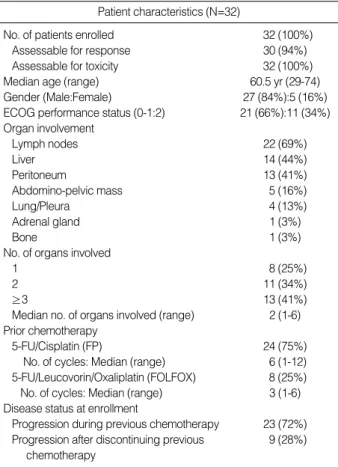
From October 2002 to January 2005, 32 patients of medi- an age 60.5 yr (29-74 yr) were enrolled from three institu- tions. Patient characteristics are given in Table 1. The major- ity of the study population was male (84%, 27 of 32). Eleven patients (34%) had an ECOG performance status of 2. Twen- ty-four patients (75%) had previously received 5-FU/cisplatin (FP) chemotherapy and 8 patients (25%) 5-FU/leucovorin/
oxaliplatin (FOLFOX) chemotherapy. Of these patients, 6 (19%) received FP chemotherapy in an adjuvant setting. At the time of enrollment, 23 patients (72%) had progressive disease during prior 5-FU/platinum-based chemotherapy and 9 (28%) progressed within 6 months of discontinuing previous chemotherapy. All patients had measurable tumor lesions. Lymph nodes (69%), liver (44%) and peritoneum (41%) were the most common metastatic sites.
Drug delivery
Of the 32 patients who received second-line chemothera- py, 2 patients (6%) were non-evaluable for response due to early drop-out after the first cycle; one patient withdrew con- sent and received further treatment at other hospital, and the other patient refused further chemotherapy due to treatment- related toxicity (severe emesis).
A total of 108 treatment cycles were delivered, with a medi- an of 3 cycles per patient (range, 1 to 6). Seven (22%) of the patients received the planned 6 cycles of chemotherapy. Treat- ment was discontinued prematurely in two patients because of chemotherapy-associated toxicities; one patient, as men- tioned above, rejected further treatment due to severe eme- sis after the first cycle of chemotherapy, and the other patient could not receive further chemotherapy because of severe peri- pheral neuropathy. Relative dose intensities were calculated for all patients and drugs according to the method described by Hryniuk (20). The calculated mean relative dose intensities of paclitaxel and cisplatin were 93% and 93%, respectively.
Objective tumor responses
Of the 32 patients who received second-line combination chemotherapy, 2 patients (6%) were not evaluable for res-
Patient characteristics (N=32)
No. of patients enrolled 32 (100%)
Assessable for response 30 (94%)
Assessable for toxicity 32 (100%)
Median age (range) 60.5 yr (29-74)
Gender (Male:Female) 27 (84%):5 (16%)
ECOG performance status (0-1:2) 21 (66%):11 (34%) Organ involvement
Lymph nodes 22 (69%)
Liver 14 (44%)
Peritoneum 13 (41%)
Abdomino-pelvic mass 5 (16%)
Lung/Pleura 4 (13%)
Adrenal gland 1 (3%)
Bone 1 (3%)
No. of organs involved
1 8 (25%)
2 11 (34%)
≥3 13 (41%)
Median no. of organs involved (range) 2 (1-6) Prior chemotherapy
5-FU/Cisplatin (FP) 24 (75%)
No. of cycles: Median (range) 6 (1-12) 5-FU/Leucovorin/Oxaliplatin (FOLFOX) 8 (25%) No. of cycles: Median (range) 3 (1-6) Disease status at enrollment
Progression during previous chemotherapy 23 (72%) Progression after discontinuing previous 9 (28%)
chemotherapy
Table 1.Patient characteristics
ponse. By intent-to-treat analysis, the overall response rate was 25% (95% confidence interval [CI]: 13-42%) and 8 of the 32 patients achieved PR. Eight patients (25%) had SD, and 14 patients (44%) tumor progression. Seven of 24 pa- tients in the FP group (29%) and 1 of 8 in the FOLFOX group (13%) responded to second-line chemotherapy.
Adverse events
Toxicities were evaluated in all 32 patients, and results are summarized in Table 2. The most common hematologic tox- icity was anemia (47%). Of the grade 3 or 4 hematologic tox- icities, 3 cases (9%) of grade 3 neutropenia occurred. No grade 3 or 4 anemia or thrombocytopenia was observed, and no pa- tient experienced febrile neutropenia.
Non-hematologic toxicities consisted mainly of emesis and
Fig. 1.Time to progression and overall survival curves.
Probability of survival
1.0
0.8
0.6
0.4
0.2
0.0
0.0 5.0 10.0 15.0 20.0
Months
Overall survival Time to progression
All patients (N=32), number (%) All
events
Grade 3 events
Grade 4 events Adverse events
Hematologic toxicities
Neutropenia 9 (28%) 3 (9%) 0 (0%)
Anemia 15 (47%) 0 (0%) 0 (0%)
Thrombocytopenia 1 (3%) 0 (0%) 0 (0%)
Neutropenic fever 0 (0%) - -
Non-hematologic toxicities
Emesis 10 (31%) 2 (6%) 1 (3%)
Diarrhea 4 (13%) 0 (0%) 0 (0%)
Hepatotoxicity 8 (25%) 0 (0%) 0 (0%)
Nephrotoxicity 3 (9%) 0 (0%) 0 (0%)
Peripheral neuropathy 12 (38%) 2 (6%) 0 (0%) Table 2.Adverse events
Study Treatment Dose and schedule
Neutro- penia (Grade 3 or 4) Response
rate No. of patients
Peripheral neuro-
pathy (Total)
Peripheral neuropathy
(Grade 3 or 4) Kornek et al. (13) First-line chemotherapy P: 160 mg/m2(3-hr infusion, Day 1) 45 44% 33% 49% 13%
C: 60 mg/m2(1-hr infusion, Day 1) (every 2 weeks, with or without G-CSF)
Gadgeel et al. (14) First-line chemotherapy P: 200 mg/m2(3-hr infusion, Day 1) 27 33% 33% 50% 8%
Cb: AUC of 5.0 (Day 1) (every 3 weeks)
Park et al. (15) First-line chemotherapy P: 175 mg/m2(3-hr infusion, Day 1) 36 46% 29% 54% 9%
C: 75 mg/m2(Day 1) (every 3 weeks)
Lee et al. (16) First-line chemotherapy P: 145 mg/m2(3-hr infusion, Day 1) 39 44% 14% 43% 3%
C: 60 mg/m2(15-min infusion, Day 1) (every 3 weeks)
Shin et al. (31) First-line or second-line P: 175 mg/m2(3-hr infusion, Day 1) 37 27% 27% NR 3%
chemotherapy C: 70 mg/m2(1-hr infusion, Day 1) (every 3 weeks)
Stathopoulos Second-line P: 175 mg/m2(3-hr infusion, Day 1) 47 28% 9% 85% 0%
et al. (21) chemotherapy Cb: AUC of 5.0 (Day 1) (every 3 weeks)
Chang et al. (30) Second-line chemotherapy P: 200 mg/m2(3-hr infusion, Day 1) 45 22% 40% 67% 2%
Cb: AUC of 6.0 (Day 1) (every 3 weeks)
This study Second-line chemotherapy P: 145 mg/m2(3-hr infusion, Day 1) 32 25% 9% 38% 6%
C: 60 mg/m2(15-min infusion, Day 1) (every 3 weeks)
Table 3.Efficacy and toxicities of paclitaxel and platinum doublet chemotherapy in gastric cancer patients
P, paclitaxel; C, cisplatin; Cb, carboplatin; AUC, Area under the concentration-time curve; G-CSF, granulocyte colony-stimulating factor; NR, not reported.
peripheral neuropathy. Nausea and vomiting occurred in 10 patients (31%) and was generally mild or moderate. Grade 3 or 4 emesis was noted in 3 patients (9%). Twelve patients (38%) developed peripheral neuropathy, which was general- ly mild, but two patients (6%) experienced severe (grade 3) peripheral neuropathy. Liver function test abnormalities were observed in 8 patients (25%), but all were mild and transient.
Mild diarrhea and nephrotoxicity were noted in 4 (13%) and 3 patients (9%), respectively. No patient experienced infu- sion-related hypersensitivity during chemotherapy. Two pati- ents dropped out of the study because of adverse events after chemotherapy. One patient rejected further treatment due to severe emesis, and the other could not receive further chemo- therapy due to severe peripheral neuropathy. No treatment- related death occurred.
Survival
The median follow-up duration was 9.3 months. Median TTP after the initiation of low-dose paclitaxel/cisplatin che- motherapy was 2.9 months (95% CI: 1.8-4.0 months) (Fig.
1), and the median TTP of responders (N=8) was 4.3 months (95% CI: 3.1-5.5 months). After paclitaxel/cisplatin chemo- therapy failure, 23 patients received third-line chemothera- py. As of reference date of final analysis (20 December 2005), 31 patients (97%) were found to have died of their disease.
The median OS of all patients was 9.1 months (95% CI: 7.7- 10.5 months) (Fig. 1), and the median OS of responders (N=
8) was 11.2 months (95% CI: 6.2-16.2 months).
DISCUSSION
The median survival of gastric cancer patients administered palliative chemotherapy has been reported to be longer than that of patients receiving best supportive care (2-4). In addi- tion to the significant survival advantage associated with che- motherapy, the patients that received therapy were observed to have a more stable quality of life. However, the clinical benefit of salvage chemotherapy has not been proven, and no randomized controlled trial data suggest a benefit for second- line chemotherapy. Some studies have suggested that patients who respond to second-line chemotherapy survive longer than non-responders and that symptomatic benefit may be obtained from second-line therapy (8, 21), but other studies have failed to demonstrate the effectiveness of second-line treatment.
These different results concerning the benefits of second-line chemotherapy in gastric cancer may be attributable to vari- ability in responsiveness to first-line chemotherapy, and to the chemotherapeutics previously used.
Paclitaxel has a cytotoxic mechanism that is different from those of older chemotherapeutic agents such as 5-FU and platinum. It has been reported that paclitaxel alone attained response rates of 20-22% in patients with gastric carcinoma
refractory to prior chemotherapy (8, 22). In previous reports on the dose-response effect of paclitaxel, no obvious benefit was observed for high-dose paclitaxel in various solid tumors, including head and neck (23), lung (24), breast (25, 26), and ovary cancer (27, 28). Moreover, it has been consistently re- ported that higher-dose paclitaxel has no additional survival benefit in various solid tumors. We previously performed phase II study using low-dose paclitaxel (145 mg/m2) and cisplatin (60 mg/m2) on day 1 every 3 weeks as first-line che- motherapy for gastric cancer. The overall response rate was 44% and median TTP and OS were 4.7 and 12.1 months, respectively. These results also suggested a similar efficacy for low- and high-dose paclitaxel-containing regimens in advanced gastric cancer patients (16). Paclitaxel binding sites on -tubulin were found to be saturated at the paclitaxel plasma steady-state concentrations achieved by doses ≥135 mg/m2(24-hr infusion), and cytotoxicity was observed to plateau in vitro on increasing the paclitaxel concentration (29). These observations may explain the lack of additional survival benefit in solid tumors treated with higher doses of paclitaxel.
The present study was performed using a low-dose pacli- taxel/cisplatin regimen as a second-line treatment for gastric cancer patients who had failed previous 5-FU/platinum-based chemotherapies at three institutions. To our knowledge, this is the first study to report the efficacy of paclitaxel/cisplatin as second-line chemotherapy in gastric cancer. In the present study, toxicities were generally mild. The major toxicities were anemia, peripheral neuropathy, emesis, and neutrope- nia, which are similar to those previously reported for higher- dose paclitaxel/platinum-containing regimens. However, grade 3 or 4 neutropenia developed only in 9% of patients, which is substantially lower than those reported for higher-dose pa- clitaxel/platinum-containing regimens (Table 3). Peripheral neuropathy is the most troublesome toxicity for patients receiv- ing paclitaxel-containing regimens, and paclitaxel dose inten- sity is related to the occurrence of severe neurotoxicities, espe- cially when combined with cisplatin, therefore cisplatin is commonly replaced with carboplatin. However, the paclita- xel/carboplatin regimen causes more myelosuppression. In this study, grade 3 or 4 neuropathy developed in 6% of pati- ents receiving low-dose paclitaxel and cisplatin as a second- line treatment, though 38% developed peripheral neuropa- thy. This frequency of peripheral neuropathy for low-dose paclitaxel/cisplatin regimen is similar to those of paclitaxel and carboplatin regimens, which showed 50-85% peripher- al neuropathy of all grades and 0-8% grade 3 or 4 peripher- al neuropathy, respectively (14, 21, 30). Moreover, compared with docetaxel-containing regimens, the low-dose paclitax- el/cisplatin combination appears to have a favorable toxicity profile, particularly with respect to myelosuppression.
We observed that this combination therapy produced 25%
response rate, which is similar to 22-28% in previously treat- ed gastric cancer patients who received higher doses of pacli-
taxel (175-200 mg/m2) and carboplatin as a second-line the- rapy (21, 30). TTP was shorter than expected (median, 2.9 months), which may be due to the patients’ prior chemother- apy regimens, all of which included platinum-based agents.
The median OS for all patients was 9.1 months from the start of second-line chemotherapy, despite a short TTP, which is probably explained in part by the administration of additional salvage chemotherapy (i.e., third-line treatment) in 23 patients (72%). Although the role of third-line chemotherapy is still controversial in gastric cancer, our results suggest that third- line chemotherapy may result in substantial prolongation of survival and warrant further prospective evaluation.
In conclusion, low-dose paclitaxel and cisplatin chemother- apy showed moderate activity with favorable toxicity profiles as a second-line treatment for patients with advanced gastric cancer who had failed 5-FU and platinum-based chemothera- py. However, relatively short TTP of this regimen warrants the development of more effective paclitaxel-based regimens other than combination with cisplatin in these patients as potential second-line therapies.
REFERENCES
1. Shin HR, Ahn YO, Bae JM, Shin MH, Lee DH, Lee CW, Ohrr HC, Ahn DH, Ferlay J, Parkin DM, Oh DK, Park JG. Cancer incidence in Korea. Cancer Res Treat 2002; 34: 405-8.
2. Murad AM, Santiago FF, Petroianu A, Rocha PR, Rodrigues MA, Rausch M. Modified therapy with 5-fluorouracil, doxorubicin, and methotrexate in advanced gastric cancer. Cancer 1993; 72: 37-41.
3. Pyrhonen S, Kuitunen T, Nyandoto P, Kouri M. Randomised com- parison of fluorouracil, epidoxorubicin and methotrexate (FEMTX) plus supportive care with supportive care alone in patients with non- resectable gastric cancer. Br J Cancer 1995; 71: 587-91.
4. Glimelius B, Ekstrom K, Hoffman K, Graf W, Sjoden PO, Haglund U, Svensson C, Enander LK, Linne T, Sellstrom H, Heuman R. Ran- domized comparison between chemotherapy plus best supportive care with best supportive care in advanced gastric cancer. Ann Oncol 1997; 8: 163-8.
5. Kim NK, Park YS, Heo DS, Suh C, Kim SY, Park KC, Kang YK, Shin DB, Kim HT, Kim HJ, Kang WK, Suh CI, Bang YJ. A phase III randomized study of 5-fluorouracil and cisplatin versus 5-fluo- rouracil, doxorubicin, and mitomycin C versus 5-fluorouracil alone in the treatment of advanced gastric cancer. Cancer 1993; 71: 3813-8.
6. Min YJ, Bang SJ, Shin JW, Kim DH, Park JH, Kim GY, Ko BK, Choi DH, Cho HR. Combination chemotherapy with 5-fluorouracil and heptaplatin as first-line treatment in patients with advanced gas- tric cancer. J Korean Med Sci 2004; 19: 369-73.
7. Ajani JA, Fairweather J, Dumas P, Patt YZ, Pazdur R, Mansfield PF.
Phase II study of Taxol in patients with advanced gastric carcino- ma. Cancer J Sci Am 1998; 4: 269-74.
8. Cascinu S, Graziano F, Cardarelli N, Marcellini M, Giordani P, Me- nichetti ET, Catalano G. Phase II study of paclitaxel in pretreated advanced gastric cancer. Anticancer Drugs 1998; 9: 307-10.
9. Yamada Y, Shirao K, Ohtsu A, Boku N, Hyodo I, Saitoh H, Miyata Y, Taguchi T. Phase II trial of paclitaxel by three-hour infusion for advanced gastric cancer with short premedication for prophylaxis against paclitaxel-associated hypersensitivity reactions. Ann Oncol 2001; 12: 1133-7.
10. Yamaguchi K, Tada M, Horikoshi N, Otani T, Takiuchi H, Saitoh S, Kanamaru R, Kasai Y, Koizumi W, Sakata Y, Taguchi T. Phase II study of paclitaxel with 3-h infusion in patients with advanced gas- tric cancer. Gastric Cancer 2002; 5: 90-5.
11. Vanhoefer U, Harstrick A, Wilke H, Schleucher N, Walles H, Schro- der J, Seeber S. Schedule-dependent antagonism of paclitaxel and cisplatin in human gastric and ovarian carcinoma cell lines in vitro.
Eur J Cancer 1995; 31A: 92-7.
12. Kim YH, Shin SW, Kim BS, Kim JH, Kim JG, Mok YJ, Kim CS, Rhyu HS, Hyun JH, Kim JS. Paclitaxel, 5-fluorouracil, and cisplatin combination chemotherapy for the treatment of advanced gastric carcinoma. Cancer 1999; 85: 295-301.
13. Kornek GV, Raderer M, Schull B, Fiebiger W, Gedlicka C, Lenauer A, Depisch D, Schneeweiss B, Lang F, Scheithauer W. Effective com- bination chemotherapy with paclitaxel and cisplatin with or without human granulocyte colony-stimulating factor and/or erythropoietin in patients with advanced gastric cancer. Br J Cancer 2002; 86: 1858- 63.
14. Gadgeel SM, Shields AF, Heilbrun LK, Labadidi S, Zalupski M, Chaplen R, Philip PA. Phase II study of paclitaxel and carboplatin in patients with advanced gastric cancer. Am J Clin Oncol 2003; 26:
37-41.
15. Park SR, Oh DY, Kim DW, Kim TY, Heo DS, Bang YJ, Kim NK, Kang WK, Kim HT, Im SA, Suh JH, Kim HK. A multi-center, late phase II clinical trial of Genexol (paclitaxel) and cisplatin for patients with advanced gastric cancer. Oncol Rep 2004; 12: 1059-64.
16. Lee KW, Im SA, Yun T, Song EK, Na, II, Shin H, Choi IS, Oh DY, Kim JH, Kim DW, Kim TY, Lee JS, Heo DS, Bang YJ, Kim NK.
Phase II Trial of Low-dose Paclitaxel and Cisplatin in Patients with Advanced Gastric Cancer. Jpn J Clin Oncol 2005; 35: 720-6.
17. Vanhoefer U, Rougier P, Wilke H, Ducreux MP, Lacave AJ, Van Cutsem E, Planker M, Santos JG, Piedbois P, Paillot B, Bodenstein H, Schmoll HJ, Bleiberg H, Nordlinger B, Couvreur ML, Baron B, Wils JA. Final results of a randomized phase III trial of sequential high-dose methotrexate, fluorouracil, and doxorubicin versus etopo- side, leucovorin, and fluorouracil versus infusional fluorouracil and cisplatin in advanced gastric cancer: a trial of the European Orga- nization for Research and Treatment of Cancer Gastrointestinal Tract Cancer Cooperative Group. J Clin Oncol 2000; 18: 2648-57.
18. Kim BS, Oh DY, Joh YH, Kim DY, Kim JH, Lee SH, Lee DH, Kim TY, Heo DS, Bang YJ, Kim NK. Efficacy of low-dose paclitaxel and cisplatin in patients with advanced non-small cell lung cancer. Can- cer Res Treat 2001; 33: 469-73.
19. Simon R. Optimal two-stage designs for phase II clinical trials. Con- trol Clin Trials 1989; 10: 1-10.
20. Hryniuk WM, Goodyear M. The calculation of received dose inten- sity. J Clin Oncol 1990; 8: 1935-7.
21. Stathopoulos GP, Rigatos SK, Fountzilas G, Polyzos A, Stathopou- los JG. Paclitaxel and carboplatin in pretreated advanced gastric
cancer: a phase II study. Oncol Rep 2002; 9: 89-92.
22. Ohtsu A, Boku N, Tamura F, Muro K, Shimada Y, Saigenji K, Aka- zawa S, Kitajima M, Kanamaru R, Taguchi T. An early phase II study of a 3-hour infusion of paclitaxel for advanced gastric cancer.
Am J Clin Oncol 1998; 21: 416-9.
23. Forastiere AA, Leong T, Rowinsky E, Murphy BA, Vlock DR, De- Conti RC, Adams GL. Phase III comparison of high-dose paclitax- el+cisplatin+granulocyte colony-stimulating factor versus low-dose paclitaxel+cisplatin in advanced head and neck cancer: Eastern Cooperative Oncology Group Study E1393. J Clin Oncol 2001; 19:
1088-95.
24. Kosmidis P, Mylonakis N, Skarlos D, Samantas E, Dimopoulos M, Papadimitriou C, Kalophonos C, Pavlidis N, Nikolaidis C, Papacon- stantinou C, Fountzilas G. Paclitaxel (175 mg/m2) plus carboplatin (6 AUC) versus paclitaxel (225 mg/m2) plus carboplatin (6 AUC) in advanced non-small-cell lung cancer (NSCLC): a multicenter ran- domized trial. Hellenic Cooperative Oncology Group (HeCOG).
Ann Oncol 2000; 11: 799-805.
25. Nabholtz JM, Gelmon K, Bontenbal M, Spielmann M, Catimel G, Conte P, Klaassen U, Namer M, Bonneterre J, Fumoleau P, Wino- grad B. Multicenter, randomized comparative study of two doses of paclitaxel in patients with metastatic breast cancer. J Clin Oncol 1996; 14: 1858-67.
26. Winer EP, Berry DA, Woolf S, Duggan D, Kornblith A, Harris LN, Michaelson RA, Kirshner JA, Fleming GF, Perry MC, Graham ML, Sharp SA, Keresztes R, Henderson IC, Hudis C, Muss H, Norton L.
Failure of higher-dose paclitaxel to improve outcome in patients with metastatic breast cancer: cancer and leukemia group B trial 9342.
J Clin Oncol 2004; 22: 2061-8.
27. Eisenhauer EA, ten Bokkel Huinink WW, Swenerton KD, Gianni L, Myles J, van der Burg ME, Kerr I, Vermorken JB, Buser K, Colom- bo N. European-Canadian randomized trial of paclitaxel in relapsed ovarian cancer: high-dose versus low-dose and long versus short infusion. J Clin Oncol 1994; 12: 2654-66.
28. Omura GA, Brady MF, Look KY, Averette HE, Delmore JE, Long HJ, Wadler S, Spiegel G, Arbuck SG. Phase III trial of paclitaxel at two dose levels, the higher dose accompanied by filgrastim at two dose levels in platinum-pretreated epithelial ovarian cancer: an in- tergroup study. J Clin Oncol 2003; 21: 2843-8.
29. Rowinsky EK, Jiroutek M, Bonomi P, Johnson D, Baker SD. Pacli- taxel steady-state plasma concentration as a determinant of disease outcome and toxicity in lung cancer patients treated with paclitaxel and cisplatin. Clin Cancer Res 1999; 5: 767-74.
30. Chang HM, Kim TW, Ryu BY, Choi SJ, Park YH, Lee JS, Kim WK, Kang YK. Phase II study of paclitaxel and carboplatin in advanced gastric cancer previously treated with 5-fluorouracil and platinum.
Jpn J Clin Oncol 2005; 35: 251-5.
31. Shin SJ, Chun SH, Kim KO, Kim MK, Lee KH, Hyun MS, Bae SH, Ryoo HM, Do YR, Kwon KY, Song HS. The efficacy of paclitaxel and cisplatin combination chemotherapy for the treatment of meta- static or recurrent gastric cancer: a multicenter phase II study. Kore- an J Intern Med 2005; 20: 135-40.