INTRODUCTION
Individuals with chronic disease suffer from life style dis- ruption and difficulty with every day activities or interests (1-3). This is largely due to a devastating illness itself (e.g., pain, physical disability) but in part also due to treatment- related factors such as adverse effects (3). Devins and his col- leagues termed this illness-induced lifestyle disruption as
“illness intrusiveness” (4). It was suggested illness intrusive- ness stands as a common underlying determinant of quality of life in chronic disease or a mediator of psychosocial impact of illness (3, 5).
They also developed a thirteen-itemed self-report scale called the Illness Intrusiveness Rating Scale (IIRS), which defines illness intrusiveness as lifestyle and activity disruptions that arise as a result of an illness and/or its treatment (4). Specifi- cally, IIRS measures illness-induced interference in 13 life domains important to quality of life; health, diet, work, active recreation (sports), passive recreation (reading, listening to music), finances, relationship with partner, sex life, family relations, other social relations, self-expression/self-improve- ment, religious expression, and community and civic involve- ment (4). This scale has been widely used in a various popu- lation of chronic diseases including end-stage renal disease
(4, 6), multiple sclerosis (5), rheumatoid arthritis (2), cancer (7), hyperhidrosis (8), lupus (9), and transplant population (10) and more recently in psychiatric disorders such as anxi- ety disorder (11), bipolar disorder (12), and sleep disorder (13).
Moderate to high reliability and validity of IIRS was report- ed through a number of studies (e.g., see review by Devins [3]). IIRS also showed a stable and common three factor solu- tion across diverse patient populations further enabling its comparison among different disease groups (14).
Despite the rigorous attention in psychosomatic research and the degree of examination of the psychometric proper- ties this scale has received, one area needing further evalua- tion is the cross-cultural adaptation of IIRS (14). Even the psychological instrument with excellent psychometric prop- erties in the original language sometimes yields the poor con- struct validity in different language versions (15). To our best knowledge, French and Chinese language versions are cur- rently being investigated but have not yet been published and a Korean version had been developed but its validity has never been tested (16).
In order to examine this issue, we developed a Korean ver- sion of IIRS and tested its cross-cultural adaptation through investigating construct validity (i.e., factor analysis, internal consistency, and correlation with other scores of functional Daeho Kim, Kwang-iel Kim*, Haewon Lee, Joonho Choi, Yong-Chon Park
Department of Neuropsychiatry, College of Medicine, Hanyang University, Seoul; Department of Neuropsychiatry, Hanyang University Guri Hospital, Guri; Kim’s Neuropsychiatric Clinic*, Seoul, Korea
Address for correspondence Daeho Kim, M.D.
Department of Neuropsychiatry, Hanyang University Guri Hospital, 249-1 Gyomun-dong, Guri 471-701, Korea
Tel : +82.31-560-2274, Fax : +82.31-554-2599 E-mail : [email protected]
302
Factor Structure of the Korean Version of Illness Intrusiveness Rating Scale: Cross-cultural Implications
The Illness Intrusiveness Rating Scale (IIRS) measures illness-induced disruptions to 13 domains of lifestyles, activities, and interests. A stable three-factor structure has been well documented; however, the cross-cultural validity of this scale needs to be tested. This study investigated the factor structure of the Korean version of IIRS in 712 outpatients at a university medical center. A predominant diagnosis of the patients was rheumatoid arthritis (47%). The Center for Epidemiological Studies- Depression Scale (CES-D), and Health Assessment Questionnaire (HAQ) were also administered. Exploratory Principal Component Analysis identified a two-fac- tor structure, “Relationships and Personal Development (RPD)” and “Instrumen- tal”, accounting for 57% of the variance. Confirmatory analyses extracted an iden- tical factor structure. However, a goodness-of-the fit test failed to support two-fac- tor solution ( 2=138.2, df=43, p<.001). Two factors had high internal consistency (RPD, =.89; Instrumental, =.75) and significantly correlated with scores of HAQ (RPD, r=.53, p<.001; Instrumental, .r=44, p<.001) and CES-D (RPD, .r=55, p<.001;
Instrumental, .r=43, p<.001). These findings supported construct validity of the Korean version of IIRS, but did not support cross-cultural equivalence of the factor structure.
Key Words : Cross-cultural Comparison; Reproducibility of Results; Validity; Factor Analysis, Statistical; Psy- chiatric Status Rating Scales
Received : 8 October 2004 Accepted : 22 October 2004
disability and depressive symptoms).
MATERIALS AND METHODS Subjects
Subjects were 712 outpatients diagnosed with a variety of medical diagnoses. Diagnostic distribution included sero-posi- tive rheumatoid arthritis (46.5%); end-stage renal disease under current dialysis (14.5%), either peritoneal or hemodial- ysis; diabetes (13.1%); hypertension (11.7%); cancer (9.4%) and others (4.9%). The sample was predominantly women (65.6%), married (77.9%) and completed high school or higher education (62.5%). Mean age was 49.6 yr (SD=14.75) and mean duration of illness was 8.3 yr (SD=5.2).
All the patients were recruited from the outpatient units of the Department of Internal Medicine and Hospital for Rheu- matic disease at Hanyang University Medical Center in Seoul during one month period. Research associates approached candidate patients after reviewing the medical charts for the above mentioned five diseases and obtained informed consent to participate in the survey. By convenient sampling, 827 patients were approached and 115 either refused to participate or did not complete the questionnaire, leaving 712 as a final sample. The study was approved by the ethics review board at the Hanyang University Medical Center.
Procedure
Subjects were asked to complete the Korean version of the IIRS (IIRS-K), Korean Health Assessment Questionnaire (HAQ) and the Korean version of The Center for Epidemio- logic Depression Scale (CES-D). Cross-cultural validation data are available for HAQ (17) and CES-D (18). Additionally, clinical and socio-demographic information was obtained from the patients and their medical records.
Measures
The IIRS captures 13 domains of everyday functioning and asks the respondents how illness or its treatment interferes with each domain. Respondents rate along a 7-point Likert scale, ranging from 1=not very much to 7=very much [4].
A total score can range from 13 to 91. Authors of this study agreed on a Korean language version (IIRS-K) after a trans- lation and back-translation process.
Health Assessment Questionnaire (HAQ) (19), widely used self-rating instrument to measure functional disability in chronic illnesses and the Center for Epidemiologic Depres- sion Scale (CES-D), a self-reporting depression scale composed of 20 items were also administered (20). Previous literature supports the association of IIRS total score with disability and depressive symptoms (2, 9, 21).
Statistical analysis
Initial factor structure of IIRS-K was examined by explo- ratory principle component analysis (PCA) with Varimax rotation in randomly split cases (n=356). This exploratory method was chosen because our objective of this study was to validate the Korean version of IIRS, although a three factor solution and its stability among diagnostic groups is known for original English version (4).
To further corroborate the stability of factor structure, re- maining cases (n=356) were analyzed by confirmatory PCA with oblique rotation. Maximum likeliness factor analysis was also employed to test the goodness-of-fit of the model. We conducted Pearson correlation among total or factor scores of IIRS, HAQ and CES-D scores. Finally, we calculated the internal consistency of the items and factors. All data analyses were conducted using the Statistical Package for the Social Sciences (SPSS) 10.0 for Windows.
RESULTS Exploratory factor analysis
Exploratory PCA with Varimax rotation in the explorato- ry sample (n=356) extracted two factors, of which the num- ber was determined by size of eigenvalue, variance explained, and the scree test. Items with factor loading exceeding 0.40 and no cross-loadings were assigned to factors.
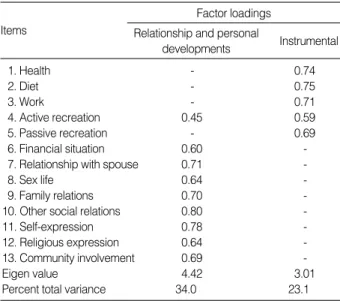
As shown in Table 1, Factor 1 labeled “Relationships and Personal Development” included eight items: financial situ- ation, relationship with spouse, sex life, family relations, other
Loadings smaller than 0.40 are not displayed. IIRS, Illness Intrusiveness Rating Scale.
Items
Factor loadings
Instrumental Relationship and personal
developments
1. Health .- 0.74
2. Diet .- 0.75
3. Work .- 0.71
4. Active recreation 0.45 0.59
5. Passive recreation .- 0.69
6. Financial situation 0.60 .-
7. Relationship with spouse 0.71 .-
8. Sex life 0.64 .-
9. Family relations 0.70 .-
10. Other social relations 0.80 .-
11. Self-expression 0.78 .-
12. Religious expression 0.64 .-
13. Community involvement 0.69 .-
Eigen value 4.42 3.01
Percent total variance 34.0 23.1
Table 1.Exploratory principal component analysis of Korean IIRS (n=356)
social relations, self-expression/self improvement, religious ex- pression, community and civic involvement. Factor 2, termed
“Instrumental” included four items: health, diet, work, and passive recreation. This two-factor solution accounted for 57%
of the total variance. Item 4, active recreation had cross load- ings (0.40 or greater on two-factors) and was excluded for subsequent statistical analyses.
Confirmatory Analysis
As the two factors in exploratory analysis were intercorre- lated (0.70), a confirmatory PCA with oblique rotation was used for the remaining half of the cases (n=356). The same two-factor structure was extracted. This result was replicated for total subjects (n=712). However, when we employ maxi- mum likelihood factor analysis with oblique rotation to test the goodness-of-fit of the two factor model, statistically sig- nificant chi-square test resulted suggesting more factors are needed ( 2=138.2, df=43, p<0.001).
Reliability
We calculated reliability (alpha coefficient) of two sub- scales in the entire sample (n=712). The alpha coefficients for Relationships and Personal Development subscale were 0.89 and Instrumental 0.75. Each item of IIRS-K had coef- ficients ranging 0.48-0.74; total items 0.92. Thus, reliabili- ty was high for both factors and also for total items.
Correlation with disability and depression
Two factors significantly correlated with scores of HAQ (Relationships and Personal Development, 0.53, p<0.001;
Instrumental, 0.44, p<0.001) and CES-D (Relationships and Personal Development, 0.55, p<0.001; Instrumental, 0.43, p<0.001).
DISCUSSION
This study examined the factor structure of IIRS-K in a sample of chronic medical diseases, predominantly rheuma- toid arthritis. Exploratory PCA and further confirmatory fac- tor analysis extracted two factor structure, “Relationships and Personal Development” and “Instrumental”. This result is comparable to original IIRS with three-factor solution; instru- mental, intimacy, and relationships and personal develop- ment (14).
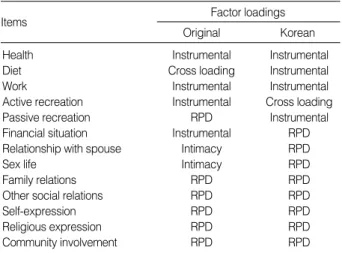
Overall speaking, more relational aspects were emphasized in the factor structure of IIRS-K when compared with the original IIRS (Table 2). For example, Intimacy (Item 7.8) in the original IIRS submerged in Relationships and Personal Development (Item 6-13) in IIRS-K. These two items (rela- tionship with spouse and sex life) may be seen as a part of
private and intimate sector distinct from relationship with others by North Americans, but Koreans may see that rela- tionship and involvement with partners as a continuum of relations with others. This value of interdependence and har- mony with others rather than individualism was described for Asians (22) and sometimes explained in the Confucian ideal (23).
Even Item 6, financial situation was loaded under factor
“Relationships and Personal Development”, not “Instrumen- tal”. It is not uncommon in Korea many patients with chron- ic illnesses depend financially on their family or relatives for medical expenditure because of incomplete coverage by med- ical insurance and welfare system. One research shows that Asian Americans are more likely to seek social support for their stress compared with European Americans (24).
Items on Instrumental (item 1, 2, 3, 5) of IIRS-K bear some differences to original Instrumental (item 1, 3, 4, 6).
Item 2, diet had cross-loading and was excluded in IIRS but included in this study. Besides, Item 4, active recreation includ- ed as Instrumental in IIRS was dropped in IIRS-K. This item had cross loading on both Instrumental and Relationships and Personal Development. Koreans seem to foster more inter- personal aspects of exercises, which was shown as an exam- ple in the questionnaire. Item 5, passive recreation belonged to Instrumental, which was under Relationships and Person- al Development in original IIRS. Once again, examples for passive recreation were reading and listening to music, which may be seen as mechanical and daily activities.
Therefore, we suggest that difference of factor structure from the original IIRS is in fact, reflection of cultural empha- sis on relation with others and difference in life styles.
The limitation of corroborating two-factor solution in IIRS- K is that confirmatory maximum likelihood method failed to support the goodness-of-fit of the model. It generally means more factors are needed to account the structure but also may
RPD, Relationships and Personal Development.
Items Factor loadings
Korean Original
Health Instrumental Instrumental
Diet Cross loading Instrumental
Work Instrumental Instrumental
Active recreation Instrumental Cross loading
Passive recreation RPD Instrumental
Financial situation Instrumental RPD
Relationship with spouse Intimacy RPD
Sex life Intimacy RPD
Family relations RPD RPD
Other social relations RPD RPD
Self-expression RPD RPD
Religious expression RPD RPD
Community involvement RPD RPD
Table 2.Comparison of factor structures between the original and Korean version of the Illness Intrusiveness Rating Scale
reflect sensitivity to sample size. Moreover, two factors had moderate to high internal consistency and correlated with disease characteristics (i.e., functional disability) and emo- tional distress (i.e., depression) well demonstrating the con- struct validity of two factors.
Other weakness of this study includes convenient sampling method and disproportion of diagnostic distribution may hazard the representativeness of the subjects. Taken togeth- er, these findings suggest construct validity of IIRS-K; how- ever, corroborating two-factor solution needs further inves- tigation. Likewise, we did not find cross-cultural equivalence of three-factor structure of IIRS.
ACKNOWLEDGEMENT
The authors wish to thank Mr. Adam Turner, the Direc- tor of English Writing Center, Hanyang University and the staff at the Department of Internal Medicine and the Hos- pital for Rheumatic Disease, Hanyang University Medical Center.
REFERENCES
1. Devins GM, Seland TP. Emotional impact of multiple sclerosis: recent findings and suggestions for future research. Psychol Bull 1987; 101:
363-75.
2. Devins GM, Edworthy SM, Guthrie NG, Martin L. Illness intrusive- ness in rheumatoid arthritis: Differential impact on depressive symp- toms over the adult life span. J Rheumatol 1992; 19: 709-15.
3. Devins GM. Illness intrusiveness and the psychosocial impact of lifestyle disruptions in chronic life-threatening disease. Adv Ren Replace Ther 1994; 1: 251-63.
4. Devins GM, Binik YM, Hutchinson TA, Hollomby DJ, Barre PE, Guttmann RD. The emotional impact of end-stage renal disease:
importance of patients’ perception of intrusiveness and control. Int J Psychiatry Med 1983; 13: 327-43.
5. Devins GM, Styra R, O’Conor P, Gray T, Seland TP, Klein GM, Shapiro CM. Relationship and Personal Developments impact of illness intrusiveness moderated by age in multiple sclerosis. Psychol Health Med 1996; 1: 179-91.
6. Devins GM, Mandin H, Hons RB, Burgess ED, Klassen J, Taub K, Schorr S, Letourneau PK, Buckle S. Illness intrusiveness and quali- ty of life in end-stage renal disease: comparison and stability across treatment modalities. Health Psychol 1990; 9: 117-42.
7. Devins GM, Stam HJ, Koopmans JP. Psychosocial impact of laryn- gectomy mediated by perceived stigma and illness intrusiveness. Can J Psychiat 1994; 39: 608-16.
8. Cina CS, Clase CM. The illness intrusiveness rating scale: a mea- sure of severity in individuals with hyperhidrosis. Qual Life Res 1999;
8: 693-8.
9. Devins GM, Edworthy SM. Illness intrusiveness explains race-relat- ed quality-of-life differences among women with systemic lupus ery- thematosus. Lupus 2000; 9: 534-41.
10. Schimmer AD, Elliott ME, Abbey SE, Raiz L, Keating A, Beanlands HJ, McCay E, Messner HA, Lipton JH, Devins GM. Illness intru- siveness among survivors of autologous blood and marrow trans- plantation. Cancer 2001; 92: 3147-54.
11. Antony MM, Roth D, Swinson RP, Huta V, Devins GM. Illness intrusiveness in individuals with panic disorder, obsessive-compul- sive disorder, or social phobia. J Nerv Ment Dis 1998; 186: 311-5.
12. Robb JC, Cooke RG, Devins GM, Young LT, Joffe RT. Quality of life and lifestyle disruption in euthymic bipolar disorder. J Psychia- tr Res 1997; 31: 509-17.
13. Devins GM, Edworthy SM, Paul LC, Mandin H, Seland TP, Klein G, Costello CG, Shapiro CM. Restless sleep, illness intrusiveness, and depressive symptoms in three chronic illness conditions: rheuma- toid arthritis, end-stage renal disease, and multiple sclerosis. J Psy- chosom Res 1993; 37: 163-70.
14. Devins GM, Dion R, Pelletier LG, Shapiro CM, Abbey S, Raiz LR, Binik YM, McGowan P, Kutner NG, Beanlands H, Edworthy SM.
Structure of lifestyle disruptions in chronic disease: a confirmatory factor analysis of the Illness Intrusiveness Ratings Scale. Med Care 2001; 39: 1097-104.
15. Zheng YP, Wei LA, Goa LG, Zhang GC, Wong CG. Applicability of the chinese beck depression inventory. Compr Psychiatry 1988;
29: 484-9.
16. Suh M, Noh S, Devins GM, Kim K, Song J, Cho N, Hong Y, Kim I, Choi H, Jung S, Kim E. Readjustment and social support of the post hospitalized stroke patients. J Korean Acad Nurs 1999; 29: 639-55.
17. Bae SC, Cook EF, Kim SY. Psychometric evaluation of a Korean Health Assessment Questionnaire for clinical research. J Rheuma- tol 1998; 25: 1975-9.
18. Cho MJ, Kim KH. Use of the Center for Epidemiologic Studies De- pression (CES-D) Scale in Korea. J Nerv Ment Dis 1998; 186: 304-10.
19. Pincus T, Summey JA, Soraci SA Jr, Wallston KA, Hummon NP.
Assessment of patient satisfaction in activities of daily living using a modified Stanford Health Assessment Questionnaire. Arthritis Rheum 1983; 26: 1346-53.
20. Radoff LS. The CES-D Scale: a self-report depression scale for re- search in the general population. Appl Psychol Measurement 1977;
1: 385-401.
21. Devins GM, Edworthy SM, Paul LC, Mandin H, Seland TP, Klein GM. Illness intrusiveness and depressive symptoms over the adult years: is there a differential impact across chronic conditions? Can J Behav Sci 1993; 25: 400-13.
22. Chang SC. The self: a nodal issue in culture and psyche-an Eastern perspective. Am J Psychother 1982; 36: 67-81.
23. Cheung P. Culture and behaviour of East Asians. Aust N Z J Psy- chiatry 1991; 25: 14-6.
24. Talyor SE, Sherman DK, Kim HS, Jarcho J, Takagi K, Dunagan MS. Culture and social support: who seeks it and why? J Pers Soc Psychol 2004; 87: 354-62.
아래의 문항들은 당신의 질병 및 그 치료 과정이 당신의 생활에 얼마나 지장을 가져오고 있는가를 묻는 문항들입니다. 현재 당신의 상 태를 보아서 가장 적절하다고 생각되는 곳 하나에 동그라미를 표 해주십시오. 만일 본인에게 해당되지 않는 문항이 있다면 생활에 별 지장이 없는 것으로 보고 1에 동그라미 표 해주십시오. 한 문항도 빠뜨리지 마시고 답해주십시오. 감사합니다.
당신의 질병 및 그 치료과정이 다음과 같은 삶의 영역에 얼마나 지장을 가져오고 있습니까?
1. 건강
거의 지장을 주지 않는다. 1 2 3 4 5 6 7 아주 많은 지장을 주고 있다.
2. 식사(먹고 마시는 일)
거의 지장을 주지 않는다. 1 2 3 4 5 6 7 아주 많은 지장을 주고 있다.
3. 업무 수행(일)
거의 지장을 주지 않는다. 1 2 3 4 5 6 7 아주 많은 지장을 주고 있다.
4. 활동적인 여가 활동(예: 운동)
거의 지장을 주지 않는다. 1 2 3 4 5 6 7 아주 많은 지장을 주고 있다.
5. 조용한 취미 생활(예: 독서, 음악 감상 등)
거의 지장을 주지 않는다. 1 2 3 4 5 6 7 아주 많은 지장을 주고 있다.
6. 경제 상태(수입)
거의 지장을 주지 않는다. 1 2 3 4 5 6 7 아주 많은 지장을 주고 있다.
7. 배우자(미혼인 경우는 이성친구)와의 관계
거의 지장을 주지 않는다. 1 2 3 4 5 6 7 아주 많은 지장을 주고 있다.
8. 성생활
거의 지장을 주지 않는다. 1 2 3 4 5 6 7 아주 많은 지장을 주고 있다.
9. 가족 관계
거의 지장을 주지 않는다. 1 2 3 4 5 6 7 아주 많은 지장을 주고 있다.
10. 사람들과 사귀는 일
거의 지장을 주지 않는다. 1 2 3 4 5 6 7 아주 많은 지장을 주고 있다.
11. 자기표현/자기개발
거의 지장을 주지 않는다. 1 2 3 4 5 6 7 아주 많은 지장을 주고 있다.
12. 종교생활
거의 지장을 주지 않는다. 1 2 3 4 5 6 7 아주 많은 지장을 주고 있다.
13. 사회와 지역사회에 참여와 공헌
거의 지장을 주지 않는다. 1 2 3 4 5 6 7 아주 많은 지장을 주고 있다.
<Appendix>
The Korean version of Illness Intrusiveness Rating Scale 한국판 질병 침습도 평가 척도