Copyright © 2016 The Korean Society for Bone and Mineral Research
This is an Open Access article distributed under the terms of the Creative Commons Attribution Non-Commercial Li- cense (http://creativecommons.org/licenses/by-nc/3.0/) which permits unrestricted non-commercial use, distribu- tion, and reproduction in any medium, provided the original work is properly cited.
pISSN 2287-6375 eISSN 2287-7029
Inadequate Dietary Calcium and Vitamin D Intake in Patients with Osteoporotic Fracture
Dong Sik Yoon1, Young-Kyun Lee2, Yong-Chan Ha3, Ha-Young Kim1
1Department of Internal Medicine, Wonkwang University Sanbon Hospital, Wonkwang University College of Medicine, Gunpo;
2Department of Orthopaedic Surgery, Seoul National University Bundang Hospital, Seoul National University College of Medicine, Seongnam;
3Department of Orthopaedic Surgery, Chung-Ang University College of Medicine, Seoul, Korea
Background: Inadequate calcium and vitamin D intake is a possible risk factor of osteo- porosis. Our purposes were to estimate calcium and vitamin D intake in women with os- teoporotic fractures, to determine associated factors for low calcium and vitamin D in- take, and to evaluate the effects of calcium and vitamin D intake on bone mineral densi- ty (BMD). Methods: This is a multicenter, hospital-based, and cross-sectional study in- volving 277 women with osteoporotic fractures. Dietary calcium and vitamin D intake were evaluated using the Korean Calcium Assessment Tool (KCAT) self-reported ques- tionnaire. BMD was measured by dual energy X-ray absorptiometry (DXA) in the lumbar spine and femoral neck. Results: Average daily calcium and vitamin D intake was 503.7
±274.7 mg and 7.5±12.6 µg, respectively. Patients with low calcium intake had less family history of osteoporosis and were older. There was a negative correlation between age and calcium intake (r=-0.14; P=0.019). In multivariate analysis, calcium intake showed a positive correlation with BMD of femoral neck (β=0.0005, P=0.021). Conclusions:
About 80% of patients with osteoporotic fracture had calcium and vitamin D intake be- low the recommended dietary intake. Low calcium intake was associated with no family history of osteoporosis and older age. Dietary calcium intake showed positive effect on BMD.
Key Words: Calcium dietary, Osteoporotic fractures, Vitamin D
INTRODUCTION
Osteoporosis has become a major public health issue. It is rapidly increasing globally, especially in elderly Asians.[1-3] The projected incidence of hip fracture in Asia will account for 37% of all hip fractures worldwide by 2025.[4] The preva- lence of osteoporosis in Korean women older than 50 years has been reported 35.5% from the Korean National Health and Nutrition Examination Survey (KNH- ANES) [5] and 24.3% from a recent regional cohort study (Ansung cohort).[6]
Calcium and vitamin D are an essential nutrient in maintaining optimal bone health. Appropriate doses of calcium and vitamin D intake were shown to be phar- macologically active, safe, and effective for the prevention and treatment of os- teoporotic fractures.[7,8] Therefore, several guidelines for osteoporosis have rec- ommended increased daily calcium and vitamin D intake to prevent and treat os- Corresponding author
Ha-Young Kim
Department of Internal Medicine, Wonkwang University Sanbon Hospital, 321 Sanbon-ro, Gunpo 15865, Korea
Tel: +82-31-390-2956 Fax: +82-31-390-2447 E- mail: [email protected] Received: March 21, 2016 Revised: April 26, 2016 Accepted: April 27, 2016
No potential conflict of interest relevant to this article was reported.
Original Article
teoporosis.[9-13] The recommended calcium and vitamin D intake varies according to age. In Korea, the daily calcium and vitamin D intake is recommended as approximately 700 mg and 10 µg, respectively, for women over 50 years of age.[14] However, the calcium intake of Korean women is reportedly only 55.2% of the dietary reference intakes for Koreans (KDRIs).[14] Vitamin D insufficiency is also very common in the general population,[15] but no data on vi- tamin D intake are available. Moreover, studies on the di- etary intake of calcium and vitamin D among osteoporotic fracture patients are limited.
In this cross-sectional study, we evaluated the prevalence of low calcium and vitamin D intake using a self-reporting questionnaire, evaluated the associated factors of low in- take, and determined the effect of calcium and vitamin D intake on bone mineral density (BMD) in patients with os- teoporotic fracture.
METHODS
1. Study participants
From January to July 2015, 277 women were enrolled in this multicenter, hospital-based cross-sectional study on osteoporotic fracture. Fourteen hospitals participated. In- clusion criteria were female sex, fall-related osteoporotic vertebral, hip, and wrist fractures, age 50 years or older, and voluntary willingness to answer the questionnaire. Ex- clusion criteria were pregnancy, high-energy trauma, patho- logic fracture secondary to metastasis, dementia and in- ability to be interviewed. The study was approved by the ethics committee in each hospital. Participants signed in- formed consent to participate in the study.
2. Assessment of dietary calcium and vitamin D intake
To evaluate dietary calcium and vitamin D intake, the Korean Calcium Assessment Tool (KCAT) self-reported ques- tionnaire was used. KCAT is a simple and convenient ques- tionnaire developed based on the Calcium CalculatorTM created by registered dietitians working for the full term for BC Dairy Foundation in the 1980s.[16] The KCAT includes 7 food groups consisting of 24 categories with 45 food items containing calcium and vitamin D, which are consumed frequently by Koreans. Using the KCAT, dietary vitamin D as well as calcium intake can be assessed with excellent
validity and reproducibility.[16] Low intake group for calci- um was defined as <700 mg daily and low intake group for vitamin D as <10 µg daily in women ≥50 years of age.
[14]
3. Risk factors for osteoporosis and fracture Demographics including age, height, weight, body mass index (BMI), family history of osteoporosis, family history of osteoporotic fracture, status of residency (alone, with family, special facility), location of residence (urban and ru- ral), status of insurance (Medicare and Medicaid), current smoking, comorbidity (hypertension, diabetes, hypercho- lesterolemia, rheumatoid arthritis, use of steroid) were eval- uated.
BMD of the lumbar spine and femoral neck measured using a dual energy X-ray absorptiometry (DXA). Diagnosis of osteoporosis was made using the World Health Organi- zation T-score criteria, with osteoporosis defined as a T-score
≤-2.5 at either the femoral neck or lumbar spine.
4. Statistical analyses
Analyses were performed using R software. Chi-square test and Student’s t-test were used for comparison between low intake and adequate intake groups. To evaluate rela- tionships and dependencies between calcium and vitamin D intake and T-score of femoral neck, Pearson’s correlation and multiple regression analysis were used. The impact of calcium and vitamin D intake on BMD was evaluated with a multiple regression model. The covariates were age, BMI, family history of osteoporosis or osteoporotic fracture, use of steroids, current smoking, diabetes, and rheumatoid ar- thritis. The results were considered significant for P<0.05.
RESULTS
From January to July 2015, 277 women were enrolled.
Mean age was 73.3 years old (range, 50-97 years). One hun- dred and forty-three patients (51.6%) were taking an osteo- porosis medication. One hundred and eighteen patients (82.5%) were taking bisphosphonate and 14 patients (9.8%) were taking a selective estrogen receptor modulator. There were vertebral fracture in 32 patients, hip fracture in 195, and wrist fracture in 50. One hundred and seven patients (38.6%) had osteoporosis indicated by BMD.
Calcium intake ranged from 36.4 to 2,090.8 mg daily, with
a mean of 503.7±274.7 mg. Vitamin D intake ranged from 2.7 to 180.8 µg daily, with mean of 7.5±12.6 µg. Only 56 patients with osteoporotic fracture (20.2%) had a daily cal- cium intake above the recommended level of 700 mg. Two hundred and twenty one patients (79.8%) had a daily cal- cium intake <700 mg/day. Similarly, dietary vitamin D in- take of 216 patients (78.0%) was <10 µg/daily. Only 19 pa- tients (6.9 %) were taking calcium and vitamin D supple-
ments. Figure 1 shows the daily calcium and vitamin D in- take in each age group. Dietary calcium intake showed a decreasing tendency according to increasing age. Howev- er, there was no difference in vitamin D intake according to age group.
Patients with low dietary calcium intake were older (P=
0.022), had less family history of osteoporosis (P=0.039), and had lower femoral neck BMD T-score (P=0.022) (Table
Table 1. Baseline characteristics of women older than 50 years with osteoporotic fracture according to dietary calcium intake Low intake of calcium
(n=221) Adequate intake of calcium
(n=56) P-value
Mean calcium intake (mg/day) 402.2±152.0 906.6±281.4
Age (yr) 74.0±9.8 70.6±9.1 0.022
BMI (kg/m2) 23.1±4.1 23.8±3.5 0.246
Family history of osteoporosis (%) 7.2 16.1 0.039
Family history of osteoporotic fracture (%) 10.4 7.1 0.461
Residence type (%) Alone Family Facility
19.9 74.2 5.4
19.6 80.4 0.0
0.194
Residence area (%) Urban
Rural 94.6
5.4 98.2
1.8 0.249
Insurance type (%) Medicare
Medicaid 97.7
2.3 96.4
3.6 0.577
Diabetes (%) 27.1 19.6 0.25
Hypertension (%) 59.7 55.4 0.552
Rheumatoid arthritis (%) 14.0 17.9 0.81
Use of steroid (%) 4.5 3.6 0.754
Current smoking (%) 0.9 0.0 0.475
T-score of femoral neck -2.7±1.0 -2.3±0.8 0.022
BMI, body mass index.
Fig. 1. Dietary calcium and vitamin D intake according to age.
150
100
50
0
Daily vitamin D intake (mg)
50-59 60-69 70-79 80-89 90- Age
Vitamin D intake according to age
2,000
1,500
1,000
500
0
Daily cardium intake (mg)
50-59 60-69 70-79 80-89 90- Age
Calcium intake according to age
A B
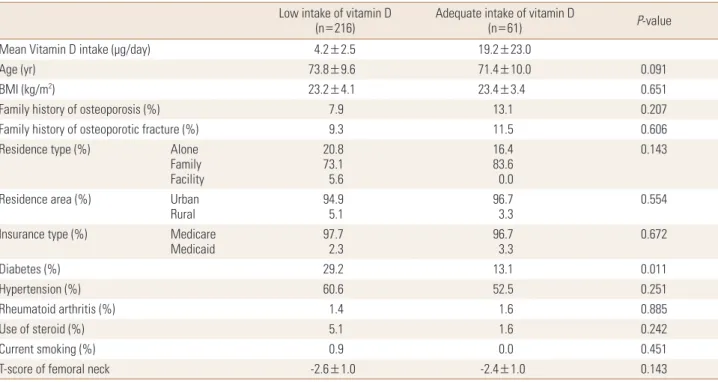
1). Diabetes was more prevalent in patients with low dietary vitamin D intake (P=0.011) (Table 2). There was no differ- ence in femoral neck T-score in subjects with low and ade- quate intake of vitamin D.
We studied the various possible predictors of low calci- um and vitamin D intake including age, BMI, family history of osteoporosis or osteoporotic fracture, residence type and area, smoking, diabetes, hypertension, rheumatoid ar- thritis, and use of glucocorticoid. Significant correlation was evident between age and calcium intake (r=-0.14;
P=0.019; Fig. 2). However, no correlating factors associat- ed with vitamin D intake were evident; the correlation be- tween vitamin D intake and age was statistically non-sig- nificant (r=-0.025; P=0.675).
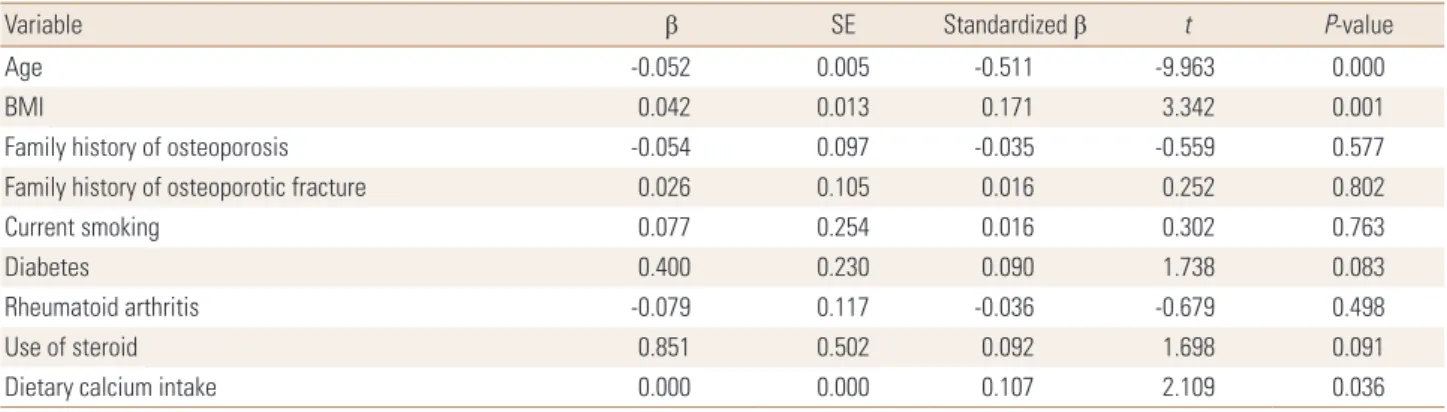
BMD was determined in 31 patients with spine fracture and 182 patients with hip fracture. Among patients with hip fracture, 71 (37.0%) patients had hip T-scores in the os- teopenic range and 111 (57.8%) patients had hip T-scores in the osteoporotic range. Among spine fracture patients, 16 (51.6%) patients had spine T-scores in the osteopenic ranges. When we applied spine or hip T-scores, 9 (22.6%) patents with spine fracture and 14 (7.7%) patients with hip fracture could be re-categorized from osteopenia to osteo- porosis. In the multivariable model, age, BMI and calcium intake were significantly associated with T-score of femoral
neck (Table 3). Vitamin D intake was not associated with T- score of femoral neck.
DISCUSSION
This study demonstrated high prevalence (about 80%) of low calcium and vitamin D intake in elderly Korean wom- en with osteoporotic fracture. Older age and no family his- Table 2. Baseline characteristics of women older than 50 years with osteoporotic fracture according to dietary vitamin D intake
Low intake of vitamin D
(n=216) Adequate intake of vitamin D
(n=61) P-value
Mean Vitamin D intake (μg/day) 4.2±2.5 19.2±23.0
Age (yr) 73.8±9.6 71.4±10.0 0.091
BMI (kg/m2) 23.2±4.1 23.4±3.4 0.651
Family history of osteoporosis (%) 7.9 13.1 0.207
Family history of osteoporotic fracture (%) 9.3 11.5 0.606
Residence type (%) Alone
Family Facility
20.8 73.1 5.6
16.4 83.6 0.0
0.143
Residence area (%) Urban
Rural 94.9
5.1 96.7
3.3 0.554
Insurance type (%) Medicare
Medicaid 97.7
2.3 96.7
3.3 0.672
Diabetes (%) 29.2 13.1 0.011
Hypertension (%) 60.6 52.5 0.251
Rheumatoid arthritis (%) 1.4 1.6 0.885
Use of steroid (%) 5.1 1.6 0.242
Current smoking (%) 0.9 0.0 0.451
T-score of femoral neck -2.6±1.0 -2.4±1.0 0.143
BMI, body mass index.
Fig. 2. Correlation between age and calcium intake.
2,000
1,500
1,000
500
0
Daily calcium intake (mg)
50 60 70 80 90 Age
Correlation between age and calcium intake
tory of osteoporosis were associated with low calcium in- take. In multivariate analysis, calcium intake showed a sta- tistically significant association with femoral neck T-score.
Calcium plays an essential role in bone health across all ages, so calcium intake is emphasized because an insuffi- cient intake negatively affects bone metabolism.[17]
Asian populations tend to have low calcium intake.[18,19]
A recent cross-sectional study from Korea reported that the mean daily calcium intake was 485 mg in the general population ≥50 years of age.[20] According to national health statistics, more than 50% of general population at any age has a lower calcium intake than the KDRI recom- mendation. In this study, dietary calcium insufficiency was observed in 80% of patients with osteoporotic fractures.
The prevalence of low calcium and low vitamin D intake in this study were higher than reported from other countries.
[21-24] The average daily calcium intake in the diet is <500 mg, meaning that older people would need to take calci- um supplements to meet the recommendations. In some Western countries, more than 30% to 50% of older women take calcium supplements.[25-28] In this study, only 7% of enrolled women were taking calcium or vitamin D supple- ments, which was lower than other previous studies. Given that participant in this study were at high risk of subsequent osteoporotic fracture, a systemic approach should be made to increase the dietary calcium intake after fracture.
In this study, factors affecting the calcium intake were age and family history of osteoporosis. Patients with family history of osteoporosis took more calcium. Awareness and concerns about osteoporosis could affect dietary habits in patients with family history of osteoporosis. As it has been confirmed in previous studies,[21,24] older women have lower calcium intake. Moreover, lower calcium intake show-
ed a statistically significant association with lower femoral neck T-score, even after adjusting age. Recently, Kim et al.
[29] also reported that low calcium intake was significantly related with low BMD and increased risk of osteoporosis in general population in Korea. Therefore, public education about the importance of adequate calcium and vitamin D intake is very important to prevent osteoporosis, especially in older women.
As vitamin D has been recognized as a critical factor in calcium metabolism, the effect of vitamin D on bone den- sity has been reported.[21,30] However, we did not find any relation between vitamin D intake and BMD. Sun ex- posure is important as a non-dietary source of vitamin D.
In this study, we did not measure serum 25-hydroxy-vita- min D (25-[OH]D), a well-known biomarker of vitamin D status, and did not investigate the time of outdoor activi- ties. This suggests that dietary vitamin D intake alone may not accurately reflect the state of vitamin D in the body.
Our study has some limitation. First, this was a cross-sec- tional study. Prospective studies on the relationship be- tween dietary calcium intake and bone are needed to de- termine whether these associations are causal. Second, data on the intake of each nutrient were provided as self- reporting questionnaire. Therefore, there is a possibility that the answer was incorrect considering the age of pa- tient.
In conclusion, the results of this study show that the ma- jority of patients with osteoporotic fracture had lower than recommended daily calcium and vitamin D intake. There- fore, all osteoporotic fracture patients would benefit from dietary education and calcium supplements to prevent bone loss and subsequent fracture.
Table 3. The estimated regression model for femur neck T-score
Variable β SE Standardized β t P-value
Age -0.052 0.005 -0.511 -9.963 0.000
BMI 0.042 0.013 0.171 3.342 0.001
Family history of osteoporosis -0.054 0.097 -0.035 -0.559 0.577
Family history of osteoporotic fracture 0.026 0.105 0.016 0.252 0.802
Current smoking 0.077 0.254 0.016 0.302 0.763
Diabetes 0.400 0.230 0.090 1.738 0.083
Rheumatoid arthritis -0.079 0.117 -0.036 -0.679 0.498
Use of steroid 0.851 0.502 0.092 1.698 0.091
Dietary calcium intake 0.000 0.000 0.107 2.109 0.036
SE, standard error; BMI, body mass index.
REFERENCES
1. Reginster JY, Burlet N. Osteoporosis: a still increasing prev- alence. Bone 2006;38:S4-9.
2. Yi H, Ha YC, Lee YK, et al. National healthcare budget im- pact analysis of the treatment for osteoporosis and frac- tures in Korea. J Bone Metab 2013;20:17-23.
3. Borgström F, Sobocki P, Strom O, et al. The societal burden of osteoporosis in Sweden. Bone 2007;40:1602-9.
4. Gullberg B, Johnell O, Kanis JA. World-wide projections for hip fracture. Osteoporos Int 1997;7:407-13.
5. Choi YJ, Oh HJ, Kim DJ, et al. The prevalence of osteoporo- sis in Korean adults aged 50 years or older and the higher diagnosis rates in women who were beneficiaries of a na- tional screening program: the Korea National Health and Nutrition Examination Survey 2008-2009. J Bone Miner Res 2012;27:1879-86.
6. Shin CS, Choi HJ, Kim MJ, et al. Prevalence and risk factors of osteoporosis in Korea: a community-based cohort study with lumbar spine and hip bone mineral density. Bone 2010;47:378-87.
7. Boonen S, Rizzoli R, Meunier PJ, et al. The need for clinical guidance in the use of calcium and vitamin D in the man- agement of osteoporosis: a consensus report. Osteoporos Int 2004;15:511-9.
8. Boonen S, Vanderschueren D, Haentjens P, et al. Calcium and vitamin D in the prevention and treatment of osteo- porosis - a clinical update. J Intern Med 2006;259:539-52.
9. American Association of Clinical Endocrinologists and Amer- ican college of Endocrinology. AACE clinical practice guide- lines for the prevention and treatment of postmenopausal osteoporosis. J Fla Med Assoc 1996;83:552-66.
10. Javid KS, Thien A, Hill R. Implementation of and compli- ance with NICE guidelines in the secondary prevention of osteoporotic fractures in postmenopausal women. Ann R Coll Surg Engl 2008;90:213-5.
11. Rizzoli R, Boonen S, Brandi ML, et al. The role of calcium and vitamin D in the management of osteoporosis. Bone 2008;42:246-9.
12. Varenna M, Binelli L, Casari S, et al. Effects of dietary calci- um intake on body weight and prevalence of osteoporo- sis in early postmenopausal women. Am J Clin Nutr 2007;
86:639-44.
13. National Osteoporosis Foundation. Physician’s guide to prevention and treatment of osteoporosis. 2nd ed. Wash-
ington, DC: National Osteoporosis Foundation; 2003.
14. The Korean Nutrition Society. Dietary reference intakes for Koreans 2010. Seoul: The Korean Nutrition Society, Minis- try of Health & Welfare, Ministry of Food and Drug Safety;
2010.
15. Choi HS, Oh HJ, Choi H, et al. Vitamin D insufficiency in Ko- rea--a greater threat to younger generation: the Korea Na- tional Health and Nutrition Examination Survey (KNHANES) 2008. J Clin Endocrinol Metab 2011;96:643-51.
16. Park Y, Kim SH, Lim YT, et al. Validation of a new food fre- quency questionnaire for assessment of calcium and vita- min d intake in korean women. J Bone Metab 2013;20:67- 74.
17. Zhu K, Prince RL. Calcium and bone. Clin Biochem 2012;
45:936-42.
18. Lau EM, Woo J, Lam V, et al. Milk supplementation of the diet of postmenopausal Chinese women on a low calcium intake retards bone loss. J Bone Miner Res 2001;16:1704-9.
19. Nakamura K, Saito T, Kobayashi R, et al. Effect of low-dose calcium supplements on bone loss in perimenopausal and postmenopausal Asian women: a randomized controlled trial. J Bone Miner Res 2012;27:2264-70.
20. Joo NS, Dawson-Hughes B, Kim YS, et al. Impact of calci- um and vitamin D insufficiencies on serum parathyroid hormone and bone mineral density: analysis of the fourth and fifth Korea National Health and Nutrition Examination Survey (KNHANES IV-3, 2009 and KNHANES V-1, 2010). J Bone Miner Res 2013;28:764-70.
21. Bischoff-Ferrari HA, Kiel DP, Dawson-Hughes B, et al. Di- etary calcium and serum 25-hydroxyvitamin D status in relation to BMD among U.S. adults. J Bone Miner Res 2009;
24:935-42.
22. Fardellone P, Cotté FE, Roux C, et al. Calcium intake and the risk of osteoporosis and fractures in French women.
Joint Bone Spine 2010;77:154-8.
23. Bruyere O, De Cock C, Mottet C, et al. Low dietary calcium in European postmenopausal osteoporotic women. Public Health Nutr 2009;12:111-4.
24. Skowrońska-Jóźwiak E, Jaworski M, Grzywa A, et al. Influ- ence of calcium intake on bone mineral density and inci- dence of fractures in treatment-naive women from Lodz urban area - a part of EPOLOS study. Ann Agric Environ Med 2014;21:201-4.
25. Bailey RL, Dodd KW, Goldman JA, et al. Estimation of total usual calcium and vitamin D intakes in the United States. J
Nutr 2010;140:817-22.
26. Anderson JJ, Roggenkamp KJ, Suchindran CM. Calcium intakes and femoral and lumbar bone density of elderly U.S. men and women: National Health and Nutrition Ex- amination Survey 2005-2006 analysis. J Clin Endocrinol Metab 2012;97:4531-9.
27. Castro-Lionard K, Dargent-Molina P, Fermanian C, et al. Use of calcium supplements, vitamin D supplements and spe- cific osteoporosis drugs among French women aged 75- 85 years: patterns of use and associated factors. Drugs Ag- ing 2013;30:1029-38.
28. Xiao Q, Murphy RA, Houston DK, et al. Dietary and supple- mental calcium intake and cardiovascular disease mortal- ity: the National Institutes of Health-AARP diet and health study. JAMA Intern Med 2013;173:639-46.
29. Kim KM, Choi SH, Lim S, et al. Interactions between dietary calcium intake and bone mineral density or bone geome- try in a low calcium intake population (KNHANES IV 2008- 2010). J Clin Endocrinol Metab 2014;99:2409-17.
30. Bischoff-Ferrari HA, Willett WC, Wong JB, et al. Fracture pre- vention with vitamin D supplementation: a meta-analysis of randomized controlled trials. JAMA 2005;293:2257-64.