Aging over 70 Years Is Not a Decisively Dismal Prognostic Factor in Gastric Cancer Surgery
Sung-Il Cho, You-Jin Jang, Jong-Han Kim, Sung-Soo Park, Seong-Heum Park, Seung-Joo Kim, Chong-Suk Kim, and Young-Jae Mok
Department of Surgery, Korea University College of Medicine, Seoul, Korea
Purpose: Gastric cancer has a high incidence and mortality rate in Korea. Despite a growing older population and an increase in the number of older patients with gastric cancer, the older patients are not willing to undergo surgery due to their operative risks. Hence, to determine the clinical characteristics and outcomes of gastric cancer surgery for them, we investigate factors influencing the treatment decision.
Materials and Methods: Between January 1996 and December 2005, a total of 1,519 patients were classified into two groups; the younger age group between 41 and 69 years of age, and the older age group of 70 years or older. The analysis conducted included pa- tient characteristics, accompanying disorders, related American Society of Anesthesiologists (ASA) grade, pathological characteristics and survival rate for each age group.
Results: Significant differences were found in the ASA grade (P<0.001) and the number of accompanying disorders (P<0.001) be- tween the two groups. The average length of hospital stay after surgery was 14.5 days in the younger age group, and 13.3 days in the older age group (P=0.065). The average survival time was 47.5 months in the younger age group, and 43.2 months in the older age group (P<0.001).
Conclusions: This study demonstrated that there was more number of accompanying disorders with a high surgical risk in the older age group. However, there was no significant difference between the older and younger age groups in terms of the incidence of complica- tions, under the given disease conditions and if proper management was provided.
Key Words: Stomach neoplasms; Aged; Survival
Correspondence to: Sung-Soo Park
Department of Surgery, Korea University College of Medicine, Korea University Anam Hospital, Inchon-ro 73, Seongbuk-gu, Seoul 136-705, Korea
Tel: +82-2-920-6772, Fax: +82-2-928-1631 E-mail: [email protected]
Received September 6, 2011 Revised October 26, 2011 Accepted October 26, 2011
Copyrights © 2011 by The Korean Gastric Cancer Association www.jgc-online.org
This is an open-access article distributed under the terms of the Creative Commons Attribution Non-Commercial License (http://creativecommons.org/
licenses/by-nc/3.0) which permits unrestricted noncommercial use, distribution, and reproduction in any medium, provided the original work is properly cited.
Introduction
Globally, gastric cancer ranks fourth and fifth for males and females respectively in terms of the incidence rate, and ranks third and fifth for males and females respectively in terms of the mor-
tality rate.(1) In Korea, gastric cancer deaths rank third among total cancer deaths, and the number of deaths from stomach cancer is almost the same as that from cardiovascular diseases.(2) Korea is classified as a high incidence area for gastric cancer. Stomach can- cer has the highest incidence and is the third leading cause of death among other cancers in males, and has the third highest incidence and is the second leading cause of death in females.(2) The highest incidence of gastric cancer is in the 70’s patient age group,(2) being considered as one of the diseases associated with aging.
The average life expectancy in Korean population has been growing and in the year 2000 it was projected to reach 76 years according to the statistics released by the Korean government. The age group with the highest incidence has also increased from 50’s
to 60’s in 1995,(3) to 70’s in 2000 as mentioned above. Older gastric cancer patients usually have worse physical status than the younger stomach cancer patients,(4) and have accompanying diseases that often force them to have an aversion to surgical treatments.
We conducted a survey on the survival rate of gastric cancer patients and based on the survey, we investigated the items for consideration in the older age group of stomach cancer patients in comparison with the younger age group of stomach cancer patients.
Materials and Methods
A total of 1,738 patients who were diagnosed with gastric cancer and who underwent surgery at the Korea University Guro Hospital between January 1996 and December 2005 were selected and then, 45 patients who underwent simple laparotomy only, and 61 patients who underwent gastroenterostomy only were excluded leaving 1,632 patients to participate in the survey. These 1,632 patients’ ages ranged from 23 to 86 years and comprised of 113 patients in their 40’s or younger, 1,270 patients between 41 and 69 years, and 249 patients in their 70’s or older.
Patients aged 41 to 69 years were categorized as the younger age group and patients aged 70 years or older were categorized as the older age group and finally the survey was conducted in a total of 1,519 patients. The purpose of the study was to compare the results in the younger age group with those in the older age group. Patients in their 70’s or older who had an average postoperative life expec- tancy of 5 years were classified as the older age group based on the median life expectancy of 76 years as of 2000 released by the Korean government in 2005. In addition, gastric cancer patients in their 40’s or younger were excluded from the present study because they were considered to show different disease progression than that seen in the age group with the highest incidence.(4)
A comparative analysis of the two groups in terms of sex, postoperative hospital stay, American Society of Anesthesiologists (ASA) risk physical status, accompanying diseases, postoperative T stage and N stage was conducted. The ASA risk physical status is not only a standard for assessing preoperative physical status but it is also an important indicator predicting postoperative deaths or development of complications. In the present study, preoperative evaluation performed by an anesthesiologist was used for analysis.
In addition, postoperative complications which developed during the hospital stay were investigated. Complication was defined as an event which required an additional procedure or administration of drugs with prolonged hospital stay, and which was in accordance
with the confirmation based on clinical findings and radiologic results. Complications were retrospectively investigated based on the medical records. Surgical complications included postoperative bleeding, necrosis or stenosis of anastomotic site, peritonitis, wound infection and bile leakage associated with surgery. Medical compli- cations included diseases such as pneumonia, myocardiac infaction, severe arrhythmia, liver dysfunction, acute kidney dysfunction and thrombosis which required administration of additional drugs.
For cancer staging, TNM stages according to the 7th edition of AJCC staging system were used.(5)
Discrete data were presented as numbers or percentages while continuous variables were presented as mean with range. For sta- tistical comparison, Window SPSS program (Version 13.0, SPSS Inc., Chicago, IL, USA) was used. For univariate analysis, chi- square test and Student’s t-test were used according to the type of data while logistic regression analysis was used for multivariate analysis. Survival rate was analyzed using Kaplan-Meier method by comparing with log rank. P-value <0.05 was considered statisti- cally significant.
Results
1. Features of the patient groups
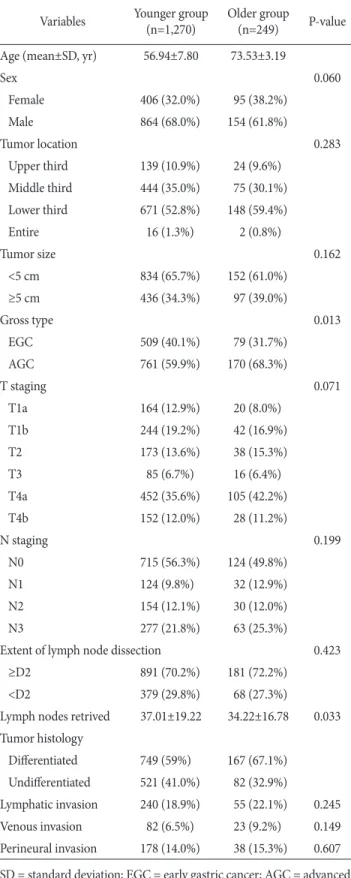
Out of the total 1,519 patients, the number of patients in the younger age group which was composed of patients between 40 41 and 69 years of age was 1,270 (83.0%) and the mean age was 56.94
±7.8, while the number of patients in the older age group which was composed of patients aged 70 years or older was 249 (17.0%) and the mean age was 73.53±3.2.
The younger age group comprised of 864 males (68.0%) and 406 females (32.0%), while the older age group comprised of 154 males (61.8%) and 95 females (38.2%). No difference was seen in the sex ratio between the two groups (P=0.060). The younger age group had 408 (32.1%) cases of early gastric cancer while the older age group had 62 cases (24.9%) of early stomach cancer and this dif- ference was statistically significant (P=0.013, Table 1). The older age group had 148 cases (59.4%) of lower one-third stomach cancer, which had a higher incidence than that in the younger age group with 671 cases (52.8%) of lower one-third gastric cancer. But, there was no statistically significant difference in the location of gastric cancer between groups (P=0.283).
There was no statistically significant difference in the range of lymph node dissection (P=0.423, Table 1), but in terms of the num- ber of lymph nodes dissected, the younger age group had a mean
of 37.01±19.22 which was significantly greater than the mean of 34.22±16.78 in the older age group (P=0.033).
2. Preoperative physical status (Table 2)
In terms of the preoperative ASA score, the older age group had a significantly higher ASA score (P<0.001). In terms of accom- panying diseases, hypertension was the most common disease in both the groups with 210 cases (16.5%) in the younger age group, and 81 cases (32.5%) in the older age group. In terms of prevalence rates for diseases, 112 cases (8.8%) of diabetes mellitus (DM) fol- lowed by 66 cases (5.2%) of respiratory diseases were reported in the younger age group, while 38 cases (15.3%) of heart diseases and 36 cases (14.5%) of DM and respiratory disease each were reported in the older age group, thereby indicating a significantly more number of accompanying systemic disease conditions in the older age group than in the younger age group (P<0.001). The number of patients having no accompanying disease in the younger age group was 828 (65.2%), while that in the older age group was 102 (41.0%) (P<0.001).
3. Postoperative complications and hospital stay (Table 3)
In terms of hospital stay, the younger patients in the younger Table 1. Comparison of clinicopathological factors between elder
and older patients with gastric carcinoma Variables Younger group
(n=1,270)
Older group
(n=249) P-value Age (mean±SD, yr) 56.94±7.80 73.53±3.19
Sex 0.060
Female 406 (32.0%) 95 (38.2%)
Male 864 (68.0%) 154 (61.8%)
Tumor location 0.283
Upper third 139 (10.9%) 24 (9.6%) Middle third 444 (35.0%) 75 (30.1%) Lower third 671 (52.8%) 148 (59.4%)
Entire 16 (1.3%) 2 (0.8%)
Tumor size 0.162
<5 cm 834 (65.7%) 152 (61.0%)
≥5 cm 436 (34.3%) 97 (39.0%)
Gross type 0.013
EGC 509 (40.1%) 79 (31.7%)
AGC 761 (59.9%) 170 (68.3%)
T staging 0.071
T1a 164 (12.9%) 20 (8.0%)
T1b 244 (19.2%) 42 (16.9%)
T2 173 (13.6%) 38 (15.3%)
T3 85 (6.7%) 16 (6.4%)
T4a 452 (35.6%) 105 (42.2%)
T4b 152 (12.0%) 28 (11.2%)
N staging 0.199
N0 715 (56.3%) 124 (49.8%)
N1 124 (9.8%) 32 (12.9%)
N2 154 (12.1%) 30 (12.0%)
N3 277 (21.8%) 63 (25.3%)
Extent of lymph node dissection 0.423
≥D2 891 (70.2%) 181 (72.2%)
<D2 379 (29.8%) 68 (27.3%)
Lymph nodes retrived 37.01±19.22 34.22±16.78 0.033 Tumor histology
Diff erentiated 749 (59%) 167 (67.1%) Undiff erentiated 521 (41.0%) 82 (32.9%)
Lymphatic invasion 240 (18.9%) 55 (22.1%) 0.245
Venous invasion 82 (6.5%) 23 (9.2%) 0.149
Perineural invasion 178 (14.0%) 38 (15.3%) 0.607 SD = standard deviation; EGC = early gastric cancer; AGC = advanced gastric cancer.
Table 2. Preoperative ASA risk and classifi cation of comorbidity
Younger group Older group P-value
Preoperative ASA risk <0.001
1 718 (56.5%) 0 (0%)
2 534 (42.0%) 176 (70.7%)
3 18 (1.4%) 73 (29.3%)
Associated disease <0.001
Hypertension 210 (16.5%) 81 (32.5%) Cardiac disease* 54 (4.3%) 38 (15.3%) Respiratory disease† 66 (5.2%) 36 (14.5%) Diabetes mellitus 112 (8.8%) 36 (14.5%) Liver disease‡ 47 (3.7%) 20 (8.0%) Neurologic disease§ 9 (0.7%) 9 (3.6%)
No. of associated disease (s) <0.001
0 828 (65.2%) 102 (41.0%)
1 360 (28.3%) 74 (29.7%)
2 82 (6.5%) 64 (25.7%)
3 0 (0%) 9 (3.6%)
ASA = American Society of Anesthesiologists; No. = number.
*Arrhythmia, valvular heart disease, coronary heart disease, old myocardial infarct, pericardial effusion; †Pulmonary tuberculosis, emphysema, asthma, chronic obstructive pulmonary disease, pleural effusion; ‡Liver cirrhosis, chronic hepatitis B, chronic hepatitis C, abnormal liver function test; §Cerebral infarct history, neurosurgery history.
age group had a hospital stay of 14.52±10.02 days while those in the older age group had a hospital stay of 13.27±8.15 days, indi- cating no significant difference (P=0.065).
The number of postoperative complications was 119 (9.4%) in the younger age group, compared with 21 (8.4%) in the older age group, indicating no significant difference (P=0.318).
4. Postoperative survival time and risk analysis The mean postoperative survival time was 47.5 months in the younger age group, and 43.2 months in the older age group, indi- cating a statistically significant difference (P=0.002, Fig. 1).
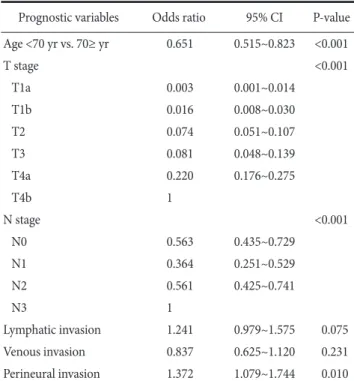
In the results of univariate analysis, age, T and N stages and stromal reaction were found to be the statistically significant fac- tors. In the results of multivariate analysis, risk increased with aging (odds ratio 0.651, P<0.001, Table 4) and additionally, the presence of perineural invasion in the T stage, N stage and stromal reaction were statistically significant (P<0.001, P=0.010, Table 4).
Discussion
As a manifestation of the aging process, elderly people have de- generated altered perioperative homeostasis due to slow neovascu-
larization, re-epithelialization, collagen accumulation and vasoper- meability.(6,7) Based on the assumption that there is a high risk of developing postoperative complications with increasing age, non- active treatment may be carried out for elderly patients. However, many studies on elderly patients with stomach cancer have reported that elderly patients who underwent radical excision did not have a lower survival rate than that in the middle-aged patients, based on features of clinical pathology and prognosis.(8-11) According to a study in Korea in 1990s, the 5 year postoperative survival rate of el- derly gastric cancer patients was 35%,(12) and the overall prognosis has improved by about 20% in 10 years since then.(13) According to the survey of the present study, the older age group had a 5 year survival rate of 63.9%.
According to the analysis, the older age group had a signifi- cantly (P<0.001) more number of high-risk patients and higher prevalence rate of accompanying chronic diseases than that in the younger age group (P<0.001). However, no significant difference was found in terms of the postoperative recovery period (P=0.065, Table 2) and postoperative complications (P=0.518, P=0.842, Table 2) between groups. Thus, in spite of the general expectations that the older age group may have more high-risk patients who may need a longer hospital stay, the actual duration of hospital stay was not longer than that in the younger age group, thereby indicating that
Table 3. Comparison of postoperative morbidity between patients and length of postoperative stay
Younger group Older group P-value Postoperative complications
Surgically related 91 (7.2%) 15 (6.0%) 0.518 Nonsurgically related 28 (2.2%) 6 (2.4%) 0.842 Postoperative hospital
stay (days)
14.52±10.02 13.27±8.15 0.065
Table 4. Multivariate analysis of prognostic factors in patients with curative surgery
Prognostic variables Odds ratio 95% CI P-value Age <70 yr vs. 70≥ yr 0.651 0.515~0.823 <0.001
T stage <0.001
T1a 0.003 0.001~0.014
T1b 0.016 0.008~0.030
T2 0.074 0.051~0.107
T3 0.081 0.048~0.139
T4a 0.220 0.176~0.275
T4b 1
N stage <0.001
N0 0.563 0.435~0.729
N1 0.364 0.251~0.529
N2 0.561 0.425~0.741
N3 1
Lymphatic invasion 1.241 0.979~1.575 0.075
Venous invasion 0.837 0.625~1.120 0.231
Perineural invasion 1.372 1.079~1.744 0.010 CI = confi dence interval.
Fig. 1. Survival curves according to age group.
the progress of postoperative recovery was not slower in the older age group compared to that in the younger age group. Eventually, despite the older age group having more number of chronic diseases and worse preoperative physical status than that in the younger age group, these factors did not affect the development of postoperative complications or progress of recovery. Consequently, active surgical treatments should be considered for elderly gastric cancer patients.
According to a recent study on the postoperative results of stomach cancer patient groups between 61~70 years of age and 75 years or older conducted by Mohri et al.,(14) the risk of death caused due to gastric cancer was the same between the groups, and the cancer- specific survival rate was not different between the patient group aged 75 years or older and the all age patient group. Accordingly, in case of the patients who are close to the average life expectancy, standard treatment modalities should be provided for long-term survival.
In the present study, the patients in the older age group were confirmed as having many accompanying diseases, and were at a high risk for surgery. However, if the underlying diseases are confirmed and appropriate care is provided, development of post- operative complications in the older age group may not be different from that in the younger age group. According to the present study, the younger age group had a longer 5 year survival time by about 4 months than that in the older age group (Fig. 1). This is a statisti- cally significant difference. In addition, the multivariate analysis showed that age itself was a risk factor (Table 4, P<0.001).
We confirmed that in gastric cancer, the treatment method and scope of surgery were not different between the older age group and the younger age group, but the postoperative survival time in the older age group could be shorter than that in the younger age group. It can be assumed that the possibility of death caused due to the underlying disease conditions is higher than that caused due to gastric cancer itself in case of the older age group of patients. Ac- cordingly, the older age group of patients should be closely moni- tored for the underlying disease conditions and development of an additional chronic disease or cancer as well as gastric cancer itself.
Nevertheless, without the analysis of the cancer-specific survival rate during the relevant period, the results cannot be interpreted as those of surgical treatment for gastric cancer. This should be con- sidered when a study is conducted, and follow-up monitoring and description of the cause of death in the future should be accurate.
As a limitation of the present study, a selection bias may be present. The patients who were selected for the present study had already undergone all the necessary surgeries. When surgery was
decided, patients in a good physical condition could have been recommended to undergo surgery, and elderly patients in a poor physical condition could have not undergone various examinations including endoscopy for detecting gastric cancer. This may lead to a possibility of lack of representativeness of the relevant age groups.
In conclusion, rather than considering old age as a contraindica- tion for surgical treatments, a standard surgical treatment can be recommended for the elderly patients who have a higher chance of suffering from accompanying diseases whether or not they have confirmed accompanying diseases, and if appropriate perioperative care is provided.(15,16)
References
1. Jemal A, Bray F, Center MM, Ferlay J, Ward E, Forman D.
Global cancer statistics. CA Cancer J Clin 2011;61:69-90.
2. Jung KW, Park S, Kong HJ, Won YJ, Lee JY, Park EC, et al.
Cancer statistics in Korea: incidence, mortality, survival, and prevalence in 2008. Cancer Res Treat 2011;43:1-11.
3. 2004 Nationwide Gastric Cancer Report in Korea. Th e Infor- mation Committee of the Korean Gastric Cancer Association.
J Korean Gastric Cancer Assoc 2007;7:47-54.
4. Mitsudomi T, Matsusaka T, Wakasugi K, Takenaka M, Kume K, Fujinaga Y, et al. A clinicopathological study of gastric cancer with special reference to age of the patients: an analysis of 1,630 cases. World J Surg 1989;13:225-230.
5. Washington K. 7th edition of the AJCC cancer staging manual:
stomach. Ann Surg Oncol 2010;17:3077-3079.
6. Kim HK, Lee CH, Choi KH, Lee SD, Seo JK. Clinical analysis of surgery in the elderly. J Korean Surg Soc 1990;39:792-799.
7. Gosain A, DiPietro LA. Aging and wound healing. World J Surg 2004;28:321-326.
8. Lee YA, Jung GA, Min YD. Operative treatment of patients over 75 years old with gastric cancer. J Korean Gastric Cancer Assoc 2005;5:217-221.
9. Chung HY, Yu W. Characteristics of gastric carcinomas in two extreme age groups. J Korean Gastric Cancer Assoc 2002;2:200-204.
10. Song RJ, Kim SP, Min YD. Clinicopathologic characteristics and the prognosis of gastric cancer patients at both extremes of age. J Korean Gastric Cancer Assoc 2007;7:67-73.
11. Shin DG, Seong SH, Kim WS, Kim DS. Th e eff ect of old age on the development of postoperative complication in surgery for gastric carcinoma. J Korean Surg Soc 2005;69:455-458.
12. Choi NK, Youn KE, Heo DS, Lee SM, Kim Y, Park BJ. Stomach cancer incidence, mortality and survival rate in Korean elderly pharmacoepidemiologic cohort (KEPEC) in 1994~1998. Can- cer Res Treat 2003;35:383-390.
13. Jung KW, Park S, Kong HJ, Won YJ, Boo YK, Shin HR, et al.
Cancer statistics in Korea: incidence, mortality and survival in 2006-2007. J Korean Med Sci 2010;25:1113-1121.
14. Mohri Y, Omori Y, Hiro J, Yokoe T, Konishi N, Tanaka K, et al. Clinicopathological features and prognosis of gastric can-
cer patients > or =75 years of age after laparotomy. Int Surg 2009;94:38-42.
15. Saif MW, Makrilia N, Zalonis A, Merikas M, Syrigos K.
Gastric cancer in the elderly: an overview. Eur J Surg Oncol 2010;36:709-717.
16. Cho GS, Kim W, Kim HH, Ryu SW, Kim MC, Ryu SY. Multi- centre study of the safety of laparoscopic subtotal gastrectomy for gastric cancer in the elderly. Br J Surg 2009;96:1437-1442.