10.3988/jcn.2010.6.3.117 J Clin Neurol 2010;6:117-126
Cost-Effectiveness of Recombinant Tissue Plasminogen Activator in the Management of Acute Ischemic Stroke:
A Systematic Review
Kee-Taig Jung, PhD, MBAa,c; Dong Wook Shin, MD, MBAb; Kyung-Jin Lee, MBAc; Myungju Oh, MDb
aDepartment of Health Services Management, School of Management, Kyung Hee University, Seoul, Korea
bDepartment of Family Medicine, Seoul National University Hospital, Seoul, Korea
cCenter for Health Services Research, Management Research Institute, Kyung Hee University, Seoul, Korea
Received March 10, 2009 Revised January 18, 2010 Accepted January 18, 2010 Correspondence Kee-Taig Jung, PhD, MBA Department of Health Services Management, School of Management, Kyung Hee University, 1 Hoegi-dong, Dongdaemun-gu, Seoul 130-701, Korea Tel +82-2-961-0489 Fax +82-2-969-1248 E-mail [email protected]
Background and PurposezzThis work was undertaken to review the current cost-effectiveness analysis data on thrombolysis by intravenous (IV) therapy with recombinant tissue plasminogen activator (rtPA) for acute ischemic stroke.
MethodszzPubMed was searched for articles published between 1995 and 2008. The cost-effec- tiveness analysis data from eight eligible studies were reviewed, paying particular attention to their modeling assumptions and the quality of the source data.
ResultszzThe reviewed studies were from six countries: USA (n=2), UK (n=2), Canada (n=1), Australia (n=1), Spain (n=1), and Denmark (n=1); most were performed from the healthcare- system and/or societal perspectives. IV rtPA was associated with an acceptable increase in short- term cost [range: US$ 36-236/patient; US$ 29,148-55,591/quality-adjusted life-years (QALYs)], and a net long-term cost saving that was higher from a societal perspective (range: -US$ 12,043 to -US$ 630/patient; -US$ 207,253 to -US$ 21,938/QALYs) than from a healthcare-system per- spective (range: -US$ 5,811 to -US$ 5,415/patient; -US$ 41,137 to -US$ 4,662/QALYs).
ConclusionszzIV rtPA seems to be a cost-effective strategy for the management of acute isch- emic stroke, and might reduce the associated healthcare costs as well as patients’ disabilities. Fur- ther cost-effectiveness research and the development of a public health strategy are warranted to optimize the use of rtPA in Korea. J Clin Neurol 2010;6:117-126 Key Wordszz thrombolysis, stroke, recombinant tissue plasminogen activator,
cost-effectiveness analysis.
Introduction
Stroke is the second leading cause of death in Korea, after can- cer, accounting for around 15% of all deaths. A study with a nationally representative inpatient sample found that isch- emic stroke was the most common subtype, accounting for 62.9% of all strokes, and that more than 62.8% of Korean patients with first-ever ischemic stroke survived to 6 years.1 However, patients who survive a stroke are often left with per- manent disabilities and an impaired quality of life,2 and have significant needs for rehabilitation and long-term care that in- evitability lead to increased healthcare costs.
There has been no systematic study of the cost or burden
of illness incurred by strokes in Korea. However, it is highly likely that ischemic stroke places a considerable economic burden on society in terms of direct medical cost. Studies from Western countries estimate that stroke alone accounts for 2- 5% of the total healthcare expenditure.3,4 Although the data are not directly comparable, considering the higher incidence of stroke relative to cardiovascular disease in Korea, the pro- portion of burden attributed to stroke care in Korea might be more than that in Western countries. This highlights a need for further economic evaluations to ensure that resources are allo- cated efficiently to the treatment of ischemic stroke in Korea.
Faced with soaring healthcare costs, which threaten the fi- nancial stability of National Health Insurance, there is an in-
creasing demand in Korea for financial evaluations of health- care interventions to enable the formulation and implemen- tation of guidelines for clinical practice, and ischemic stroke is no exception. However, thus far there have been few cost-ef- fectiveness studies conducted in Korea, primarily due to a lack of sufficient clinical and cost data. In contrast, numerous cost- effectiveness studies on ischemic stroke have been conducted in other countries, including primary prevention,5-8 diagnostic testing (echocardiography and carotid ultrasound,9,10 and sc- reening for deep vein thrombosis by ultrasound11), mechanical thrombectomy,12 thrombolysis,13-20 secondary prevention,21-24 rehabilitation,25,26 and management systems.27,28
In this systematic review, we summarize the current data on the cost-effectiveness of intravenous (IV) thrombolysis by re- combinant tissue plasminogen activator (rtPA; e.g., alteplase) for acute ischemic stroke. We have chosen this topic because it is not only a treatment with well-established efficacy,29,30 but improving the IV rtPA treatment rate and performance requ- ires greater healthcare resource allocation. Two previous sys- tematic reviews, published in 199931 and 2004,32 covered the cost-effectiveness of IV rtPA. However, given the consider- able time that has elapsed since these studies were published, we believe that there is a considerable need to revisit the cost- effectiveness of rtPA, taking into account more results from various data sources and modeling approaches. The aim of this study was to summarize the results of the economic im- pact of IV rtPA, and to interpret the results in the context of the qualities and methods of the various studies.
Methods
An electronic, PubMed-based search of articles published be- tween 1995 and 2008 was conducted using a combination of the following keywords: stroke, thrombolysis, plasminogen ac- tivator, cost-effectiveness, and cost. Additional studies were sought among the citations of the papers retrieved as a result of that initial search. The search included published, model- based, full-economic-evaluation studies regarding the use of IV thrombolysis by rtPA in a first-ever acute ischemic stroke setting. Exclusion criteria were non-English articles and re- view articles. After screening the abstracts and whole articles, eight were found to comply with the study criteria. The qual- ities of the selected studies were evaluated using a checklist based on other studies. Disagreements between the reviewers were resolved in a consensus meeting.
To enable comparison and summary of the study results, the incremental cost-effectiveness ratio (ICER) values and net cost of each study were recalculated to reflect the current values in US dollars (US$). If the study results were reported in a currency other than US$, the mean exchange rate during the
year of publication was applied to convert them to US$.33 The data were then multiplied by the inflation rate in the USA be- tween the year of publication and the year 2009 to reflect the current value.34 The results are presented according to the time horizon considered (1-year vs. 30-years or lifetime) and the perspective from which the study was taken (i.e., health system vs. societal).
Results
Study design and perspective
All of the studies included in this review employed a cost util- ity analysis (CUA). Utility analysis is viewed as a particular- ly useful technique because it allows for given treatment out- comes to be adjusted for the health-related quality of life, while simultaneously providing a generic outcome measure for com- parison of costs and outcomes in different programs. The ge- neric outcome, which is usually expressed in quality-adjusted life-years (QALYs), is determined by adjusting the length of time affected by the health outcome according to the utility value of the resulting level of health status. Other generic out- come measures, such as disability-adjusted life-years (DALYs) and healthy years equivalent, have been proposed as alterna- tives to the QALY.
Considering the importance of the perspective of an evalu- ation study, it was remarkable that seven of the eight studies explicitly mentioned the perspective used. Two studies were performed from the societal perspective (i.e., all costs and ef- fects were included regardless of who incurred the costs and who obtained the effects),16,18 and four studies (and one other study that did not explicitly mention the perspective17) were performed from the healthcare-system perspective.12,13,15,19 The studies assessed only the direct medical costs of rtPA treatment for stroke. One study was performed from both the health- care-system and societal perspectives.14
General characteristics
The studies provided data regarding the cost-effectiveness of thrombolysis treatment for stroke for six countries: USA (n=
2), UK (n=2), Canada (n=1), Australia (n=1), Spain (n=1), and Denmark (n=1). The national healthcare systems in different countries appear diverse, and so the components of cost evalu- ated by these studies differ markedly.
Modeling techniques
This systematic review concentrates on model-based econom- ic evaluation studies. A model-based approach is necessary to estimate the long-term cost impact and consequences of interventions as well as the impact on the economic results of varying assumptions about risks of events, effectiveness of
therapy, the cost of the intervention itself, and patient care.
Five studies used a Markov modeling approach to evaluate the cost-effectiveness of rtPA treatment for stroke. Another th- ree studies used a discrete-event simulation model, the Model of Resource Utilization, Costs, and Outcomes for Stroke (MO- RUCOS), and the Stroke Outcome Model (SOM), but both of these simulation models use a semi-Markov modeling ap- proach. Markov models are based on a series of “states” that a patient can occupy at a given point in time. Time elapses explicitly in a Markov model, with the probability of a patient occupying a given state assessed over a series of discrete time periods, called cycles. The length of these cycles vary with the disease and intervention being evaluated, but can be a certain number of months or even years. Each state in the model has a cost associated with it and, for CUA, a utility value. The du- ration of time during which the average patient occupies the various states in the model will-when weighted according to the relevant cost or utility-be used to calculate expected costs and outcomes. The rate with which patients move between the states in the model is determined by a set of transition proba- bilities.
Fagan et al.13 and Sinclair et al.14 developed a model to de- scribe the short- and long-term outcomes of hospitalization.
During hospitalization, the risk of symptomatic intracranial hemorrhage or death varied according to whether rtPA thera- py was chosen. The 30-year time horizon was chosen in both of those studies. Sandercock et al.16 used a Markov modeling approach to predict the health and economic outcome of rtPA and standard care groups. The Markov model used age-specif- ic mortality, risk of recurrent stroke, and stroke-specific case- fatality to estimate the probabilities of being dead, dependent, and independent at the beginning of each year. The Markov process was run repeatedly in 1-year cycles until the end of the cohort lifetime, and totals were computed for the accumulat- ed health outcomes and costs. Mar et al.19 employed a cycle length of 1-year and the whole life as the time horizon. The probabilities of transition to other states changed depending on the type of stroke. The states of stroke were transitory, since at the end of the 1-year cycle all patients had moved to another state (i.e., death, autonomy, or disability). Ehlers et al.20 designed a decision tree with Markov modeling of the long-term consequences, which calculated the marginal cost- effectiveness ratio for time spans of 1, 2, 3, and 30-years. The model assumes that the patient can receive either thromboly- sis or conservative treatment. Depending on the treatment in- stituted, the patient is exposed to a different risk of intracrani- al hemorrhage.
Other studies adopted modeling approaches other than the simple Markov modeling approach. Chambers et al.15 de- signed the SOM. The SOM comprises two modules: acute
care and long-term care/prevention of recurrence among st- roke survivors. A prototype primary prevention module has also been developed. The model was constructed so that results from the long-term care/prevention of recurrence module could be used as a payoff in the acute care module. This design allowed both the long-term consequences of acute events and interventions during acute care to be considered. Stahl et al.17 conducted a discrete-event simulation model of the process of stroke care from symptom onset through administration of rtPA.
A literature review was performed to determine the process ties, performance of CT, health outcomes, and cost estimates.
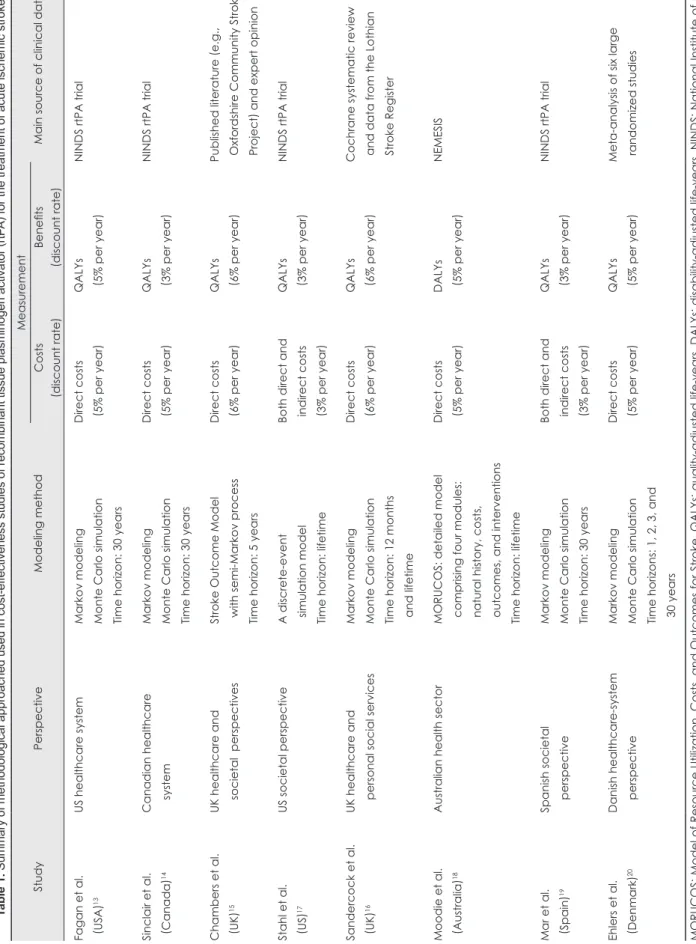
The model assumed that the patient received either a Nation- al Institute of Neurological Disorders and Stroke (NINDS)- compliant strategy (i.e., evaluation by an emergency physi- cian within 10-minutes, interpretation of CT scans within 45-minutes, and administration of rtPA within 1-hour of presen- tation) or current practice. Moodie et al.18 designed the MO- RUCOS system, which is a detailed model consisting of four modules (natural history, costs, outcomes, and interventions) that was developed through a series of linked spreadsheets. In this model, interventions were assumed to be operating in a st- eady state (i.e., fully implemented and operating in accordance with efficacy potential), and they were applied to all eligible patients who presented during a 1-year period. Interventions were applied for a duration that realistically reflected their re- al-world use. The time horizon for tracking-associated costs and consequences extended over the lifetime of the target pop- ulation (Table 1).
Data sources
Fagan et al.,13 Sinclair et al.,14 Stahl et al.,17 Mar et al.19 estimat- ed the outcomes (with or without rtPA treatment) based on the NINDS trial, which was a randomized, double blind, placebo- controlled trial evaluating the short- and long-term outcomes of tissue plasminogen activator (tPA) in 624 patients with acute ischemic stroke. Moodie et al.18 used stroke incidence, mortality, and service utilization data from the North East Melbourne Stroke Incidence Study (NEMESIS), a communi- ty-based stroke incidence study that provides the most realis- tic picture of current-practice stroke care, including post acute care in Australia.
More efficacy data are available nowadays, such as that from the study by Chambers et al.,15 who used clinical data includ- ing trials, meta-analysis, and prospective cohort studies such as the Oxfordshire Community Stroke Project and the North- ern Manhattan Stroke Study. Sandercock et al.16 estimated ef- ficacy based on a systematic review of all relevant randomized trials supplemented by data from a local stroke registry, the Lo- thian Stroke Register (LSR). The LSR data items analyzed included the length of hospital stay, the score on the modified
Table 1. Summary of methodological approached used in cost-effectiveness studies of recombinant tissue plasminogen activator (rtPA) for the treatment of acute ischemic stroke StudyPerspectiveModeling methodMeasurement Main source of clinical dataCosts (discount rate
)Benefits
(discount rate
) Fagan et al. (USA
)13US healthcare systemMarkov modeling Monte Carlo simulation Time horizon: 30 years
Direct costs (5% per year
)QALYs (5% per year
)NINDS rtPA trial Sinclair et al. (Canada
)14Canadian healthcare systemMarkov modeling Monte Carlo simulation Time horizon: 30 years
Direct costs (5% per year
)QALYs (3% per year
)NINDS rtPA trial Chambers et al. (UK
)15UK healthcare and societal perspectivesStroke Outcome Model with semi-Markov process Time horizon: 5 years
Direct costs (6% per year
)QALYs (6% per year
)Published literature
(e.g.,
Oxfordshire Community Stroke Project
) and expert opinion
Stahl et al. (US
)17US societal perspectiveA discrete-event simulation model Time horizon: lifetime
Both direct and indirect costs (3% per year
)
QALYs (3% per year
)NINDS rtPA trial Sandercock et al. (UK
)16UK healthcare and personal social services Markov modeling Monte Carlo simulation Time horizon: 12 months and lifetime
Direct costs (6% per year
)QALYs (6% per year
)Cochrane systematic review and data from the Lothian Stroke Register Moodie et al. (Australia
)18Australian health sectorMORUCOS: detailed model comprising four modules: natural history, costs, outcomes, and interventions Time horizon: lifetime
Direct costs (5% per year
)DALYs (5% per year
)NEMESIS Mar et al. (Spain
)19Spanish societal perspectiveMarkov modeling Monte Carlo simulation Time horizon: 30 years
Both direct and indirect costs (3% per year
)
QALYs (3% per year
)NINDS rtPA trial Ehlers et al. (Denmark
)20Danish healthcare-system perspectiveMarkov modeling Monte Carlo simulation Time horizons: 1, 2, 3, and 30 years
Direct costs (5% per year
)QALYs (5% per year
)Meta-analysis of six large randomized studies MORUCOS
: Model
of Resource Utilization, Costs, and Outcomes for Stroke, QALYs
: quality-adjusted
life-years, DALYs
: disability-adjusted
life-years, NINDS
: National
Institute of Neu- rological Disorders and Stroke, NEMESIS
: North East Melbourne Stroke Incidence Study.
Rankin Scale (mRS), the occurrence of recurrent stroke, death from recurrent stroke, and death from all causes up to 12- months after the index stroke. Ehlers et al.20 extracted efficacy data from a meta-analysis of six large-scale, randomized, and place- bo-controlled studies of thrombolytic therapy (Table 1).20 Outcomes considered
As described above, all of the studies reviewed were undertak- en from different perspectives (i.e., societal, healthcare system, or mixed). Many experts consider a societal perspective to be highly appropriate for carrying out economic evaluations of healthcare interventions. However, only two of the studies were performed from the societal perspective and included di- rect and indirect costs.17,19 To measure direct costs, the stud- ies used published literature and hospital records. Indirect costs were measured based on the average daily wages report- ed by the United States Bureau of Labor Statistics, the Sakont- zen questionnaire, and the matrix of societal needs defined by a committee of social service experts from the province of Gipuzkoa, Spain.19 Other studies included only direct costs based on published literature, local surveys, expert opinions, and hospital records. Since the healthcare system in each coun- try is different, the components of direct cost evaluated by these studies differ markedly. In our review, two studies used a microcosting approach and listed key unit costs and quanti- ties of resources base on hospital records and literature.18,20 The precision in costing has also varied. The least-precise estimates are likely to be based on average per diems (or daily costs), while the most-precise estimates are likely to be based on microcosting, in which each component of the resource used (e.g., laboratory tests or drugs) is estimated and a unit cost is derived for each.
Seven of the studies reviewed herein used QALYs as the he- alth outcome summary measure to compare health outcomes of different types. A QALY is a year lived whilst weighted by the quality of life during that time. A patient’s quality of life depends on his or her current health state.13-17,19,20 Fagan et al.,13 Sinclair et al.,14 Chamber et al.,15 Stahl et al.,17 Sandercock et al.,16 and Ehlers et al.20 categorized the health state based on the mRS as follows: no symptoms (R0), no significant disabil- ity (R1), minimal disability (R2), moderate disability (R3), moderate to severe disability (R4), severe disability (R5), and dead. Mar et al.19 used the European Quality of Life Question- naire (EuroQol) with a random sampling of patients to deter- mine values for the utilities of a health state. Moodie et al.18 used DALYs to estimate the health gain attributable to each intervention (Table 1).
Cost-effectiveness results of the studies
All of the studies reviewed herein concluded that thromboly-
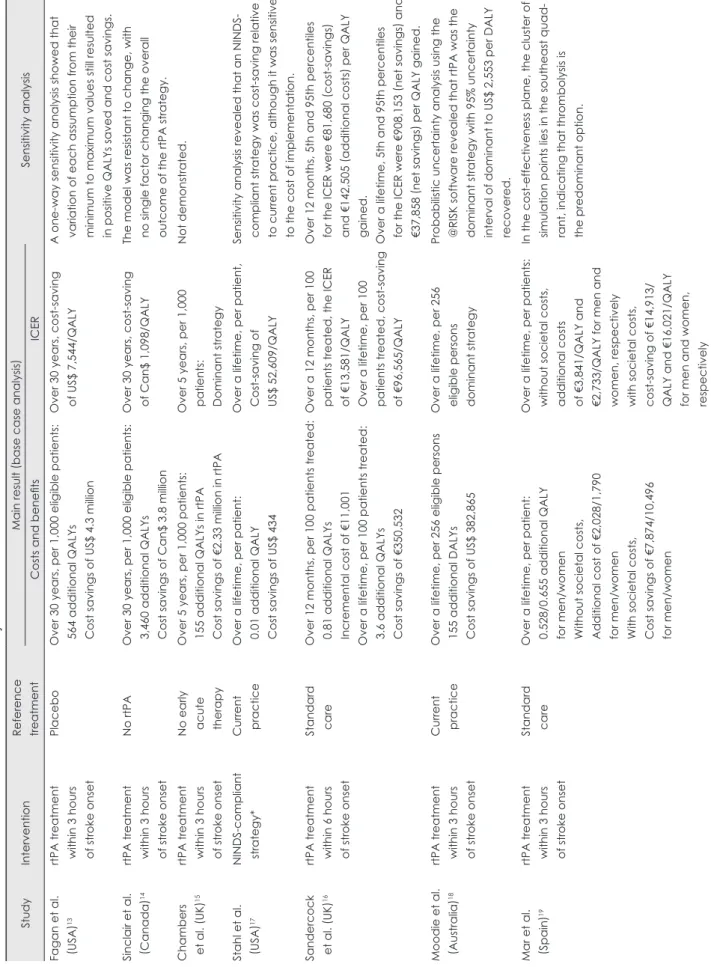
sis treatment can be a cost-effective strategy, especially in the long term. Fagan et al.13 estimated an increase in hospitaliza- tion costs of US$ 1.7-million and decreases in rehabilitation and nursing home costs of US$ 1.4-million and US$ 4.8-mil- lion, respectively, per 1,000 eligible treatment patients, for a healthcare system that includes care facilities from acute through to long term. Sinclair et al.14 estimated a lifetime cost difference of 3.8-million Canadian dollars (Can$) in favor of tPA versus no tPA (Can$-3,800/patient). In the hypothetical co- hort, tPA treatment resulted in 13,130-QALYs, versus 9,670- QALYs with no tPA treatment. This translated into a net ben- efit of 3,460 additional QALYs per 1,000 patients (i.e., 3.46- QALYs/patient). Chamber et al.15 demonstrated that rtPA in acute ischemic stroke administered within 3-hours of symp- tom onset could result in 155 additional QALYs per 1,000 patients, at a cost saving of €2.33-million, suggesting that in treated patients, the savings related to disability and long-term care considerably outweigh any potential extra costs of acute therapy, given a broad cost perspective and a time horizon of 5-years. Stahl et al.17 found that the NINDS-compliant strate- gy including t-PA treatment resulted in an average QALYs value of 3.64, versus 3.63 QALYs for the base case, at an ap- proximate cost of US$ 434/patient.
Sandercock et al.16 showed that over the cohort lifetime, ap- plying rtPA becomes the dominant strategy. Treatment with rtPA was more effective (gain in QALYs of 3.63 per 100 pa- tients treated), less expensive than standard treatment (cost savings of €350,532), and resulted in a reduced cost of €96,565/
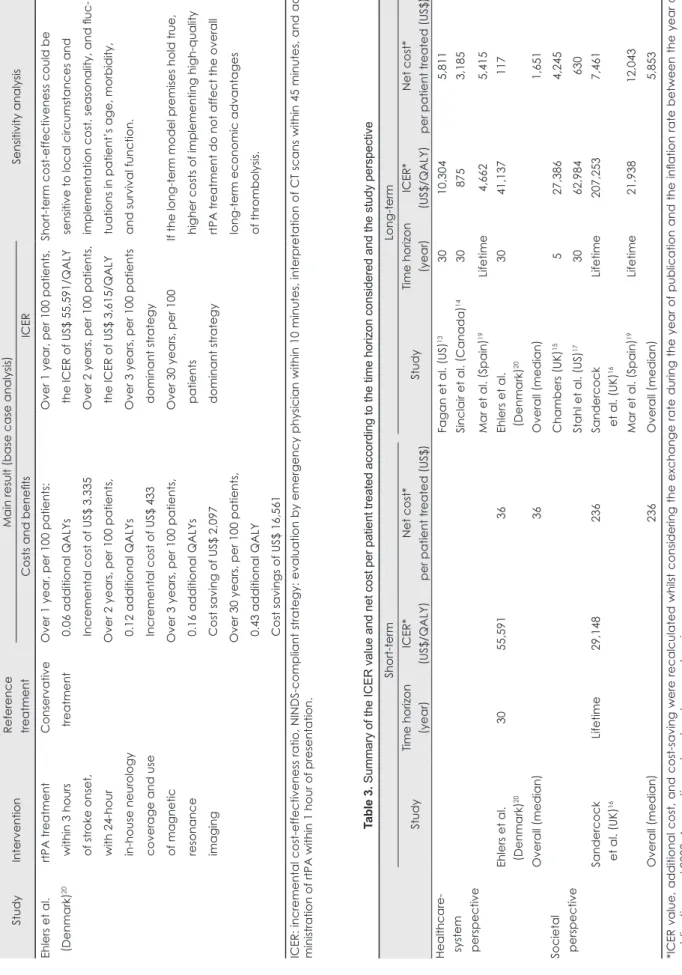
QALY. Moodie et al.18 estimated that aspirin intervention was effective for reducing stroke mortality, but required a higher overall cost because of increased stroke survival (US$ 1.7-mil- lion), whereas rtPA effectively reduced post-stroke disability and led to long-term cost savings (US$ 0.4-million). Mar et al.19 calculated that the ICER obtained with thrombolytic treatment had values of €3,841/QALY and €2,733/QALY for men and women, respectively, without consideration of soci- etal cost, but produced a net saving of €14,913/QALY for men and €16,021/QALY for women when the societal costs were incorporated in the model. Ehlers et al.20 calculated the ICER for 1, 2, 3, and 30-years. In that study, short-term thromboly- sis (first year) increased the net health costs, but the picture changed after 2-years when, given the assumptions about ef- fect and costs, thrombolysis became cost-effective. In the long term (30-years), IV thrombolysis with rtPA was the dominant strategy compared with conservative treatment (Table 2).
The overall results are summarized in Table 3. IV rtPA was associated with an acceptable increase in short-term cost (rang- es: US$ 36-236/patient, US$ 29,148-55,591/QALY), and a net long-term cost saving that was higher from a societal per- spective (ranges: -US$ 12,043 to -US$ 630/patient, -US$
Table 2. Summary of the results of cost-effectiveness studies of rtPA for acute ischemic stroke StudyInterventionReference treatmentMain result (base case analysis
) Sensitivity analysis Costs and benefitsICER Fagan et al. (USA
)13rtPA treatment within 3 hours of stroke onset
PlaceboOver 30 years, per 1,000 eligible patients: 564 additional QALYs Cost savings of US$ 4.3 million
Over 30 years, cost-saving of US$ 7,544/QALYA one-way sensitivity analysis showed that variation of each assumption from their minimum to maximum values still resulted in positive QALYs saved and cost savings. Sinclair et al. (Canada
)14rtPA treatment within 3 hours of stroke onset
No rtPAOver 30 years, per 1,000 eligible patients: 3,460 additional QALYs Cost savings of Can$ 3.8 million
Over 30 years, cost-saving of Can$ 1,098/QALYThe model was resistant to change, with no single factor changing the overall outcome of the rtPA strategy. Chambers et al.
(UK
)15rtPA treatment within 3 hours of stroke onset
No early acute therapy
Over 5 years, per 1,000 patients: 155 additional QALYs in rtPA Cost savings of €2.33 million in rtPA
Over 5 years, per 1,000 patients: Dominant strategy
Not demonstrated. Stahl et al. (USA
)17NINDS-compliant strategy*Current practiceOver a lifetime, per patient: 0.01 additional QALY Cost savings of US$ 434
Over a lifetime, per patient, Cost-saving of US$ 52,609/QALY
Sensitivity analysis revealed that an NINDS- compliant strategy was cost-saving relative to current practice, although it was sensitive to the cost of implementation. Sandercock et al.
(UK
)16rtPA treatment within 6 hours of stroke onset
Standard careOver 12 months, per 100 patients treated: 0.81 additional QALYs Incremental cost of €11,001 Over a lifetime, per 100 patients treated: 3.6 additional QALYs Cost savings of €350,532
Over a 12 months, per 100 patients treated, the ICER of €13,581/QALY Over a lifetime, per 100 patients treated, cost-saving of €96,565/QALY
Over 12 months, 5th and 95th percentiles for the ICER were €81,680
(cost-savings )
and €142,505
(additional costs ) per QALY
gained. Over a lifetime, 5th and 95th percentiles for the ICER were €908,153
(net savings ) and
€37,858
(net savings ) per QALY gained.
Moodie et al. (Australia
)18rtPA treatment within 3 hours of stroke onset
Current practiceOver a lifetime, per 256 eligible persons 155 additional DALYs Cost savings of US$ 382,865
Over a lifetime, per 256 eligible persons dominant strategy
Probabilistic uncertainty analysis using the @RISK software revealed that rtPA was the dominant strategy with 95% uncertainty interval of dominant to US$ 2,553 per DALY recovered. Mar et al. (Spain
)19rtPA treatment within 3 hours of stroke onset
Standard careOver a lifetime, per patient: 0.528/0.655 additional QALY for men/women Without societal costs, Additional cost of €2,028/1,790 for men/women With societal costs, Cost savings of €7,874/10,496 for men/women
Over a lifetime, per patients: without societal costs, additional costs of €3,841/QALY and €2,733/QALY for men and women, respectively with societal costs, cost-saving of €14,913/ QALY and €16,021/QALY for men and women, respectively
In the cost-effectiveness plane, the cluster of simulation points lies in the southeast quad- rant, indicating that thrombolysis is the predominant option.
Table 2. Continued StudyInterventionReference treatmentMain result (base case analysis
) Sensitivity analysis Costs and benefitsICER Ehlers et al. (Denmark
)20rtPA treatment within 3 hours of stroke onset, with 24-hour in-house neurology coverage and use of magnetic resonance imaging
Conservative treatmentOver 1 year, per 100 patients: 0.06 additional QALYs Incremental cost of US$ 3,335 Over 2 years, per 100 patients, 0.12 additional QALYs Incremental cost of US$ 433 Over 3 years, per 100 patients, 0.16 additional QALYs Cost saving of US$ 2,097 Over 30 years, per 100 patients, 0.43 additional QALY Cost savings of US$ 16,561
Over 1 year, per 100 patients, the ICER of US$ 55,591/QALY Over 2 years, per 100 patients, the ICER of US$ 3,615/QALY Over 3 years, per 100 patients dominant strategy Over 30 years, per 100 patients dominant strategy
Short-term cost-effectiveness could be sensitive to local circumstances and implementation cost, seasonality, and fluc- tuations in patient’s age, morbidity, and survival function. If the long-term model premises hold true, higher costs of implementing high-quality rtPA treatment do not affect the overall long-term economic advantages of thrombolysis. ICER: incremental cost-effectiveness ratio, NINDS-compliant strategy: evaluation by emergency physician within 10 minutes, interpretation of CT scans within 45 minutes, and ad- ministration of rtPA within 1 hour of presentation. Table 3. Summary of the ICER value and net cost per patient treated according to the time horizon considered and the study perspective Short-termLong-term StudyTime horizon
(year
)ICER*
(US$/QALY
)Net cost* per patient treated
(US$
)StudyTime horizon
(year
)ICER*
(US$/QALY
)Net cost* per patient treated
(US$
) Healthcare- system perspective
Fagan et al.
(US
)133010,3045,811 Sinclair et al.
(Canada
)14308753,185 Mar et al.
(Spain
)19Lifetime4,6625,415 Ehlers et al. (Denmark
)203055,59136Ehlers et al. (Denmark
)203041,137117 Overall
(median
)36Overall
(median
)1,651 Societal perspectiveChambers
(UK
)15527,3864,245 Stahl et al.
(US
)173062,984630 Sandercock et al.
(UK
)16Lifetime29,148236Sandercock et al.
(UK
)16Lifetime207,2537,461 Mar et al.
(Spain
)19Lifetime21,93812,043 Overall
(median
)236Overall
(median
)5,853 *ICER value, additional cost, and cost-saving were recalculated whilst considering the exchange rate during the year of publication and the inflation rate between the year of
publication and 2009. A negative value denotes a cost saving. ICER: incremental cost-effectiveness ratio.
207,253 to -US$ 21,938/QALY) than from a healthcare-sys- tem perspective (ranges: -US$ 5,811 to US$ 5,415/patient, -US$ 41,137 to US$ 4,662/QALY).
Discussion
Our study shows that IV rtPA is associated with an acceptable increase in short-term cost and a net cost saving in the long term; more favorable estimates were obtained when involv- ing the societal perspective. At the same time, we also found considerable variations in the methodological approaches, data used, and results obtained in previous studies on the cost-effectiveness of IV rtPA. This indicates the need for care- ful interpretation of the individual studies in light of their methodological robustness, and further study to evaluate the cost-effectiveness of IV rtPA in the context of Korean data.
Health economic evaluation is considered increasingly im- portant in health policy decision making, including insurance coverage and resource allocation, and in turn has huge influ- ences on clinical practice. However, since the results of cost- effectiveness could be susceptible to modeling assumptions, critical appraisal and judicious interpretation of cost-effective- ness research is essential, and these analyses should also be systematically updated as new research emerges.
To our knowledge, the present study is the most extensive systematic review of the cost-effectiveness of the use of rtPA in acute ischemic stroke by modeling approach. Economic evaluation using the modeling approach has unique strengths and drawbacks when compared to economic evaluation along- side clinical trials. Although modeling approaches were un- able to provide high internal validity, which can be optimized in randomized clinical trials, they rarely examine the long-term consequences of a given intervention. However, they could be utilized in situations where the relevant clinical trials and ob- servational data are constrained by the range of outcome data collected or the length of follow-up. Thus in practice, model- ing approaches may have better external validity, and are there- fore highly desirable in health economic evaluations.35
The greatest strength of our study is the comprehensiveness of the data reviewed, which were from six countries that used various sources of clinical and cost data, and adopted various perspectives and modeling assumptions (i.e., short- and long- term time horizons). Despite these differences in model struc- ture and input variables, the analyzed studies demonstrated that applying rtPA is cost-effective, in all cases producing cost savings in the long-term.
We also found large variations in the estimates of ICER am- ong the studies, some of which can be explained. First, eco- nomic modeling is highly susceptible to assumptions about clinical parameters implicit in a model, including the life ex-
pectancy, mortality hazard ratio, and utility. For example, the Fagan et al.13 study projected that long-term mortality rates beyond the first poststroke year are the same across all five levels of mRS poststroke disability. However, the subsequent UK Lothian cohort study36 and the Swedish Riks-Stroke co- hort study37 have shown that long-term life expectancy de- creases monotonically as the mRS level increases. In this sense, we can assume that the Fagan et al.13 study probably un- derestimated the effectiveness of IV rtPA. On the other hand, in other large trials conducted in Europe [i.e., the European Cooperative Acute Stroke Study (ECASS) and ECASS-II],38 IV rtPA was not as effective as was shown in the NINDS rtPA trial. So, in this regard, we can assume that earlier cost- effectiveness studies based on the NINDS trial,13,14,17 includ- ing that of Fagan et al.,13 could have overestimated the cost- effectiveness of IV rtPA relative to later studies that were based on systematic reviews or meta-analyses.16,20 Second, economic modeling is also highly susceptible to the other assumptions used in the model, including the model structure, cost of care, and discount rate. Fagan et al.13 and Sinclair et al.14 used the same clinical data, but produced hugely different QALYs and cost-saving results. Differences in the modeling methods and costs of care between the USA and Canada could explain this difference. We therefore consider that more valid and consistent methods should be used in future cost-effective- ness analysis or IV rtPA.
While the cost-effectiveness of rtPA treatment appears very convincing across studies, economic evaluations need to be checked in each country due to intercountry variations in clini- cal practice patterns and healthcare resources. Cost-effective- ness analysis requires information on an intervention’s effec- tiveness and country-specific sources of epidemiological and resource utilization data, most of which are not readily avail- able in Korea. Future research should include direct econom- ic evaluation or rtPA use from a Korean perspective.
Apart from the theoretical cost-effectiveness of the drug, implementation of the strategy is another factor. The propor- tion of eligible patients who are receiving this costly but si- multaneously cost-saving IV rtPA treatment in Korea is not well known, but it was reported for other countries that only about 20% of stroke patients arrive in time to be treated with thrombolysis, and only 1-8% of all stroke patients are actual- ly treated with IV rtPA.39 Interorganizational, intraorganiza- tional, medical, and psychological barriers hamper the broad implementation of thrombolysis for acute ischemic stroke.40 If the cost-effectiveness of rtPA is accepted, every single mea- sure should be considered in order to increase the proportion of patients who may benefit from the treatment. Since a short door-to-door time is critical for the clinical effectiveness of rtPA treatment, investment in improving the system for deliv-
ering emergency healthcare and public education should be considered. Since the administration of rtPA requires pretreat- ment imaging41 and careful follow-up, the appropriate care setting and availability of a trained physician are essential.
Designation of stroke centers (both primary and comprehen- sive) to improve the organization and delivery of care to stroke patients might be considered from the cost-effective- ness perspective.42,43
In summary, based on a comprehensive review of the avail- able literature, we conclude that IV rtPA is a cost-effective strategy for the management of acute ischemic stroke that might reduce healthcare costs as well as patient disability. Fur- ther cost-effectiveness research and development of a public health strategy is warranted to optimize the use of rtPA in Korea.
Conflicts of Interest
The authors have no financial conflicts of interest.
Acknowledgements
This study was supported by a grant (A060171) of the Korea Health 21 R&D project, Ministry of Health, Welfare and Family Affairs, Republic of Korea.
REFERENCES
1. Kim HC, Choi DP, Ahn SV, Nam CM, Suh I. Six-year survival and causes of death among stroke patients in Korea. Neuroepidemiology 2009;32:94-100.
2. Kim JS, Choi-Kwon S, Kwon SU, Lee HJ, Park KA, Seo YS. Factors affecting the quality of life after ischemis stroke: young versus old pa- tients. J Clin Neurol 2005;1:59-68.
3. Bergman L, van der Meulen JH, Limburg M, Habbema JD. Costs of medical care after first-ever stroke in The Netherlands. Stroke 1995;
26:1830-1836.
4. Saka O, Serra V, Samyshkin Y, McGuire A, Wolfe CC. Cost-effective- ness of stroke unit care followed by early supported discharge. Stroke 2009;40:24-29.
5. Ebrahim S. Cost-effectiveness of stroke prevention. Br Med Bull 2000;56:557-570.
6. Lindgren P, Buxton M, Kahan T, Poulter NR, Dahlöf B, Sever PS, et al. Cost-effectiveness of atorvastatin for the prevention of coronary and stroke events: an economic analysis of the Anglo-Scandinavian Cardiac Outcomes Trial--lipid-lowering arm (ASCOT-LLA). Eur J Cardiovasc Prev Rehabil 2005;12:29-36.
7. Lundkvist J, Ekman M, Kartman B, Carlsson J, Jönsson L, Lithell H.
The cost-effectiveness of candesartan-based antihypertensive treat- ment for the prevention of nonfatal stroke: results from the Study on COgnition and Prognosis in the Elderly. J Hum Hypertens 2005;19:
569-576.
8. Sullivan PW, Arant TW, Ellis SL, Ulrich H. The cost effectiveness of anticoagulation management services for patients with atrial fibrilla- tion and at high risk of stroke in the US. Pharmacoeconomics 2006;24:
1021-1033.
9. Meenan RT, Saha S, Chou R, Swarztrauber K, Krages KP, O’Keefee- Rosetti M, et al. Effectiveness and cost-effectiveness of echocardiog- raphy and carotid imaging in the management of stroke. Evid Rep Technol Assess (Summ) 2002:1-10.
10. Meenan RT, Saha S, Chou R, Swarztrauber K, Pyle Krages K, O’Keeffe-Rosetti MC, et al. Cost-effectiveness of echocardiography to identify intracardiac thrombus among patients with first stroke or
transient ischemic attack. Med Decis Making 2007;27:161-177.
11. Wilson RD, Murray PK. Cost-effectiveness of screening for deep vein thrombosis by ultrasound at admission to stroke rehabilitation. Arch Phys Med Rehabil 2005;86:1941-1948.
12. Patil CG, Long EF, Lansberg MG. Cost-effectiveness analysis of me- chanical thrombectomy in acute ischemic stroke. J Neurosurg 2009;
110:508-513.
13. Fagan SC, Morgenstern LB, Petitta A, Ward RE, Tilley BC, Marler JR, et al. Cost-effectiveness of tissue plasminogen activator for acute isch- emic stroke. NINDS rt-PA Stroke Study Group. Neurology 1998;50:
883-890.
14. Sinclair SE, Frighetto L, Loewen PS, Sunderji R, Teal P, Fagan SC, et al. Cost-Utility analysis of tissue plasminogen activator therapy for acute ischaemic stroke: a Canadian healthcare perspective. Pharma- coeconomics 2001;19:927-936.
15. Chambers MG, Koch P, Hutton J. Development of a decision-analytic model of stroke care in the United States and Europe. Value Health 2002;
5:82-97.
16. Sandercock P, Berge E, Dennis M, Forbes J, Hand P, Kwan J, et al.
Cost-effectiveness of thrombolysis with recombinant tissue plasmin- ogen activator for acute ischemic stroke assessed by a model based on UK NHS costs. Stroke 2004;35:1490-1497.
17. Stahl JE, Furie KL, Gleason S, Gazelle GS. Stroke: effect of imple- menting an evaluation and treatment protocol compliant with NINDS recommendations. Radiology 2003;228:659-668.
18. Moodie ML, Carter R, Mihalopoulos C, Thrift AG, Chambers BR, Donnan GA, et al. Trial application of a Model of Resource Utiliza- tion, Costs, and Outcomes for Stroke (MORUCOS) to assist priority setting in stroke. Stroke 2004;35:1041-1046.
19. Mar J, Begiristain JM, Arrazola A. Cost-effectiveness analysis of thrombolytic treatment for stroke. Cerebrovasc Dis 2005;20:193-200.
20. Ehlers L, Andersen G, Clausen LB, Bech M, Kjolby M. Cost-effec- tiveness of intravenous thrombolysis with alteplase within a 3-hour window after acute ischemic stroke. Stroke 2007;38:85-89.
21. Wade WE. Cost-effectiveness of venous thrombosis prophylaxis fol- lowing ischemic stroke: an assessment of currently available literature.
Thromb Res 1998;89:199-202.
22. Sarasin FP, Gaspoz JM, Bounameaux H. Cost-effectiveness of new an- tiplatelet regimens used as secondary prevention of stroke or transient ischemic attack. Arch Intern Med 2000;160:2773-2778.
23. Matchar DB, Samsa GP, Liu S. Cost-effectiveness of antiplatelet agents in secondary stroke prevention: the limits of certainty. Value He- alth 2005;8:572-580.
24. Shah H, Gondek K. Aspirin plus extended-release dipyridamole or clopidogrel compared with aspirin monotherapy for the prevention of recurrent ischemic stroke: a cost-effectiveness analysis. Clin Ther 2000;
22:362-370.
25. Kane K, Andary MT, Turk M, Goldberg G. Cost-effectiveness in stroke rehab. Arch Phys Med Rehabil 1996;77:521.
26. Keith RA. Rehabilitation after stroke: cost-effectiveness analyses. J R Soc Med 1996;89:631-633.
27. van Exel NJ, Koopmanschap MA, Scholte op Reimer W, Niessen LW, Huijsman R. Cost-effectiveness of integrated stroke services. QJM 2005;98:415-425.
28. Launois R, Giroud M, Mégnigbêto AC, Le Lay K, Présenté G, Ma- hagne MH, et al. Estimating the cost-effectiveness of stroke units in France compared with conventional care. Stroke 2004;35:770-775.
29. Adams HP Jr, del Zoppo G, Alberts MJ, Bhatt DL, Brass L, Furlan A, et al. Guidelines for the early management of adults with ischemic stroke: a guideline from the American Heart Association/American Stroke Association Stroke Council, Clinical Cardiology Council, Car- diovascular Radiology and Intervention Council, and the Atheroscle- rotic Peripheral Vascular Disease and Quality of Care Outcomes in Research Interdisciplinary Working Groups: the American Academy of Neurology affirms the value of this guideline as an educational
tool for neurologists. Stroke 2007;38:1655-1711.
30. National Institute for Health and Clinical Excellence. Stroke: Diag- nosis and initial management of acute stroke and transient ischaemic attack (TIA); 2008.
31. Holloway RG, Benesch CG, Rahilly CR, Courtright CE. A systemat- ic review of cost-effectiveness research of stroke evaluation and treat- ment. Stroke 1999;30:1340-1349.
32. Tseng MC, Chang KC. Cost-effectiveness analysis of tissue plasmin- ogen activator for acute ischemic stroke: a comparative review. Acta Neurol Taiwan 2004;13:149-155.
33. Korean Exchange Bank. [cited]; Available from: http://inflationdata.
com/.
34. Inflationdata.com. [cited]; Available from: http://inflationdata.com/.
35. Buxton MJ, Drummond MF, Van Hout BA, Prince RL, Sheldon TA, Szucs T, et al. Modelling in economic evaluation: an unavoidable fact of life. Health Econ 1997;6:217-227.
36. Slot KB, Berge E, Dorman P, Lewis S, Dennis M, Sandercock P; Ox- fordshire Community Stroke Project, the International Stroke Trial (UK): Lothian Stroke Register. Impact of functional status at six months on long term survival in patients with ischaemic stroke: prospective cohort studies. BMJ 2008;336:376-379.
37. Eriksson M, Norrving B, Terént A, Stegmayr B. Functional outcome 3
months after stroke predicts long-term survival. Cerebrovasc Dis 2008;
25:423-429.
38. Hacke W, Kaste M, Fieschi C, von Kummer R, Davalos A, Meier D, et al. Randomised double-blind placebo-controlled trial of thrombo- lytic therapy with intravenous alteplase in acute ischaemic stroke (EC- ASS II). Second European-Australasian Acute Stroke Study Investi- gators. Lancet 1998;352:1245-1251.
39. Dirks M, Niessen LW, Huijsman R, van Wijngaarden J, Minkman MM, Franke CL, et al. Promoting Acute Thrombolysis for Ischaemic Stroke (PRACTISE). Int J Stroke 2007;2:151-159.
40. Choi JC, Kang SY, Kang JH, Ko YJ, Bae JM. Are in-Hospital Delays Important Obstacles In Thrombolytic Therapy Following Acute Isch- emic Stroke? J Clin Neurol 2007;3:71-78.
41. Bang OY. Multimodal MRI for ischemic stroke: from acute therapy to preventive strategies. J Clin Neurol 2009;5:107-119.
42. Alberts MJ, Hademenos G, Latchaw RE, Jagoda A, Marler JR, May- berg MR, et al. Recommendations for the establishment of primary stroke centers. Brain Attack Coalition. JAMA 2000;283:3102-3109.
43. Alberts MJ, Latchaw RE, Selman WR, Shephard T, Hadley MN, Brass LM, et al. Recommendations for comprehensive stroke centers: a con- sensus statement from the Brain Attack Coalition. Stroke 2005;36:
1597-1616.