INTRODUCTION
Inflammatory destruction of periodontal attachment apparatus is the hallmark of periodontal disease. The inflammatory reaction associated with periodontitis may damage the surrounding cells and connective tissue structures, including alveolar bone, causing tooth loss1).
The current concepts of the etiology of periodontitis implicate bacterial infection by gram-negative organ- isms as the primary cause of the disease2). However, the simple presence, type or quantity of infection does not explain the different evolution and the poor prognosis in
severe chronic periodontitis or aggressive periodontitis.
Therefore, Michalowicz et al.3) reported both genetic and environmental factors are involved in this inflammatory disease etiology of which is influenced by interaction of periodontal pathogens and host responses.
Matrix metalloproteinases (MMPs) are a family of metal-dependent proteolytic enzymes that mediate the degradation of extracellular matrix and basement membranes. Currently, at least 23 MMPs have been characterized4). A wide range of evidences has in- dicated that MMPs are found in the gingival crevicular fluid of patients with periodontitis in much larger amounts than in the control subjects5). There are also many evidences for the role of MMPs in the destruc- tive processes of periodontal disease linked with the unbalanced production between M M Ps and their en- dogenous tissue inhibitors6). Thus, these enzymes are thought to play a crucial role in the destruction of
MMP-1 promoter polymorphism in Korean with generalized aggressive periodontitis
Hyong-Suk Oh
1, Ok-Su Kim
1, Young-Jun Kim
1,2, Hyun-Ju Chung
1,2*1. Department of Periodontology, School of Dentistry and Dental Science Research Institute, Chonnam National University 2. 2nd stage of BK 21 project, School of Dentistry, Chonnam National University
ABSTRACT
Purpose: The aim of this study was to investigate matrix metalloproteinase 1 (MMP-1) gene polymorphism (1G/2G at -1607 and A/G at -519) in Korean subject and to assess the association between polymorphism and periodontal status.
Methods: Forty nine generalized aggressive periodontitis (GAP) patients and 57 periodontally healthy children were recruited and genomic DNA was extracted from buccal swab. The polymorphisms of MMP-1 promoter genes were determined by polymerase chain reaction and restriction fragment length product (PCR-RFLP) method. The distribution of genotype and allele frequency was compared between 2 groups by χ2 test.
Results: There was a significant difference in the distribution of genotypes and frequency of alleles between the GAP and reference groups at the position - 519 of MMP-1 gene promoter (P < 0.05). Allele G carrier rate was significantly lower in GAP group than that of the reference group (P < 0.001). At the position -1607 of MMP-1 gene promoter, genotype distribution and allele frequency showed no statistically significant difference between the groups. However, in the female group, a significant difference was observed between the groups for the genotype distribution, allele frequency and allele 1G carrier rate (P < 0.05).
Conclusions: The DNA polymorphism at the MMP-1 gene promoter might be associated with GAP in Korean.
(J Korean Acad Periodontol 2009;39:269-278)
KEY WORDS: aggressive periodontitis; genetic polymorphism; matrix metalloproteinase 1
Correspondence: Dr. Hyun-Ju Chung, Ph.D.
Department of Periodontology, School of Dentistry, Chonnam National University, 77 Yong Bong Ro, Buk-Gu, Gwangju, 500-757, Korea.
E-mail: [email protected], Tel: 82-62-530-5648, Fax: 82-62-530-5649.
Received: Jul 11, 2009; Accepted: Jul 29, 2009
This study was financially supported in part by the 2nd stage of BK project, School of Dentistry and in part by Chonnam National University.
periodontal tissues.
MMP-1 is the most widely expressed MMP possess- ing proteolytic activities against fibrillar collagens (collagen types I, II and III), which are the most abundant protein components of periodontal ex- tracellular matrix6). Normally, the expression levels of M M P-1 in most cells are low, but in pathological state, such as periodontitis, the gene transcript levels for MMP-1 are significantly upregulated by cytokines and growth factors7). Furthermore, MMP-1 levels were found to increase in periodontitis-affected gingival tissues8), both the protein amounts and the activities of MMP-1 not only in gingival crevicular fluid but al- so in gingival tissue were reported to be higher in periodontitis affected sites than in healthy sites9). These findings suggest that MMP-1 is the key player acting in the periodontal extracellular matrix degra- dation and remodelling.
Kornman et al.10) reported the association between interleukin (IL)-1 genotype and periodontitis severity, encouraging the search for some specific genetic risk factors for periodontitis. In Korean subjects, Jeong et al.11) suggested that IL-1 gene polymorphism might have an influence on periodontal disease and Bang et al.12) found a significant association between IL-6 gene polymorphisms and generalized aggressive periodontitis (GAP). However, Ryu et al.13) failed to find anassocia- tion between IL-10 gene polymorphisms and GAP.
DNA polymorphisms have been found in the pro- moter regions of several MMPs. Rutter et al.14) re- ported an additional G at the nucleotide position –1607 in the promoter region of the MMP-1 gene creates a binding site for Ets family of transcription factors, 5ʼ -GGA-3ʼ, as well as increased transcription of the MMP-1 gene and enzyme activity in normal fibroblasts and melanoma cells. Jurajda et al.15) described the polymorphism at another position -519 of the MMP-1 gene promoter corresponding to an A/G change. They reported linkage between the -519 A/G and the -1607 1G/2G polymorphisms that the allele A at -519 is more
often found with the allele 2G at -1607 and the allele G at -519 with the allele 1G at -1607, respectively.
Levels of MMP-1 expression can be influenced by these genetic variations and the cells expressing these polymorphism may provide a mechanism for more ag- gressive matrix degradation and hence this gene might be crucial in mediating connective tissue degradation in the pathogenesis of several diseases such as colorectal cancer16), carotid artery disease17), acute myocardial in- farction18) and ovarian cancer19), including periodontitis.
A case–control study performed in Caucasian subjects showed a positive association between the allele 2G and the severity of chronic periodontal disease20). This same allele was also associated with early dental–im- plants failure21). Other studies performed in a Czech and Japanese population have found no association be- tween this MMP-1 polymorphism and periodontitis22,23). All types of periodontitis, especially aggressive pe- riodontitis, have at least a genetic basis for suscepti- bility to periodontal microbial infection and as single nucleotide polymorphism (SNP) displays ethnic varia- tions and it is worthy to explore whether SNP of M M P-1 gene in Korean subjects is associated with GAP. Thus, this study was aimed to investigate MMP-1 gene polymorphism (1G/2G at -1607 and A/G at -519) in Korean subject and to assess the associa- tion between polymorphism and periodontal status.
MATERIALS AND METHODS
1. Subjects
A total of 106 non-smoking Korean subject were recruited for this study. We included 49 GAP patients from the Department of Periodontics and 57 children from the Department of Pediatric Dentistry, Chonnam National University Hospital. A diagnosis of GAP was made on clinical and radiographic examination with the basis of medical and dental history questionnaires.
Subjects in the GAP group were diagnosed by following
the criteria defined by the American Academy of Periodontology in 199924). Each subject had no history of systemic diseases, and had not taken any medications.
They are usually under 30 years of age, but may be older, and presented with more than 5 mm of clinical attachment loss, loss of generalized interproximal at- tachment and loss of alveolar bone at least three per- manent teeth other than first molars and incisors.
This study protocol was approved by an Institutional Review Board (Chonnam National University IRB No.1-2007-09-070) and subjects signed a consent form after being advised of the nature of the study.
2. Clinical Measurement
M easurements of probing depth (PD) and clinical attachment level (CAL) were recorded at six points around each tooth (mesio-buccal, mid-buccal, disto- buccal, mesio-lingual, mid-lingual and disto-lingual) except third molars using Williams probe (Hu-Friedy, Chicago, USA).
3. Buccal Swab and DNA Extraction
The sampling of epithelial buccal cells was per- formed as described by Trevilatto and Line25). Briefly, individuals undertook a mouthwash, buccal swab was taken with a sterile foam tipped applicator (Hardwood product company, Guilford, USA). The applicator was then frozen at -20 ℃ until used for DNA extraction.
Genomic DNA was extracted with heating at 95 ℃ for 5 min in 200 μl of 50 mM NaOH and neutralization with 20 μl Tris buffer (pH 8.0).
4. Analysis of SNPs
The polymorphisms of promoter were determined by PCR-RFLP method as previously described20). The se- quences of the PCR primers (Bioneer, Daejeon, Korea) are shown in Table 1. For the MMP-1-1607, the re- verse primer was specially designed to introduce a recognition site of restriction enzyme XmnI (New England Biolabs, Ipswich, USA). The allele 1G has this recognition site, whereas the allele 2G destroy the recognition site by inserting a G20). Primer sequence for the MMP-1-519 introduce a recognition site of re- striction enzyme KpnI (BEAMS biotechnology, Sungnam, Korea). Allele A/G substitution at position -519 re- moves the recognition site of this enzyme15).
PCR was carried out in a total volume of 25 μl, containing 4 μl of genomic DNA, 10 pmol of each pri- mer and 12.5 μl of GoTaq◯R Green Master Mix (premixed solutions containing GoTaq◯R DNA Polymerase, dNTPs, MgCl2 and reaction buffers), (Promega, Madison, USA) using thermal cycler (Geneamp PCR system 2700◯R), (Biosystems, Middletown, USA). The PCR cycling con- ditions of MMP-1-1607 were 1 min at 95℃ followed by 35 cycles of 30 s at 95 ℃, 30 s at 55℃ and 30 s at 72
℃, with a final extension of 72 ℃ for 5 min. The PCR cycling of MMP-1-519 was constructed of initial de- naturation at 95℃ for 2 min, followed by 30 cycles of denaturation at 93℃ for 30 s, annealing at 49 ℃ for 30 s, elongation at 72 ℃ for 20 s and final elongation at 72 ℃ for 4 min. The PCR products were electro- phoresed in 3% agarose gel and stained with 0.1%
ethidium bromide.
Table 1. The Sequences of the PCR Primers, Restriction Enzymes and Fragment Length
Primer (5ʼ - 3ʼ) Restriction enzyme Fragment (bp)
MMP-1-1607 F: 5ʼ-TCG TGA GAA TGT CTT CCC ATT-3'
R: 5ʼ-TCT TGG ATT GAT TTG AGA TAA GTG AAA TC-3' XmnI (37℃) 118 (29+89) MMP-1-519 F: 5ʼ-CAT GGT GCT ATC GCA ATA GGG T-3'
R: 5ʼ-TGC TAC AGG TTT CTC CAC ACA C-3' KpnI (37℃) 200 (176+24)
MMP-1 : matrix metalloproteinase-1.
A 15 μl of resulting product was digested with re- striction enzyme; 20 U/ml of XmnI for MMP-1-1607, 3 U/ml of KpnI for MMP-1-519 at 37℃ overnight. The restriction fragments were determined on 3% agarose gel electrophoresis and stained with 0. 1% ethidium bromide. The sequences of the PCR primers, restriction enzymes and fragment length are shown in Table 1.
5. Statistical Analysis
Data analysis was performed with the SPSS 14.0K software program. The distribution of genetic poly- morphism in the subjects was calculated using de- scriptive statistical analysis. The χ2 test was used to analyze the data obtained to determine the association between GAP and MMP-1-1607 and MMP-1-519 genotypes. The P value of 0.05 determined the stat- istical significance of the results.
RESULTS
1. Clinical Assessments
A total of 106 subjects were enrolled in this study.
Forty nine non-smoking patients (26 males and 23 fe-
males) met the criteria for the GAP group with mean PD of 4.7 mm, mean CAL of 4.8 mm and mean 43.1 years of age when diagnosis was made. Fifty seven children (23 male and 34 female) who were perio- dontally healthy were included in the reference group.
2. Analysis of MMP-1 Gene Polymorphism
1) Gel Electrophoresis Results
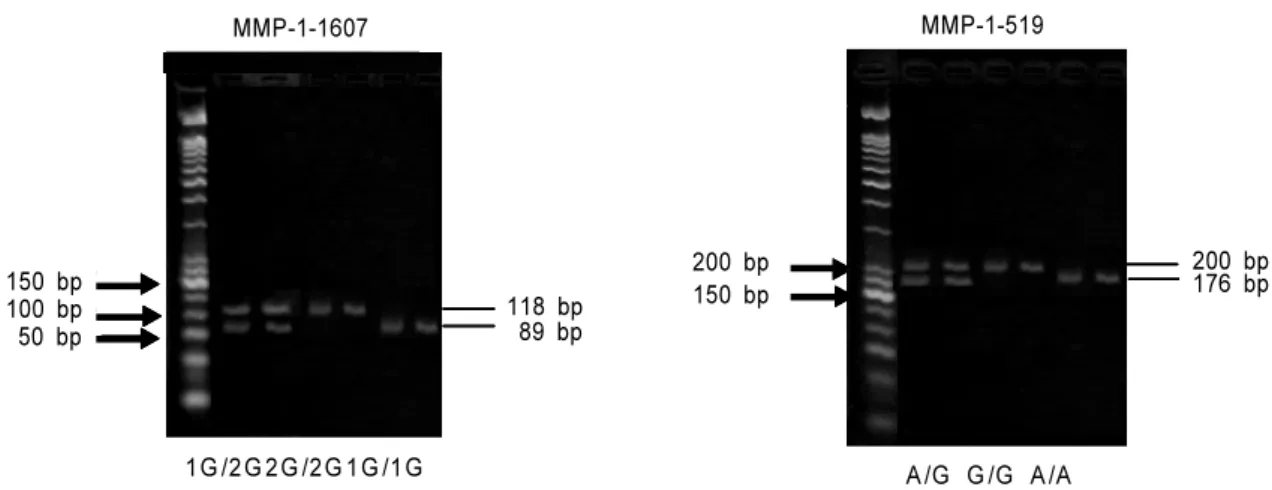
The PCR products were 118 bp and 200 bp for MMP-1-1607 and MMP-1-519, respectively (Fig. 1).
Since XmnI digested the allele 1G of MMP-1-1607, allele 1G gave product of 89 bp and allele 2G gave product of 118 bp. For the MMP-1-519, allele A and allele G gave products of 176 bp and 200 bp re- spectively (Fig. 2).
2) Distribution of Genotypes and Allele Frequency Genotype and allele distribution of M M P-1-1607 and MMP-1-519 are shown in Table 2. For MMP- 1-1607, the allele 2G was observed at a frequency of 68.4% and 79.8% in GAP and reference group respectively. The 1G/1G, 1G/2G and 2G/2G genotype was found at a frequency of 6.1%, 51.0% and 42.9%
for GAP group, 3.5%, 33.3% and 63.2% for reference Figure 1. The PCR products of MMP-1-1607 and MMP-1-519 were electrophoresed in 3% agarose gel and stained with 0.1% ethidium bromide. The PCR products were 118 bp and 200 bp for MMP-1-1607 and MMP-1-519, respectively.
MMP-1-519
200bp 150bp 100bp
MMP-1-1607
118bp
150bp 200bp
MMP-1-519
200bp 150bp 100bp
MMP-1-1607
118bp
150bp 200bp
MMP-1-1607 MMP-1-519
150 bp 100 bp
200 bp 150 bp 118 bp
200 bp
group, no significant difference was found between the two groups.
For MMP-1-519, allele A was shown in 83.7% and 64.0% for each group, the A/A, A/G and G/G genotype was found at a frequency of 69.4%, 28.6% and 2.0%
for GAP group, and 31.6%, 64.9% and 3.5% for the reference group, which was significantly different be- tween two groups (P< 0.05) (Table 2).
The distribution of 1G/1G, 1G/2G and 2G/2G geno- type at -1607 position of MMP-1 promoter was 0.0%, 57.7% and 42.3% for GAP group, 8.7%, 43.5% and 47.8% for reference group in male, which was not significantly different. However, it was 13.0%, 43.5%
and 43.5% for GAP group, 0.0%, 26.5% and 73.5% for reference group in female subject which was sig- nificantly different (P< 0.05). Allele 1G frequency of
176bp 200bp 150bp
200bp 118bp
89bp 1G/2G
150bp 100bp 50bp
2G/2G1G/1G MMP-1-1607
A/A MMP-1-519
MMP-1-1607
MMP-1-519
A/G G/G
176bp 200bp 150bp
200bp 118bp
89bp 1G/2G
150bp 100bp 50bp
2G/2G1G/1G MMP-1-1607
A/A MMP-1-519
MMP-1-1607
MMP-1-519 MMP-1-519
A/G G/G
MMP-1-1607 MMP-1-519
150 bp 100 bp 50 bp
200 bp 150 bp 118 bp
89 bp
200 bp 176 bp
1 G /2 G 2 G /2 G 1 G /1 G A /G G /G A /A
Figure 2. SNPs at MMP-1-1607 and MMP-1-519 after restriction enzyme digestion were electrophoresed in 3% agarose gel and stained with 0.1% ethidium bromide. The allele 1G of MMP-1-1607 gave product of 89 bp and allele 2G gave product of 118 bp. For the MMP-1-519, allele A and allele G gave products of 176 bp and 200 bp respectively.
Table 2. Distribution of Genotypes and Alleles of MMP-1-1607 and -519
GAP (n=49) Reference (n=57) P-value
MMP-1-1607
1G / 1G 6.1 3.5 0.060
1G / 2G 51.0 33.3
2G / 2G 42.9 63.2
Allele 1G frequency 31.6 20.2 0.060
Allele 2G frequency 68.4 79.8
MMP-1-519
A/A 69.4 31.6 0.000*
A/G 28.6 64.9
G/G 2.0 3.5
Allele A frequency 83.7 64.0 0.020*
Allele G frequency 16.3 36.0
The data were presented in percentage (%).
MMP-1 : matrix metalloproteinase-1
Allele frequency : proportion of specific allele to the total number of alleles.
* Statistically significant at P<0.05 by χ2 test compared to the reference group.
MMP-1-1607 was shown in 28.8% and 30.4% in male, 34.8% and 13.2% in female that a significant differ- ence was observed in female subject between the GAP and the reference groups (P< 0.05).
At the position of MMP-1-519, A/A, A/G and G/G genotype distribution was 73.1%, 26.9% and 0.0% for male and 65.2%, 30.4% and 4.3% for female in GAP group, 34.8%, 60.9% and 4.3% for male 29.4%, 67.6%
and 2.9% for female in the reference group. Both male and female showed a significant difference between the GAP and reference group (P< 0.05). Allele A fre- quency of MMP-1-519 was 86.5%, 80.4% in GAP group, and 65.2%, 63.2% in the reference group for male and female respectively. Statistically significant difference between 2 groups was observed in male subject only (Table 3).
3) Distribution of Allele Carrier
At the position of M M P-1-1607, allele 1G carrier rate was 57.1% and 36.8% for GAP and reference group respectively which is not significantly different between two groups. For the M M P-1-519, allele G carrier rate was significantly higher in the reference group than that in the GAP group (68.4% versus 30.6%) (Table 4).
The allele 1G carrier rate of MMP-1-1607 was 57.7%
for the GAP group, 52.2% for the reference group in male, 56.5% for the GAP group and 26.5% for the ref- erence group in female. A statistic significant differ- ence was in female subject (P<0.05). The allele G car- rier rate at the position of -519 for the GAP group and reference group was 26.9%, 65.2% in male, 34.8%, 70.6% in female, and both gender subject showed a significant difference between groups (Table 5).
DISCUSSION
M M Ps are a group of endogenous proteinases that contribute to degradation of extracellular matrix and
basement membrane components. Among these struc- turally related but genetically distinct enzymes, MMP-1 is the key proteolytic enzymes capable of de- grading fibrillar collagen, especially type I and III, which are the predominant types of interstitial colla- gen in gingiva26). Evidences indicated that levels and the activities of MMP-1 are found to be increased higher in periodontitis affected sites than in healthy sites9,27). Thus, M M P-1 might be a key player acting in the periodontal extracellular matrix degradation and remodelling.
The MMP and/or their inhibitors are regulated at various levels under tight control by factors such as regulation of gene expression, activation of zymogens and inhibition of activated enzymes by specific in- hibitors4). Previous reports indicated that sequence variations in the promoters of M M Ps may influence critical steps in binding to transcription factors or overall transcriptional efficiency, which results in differential expression of MMPs. These promoter poly- morphisms are reported to be associated with suscept- ibility to diseases such as coronary artery disease, cancers and periodontitis28).
A common single nucleotide G insertion/deletion polymorphism in the MMP-1 promoter at the position -1607 was reported to create a binding site for ets family transcription factor which have been shown to increase transcription of MMP-114) and the linkage be- tween MMP-1-1607 polymorphism and A/G sub- stitution polymorphism at the MMP-1-519 was re- ported15). The association of this gene polymorphism and periodontitis has been reported, but no studies have been reported in Korean subjects. Therefore, the purpose of this study was to investigate the associa- tion of the MMP-1-1607 (1G/2G) and MMP-1-519 (A/G) polymorphisms with the susceptibility to GAP in Korean subjects.
De Souza et al.20) showed an association between MMP-1-1607 polymorphism and severe chronic perio- dontitis in 87 Brazilian subject. However, their recent
Table 3. Distribution of Genotypes and Allele Frequencies of MMP-1-1607 and -519 According to Genders
Male Female
GAP (n=26) Reference (n=23) P-value GAP (n=23) Reference (n=34) P-value MMP-1-1607
1G/1G 0.0 8.7 0.303 13.0 0.0 0.020*
1G/2G 57.7 43.5 43.5 26.5
2G/2G 42.3 47.8 43.5 73.5
Allele 1G frequency 28.8 30.4 1.000 34.8 13.2 0.010*
Allele 2G frequency 71.2 69.6 65.2 86.8
MMP-1-519
A/A 73.1 34.8 0.013* 65.2 29.4 0.015*
A/G 26.9 60.9 30.4 67.6
G/G 0.0 4.3 4.3 2.9
Allele A frequency 86.5 65.2 0.017* 80.4 63.2 0.061
Allele G frequency 13.5 34.8 19.6 36.8
The data were presented in percentage (%).
MMP-1 : matrix metalloproteinase-1
Allele frequency : proportion of specific allele to the total number of alleles.
*Statistically significant at p<0.05 by χ2 test compared to the reference group.
Table 4. Distribution of Allele 1G Carrier of MMP-1-1607 and Allele G Carrier of MMP-1-519 in Each Group
GAP (n=49) Reference (n=57) P-value
MMP-1-1607
Allele 1G noncarrier 42.9 63.2 0.051
Allele 1G carrier 57.1 36.8
MMP-1-519
Allele G noncarrier 69.4 31.6 0.000*
Allele G carrier 30.6 68.4
The data were presented in percentage (%).
MMP-1 : matrix metalloproteinase-1
*Statistically significant at p<0.05 by χ2 test compared to the reference group.
Table 5. Distribution of Allele 1G Carrier of MMP-1-1607 and Allele G Carrier of MMP-1-519 in Each Group According to Genders
Male Female
GAP (n=26) Reference (n=23) P-value GAP (n=23) Reference (n=34) P-value MMP-1-1607
Allele 1G noncarrier 42.3 47.8 0.778 43.5 73.5 0.029*
Allele 1G carrier 57.7 52.2 56.5 26.5
MMP-1-519
Allele G noncarrier 73.1 34.8 0.010* 65.2 29.4 0.014*
Allele G carrier 26.9 65.2 34.8 70.6
The data were presented in percentage (%).
MMP-1 : matrix metalloproteinase-1
*Statistically significant at P<0.05 by χ2 test compared to the reference group.
larger population study (n=223) showed no significant association29). The discrepancy might occur due to methodological differences, in that the periodontitis group had not been classified by disease severity. In Japanese, Itagaki et al.23) did not find any differences in MMP-1 allele and genotype distributions between healthy and chronic periodontitis groups. However, Cao et al.30) reported that a single nucleotide poly- morphism in the MMP-1 promoter region of -1607 may be associated with GAP in Chinese population. In this study, at the position -1607 of MMP-1 gene, dis- tribution of genotypes failed to show any significant difference between the GAP and the reference group except in the female group. However, For the MMP-1-519, allele A was observed at the frequency of 83.7% that was significantly larger than that of ref- erence group. The genotype of A/A, A/G and G/G of M M P-1-519 was 31.6%, 64.9% and 3.5% respectively and also showed a statistically significant difference between 2 groups. These results show that M M P-1 polymorphism can be associated with prevalence of GAP in Korean subject.
Ju et al.31) conducted SNP analysis in Korean sub- ject using the TaqMan assay method, which con-
stitutes PCR and probing. Similar genotype dis- tribution and allele frequency of the MMP-1-1607 gene in control group with my study was observed.
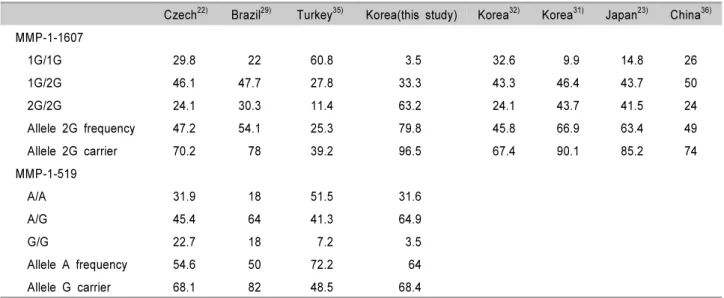
The allele frequency of 2G in the cervical cancer group was 66.1%, and 66.9% in the control group, showing Korean with specific polymorphism in MMP-1 are neither more susceptible to develop cervical cancer nor more vulnerable for cancer progression. Nho et al.32) however, reported MMP-1-1607 and MMP-1-519 polymorphisms can be associated with Body Mass Index with age ≥50 years in Korean by using the py- rosequencing SNP Reagent kits. They suggest that al- lele 1G in MMP-1-1607 and allele A in MMP-1-519 polymorphisms may play a protective factor against the increase in BMI in Korean population. But their control group showed a large different distribution of genotypes and alleles from other studies (Table 6).
These contradictory results on genes polymorphisms are might occur due to several reasons. Difference races and/or populations may have different risk al- leles for the same disease. There are many regulatory mechanisms that may control the action of MMPs on the components of the extracellular matrix33). There are also various regulatory steps involved in destruc-
Table 6. Genotype Distribution and Allele Frequency of the Control Group Versus Previous Reports
Czech22) Brazil29) Turkey35) Korea(this study) Korea32) Korea31) Japan23) China36) MMP-1-1607
1G/1G 29.8 22 60.8 3.5 32.6 9.9 14.8 26
1G/2G 46.1 47.7 27.8 33.3 43.3 46.4 43.7 50
2G/2G 24.1 30.3 11.4 63.2 24.1 43.7 41.5 24
Allele 2G frequency 47.2 54.1 25.3 79.8 45.8 66.9 63.4 49
Allele 2G carrier 70.2 78 39.2 96.5 67.4 90.1 85.2 74
MMP-1-519
A/A 31.9 18 51.5 31.6
A/G 45.4 64 41.3 64.9
G/G 22.7 18 7.2 3.5
Allele A frequency 54.6 50 72.2 64
Allele G carrier 68.1 82 48.5 68.4
The data were presented in percentage (%).
tion of periodontal connective tissue and/or bone;
from bacterial infection into a host cell, host immune responses including the cytokine networks, MMPs and tissue inhibitors of MMPs regulation. Therefore, an increase in mRNA transcription only which is the re- sult of MMP-1 polymorphism may not necessarily lead to the increased enzyme activity on the extracellular matrix. Furthermore, a study proved that some MMP members share common extracellular matrix substrates and compensate these functions for each other34). These shared functions indicate that a single gene polymorphism of an MMP may not have enough effect on disease susceptibility or progression.
In the present study, DNA samples from the sub- jects were limited in number, and the associations among SNP, clinical stage and prognosis in a larger number of patients were not investigated. In addition, this study may be limited by biases resulting from observational investigation and the ethnic composition since only Koreans were included. However, on the basis of these results, there may be some association between MMP-1 polymorphisms and susceptibility of GAP and it may contribute to the periodontal tissue destruction in Korean subjects. Further series studies are needed to search for other risk gene polymorphism that may synergistically elevate a susceptibility to the periodontal disease and haplotype analysis of these genes could be more important. In the future, the as- sessments of diagnostic periodontal risk gene may give an assurance in the detection of periodontitis suscep- tible patients.
REFERENCES
1. Genco RJ. Host responses in periodontal diseases: current concepts. J Periodontol 1992;63:338-355.
2. Haffajee AD, Socransky SS. Microbial etiological agents of destructive periodontal diseases. Periodontol 2000 1994;5:
78-111.
3. Michalowicz BS, Aeppli D, Virag JG et al. Periodontal findings in adult twins. J Periodontol 1991;62:293-299.
4. Clark IM, Swingler TE, Sampieri CL, Edwards DR. The regulation of matrix metalloproteinases and their inhibitors.
Int J Biochem Cell Biol 2008;40:1362-1378.
5. Mäkelä M, Salo T, Uitto VJ, Larjava H. Matrix metal- loproteinases (MMP-2 and MMP-9) of the oral cavity: cel- lular origin and relationship to periodontal status. J Dent Res 1994;73:1397-1406.
6. Birkedal-Hansen H, Yamada S, Windsor J et al. Role of cytokines and inflammatory mediators in tissue destruction.
J Periodontal Res 1993;28:500-510.
7. Kubota T, Nomura T, Takahashi T, Hara K. Expression of mRNA for matrix metalloproteinases and tissue inhibitors of metalloproteinases in periodontitis-affected human gin- gival tissue. Arch Oral Biol l996;41:253-262.
8. Séguier S, Gogly B, Bodineau A, GodeauG, Brousse N. Is collagen breakdown during periodontitis linked to in- flammatory cells and expression of matrix metal- loproteinases and tissue inhibitors of metalloproteinases in human gingival tissue? J Periodontol 2001;72:1398-1406.
9. Soell M, Elkaim R, Tenenbaum H. Cathepsin C, Matrix metalloproteinases, and their tissue inhibitors in gingiva and gingival crevicular fluid from periodontitis-affected patients.
J Dent Res 2002;81:174-178.
10. Kornman KS, Crane A, Wang HY et al. The interleukin-1 genotype as a severity factor in adult periodontal disease. J Clin Periodontol 1997;24:72-77.
11. Jeong HN, Chung HJ, Kim OS et al. Association between periodontitis and coronary heart disease in Korea:
Inflammatory markers and IL-1 gene polymorphism. J Korean Acad Periodontol 2004;34:607-622.
12. Bang SJ, Kim IS, Kim OS, Kim YJ, Chung HJ. IL-6 gene polymorphisms in Korean generalized aggressive periodontitis.
J Korean Acad Periodontol 2008;38:579-588.
13. Ryu JS, Kim OS. IL-10 gene promoter polymorphism in Korean generalized aggressive periodontitis patients. J Korean Acad Periodontol 2007;37:563-573.
14. Rutter JL, Mitchell TI, Butticè G et al. A single nucleotide polymorphism in the matrix metalloproteinase-1 promoter creates an Ets binding site and augments transcription.
Cancer Res 1998;58:5321-5325.
15. Jurajda M, Muzík J, Izakovicová-Hollá L, Vácha J. A new- ly identifiednucleotide polymorphism in the promoter of the
matrix metalloproteinase-1 gene. Mol Cell Probes 2002;16:
63-66.
16. Hinoda Y, Okayama N, Takano N et al. Association of functional polymorphisms of matrix metalloproteinase (MMP)-1 and MMP-3 genescolorectal cancer. Int J Cancer 2002;102:526-529.
17. Ghilardi G, Biondi ML, DeMonti M et al. Matrix metal- loproteinase-1 and matrix metalloproteinase-3 gene promo- terpolymorphisms are associated with carotid artery stenosis. Stroke 2002;33:2408-2412.
18. Terashima M, Akita H, Kanazawa K et al. Stromelysin pro- moter 5A/6A polymorphism is associated with acute my- ocardial infarction. Circulation 1999;99:2717-2719.
19. Kanamori Y, Matsushima M, Minaguchi T et al. Correlation between expression of the matrix metalloproteinase-1 gene in ovarian cancers and an insertion/deletion polymorphism in its promoter region. Cancer Res 1999;59:4225-4227.
20. de Souza AP, Trevilatto PC, Scarel-Caminaga RM, Brito Jr RB, Line SR. MMP-1 promoter polymorphism: association with chronic periodontitis severity in a Brazilian population.
J Clin Periodontol 2003;30:154-158.
21. Santos MC, Campos MI, de Souza AP, Trevilatto PC, Line SR. Analysis of MMP-1 and MMP-9 promoter poly- morphisms in early osseointegrated implant failure. Int J Oral Maxillofac Implants 2004;19:38-43.
22. Hollá LI, Jurajda M, Fassmann A et al. Genetic variations in the matrix metalloproteinase-1 promoter and risk of sus- ceptibility and or severity of chronic periodontitis in the Czech population. J Clin Periodontol 2004;31:685-690.
23. Itagaki M, Kubota T, Tai H et al. Matrix metal- loproteinase-1 and -3 gene promoter polymorphisms in Japanese patients with periodontitis. J Clin Periodontol 2004;31:764-769.
24. Armitage GC. Development of a classification system for periodontal diseases and conditions. Ann Periodontol 1999;
4:1-6.
25. Trevilatto PC, Line SR. Use of buccal epithelial cells for PCR amplification of large DNA fragments. J Forensic Odontostomatol 2000;18:6-9.
26. Matrisian LM. Metalloproteinase and their inhibitors in ma- trix remodelling. Trends in Genetics 1990;6:121-125.
27. Ryu SH, Park JW, Suh JY, Lee JM. Stromelysin-1 and membrane type-MMP-1 expressions in human chronic pe- riodontitis with type 2 diabetes mellitus. J Korean Acad Periodontol 2008;38:629-638.
28. Ye S. Polymorphism in matrix metalloproteinase gene pro- moters: implication in regulation of gene expression and susceptibility of various diseases. Matrix Biology 2000;19:
623-629.
29. Astolfi CM, Shinohara AL, da Silva RA et al. Genetic polymorphisms in the MMP-1 and MMP-3 gene may con- tribute to chronic periodontitis in a Brazilian population. J Clin Periodontol 2006;33:699-703.
30. Cao Z, Li C, Jin L, Corbet EF. Association of matrix met- alloproteinase-1 promoter polymorphism with generalized aggressive periodontitis in a Chinese population. J Periodontal Res 2005;40:427-431.
31. Ju W, Kang S, Kim JW et al. Promoter polymorphism in the matrix metalloproteinase-1 and risk of cervical cancer in Korean women. Cancer Lett 2005;20:191-196.
32. Nho YK, Ha EY, Yu KI. et al. Matrix metalloproteinase-1 promoter is associated with body mass index in Korean population with aged greater or equal to 50 years. Clin Chim Acta 2008;396:14–17.
33. Sternlicht MD, Werb Z. How matrix metalloproteinases regulate cell behavior. Annu Rev Cell Dev Biol 2001;17:
463-516.
34. Zhou Z, Apte SS, Soininen R et al. Impaired endochondral ossification and angiogenesis in mice deficient in mem- brane-type matrix metalloproteinase I. Proc Natl Acad Sci USA 2000;97:4052-4057.
35. Pirhan D, Atilla G, Emingil G et al. Effect of MMP-1 pro- moter polymorphisms on GCF MMP-1 levels andoutcome of periodontal therapy in patients with severe chronic periodontitis. J Clin Periodontol 2008;35:862-870.
36. Cao Z, Li C, Zhu G. MMP-1 promoter gene polymorphism and susceptibility to chronic periodontitis in a Chinese population. Tissue Antigens 2006;68:38-43.