Introduction
Statistics Korea has published an annual report on the cause-of-death statistics of the Korean population since
1982. The first report, published in 1982, dealt with causes of death in 1980. Analyses of the cause-of-death data from 2003 to 2014 are available at the homepage of Statistics Korea [1]. Although this resource is easily accessible to the public, it is difficult to cite the data since the report is in Korean, making it difficult to foreigners to access. Therefore, the editor of the Journal of the Korean Medical Association and the corresponding staff of Statistics Korea discussed the publication of these data in the journal in December 2015, and agreed to jointly author an article in English drawing on the cause-of-death data from 2014, which was made
2014년 사망원인 통계
신 현 영1·이 지 연2·송 주 화2·이 석 민2·이 정 훈2·임 병 선2·김 혜 란2·허 선3 | 1서남대학교 의과대학 명지병원 가정의학과, 2통계
청 인구동향과, 3한림대학교 의과대학 기생충학교실 및 의학교육연구소
Cause-of-death statistics in the Republic of Korea, 2014
Hyun-Young Shin, MD1 · Ji-Youn Lee, PhD2 · Juhwa Song, BSc2 · Seokmin Lee, BSc2 · Junghun Lee, BSc2 · Byeongsun Lim, MSc2 · Heyran Kim, BSc 2 · Sun Huh, MD3
1Department of Family Medicine, Myongji Hospital, Seonam University College of Medicine, Goyang; 2Vital Statistics Division, Statistics Korea, Deajeon; 3Department of Parasitology and Institute of Medical Education, College of Medicine, Hallym University, Chuncheon, Korea
This article presents recent trends and statistical indicators related to mortality in the Republic of Korea by analyzing the 2014 cause-of-death statistics. Specifically, we assessed the number of deaths, the crude death rate, the ranking of causes of death, and trends in the death rate from the major causes of death. Causes of death were classified according to the International Statistical Classification of Diseases and Related Health Problems, 10th revision, as recommended by the World Health Organization. In order to determine the ranking of causes of death, Statistics Korea used the selection list of 56 causes of death from the 80 causes of death list for tabulation mortality statistics recommended by World Health Organization to better fit the Korean situation. The 10 leading causes of death were, in order, cancer, heart disease, cerebrovascular disease, suicide, pneumonia, diabetes mellitus, chronic lower respiratory disease, liver disease, transport accidents, and hypertensive diseases. The top 10 causes of death accounted for 70.5% of all Korean deaths. The ranking of cancer types as causes of death was lung, liver, stomach, colon, and pancreatic cancer. Death rates for heart disease increased from the third in 2013 to the second leading cause in 2014 and the rank of pneumonia moved up from the sixth in 2013 to the fifth in 2014. The mortality rate due to stomach cancer has decreased continuously over time.. This finding may reflect changes in Korean society involving population structure, epidemiological patterns, and lifestyles, including dietary habits.
Key Words: Neoplasms; Cardiovascular diseases; Cause of death; Heart diseases; Korea
Received: February 9, 2016 Accepted: February 21, 2016 Corresponding author: Sun Huh
E-mail: [email protected]
© Korean Medical Association
This is an Open Access article distributed under the terms of the Creative Commons Attribution Non-Commercial License (http://creativecommons.
org/licenses/by-nc/3.0) which permits unrestricted non-commercial use, distribution, and reproduction in any medium, provided the original work is properly cited.
publically available in September 2015. This is the first effort between these two organizations to facilitate the wider propagation of this valuable information.
The annual reporting of cause-of-death statistics is a duty of the governments of World Health Organization (WHO) member countries, and the Korean government has fulfilled this duty. These statistics are important because they can provide a basis for national demographic and health care policies by identifying the number, causes, and geographical distribution of deaths. The distribution of causes of death in the Korean population is of interest not only for members researchers, and the government, but also for policymakers and researchers worldwide, because Korea is undergoing economic and demographic changes at an unusually rapid rate. Examining the corresponding changes in the causes of death in the Korean population may provide some insights regarding how to cope with issues of public health and welfare in developing countries as well as in other Organization for Economic Co-operation and Development countries.
Beginning in 2000, cause of death statistics has provided regional figures along with nation-wide data. However, in this article, only nation-wide data are presented and discussed. This article presents the recent trends and statistical indicators related to death by analyzing the cause-of-death statistics in 2014. In particular, we analyzed the number of deaths, the crude death rate, the ranking of causes of death, and trends in the death rate from the major causes of death.
Methods
Cause-of-death statistics were collected based on the Statistics Act and Act on the Registration, etc. of Family Relationships (http://elaw.klri.re.kr). Statistics Korea collected
data from death certificates issued for deaths in 2014 filed in local administration offices. When death occurs, family should submit the death report form with death medical certificate issued by physicians to local offices. The present data reflect an analysis of death certificates issued up to April 30, 2015 for deaths from January 1, 2014 to December 31, 2014 [1]. In order to compare the data internationally, the causes of death were classified according to the International Statistical Classification of Diseases and Related Health Problems, 10th revision, as recommended by the WHO, as well as the KCD-6 (Korean Standard Classification of Diseases and Causes of Death), which has been modified to fit circumstances in Korea [2,3]. In order to determine the ranking of causes of death, Statistics Korea used the selection list of 56 causes of death from the 80 causes of death list for tabulation mortality statistics recommended by WHO to better fit the Korean situation. A variety of cancers (malignant neoplasms) were integrated into the single item of cancer [1].
Descriptive analysis was performed.
Results
1. Number of deaths and crude death rate
The total number of deaths was 267,692, which was an increase of 1,435 (0.5%) from 2013. The number of deaths has continually increased over the last 20 years (Figure 1, Table 1). The number of deaths among men was 147,321, which was an increase of 722 (0.5%) from 2013. The number of deaths among women was 120,371, which was an increase of 713 (0.6%) from 2013. More precise information on the death rate is available in Supplementary Tables 1 and 2.
The crude death rate (number of deaths per 100,000 population) was 527.3, which was an increase of 0.7 (0.1%) compared to the crude death rate observed in 2013 (Table 1).
The crude death rate among men was 580.6, which was
an increase of 0.8 (0.1%) from 2013. The crude death rate among women was 474.1, which was an increase of 0.7 (0.1%) from 2013. The crude death rate among men was 1.22 times higher than among women, and this discrepancy did not change from 2013 (Table 2).
When death numbers were analyzed according to age, increases were observed in the over 80-year-old group
(4.4%) and in the 10- to 19-year- old group (2.3%) (Table 2). Deaths in people over 80 years of age accounted for 38.8% of all deaths.
In most age groups, the number of deaths in both sexes decreased compared to 2013. However, in- creases were observed in males aged 0 year (2.4%), men in their fifties (0.2%), men in their eighties or older (5.6%), females aged 10 to 19 years (12.5%), and women in their eighties or older (3.8%). The male-to-female death ratio was 2.88 for people in their fifties, 2.51 for people in their sixties, and 2.37 times for people in their forties.
The death rate according to years of age decreased in all age groups except the 10- to 19-year- old groups (Table 3) due to tragic water transport accident happened in 2014. The male death rate showed the greatest decrease in the 1- to 9-year-old group (-24.0%) and in individuals in their twenties (-6.7%). The female death rate exhibited the greatest decrease among individuals in their twenties (-9.1%) and the 1- to 9-year-old group (-6.4%).
The death rate was higher in men, and in particular, the death rate among men in their fifties was 2.85 times higher than that of women in their fifties. The death rate of women increased with age up to women in their fifties, but then decreased slowly afterwards.
Figure 1. Trends in the number of deaths and crude death rate from 1994 to 2014 based on annual cause-of-death statistics for the Korean population.
1994 1996 1998 2000 2002 2004 2006 2008 2010 2012 2014 270
260
250
240
230
220
Death Crude death rates
(per 100,000 population) (1,000 person)
600
550
500
450
400
Table 1. Trends of number of deaths and crude death rates of Korean people from 1990 to 2014 Year
No. of deaths Crude death rate Sex ratio (male/
female)
Average daily no. of deaths
Total Male Female Total Male Female
1990 241,616 138,730 102,886 563.6 643.2 483.0 1.33 662
1991 242,270 138,270 104,000 559.6 634.7 483.5 1.31 664
1992 236,162 134,231 101,931 539.8 609.8 469.0 1.30 645
2000 246,163 136,486 109,677 517.9 571.9 463.3 1.23 673
2001 241,521 134,058 107,463 504.5 557.8 450.7 1.24 662
2002 245,317 134,742 110,575 509.7 557.9 461.2 1.21 672
2003 244,506 134,887 109,619 506.1 556.6 455.4 1.22 670
2004 244,217 135,218 108,999 503.7 556.1 451.0 1.23 667
2005 243,883 134,382 109,501 501.0 550.5 451.1 1.22 668
2006 242,266 133,725 108,541 495.6 545.7 445.2 1.23 664
2007 244,874 134,922 109,952 498.4 547.9 448.7 1.22 671
2008 246,113 136,932 109,181 498.2 553.1 443.0 1.25 672
2009 246,942 137,736 109,206 497.3 553.7 440.7 1.26 677
2010 255,405 142,358 113,047 512.0 570.0 454.0 1.26 700
2011 257,396 143,250 114,146 513.6 571.1 456.0 1.25 705
2012 267,221 147,372 119,849 530.8 585.1 476.4 1.23 730
2013 266,257 146,599 119,658 526.6 579.8 473.4 1.22 729
2014 267,692 147,321 120,371 527.3 580.6 474.1 1.22 733
From
2013 Change 1,435 722 713 0.7 0.8 0.7
Percentage
change 0.5 0.5 0.6 0.1 0.1 0.1
Unit: person, per 100,000 population, person, %
2. Ranking of causes of death
The mortality rates of the three top causes of death per
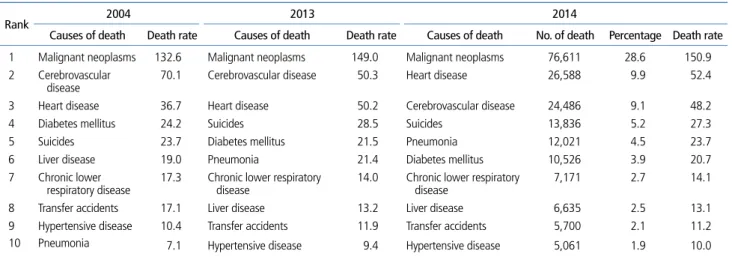
100,000 people were 150.9 for cancer, 52.4 for heart disease, and 48.2 for cerebrovascular disease (Table 4). These
Table 3. Trends of death rates of Korean people by sex and age in 2004, 2013, and 2014 Age (yr)
Total 0 1-9 10-19 20-29 30-39 40-49 50-59 60-69 70-79 80≤
Total 2004 503.7 484.1 24.4 23.1 50.3 96.8 252.1 545.0 1,306.8 3,506.6 11,199.5
2013 526.6 294.6 14.2 17.1 42.3 78.2 174.4 382.1 821.8 2,475.5 8,902.6
2014 527.3 310.2 11.8 18.2 39.2 75.7 165.8 372.4 781.7 2,358.0 8,597.5
From 2013 Change 0.7 15.6 -2.4 1.1 -3.1 -2.5 -8.6 -9.7 -40.2 -117.5 -305.1 Percentage
change 0.1 5.3 -16.8 6.1 -7.4 -3.2 -4.9 -2.5 -4.9 -4.7 -3.4
Male 2004 556.1 510.2 27.6 29.3 66.1 130.6 367.3 817.1 1,945.3 4,912.6 13,134.3
2013 579.8 306.9 16.2 22.1 53.8 99.9 243.3 564.5 1,209.1 3,534.4 11,044.8 2014 580.6 331.4 12.3 22.4 50.2 96.1 229.7 550.2 1,154.1 3,380.9 10,608.0 From 2013 Change 0.8 24.5 -3.9 0.3 -3.6 -3.9 -13.6 -14.3 -55.0 -153.5 -436.8
Percentage
change 0.1 8.0 -24.0 1.4 -6.7 -3.9 -5.6 -2.5 -4.6 -4.3 -4.0
Female 2004 451.0 455.9 21.0 16.1 33.7 61.6 132.6 274.0 766.2 2,674.1 10,404.6
2013 473.4 281.7 11.9 11.7 29.7 55.7 103.1 198.2 461.1 1,707.8 8,013.0
2014 474.1 287.9 11.2 13.6 27.0 54.5 99.9 192.8 431.8 1,606.1 7,743.3
From 2013 Change 0.7 6.3 -0.8 1.9 -2.7 -1.2 -3.2 -5.5 -29.3 -101.6 -269.6 Percentage
change 0.1 2.2 -6.4 16.4 -9.1 -2.1 -3.1 -2.8 -6.3 -6.0 -3.4
Sex ratio (male/
female)
2004 1.23 1.12 1.32 1.81 1.96 2.12 2.77 2.98 2.54 1.84 1.26
2013 1.22 1.09 1.36 1.89 1.81 1.79 2.36 2.85 2.62 2.07 1.38
2014 1.22 1.15 1.10 1.64 1.86 1.76 2.30 2.85 2.67 2.10 1.37
Unit: per 100,000 population, %
Table 2. Trends of number of deaths of Korean people by sex and age in 2004, 2013, and 2014 Age (yr)
Total 0 1-9 10-19 20-29 30-39 40-49 50-59 60-69 70-79 80≤
Total 2004 244,217 2,228 1,375 1,526 3,961 8,613 20,649 26,080 47,578 61,943 70,255
2013 266,257 1,305 595 1,084 2,782 6,273 15,270 29,754 35,696 74,130 99,332
2014 267,692 1,305 493 1,109 2,580 5,940 14,611 29,795 35,409 72,660 103,748
From
2013 Change 1,435 0 -102 25 -202 -333 -659 41 -287 -1,470 4,416
Percentage
change 0.5 0.0 -17.1 2.3 -7.3 -5.3 -4.3 0.1 -0.8 -2.0 4.4
2004 135,218 1,221 814 1,021 2,667 5,927 15,319 19,510 32,470 32,273 23,994
2013 146,599 698 352 733 1,850 4,083 10,833 22,068 25,329 44,484 36,159
2014 147,321 715 266 714 1,735 3,843 10,278 22,123 25,324 44,135 38,167
From
2013 Change 722 17 -86 -19 -115 -240 -555 55 -5 -349 2,008
Percentage
change 0.5 2.4 -24.4 -2.6 -6.2 -5.9 -5.1 0.2 -0.0 -0.8 5.6
Male 2004 108,999 1,007 561 505 1,294 2,686 5,330 6,570 15,108 29,670 46,261
2013 119,658 607 243 351 932 2,190 4,437 7,686 10,367 29,646 63,173
2014 120,371 590 227 395 845 2,097 4,333 7,672 10,085 28,525 65,581
From
2013 Change 713 -17 -16 44 -87 -93 -104 -14 -282 -1,121 2,408
Percentage
change 0.6 -2.8 -6.6 12.5 -9.3 -4.2 -2.3 -0.2 -2.7 -3.8 3.8
Sex ratio (male/
female)
2004 1.24 1.21 1.45 2.02 2.06 2.21 2.87 2.97 2.15 1.09 0.52
2013 1.23 1.15 1.45 2.09 1.98 1.86 2.44 2.87 2.44 1.50 0.57
2014 1.22 1.21 1.17 1.81 2.05 1.83 2.37 2.88 2.51 1.55 0.58
Unit: person
three major causes of death (cancer, heart disease, and cerebrovascular disease) accounted for 47.7% of the total mortality rate, which was an increase of 0.3%p from 2013. Within the 10 top causes of death, the rankings of heart disease and pneumonia increased; while those of cerebrovascular disease and diabetes fell. In comparison to 10 years ago (2004), increases were found in the ranking of heart disease (third to second place), suicide (fifth to fourth place), and pneumonia (tenth to fifth place), while decreases were observed in the ranking of cerebrovascular disease (second to third place), diabetes (fourth to sixth place), liver disease
(sixth to eighth place), traffic/
transit accidents (eighth to ninth place), and hypertensive disorders (ninth to tenth).
The top-ranking cause of death for men was the same as in 2013. In women, rises in the ranking of heart disease (third to second place), pneumonia (fifth to fourth place), and liver disease (eleventh to tenth place) were observed (Figure 2). In both sexes, cancer was the top-ranking cause of death. The mortality rate of men due to cancer was 1.67 times higher than that of women.
The top-ranked causes of death were cancer in the 1- to 9-year-old group and the forties or older, transport accidents in the 10- to 19-year-old group, and suicide in individuals in their thirties (Table 5). More detailed infor- mation is presented in Supplementary Tables 3 and 4.
3. Trends in the top two causes of death 1) Cancer mortality rate
The mortality rate due to cancer was found to have
Figure 2. Leading causes of death by sex in 2014 based on annual cause-of-death statistics for the Korean population.
Malignant neoplasms Malignant neoplasms
Rank
Death rate (per 100,000 polulation) Death rate (per 100,000 polulation)
Suicides
Heart Heart disease
Cerebrovascular disease Cerebrovascular disease
Pneumonia Diabetes mellitus Suicides
Hypertensive disease Alzheimer’s disease
Chronic lower respiratory disease Liver disease
Pneumonia Diabetes mellitus
Liver disease Chronic lower respiratory disease Transfer accidents
Falls 1st 2nd 3rd 4th 5th 6th 7th 8th 9th 10th
Men Women
180 160 140 120 100 80 60 40 20 0 0 20 40 60 80 100 120 140 160 180
Table 4. Trends of leading causes of death of Korean people in 2004, 2013, and 2014
Rank 2004 2013 2014
Causes of death Death rate Causes of death Death rate Causes of death No. of death Percentage Death rate 1 Malignant neoplasms 132.6 Malignant neoplasms 149.0 Malignant neoplasms 76,611 28.6 150.9 2 Cerebrovascular
disease 70.1 Cerebrovascular disease 50.3 Heart disease 26,588 9.9 52.4
3 Heart disease 36.7 Heart disease 50.2 Cerebrovascular disease 24,486 9.1 48.2
4 Diabetes mellitus 24.2 Suicides 28.5 Suicides 13,836 5.2 27.3
5 Suicides 23.7 Diabetes mellitus 21.5 Pneumonia 12,021 4.5 23.7
6 Liver disease 19.0 Pneumonia 21.4 Diabetes mellitus 10,526 3.9 20.7
7 Chronic lower
respiratory disease 17.3 Chronic lower respiratory
disease 14.0 Chronic lower respiratory
disease 7,171 2.7 14.1
8 Transfer accidents 17.1 Liver disease 13.2 Liver disease 6,635 2.5 13.1
9 Hypertensive disease 10.4 Transfer accidents 11.9 Transfer accidents 5,700 2.1 11.2
10 Pneumonia 7.1 Hypertensive disease 9.4 Hypertensive disease 5,061 1.9 10.0
Unit: per 100,000 population, person, %
increased to 150.9 out of 100,000, which was an increase of 1.9 (1.3%) compared to 2013. The greatest contributions to the mortality rate due to cancer were made by lung
cancer (34.4), liver cancer (22.8), and stomach cancer (17.6). The mortality rate of men due to cancer (188.7) was 1.67-fold higher than that of women (113.2) (Table
Table 6. Trends of death rate of Korean people due to cancer by sex in 2004, 2013, and 2014 Malig-
nant plasmneo-
phagusEso- Sto- mach
Colon, rectum anusand
Liver and intrahe- patic bile
ducts creasPan-
Trachea, bronchus
and lung Breast Cervix uteri Pro- state
Meninges, brain and central nervous system
kaemiaLeu-
Total 2004 132.6 3.1 23.1 12.1 22.4 6.3 27.3 3.1 2.2 1.9 2.3 3.0
2013 149.0 2.9 18.2 16.4 22.6 9.6 34.0 4.4 1.8 3.2 2.4 3.2
2014 150.9 3.0 17.6 16.5 22.8 10.1 34.4 4.5 1.9 3.3 2.5 3.3
From
2013 Change 1.9 0.2 -0.6 0.2 0.2 0.5 0.4 0.0 0.1 0.1 0.2 0.1
Percentage
change 1.3 5.9 -3.3 1.1 1.0 5.5 1.1 0.8 7.2 1.9 7.0 4.5
Male 2004 168.7 5.6 29.9 13.3 33.7 7.2 40.4 0.1 - 3.8 2.4 3.5
2013 186.2 5.2 23.7 18.5 33.3 10.3 49.5 0.1 - 6.4 2.5 3.7
2014 188.7 5.5 22.7 18.9 34.0 10.8 50.4 0.1 - 6.6 2.8 3.6
From
2013 Change 2.4 0.3 -1.0 0.3 0.6 0.5 0.9 0.0 - 0.1 0.3 -0.1
Percentage
change 1.3 6.2 -4.2 1.9 1.9 4.9 1.8 30.3 - 2.0 14.1 -2.9
Female 2004 96.4 0.5 16.2 10.8 11.0 5.4 14.2 6.1 4.5 - 2.2 2.6
2013 111.8 0.5 12.6 14.2 11.8 8.8 18.4 8.8 3.5 - 2.3 2.6
2014 113.2 0.5 12.4 14.2 11.6 9.3 18.3 8.9 3.8 - 2.2 3.0
From
2013 Change 1.4 0.0 -0.2 0.0 -0.2 0.5 -0.1 0.1 0.3 - -0.0 0.4
Percentage
change 1.3 3.4 -1.5 0.2 -1.6 6.2 -0.5 0.6 7.1 - -0.8 15.2
Sex ratio (male/
female)
2004 1.75 10.27 1.85 1.23 3.06 1.34 2.85 0.01 - - 1.11 1.37
2013 1.67 10.31 1.88 1.31 2.82 1.18 2.69 0.01 - - 1.09 1.46
2014 1.67 10.58 1.83 1.33 2.92 1.16 2.75 0.01 - - 1.26 1.23
unit: per 100,000 population, %
Table 5. Percentage and death rate of Korean people due to three leading causes by age in 2014 Age (yr)
1st 2nd 3rd
Cause of death Percentage Death rate Cause of death Percentage Death rate No. of death Percentage Death rate 1-9 Malignant
neoplasms 17.8 2.1 Transfer accidents 10.5 1.2 Congenital deformity 9.5 1.1
10-19 Transfer accidents 26.2 4.8 Suicides 24.7 4.5 Malignant neoplasms 14.3 2.6
20-29 Suicides 45.5 17.8 Transfer accidents 15.4 6.0 Malignant neoplasms 10.6 4.1
30-39 Suicides 36.9 27.9 Malignant neoplasms 19.5 14.7 Transfer accidents 7.8 5.9
40-49 Malignant
neoplasms 29.3 48.6 Suicides 19.5 32.4 Liver disease 7.9 13.2
50-59 Malignant
neoplasms 38.8 144.6 Suicides 9.8 36.4 Heart disease 7.9 29.3
60-69 Malignant
neoplasms 44.1 344.4 Heart disease 8.6 67.1 Cerebrovascular
disease 7.7 59.8
70-79 Malignant
neoplasms 35.1 827.1 Cerebrovascular
disease 10.5 248.5 Heart disease 9.9 234.6
80≤ Malignant
neoplasms 17.3 1490.8 Heart disease 11.9 1027.2 Cerebrovascular
disease 10.8 925.1
Unit: %, per 100,000 population
6). Compared to the previous year, mortality due to lung cancer (1.1%) and liver cancer (1.0%) increased, while mortality due to gastric cancer (-3.3 %) decreased (Figure 3). The mortality rate increased by 2.4 in men (1.3%) and 1.4 (1.3%) in women compared to 2013. The major types of cancer among men were lung cancer (50.4), liver cancer (34.0), and stomach cancer (22.7), in comparison to lung cancer (18.3), colo-rectal cancer (14.2), and stomach
cancer (12.4) in women. Differences in mortality between men and women were highest in esophageal cancer (10.58 times), liver cancer (2.92 times), and lung cancer (2.75 times).
Individuals in their thirties showed a high mortality rate due to stomach cancer, while individuals in their forties and fifties showed high mortality rates due to liver cancer, and lung cancer took an especially high toll among
Table 7. Trends of death rate of Korean people due to cancer by sex in 2004, 2013, and 2014
Age (yr) 2013 2014
Malignant neoplasm phagusEso- Sto-
mach Colon, rectum anusand
Liver and intrahepatic
bile ducts Pancreas Trachea, bronchus
and lung Breast Cervix uteri Prostate
Meninges, brain and central nervous
system
kaemiaLeu-
Total 149.0 150.9 3.0 17.6 16.5 22.8 10.1 34.4 4.5 1.9 3.3 2.5 3.3
0 2.5 2.1 - - - 0.5 - - - - - 0.2 0.2
1-9 2.4 2.1 - - - 0.0 - - - - - 0.7 0.8
10-19 2.7 2.6 - 0.0 - 0.1 - 0.0 0.0 - - 0.6 0.9
20-29 4.7 4.1 0.0 0.3 0.2 0.2 0.1 0.1 0.1 0.1 - 0.5 1.1
30-39 15.4 14.7 0.0 2.4 1.1 2.1 0.4 1.2 1.7 0.8 0.0 0.7 1.2
40-49 50.3 48.6 0.6 6.7 4.3 10.4 2.2 4.7 5.8 1.7 0.0 1.7 1.7
50-59 146.3 144.6 3.2 17.2 14.2 33.4 9.4 22.1 9.0 2.5 0.6 3.1 3.2
60-69 361.5 344.4 8.9 34.8 34.1 61.6 24.9 85.1 9.0 3.0 4.3 6.0 6.2
70-79 852.2 827.1 19.6 88.8 89.0 106.8 61.8 227.5 9.7 7.1 21.8 10.2 15.3
80≤ 1,477.6 1,490.8 18.0 201.0 206.2 141.9 91.4 355.5 15.5 15.7 61.6 12.3 21.4
Unit: per 100,000 population
(C16) Malignant neoplasm of stomach
(C18-C21) Malignant neoplasm of colon, rectum and anus
(C22) Malignant neoplasm of liver and intrahepatic bile ducts
(C25) Malignant neoplasm of pancreas
(C33-C34) Malignant neoplasm of trachea, bronchus and lung
2000 2002 2004 2006 2008 2010 2012 2014
(per 100,000 population) 40
35 30 25 20 15 10 5 0
Figure 3. Trends in the death rate due to the five leading cancers from 2000 to 2014 based on annual cause-of-death statistics for the Korean population.
A
(per 100,000 population)
0 1-4 5-9 10-14 15-19 20-24 25-29 30-34 35-39 40-44 45-49 50-54 55-59 60-64 65-69 70-74 75-79 80-84 85-89 90≤
2000 2007 2014
350 300 250 200 150 100 50 0
B
(per 100,000 population)
0 1-4 5-9 10-14 15-19 20-24 25-29 30-34 35-39 40-44 45-49 50-54 55-59 60-64 65-69 70-74 75-79 80-84 85-89 90≤
300 250 200 150 100 50 0
2000 2007 2014
C
(per 100,000 population)
0 1-4 5-9 10-14 15-19 20-24 25-29 30-34 35-39 40-44 45-49 50-54 55-59 60-64 65-69 70-74 75-79 80-84 85-89 90≤
160
120
80
40
0
2000 2007 2014
D
(per 100,000 population)
0 1-4 5-9 10-14 15-19 20-24 25-29 30-34 35-39 40-44 45-49 50-54 55-59 60-64 65-69 70-74 75-79 80-84 85-89 90≤
400.0
300.0
200.0
100.0
0.0
2000 2007 2014
E
(per 100,000 population)
0 1-4 5-9 10-14 15-19 20-24 25-29 30-34 35-39 40-44 45-49 50-54 55-59 60-64 65-69 70-74 75-79 80-84 85-89 90≤
25 20 15 10 5 0
2000 2007 2014
Figure 4. (Continuing)
individuals in their sixties or older (Table 7). Age-specific mortality rate trends due to cancers of the stomach, colon, liver, lung, breast, cervix, and prostate are shown in Figure 4. The age-specific mortality rate due to cancer decreased in all age groups in comparison to the rates observed in 2013 except among individuals in their eight-ies or older.
2) Mortality rates due to circulatory system diseases
The mortality rate due to circulatory system diseases was 113.9 out of 100,000 and this category consisted of heart disease (52.4), cerebrovascular disease (48.2), and hypertensive disorders (10.0). Women (119.4) had a higher mortality rate than men (108.4) (Table
(per 100,000 population)
0 1-4 5-9 10-14 15-19 20-24 25-29 30-34 35-39 40-44 45-49 50-54 55-59 60-64 65-69 70-74 75-79 80-84 85-89 90≤
2000 2007 2014
25 20 15 10 5 0
F
G
(per 100,000 population)
0 1-4 5-9 10-14 15-19 20-24 25-29 30-34 35-39 40-44 45-49 50-54 55-59 60-64 65-69 70-74 75-79 80-84 85-89 90≤
2000 2007 2014
100 80 60 40 20 0
Table 8. Trends of death rate of Korean people due to disease of the circulatory system by sex in 2004, 2013, and 2014
Disease of the circulatory
Hyper- tensive disease
Heart disease
Cerebroavas- cular disease Total Ischemica)
heart disease
Otherb) heart disease
Total 2004 119.9 10.4 36.7 26.2 10.5 70.1
2013 113.1 9.4 50.2 26.8 23.3 50.3
2014 113.9 10.0 52.4 27.9 24.4 48.2
From
2013 Change 0.8 0.6 2.2 1.1 1.1 -2.1
Percentage
change 0.7 6.5 4.4 4.1 4.8 -4.2
Male 2004 114.7 6.9 38.5 27.9 10.6 66.5
2013 107.2 5.9 49.9 28.3 21.6 47.8
2014 108.4 6.0 52.3 29.5 22.8 46.6
From
2013 Change 1.2 0.1 2.4 1.2 1.3 -1.2
Percentage
change 1.1 1.0 4.9 4.2 5.8 -2.6
Female 2004 125.1 13.8 34.9 24.5 10.3 73.8
2013 119.0 12.8 50.4 25.4 25.1 52.8
2014 119.4 14.0 52.4 26.4 26.0 49.9
From
2013 Change 0.4 1.2 2.0 1.0 1.0 -3.0
Percentage
change 0.3 9.1 3.9 4.0 3.9 -5.6
Sex ratio (male/
female)
2004 0.92 0.50 1.10 1.14 1.02 0.90
2013 0.90 0.46 0.99 1.11 0.86 0.91
2014 0.91 0.43 1.00 1.12 0.88 0.93
Unit: per 100,000 population, %
a)Myocardial infarction and angina were include in ischemic heart disease; b)Heart failure and endocarditis, etc were included in other heart disease.x
Figure 4. Trends in the death rate due to cancers by age from 2000 to 2014 based on annual cause-of-death statistics for the Korean population. (A) Malignant neo- plasm of stomach, (B) malignant neoplasm of colon, rectum and anus, (C) malignant neoplasm of liver and intrahepatic bile ducts, (D) malignant neoplasm of trachea, bronchus and lung, (E) malignant neoplasm of breast, (F) malignant neoplasm of cervix uteri, and (G) malignant neoplasm of prostate.
8). Within the category of heart disease, ischemic heart disease (27.9) caused the most mortality. The mortality rate of women (119.4 people) due to circulatory system diseases was higher than that of men (108.4 people). The mortality rates due to circulatory system diseases increased by 1.2 (1.1%) in men and 0.4 (0.3%) in women in comparison to 2013. The mortality rate of women due to hypertensive disorders (14.0) was higher than that of men (6.0). The mortality rate of men due to ischemic heart disease (29.5) was higher than that of women (26.4).
The mortality rate due to circulatory system diseases decreased in all age groups except in individuals in their thirties (Table 9). Mortality due to circulatory system diseases showed a tendency to increase with increasing age.
In particular, age-specific mortality rates soared after age 70. The highest death rate due to diseases of the circulatory system was due to heart disease in most age groups, except for participants in their seventies, in whom the mortality rate due to cerebrovascular disease (248.5) was higher than that due to heart disease (234.6). Within the category of heart disease, other heart disease was the most common cause of death in individuals less than 50 years of age,
whereas ischemic heart disease was the most common cause of death in this category in individuals 50 years of age or older.
Discussion
The total number of deaths of in the Korean population was 267,692 in 2014. This number has continued to grow as the proportion of the aging population has increased; however, the mortality rate has remained at a similar level, exhibiting an increase of 0.5%. The ten leading causes of death, in order, were cancer, heart disease, cerebrovascular disease, suicide, pneumonia, diabetes mellitus, chronic lower respiratory disease, liver disease, traffic/transit accidents, and hyper-tensive diseases. The most remarkable change from the 2013 data was the increase in heart disease and decrease in cerebrovascular disease, such that heart disease increased from being the third most common cause of death to the second most common cause of death. This reflects changes in the prevalence of diseases corresponding to changes in dietary and exercise habits. Another remarkable change was the increase in pneumonia as a cause of death from sixth place in 2013 (21.4 persons out of 100,000 people) to fifth place in 2014 (23.7). This most likely reflects the increased proportion of elderly people in the population.
In fact, pneumonia is expected to increase continuously if the population structure of Korea does not change. The mortality rate due to diabetes decreased compared to 2013, from 21.5 to 20.7. This is a good sign regarding the nationwide control of diabetes. Diabetes and pre-diabetes have been found to be epidemic in Korea, as reflected by an
Table 9. Trends of death rate of Korean people due to diseases of the circulatory system by age in 2013 and 2014
Age (yr) 2013 2014 Hyper- tensive disease
Heart disease
Cerebroavascular disease Total Ischemica)
heart disease Otherb) heart disease
Total 113.1 113.9 10.0 52.4 27.9 24.4 48.2
0 5.6 4.0 - 3.6 - 3.6 0.2
1-9 0.7 0.7 - 0.6 - 0.6 0.1
10-19 1.1 0.9 - 0.5 0.0 0.5 0.3
20-29 2.3 2.3 - 1.5 0.3 1.3 0.7
30-39 7.3 7.6 0.2 4.2 2.0 2.2 3.0
40-49 23.4 23.2 0.3 12.2 5.7 6.4 10.1
50-59 55.4 54.4 1.5 29.3 16.4 13.0 22.1
60-69 139.8 137.2 5.3 67.1 38.1 29.0 59.8
70-79 571.2 533.9 33.7 234.6 130.5 104.1
80≤ 2,398.7 2,311.1 299.8 1,027.2 534.1 493.1 925.1
Unit: per 100,000 population
a)Myocardial infarction and angina were include in ischemic heart disease; b)Heart failure and endocarditis, etc were included in other heart disease.
estimated prevalence of diabetes and prediabetes of 12.4%
and 38.3%, respectively, based on both hemoglobin A1c levels and fasting plasma glucose levels [4].
The cancers associated with the highest mortality rates were lung, liver, stomach, colon, and pancreatic cancer, in descending order. Mortality due to lung cancer has increased continuously from 2000 to the present. The mortality rate due to liver cancer has been consistent over recent years.
However, the number of deaths due to liver cancer is expected to decrease soon in response to control of hepatitis B virus infections with antiviral drugs and improved sanitation. Stomach cancer is the only one of the five leading cancers to exhibit a continuously decreasing mortality rate since 2000. This is due to early detection and treatment, although stomach cancer remains the second most prevalent cancer, after thyroid cancer [5]. Mortality rates due to colon and pancreatic cancer have increased continuously from 2000. Colon cancer will increase further due to the increased preference for meat consumption exhibited by the Korean population.
The mortality rate of circulatory system diseases included heart disease (52.4), cerebrovascular disease (48.2), and hypertensive disorders (10.0). The mortality rate due to circulatory system diseases in women was higher than in men. Although the mortality rate of women (26.4) due to ischemic heart disease was lower than that of men (29.5), the mortality rates due to hypertensive diseases (14.0) and other heart diseases (26.0) were higher than those observed in men (6.0 and 22.8). It is estimated that heart disease will remain the leading cause of death in this category into the medium- to long-term future.
Conclusion
We summarized the annual report on the cause-of-death
statistics of the Korean population. We also identified changes in the ranking of leading causes of death in the Korean population from 2013 to 2014. Such findings are evidence of the dynamic changes that Korean society is currently undergoing from the perspective of population structure, disease patterns, and lifestyles, including dietary habits. Further analysis of supplementary raw data from Statistics Korea [1] may facilitate further valuable analyses with the goal of promoting the health of the Korean population.
Acknowledgement
Data collection and the analysis of the raw data were done under the budget of the Korean government. This study was supported by the Hallym University Research Fund (HRF-G-2015-4).
Supplementary materials
Supplementary tables are available from online only.
찾아보기말: 종양; 심장혈관질환; 사망원인; 심장질환; 한국
ORCID
Hyun-Young Shin, http://orcid.org/0000-0001-7261-3365 Ji-Youn Lee, http://orcid.org/0000-0002-5718-060X Juhwa Song, http://orcid.org/0000-0002-6218-5026 Seokmin Lee, http://orcid.org/0000-0001-6642-2677 Junghun Lee, http://orcid.org/0000-0002-2625-0775 Byeongsun Lim, http://orcid.org/0000-0001-5900-5517 Heyran Kim, http://orcid.org/0000-0001-9609-4766 Sun Huh, http://orcid.org/0000-0002-8559-8640
REFERENCES
1. Statistics Korea. Annual report on the causes of death statistics [Internet]. Daejeon: Statistics Korea; 2015 [cited 2016 Feb 9].
Available from: http://kostat.go.kr/portal/korea/kor_nw/2/6/2/
index.board.
2. World Health Organization. International Statistical Classi- fication of Diseases and Related Health Problems 10th revision 2016 [Internet]. Geneva: World Health Organization; 2016 [cited 2016 Feb 9]. Available from: http://apps.who.int/classifications/
icd10/browse/2016/en.
3. Statistics Korea. Korean Standard Classification of Diseases and Causes of Death (KCD-6) [Internet]. Daejeon: Statistics Korea;
2011 [cited 2016 Feb 9]. Available from: https://kssc.kostat.
go.kr:8443/ksscNew_web/ekssc/main/main.do.
4. Jeon JY, Ko SH, Kwon HS, Kim NH, Kim JH, Kim CS, Song KH, Won JC, Lim S, Choi SH, Jang MJ, Kim Y, Oh K, Kim DJ, Cha BY; Taskforce Team of Diabetes Fact Sheet of the Korean Diabetes Association. Prevalence of diabetes and prediabetes according to fasting plasma glucose and HbA1c. Diabetes Metab J 2013;37:349-357.
5. Jung KW, Won YJ, Kong HJ, Oh CM, Cho H, Lee DH, Lee KH.
Cancer statistics in Korea: incidence, mortality, survival, and prevalence in 2012. Cancer Res Treat 2015;47:127-141.
Peer Reviewers’ Commentary
The cause of death statistics of Korean people is one of the most important statistical data not only for the establishment of health policy by Korean Government, but also for the approach to patients care by medical health personnels. This article is a memorable one since this cause of death statistics is first exposed from the journal through agreement between editorial board of the Journal of the Korean Medical Association and Vital Statistics Division of the Statistics Korea. Korea is known to be one of the most dynamic countries in the world. The change of the cause of death may reflect the change of the Korean society from the perspective of economics, medical health, and social behavior. Especially the heart diseases became the 2nd ranking cause of death in 2014, surpassing cerebrovascular diseases. It may be originated from the increased uptake of meat and fatty diet. It is anticipated that this article to be read and cited by the researchers from both Korea and abroad. Articles on the health statistics of Korea will be published continuously with a variety of topics or more intensive analysis of each cause of death statistics.
[정리: 편집위원회]