• 검색 결과가 없습니다.

Modified Surgical Intervention for Extensive Mitral Valve Endocarditis and Posterior Mitral Annular Calcification

N/A
N/A
Protected

Academic year: 2021

Share "Modified Surgical Intervention for Extensive Mitral Valve Endocarditis and Posterior Mitral Annular Calcification"

Copied!
4
0
0

로드 중.... (전체 텍스트 보기)

전체 글

(1)

ISSN: 2233-601X (Print) ISSN: 2093-6516 (Online)

− 46 − Department of Thoracic and Cardiovascular Surgery, St. Carollo General Hospital

Received: March 11, 2015, Revised: April 22, 2015, Accepted: April 22, 2015, Published online: February 5, 2016

Corresponding author: Sang Wan Ryu, Department of Thoracic and Cardiovascular Surgery, St. Carollo General Hospital, 221 Sungwang-ro, Suncheon 57931, Korea

(Tel) 82-61-720-6230 (Fax) 82-61-720-6000 (E-mail) [email protected]

C

The Korean Society for Thoracic and Cardiovascular Surgery. 2016. All right reserved.

CC

This is an open access article distributed under the terms of the Creative Commons Attribution Non-Commercial License (http://creative- commons.org/licenses/by-nc/4.0) which permits unrestricted non-commercial use, distribution, and reproduction in any medium, provided the original work is properly cited.

Modified Surgical Intervention for Extensive Mitral Valve Endocarditis and Posterior Mitral Annular Calcification

Gwan Sic Kim, M.D., Min Sun Beom, M.D., Sung Ryong Kim, M.D., Na Rae Kim, R.N., Ji Wook Jang, R.N., Mi Hee Jang, R.N., Sang Wan Ryu, M.D., Ph.D.

The concomitant presence of posterior mitral annular calcification and infectious mitral valve lesions poses a techni- cal challenge with considerable perioperative risk when using previously proposed techniques for mitral valve surgery. Herein, we report a case of the use of a modified surgical technique to successfully treat a patient with mitral infective endocarditis complicated by a subendocardial abscess and extensive posterior mitral annular calcification.

Key words: 1. Mitral valve 2. Endocarditis 3. Calcification

CASE REPORT

A 79-year-old woman with a history of hypertension was transferred in a near-shock state from a regional hospital where she had presented 10 days previously, complaining of one week of nausea, diarrhea, and nocturnal fever. Despite various conservative treatments including antibiotics, dyspnea with palpitations had developed and worsened over the course of three days prior to transfer. She denied any history of trauma, recent invasive procedures such as dental care, in- fections, or tuberculosis. One year previously, she refused to undergo recommended surgical treatment for symptomatic se- vere aortic stenosis at St. Carollo General Hospital. Her vital signs at arrival were a blood pressure of 70/30 mmHg, an ir- regular heart rate of 127 beats/min, a respiratory rate of 26 cycles/min, and a body temperature of 36.9

o

C. Laboratory testing revealed a white blood cell count of 3,730/mm

3

, a he-

moglobin level of 9.0 g/dL, an aspartate transaminase/alanine transaminase ratio of 168/89 IU/L, and a C-reactive protein level of 23.7 mg/dL, while other parameters were within their normal limits. Severe cardiomegaly and bilateral pulmonary edema were apparent in chest radiography, and electro- cardiography showed atrial fibrillation with rapid ventricular response. Portable transthoracic echocardiography (TTE) re- vealed a massive pericardial effusion, which prompted emer- gency pericardiocentesis with the drainage of large amounts of serous pericardial fluid. The findings of TTE and trans- esophageal echocardiography (TEE) after pericardiocentesis were suspicious for a 1.2-cm hypermobile vegetation on the anterior mitral valve leaflet with calcification through the pos- terior mitral annulus and severe aortic valve stenosis. The left and right ventricular sizes and systolic function were normal.

Brain magnetic resonance imaging revealed focal acute em- bolic infarction of the left basal ganglia, without focal neuro-

Korean J Thorac Cardiovasc Surg 2016;49:46-49 Case Report

http://dx.doi.org/10.5090/kjtcs.2016.49.1.46

(2)

Mitral Endocarditis and MAC

− 47 − Fig. 1. Preoperative chest computed tomography. Extensive mitral annular calcification was present through the posterior mitral annu- lus (black arrows). LA, left atrium.

Fig. 2. An abscess pocket extending into the endocardium of the left ventricular posterior wall was found on the posterior annulus between P2 and P3. A Foley catheter was inserted into the pock- et to identify the connection to the left ventricle.

logical signs. Chest computed tomography showed extensive mitral valve calcification (MAC) through the posterior mitral annulus, pulmonary edema, and pleural effusion around both lungs (Fig. 1). Emergency surgery was performed with a di- agnosis of mitral infective endocarditis with extensive posteri- or MAC and aortic valve stenosis.

The operation was performed using conventional ascending aortic and bicaval bypass under moderate hypothermia.

Retrograde cold blood cardioplegia was used for myocardial protection. After aortic cross-clamping, exposure of the mitral valve was achieved through a longitudinal left atriotomy via the interatrial groove, revealing multiple friable vegetations attached to the anterolateral commissure and leaflets, as well as extensive MAC through the posterior annulus. The anterior mitral valve leaflet was nearly completely necrotized with in- flammation, but the annulus and subvalvular apparatus were preserved with only degenerative changes. An abscess pocket containing dirty yellowish pus was found on the posterior an- nulus between P2 and P3, extending into the endocardium of the left ventricular posterior wall, without an intracavitary connection to the left ventricle (Fig. 2). The aortic valve and its roots showed degenerative changes without evidence of infection. After complete debridement and resection of the in- fected tissue leaving the MAC intact, multiple 2-0 polyester

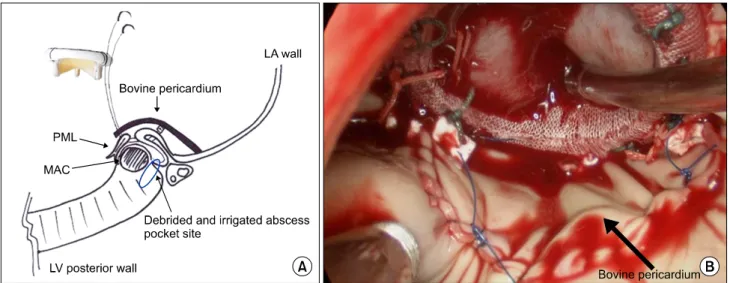
pledgeted mattress sutures were placed on the left atrial wall and the remaining posterior leaflet for plication. We passed the valve sutures from the atrial wall to the posterior leaflets, while avoiding passing through the MAC and obliterating the abscess pocket site. The sutures were sequentially passed through bovine pericardium, and then through the sewing ring of a prosthetic valve (27-mm Carpentier-Edwards PERIMOUNT Magna valve; Edwards Lifesciences Inc., Irvine, CA, USA) (Fig. 3). The bovine pericardium was sutured to the left atrial wall with 4-0 polypropylene running stitches to cover the ab- scess pocket site and MAC. After repairing the left atriotomy, the aortic valve was also replaced with a prosthetic valve (21-mm Carpentier-Edwards PERIMOUNT Magna valve;

Edwards Lifesciences Inc.). Intraoperative TEE revealed well-functioning prosthetic valves without paravalvular leak- age or subendocardial flow. Preoperative blood culture and tissue culture were negative due to the use of preoperative antibiotics, and the patient was treated with broad-spectrum antibiotics (ampicillin-sulbactam, 8 g/day; gentamicin, 3 mg/kg/day) for six weeks. Follow-up TTE on postoperative day 19 showed well positioned and functioning prosthetic valves without paravalvular leakage or dehiscence (Fig. 4).

The patient was discharged to the rehabilitation hospital two

months after admission.

(3)

Gwan Sic Kim, et al

− 48 −

Fig. 3. (A) Schematic illustration of the surgical technique. We passed the valve sutures from the atrial wall to the posterior leaflets, while avoiding passing through the MAC and obliterating the abscess pocket site. The sutures were sequentially passed through a piece of bo- vine pericardium, and then through the sewing ring of a prosthetic valve. (B) Intraoperative picture. LA, left atrium; LV, left ventricle; PML, posterior mitral leaflet; MAC, mitral annular calcification.

Fig. 4. Parasternal long-axis view of the two-dimensional echocardiogram on postoperative day 19. (A) Showing well functioning prosthetic valve. (B) Color Doppler showing no paravalvular leak or dehiscence.

DISCUSSION

Although mitral valve repair is the preferred surgical ap- proach if circumstances allow, the complete debridement of infectious necrotic lesions on the mitral valve may often hin- der valve repair, inevitably requiring replacement. In partic- ular, the existence of extensive MAC renders mitral valve re- placement a risky procedure because aggressive annular de-calcification is associated with an increased risk of fatal

complications, including intractable hemorrhage from atrio-

ventricular disruption or ventricular rupture, as well as acute

myocardial infarction secondary to circumflex artery injury

[1,2]. Partial annular decalcification can lead to a post-

operative paravalvular leak and/or dehiscence and fracture of

the remaining calcified annulus. Several surgical techniques

have been reported for addressing the presence of an un-

suitable mitral annulus during mitral valve replacement, and

can be divided into two categories: those for MAC and those

(4)

Mitral Endocarditis and MAC

− 49 − for the management of conditions involving destruction of the annulus, such as infective endocarditis or redo valve replacement. One approach involves leaving the MAC intact and building a new annulus, securing the prosthesis to the leaflet tissue [3,4] with intra-atrial implantation of a mitral prosthesis [5]. Another approach, pioneered by Feindel et al.

[1] and Carpentier et al. [2], involves reconstructing a mitral annulus after complete decalcification. Some surgeons have also used the Cavitron Ultrasonic Surgical Aspirator (Cavitron Surgical Systems Inc., Stanford, CT, USA) to decalcify MAC [6]. Despite their variety, the proposed surgical techniques must be modified in practice for cases combining an ex- tensive endocarditis lesion and MAC, as in the case presented here. In this case, we planned to avoid decalcification of the MAC and to reconstruct a stronger annulus with the hope of minimizing the risk of grave postoperative complications. We modified the surgical techniques proposed by Di Stefano et al. [7] and Taguchi et al. [8] to reconstruct the new annulus.

We used bovine pericardium to reinforce the new anchoring site after plicating both the mitral posterior leaflet and the left atrial wall to secure the mitral prosthesis without decalcifying the MAC. The bovine pericardium not only reinforced the su- ture on the new annulus, but also acted as a barrier to pre- vent perivalvular leakage, and may have strengthened the vul- nerable left atrial wall by covering the fragile site after de- bridement of the abscess pocket.

In conclusion, the presence of an unsuitable mitral annulus remains a challenge for current surgical techniques. We report a surgical modification used to successfully treat a patient with extensive endocarditis complicated by subendocardial ab- scess and posterior MAC by reconstructing the new annulus with plication between the left atrial wall and posterior mitral leaflet, reinforcing the bovine pericardium without decal-

cifying the MAC. Further evaluation and extended follow-up are warranted to assess the effectiveness of this surgical technique.

CONFLICT OF INTEREST

No potential conflict of interest relevant to this article was reported.

REFERENCES

1. Feindel CM, Tufail Z, David TE, Ivanov J, Armstrong S.

Mitral valve surgery in patients with extensive calcification of the mitral annulus. J Thorac Cardiovasc Surg 2003;126:

777-82.

2. Carpentier AF, Pellerin M, Fuzellier JF, Relland JY.

Extensive calcification of the mitral valve anulus: pathology and surgical management. J Thorac Cardiovasc Surg 1996;

111:718-29.

3. Coselli JS, Crawford ES. Calcified mitral valve annulus:

prosthesis insertion. Ann Thorac Surg 1988;46:584-6.

4. McEnany MT. Mitral valve replacement in the presence of severe valvular and annular calcification. J Card Surg 1993;

8:117-24.

5. Atoui R, Lash V, Mohammadi S, Cecere R. Intra-atrial im- plantation of a mitral valve prosthesis in a heavily calcified mitral annulus. Eur J Cardiothorac Surg 2009;36:776-8.

6. Unal M, Sanisoglu I, Konuralp C, et al. Ultrasonic decal- cification of calcified valve and annulus during heart valve replacement. Tex Heart Inst J 1996;23:85-7.

7. Di Stefano S, Lopez J, Florez S, Rey J, Arevalo A, San Roman A. Building a new annulus: a technique for mitral valve replacement in heavily calcified annulus. Ann Thorac Surg 2009;87:1625-7.

8. Taguchi S, Niibori T, Hayashi I, Kasahara H, Yozu R.

Using a double-plicated posterior leaflet as an anchor for mi- tral valve replacement: a case of mitral annular calcification.

J Cardiothorac Surg 2013;8:58.

수치

Fig. 2. An abscess pocket extending into the endocardium of the  left ventricular posterior wall was found on the posterior annulus  between P2 and P3
Fig. 3. (A) Schematic illustration of the surgical technique. We passed the valve sutures from the atrial wall to the posterior leaflets, while  avoiding passing through the MAC and obliterating the abscess pocket site

참조

관련 문서

3) A comparison of the stoichiometric equation with the experimental kinetic expression can suggest whether or not we are dealing with an elementary reaction. 4) If one

Post-surgical use of radioiodine (131I) in patients with papillary and follicular thyroid cancer and the issue of remnant ablation: a consensus

Method We obtained blood samples from 49 patients who underwent surgical treatment for esophageal squamous cell cancer (ESCC) We performed ctDNA analysis with

The questionnaire consisted of a background question and the modified Foreign Language Classroom Anxiety Scale (Horwitz, 1983). The study's research questions

 Modified version of PVW : “a particle is in static equilibrium if and only if the virtual work done by the externally applied forces vanishes for all

SEM micrographs of electrospun fibers fabricated with two different collector speeds (CS) for the (a) normal electrospinning process, (b) modified electrospinning process with

Secure coding, a safe software production technique, removes security weakness of a software source code to prevent security breaches.. By doing so, it allows use

Just as we achieved good control with a joint-based controller that was based on a linearizing and decoupling model of the arm, we can do the same for the Cartesian case.