73
급성 신우신염의 치료 영향인자
고신대학교 의과대학 비뇨기과학교실,
1부산대학교 의과대학 비뇨기과학교실
정재민․최 성․이상돈
1[Abstract]
Affecting Factors on the Treatment of Acute Pyelonephritis
Jae Min Chung, Seong Choi, Sang Don Lee
1From the Department of Urology, College of Medicine, Kosin University and
1Pusan National University, Busan, Korea
Purpose: We analyzed the clinical aspects of acute pyelonephritis patients who received hospitalization treatment and the factors to effect a therapy session.
Materials and Methods: We evaluated 108 patients with acute pyelonephritis who underwent hospi- talization treatment between January 2003 and May 2006. The patients were divided into two groups by history taking, radiological and laboratory finding: group A consisted of 60 patients without co-morbid condition and group B consisted of 48 patients with co-morbid conditions. Comparisons of the two groups were made using independent t-tests with hospitalized durations, uropathogen types, clinical improvement durations, laboratory improvement durations and co-morbid conditions.
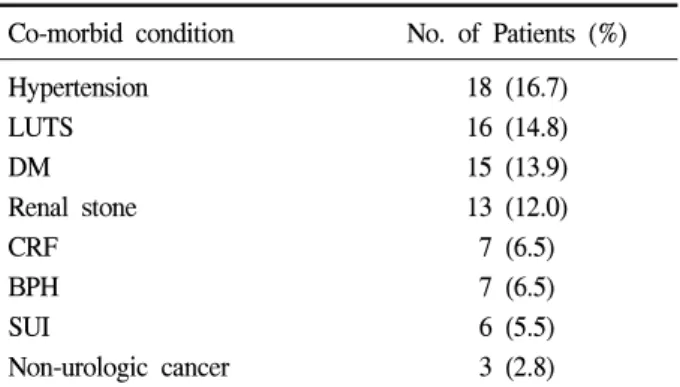
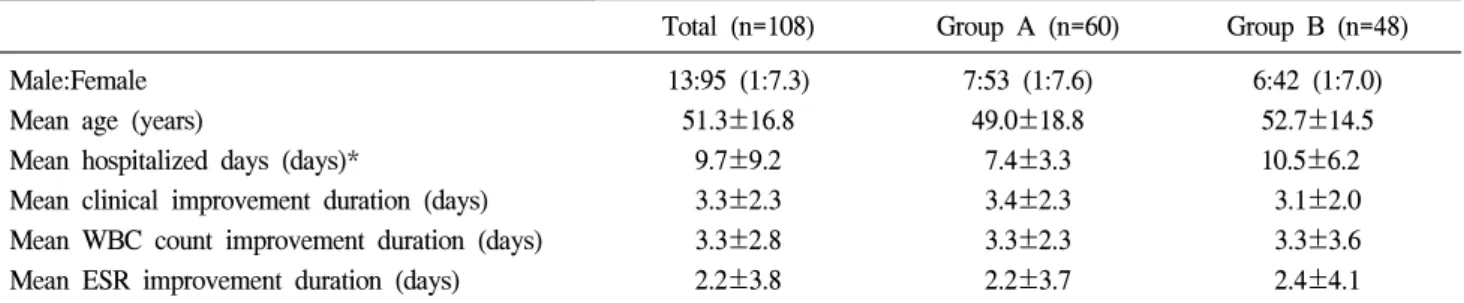
Results: The analysis included 108 patients with a male to female sexual ratio of 1:7.3, a mean age of 51.3±16.8 years and a mean number of hospitalized days of 9.7±9.2 days. The co-morbid conditions were hypertension in 18 patients (16.7%), LUTS in 16 patients (14.8%), and diabetes mellitus in 15 patients (13.9%).
The hospitalized durations of two groups were 7.4±3.3 and 10.5±6.2 days in group A and B. The uropatho- gen types were all E. coli in group A, whereas E. coli, Pseudomonas and Enterococcus were isolated in group B. Clinical and laboratory improvement duration of group A was significantly shorter than group B.
The longer hospitalized duration of group B was seen in chronic renal failure and diabetes mellitus patients for 10.4±5.4 and 14.0±4.3 days and the longer laboratory improvement duration of group B was seen in chronic renal failure and diabetes mellitus patients for 5.3±5.2 and 5.9±5.5 days.
Conclusions: We concluded that the acute pyelonephritis with co-morbidity conditions need longer hospitalized days than that without co-morbidity conditions. Two variable (diabetes mellitus, chronic renal failure) that predicted a poor response after therapy for acute uncomplicated pyelonephritis. The more variable uropathogen were identified in a urine culture with co-morbidity conditions. (Korean J UTII 2007;2:73-77)
Key Words: Acute pyelonephritis, Urinary tract infection, Hospitalization
•교신저자:이상돈, 부산대학교 의과대학 비뇨기과학교실 부산시 서구 아미동 1가 10
Tel: 051-240-7348, Fax: 051-247-5443 E-mail: [email protected]