Clinical Feasibility of Postural Alignment Exercise on Decreased Chest Function Secondary to Thoracic Kyphosis: A Single-Subject Study Design
Purpose: This study demonstrated a postural alignment exercise as conservative management strategy for a woman with excessive thoracic kyphosis presenting decreased chest function, and reports its results.
Methods: A 21-year-old woman with thoracic kyphosis presenting limited chest function. The exercise program underwent for 30 min in the intervention phase, which consisted of exercises to improve the strength of back extensor and to stretch anterior chest region. Outcome measures comprised the severity of thoracic kyphosis and chest function (vital capacity [VC], forced expiratory volume in a second [FEV1], and chest expansion length).
Results: The thoracic kyphotic angle decreased by 23.6% (9.38°) and 25.4% (10.58°) in the intervention and follow-up phases respectively. Also, chest function was improved in the intervention (VC: 3.7% [0.10 ℓ], FEV1: 17.1% [0.39 ℓ], and chest expansion length: 17.1% [0.96 cm]), and the improvement was maintained during the follow-up phase (VC: 4.8% [0.13 ℓ], FEV1: 17.1% [0.3 9 ℓ], and chest expansion length: 64.3% [1.81 cm]).
Conclusion: These findings suggest that the postural alignment exercise was favorable for improving chest function of a woman with thoracic kyphosis.
Key Words:Thoracic kyphosis, Chest function, Postural alignment exercise Hyun-Jung Jang1, Suhn-Yeop Kim1, Duck-Won Oh2
1Department of Physical Therapy, College of Natural Science, Daejeon University, 2Department of Physical Therapy, College of Health Science, Cheongju University
The Journal of Korean Society of Physical Therapy Original articles
I. Introduction
Thoracic kyphosis has been commonly reported as one of the most postural abnormalities in orthopedic practice, leading to spinal dysfunction and musculoskeletal discomfort, and may be related to poor postural habit and unsuitable work patterns that cause prolonged positioning in poor postural alignment, with lack of postural awareness.1 Thoracic kyphosis contributes to the changes in the position of the rib cage and the thoracic and abdominal cavities,2 these changes
Copylight ⓒ 2014 The Korea Society of Physical Therapy
This is an Open Access article distribute under the terms of the Creative Commons Attribution Non-commercial License (Http:// creativecommons.org/license/by-nc/3.0.) which permits unrestricted non-commercial use, distribution,and reproduction in any medium, provided the original work is properly cited.
Received May 19, 2014 Revised Jun 10, 2014 Accepted Jun 13, 2014
Corresponding author Duck-Won Oh, [email protected]
may be one of contributing factors to decrease rib mobility and to cause mechanical impairment in the respiratory system that results in mechanical disadvantages for the activities of respiratory muscles.3 That is, in thoracic cage, the organization of muscular activities can be disturbed by postural change, which leads to a failure in meeting requirements for adequate ventilation of the lung.4,5 Subsequently, the inspiratory effort is increased and the work efficiency for breathing is decreased by causing the decrease in chest expansion and loosing ventilatory capacity during a variety of physical activities.6
Postural abnormalities would be generally severer in an older population; however, treatment trials for thoracic kyphosis of a younger population are more essential because their symptoms may be more modifiable to change.1 In most researches that studied therapeutic strategies to improve
thoracic kyphosis, study focus has commonly been on its severity and the level of performance of the elderly as one of incidental symptoms induced by aging process. Although the etiology and disease course of postural thoracic kyphosis are unclear, it needs to understand the underlying mechanisms of musculoskeletal, neuromuscular, and sensory impairments in relation to postural kyphosis.7 Previous study suggested that increased kyphosis may impair postural perception and decrease an ability to integrate postural alignment, which make difficult to maintain normal upright posture.8
Strengthening and stretching exercises have been generally prescribed to encourage adaptive shortening of weakened musculotendinous units of back and to release shortened anterior torso portion in clinical setting, allowing reinforcing posture realignment.9 Some researchers studied the effects of a variety of exercise approaches including yoga10 and multi-dimensional program11 for individuals with thoracic hyperkyphosis. However, their results for the severity of thoracic kyphosis were not consistent, and they also did not involve the measure of respiratory function, which can be directly affected by postural change.
Study effort to identify whether enhancing the amendable impairment factors such as strength, range of motion, and postural alignment is beneficial in correcting flexed posture and concomitant symptoms had a little attention relatively.
Accordingly, this study aimed to describe detailed exercise protocol for an individual with thoracic kyphosis presenting reduced chest function and then to report the outcome of its application.
II. Methods
1. Subjects and Period
This study was performed from September 2nd to October 14th 2013 at D University. Subject was a 21-year-old female who displayed postural abnormality with forward head, thoracic kyphosis, and round shoulder, resulting from poor postural habit and sedentary lifestyle. She reported there were no any difficulties in her daily routine activities and limitations in neck, trunk, and shoulder motions. Further, she did not have a medical history with any neurological, orthopedic
and cardiopulmonary problems. The angle of her thoracic kyphosis was 42° as measured with a portable inclinometer.
She complained of reduced respiratory function (forced vital capacity <80% predicted value) with <3 cm of chest expansion length, which indicates a restrictive disease.12 No treatment has been performed for these problems in previous 6 months.
2. Protocol for intervention
A single-subject was used to identify the efficacy of the postural alignment exercise for the subject. This study was separated into three phases over 5 weeks: baseline, intervention, and follow-up with the session of the intervention.13 Within the initial week, no intervention was engaged for subject and then four measurements were performed to obtain baseline data. She participated in 8 exercise sessions that were conducted during the following 3 weeks, and the initial effects of the exercise were measured after completing each session. During the final week, 4 measurement sessions were carried out with withholding the intervention. All measurements and interventions were undertaken in the same sequence and at the same time of day by the first author. Prior to the initiation of this study, the detailed information about the study procedure and safety was given to her, and she singed to written, informed consent form. This study was in an approval from the University Institutional Review Board.
3. Measurement
The severity of thoracic kyphosis was measured by using specific inclinometers (Isomed Inc. 975 SE Sandy Blvd, Portland, OR 97214, USA), which consisted of two gravity- depending units. A unit of the inclinometers was positioned over the spinal processes of the 1st and 2nd thoracic spines, and another unit was placed over the 12th thoracic and 1st lumbar spines. The placement of the inclinometers was determined by manual palpation of the spinal levels, and the places were indicated by using 6 mm diameter adhesive markers to maintain measurement consistency. Measurements were performed in relaxed standing with subject employing a comfortable posture. To adopt a posture that felt natural to subject, we asked to swing subject’s arm smoothly forward
and backward 3 times by the sides; to inhale and exhale 3 times gently; and to take a comfortable position prior to each measurement. In addition, an electronic spirometer (Masterscop, Jaegger GmBh Co, Wuerzburg, Germany) was used to measure the vital capacity (VC) and forced expiratory volume in a second (FEV1), reflecting subject’s chest function.
For the measurement of VC and FEV1, subject was started with breathing at rest after the completion of zero adjustment.
Subject repeated several times to inhale slowly to maximal range and exhale in full force to the maximum at the sound of a beeper. All measurements were averaged over triplicate trials with 1-min rest interval. In addition, for the evaluation of chest expansion length, a difference of the circumference of the thorax between inhalation and exhalation in maximal
range was measured at the level of 10th ribs using a flat tape measure.
4. Postural alignment exercise program
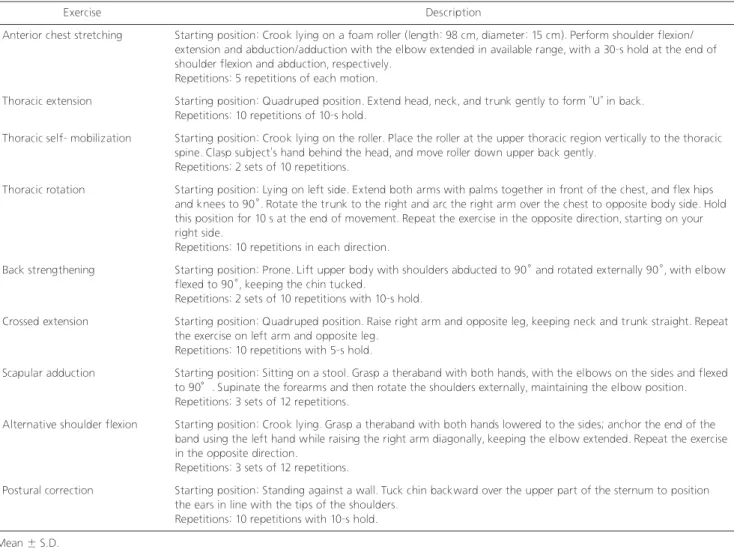
The postural alignment exercise program was established with a modification in previous studies of Kazman et al and Johnson & Grindstaff, which involved 9 exercise elements for improving flexibility, mobility, and strength of chest and trunk, attempting to enhance thoracic posture and breathing capability (Table 1).12,13 The intervention consisted of anterior chest stretching, thoracic extension, thoracic self-mobilization, back strengthening, scapular and shoulder exercises, and postural correction. The exercise program was performed for 30 minutes, three times per week during a 3-week period of
Exercise Description
Anterior chest stretching Starting position: Crook lying on a foam roller (length: 98 cm, diameter: 15 cm). Perform shoulder flexion/
extension and abduction/adduction with the elbow extended in available range, with a 30-s hold at the end of shoulder flexion and abduction, respectively.
Repetitions: 5 repetitions of each motion.
Thoracic extension Starting position: Quadruped position. Extend head, neck, and trunk gently to form “U” in back.
Repetitions: 10 repetitions of 10-s hold.
Thoracic self- mobilization Starting position: Crook lying on the roller. Place the roller at the upper thoracic region vertically to the thoracic spine. Clasp subject’s hand behind the head, and move roller down upper back gently.
Repetitions: 2 sets of 10 repetitions.
Thoracic rotation Starting position: Lying on left side. Extend both arms with palms together in front of the chest, and flex hips and knees to 90°. Rotate the trunk to the right and arc the right arm over the chest to opposite body side. Hold this position for 10 s at the end of movement. Repeat the exercise in the opposite direction, starting on your right side.
Repetitions: 10 repetitions in each direction.
Back strengthening Starting position: Prone. Lift upper body with shoulders abducted to 90° and rotated externally 90°, with elbow flexed to 90°, keeping the chin tucked.
Repetitions: 2 sets of 10 repetitions with 10-s hold.
Crossed extension Starting position: Quadruped position. Raise right arm and opposite leg, keeping neck and trunk straight. Repeat the exercise on left arm and opposite leg.
Repetitions: 10 repetitions with 5-s hold.
Scapular adduction Starting position: Sitting on a stool. Grasp a theraband with both hands, with the elbows on the sides and flexed to 90°. Supinate the forearms and then rotate the shoulders externally, maintaining the elbow position.
Repetitions: 3 sets of 12 repetitions.
Alternative shoulder flexion Starting position: Crook lying. Grasp a theraband with both hands lowered to the sides; anchor the end of the band using the left hand while raising the right arm diagonally, keeping the elbow extended. Repeat the exercise in the opposite direction.
Repetitions: 3 sets of 12 repetitions.
Postural correction Starting position: Standing against a wall. Tuck chin backward over the upper part of the sternum to position the ears in line with the tips of the shoulders.
Repetitions: 10 repetitions with 10-s hold.
Table 1. Postural alignment exercise program
Mean ± S.D.
VAS: visual analogue scale
the intervention phase (a total of 8 sessions).
5. Data analysis
Change in trend and stability of data collected from each variable was identified by visual inspection. For this, data collected from each session across all three phases (baseline, intervention, and follow-up phases) were plotted on a sample line graph, and presented as mean and standard deviation.
III. Results
Changes in thoracic kyphotic angle, VC, FEV1 and chest expansion length across the phases were summarized in Figure 1. The thoracic kyphotic angle decreased by 23.6%
(9.38°) and 25.4% (10.58°) in the intervention and follow- up phases respectively, as compared with the baseline data.
Also, the chest function was improved during a period of the intervention phase (VC: 3.7% [0.10 ℓ], FEV1: 17.1% [0.39 ℓ],
and chest expansion length: 17.1% [0.96 cm]), and it was maintained in the follow-up phase (VC: 4.8% [0.13 ℓ], FEV1: 17.1% [0.39 ℓ], and chest expansion length: 64.3% [1.81 cm]).
IV. Discussion
In present study, the postural alignment exercise was favorable for improving the severity of thoracic kyphosis and chest function of the subject. As found in this study, the severity of thoracic kyphosis of the subject decreased by 23.6% during a period of the intervention phase, and it was maintained in the follow-up phase. In such cases, there may be modifications of the contractile and non-contractile components within muscles,14 leading to the changes in muscle length and articular mobility. Also, muscle strength might be attributable to better interaction between the contractile components.15 Therefore, in this study, possible mechanism for improved
Figure1.
thoracic kyphosis may be a positive change in the interaction between the contractile components (actin and myosin) and a subsequent increase in the contractile capacity of the postural muscles within thoracic region.
In our study, main focuses in the exercise program were to enhance the strength of the scapulothoracic muscles and to stretch shortened anterior chest region, with an aim of encouraging postural realignment. These factors in the program may be beneficial to reinforce a proprioception in postural alignment.16 Strengthening weakened back muscles produces adaptive shortening of elongated back-supporting muscles and may be helpful to facilitate reciprocal relaxation of shortened anterior chest muscles simultaneously.
As found in this study, the improvement in the intervention phase was maintained during the follow-up phase, although there was no any therapeutic option in this phase. We believe that the exercise program may be likely to facilitate the proprioceptive function and thereby lead to the improved postural awareness. This study supports the study of Itoi and Sinaki that investigated the effects of the exercise program on the severity of thoracic kyphosis in post-menopausal subjects.11
Along with the improvement of thoracic kyphosis, chest function of the subject was enhanced in the intervention phase (VC: 3.7%, FEV1: 4.8%, and chest expansion length:
17.1%), and improved chest function was maintained during the follow-up phase (VC: 4.8%, FEV1: 17.1%, and chest expansion length: 64.3%). In restrictive pulmonary disease including thoracic kyphosis, the VC and FEV1 were remarkably decreased; therefore, these variables can be used as good indicators to determine the restrictive pulmonary conditions.17 Although FEV1 is to measure expiratory capacity, expiratory volume is related with inspiratory capacity to a certain degree. This study showed the increase in the VC and FEV1, which indicates the improvement of ventilatory capacity.
In people with excessive thoracic kyphosis, reduction in chest function may attribute to the functional changes of respiratory muscles, which result from mechanical disadvantage in the action of respiratory muscles, positioning for a longer time at poor postural alignment. Therefore, our findings suggest that the exercise program used in this study may be a good option
to modify postural alignment and to reinforce chest function of a woman with thoracic kyphosis. The measurement of chest expansion length used in this study has been commonly adopted for clinicians to evaluate the ability of rib mobility, with easy application.18
As seen in this study, an increase in chest expansion length during a period of the intervention phase is to indicate improved chest mobility, and it may be strongly related with improved VC and FEV1 because chest mobility affect respiratory capacity.19 Our study is in agreement with the study of Moreno that investigated the effects of the proprioceptive neuromuscular facilitation techniques on chest mobility and function of respiratory muscles in young women with sedentary life style.20
Single subject design provides valuable information about a subject’s response to intervention in a practical yet controlled way; therefore, it may be suitable research design that clinicians with limited resources study systemically a variety of therapeutic approaches in clinical setting. In this study, the long-term effects of the intervention couldn’t clarify because this design requires evaluating only the initial response to the intervention during the intervention phase.
In conclusion, the postural alignment exercise showed favorable outcomes for the severity of thoracic kyphosis and chest function of a woman with excessive thoracic kyphosis.
Therefore, the postural alignment exercise may be feasible as an extra-option to manage the symptoms of thoracic kyphosis in clinical setting.
References
1. Griegel-Morris P, Larson K, Mueller-Klaus K et al. Incidence of common postural abnormalities in the cervical, shoulder, and thoracic regions and their association with pain in two age groups of healthy subjects. Phys Ther. 1992;72(6):425-31.
2. Kang JI, Jung DG, Park SK et al. Forced expiratory volume in one second, Chest resistance exercise, Proprioceptive neuromuscular facilitation. J Koreran Soc Phys Ther.
2011;23(2):37-43.
3. Riera HS, Rubio TM, Ruiz FO et al. Inspiratory Muscle Training in Patients With COPD: Effect on Dyspnea, Exercise Performance, and Quality of Life. Chest. 2001;120(3):748-56.
4. Lee HY, Kang DY, Kim J. Analysis of Correlation between
Respiratory Characteristics and Physical Factors in Healthy Elementary School Childhood. J Korean Soc Phys Ther.
2013;25(5):330-6.
5. Lima LC, Baraúna MA, Sologurem MJ et al. Postural alterations in children with mouth breathing assessed by computerized biophotogrammetry. J Appl Oral Sci 2004;12(3):232-7.
6. Lee JH, Gwon YJ, Kim J. The Effect of Chest Expansion and Pulmonary Function of Stroke Patients after Breathing Exercise.
J Kor Soc Phys Ther. 2009;21(3):25-32.
7. Hinman MR. Comparison of thoracic kyphosis and postural stiffness in younger and older women. Spin J. 2004;4(4):413-7.
8. Itoi E, Sinaki M. Effect of back-strengthening exercise on posture in healthy women 49 to 65 years of age. Mayo Clin Proc 1994;69(11):1054-9.
9. Johnson KD, Grindstaff TL. Thoracic region self-mobilization: a clinical suggestion. Int J Sports Phys Ther. 2012;7(2):252-6.
10. Greendale GA, McDivit A, Carpenter A et al. Yoga for women with hyperkyphosis: results of a pilot study. Am J Public Health.
2002;92(10):1611-4.
11. Katzman WB, Sellmeyer DE, Stewart AL et al. Changes in flexed posture, musculoskeletal impairments, and physical performance after group exercise in community-dwelling older women. Arch Phys Med Rehabil. 2007;88(2):192-9.
12. Kagaya H, Takahashi H, Sugawara K et al. Effective home- based pulmonary rehabilitation in patients with restrictive lung diseases. Tohoku J Exp Med. 2009;218(3):215-9.
13. Mudge S, Rochester L, Recordon A. The effect of treadmill training
on gait, balance and trunk control in a hemiplegic subject: a single system design. Disabil Rehabil. 2003;25(7):1000-7.
14. Williams PE, Goldspink G. Changes in sarcomere length and physiological properties in immobilized muscle. J Anat.
1978;127(3):459-68.
15. Tursky EA. Muscle training: physiology and practical applications of training for strength versus endurance. Orthop Nurs. 1991;10(2):27-32.
16. Sinaki M, Brey RH, Hughes CA et al. Significant reduction in risk of falls and back pain in osteoporotic-kyphotic women through a Spinal Proprioceptive Extension Exercise Dynamic (SPEED) program. Mayo Clin Proc. 2005;80(7):849-55.
17. Di Bari M, Chiarlone M, Matteuzzi D et al. Thoracic kyphosis and ventilatory dysfunction in unselected older persons:
an epidemiological study in Dicomano. J Am Geriatr Soc 2004;52(6):909-15.
18. Bockenhauer SE, Chen H, Julliard KN et al. Measuring thoracic excursion: reliability of the cloth tape measure technique. J Am Osteopath Assoc 2007;107(5):191-6.
19. Putt MT, Watson M, Seale H et al. Muscle stretching technique increases vital capacity and range of motion in patients with chronic obstructive pulmonary disease. Arch Phys Med Rehabil 2008;89(6):1103-7.
20. Moreno MA. Padrões de facilitação neuromuscular proprioceptiva e seu efeito na capacidade respiratória, Campinas. Fisioter Mov.
2005;18(2);53061.