Association between Body Mass Index and Serum Dehydroepiandrosterone Sulfate Level in 8-Year-Old Girls
Ji-Hyun Na, Young-Hwan Kim, Suk-Jin Hong, Jin-Kyung Kim*
Department of Pediatrics, Daegu Catholic University School of Medicine, Daegu, Korea
Background: Adiposity may play a role as a potential trigger for adrenarche. The purpose of this study was to evaluate the association between body mass index (BMI) and serum dehydroepiandrosterone sulfate (DHEAS) level.
Methods: The medical records of 8-year-old girls who presented to our clinic between 2014 and 2016 with concerns regarding pubertal changes were retrospectively reviewed. The 192 girls were divided into two groups depending on activation of the hypothalamic-pituitary-gonadal (HPG) axis. Group I included 77 subjects with a breast Tanner stage 1 with unknown HPG axis or thelarche without activated HPG axis. Group II included 115 subjects with activated HPG axis. Serum DHEAS level ≥1.1 µmol/L was regarded as biochemical adrenarche.
Results: Based on correlation analyses, BMI standard deviation score (SDS) was positively correlated with height SDS, bone age divided by chronological age (BA/CA), and DHEAS level in all subjects (r=0.269, r=0.270, r=0.298; all P<0.001, respectively). BMI SDS was negatively correlated with peak luteinizing hormone level in group II (r=–0.236, P=0.011). Based on multiple linear regression analyses, BMI SDS was associated with serum DHEAS level in all subjects (β=0.280, P<0.001), group I (β=0.415, P=0.001), and group II (β=0.206, P=0.030).
DHEAS level was also associated with BA/CA in all subjects (β=0.402, P<0.001), group I (β=0.494, P<0.001), and group II (β=0.347, P<0.001).
Conclusion: BMI SDS was associated with DHEAS level, which was associated with BA/CA. Childhood obesity may influence the development of adrenarche, which may contribute to advanced skeletal maturation.
Key words: Biochemical adrenarche, Dehydroepiandrosterone sulfate, Body mass index
Received January 23, 2018 Reviewed February 20, 2018 Accepted April 23, 2018
* Corresponding author Jin-Kyung Kim
https://orcid.org/0000-0003-0018-851X Department of Pediatrics, Daegu Catholic University School of Medicine, 33 Duryugongwon-ro 17-gil, Nam-gu, Daegu 42472, Korea
Tel: +82-53-650-4597 Fax: +82-53-650-4243 E-mail: [email protected]
INTRODUCTION
Pubertal maturation consists of two processes, gonadarche and adrenarche. Gonadarche is the secretion of gonadal sex steroids by pubertal activation of the hypothalamic-pituitary-gonadal (HPG) axis. The age of onset in girls is typically between 8 and 13 years.
1Adrenarche refers to a maturational increase in adrenal androgen production.
2,3Adrenarche is characterized by expansion of the ad- renal zona reticularis, unique expression of steroidogenic enzymes and cofactors
4-6, and changes in the pattern of adrenal biosynthetic
and secretory response to adrenocorticotropic hormone (ACTH).
In adrenarche, 17-ketosteroid responsiveness to ACTH increases, while cortisol responsiveness to ACTH remains unchanged.
7Therefore, adrenarche leads to increased production of adrenal an- drogens, dehydroepiandrosterone (DHEA), and its sulfate ester (dehydroepiandrosterone sulfate [DHEAS]), but no increase in cortisol level.
2-4While the clinical signs of adrenal androgen action are normally observed after the age of 8 years, the increase in adre- nal androgen production associated with adrenarche generally be- gins at approximately 6–8 years of age.
3DHEAS has a much lower
Copyright © 2018 Korean Society for the Study of Obesity
This is an Open Access article distributed under the terms of the Creative Commons Attribution Non-Commercial License (http://creativecommons.org/licenses/by-nc/4.0/) which per- mits unrestricted non-commercial use, distribution, and reproduction in any medium, provided the original work is properly cited.
2017-03-16 https://crossmark-cdn.crossref.org/widget/v2.0/logos/CROSSMARK_Color_square.svg
Association between Body Mass Index and Serum Dehydroepiandrosterone Sulfate Level in 8-Year-Old Girls
Ji-Hyun Na, Young-Hwan Kim, Suk-Jin Hong, Jin-Kyung Kim*
Department of Pediatrics, Daegu Catholic University School of Medicine, Daegu, Korea
Background: Adiposity may play a role as a potential trigger for adrenarche. The purpose of this study was to evaluate the association between body mass index (BMI) and serum dehydroepiandrosterone sulfate (DHEAS) level.
Methods: The medical records of 8-year-old girls who presented to our clinic between 2014 and 2016 with concerns regarding pubertal changes were retrospectively reviewed. The 192 girls were divided into two groups depending on activation of the hypothalamic-pituitary-gonadal (HPG) axis. Group I included 77 subjects with a breast Tanner stage 1 with unknown HPG axis or thelarche without activated HPG axis. Group II included 115 subjects with activated HPG axis. Serum DHEAS level ≥1.1 µmol/L was regarded as biochemical adrenarche.
Results: Based on correlation analyses, BMI standard deviation score (SDS) was positively correlated with height SDS, bone age divided by chronological age (BA/CA), and DHEAS level in all subjects (r=0.269, r=0.270, r=0.298; all P<0.001, respectively). BMI SDS was negatively correlated with peak luteinizing hormone level in group II (r=–0.236, P=0.011). Based on multiple linear regression analyses, BMI SDS was associated with serum DHEAS level in all subjects (β=0.280, P<0.001), group I (β=0.415, P=0.001), and group II (β=0.206, P=0.030).
DHEAS level was also associated with BA/CA in all subjects (β=0.402, P<0.001), group I (β=0.494, P<0.001), and group II (β=0.347, P<0.001).
Conclusion: BMI SDS was associated with DHEAS level, which was associated with BA/CA. Childhood obesity may influence the development of adrenarche, which may contribute to advanced skeletal maturation.
Key words: Biochemical adrenarche, Dehydroepiandrosterone sulfate, Body mass index
Received January 23, 2018 Reviewed February 20, 2018 Accepted April 23, 2018
* Corresponding author Jin-Kyung Kim
https://orcid.org/0000-0003-0018-851X Department of Pediatrics, Daegu Catholic University School of Medicine, 33 Duryugongwon-ro 17-gil, Nam-gu, Daegu 42472, Korea
Tel: +82-53-650-4597 Fax: +82-53-650-4243 E-mail: [email protected]
rate of clearance from the circulation than DHEA. DHEAS has neither a diurnal rhythm nor day-to-day variation. Serum DHEAS level is the best marker of adrenal androgen secretion.
2,3DHEAS levels above 1.1 µmol/L are regarded as a biochemical hallmark of adrenarche.
2,3Guran et al.
8reported the cut-off age for an increase in DHEAS above 1.1 µmol/L is 8 years for girls and 7 years for boys. High prepubertal DHEAS level is associated with premature adrenarche (PA), defined as the appearance of clinical signs of ad- renarche before the age of 8 years in girls, along with elevated DHEAS level for that age. Although PA is usually considered be- nign, in some girls, PA has been associated with several metabolic disturbances including hyperinsulinemia, dyslipidemia, or polycys- tic ovary syndrome.
2,3The initiation mechanisms of adrenarche re- main mostly unclear although adiposity may play a role as a poten- tial trigger.
2,3Previous studies have shown that low birth weight and small size for gestational age are associated with higher prepubertal adrenal androgen production, mainly in girls, especially if accompa- nied by rapid weight gain in early childhood.
9-13Higher prepubertal adrenal androgen production has also been reported in obese chil- dren with normal birth weight.
13-15Therefore, we retrospectively evaluated the medical records of 8-year-old girls to investigate the associations between body mass index (BMI) and serum DHEAS level.
METHODS Subjects
We retrospectively reviewed the medical records of 8-year-old girls who visited Daegu Catholic University Medical Center be- tween January 2014 and December 2016 with concerns regarding pubertal changes. In the present study, 192 healthy girls who un- derwent medical and physical examinations were evaluated. All subjects were born at term with a birth weight ≥ 2,500 g. Girls with chronic diseases, organic brain lesions, or receiving any drug treat- ment or exogenous hormone therapy were excluded. Pubertal sta- tus (breast development and pubic hair) was also recorded. Go- nadotropin-releasing hormone (GnRH) stimulation test was con- ducted in 178 girls. The subjects were divided into two groups de- pending on activation of the HPG axis. Group I included 77 sub- jects with a breast Tanner stage 1 with unknown HPG axis or the-
larche without activation of the HPG axis, and group II included 115 subjects with activated HPG axis. This study was approved by the Institutional Review Board of the Daegu Catholic University Medical Center, Daegu, Korea (IRB No. CR-17-060). The need for informed consent was waived by the board.
Measurement and laboratory evaluation
The height and weight of each patient were measured, and BMI was calculated by dividing weight (kg) by squared height (m
2).
Height, weight, and BMI were expressed as a standard deviation score (SDS) according to age- and sex-matched growth charts of Korean children and adolescents published in 2007 by the Korea Centers for Disease Control and Prevention and the Korea Nation- al Institute of Health.
16Normal weight was defined as a BMI
< 85th percentile for age and sex, and overweight/obese was de- fined as a BMI ≥ 85th percentile for age and sex. Sexual maturity ratings were determined according to the Marshall and Tanner staging method.
17Bone age (BA) was assessed using radiographs of the left hand according to the method of Greulich and Pyle.
18Bone age divided by chronological age (BA/CA) was used as an index of BA advancement. In subjects with thelarche, the GnRH stimula- tion test was performed by intravenous administration of 100 µg of gonadorelin (Relefact; Sanofi-Aventis, Frankfurt am Main, Germa- ny) for the diagnosis of gonadarche. Activation of the HPG axis was defined by peak luteinizing hormone (LH) level ≥ 5 IU/L us- ing the GnRH stimulation test.
19Serum LH level was measured us- ing an electrochemiluminescence immunoassay on a Cobas 8000 modular analyzer (Roche Diagnostics, Mannheim, Germany). Se- rum DHEAS concentration was measured using chemilumines- cence immunoassay on an Immulite 2000 XPi System (Siemens Healthcare Diagnostics, Flanders, NJ, USA). Biochemical adre- narche was defined as an increase in circulating adrenal androgen concentration with a serum DHEAS level ≥ 1.1 µmol/L.
2,3Statistical analysis
All statistical analyses were performed using IBM SPSS version
20.0 (IBM Corp., Armonk, NY, USA). Values are presented as
mean± standard deviation for continuous variables. Student t-test
and Mann-Whitney U-test were applied for comparison between
two groups. The chi-square test was used to compare proportions.
Correlations were evaluated using Spearman correlation coeffi- cient. Multivariate linear regression analyses were performed to in- vestigate the influence of clinical and biochemical variables on the changes in serum DHEAS level and the degree of advanced skeletal maturation (BA/CA). A P-value <0.05 was considered statistically significant.
RESULTS
Anthropometric characteristics and hormonal status of the study population
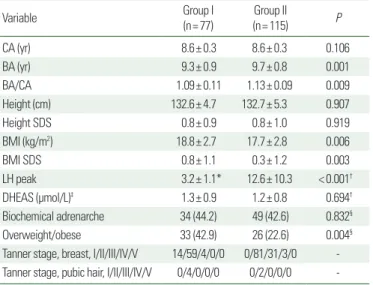
Medical records of 192 girls aged 8 years were evaluated. Group I included 77 girls and group II included 115 girls. The mean BA/CA was 1.09± 0.11 in group I and 1.13± 0.09 in group II (P=0.009).
The mean BMI SDS was 0.8± 1.1 in group I and 0.3± 1.2 in group II (P=0.003). The mean DHEAS level was 1.3±0.9 µmol/L in group I and 1.2± 0.8 µmol/L in group II. Biochemical adrenarche was observed in 34 girls (44.2%) in group I and 49 girls (42.6%) in
group II. The number of overweight/obese girls was higher in group I (42.9%) than in group II (22.6%, P=0.004) (Table 1).
Correlations and multiple linear regression analysis
Based on Spearman correlation analyses, BMI SDS was signifi- cantly and positively correlated with height SDS, BA/CA, and DHEAS level in all subjects (r = 0.269, r = 0.270, r = 0.298; all P <0.001, respectively); group I subjects (r =0.292, P =0.010;
r= 0.276, P=0.015; r=0.398, P<0.001, respectively), and group II subjects (r= 0.251, P=0.007; r=0.366, P<0.001; r=0.252, P=
0.007, respectively). BMI SDS was significantly and negatively cor- related with peak LH level in all subjects (r= –0.353, P<0.001) and in group II subjects (r= –0.236, P=0.011) (Table 2).
Based on multiple linear regression analyses, BMI SDS was asso- ciated with serum DHEAS level in all subjects (β = 0.280, P <
0.001), group I (β= 0.415, P=0.001), and group II (β=0.206, P=
0.030) (Table 3). DHEAS level was associated with BA/CA in all subjects (β= 0.402, P<0.001), group I (β=0.494, P<0.001), and group II (β= 0.347, P<0.001) (Table 4).
Table 1. Anthropometric characteristics and hormonal status of the subjects
Variable Group I
(n= 77) Group II
(n= 115) P
CA (yr) 8.6± 0.3 8.6± 0.3 0.106
BA (yr) 9.3± 0.9 9.7± 0.8 0.001
BA/CA 1.09± 0.11 1.13± 0.09 0.009
Height (cm) 132.6± 4.7 132.7± 5.3 0.907
Height SDS 0.8± 0.9 0.8± 1.0 0.919
BMI (kg/m2) 18.8± 2.7 17.7± 2.8 0.006
BMI SDS 0.8± 1.1 0.3± 1.2 0.003
LH peak 3.2± 1.1* 12.6± 10.3 < 0.001†
DHEAS (µmol/L)‡ 1.3± 0.9 1.2± 0.8 0.694†
Biochemical adrenarche 34 (44.2) 49 (42.6) 0.832§
Overweight/obese 33 (42.9) 26 (22.6) 0.004§
Tanner stage, breast, I/II/III/IV/V 14/59/4/0/0 0/81/31/3/0 - Tanner stage, pubic hair, I/II/III/IV/V 0/4/0/0/0 0/2/0/0/0 - Values are presented as mean± standard deviation or number (%). Student t-test was applied for comparison between the two groups. Group I included subjects with a breast Tanner stage 1 with unknown HPG axis or thelarche without activation of the HPG axis, and group II included subjects with activated HPG axis.
*Gonadotropin-releasing hormone stimulation test was conducted in 63 of 77 girls in group I and all girls in group II; †Mann-Whitney U-test was applied for comparison be- tween the two groups; ‡DHEAS level < 0.4 µmol/L was calculated as 0.38 µmol/L; §Chi- square test was applied to compare proportions.
CA, chronological age; BA, bone age; BA/CA, bone age divided by chronological age;
SDS, standard deviation score; BMI, body mass index; LH peak, peak stimulated lutein- izing hormone level; DHEAS, dehydroepiandrosterone sulfate; HPG, hypothalamic-pitu- itary-gonadal.
Table 2. Spearman correlation coefficients of the subjects
Variable BMI SDS BA/CA DHEAS LH peak*
r P r P r P r P
Total (n= 192)
Height SDS 0.269 < 0.001 0.407 < 0.001 0.206 0.004 0.085 0.262 BMI SDS 0.270 < 0.001 0.298 < 0.001 –0.353 < 0.001
BA/CA 0.487 < 0.001 0.175 0.019
DHEAS –0.050 0.512
Group I (n= 77)
Height SDS 0.292 0.010 0.316 0.005 0.291 0.010 0.055 0.670 BMI SDS 0.276 0.015 0.398 < 0.001 0.007 0.959
BA/CA 0.578 < 0.001 –0.027 0.834
DHEAS 0.069 0.594
Group II (n= 115)
Height SDS 0.251 0.007 0.482 < 0.001 0.150 0.110 0.167 0.075 BMI SDS 0.366 < 0.001 0.252 0.007 –0.236 0.011
BA/CA 0.453 < 0.001 0.123 0.190
DHEAS –0.090 0.339
Group I included subjects with a breast Tanner stage 1 with unknown HPG axis or the- larche without activation of the HPG axis, and group II included subjects with activated HPG axis.
*Gonadotropin-releasing hormone stimulation test was conducted in 178 girls.
BMI, body mass index; SDS, standard deviation score; BA/CA, bone age divided by chronological age; DHEAS, dehydroepiandrosterone sulfate; LH peak, peak stimulated luteinizing hormone level; HPG, hypothalamic-pituitary-gonadal.
DISCUSSION
A distinct interindividual variation was observed not only in the timing of adrenarche, but also in the amount of adrenal androgen precursor production.
2,3In this study, serum DHEAS level showed a wide distribution from 0.4 µmol/L to 5.1 µmol/L. Serum DHEAS level was below 0.4 µmol/L in 20 of 192 girls. The prevalence of biochemical adrenarche in all subjects with concerns regarding pu- bertal changes was 43.2% (44.2% of girls without HPG axis activa- tion and 42.6% of girls with HPG axis activation). In most girls without HPG axis activation, thelarche may reflect the peripheral source of sex steroids. However, in several girls, the degree of the- larche progressed during the follow-up period, which might be as- sociated with activation of the HPG axis. Furthermore, some of the overweight/obese girls may have experienced HPG axis activation.
Recent studies have shown that obesity affects the LH response to the GnRH stimulation test in girls.
20,21During the GnRH stimula- tion test, peak LH level was significantly lower in obese and over- weight subjects than in normal weight subjects, in Tanner stage 2
and 3 girls.
21BMI was negatively correlated with peak LH level.
20In this study, BMI SDS was also negatively correlated with peak LH level. Therefore, it is difficult to conclude that the prevalence of biochemical adrenarche in girls with gonadarche (activation of HPG axis) was lower than in girls without activation of the HPG axis.
The present study included 83 girls with biochemical adre- narche. However, only six of these 83 girls presented with pubarche, four of whom presented with pubarche without thelar- che. Pubarche in these four girls was due to the development of ad- renarche. The clinical presentation of adrenarche did not always correlate with serum DHEAS concentration. DHEA and DHEAS are very weak androgen receptor agonists that undergo extraglan- dular metabolism to produce active androgen, which activates the androgen receptor. The appearance of clinical signs varies depend- ing on the peripheral metabolism and sensitivity to androgens.
2,3In addition, the conversion to active androgens in peripheral adipose tissue may be enhanced by obesity.
22In several studies, obese children were reported to have BA that
Table 3. Multiple linear regression analysis of factors affecting serum DHEAS level in 8-year-old girlsVariable All subjects (n= 192) Group I (n= 77) Group II (n= 115)
B SE β P B SE β P B SE β P
CA –0.682 4.892 –0.010 0.889 –1.795 9.144 –0.023 0.845 –0.618 5.667 –0.010 0.913
BMI SDS 7.461 1.988 0.280 < 0.001 14.833 4.236 0.415 0.001 4.932 2.243 0.206 0.030
LH peak –0.145 0.240 –0.045 0.545 –0.992 3.889 –0.030 0.800 –0.242 0.250 –0.090 0.335
Adjusted R2 0.071 0.133 0.029
Group I included subjects with a breast Tanner stage 1 with unknown HPG axis or thelarche without activation of the HPG axis, and group II included subjects with activated HPG axis.
DHEAS, dehydroepiandrosterone sulfate; B, unstandardized coefficients; SE, standard error; β, standardized coefficients; CA, chronological age; BMI, body mass index; SDS, stan- dard deviation score; LH peak, peak stimulated luteinizing hormone; HPG, hypothalamic-pituitary-gonadal.
Table 4. Multiple linear regression analysis of factors affecting BA/CA in 8-year-old girls
Variable All subjects (n= 192) Group I (n= 77) Group II (n= 115)
B SE β P B SE β P B SE β P
Height SDS 0.036 0.007 0.335 < 0.001 0.034 0.014 0.273 0.020 0.037 0.007 0.391 < 0.001
BMI SDS 0.007 0.006 0.080 0.231 –0.001 0.014 –0.005 0.971 0.013 0.006 0.166 0.034
DHEAS 0.001 0.000 0.402 < 0.001 0.002 0.000 0.494 < 0.001 0.001 0.000 0.347 < 0.001
LH peak 0.002 0.001 0.196 0.002 –0.005 0.011 –0.052 0.620 0.001 0.001 0.148 0.052
Adjusted R2 0.381 0.334 0.406
Group I included subjects with a breast Tanner stage 1 with unknown HPG axis or thelarche without activation of the HPG axis, and group II included subjects with activated HPG axis.
BA/CA, bone age divided by chronological age; B, unstandardized coefficients; SE, standard error; β, standardized coefficients; SDS, standard deviation score; BMI, body mass index;
DHEAS, dehydroepiandrosterone sulfate; LH peak, peak stimulated luteinizing hormone; HPG, hypothalamic-pituitary-gonadal.