52
아세클로페낙과 그 대사체의 약물동태 연구 및 생물학적 동등성
임춘화a·황인택a·김은영b·강원구c
a을지의과대학교, b삼성서울병원 약제부,
c대구가톨릭대학교 약학대학
Pharmacokinetic Study of Aceclofenac and its Metabolites, and Application to Bioequivalence Study
Chun-hwa Ihma, In-taek Hwanga, Eun-young Kimb and Wonku Kangc
aEulgi University School of medicine, Daejeon 301-832
bDepartment of Pharmacy, Samsung Medical Center, Seoul 135-710
cCollege of Pharmacy, Catholic University of Daegu, Kyungbuk 712-702
Aceclofenac, a nonsteroidal antiinflammatory agent of a phenylacetic acid type, has been used for rheumatoid arthritis and osteoarthritis. Although the metabolic pathway of aceclofenac is relatively well-known in vitro, pharmacokinetic profiles of its three major metabolites are still unclear in human. The present study was designed to investigate pharma- cokinetic profiles of the metabolites of aceclofenac, and to evaluate the bioequivalence of the generic preparation of aceclofenac 100 mg tablet. Blood samples were serially collected for a period of 12 hours following a single oral administration of 100 mg aceclofenac in 20 healthy human volunteers. A simple protein precipitation with acetonitrile was employed to purify those substances from plasma. Aceclofenac, diclofenac, 4'-hydroxyaceclofenac and 4'-hydroxy- diclofenac in heparinized plasma were simultaneously measured with flufenamic acid, an internal standard, using HPLC coupled to a tandem mass spectrometer. Time courses of 4’-hydroxydiclofenac, diclofenac and aceclofenac plasma con- centrations were clearly revealed, and the pharmacokinetic properties were analyzed. The 90% confidence intervals for the ratios of test/reference for log-transformed AUC and Cmax lie within 0.80-1.25.
□Keywords − aceclofenac, metabolites, LC/MS/MS, pharmacokinetics, bioequivalence
아세클로페낙은 2-[(2,6-dichlorophenyl)amino] phenylacetoxyacetic acid의 화학구조를가진 비스테로이드성소염진통제로류마 티스성관절염이나골관절염에우수한효과를나타내고있다.
1-3)급성관절통증을호소하는환자들의활액(synovial fluid)내
의 prostaglandin E2를감소시키는역할을하며, 심한골관절
염을 앓고 있는 환자들의 다형핵백혈구(polymorphonuclear leukocytes)나 단핵구 세포(mononuclear cells)들에 의한
prostaglandin E2의 생성을억제하는 것으로알려져 있다.4-5)
Yamazaki 등의 연구에 의하면 아세클로페낙은 류마티스성
활액세포에의한 prostaglandin E2의생성또한억제하는것 으로밝혀졌다.
아세클로페낙은 간마이크로좀 효소군(cytochrome P450 enzyme, CYP) 중 CYP2C9에 의해 대사되어 4’-hydroxy-
aceclofenac으로 대사되며가수분해를거쳐최종 대사산물인
4’-hydroxy-diclofenac으로전환된다. 한편아세클로페낙은먼 저 가수분해되어 diclofenac으로 전환된후 CYP2C9에 의해 최종산물로전환되기도한다7-8) (Fig. 1).
Henrotin 등이 발표한 아세클로페낙 및 그 대사체들의
cytokines생성 및 cyclooxygenase(COX) 저해 연구에서디클 로페낙과 4’-hydroxy-aceclofenac은모화합물에비해 interlukin- 6 생성 및 prostaglandin E2 생성을 유의성 있게 억제하는 것으로 나타났다. 또한 디클로페낙이 COX-1 및 COX-2에 대해 강한 억제 작용을 나타낸 반면 아세클로페낙과
4’hydroxy-aceclofenac은 COX-2에 대해서만억제 작용을나
타냈으며 아세클로페낙은 4’hydroxy-aceclofenac에 비해 4.5
배강력한효과를보였다. 9)
대사경로및대사체가밝혀졌으나아세클로페낙대사체들 의 체내거동에 관해서는거의 보고되어있지않다. 유일하 게 medline에보고된문헌은 2003년 Hinz 등에 의해보고된 것으로아세클로페낙및세가지대사체의동시분석법이소 개되었고, 3명의 건강한 성인을 대상으로 아세클로페낙
Correspondence to : 강원구
대구가톨릭대학교약학대학 경북경산시하양읍
Tel: 053-850-3619, Fax: 053-850-3602 E-mail: [email protected]
100mg을단회투여한후혈중농도의추이가보고되었다. 이 들의연구에서는혈장내의아세클로페낙과세가지대사체를 헥산(n-hexane)과 에테르(diethylether)의 혼합 유기용매로추 출한후유기층을증발건고시켜이동상으로재용해하여자 외선검출기로 측정하였다. 검출한계가 충분히낮지 않았고 적은지원자들로부터얻은결과였기때문에아세클로페낙의 대사체들에관한체내약물동태를충분히얻지못하였다.10)
최근본연구팀에서는병렬질량분석기(tandem mass spectro-
meter)를이용하여매우감도가좋고, 간단한전처리과정만
을통해단시간내에아세클로페낙과세가지대사체를동시 에정량하는방법을개발하였다.11)본연구는분석법검증을 마친분석법을이용하여건강한성인지원자들에게아세클로
페낙 100 mg을단회 경구투여한 후시간별 혈중농도의추
이를 분석하였다. 모화합물인아세클로페낙의혈중 농도자 료로부터대조약에대한시험약의생물학적동등성을평가하 였고, 아세클로페낙의대사체들의체내거동을파악하였다.
실험재료 및 방법
재료 및 시약
아세클로페낙(aceclofenac), 디클로페낙(diclofenac) 및 4'- hydroxy-diclofenac 표준품은 Novartis Pharma AG(Basel,
Switzerland)로부터 제공받았고, 내부표준물질로 사용한
flufenamic acid와 이동상에 사용한 formic acid는 Sigma 사
로부터 구입하였다. 그 외의 용기용매 등은 모두 Merck사
(Darmstadt, Germany)의 HPLC용을사용하였다.
대조약으로는대웅제약의에어탈을, 시험약으로는대우약 품의대우아세클로페낙을각각사용하였다.
임상시험 디자인
20명의건강한성인남녀를대상으로생물학적동등성시험 을실시하였다. 시험전시험에관한충분한설명후지원자 개개인으로부터자필서명을받은 후시험을실시하였고시 험참가의적절성은사전에실시한건강검진결과에따라판 정하였다. 임상시험실시전에을지의과대학의임상시험윤리
위원회(IRB, Institutional Review Board)의 승인을 득하였으
며시험결과에관해서도검토를받았다.
시험에참여한지원자들의평균연령은 24±3세 (20~29세)
였으며 평균 체중은 63.2±9.5 kg (45~75 kg)이었고 키는
165.4±8.4 cm (150~179 cm)였다. 시험실시 전에 혈액학
(hemoglobin, hematocrit, white blood cell, platelets, WBC differential counts), 혈액생화학(blood urea nitrogen, total bilirubin, cholesterol, total protein, albumin, alkaline phos- phatase, glucose, AST, ALT) 및 뇨검사(specific gravity, color, pH, sugar, albumin, bilirubin, RBC, WBC, casts) 결과와 내 과적진찰소견을통해건강한것으로판정된지원자들만을 시험에참여시켰다.
지원자들을 10명씩 각각 2군으로나누고, 12시간 절식후
아세클로페낙 100 mg을 함유하고있는대조약및 시험약을
각각 1정씩 1회경구 투여 하였다. 투여전 및투여 후 0.5, 1, 1.5, 2, 2.5, 3, 4, 6, 8, 10 및 12 시간에반복적으로혈액 을 채취하였다. 혈액은헤파린이 처리된 튜브에 담아 냉장 원심분리기를이용하여 3000 rpm에서 10분간 원심분리하여 혈장 시료를얻었고분석시까지 -80oC 에보관하였다. 1주 일의 휴약기간을 두고 두 약물을 교차 투여 한 후 동일한 시간에채혈하여혈장을분리보관하였다.
혈중농도 분석
아세클로페낙및대사체들의정량은검증을마친분석법에 따라 수행하였다.11) 아세클로페낙, 디클로페낙, 4'-hydroxy- diclofenac 및 flufenamic acid를 각각 메탄올에 녹여 1 mg/
ml의표준용액을제조하여냉장보관하면서사용하였다. 아
세클로페낙및대사체의표준혈장시료는메탄올에의해계 열 희석된 표준용액을 공혈장에 넣어 표준혈장용액으로써
100µl를 제조하였다. 아세클로페낙의 검량선에 사용되었던 표준혈장시료의농도는 0.1, 0.2, 0.5, 1, 2, 5, 10µg/ml였으 며 디클로페낙과 4'-hydroxy-diclofenac의 표준혈장시료농도 는 0.001, 0.005, 0.01, 0.02, 0.05, 0.1, 0.5, 1µg/ml였다.
표준혈장시료 및건강한성인지원자들로부터얻은혈장 시료 각 100µl에 내부표준물질 (flufenamic acid, 10 ng/ml)
을포함하고있는메탄올용액 400µl를가한후 5초간격렬 히 혼화하였고, 13,200 rpm에서 10분간 원심분리하여 단백 질을 제거하였다. 상등액 10µl를 HPLC에 주입하였으며검 량선의농도에따른내부표준물질의피이크면적에대한시 험물질의피이크면적비를이용하여검량선을작성하였다.
분석용칼럼으로는 (Zorvax eclipse XDB-C18, 2.1×100 mm, Fig. 1. Metabolic pathways of aceclofenac in human (adapted
from Bort et al. 7-8)).
3.5µm; Agilent, DE, USA)를 사용하였으며 이동상으로는
0.1% formic acid를 함유하고 있는 80% 메탄올 수용액을
0.2 ml/min의 속도로 흘렸다. 검출기로는 ABI Applied Bio- systems/MDS SCIEX API 4000TM LC/MS/MS System (Sciex Division of MDS Inc., Toronto, Canada)을이용하였다. Turboion spray interface가 장착되어 있으며 5500V, 400oC에서
negative mode를사용하였고분석에필요한질소가스의압력
및 유속은 다음과 같다. Nebulizing gas flow는 1.04 l/min, auxiliary gas flow 및 curtain gas는 각각 4.0 및 16 l/min였 다. Orifice voltage는 80V, ring voltage는 400V, collision gas (nitrogen) pressure는 3.58×10⁻⁵ Torr였다. 정량을 위해서 는아세클로페낙, 디클로페낙, 4'-hydroxy-diclofenac과내부표
준물질의 protonated precursor 이온과 product 이온을동시에
측정하는 multiple reaction monitoring (MRM)을실시하였다.
아세클로페낙, 디클로페낙, 4'-hydroxy-diclofenac 및
flufenamic acid의 [M-H]- 이온의 mass transition은 각각 m/z 352.9→74.9 [declustering potential (DP), -55 eV; collision energy (CE), -20 eV], 296.1→251.7 (DP, -35 eV; CE, -16 eV), 311.8→267.7 (DP, -30 eV; CE, -16 eV) 및 279.9→ 235.9 (DP, -70 eV; CE, -26 eV), 이었다. 4'-hydroxy- aceclofenac의 mass transition은 아세클로페낙과 동일한
product 이온을가정하였고 DP 및 CE 값도 아세클로페낙과 동일한 조건하에서 검출하였다 (m/z 368.974.9; DP, -55 eV;
CE, -20 eV).
약물동태학적 분석 및 통계처리
아세클로페낙과대사체들의시간별혈중농도자료를모델 비의존형방법(non-compartmental analysis)에 따라 분석하여 약물동태학적 parameter들을 산출하였다. 시간별 혈중농도 곡선으로부터 최고혈중농도(Cmax)와 최고혈중농도도달시간
(Tmax)을얻었고시간별혈중농도곡선하면적(AUCt)은사다리 꼴법칙을이용하여구하였다. 소실속도상수 (ke)로부터 약물
의 반감기(t1/2=0.693/ke)를 산출하였다. 아세클로페낙을함유 하고있는두제제의최고혈중농도(Cmax)와시간별혈중농도 곡선하면적(AUCt)을로그변환한값의평균차이에대한통계 적 분석을 위해 분산분석(analysis of variance, ANOVA)을 실시하였고 90% 신뢰구간을산출하였다.
실험결과 및 고찰
아세클로페낙 및 대사체의 약물동태학
건강한성인에게아세클로페낙 100 mg 투여후시간별혈
중 아세클로페낙 및 아세클로페낙의 대사체인 diclofenac과 4’-hydroxy-diclofenac의 농도추이는 Fig. 2에, 약물동태학적 파라미터는 Table 1에각각나타내었다.
아세클로페낙은평균 1.5시간 (표준편차 0.6 시간)에최고 혈중농도 7.1±1.6µg/ml에 도달하였고 1.4±0.3 시간의 반감
기를 나타내며 1차 소실(1st-order elimination)에 의해 혈중 에서 사라졌다. 12시간까지의 시간별 농도곡선하 면적은 21.0±3.9µg·h/ml였으며, 체내평균잔류시간은 2.4±0.4 시간이 었고청소율은 4.9±1.0 L/h로나타났다.
아세클로페낙투여후생성된디클로페낙은모화합물에비 해약 100배낮은농도를나타내었으나혈중농도추이는비 슷한 패턴을나타내었다. 약 1.6시간에 최고혈중농도 92±23
ng/ml에 도달하였으며, 아세클로페낙과 비슷한 반감기
(1.0±0.5 시간) 및 체내 평균잔류시간 (2.5±0.4 시간)을나타
내었다. Hinz 등에 의해 보고된자료에 의하면 디클로페낙
12.5 및 25 mg 단회경구투여시평균최고혈중농도는각각 약 334 및 588 ng/ml였으며평균 소실반감기는 약 0.8시간 이었다.12)두용량에서용량증가에따른최고혈중농도의선 형적증가 패턴을나타내었으므로아세클로페낙 100 mg 투 여후생성된디클로페낙의최고혈중농도는디클로페낙으로
서 약 4 mg을 경구 투여한 것에 해당하는 것으로 외삽할
수있다.
반면 4’-hydroxy-diclofenac은약 2.2시간에최고혈중농도인
43±14 ng/ml에도달하였으며 7.6±4.7 시간의반감기를나타 내며 혈중에서서서히소실되었다. 체내평균잔류시간도아
Fig. 2. Time course of the plasma aceclofenac, diclofenac, and 4’-hydroxy-diclofenac concentrations after a single 100-mg oral dose of aceclofenac in healthy volunteers. Each point represents the mean±S.D. (n=20).
Table 1. Pharmacokinetic parameters of aceclofenac, diclo- fenac and 4’-hydroxy-diclofenac after an oral administration of 100mg aceclofenac in healthy volunteers
Parameter aceclofenac diclofenac 4’-hydroxy-diclofenac Tmax (h) 1.5±0.6 1.6±0.7 2.2±0.9 Cmax (µg/ml) 7.1±1.6 0.09±0.02 0.04±0.01 AUC12h (µg·h/ml) 21.0±3.9 0.26±0.07 0.37±0.13 t1/2 (h) 1.4±0.3 1.0±0.5 7.6±4.7 MRT (h) 2.4±0.4 2.5±0.4 11.9±4.9 Cl (L/h) 4.9±1.0
세클로페낙이나디클로페낙에비해약 5배긴 11.9±4.9 시간 을나타내었다.
4’-hydroxy-aceclofenac의 표준물질을 찾지 못하여 정량은 불가능하였다. 기존 연구자들도 자체 합성하여 사용하였고 대부분 잔량을남기고있지않아표준물질의확보는불가능 하였다. 4’-hydroxy-aceclofenac의 LC/MS/MS의 조건을최적
화하는것도표준물질이없는관계로모화합물인아세클로페 낙의조건을그대로따라서측정하였다. 모화합물과 16의분
자량 차이를나타내는 것을 감안하여 전구 이온 (precursor
ion)의 분자량을 지정하였고 조각 이온 (fragment ion) 역시 아세클로페낙과동일한분자를선택하여분석하도록하였다. Fig. 3은 시간에 따른 4’-hydroxy-aceclofenac의 시간별 혈
중추이를나타낸것으로내부표준물질로사용한 flufenamic acid의 피이크면적에 대한 4’-hydroxy-aceclofenac의 피이크 면적비로표시하였다. 4’-hydroxy-diclofenac과같이약 2시간 에 최고혈중농도에 도달하였으며 4.7±0.4 시간의 반감기를 나타내며 1차소실을나타내며혈중에서서서히소실되었다.
아세클로페낙 대사체의약물동태학적 분석에 관한 Hinz
등의 자료와비교할 때 가장 두드러진차이점은시간별혈 중농도의 패턴과 혈중 소실 반감기이다.9) 4’-hydroxy- diclofenac의 반감기는 7.9±0.6 시간으로 본 연구와 매우 유 사한 결과를나타낸 반면 나머지세 화합물의반감기는본
시험 결과보다 매우 긴 것으로 보고되었다 (아세클로페낙, 5.0±0.4시간; 디클로페낙, 7.3±3.4 시간; 4’-hydroxy-aceclofenac, 18.8±8.1시간). 이는 세 화합물의 시간별 혈중농도 양상이
biphasic pattern을 나타내는것으로 측정되었고â-phase 에서 의소실반감기가고려되었기때문으로해석될수있다. 하지
만이보다앞서, 단지 3명의지원자들을대상으로충분치못
한시험예수와자외선검출기를이용한분석방법의낮은감 도및 간섭물질의영향이, 20명의피험자들을대상으로 LC/
MS/MS를이용하여분석한본 연구와큰 차이를 나타낸것
으로판단된다.
본연구를통해 아세클로페낙및대사체들의시간에따른 혈중변화양상을정확히파악하여약물동태학적분석을수행 하였다. 이는사람을대상으로한아세클로페낙대사체연구
및대사 관련약물상호작용이해를위한 중요한기초자료 를제공한것이라할수있다.
생물학적동등성 평가
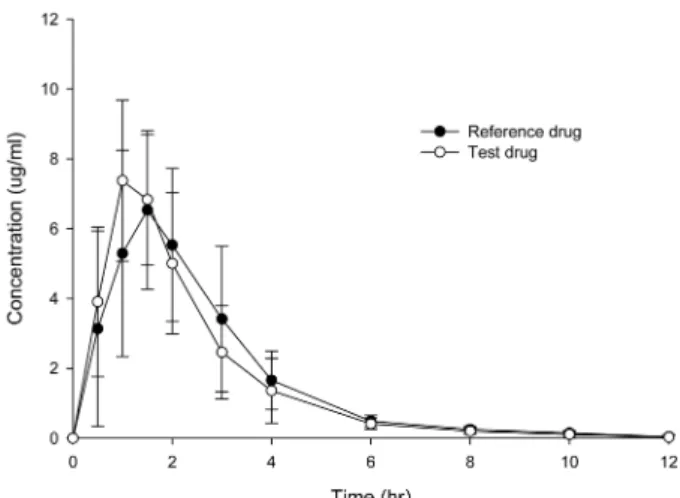
대웅제약의에어탈정 (아세클로페낙 100 mg)을대조약으 로하고 대우약품의아세클로페낙정 (아세클로페낙정 100 mg)을 시험약으로하여 건강한 성인 20명을 대상으로생물 학적 동등성을평가하였다. 두 제제의시간에따른 혈중아 세클로페낙의 농도변화는 Fig. 4에, 생물학적동등성 평가를 위한두약물동태학파라미터인최고혈중농도 (Cmax)와 12시
Fig. 3. Time course of the peak area ratio of 4’-hydroxy- aceclofenac to internal standard after a single 100-mg oral dose of aceclofenac in healthy volunteers. Each point represents the mean±S.D. (n=20).
Table 2. Analysis of variance test (α=0.05) and 90% confidence intervals (CI) for AUCt (ln-transformed) and Cmax (ln- transformed) for the 100 mg aceclofenac tablets
Parameter Group or sequence (4.414) Subjects/group (2.217)ANOVA Period (4.414) Drug (4.414) Confidence Interval
Cmax(µg/ml) 1.999 2.525 0.217 0.866 0.9636~1.1310
AUCt(µg·h/ml) 3.794 8.051 0.005 0.829 0.9292~1.0231
Fig. 4. Time course of the plasma aceclofenac concentrations after a single 100-mg oral dose of aceclofenac in healthy volunteers. Each point represents the mean±S.D. (n=20).
간까지의시간별혈중농도곡선하면적 (AUCt)의통계학적분 석은 Table 2에각각나타내었다.
대조약은 평균 1.5시간에 최고혈중농도 6.4±2.2µg/ml에 도달한데 비해 시험약은약 1 시간에 7.5±2.3µg/ml를 나타 내었다. 대조약과시험약의 12시간까지시간별혈중농도곡선
하면적 (AUCt)은 각각 19.1±4.6 및 19.5±4.1µg·h/ml를 나타
내었다. 두 파라미터를로그변환한값을이용하여분산분석 을 실시한 결과 약물간, 시기별, 및 그룹간에 유의성 있는 차이는없었다.
로그변환한최고혈중농도및시간별혈중농도곡선하면적의 평균치에대한 90% 신뢰구간은각각 0.9636~1.1310, 0.9292~
1.0231로서, 0.81.25범위에들어있으므로시험약은대조약에
대해생물학적으로동등한것으로평가하였다. 참고문헌
1. Grau M, Guasch J, Montero JL Felipe A, Carrasco E, Julia S. Pharmacology of the potent new non-steroidal anti-infla- mmatory agent aceclofenac. Arzneimittel-Forschung 1999; 41:
1265-1276.
2. Ballesteros R, Ansoleaga JJ, Tapounet R. The efficacy and tolerance of aceclofenac in rheumatoid arthritis. A double-blind study v. placebo. Clin Trials J. 1990; 27: 12-19.
3. Ward DE, Veys EM, Bowdler JM, Roma J. Comparison of aceclofenac with diclofenac in the treatment of osteoar- thritis. Clin Rheumatol 1995; 14: 656-662.
4. Cecchettin M, Cerea P, Torri G. Therapeutic efficacy of aceclofenac and diclofenac in acute knee artherosis. A study of E2-prostaglandin levels in synovial fluid and in serum. Clin Trials J. 1988; 25: 144-151.
5. Gonzalez E, del la Cruz C, de Nicolas R, Egido J, Her- rero-Beaumont G. Long-term effect of nonsteroidal anti- inflammatory drugs on the production of cytokines and
other inflammatory mediators by blood cells of patients with osteoarthritis. Agents Actions 1994; 41: 171-178.
6. Yamazaki R, Kawai S, Matsuzaki T, Kaneda N, Hashim- oto S, Yokokura T, Okamoto R, Koshino T, Mizushima Y.
Aceclofenac blocks prostaglandin E2 production following its intracellular conversion into cyclooxygenase inhibitors.
Eur J Pharmacol 1997; 329: 181-187.
7. Bort R, Ponsoda X, Carrasco E, Gomez-Lechon MJ, Cas- tell JV. Metabolism of aceclofenac in humans. Drug Metabolism and Disposition 1996a; 24: 834-841.
8. Bort R, Ponsoda X, Carrasco E, Gomez-Lechon MJ, Cas- tell JV. Cmparative metabolism of the nonsteroidal anti- inflammatory drug, aceclofenac, in the rat, monkey, and human. Drug Metabolism and Disposition 1996b; 24: 969- 9. Henrotin Y, de Laval X, Mathy-Hartet M, Mouithys-975.
Mickalad A, Deby-Dupont G, Dogne JM, Delarge J, Reginster JY. In vitro effects of aceclofenac and its metabolites on the production by chondrocytes of inflam- matory mediators. Inflamm Res. 2001; 50: 391-399.
10. Hinz B, Auge D, Rau T, Rietbrock S, Brune K, Werner U. Simultaneous determination of aceclofenac and three of its metabolites in human plasma by high-performance liquid chromatography. Biomedical Chromatography 2003;
17: 268-275.
11. Kang W. A new sensitive determination of aceclofenac and its three metabolites in human plasma using LC/MS/
MS. J Chromatogr B. in press.
12. Hinz B, Chevts J, Renner B, Wuttke H, Ran T, Schmidt A, Szelenyi I, Brune K, Werner U. Bioavailability of diclofenac potassium at low doses. Br J Clin Pharmacol 2005; 59:
80-84.