• 검색 결과가 없습니다.

The Effect of Distal Aortic Pressure on Spinal Cord Perfusion in Rats

N/A
N/A
Protected

Academic year: 2021

Share "The Effect of Distal Aortic Pressure on Spinal Cord Perfusion in Rats"

Copied!
7
0
0

로드 중.... (전체 텍스트 보기)

전체 글

(1)

http://dx.doi.org/10.5090/kjtcs.2012.45.2.73 ISSN: 2233-601X (Print) ISSN: 2093-6516 (Online)

Department of Thoracic and Cardiovascular Surgery, Kangwon National University Hospital, Kangwon National University School of Medicine

†This work was supported by a National Research Foundation of Korea grant funded by the Korea government (MEST) (No. 331-2008-1- E00201).

Received: August 31, 2011, Revised: November 11, 2011, Accepted: November 11, 2011

Corresponding author: Sung-Min Park, Department of Thoracic and Cardiovascular Surgery, Kangwon National University Hospital, Kangwon National University School of Medicine, 156 Baengnyeong-ro, Chuncheon 200-722, Korea

(Tel) 82-33-258-2294 (Fax) 82-33-258-2182 (E-mail) [email protected]

C

The Korean Society for Thoracic and Cardiovascular Surgery. 2012. All right reserved.

CC

This is an open access article distributed under the terms of the Creative Commons Attribution Non-Commercial License (http://creative- commons.org/licenses/by-nc/3.0) which permits unrestricted non-commercial use, distribution, and reproduction in any medium, provided the original work is properly cited.

The Effect of Distal Aortic Pressure on Spinal Cord Perfusion in Rats

Sung-Min Park, M.D., Seong-Joon Cho, M.D., Se Min Ryu, M.D., Kyung-Hak Lee, M.D., Gu Kang, M.D.

Background: Aortic cross clamping is associated with spinal cord ischemia. This study used a rat spinal cord is- chemia model to investigate the effect of distal aortic pressure on spinal cord perfusion. Materials and Methods:

Male Sprague-Dawley rats (n=12) were divided into three groups. In group A (n=4), the aorta was not occluded.

In groups B (n=4) and C (n=4), the aorta was occluded. In group B the distal aortic pressures dropped to around 20 mmHg. In group C, the distal aortic pressure was decreased to near zero. The carotid artery and tail artery were cannulated to monitor the proximal aortic pressure and the distal aortic pressure. Fluorescent microspheres were used to measure the regional blood flow in the spinal cord. Results: After aortic occlusion, blood flow to the cervical spinal cord showed no significant difference among the three groups. In groups B and C, the thoracic and lumbar spinal cord and renal blood flow decreased. No microspheres were detected in the thoracic and lumbar spinal cord of group C. Conclusion: The spinal cord blood flow is dependent on the distal aortic pressure after thoracic aortic occlusion.

Key words: 1. Animal model 2. Aorta

3. Spinal cord ischemia 4. Neurologic injury

INTRODUCTION

Paraplegia is one of the most feared complications after thoracoabdominal aortic surgery. The incidence is reported to be 5% to 40% in patients who have undergone thoracoabdo- minal aortic surgery [1].

Obstruction of the Adamkiewicz artery, reperfusion injury, collateral network concept and the steal phenomenon have all been suggested as causes of the paraplegia [1,2]. Among them, occlusion of the Adamkiewicz artery has long been be-

lieved to be the most important mechanism of spinal cord in- jury after thoracic or thoracoabdominal aortic surgery and most surgeons try to maintain blood flow to the Adamkie- wicz artery during and after surgery [3].

Recently, endovascular aneurysm repair (EVAR) has been

developed for the treatment of descending aortic disease and

has become a popular procedure. Because there is no way to

reestablish blood flow to the Adamkiewicz artery when it is

occluded by a stent graft after EVAR, the debate over the

role of thr Adamkiewicz artery on the mechanism of spinal

(2)

Fig. 1. Cannulation of the carotid artery (A) and tail artery (B) to monitor proximal and distal aortic pressure.

Fig. 2. (A) Fogarty catheter (2 Fren- ch) insertion through the right femo- ral artery. (B) Blood draining from the left femoral artery catheter.

cord ischemia has resurfaced again.

In one study using a swine model, all the segmental ar- teries were ligated but no paraplegia was observed [4]. A clinical report from the same group, in which the segmental arteries were ligated or clipped before opening the descending aorta during aortic surgery, showed a low rate of post- operative paraplegia [5]. The basis of this procedure is the collateral network concept [5]. This is the theory that there are sufficient collaterals around the paravertebral area and spinal muscles to provide blood supply to the spinal cord even if the segemental arteries are occluded. This implies that, during thoracoabdominal aortic surgery, the artery of Adamkiewicz may function as a channel for the blood flow away from the spinal cord, the steal phenomenon. This study was designed to observe the steal phenomenon in a rat aortic occlusion model simulating thoracoabdominal aortic surgery.

MATERIALS AND METHODS

The experimental procedure described in this study was ap- proved by the Institutional Animal Care and Use Committee of the Kangwon National University. Male Sprague-Dawley

rats (n=12; weight, 350−400 g) were used in this study. For induction anesthesia, the animals were first placed in an acrylic plastic box perfused with 4% isoflurane and oxygen.

After induction, they were each intubated with a 16-gauge catheter and mechanically ventilated with a tidal volume of 2.5 mL and a respiratory rate of 75 breaths/min. The in- halation anesthesia was maintained with 3% isofluorane in oxygen. The right common carotid artery and the tail artery were cannulated with a 22 gauge catheter for monitoring of the proximal and distal aortic pressure (Fig. 1). A 2 French Fogarty catheter was introduced through the right femoral ar- tery and its tip was located just distal to the left subclavian artery (Fig. 2A). All animals were injected with 200 IU of heparin to prevent thrombosis. The chest was opened verti- cally and the left atrium was exposed by tearing the pericardium. The left atrium was cannulated with a small tube (internal diameter=1 mm) and connected to the micro- sphere loaded syringe (Fig. 3A).

The animals were divided into three groups. In group A

(n=4), all the catheters were inserted but the aorta was not

occluded. In group B (n=4), the aorta was occluded with in-

flation of the Fogarty catheter balloon with 0.15 mL of air.

(3)

Fig. 3. (A) A catheter inserted in the left atrium (arrow) for microsph- ere injection. (B) Microspheres under a fluorescence microscope (×400).

The distal and proximal aortic pressures were allowed to fall or rise and become stabilized. However, in group C (n=4), the left femoral artery was cannulated with a 22-gauge cathe- ter and the blood was drained to decrease the distal aortic pressure down to near zero (Fig. 2B). The drained blood was infused back into the animal with a mini-peristaltic pump through another catheter (22 gauge) placed in the left or right femoral vein.

After occlusion of the aorta with inflation of the balloon (groups B and C) and draining of the distal aortic blood (group C), the proximal and distal aortic pressures were al- lowed to stabilize. The changes in blood pressures were re- corded in a laptop computer with a digital-analog converter (Compact DAQ; National Instruments, Austin, TX, USA) and software (Labview 8.5, National Instruments). In all the groups, after recording the blood pressure, reference blood sampling by withdrawing blood from the right carotid artery at the rate of 0.566 mL/min was begun. Then 0.1 mL of flu- orescent microspheres (Fluo-Spheres, 15 μm, 1.0×10

6

/mL;

Molecular Probes Inc., Eugene, OR, USA) was infused into the left atrium. Reference blood sampling was continued until 2 minutes after the microsphere injection was over. Because the diameter of the microsphere was larger than the diameter of a capillary, the tissue was embolized with the injected mi- crospheres and the number of the embolized microspheres found in the tissue correlates with the regional blood flow of the tissue.

Both kidneys and the spinal cord were removed. Each spi- nal cord was divided into cervical (C1−8), thoracic (T1−

13) and lumbar (L1−6) segments. In order to calculate the regional blood flow, the microspheres were recovered from each of the tissue and blood samples that had been removed.

To isolate the microspheres from the tissue, the sedimentation method was used as previously reported [6]. Briefly, the har- vested organs were put in 4N KOH solution for 48 hours at room temperature. The samples were centrifuged 20 minutes at 2,000 g. Removing all but 1.5 mL supernatant, 8 mL 1%

Triton X-100 was added and centrifuged at the same settings.

The supernatant was discarded leaving 1 mL of the sample.

Seven milliliters of distilled water was added and the sample centrifuged again. 0.15 mL of sample was left and the num- ber of microspheres was counted using a cell count slide (C-chip; Digital Bio Technology Co. Ltd., Seoul, Korea) and fluorescence microscopy (BX53; Olympus, Tokyo, Japan) (Fig. 3B).

Calculation of the regional blood flow was performed us- ing following formula:

Q=([FR×CT])/[CR×VT])

Where Q is the flow in mL/min/g; FR is the flow rate of the reference sample (mL/min); CT is the microsphere count in the tissue; CR is the microsphere count in the reference sample; and VT is the tissue weight (g).

Data are expressed as mean±standard deviation. To eval- uate the statistically significant difference between the groups, the results were analyzed by Kruskal-Wallis one-way analysis of variance followed by Tukey’s post hoc test using statistical analysis software SPSS ver. 11.0 (SPSS Inc., Chicago, IL, USA). A p-value less than 0.05 was considered to be significant.

RESULTS

Before aortic occlusion, the mean proximal aortic pressure

(PAP) was about 90 mmHg and there was no significant dif-

(4)

Fig. 4. Arterial pressure before occluding the aorta. No statistical difference was observed among the groups (Kruskal-Wallis one- way analysis of variance). PAP=proximal aortic pressure; DAP=dis- tal aortic pressure.

Fig. 5. The proximal aortic pressure (PAP) and distal aortic pressure (DAP) after aortic occlusion. Between groups B and C, the PAP showed no statistical difference (A). DAP was significantly different between the group B and C (B) (Kruskal-Wallis one-way analysis of variance followed by Tukey’s post hoc test, p-value cutoff of 0.05). *aorta was not occluded in group A.

ference among the groups (Fig. 4). The mean distal aortic pressure (DAP) also did not show any statistical difference between the groups (Fig. 4). The group in which the de- scending thoracic aorta was occluded without distal arterial drainage (group B) showed elevation of the PAP to 123±17 mmHg (Fig. 5). Also in group C, the PAP was elevated after aortic occlusion and the elevated PAP of groups B and C showed no difference. The DAP dropped to 21±1.3 mmHg in group B (Fig. 5). In group C the DAP decreased almost to

zero after aortic occlusion and femoral artery drainage. The DAP was significantly different between group B and group C (Fig. 5).

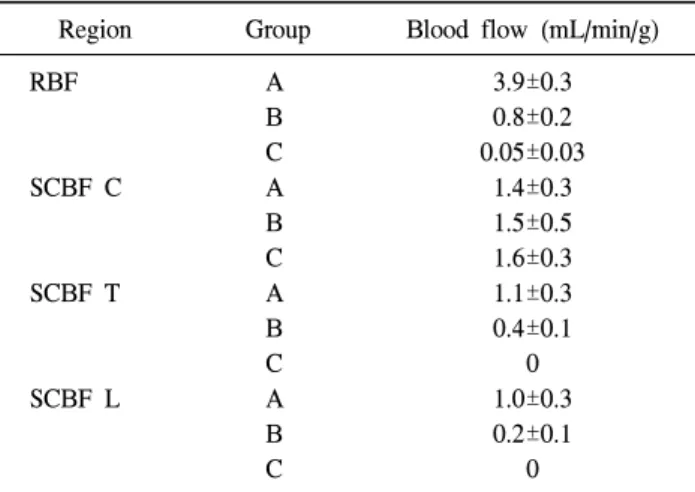
The regional blood flow was calculated from the micro- sphere count and tissue weight using the formula above (Table 1). The microsphere counts in the carotid arteries were used as reference microsphere counts. The blood flow to the cervical spinal cord showed no significant differences among all three groups. However, all the three groups showed stat- istically significant differences in the renal blood flow, and thoracic and lumbar spinal cord blood flow (Fig. 6). The blood flow to the thoracic spinal cord and lumbar spinal cord in group B were 0.4±0.1 mL/min/g and 0.2±0.1 mL/min/g, respectively (Table 1). In group C there were no micro- spheres detected in the thoracic or lumbar spinal cord, in- dicating no blood flow to the lumbar spinal cord. The differ- ences in the thoracic and lumbar spinal cord blood flow be- tween group B and group C were statistically significant (Fig.

6).

DISCUSSION

Occlusion of the aorta just distal to the subclavian artery

generates conditions similar to those of thoracoabdominal

aortic surgery. Examining the distribution of microspheres

showed no microspheres in the lumbar and thoracic levels of

(5)

Table 1. Calculated regional blood flow

Region Group Blood flow (mL/min/g) RBF

SCBF C

SCBF T

SCBF L

A B C A B C A B C A B C

3.9±0.3 0.8±0.2 0.05±0.03

1.4±0.3 1.5±0.5 1.6±0.3 1.1±0.3 0.4±0.1

0 1.0±0.3 0.2±0.1

0 Values are presented as mean±standard deviation.

RBF=renal blood flow; SCBF C=cervical spinal cord blood flow; SCBF T=thoracic spinal cord blood flow; SCBF L=lum- bar spinal cord blood flow.

Fig. 6. The calculated regional blood flow during aortic occlusion.

The blood flow to the cervical spinal cord showed no statistical difference among the three groups but the regional blood flow of other tissues of group B and group C differed significantly (Krus- kal-Wallis one-way analysis of variance followed by Tukey’s post hoc test, p-value cutoff of 0.05).

the spinal cord when the distal aortic pressure was kept near zero. In contrast, though small in amount, microspheres were found throughout the lower spinal cord in group B, in which the distal aortic pressures were maintained around 20 mmHg.

Two conclusions can be drawn from these results. One is that there are collaterals supplying the spinal cord so that the blood flow is maintained even after occlusion of the descend- ing thoracic aorta. The other is that the spinal cord blood flow from the collateral is affected by the distal aortic pres- sure and lowering the distal aortic pressure causes “stealing”

of blood flow from the spinal cord. Although we could not observe how the spinal cord blood flow changes when the distal aortic pressure is increased to a higher level, the results of our experiment indicate that the distal aortic pressure is an important factor influencing the spinal cord blood flow.

Several mechanisms of spinal cord injury after aortic sur- gery have been suggested [1,2]. One of the oldest and most strongly believed mechanisms is Adamkiewicz artery occlu- sion during aortic surgery. During thoracoabdominal aortic re- placement surgery, most surgeons routinely save segmental branches at the level of T10 to L2 where the Adamkiewicz artery is believed to originate [3]. However, this theory lacks confirmative evidence, and there are several studies showing that the blood supply from the Adamkiewicz artery is not es- sential for preventing spinal cord ischemic injury [4]. The

so-called collateral network concept suggest that there exist abundant paravertebral collateral arteries that supply sufficient blood to the spinal cord and therefore segmental branches of the descending aorta can be ligated safely without causing paraplegia [4,5]. The other mechanism of spinal cord injury is the steal phenomenon. During aortic surgery, when the distal aorta is opened after clamping of the descending aorta, a con- siderable amount of blood flows back from the segmental arteries. This can cause blood flow away from the spinal cord during surgery. Indirect evidence the steal phenomenon as a cause of spinal cord ischemic injury has been presented by a study in which the descending thoracic aorta was double clamped some distance apart [7]. There was no spinal cord ischemia at the level between the two clamps suggesting no steal phenomenon and no spinal cord ischemia. Since the dis- tal spinal cord blood flow was dependent on the DAP, we believe that the results of our experiment show evidence of the steal phenomenon and collateral blood flow.

The proximal aortic pressure is also an important factor in-

fluencing spinal cord ischemia after aortic clamping. One

study found that a proximal aortic pressure below 40 mmHg

resulted in ischemic spinal cord injury in rats when the thora-

cic aorta was occluded [8]. In that experiment, the distal aort-

ic pressure decreased in accordance with proximal aortic pres-

(6)

sure, and was almost zero when the proximal aortic pressure was 40 mmHg. In our study, the same animal model and technique was employed to monitor the proximal and distal aortic pressure and to occlude the aorta, but the proximal aortic pressure did not change. Instead, only the distal aortic pressure changed. Since the results showed changes in blood flow to the spinal cord, we can infer that the distal aortic pressure is in direct relationship to the spinal cord blood flow.

It is interesting that no microspheres were found in the lower spinal cord when the distal aortic pressure was around 0 mmHg. This means that there was no blood flow to the tis- sue capillary bed. This can be explained by the difference be- tween the arterial perfusion pressure and capillary pressure.

Since the capillary pressure is known to be around 12 to 32 mmHg, there would be no flow to the tissue when the perfu- sion pressure was below that level.

Extrapolating the results from animal experiments to hu- mans is always controversial, especially if they are small ani- mals like rats. Because of their small size, the metabolism and distribution of substances in rats are different from humans. The spinal injury rat model is also notorious for its poor reproducibility of paraplegia. However, there are many previous studies using a rat spinal cord ischemia model be- cause of its low cost and effectiveness. Although small in size, the hemodynamics and vascular structures of rats are similar to those of humans. The internal thoracic artery, ante- rior spinal artery, posterior spinal artery and paravertebral anastomosis are also found in rats [8,9]. In this study, we ob- served the distribution of microspheres to observe the hemo- dynamic response rather than observing paraplegia. We be- lieve this obviates the influence of the size discrepancy.

There exist limitations in this study. It does not prove that extensive segmental artery occlusion is safe. The results in- dicate that aortic occlusion causes a distal aortic pressure drop and decreased spinal cord blood flow. However, we do not know how extensive the collateral blood flow would be if all segmental branches were occluded. Because there are col- laterals to the spinal cord from the arteries distal to the de- scending aorta, the collateral blood flow when the aorta is occluded must be different from the blood flow when all the segmental arteries are occluded. For the same reason, we can-

not conclude that the collateral blood flow is insufficient to prevent spinal cord ischemia. One other limitation is that par- aplegia was excluded from the experimental parameters.

Besides the difficulty of keeping the animal alive with para- plegia, death is inevitable immediately after microsphere injection. Even if the animal could survive microsphere em- bolization, the microsphere emboli could influence the results, making them difficult to interpret. Consequently, we cannot directly identify the steal phenomenon as a cause of paraplegia. Furthermore, other influencing factors like central venous pressure and the parameters of reperfusion injury were not evaluated.

Despite all these limitations, this study provides insight in- to the collateral blood flow of the spinal cord and the im- portance of distal aortic pressure as a factor in spinal cord is- chemia that might cause paraplegia during aortic surgery.

CONCLUSION

There is collateral blood flow to the spinal cord after thoracic aortic occlusion. This collateral blood flow is influ- enced by distal aortic pressure. Decreasing the distal aortic pressure to zero leads the blood flow away from the spinal cord. Low distal aortic blood pressure or low perfusion pres- sure of the spinal cord causes the steal phenomenon, which might be one of the mechanisms of spinal cord ischemic in- jury and paraplegia after aortic surgery.

REFERENCES

1. Wan IY, Angelini GD, Bryan AJ, Ryder I, Underwood MJ.

Prevention of spinal cord ischaemia during descending thoracic and thoracoabdominal aortic surgery. Eur J Cardio- thorac Surg 2001;19:203-13.

2. Gelman S. The pathophysiology of aortic cross-clamping and unclamping. Anesthesiology 1995;82:1026-60.

3. Svensson LG. Descending thoracic and thoracoabdominal aortic surgery. In: Sellke FW, Del Nido PJ, Swanson SJ, Sabiston DC. Sabiston and Spencer’s surgery of the chest.

8th ed. Philadelphia: Saunders Elsevier. 2010;1063-87.

4. Halstead JC, Wurm M, Etz C, et al. Preservation of spinal cord function after extensive segmental artery sacrifice: re- gional variations in perfusion. Ann Thorac Surg 2007;84:

789-94.

5. Griepp RB, Griepp EB. Spinal cord perfusion and protection

(7)

during descending thoracic and thoracoabdominal aortic surgery: the collateral network concept. Ann Thorac Surg 2007;83:S865-9.

6. De Visscher G, Haseldonckx M, Flameng W. Fluorescent microsphere technique to measure cerebral blood flow in the rat. Nat Protoc 2006;1:2162-70.

7. Christiansson L, Ulus AT, Hellberg A, Bergqvist D, Wik- lund L, Karacagil S. Aspects of the spinal cord circulation as assessed by intrathecal oxygen tension monitoring during various arterial interruptions in the pig. J Thorac Cardio-

vasc Surg 2001;121:762-72.

8. Taira Y, Marsala M. Effect of proximal arterial perfusion pressure on function, spinal cord blood flow, and histo- pathologic changes after increasing intervals of aortic occlu- sion in the rat. Stroke 1996;27:1850-8.

9. Biglioli P, Roberto M, Cannata A, et al. Upper and lower

spinal cord blood supply: the continuity of the anterior spi-

nal artery and the relevance of the lumbar arteries. J Tho-

rac Cardiovasc Surg 2004;127:1188-92.

수치

Fig. 1. Cannulation of the carotid  artery (A) and tail artery (B) to  monitor proximal and distal aortic  pressure.
Fig. 5. The proximal aortic pressure (PAP) and distal aortic pressure (DAP) after aortic occlusion
Fig. 6. The calculated regional blood flow during aortic occlusion.

참조

관련 문서