159
심방세동 환자의 고주파 도자절제술 전·후의 항응고약물요법 사용실태 분석
김수현1·안성심2·김순주2·방준석2*·나현오2,3*
1가톨릭대학교 여의도성모병원 약제팀, 2가톨릭대학교 서울성모병원 약제부, 3가톨릭대학교 의과대학 약리학교실
(2010년 8월 27일 접수·2010년 9월 10일 수정·2010년 9월 13일 승인)
Evaluation of Peri-procedural Anticoagulation Drug Therapy undergoing Radiofrequency Ablation in Patients with Atrial Fibrillation
Suhyun Kim
1, Sung Shim An
2, SoonJoo Kim
2, Joon Seok Bang
2*, and Hyen Oh La
2,3*
1Department of Pharmacy, Yeoido St. Mary's Hospital The Catholic University of Korea
2Department of Pharmacy, Seoul St. Mary's Hospital The Catholic University of Korea
3Department of Pharmacology, College of Medicine, The Catholic University of Korea Seoul, 137-701, Korea (Received August 27, 2010·Revised September 10, 2010·Accepted September 13, 2010)
Radiofrequency ablation (RA) is being used to manage atrial fibrillation (AF) with patients failed at the 1st-line anti-arrhyth- mic medications. Patients undergoing this procedure are at increased risk of thromboembolism after ablation, and anticoagula- tion management surrounding the ablation remains controversial. Although no conclusive recommendations can be made, published guidelines and data support therapeutic anticoagulation with warfarin. The purpose of this study was to analyze effectiveness of current therapy and to find factors fluctuate International Normalized Ratio (INR) values in patients under- gone RA followed by anticoagulation service (ACS). Retrospective review was conducted utilizing database in a hospital.
Among 110 patients under warfarin around ablation between January 2006 to September 2007, 54 patients were selected and allocated into 2 groups: Group A included 47 who discontinued warfarin after ablation, while 7 in B continued the medica- tion. Information on demographics, amount and length of warfarin dosing, INR values and measuring frequencies, and the causing factors on INR fluctuation were abstracted. Differences were analyzed using chi-squared test, Fisher's Exact test, and unpaired Student t-test. Mean amount of warfarin before and after surgery was 4.0 mg, 4.1 mg in Group A and was 5.1 mg, 4.6 mg in Group B, respectively. Average duration of warfarin doing before ablation was 73.7 days in Group A, 129.9 days in B with no significant difference (p = 0.312). The duration time of warfarin on groups after ablation lasted several months. The number of checking INRs was 4.1 and 7.6, respectively. Inter-individual variability of INR fluctuations were 2.1 ± 0.6 in Group A and 2.2 ± 0.7 in B which were not significantly different (p = 0.062). 164 cases of decreased INR were: ‘omission in taking medication, stressfulness and headache, ‘increased intake of high vitamin K foods’, ‘lifestyle change of increased physi- cal activities’, and ‘increase of food-intakes’. To the contrary, 36 cases of increased INR were: ‘reduce of food-intake’, ‘use of non-prescription drugs’, ‘reduction in physical activities’, and ‘excessive restriction on food-intake’, consecutively. In conclu- sion, the study validated therapeutic outcomes of RA patients who we treated with standard guideline and demonstrated 9 fac- tors of INR fluctuations in the patient. A well-trained, pharmacist-monitored anticoagulation service could reduce the risk of adverse effects and prevent complications in patients with AF around RA operation.
□ Key words - atrial fibrillation, radiofrequency ablation, warfarin, anticoagulation service, INR
심방세동(atrial fibrillation, 이하 AF)은 가장 오래 지속되 는 부정맥의 일종이며 혈전색전증에 의한 사망률과 이환율이 높은 질병이다.1) 외국의 보고에 따르면, 심방세동의 유병률 은 40세 이상에서 2.3%, 65세 이상에서는 5.9%, 80세 이상 에서 8.8%라고 알려진다.2,3) 미국심장협회(American Heart Association, 이하 AHA)가 2006년에 발표한 심장질환치료지 침에 의하면, 수주간 지속되는 심방세동 환자에게는 항부정 맥약물을 투여하여 심박수를 조절해주고, 그래도 증상이 호 전되지 않을 때는 전류를 이용한 심방세동의 동율동 전환 (sinus rhythm restoration 또는 cardioversion)을 시도하도록
Correspondence to : 나현오
가톨릭대학교 의과대학 약리학교실 137-701 서울특별시 서초구 반포동 505 Tel: 02-2258-7853, Fax: 02-2258-7859 E-mail: [email protected]
방준석
가톨릭대학교 서울성모병원 약제부
137-701 서울특별시 서초구 반포동 505
Tel: 02-2258-2571, Fax: 02-2258-2526
E-mail: [email protected]
제시하고 있다. 또한, 약물요법과 동율동 유지법에 반응하지 않는 환자에게는 고주파 도자절제술(Radiofrequency Ablation, 이하 RA)을 사용하도록 권고하고 있다.4,5) RA는 환자의 심장 안에 전극도자(catheter)를 삽입하고 이를 통하여 라디오주파 전류(radiofrequency current)를 방출시킴으로써 국소적으로 조 직괴사를 유도하여 부정맥 발생부위를 제거하거나 심장근육 내 전류가 흐르는 회귀회로를 절제하는 치료법이다.6,7)
RA적용대상 환자는 일반적으로 시술일로부터 2~3개월 전 부터 항응고약물인 warfarin을 투여 받으면서 International Normalized Ratio (INR)값을 2.0~3.0 범위 내로 지속적으로 유지해야 하며, 경식도초음파(transesophageal scan) 검사 결과 에서 혈전 소견이 없어야만 안전하게 시술할 수 있다.8-10) 또 한 RA시술이 성공적으로 끝난 환자라도 적어도 2~3개월 동 안 warfarin을 지속적으로 투여할 것을 권장 받고 있다.11) 하 지만, 심방세동 환자가 RA시술을 받기 전·후에 투여되는 약 물의 종류는 다양하며 warfarin 과 상호작용의 가능성이 크므 로 의료인의 세심한 관찰과 전·후 관리가 필요하다. 12,13)
이를 위하여, 의료기관에서는 약사에 의한 항응고약물서비 스(Anticoagulation Service, 이하 ACS)를 다양한 상황에 놓 인 심방세동 환자에게 지속적으로 확대 중이며 그 효과와 유 용성이 부각되고 있다.14-16) 일반적으로, warfarin은 복용 후 대사 및 약효 측면에서 개인 차이가 큰 약물이므로 RA시술 전·후의 환자 INR값이 치료수준에 적절히 유지되도록 ACS 를 제공하기 위해서는 현행 치료지침에 따른 약물사용 및 환 자의 실제반응에 대한 실태분석에 근거한 대안 마련이 필요
하다.17,18) 따라서, 본 연구는 의료기관 내에서 임상약사가 주
관하는 ACS의 수혜자인 RA 시술 전·후 환자들의 warfarin 사용에 따른 성과를 파악함으로써, INR값의 변동요인을 찾 아내고 향후 RA시술 전·후 환자에게 향상된 ACS를 제공하 기 위하여 실시하였다.
연구방법
대상환자
2006년 1월부터 2007년 9월까지 가톨릭대학교 여의도성모 병원 순환기내과에서 심방세동을 진단받고 RA를 시술 받을 때 적용되었던 항응고치료지침에서 warfarin 투여와 관련된 1, 5번 항목에 대해 평가할 수 있는 환자 110명을 선정하였 다(Table 1). 이 중에서 관련 자료의 조사 시작 시점에 시술 을 받았거나, 시술 후 투약기간이 2~3개월간 지속되지 않은 경우, 도중에 사망한 경우, 도중에 임상시험용 약제로 전환한 경우, 다른 진료과로 전환한 경우에 해당하는 환자는 연구대 상에서 제외하였고, 지속적으로 ACS를 제공받았던 환자만을 추출하여 RA시술 이후에 warfarin 투여를 중단한 환자(A군) 와 지속 투여했던 환자(B군)로 구분하였다.
조사방법
연구대상 심방세동 환자의 정보는 동 기간 중에 약사가 ACS를 제공하며 작성했던 상담기록지(patient monitoring profile, 이하 PMP)와 의무기록 database를 활용하여 필요한 정보를 후향적으로 수집하였다. 그리고, 약물 처방시 적용된 항응고약물치료지침의 실태정보 분석을 위하여 A군과 B군에 소속한 환자에 대하여 시술 전·후의 1) warfarin 평균사용량, 2) warfarin 사용기간, 3) INR 측정횟수, 4) 평균 INR값 비교, 5) 개인별 INR 변동, 6) ACS 기간, 7) INR 변동요인 확인 건수, 8) INR 증가 또는 감소요인 등을 측정, 비교하였다.
통계처리
각 항목별로 조사된 데이터와 결과에 대하여 두 군사이의 차이를 Chi-squared test, Fisher's Exact test 및 Unpaired Student t-test를 실시하였고 95% 신뢰구간에서 P값이 0.05 미 만일 때를 통계적인 유의성을 가진다고 판정하였다.
연구결과
연구대상 환자
연구대상자로 선별된 110명 중에서 지속적으로 ACS를 받 았던 연구대상 심방세동 환자는 총 54명(49.1%)이었으며, 이 중에서 RA 시술 이후에 warfarin 투여를 중단했던 환자(A군) 는 47명(87%)이었고 지속적으로 투여했던 환자(B군)는 7명 (13%) 이었다. 연구대상자 중 남성이 39명(72.2%), 여성은 15 명(27.8%)이었으며, 평균연령은 남성이 57세, 여성이 63세 이 었다(Table 2).
Warfarin의 사용량 및 기간
A와 B군의 warfarin 사용실태를 비교한 결과, 시술 전 투 약기간의 개인차를 제외하면 처방 시 기준으로 채택한 AHA 의 항응고치료지침을4) 준수한 것으로 나타났다.
처방된 warfarin의 평균용량은 A군의 경우에 RA 시술 전·후 각각 4.0 mg과 4.1 mg 이었고, B군은 각각 5.1 mg과 4.6 mg이었다. RA 시술전 warfarin사용기간은 A군이 평균 73.7일로서 진료지침이 제시한 기준을 충족했으며, B군은 129.9일로써 기준보다는 길었지만 이는 환자가 보유한 기저질 환 및 개인차에 기인한 것으로서 유의성 있는 차이는 없었다 (p = 0.312).
한편, RA시술후 warfarin의 사용기간은 A, B군 모두 최소 3개월 이상이었고 특히, B군에서 개인이 보유한 질환의 기질 적인 문제로 warfarin이 지속적으로 투여되었다(Table 3).
시술 전·후 INR값
환자의 RA시술 전·후의 INR값 측정횟수는 warfarin을 투
여했던 기간과 비례하였으며, RA시술 전 평균 측정횟수는 A군이 4.1회, B군이 7.6회 이었다. 특히, B군에 속한 환자는 기저질환에 의하여 warfarin 요법을 지속했으므로 시술 전·
후의 INR 측정 횟수가 각각 7.6과 7.9회로 A군 보다 많았다.
한편, A, B군 모두 시술 전·후의 INR 평균값은 2.0~3.0범 위 내에 잘 유지되었으며, 수술 일을 기점으로 INR값의 변 동은 크지 않았다. 반면, 환자내 INR값의 변동은 시술전 평 균값이 A군은 2.1 ± 0.6이었고 B군이 2.2 ± 0.7으로써 유의한 차이가 없었다(p = 0.062) (Table 3). ACS가 필요했던 기간 역시 warfarin을 투여했던 기간과 비례하였으며(Table 3), 동 기간 ACS를 받기 위해 방문했던 환자의 INR값을 분석한 결 과, 환자 측의 변동을 유발했던 요인을 찾아내지 못한 경우 가 시술 전·후에서 각각 36.7%과 29.7% 이었다(Fig. 1).
ACS횟수 및 INR 값 변동요인
환자들이 시술 전·후를 포함한 치료기간 중 ACS를 받은 횟수는 평균 4~8회로 2배의 차이가 있었다. INR값이 감소되 었던 경우는 전체 164건이었으며 주요 요인으로는, ‘약물복 용 누락’ 이 78건(47.6%), ‘스트레스와 두통’이 29건(17.7%),
‘비타민 K를 함유한 식품의 섭취 증가’가 28건(17.1%), ‘신체 활동량의 증가’가 25건(15.2%), ‘음식 섭취량의 증가’가 17건 (10.4%) 순으로 조사되었다(Fig. 2).
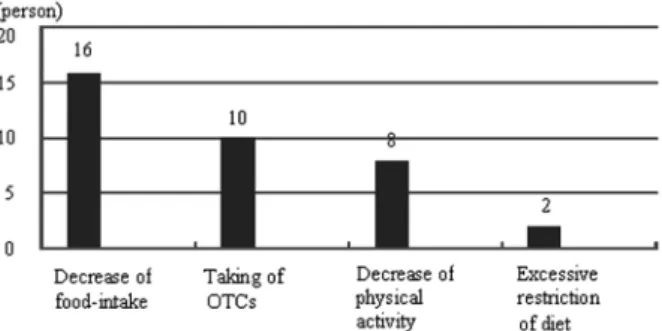
한편, INR값이 상승된 경우는 전체 36건이었고, 개별 요 인은, ‘식이 섭취량의 감소’가 16건(44.4%)으로써 INR 값에 가장 큰 영향을 미쳤으며, ‘종합감기약 등 일반의약품의 복 용’이 10건(27.8%), ‘신체 활동량의 감소’는 8건(22.2%), ‘음 식물의 지나친 섭취 제한’ 2건(5.6%)의 순으로 그 뒤를 이었 Table 1. A guideline of anticoagulation therapy applying for radiofrequency ablation§
Time of warfarin dosing Regimen
1. ~ D-7 of RA Start warfarin for 6~8 weeks: INR adjusted within 2.0~3.0 range*
2. D-6~D-5 of RA Hold warfarin
3. D-0 (during RA) Inject heparin intravenously (ACT 250~300 seconds) 4. D+1~ (after RA) Restart warfarin on the next day of ablation 5. ~ D+90 (after RA) Sustain warfarin at least 3-month-long after RA**
§Institutional guideline of The Catholic University of Korea Yeoido St. Mary’s Hospital
*Dosing period before radiofrequency ablation is changeable according to the individual’s condition
**Additional administration for 1-2 months is possible when thromboembolic risk is high)
RA (Radiofrequency Ablation); ACT (Activated Coagulation Time); INR (International Normalized Ratio)
Table 2. Characteristics of the study population (n = 54)
Subject Sex n (%) Mean age (yr) Height (cm) Weight (kg)
Group A Male 34 (72) 58 169.9 ± 7.1 72.0 ± 9.4
Female 13 (28) 63 152.8 ± 6.8 61.7 ± 9.8
Group B Male 5 (71) 56 172.2 ± 4.7 70.6 ± 8.0
Female 2 (29) 63 154.3 ± 1.8 69.0 ± 5.8
All data shown as Mean ± SD. Group A represents an experimental group which discontinued warfarin therapy after ablation; by contrast, Group B is an experimental group which continued warfarin therapy after ablation.
Table 3. Comparison between study groups (n = 54)
Comparison factors Group A (n = 47) Group B (n = 7)
Before ablation After ablation Before ablation After ablation Amount of warfarin (mg) 4.0 ± 1.1 4.1 ± 1.2 5.1 ± 2.2 4.6 ± 2.3 Duration of warfarin (day) 73.7 ± 59.6 161.0 ± 207.3 129.9 ± 106.7 Continued Number of INR measurement 4.1 ± 1.7 5.0 ± 3.0 7.57 ± 5.6 7.9 ± 3.4
INR value 2.1 ± 0.8 2.0 ± 0.8 1.9 ± 0.9 2.4 ± 0.9
INR fluctuation in each patient 2.1 ± 0.6 2.0 ± 0.5 2.2 ± 0.7 2.4 ± 0.5 Duration of ACS practice (day) 67.7 ± 67.5 111.1 ± 189.7 149.2 ± 228.2 228.0 ± 102.5
All data shown as Mean ± SD.
다(Fig. 3).
고 찰
심장순환계 질환의 발병률 증가추세와 더불어 warfarin의 사용량도 증가하고 있으며 특히, 고령자 인구의 증가와 더불 어 늘어나는 심방세동 환자 및 그 합병증에 대한 적절한 약 물처방과 후속적 관리방안이 의료계에서 주목 받고 있다.19-21) 이번 연구는 외국의 대표적 치료지침을 준수하여 처방되는 warfarin에 대한 환자 측의 약물반응과 치료상의 문제요인을 후향적으로 검토한 것이다. RA시술 전·후의 혈전생성을 방 지하기 위하여 warfarin 을 복용중인 환자는 약 3회 이내의 ACS로 INR값이 치료목표범위에 도달하도록 조절되는 것이 질병의 예후관리에 적절하다. 하지만, 임상에서는 환자에 대 한 지속적인 교육에도 불구하고 ACS를 제공받는 환자의
INR값이 정상범위를 벗어나는 경우가 빈번하다. 이를 해소하 기 위한 방안으로써 약사에 의한 ACS 상담의 유용성에 대한 연구들이 있었으며 약사가 제공한 ACS 에 의하여 치료목표 INR값에 도달하는 환자의 비율이 높아지며,22,23)부작용 발생 빈도가 줄어들고,24,25)특히, 심방세동 환자 치료를 위한 의료 비용을 절감시켰다는 보고가 있다.26,27)
성공적인 RA시술을 위해서는 일정 기간 안에 목표 INR값 을 달성하여 혈전이 생성되는 위험을 줄여주는 ACS활동이 매우 중요하다.21) 이번 연구의 결과, RA시술 후 warfarin 복 용을 중단한 환자들과 일정기간 이상 계속 warfarin을 복용 하는 환자들의 복용량, 복용기간에 비례한 ACS횟수에서는 큰 차이를 나타내지 않았다. 그러나, A와 B군 모두 환자 측 의 INR값의 변동을 유발하는 요인을 확인하지 못한 경우가 A군이 36.7%, B군은 29.7%나 되었으므로(Fig. 1), 우선 본 연구로 밝혀진 세부적인 문제항목은 환자별 특성을 고려한 ACS상담에 곧바로 적용하여 치료성과 향상에 기여할 수 있 으리라 기대된다. 실례로, 내원하지 않고 약사와 전화를 이 용한 신속한 ACS상담은 의료진과 환자 양측에 효과적이며 만족도를 높이는 방법으로 알려져 있다.28,29)
본 연구에서 밝혀진 INR값의 상승 혹은 하락시키는 요인 9가지 외에도 추가적인 변동요인들을 지속적으로 찾아내어 개별 환자의 복약순응도 향상과 식이섭취 관리 등을 위한 세 부적 상담지침을 지속적으로 보완, 개선하는 노력이 중요하 다. 일부 환자의 복약순응도 증진을 위해 사용중인 ‘복약 캘 린더’를 ACS대상환자 전체로 확대, 적용하는 것도 효과적일 것으로 기대되며, INR값 변동요인을 명확히 규명하기 위한 점검항목을 추가적으로 개발하여 환자의 약물치료의 성과 향 상과 만족도 제고를 달성하는 것이 향후 과제일 것이다. 한 편, 의사보다는 약사에 의한 ACS가 더 효과적이었다는 외국 의 보고와 같이30,31)향후 제도적 개선을 위한 근거자료로 사 용될 수 있는 비용-효과 연구결과를 지속적으로 축적함으로 써 약사의 약물요법 모니터링에 필요한 제도적 보완은 물론, 경제적 재원확보를 위한 다각적인 노력도 필요하다.32-34)
본 연구는 의료기관 약사로부터 지속적으로 ACS를 제공 받았던 환자의 자료만을 추출하여 RA시술 이후에 warfarin Fig. 1. Rates of defined factors that casing fluctuations on INR
values in patients with warfarin therapy before and after radiofrequency ablation.
Fig. 2. Causing factors that reducing INR value in patients with warfarin therapy before and after ablation.
Fig. 3. Causing factors that increasing INR value in patients with warfarin therapy before and after ablation.
투여를 중단했거나 지속 투여했던 환자군으로 구분하여 상호 비교하였는데, 그 이유는 첫째, RA전·후에 지속적인 상담을 진행하며 작성된 환자의 PMP에 비교적 소상히 관련 기록이 남아있기 때문이며 둘째, 도자절제술 전·후의 항응고요법에 대한 표준치료지침이 아직까지 명확히 제시되지 못한 상태이 기 때문이다.19) B군 환자는 A군 환자에 비하여 기저질환을 보유한 경우가 많았으므로 warfarin의 평균적인 투여량이나 투여지속기간, INR 측정횟수, INR 변동폭이 컸으며, ACS에 소요된 기간은 2배 이상이었다. 이는 심방세동 이외 심순환 계와 관련된 기저질환을 보유한 환자에게 warfarin의 투여는 빈도 높은 임상적 결정사항이며, 특히 RA시술을 병행할 때 에는 ACS가 예후 관리에 매우 중요한 역할을 담당한다는 것을 의미한다. 심방세동 환자에서 주의해야 할 합병증은 혈 전에 의한 뇌졸중의 발생이다.21) 더욱이, RA직후부터 단기간 동안 혈전색전증의 발생위험이 상승하므로 현행 뇌졸중 발생 예측 평가도구인 CHADS2 Score와 INR값을 동시에 활용한 환자별 ACS는 점차 중요성이 커질 것이다.24)
이번 연구는 환자 및 데이터의 수가 적었고, 연구대상 환 자들이 사용한 항응고약물은 warfarin에 국한되었으며, 항응 고약물의 병합요법에 따른 효과나 그로 인한 문제점 등이 고려되지 않았다.또한, 연구대상 환자가 보유한 고혈압이나 당뇨, 지질이상 등과 같은 동반 질환이나, 신장 배설능, 흡연 및 기타 항응고약물의 사용 이력과 같은 세부 정보를 실험에 사용하지 않았다. 그러나, 최근 한 연구에 따르면, 위에 열거 된 요인들 중에서 warfarin의 선행사용 여부를 제외하면 각 요소들이 INR의 변화에 통계적으로 유의한 정도의 차이를 발생시키지는 않았다는 결과가 있다.35) 또한, 현재 warfarin의 대사와 관련한 지역별, 개인별 유전체학적 차이를 규명한 연 구가 활발하지만36) 본 연구는 한 병원을 내원했던 한국인 환자의 정보만을 분석한 결과였다.
RA시술을 받고 퇴원하여 지속적인 진료를 받는 심방세동 환자들은 각자가 상이한 식이섭취와 신체활동 및 일상적 스 트레스 환경에 노출되므로 잘 통제된 입원 시와 동일한 치료 나 조치가 어렵다. 이번 심방세동 환자의 RA시술 전·후의 warfarin 사용실태 조사로부터 치료지침을 준수한 처방이 목 표한 약물치료 효과를 나타내고 있음을 확인하였고, INR값을 변동시키는 주요 요인 9가지를 발견하였다. 향후 이를 활용 한 보다 적극적인 상담 및 환자관리 서비스 제공 시 시술 전·후에 발생하는 혈전생성 부작용의 위험을 낮추고 합병증 의 예방효과에 대한 추가 연구가 필요하다.
참고문헌
1. Benjamin EJ, Wolf PA, D’Agostino RB, et al., Impact of atrial fibrillation on the risk of death. Circulation 1998; 98:
946-52.
2. Feinburg WM, Blackshear JL, Laupacis A, et al., Prevalence,
age distribution, a gender of patients with atrial fibrillation:
analysis and implications. Arch Intern Med 1995; 155: 469- 73.
3. Ryder KM, Benjamin EJ. Epidemiology and significance of atrial fibrillation. Am J Cardiol 1999; 84: 131R-8R.
4. AHA 2006 Guidelines for the Management of Patients with Atrial Fibrillation. 2006 American Heart Association, Inc.
2006; 114: e257-e354.
5. Pratola C, Baldo E, Notarstefano P, et al., Radiofrequency ablation of atrial fibrillation: is the persistence of all intraprocedural targets necessary for long-term maintenance of sinus rhythm? Circulation 2008; 117: 136-43.
6. Mateos JC, Mateos EI, Lobo TJ, et al., Radiofrequency catheter ablation of atrial fibrillation guided by spectral mapping of atrial fibrillation nests in sinus rhythm. Arq Bras Cardiol 2007; 89: 124-34, 140-50.
7. Martìn-Suàrez S, Claysset B, Botta L, et al., Surgery for atrial fibrillation with radiofrequency ablation. Interact Cardiovasc Thorac Surg 2007; 6: 71-6.
8. Nehra D, Liberman M, Vagefi PA, et al., Complete pulmonary venous occlusion after radiofrequency ablation for atrial fibrillation. Ann Thorac Surg 2009; 87: 292-5.
9. De Piccoli B, Rossillo A, Zanella C, et al., Role of transoesophageal echocardiography in evaluating the effect of catheter ablation of atrial fibrillation on anatomy and function of the pulmonary veins. Europace 2008; 10: 1079-84.
10. Scanavacca MI, Kajita LJ, Vieira M, et al., Pulmonary vein stenosis complicating catheter ablation of focal atrial fibrillation. J Cardiovasc Electrophysiol 2000; 11: 677-81.
11. American College of Cardiology/American Heart Association Task Force on Practice Guidelines and the European Society of Cardiology Committee for Practice Guidelines (Writing Committee to Revise the 2001 Guidelines for the Management of Patients with Atrial Fibrillation): Developed in Collaboration with the European Heart Rhythm Association and the Heart Rhythm Society.
12. Bubien RS, Knotts-Dolson SM, Plumb VJ, et al., Effect of radiofrequency catheter ablation on health-related quality of life and activities of daily living in patients with recurrent arrhythmias. Circulation 1996; 94: 1585-91.
13. Hindricks G, Piorkowski C, Tanner H, et al., Perception of atrial fibrillation before and after radiofrequency catheter ablation: relevance of asymptomatic arrhythmia recurrence.
Circulation 2005; 112: 307-13.
14. Isma'eel H, Zebian R, El-Accaoui R, et al., Anticoagulation clinics are needed in developing countries. Int J Cardiol 2007; 115: 410-1.
15. Burkiewicz JS. Effect of access to anticoagulation management services on warfarin use in patients with atrial fibrillation.
Pharmacotherapy 2005; 25: 1062-7.
16. Matchar DB, Samsa GP, Cohen SJ, et al., Improving the quality of anticoagulation of patients with atrial fibrillation in managed care organizations: results of the managing anticoagulation services trial. Am J Med 2002; 113: 42-51.
17. Mortada ME, Chandrasekaran K, Nangia V, et al., Peripro- cedural anticoagulation for atrial fibrillation ablation. J Cardiovasc Electrophysiol 2008; 19: 362-6.
18. Oral H, Chugh A, Ozaydin M, et al., Risk of thromboembolic events after percutaneous left atrial radiofrequency ablation of atrial fibrillation. Circulation 2006; 114: 759-65.
19. European Heart Rhythm Association, Heart Rhythm Society, Fuster V, Rydén LE, Cannom DS, et al., ACC/AHA/ESC 2006 guidelines for the management of patients with atrial fibrillation-executive summary: a report of the American College of Cardiology/American Heart Association Task Force on Practice Guidelines and the European Society of Cardiology Committee for Practice Guidelines (Writing Committee to Revise the 2001 Guidelines for the Management of Patients With Atrial Fibrillation). J Am Coll Cardiol 2006; 48: 854-906.
20. Laupacis A, Boysen G, Connolly S, et al., Risk factors for stroke and efficacy of antithrombotic therapy in atrial fibrillation. Analysis of pooled data from five randomized controlled trials. Arch Intern Med 1994; 154: 1449-57.
21. Vazquez SR, Johnson SA, Rondina MT. Peri-procedural anticoagulation in patients undergoing ablation for atrial fibrillation. Thrombosis Research 2010; 126: 69-77.
22. Jones C, Lacombe G. Enhancing patient care via a pharmacist- managed rural anticoagulation clinic. Healthc Q 2009; 13:
69-74.
23. Bond CA, Raehl CL. Pharmacist-provided anticoagulation management in United States hospitals: death rates, length of stay, Medicare charges, bleeding complications, and transfusions. Pharmacotherapy 2004; 24: 953-63.
24. Garcia DA, Witt DM, Hylek E, et al., Delivery of optimized anticoagulant therapy: consensus statement from the Anti- coagulation Forum. Ann Pharmacother. 2008; 42: 979-88.
25. Poon IO, Lal L, Brown EN, et al., The impact of pharmacist-managed oral anticoagulation therapy in older
veterans. J Clin Pharm Ther 2007; 32: 21-9.
26. Sullivan PW, Arant TW, Ellis SL, et al., The Cost Effectiveness of Anticoagulation Management Services for Patients with Atrial Fibrillation and at High Risk of Stroke in the US. Pharmacoeconomics 2006; 24: 1021-33.
27. Dager WE, Branch JM, King JH, et al., Optimization of inpatient warfarin therapy: impact of daily consultation by a pharmacist-managed anticoagulation service. Ann Pharmacother 2000; 34: 567-72.
28. Waterman AD, Milligan PE, Banet GA, et al., Establishing and running an effective telephone-based anticoagulation service. J Vasc Nurs 2001; 19: 126-34.
29. Waterman AD, Banet G, Milligan PE, et al., Patient and Physician Satisfaction with a Telephone-based Anticoagulation Service. J Gen Intern Med 2001; 16: 460-3.
30. Chenella FC, Klotz TA, Gill MA, et al., Comparison of physician and pharmacist management of anticoagulant therapy of inpatients. Am J Hosp Pharm 1983; 40:1642-5.
31. Tschol N, Lai DK, Tilley JA, et al., Comparison of physician- and pharmacist-managed warfarin sodium treatment in open heart surgery patients. Can J Cardiol 2003;
19: 1413-7.
32. Chiquette E, Amato MG, Bussey HI. Comparison of an anticoagulation clinic with usual medical care: anticoagulation control, patient outcomes, and health care costs. Arch Intern Med 1998; 158: 1641-7.
33. Gray DR, Garabedian-Ruffalo SM, Chretien SD. Cost- justification of a clinical pharmacist-managed anticoagulation clinic. Drug Intell Clin Pharm 1985; 19: 575-80.
34. Anderson RJ. Cost analysis of a managed care decentralized outpatient pharmacy anticoagulation service. J Manag Care Pharm 2004; 10: 159-65.
35. Lip GY, Huber K, Andreotti F, et al., Management of antithrombotic therapy in atrial fibrillation patients presenting with acute coronary syndrome and/or undergoing percu- taneous coronary intervention/stenting. Thromb Haemost 2010; 103: 13-28.
36. Ross KA, Bigham AW, Edwards M, et al., Worldwide allele frequency distribution of four polymorphisms associated with warfarin dose requirements. J Human Genet (advance online publication 17 June 2010); doi: 10.1038/jhg.2010.73.