• 검색 결과가 없습니다.

A Review of Chuna Manual Therapy for Tension Type Headache: Focusing on Pubmed and Korean Literature

N/A
N/A
Protected

Academic year: 2021

Share "A Review of Chuna Manual Therapy for Tension Type Headache: Focusing on Pubmed and Korean Literature"

Copied!
10
0
0

로드 중.... (전체 텍스트 보기)

전체 글

(1)

Ⅰ. 서 론

두통은 일생 동안 전체 인구의 약 96.7%가 경험 하는 흔한 질환이며, 전통적으로 두통은 증상학적 으로 여러 두통증후군으로 구분하여 편두통, 군발

성, 긴장성 등으로 나누어져있다. 이 중 가장 흔한 두통의 유형인 긴장성 두통의 1년 유병률은 86%을 차지하고 있다. 계속적인 근수축을 특징적인 증상 으로 호소하며, 머리 전체가 뻐근하게, 머리가 조이 는 듯한 통증으로 머리덮개(scalp)에 무엇이 닿거

긴장성 두통의 추나치료에 대한 임상 고찰:

Pubmed와 국내문헌 중심으로

김주용

1

, 김보현

1

, 김혜빈

2

, 육태한

1

, 김종욱

1

1우석대학교 부속한방병원 침구의학과

2나눔요양병원

A Review of Chuna Manual Therapy for Tension Type Headache:

Focusing on Pubmed and Korean Literature

Ju-Yong Kim, K.M.D.

1

, Bo-Hyun Kim, K.M.D.

1

, Hye-Bin Kim, K.M.D.

2

, Tae-Han Yook, K.M.D.

1

, Jong-Uk Kim, K.M.D.

1

1

Dept. of Acupuncture & Moxibustion Medicine, Korean Medicine Hospital of Woo-Suk University

2

Na-Num Long-Term Care Hospital

Objectives : The purpose of this study was to review the effectiveness of Chuna manual therapy for the treatment of tension type headache(TTH).

Methods : All processes were independently carried out by three investigators. Literature search was performed in 3 databases(pubmed, OASIS, NDSL) from their inception to May 2016. Searched reports was twice excluded for title, abstract and body.

And then, data extract and analysis was done before assessing risk of bias by Cochrane Handbook.

Results : 11 RCT were included. Generally, Fascia Chuna therapy and Chuna spine & joint manipulation therapy were used for TTH.

Except for 1 report, Chuna manual therapy was shown to be effective in treating TTH. In assessing risk of bias, because of the characteristic of intervention, blinding of participants was high risk of bias in most reports.

Conclusions : Chuna manual therapy was shown to be effective in treating TTH. In korea, better designed trials with high quality is needed from now on.

Key words : Tension type headache(TTH), Chuna manual therapy. Systematic review, Risk of bias(ROB). Randomized controlled trials(RCT).

Received : 2016. 05. 30 Reviewed : 2016. 06. 08 Accepted : 2016. 06. 10

■ 교신저자 : 김종욱. 전북 전주시 완산구 중화산동 2가 5번지 우석대학교부속 전주한방병원 침구의학과 Tel : (063) 220-8625 Fax : (063) 227-6234 E-mail : [email protected]

(2)

나 주위가 시끄러우면 더 심해진다

1,2)

.

두통의 서양의학적 치료는 약물투여와 신경블록 이 병행되고 있으나 그 효과에 대해 이견이 분분한 실정이다

3)

. 두통에 대한 치료가 효과가 없어 매일 두통에 시달리는 환자가 상당수 존재하며, 보편적 인 치료인 약물치료는 과량으로 복용하게 될 시에 반동성 두통(rebound headache)의 위험이 있고 만 성화되는 경향이 있다

4)

. 이러한 한계로 인해 효과적 인 비약물치료법에 대한 관심이 높아졌다.

한의학에서 두통은『內徑』 에서 처음 언급되었으 며, 발생원인에 따라 외감육음 및 내상잡병으로, 正 邪의 盛衰에 따라 實證과 虛證으로, 발생기간에 따 라 久病과 新病으로, 부위에 따라 前頭痛 後頭痛 側 頭痛 前頭痛으로, 경락유주부위에 따라 太陽頭痛, 陽明頭痛, 少陽頭痛, 厥陰頭痛 등으로 분류한다

5)

. 치료는 각각의 원인에 맞추어 침, 한약, 추나요법 등 을 시도하고있으며, 그 중 긴장성 두통에 대한 추나 요법의 국내 연구는 최근 단, 2건의 증례보고

6,7)

가 있었다. 그러나 국내와는 달리 국외에서는 무작위 배정 임상연구(randomized controlled trials, RCT), 체계적 문헌고찰(systematic review, SR) 등 다양한 연구가 활발하게 진행되고 있다. 국내에 서 김 등

8)

의 두통에 대한 추나요법의 효과에 체계적 문헌고찰과 메타분석이 보고되긴 하였으나 중재를 추나요법에 한정하여 검색을 하였고 모든 두통에 대한 고찰을 하였다.

때문에 본 연구에서는 국내·외에서 시행되고 있 는 수기 치료를 포함한 추나요법과 두통의 가장 흔 한 유형인 긴장성 두통을 주제로 문헌고찰을 시행 하였다.

Ⅱ. 방 법

1. 문헌검색 방법

검색방법은 2016년 5월 15일까지 데이터베이스

에 등록되거나 발간된 논문의 원본 및 초록을 대상 으로 시행하였다. 연구진 세 명이 독립적으로 Pubmed, 전통의학정보포털(OSASIS), 과학기술정 보통합서비스(NDSL)에서 전자저널을 검색하였고, 출판되었지만 데이터베이스에 등록되지 않은 논문 도 추가 포함하였다. Pubmed에서 검색어는 긴장성 두통의 MESH term 인‘Tension type headache’

와‘manipulation OR chiropractic OR tuina OR chuna’ 였으며, OASIS와 NDSL에서는‘긴장성 두 통’ , ‘긴장형 두통’과‘추나’ 로 교차 검색하였다.

문헌 검색 후 각각의 연구진이 검색한 문헌목록을 병합하였다.

2. 문헌선택 및 배제

발간된 논문 중 원문을 기반으로 연구 방법과 연 구내용을 확인한 후 추나치료와 관련된 RCT만을 최종적으로 선정하였다.

3. 자료추출 및 비뚤림 위험평가

자료추출은 세 명의 연구진에 의해 수행되었으며, 대상질환 및 중재 시술법과 기간 및 횟수, 평가도구, 피험자수, 치료유효성, 이상반응 등을 위주로 추출 하 였 다 . 비 뚤 림 위 험 평 가 는 무 작 위 대 조 군 Cochrane group이 개발한 risk of bias(RoB) 도구

9)

를 사용하여, 선택 비뚤림, 실행 비뚤림, 결과 확인

비뚤림, 탈락 비뚤림, 보고 비뚤림의 다섯 가지 항목

에 대하여 비뚤림 위험이 큰경우는‘높음(high risk

of bias)’ , 적은 경우는‘낮음(low risk of bias)’ ,

판단하기 어려운 경우는‘불확실(uncertain risk of

bias)’ 로 표기하였다.

(3)

Ⅲ. 결 과

1. 문헌검색 및 분석 결과

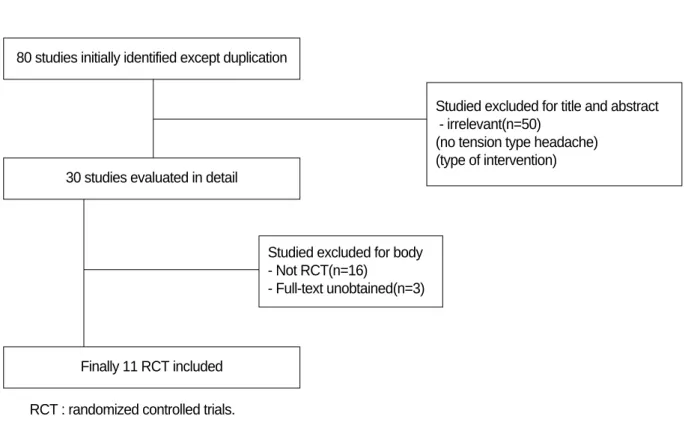
이중 게재를 제외하고 검색된 80편의 논문 중, 제 목과 초록을 통해 긴장성 두통을 대상으로 하지 않 거나, 추나 중재법의 효능 비교를 목적으로 하지 않 은 논문을 제외하여 30편의 논문을 일차 선정하였 다. 이차적으로는 본문검색을 통하여 비 무작위 대 조군 연구, 단일군 연구, 후향적 연구를 제외하고 기 준에 맞는 11편

10-20)

의 논문을 최종 선정하였다.

(Fig. 1.)

2. 자료추출 및 분석

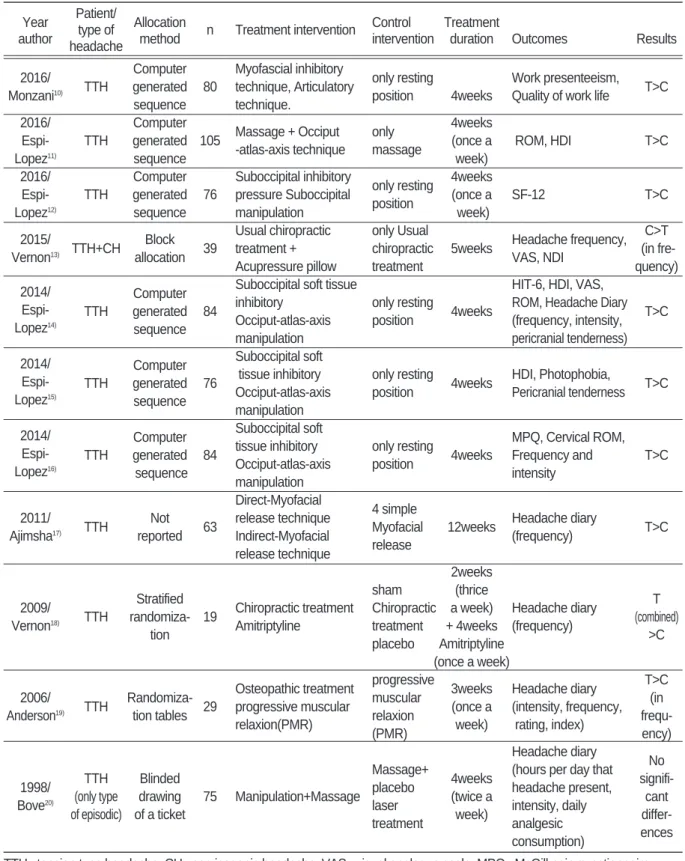
총 11건의 연구를 분석하였으며 이는 Table Ⅰ과 같다.

1) 진단 및 증상

총 11편의 무작위 대조군 연구에서 삽화성(episodic) 긴장성 두통만을 환자군으로 설정한 논문이 1편

20)

, 경추성 두통을 포함한 환자군을 설정한 논문이 1편

13)

있었으며, 나머지 9편

10-12,14-19)

의 논문들은 삽화성 (episodic)과 만성(chronic)의 구분 없이 모든 긴장 성 두통을 환자군으로 설정하였다.

2) 무작위 배정방법

4편

13,18-20)

의 논문에서 각각 Block allocation,

Stratified randomization, Randomization tables, Blinded drawing of a ticket의 방법으로 배정하였 고, 언급을 하지 않은 논문이 1편

17)

있었고, 나머지 6편의 논문에서는 모두 Computer generated sequence의 방법으로 배정하였다.

80 studies initially identified except duplication

30 studies evaluated in detail

Studied excluded for title and abstract - irrelevant(n=50)

(no tension type headache) (type of intervention)

Studied excluded for body - Not RCT(n=16)

- Full-text unobtained(n=3)

Finally 11 RCT included

Fig. 1. Flowchart of trial selection process.

RCT : randomized controlled trials.

(4)

Table Ⅰ. Summary of Randomized Controlled Trials of Chuna in Tension Type Headache Year Patient/

Allocation Control Treatment

author type of

method n Treatment intervention

intervention duration Outcomes Results headache

2016/ Computer Myofascial inhibitory

only resting Work presenteeism, Monzani

10)

TTH generated 80 technique, Articulatory

position 4weeks Quality of work life T>C sequence technique.

2016/ Computer

Massage + Occiput only 4weeks Espi- TTH generated 105

-atlas-axis technique massage (once a ROM, HDI T>C

Lopez

11)

sequence week)

2016/ Computer Suboccipital inhibitory

only resting 4weeks Espi- TTH generated 76 pressure Suboccipital

position (once a SF-12 T>C

Lopez

12)

sequence manipulation week)

2015/ Block Usual chiropractic only Usual

Headache frequency, C>T Vernon

13)

TTH+CH

allocation 39 treatment + chiropractic 5weeks

VAS, NDI (in fre-

Acupressure pillow treatment quency)

Computer Suboccipital soft tissue HIT-6, HDI, VAS,

2014/

TTH generated 84 inhibitory only resting

4weeks ROM, Headache Diary T>C Espi-

sequence Occiput-atlas-axis position (frequency, intensity, Lopez

14)

manipulation pericranial tenderness)

Computer Suboccipital soft 2014/

TTH generated 76 tissue inhibitory only resting

4weeks HDI, Photophobia,

T>C Espi-

sequence Occiput-atlas-axis position Pericranial tenderness Lopez

15)

manipulation Computer Suboccipital soft

MPQ, Cervical ROM, 2014/

TTH generated 84 tissue inhibitory only resting

4weeks Frequency and T>C Espi-

sequence Occiput-atlas-axis position

intensity Lopez

16)

manipulation Direct-Myofacial

4 simple 2011/

TTH Not

63 release technique

Myofacial 12weeks Headache diary

T>C Ajimsha

17)

reported Indirect-Myofacial

release (frequency)

release technique

2weeks

Stratified sham (thrice

2009/ T

TTH randomiza- 19 Chiropractic treatment Chiropractic a week) Headache diary

(combined) Vernon

18)

tion Amitriptyline treatment + 4weeks (frequency)

>C placebo Amitriptyline

(once a week) Osteopathic treatment progressive

Headache diary T>C 2006/

TTH Randomiza-

29 progressive muscular muscular 3weeks

(intensity, frequency, (in Anderson

19)

tion tables

relaxion(PMR) relaxion (once a

rating, index) frequ-

(PMR) week)

ency) Headache diary

TTH Blinded Massage+

4weeks (hours per day that No 1998/

(only type drawing placebo

(twice a headache present, signifi- Bove

20)

of episodic) of a ticket

75 Manipulation+Massage laser

week) intensity, daily cant

treatment analgesic differ-

consumption) ences TTH : tension type headache. CH : cervicogenic headache. VAS : visual analogue scale. MPQ : McGill pain questionnaire.

ROM : range of motion. SF-12 : short-form 12. HDI : headache disability inventory. NDI : neck disability inventory.

HIT-6 : headache impact test-6. T : treatment group. C : control group.

(5)

3) 실험군 및 대조군 추나 중재법

실험군으로 관절교정추나와 근막추나를 혼합해 서 평가대상으로 한 논문이 8편

10-12,14-16,20)

으로 가장 많았으며, 관절교정추나와 근막추나, 두개천골추나, 관절가동추나를 혼합해 평가대상으로 한 논문이 1 편

19)

, 추나요법과 진통제를 평가대상으로 한 논문이 1편

18)

, 근막추나만을 평가대상으로 한 논문이 1편

17)

, 추나요법과 Acupressure pillow를 실험군으로 한 논문이 1편

13)

이었다.

대조군으로 단순 침상안정을 대조군으로 한 논 문이 5편

10,12,14-16)

으로 가장 많았으며, 그 외의 대조 군으로는 자가 스트레칭, placebo medication과 headpiece를 이용한 sham 추나요법, 근막추나, placebo laser treatment 등을 사용한 논문

11,13,17-20)

등이 있었다.

4) 치료기간 및 횟수

치료기간은 3주에서 최장 12주까지로 설정하였 으며, 4주를 치료기간으로 설정한 논문이 7편

10-

12,14-16,20)

으로 가장 많았다. 치료횟수에 대한 언급을 하지 않은 논문이 6편

10,13-17)

있었으며, 주 1회 치료 를 설정한 논문이 3편, 주 2회 치료를 설정한 논문 이 1편

20)

, 처음 2주까지 주3회와 3주부터 6주까지 주 1회 치료를 설정한 논문이 1편

18)

있었다.

5) 평가척도

긴장성 두통의 평가도구로 사용된 평가척도 중 Headache Diary를 사용한 논문이 5편

14,17-20)

으로 가장 많았다. 그 외에 사용된 평가척도로는 Range Of Motion(ROM) 3편

11,14,16)

, Headache Disability Inventory 3편

11,14,15)

, Headache frequency, Neck Disability Inventory(NDI), McGill Pain Questionnaire(MPQ), Headache Impact Test- 6(HIT-6), Short Form-12(SF-12),

Pericranial tenderness, Daily analgesic consumption, Photophobia, Work presenteeism, Quality of work life 등이 있었다.

6) 치료결과 총 9편

10-12,14-19)

의 무작위 대조군 연구에서 실험군 이 대조군에 비하여 효과적으로 나타났고, 1편

13)

의 논문에서 대조군이 실험군보다 더 효과적인 것으로 나왔으나 이는 baseline frequency의 차이 때문인 것으로 보이며, 대조군은 추나요법을 받고 실험군 은 추나요법에 Acupressure Pillow를 사용하는 연 구였다. 나머지 1편

20)

에서만 실험군과 대조군에서 유의한 차이가 없다는 보고를 하였다.

7) 이상반응과 연구윤리 보고

11편

10-20)

의 모든 논문들이 연구윤리심의위원회

(Institutional Review Board, IRB)의 승인을 받아 시행되었다.

이상반응에 대하여 보고를 하지 않은 논문이 3편

10,15,19)

있었으며, 이상반응이 나타나지 않은 논문이

5편

11-13,17,20)

, 1건의 이상반응을 보고하였으나 어떤 이상반응인지 언급을 하지 않은 논문이 1편

14)

, 치료 후 다소 통증 증가의 이상반응을 보고한 논문이 2 편

7,9)

이었다.

3. 연구의 비뚤림 위험평가

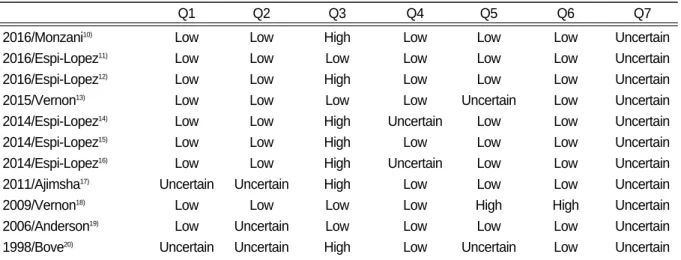
대상 무작위 대조 논문들을 NECA(한국보건의료

연구원)체계적 문헌고찰메뉴얼의 risk of bias 번역

본을 참고하여 평가하였다.(Table Ⅱ) ‘무작위 배

정 항목’ 에서는 난수표, 컴퓨터를 이용한 난수생성,

블록배정법, 층화배정법을 사용한 논문들

10-16,18,19)

서는 낮은 비뚤림 위험을 보였지만, 나머지 논문들

에서는 자료부족으로 불확실한 비뚤림 위험을 보였

으며‘배정 은폐’ 에서는 제 3자에 의한 중앙무작위

(6)

화 방식이 6편

11,12,14-16,18)

이었으며, 일련번호가 기록 된 밀봉된 봉투에 의한 은폐가 2편

10,13)

이었고, 나머 지 3편은 정확한 언급을 하지 않았다. ‘연구 참여 자, 연구자에 대한 눈가림’항목에서는 대조군으로 resting position을 설정한 논문

10,12,14-16)

이 많았기 때문에 맹검이 이루어지기 어려운 연구들이 대부분 으로 높은 비뚤림 위험을 보였다. ‘결과평가에 대한 눈가림’항목과‘불충분한 결과자료’항목에서는 대부분 낮은 비뚤림 위험을 보였으며, ‘외 비뚤림’

항목에서는 모든 논문에서 정확한 판단을 할 수 없 었다.

Ⅳ. 고 찰

긴장성 두통의 발생 배경을 보면 과로, 긴장 등으 로 두경부(頭頸部)에 지속적인 근 수축이 생겨 그 계속적인 근 수축의 영향으로 근육 사이로 지나가 는 말초 신경과 혈관이 눌려 혈관 단면적이 감소되 어 혈류가 저하되며 이때 자극 받은 말초신경이 중 추신경계로 전달되어 통증으로 인식하게 되어, 두

개(頭蓋) 주위 근의 압통과 근막 통증이 나타난다

21,22)
.

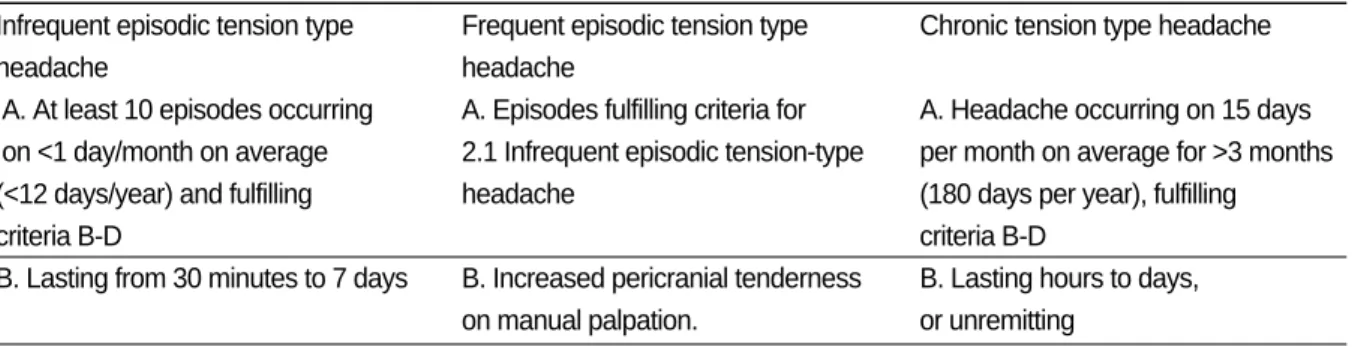
긴장성 두통의 진단은 국제두통협회(Inter- national Headache Society)의 진단기준이 널리 사 용되고 있으며(Table Ⅲ)

23)

, 최근 긴장성 두통에 대 한 약물요법의 한계로 비약물치료요법에 대한 관심 도가 높아져있고, 국외에서는 추나요법과 같은 수 기치료를 적극적으로 치료에 적용하고 효과가 검증 되어 보고되고 있다

24)

.

추나요법은『內經』 의 치료법 가운데 도인(導引), 안교(按 )에서 유래되어 안마 또는 추나라고 혼용 해 오다가, 중국 근대에 이르러 추나를 안마와 구별 하여 보다 전문적인 용어로 사용되기 시작했다. 추 나요법은 수기법의 직접적인 작용을 통하여 기혈순 행 계통의 기능을 개선하고, 기혈순행을 촉진하는 작용을 갖고, 五臟六腑의 기능에 대해서도 經絡, 氣 血 등을 통하여 음양평형조절작용을 한다

25)

.

최종 선택된 11편의 긴장성 두통에 대한 추나요 법 임상시험을 고찰한 결과, 일반적으로 관절교정 추나와 근막추나를 사용하였으며, 치료기간은 평균 적으로 주 1회 총 4주에 걸쳐 진행되었다. 대부분의

Table Ⅱ. ‘Risk of Bias’ Assessment in Included RCT

Q1 Q2 Q3 Q4 Q5 Q6 Q7

2016/Monzani

10)

Low Low High Low Low Low Uncertain

2016/Espi-Lopez

11)

Low Low Low Low Low Low Uncertain

2016/Espi-Lopez

12)

Low Low High Low Low Low Uncertain

2015/Vernon

13)

Low Low Low Low Uncertain Low Uncertain

2014/Espi-Lopez

14)

Low Low High Uncertain Low Low Uncertain

2014/Espi-Lopez

15)

Low Low High Low Low Low Uncertain

2014/Espi-Lopez

16)

Low Low High Uncertain Low Low Uncertain

2011/Ajimsha

17)

Uncertain Uncertain High Low Low Low Uncertain

2009/Vernon

18)

Low Low Low Low High High Uncertain

2006/Anderson

19)

Low Uncertain Low Low Low Low Uncertain

1998/Bove

20)

Uncertain Uncertain High Low Uncertain Low Uncertain

L : low risk of bias. H : high risk of bias. U : uncertain risk of bias.

Q1 : 무작위 배정순서 생성, Q2 : 배정순서은폐, Q3 : 연구참여자, 연구자에 대한 눈가림, Q4 : 결과평가에 대한 눈가림,

Q5 : 불충분한 결과보고, Q6 : 선택적 보고, Q7 : 그 외 비뚤림

(7)

논문에서 추나요법이 긴장성두통에 효과적이라는 결과가 보고되었으며, 치료 후 통증이 증가되는 이 상반응이 보고되었으나, 가벼운 정도의 악화였으며 하루가 지나면서 통증이 완화가 되었다고 보고되었 다.

무작위 배정은 참가자 혹은 연구진에 의한 선택 비뚤림(selection bias)을 낮춰 보고의 신뢰성을 높 이고, 배정은폐(allocation concealment)는 전화, 이메일, 동봉된 우편, 스크래치 카드를 이용하여 군 배정을 연구진이 예측하지 못하게 진행하는 것으로 맹검(blinding)과 더불어 무작위 대조군에서 비뚤 림을 최소화하는 방법

26)

으로 대부분의 논문

10-16,18)

에 서 무작위 배정과 은폐에 대한 낮은 비뚤림 위험을 보이고 있으나, ‘연구 참여자, 연구자에 대한 눈가 림’항목에서는 대부분의 논문들이 높은 비뚤림 위 험을 보이고 있다. 중재의 특성상 참가자와 연구자 의 눈가림이 거의 불가능하였고, 대조군으로 resting position을 설정한 논문이 많았기 때문에 눈가림을 했다는 언급이 있었음에도 눈가림이 유지 되지 않았을 것으로 판단되었다. 하지만 이 외‘결

과평가에 대한 눈가림’ , ‘불충분한 결과자료’ 와‘선 택적보고’에 대한 비뚤림은 대체로 낮은 비뚤림 위 험을 보였다.

이처럼 적절한 대조군에 대한 보완을 통하여 잘 설계된 무작위 대조군 연구가 더 많이 시행되어야 하며, 이 외에 치료 시간 언급, 이상반응보고, 표본 수 도출에 대한 통계학적 산출 근거 언급, 병용 치료 법의 최소화 등의 추가 보완이 필요할 것으로 보인 다.

또한 본 고찰은 회색문헌이나, 진행중인 임상시험 등은 전자저널의 데이터베이스 상 포함되지 않았을 가능성이 있고, 논문 검색에 있어서 양질의 체계적 문헌고찰을 위해 Pubmed와 전통의학정보포털 (OSASIS), 과학기술정보통합서비스(NDSL) 뿐만 이 아닌 Excerpta Medica dataBASW(EMBASE), Cumulative Index to Nursing and Allied Health Literature(CINAHL), CNKI 등 해외 검색원에 대 한 포괄적인 검색이 필요할 것으로 보인다.

마지막으로 본 고찰을 통하여 국내에서도 추나요 법에 대한 활발한 무작위 대조군 연구 및 체계적 문

Table Ⅲ. Diagnostic Criteria for Chronic Tension Type Headache

Infrequent episodic tension type Frequent episodic tension type Chronic tension type headache

headache headache

A. At least 10 episodes occurring A. Episodes fulfilling criteria for A. Headache occurring on 15 days on <1 day/month on average 2.1 Infrequent episodic tension-type per month on average for >3 months (<12 days/year) and fulfilling headache (180 days per year), fulfilling

criteria B-D criteria B-D

B. Lasting from 30 minutes to 7 days B. Increased pericranial tenderness B. Lasting hours to days, on manual palpation. or unremitting

C. At least two of the following four characteristics:

1. bilateral location

2. pressing or tightening (non-pulsating) quality 3. mild or moderate intensity

4. not aggravated by routine physical activity such as walking or climbing stairs D. Both of the following:

1. no nausea or vomiting

2. no more than one of photophobia or phonophobia

E. Not better accounted for by another ICHD-3 diagnosis

(8)

헌고찰이 이루어져 추나 치료의 근거 창출에 이바 지할 것으로 기대한다.

Ⅴ. 결 론

긴장성 두통의 추나요법에 대한 무작위 대조군 연구에 대한 고찰을 한 결과 다음과 같은 결론을 얻 었다.

1. 긴장성 두통에는 관절교정추나, 근막추나, 두 개천골추나, 관절가동추나 등이 사용되고 있 다. 치료기간은 평균 4주간 주 1회이며, 1편을 제외한 10편의 논문에서 추나요법이 긴장성두 통에 유효한 효과를 가지고 있다고 보고되었 다.

2. 전체 연구에서 추나요법과 관련된 중대한 이상 반응은 보고되지 않았으나, 경미한 이상반응으 로 치료 후 통증 증가가 보고되었다.

3. 대부분의 연구에서 중재의 특성상 연구참여자 및 연구자의 눈가림이 취약한 것으로 보이며, 적절한 대조군 설정이 필요할 것이다.

4. 그 외의 치료 시간 언급, 이상반응보고, 표본수 도출에 대한 통계학적 산출 근거 언급, 병용 치 료법의 최소화등이 필요할 것으로 보인다.

위와 같이 추나요법이 긴장성 두통에 유효한 효 과를 가지고 있는 것으로 보이며, 국내에서도 연구 설계에 대하여 추가 보완을 하여, 철저한 계획 아래 근거중심의학을 위한 무작위배정 임상연구가 필요 할 것으로 보인다.

Ⅵ. 참 고 문 헌

1. Korean Acupuncture & Moxibustion Medicine Society. Acupuncture and Moxibustion Medicine. Jipmoondang.

2012:770-3.

2. Stovner LJ, Zwart JA, Hagen K, Terwindt GM, Pascual J. Epidemiology of headache in Europe. Eur J Neurol. 2006;13(4):333- 45.

3. Yoon JW, Moon DE, Yang SY, Park CM.

Therapeutic effect of the patients with chronic migraine in pain clinic. Korean J pain. 2004;17:146-52.

4. Grazzi L, Andrasik F, D’ Amico D, Leone M, Usai S, Kass SJ, Bussone Gl.

Behavioral and pharmacologic treatment of transformed migraine with analgesic overuse: outcome at 3years. Headache.

2002;42:483-90.

5. Korean Cardiac Internal Medicine Society.

Circulation·Neurointernal medicine.

Goonja publisher. 2010:367-87.

6. Won JH, Kim YJ, An HD, Woo CH. 3 Case reports on tension-type headache treated by chuna manipulative therapy. The Journal of Korea CHUNA Manual Medicine for spine & nerves. 2015;10(1):97-107.

7. Won JH, Ahn HD, Woo CH. A case report on chronic tension-type headache improved by korean medicine with chuna manual therapy. The Journal of Korea CHUNA Manual Medicine for spine &

nerves. 2013;8(2):105-11.

8. Kim DH, Hwang EH, Heo I, Kim BJ, Bae

JM, Kim JK. Chuna Manual Therapy for

Headache : A Systematic Review and

(9)

Meta-analysis. The Journal of Korea CHUNA Manual Medicine for Spine &

Nerves. 2015;10(2):1-12.

9. Higgins JPT, Green S, editors. Cochrane handbook for systematic reviews of interventions [Internet]. Version 5.1.0.

Chichester(UK) : John Wiley & Sons, Ltd.

2011 [updated 2011 Mar]. Chapter 8, Assessing risk of bias in included studies ; [cited 2011 Mar 20]. Available from:

URL:http://handbook.cochrane.org/

10. Monzani L, Espi-Lopez GV, Zurriaga R, Andersen LL. Manual therapy for tension-type headache related to quality of work life and work presenteeism:

Secondary analysis of a randomized controlled trial. Complement Ther Med.

2016;25:86-91.

11. Espi-Lopez GV, Zurriaga R, Monzani L, Falla D. The effect of manipulation plus massage therapy versus massage therapy alone in people with tension-type headache. a randomized controlled clinical trial. Eur J Phys Rehabil Med. 2016;[Epub ahead of print].

12. Espi-Lopez GV, RODRIGUEZ-Blanco C, Oliva-Pascual-Vaca A, Molina-Martinez FJ, Falla D. Do manual therapy techniques have a positive effect on quality of life in people with tension-type headache? A randomized controlled trial. Eur J Phys Rehabil Med. 2016;[Epub ahead of print].

13. Vernon H, Borody C, Harris G, Muir B, Goldin J, Dinulos M. A Randomized Pragmatic Clinical Trial of Chiropractic Care for Headaches With and Without a Self-Acupressure Pillow. J Manipulative

Physiol Ther. 2015;38(9):637-43.

14. Espi-Lopez GV, Gomez-Conesa A, Gomez AA, Martinez JB, Pascual-Vaca AO, Blanco CR. Treatment of tension- type headache with articulatory and suboccipital soft tissue therapy: A double-blind, randomized, placebo- controlled clinical trial. J Bodyw Mov Ther. 2014;18(4):576-85.

15. Espi-Lopez GV, Rodriguez-Blanco C, Oliva-Pascual-Vaca A, Benitez-Martinez JC, Lluch E, Falla D. Effect of manual therapy techniques on headache disability in patients with tension-type headache.

Randomized controlled trial. Eur J Phys Rehabil Med. 2014;50(6):641-7.

16. Espi-Lopez GV, Gomez-Conesa A.

Efficacy of manual and manipulative therapy in the perception of pain and cervical motion in patients with tension- type headache: a randomized, controlled clinical trial. J Chiropr Med. 2014;

13(1):4-13.

17. Ajimsha MS. Effectiveness of direct vs indirect technique myofascial release in the management of tension-type headache. J Bodyw Mov Ther. 2011;

15(4):431-5.

18. Vernon H, Jansz G, Goldsmith CH, McDermaid C. A randomized, placebo- controlled clinical trial of chiropractic and medical prophylactic treatment of adults with tension-type headache: results from a stopped trial. J Manipulative Physiol Ther. 2009;32(5):344-51.

19. Anderson RE, Seniscal C. A comparison of

selected osteopathic treatment and

(10)

relaxation for tension-type headaches.

Headache. 2006;46(8):1273-80.

20. Bove G, Nilsson N. Spinal manipulation in the treatment of episodic tension-type headache: a randomized controlled trial.

JAMA. 1998;280(18):1576-9.

21. Langemark M, Jensen K, Jensen TS, Olesen J. Pressure pain thresholds and thermal nociceptive thresholds in chronic tension-type headache. Pain. 1989;

38(2):203-10.

22. Jensen R, Bendtsen L, Olesen J. Muscular factors are of importance in tension-type headache. Headache. 1998;38(1):10-7.

23. International Headache Society. The International Classification of Headache

Disorder. 3rd edition. Cephalalgia.

2013,33(9):660-1.

24. Bronfort G, Haas M, Evans R, Leininger B, Triano J. Effectiveness of manual therapies: the UK evidence report. Chiropr Osteopat. 2010;18:3.

25. Korean Society of Chuna Manual Medicine for Spine & Nerves. Chuna manual medicine. Seoul: Korean Society of Chuna Manual Medicine for Spine & Nerves.

2014:4-31.

26. Viera AJ, Bangdiwala SI. Eliminating bias in randomized controlled trials: importance of allocation concealment and masking.

Fam Med. 2007;39(2):132-7.

수치

Fig. 1. Flowchart of trial selection process.
Table Ⅰ. Summary of Randomized Controlled Trials of Chuna in Tension Type Headache Year Patient/
Table Ⅱ. ‘Risk of Bias’ Assessment in Included RCT
Table Ⅲ. Diagnostic Criteria for Chronic Tension Type Headache

참조

관련 문서

A new intravenous fat emulsion containing soybean oil, medium-chain triglycerides, olive oil, and fish oil: a single-center, double-blind randomized study

Conclusion: The mean CGRP level in overweight and obese children with headache was not significantly higher than in overweight and obese children without headache. There

Sedation, analgesia, and cardiorespiratory function in colonoscopy using midazolam combined with fentanyl or propofol.. A randomized, double-blind, phase 3 study

(Result) The reports of nausea, vomiting, abdominal discomfort, jaundice and hepatomegaly in acute hepatitis A patients and febrile sensation, chillness,

• KCI code provides a basic equation of the required development length for deformed bar in tension. development length for deformed bar in tension, including ALL

ƒ Define a type Department with a field name and a field head which is a reference to the type Person, with table people as scope:. create type Department ( create

Figure 7.1 Yield strengths for a ductile metal under various states of stress: (a) uniaxial tension, (b) tension with transverse compression, (c) biaxial tension, and

However, the present study showed that four components of the BSS (cough, sputum, dyspnea, and chest pain) were improved more with HL301 treat- ment than with placebo