Prostate Size Correlates with Fasting Blood Glucose in Non- Diabetic Benign Prostatic Hyperplasia Patients with Normal Testosterone Levels
We evaluated the correlations between BMI, fasting glucose, insulin, testosterone level, insulin resistance, and prostate size in non-diabetic benign prostatic hyperplasia (BPH) patients with normal testosterone levels. Data from 212 non-diabetic BPH patients with normal testosterone levels, who underwent transurethral resection of the prostate (TURP) due to medical treatment failure, were evaluated retrospectively. Patients with prostate specific antigen (PSA) levels of ≥ 3 ng/mL underwent multicore transrectal prostate biopsy before TURP to rule out prostate cancer. Patients with diabetes mellitus (DM) or serum testosterone levels of < 3.50 ng/mL were excluded from analysis. Correlations between clinical and laboratory parameters were determined. Prostate size correlated positively with age (r = 0.227, P < 0.001), PSA (r = 0.510, P < 0.001), and fasting glucose level (r = 0.186, P = 0.007), but not with BMI, testosterone, insulin level, or insulin resistance (each P > 0.05).
Testosterone level inversely correlated with BMI (r = -0.327, P < 0.001), insulin level (r = -0.207, P = 0.003), and insulin resistance (r = -0.221, P = 0.001), but not with age, prostate size, PSA, or fasting glucose level (each P > 0.05). Upon multiple adjusted linear regression analysis, prostate size correlated with elevated PSA (P < 0.001) and increased fasting glucose levels (P = 0.023). In non-DM BPH patients with normal testosterone levels, fasting glucose level is an independent risk factor for prostate hyperplasia.
Key Words: Prostatic Hyperplasia; Insulin Resistance; Prostate Won Tae Kim1,2, Seok Joong Yun1,
Young Deuk Choi2, Gi-Young Kim3, Sung-Kwon Moon4, Yung Hyun Choi5, Isaac Yi Kim6 and Wun-Jae Kim1
1Department of Urology, College of Medicine, Chungbuk National University, Cheongju;
2Department of Urology, College of Medicine, Yonsei University, Seoul; 3Department of Marine Life Science, Jeju National University, Jeju; 4Department of Food and Biotechnology, Chungju National University, Chungju; 5Department of Biomaterial Control, Dong-Eui University, Busan, Korea; 6Section of Urological Oncology, The Cancer Institute of New Jersey, Robert Wood Johnson Medical School, New Brunswick, New Jersey, USA
Received: 16 May 2011 Accepted: 21 June 2011 Address for Correspondence:
Won Tae Kim, MD
Department of Urology, College of Medicine, Chungbuk National University, 410 Seongbong-ro, Heungduk-gu, Cheongju 361-711, Korea
Tel: +82.43-269-6133, Fax: +82.43-269-6144 E-mail: [email protected]
This work was supported by a 2010 research grant from Chungbuk National University. This research was also supported by the Basic Science Research Program through the National Research Foundation of Korea (NRF), which is funded by the Ministry of Education, Science and Technology (2010-0001730).
http://dx.doi.org/10.3346/jkms.2011.26.9.1214 • J Korean Med Sci 2011; 26: 1214-1218
INTRODUCTION
Benign prostatic hyperplasia (BPH) is the most common pros- tate disease, characterized by nonmalignant enlargement of the prostate gland in aging men. The prevalence of BPH rises with age (1). Although the exact pathogenesis of BPH is far from completely understood, aging, testosterone levels, clinically sig- nificant lower urinary tract symptoms, inflammation, alteration in cell signaling are the significant risk factors for the develop- ment of BPH (2, 3). In addition, insulin, insulin-like growth fac- tors (IGFs), diabetes mellitus (DM), and obesity are known an- drogen-independent risk factors in BPH development (4).
Testosterone is the main circulating androgen in adult males and is secreted primarily by the testis. It also promotes prostate growth by increasing the ratio of cellular proliferation to death.
Testosterones and growth factors regulate this ratio by both stim-
ulating proliferation and inhibiting apoptosis (5). Dihydrotestos- terone (DHT), a derivative of testosterone, modulates the effects of several growth factors involved in BPH development, includ- ing fibroblast growth factors (FGFs), vascular endothelial growth factors (VEGFs), and IGFs (5-8).
In particular, IGFs are regarded as potent inducers of prostate growth in vitro (9, 10), and insulin levels, obesity and DM are considered risk factors for BPH development (11, 12). These fac- tors are associated with a metabolic syndrome characterized by insulin resistance and hyperinsulinemia. Two main components of the metabolic syndrome are obesity and abnormal glucose homeostasis (13). Vikram et al. (14) demonstrated that a high-fat diet resulting in hyperinsulinemia led to increased cellular pro- liferation and enlargement of the prostate in rats. Also, Nandee- sha et al. (15) reported that hyperinsulinemia associated with insulin resistance was an independent risk factor for the devel-
opment of BPH in non-DM men. Therefore, insulin resistance and hyperinsulinemia play a significant role in the BPH devel- opment. However, in non-DM BPH patients with normal testos- terone levels, the relationships between body mass index (BMI), insulin level, insulin resistance and prostate growth have not been yet established. This study evaluated these relationships in non-diabetic BPH patients with normal testosterone levels who underwent transurethral resection of the prostate (TURP).
MATERIALS AND METHODS Patient characteristics
Clinical data from 345 BPH patients who underwent TURP was reviewed retrospectively. From July 1996 to February 2010, pa- tients whose serum was taken on the morning of the operation day among patients underwent TURP were enrolled. To rule out prostate cancer, patients whose prostate specific antigen (PSA) levels were greater than or equal to 3 ng/mL were subjected to multicore transrectal prostate biopsy (generally 12 cores) before TURP. Prostate size was measured by transrectal ultrasound and the volume was calculated from transverse images by using the prolate-ellipsoid formula (0.524 × height × width × length) (16).
Patients on medical treatment for DM were excluded, as were patients whose serum testosterone levels were less than 3.50 ng/
mL, or who had been placed on any testosterone replacement medications such as testosterone injection or testosterone gel that could affect testosterone levels. Altogether, 212 BPH patients without DM and with normal testosterone levels were included in the analysis.
Laboratory tests
On the morning of the operation day, patient’s serum was taken.
Serum PSA levels were measured by using a quantified mono- clonal IRMA radioimmunoassay (Izotop, Budapest, Hungary).
Glucose levels were measured on a Hitachi 7600 automatic chemical analyzer (Hitachi, Tokyo, Japan) using the hexokinase method. Insulin and testosterone levels were measured by us- ing an Elecsys 2010 autoanalyzer (Roche Diagnostics, Indianap- olis, IN, USA) according to electrochemiluminescence immu- noassay principles. Insulin levels were measured by a method that employs insulin-specific monoclonal antibodies and is based on the sandwich test principle. The testosterone assay was based on the competitive test principle and employed a polyclonal testosterone-specific antibody. All assays were per- formed according to the manufacturers’ instructions. Insulin resistance was determined by the homeostasis model assess- ment (HOMA) using the following formula (17):
HOMA = (fasting glucose × fasting insulin) 22.5 × 18
Statistical analysis
Correlations between prostate size, testosterone level, insulin resistance, and other clinico-laboratory parameters (age, height, weight, BMI, PSA, fasting glucose, and insulin levels) were as- sessed. In addition, multiple linear regression analysis was per- formed to evaluate the association between prostate size and other parameters. Statistical analyses were performed by the Sta- tistical Package for Social Sciences, version 12.0, software (SPSS Inc., Chicago, IL, USA). All tests were performed using a 2-tailed analysis, and a P value of < 0.05 was considered statistically sig- nificant.
Ethics statement
The collection and analysis of all samples was approved by the institutional review board of Chungbuk National University Hos- pital (Cheongju, Korea; IRB registration number 2006-01-001).
An informed consent was obtained from each patient.
RESULTS
Baseline characteristics
The mean age of the study population was 68.81 ± 7.14 yr and the mean BMI was 23.56 ± 3.14 kg/m2. The mean serum PSA, testosterone, fasting glucose, and insulin levels were 4.14 ± 3.82 ng/mL, 6.00 ± 2.11 ng/mL, 93.89 ± 18.49 mg/dL, and 9.51 ± 10.97 mg/dL, respectively. The mean HOMA-IR and prostate size were 2.26 ± 2.73 and 44.08 ± 24.76 g. Additional baseline characteristics of the patients included in this study are presented in Table 1.
Correlations among prostate size, testosterone, HOMA-IR, and clinico-laboratory parameters
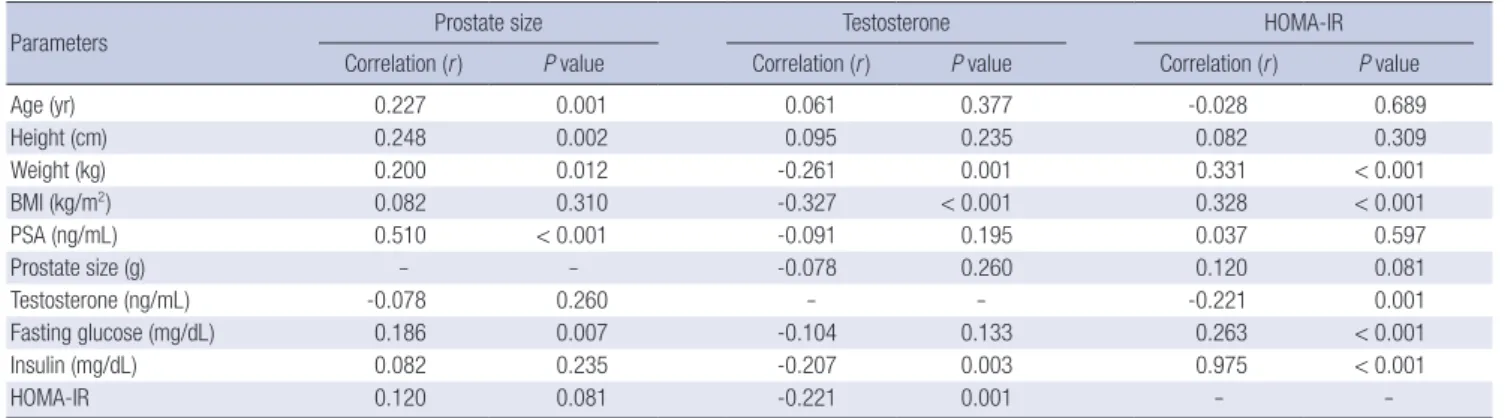
As shown in Table 2, prostate size positively correlated with age (r = 0.227, P < 0.001), PSA (r = 0.510, P < 0.001), and fasting glu- cose (r = 0.186, P = 0.007), but not with BMI, testosterone, insu- lin level, or HOMA-IR. Testosterone level inversely correlated with BMI (r = -0.327, P < 0.001), insulin level (r = -0.207, P = 0.003), and HOMA-IR (r = -0.221, P = 0.001), but not with age, prostate Table 1. Baseline characteristics of the BPH patients without DM and with normal testosterone levels
Parameters Mean ± standard deviation
Age (yr) 68.81 ± 7.14
Height (cm) 164.12 ± 6.02
Weight (kg) 63.52 ± 9.57
BMI (kg/m2) 23.56 ± 3.14
PSA (ng/mL) 4.14 ± 3.82
Prostate size (g) 44.08 ± 24.76
Testosterone (ng/mL) 6.00 ± 2.11
Fasting glucose (mg/dL) 93.89 ± 18.49
Insulin (mg/dL) 9.51 ± 10.97
HOMA-IR 2.26 ± 2.73
BMI, body mass index; PSA, prostate-specific antigen; HOMA, homeostasis model assessment; IR, insulin resistance.
size, PSA, or fasting glucose. HOMA-IR significantly correlated with BMI (r = 0.328, P < 0.001), fasting glucose (r = 0.263, P <
0.001), and insulin level (r = 0.975, P < 0.001), but not with age, PSA, or prostate size.
Multiple linear regression analysis of the associations between prostate size and other clinico-laboratory parameters
As shown in Table 3, in multiple adjusted linear regression anal- ysis, prostate size was significantly associated with PSA (P < 0.001) and fasting glucose level (P = 0.023). However, prostate size was not related to age, BMI, testosterone, insulin level, or HOMA-IR.
DISCUSSION
In this study, several well-known risk factors for the develop- ment of BPH were evaluated in BPH patients with normal tes- tosterone levels and no evidence of DM. Fasting glucose level was the only independent risk factor for prostatic hyperplasia in these patients. Other factors, including obesity, hyperinsu- linemia, and insulin resistance, were not significantly associat- ed with prostate size.
Many previous studies have demonstrated that obesity, DM,
high insulin, and low HDL cholesterol are risk factors for the de- velopment of BPH (12, 14, 15). It is likely that obesity promotes BPH by inducing systemic inflammation and oxidative stress (18). Inflammatory mediators and oxidative stress could possi- bly promote unregulated prostate growth through a nonmalig- nant pathway (19, 20). It is also possible that alterations in the balance between testosterone and estrogen levels in prostate tissue contribute to BPH development (21), because increased adipose tissue promotes increased aromatization of circulating testosterone into estrogen (22). However, in the current study of non-DM BPH patients with normal testosterone levels, BMI was not correlated with prostate size. In our previous study (23), the positive correlation between BMI and prostate size in patholog- ically proven BPH patients might be due to the inclusion of pa- tients with DM and low testosterone levels. These findings sug- gest that obesity may not be an independent risk factor for the development of BPH in non-DM patients with normal testos- terone levels.
Insulin resistance, a condition in which a normal level of in- sulin elicits a subnormal response, is associated with a group of disorders such as obesity, dyslipidemia, elevated fasting glucose levels, hyperinsulinemia, and hypertension (4). Recent experi- mental animal studies showed that hyperinsulinemia led to in- creased cellular proliferation and enlargement of the prostate in rats (14). In addition, several studies have shown that insulin- resistance and hyperinsulinemia could be independent risk fac- tors for BPH (15, 24). In the present study, there was no correla- tion between insulin level, or insulin resistance and prostate size. Vikram et al. (4) suggested that prostate growth by hyper- insulinemia could be attributed to the 1) enhanced mitogenic activity of insulin; 2) altered steroidal hormonal activity; 3) in- creased sympathetic tone; or 4) perturbed endocrine levels in the prostate. However, in the current study of non-DM BPH pa- tients with normal testosterone levels, no relationship between prostate growth and the above-mentioned metabolic factors was observed.
Although normal prostate growth is known to be testosterone- Table 2. Correlations between prostate size, testosterone, HOMA-IR, and other clinical and laboratory parameters
Parameters Prostate size Testosterone HOMA-IR
Correlation (r ) P value Correlation (r ) P value Correlation (r ) P value
Age (yr) 0.227 0.001 0.061 0.377 -0.028 0.689
Height (cm) 0.248 0.002 0.095 0.235 0.082 0.309
Weight (kg) 0.200 0.012 -0.261 0.001 0.331 < 0.001
BMI (kg/m2) 0.082 0.310 -0.327 < 0.001 0.328 < 0.001
PSA (ng/mL) 0.510 < 0.001 -0.091 0.195 0.037 0.597
Prostate size (g) - - -0.078 0.260 0.120 0.081
Testosterone (ng/mL) -0.078 0.260 - - -0.221 0.001
Fasting glucose (mg/dL) 0.186 0.007 -0.104 0.133 0.263 < 0.001
Insulin (mg/dL) 0.082 0.235 -0.207 0.003 0.975 < 0.001
HOMA-IR 0.120 0.081 -0.221 0.001 - -
BMI, body mass index; PSA, prostate-specific antigen; HOMA, homeostasis model assessment; IR, insulin resistance.
Table 3. Multiple linear regression analysis of the correlation between prostate size and other clinical and laboratory parameters
Parameters Estimate (β) Standardized
coefficients P value
Age (yr) 0.429 0.125 0.087
Height (cm) -0.564 -0.138 0.738
Weight (kg) 1.692 0.658 0.423
BMI (kg/m2) -3.250 -0.422 0.570
PSA (ng/mL) 3.809 0.572 < 0.001
Testosterone (ng/mL) -0.143 -0.012 0.867
Fasting glucose (mg/dL) 0.285 0.215 0.023
Insulin (mg/dL) 0.491 0.230 0.601
HOMA-IR -2.081 -0.243 0.591
BMI, body mass index; PSA, prostate-specific antigen; HOMA, homeostasis model as- sessment; IR, insulin resistance.
dependent, higher testosterone levels do not necessarily result in enhanced prostate growth (25). For example, in hypogonadal men, testosterone replacement increased PSA and prostate size, mainly during the first 6 months of therapy, to levels equivalent to those of men without hypogonadism but no higher (26). Fur- thermore, within the range of normal testosterone levels, there is no clear relationship between the concentration of circulating testosterone and prostate size in aging males (27). In this study, there was no correlation between testosterone level and prostate size in non-DM BPH patients with normal testosterone levels.
Low testosterone levels may predispose males to visceral obe- sity, which leads to the dysregulation of fatty acid metabolism, which in turn promotes insulin resistance (28). Testosterone in- hibits lipoprotein lipase activity in abdominal adipose tissue, which leads to decreased triglyceride uptake in central fat de- pots (29). Pitteloud et al. (30) reported that low serum testoster- one levels were associated with an adverse metabolic profile and that low testosterone levels promoted insulin resistance in men.
They also reported that serum testosterone levels were positive- ly related to insulin sensitivity (30); nevertheless, it does not nec- essarily follow that serum testosterone levels are inversely asso- ciated with insulin resistance. In the current study, serum testos- terone levels were inversely correlated with BMI, insulin level, and HOMA-IR. In addition, because low testosterone levels are a consequence of the dysregulation of fatty acid metabolism and BPH patients with low testosterone were excluded, patients with insulin resistance due to the dysregulation of fatty acid metabo- lism were not evaluated within this study. Thus, metabolic dys- regulation does not contribute to prostate growth in non-DM BPH patients with normal testosterone levels.
In the present study, multiple regression analysis revealed that serum fasting glucose levels correlated positively with prostate size. Parsons et al. (12) reported that obesity, elevated fasting glu- cose and diabetes were risk factors for BPH. In their study of 422 men, obesity and DM as well as fasting glucose were related to prostate size. However, that study included patients with diabe- tes and/or low testosterone levels. Altogether, these findings sug- gest that other unknown factors may influence prostate growth in non-DM patients with normal testosterone levels through mechanisms other than testosterone, obesity, or abnormal glu- cose homeostasis. Furthermore, lowering fasting glucose levels by drug and exercise might decrease prostate size and reduce the need for TURP in these patients.
In conclusion, this study is the first to examine the relation- ships between BMI, insulin levels, insulin resistance, and pros- tate size in non-DM BPH patients with normal testosterone lev- els. In non-DM BPH patients with normal testosterone levels, prostate size correlated with fasting glucose levels but not with BMI, testosterone levels, insulin levels, or insulin resistance.
Therefore, in these patients, fasting glucose level is an indepen- dent risk factor for prostate hyperplasia. Consequently, further
studies examining the relationship between BMI, insulin resis- tance and prostate growth in different races are warranted, along with prospective, population-based studies in healthy individu- als to evaluate the relationship between fasting blood glucose levels and the risk of developing BPH.
REFERENCES
1. Berry SJ, Coffey DS, Walsh PC, Ewing LL. The development of human benign prostatic hyperplasia with age. J Urol 1984; 132: 474-9.
2. Lee C, Kozlowski JM, Grayhack JT. Etiology of benign prostatic hyper- plasia. Urol Clin North Am 1995; 22: 237-46.
3. Donnell RF. Benign prostate hyperplasia: a review of the year’s progress from bench to clinic. Curr Opin Urol 2011; 21: 22-6.
4. Vikram A, Jena G, Ramarao P. Insulin-resistance and benign prostatic hyperplasia: the connection. Eur J Pharmacol 2010; 641: 75-81.
5. Lee KL, Peehl DM. Molecular and cellular pathogenesis of benign pros- tatic hyperplasia. J Urol 2004; 172: 1784-91.
6. Story MT, Livingston B, Baeten L, Swartz SJ, Jacobs SC, Begun FP, Law- son RK. Cultured human prostate-derived fibroblasts produce a factor that stimulates their growth with properties indistinguishable from basic fibroblast growth factor. Prostate 1989; 15: 355-65.
7. Walsh K, Sriprasad S, Hopster D, Codd J, Mulvin D. Distribution of vas- cular endothelial growth factor (VEGF) in prostate disease. Prostate Can- cer Prostatic Dis 2002; 5: 119-22.
8. Peehl DM, Cohen P, Rosenfeld RG. The insulin-like growth factor system in the prostate. World J Urol 1995; 13: 306-11.
9. Cohen P, Peehl DM, Lamson G, Rosenfeld RG. Insulin-like growth factors (IGFs), IGF receptors, and IGF-binding proteins in primary cultures of prostate epithelial cells. J Clin Endocrinol Metab 1991; 73: 401-7.
10. Monti S, Di Silverio F, Lanzara S, Varasano P, Martini C, Tosti-Croce C, Sciarra F. Insulin-like growth factor-I and -II in human benign prostatic hyperplasia: relationship with binding proteins 2 and 3 and androgens.
Steroids 1998; 63: 362-6.
11. Dahle SE, Chokkalingam AP, Gao YT, Deng J, Stanczyk FZ, Hsing AW.
Body size and serum levels of insulin and leptin in relation to the risk of benign prostatic hyperplasia. J Urol 2002; 168: 599-604.
12. Parsons JK, Carter HB, Partin AW, Windham BG, Metter EJ, Ferrucci L, Landis P, Platz EA. Metabolic factors associated with benign prostatic hyperplasia. J Clin Endocrinol Metab 2006; 91: 2562-8.
13. Haffner S, Taegtmeyer H. Epidemic obesity and the metabolic syndrome.
Circulation 2003; 108: 1541-5.
14. Vikram A, Jena GB, Ramarao P. Increased cell proliferation and contrac- tility of prostate in insulin resistant rats: linking hyperinsulinemia with benign prostate hyperplasia. Prostate 2010; 70: 79-89.
15. Nandeesha H, Koner BC, Dorairajan LN, Sen SK. Hyperinsulinemia and dyslipidemia in non-diabetic benign prostatic hyperplasia. Clin Chim Acta 2006; 370: 89-93.
16. Matthews GJ, Motta J, Fracehia JA. The accuracy of transrectal ultrasound prostate volume estimation: clinical correlations. J Clin Ultrasound 1996;
24: 501-5.
17. Matthews DR, Hosker JP, Rudenski AS, Naylor BA, Treacher DF, Turner RC. Homeostasis model assessment: insulin resistance and beta-cell func- tion from fasting plasma glucose and insulin concentrations in man. Di-
abetologia 1985; 28: 412-9.
18. Furukawa S, Fujita T, Shimabukuro M, Iwaki M, Yamada Y, Nakajima Y, Nakayama O, Makishima M, Matsuda M, Shimomura I. Increased oxi- dative stress in obesity and its impact on metabolic syndrome. J Clin In- vest 2004; 114: 1752-61.
19. Wang W, Bergh A, Damber JE. Chronic inflammation in benign prostate hyperplasia is associated with focal upregulation of cyclooxygenase-2, Bcl-2, and cell proliferation in the glandular epithelium. Prostate 2004;
61: 60-72.
20. Suzuki S, Platz EA, Kawachi I, Willett WC, Giovannucci E. Intakes of en- ergy and macronutrients and the risk of benign prostatic hyperplasia. Am J Clin Nutr 2002; 75: 689-97.
21. Shibata Y, Ito K, Suzuki K, Nakano K, Fukabori Y, Suzuki R, Kawabe Y, Honma S, Yamanaka H. Changes in the endocrine environment of the human prostate transition zone with aging: simultaneous quantitative analysis of prostatic sex steroids and comparison with human prostatic histological composition. Prostate 2000; 42: 45-55.
22. Hautanen A. Synthesis and regulation of sex hormone-binding globulin in obesity. Int J Obes Relat Metab Disord 2000; 24(Suppl 2): S64-S70.
23. Kim WT, Choi YD, Park C, Kim YW, Yun SJ, Kim IY, Kim WJ. Parathyroid hormone is not involved in prostate growth in patients with benign pros- tatic hyperplasia. Prostate 2011; 71: 1210-5.
24. Hammarsten J, Högstedt B. Hyperinsulinaemia as a risk factor for devel- oping benign prostatic hyperplasia. Eur Urol 2001; 39: 151-8.
25. Morgentaler A. Testosterone replacement therapy and prostate risks:
where’s the beef? Can J Urol 2006; 13(Suppl 1): 40-3.
26. Meikle AW, Arver S, Dobs AS, Adolfsson J, Sanders SW, Middleton RG, Stephenson RA, Hoover DR, Rajaram L, Mazer NA. Prostate size in hy- pogonadal men treated with a nonscrotal permeation-enhanced testos- terone transdermal system. Urology 1997; 49: 191-6.
27. Tan MO, Karabiyik I, Uygur MC, Diker Y, Erol D. Serum concentrations of sex hormones in men with severe lower urinary tract symptoms and benign prostatic hyperplasia. Int Urol Nephrol 2003; 35: 357-63.
28. Boden G, Jadali F, White J, Liang Y, Mozzoli M, Chen X, Coleman E, Smith C. Effects of fat on insulin-stimulated carbohydrate metabolism in nor- mal men. J Clin Invest 1991; 88: 960-6.
29. Mårin P, Odén B, Björntorp P. Assimilation and mobilization of triglyc- erides in subcutaneous abdominal and femoral adipose tissue in vivo in men: effects of androgens. J Clin Endocrinol Metab 1995; 80: 239-43.
30. Pitteloud N, Mootha VK, Dwyer AA, Hardin M, Lee H, Eriksson KF, Trip- athy D, Yialamas M, Groop L, Elahi D, Hayes FJ. Relationship between testosterone levels, insulin sensitivity, and mitochondrial function in men.
Diabetes Care 2005; 28: 1636-42.
AUTHOR SUMMARY
Prostate Size Correlates with Fasting Blood Glucose in Non-Diabetic Benign Prostatic Hyperplasia Patients with Normal Testosterone Levels
Won Tae Kim, Seok Joong Yun, Young Deuk Choi, Gi-Young Kim, Sung-Kwon Moon, Yung Hyun Choi, Isaac Yi Kim and Wun-Jae Kim
Recently, hyperinsulinemia associated with insulin resistance has also been shown to be an independent risk factor for BPH. We evaluated the correlations between BMI, fasting glucose, insulin, testosterone level, insulin resistance, and prostate size in 212 non-diabetic BPH patients with normal testosterone levels. In these patients, prostate size correlated with fasting glucose levels but not with BMI, testosterone level, insulin, and insulin resistance.