© 2012 The Korean Academy of Medical Sciences.
This is an Open Access article distributed under the terms of the Creative Commons Attribution Non-Commercial License (http://creativecommons.org/licenses/by-nc/3.0) which permits unrestricted non-commercial use, distribution, and reproduction in any medium, provided the original work is properly cited.
pISSN 1011-8934 eISSN 1598-6357
Ceftiaxone-Induced Neurotoxicity: Case Report, Pharmacokinetic Considerations, and Literature Review
Ceftriaxone is widely used in patients for the treatment of serious gram-negative infections. Ceftriaxone can induce some potential side effects, including neurotoxicity, however, nonconvulsive status epilepticus has rarely been reported. We report a case of acute reversible neurotoxicity associated with ceftriaxone. A 65-yr-old woman with chronic kidney disease developed altered consciousness during ceftriaxone treatment for urinary tract infection. The electroencephalogram demonstrated continuous bursts of generalized, high-voltage, 1 to 2 Hz sharp wave activity. Neurologic symptoms disappeared following withdrawal of ceftriaxone. The possibility of ceftriaxone-induced neurotoxicity should be considered in patients developing neurological impairment during ceftriaxone use, and the discontinuation of the drug could lead to complete neurological improvement.
Key Words: Ceftriaxone; Cephalosporins; Chronic Kidney Failure; Seizures Ki Bae Kim1, Sun Moon Kim1,
Woori Park1, Ji Seon Kim2,
Soon Kil Kwon1,3, and Hye-Young Kim1,3
1Department of Internal Medicine, Chungbuk National University Hospital; Departments of
2Neurology and 3Internal Medicine, Chungbuk National University College of Medicine, Cheongju, Korea
Received: 16 January 2012 Accepted: 19 April 2012 Address for Correspondence:
Sun Moon Kim, MD
Department of Internal Medicine, Chungbuk National University Hospital, 776 1Sunhwan-ro, Heungdeok-gu, Cheongju 361-711, Korea
Tel: +82.43-269-6351, Fax: +82.43-273-3252 E-mail: [email protected]
http://dx.doi.org/10.3346/jkms.2012.27.9.1120 • J Korean Med Sci 2012; 27: 1120-1123
CASE REPORT
Neuroscience
INTRODUCTION
Ceftriaxone is a third-generation cephalosporin, commonly used in the treatment of serious gram-negative infections due to its broad antimicrobial spectrum, long half-life, and easy pen- etration into the cerebrospinal fluid (1, 2). Contrary to other ceph- alosporins, a dose adjustment is not required for ceftriaxone even in the presence of renal insufficiency, thus it is prescribed conveniently for patients with chronic kidney disease (CKD) (3).
Neurologic adverse effects of ceftriaxone are infrequent, how- ever, encephalopathy, myoclonus, and seizures may occur as exemplified in other cephalosporins (4-6). Here, we describe a case of ceftriaxone-induced nonconvulsive status epilepticus (NCSE) with characteristic electroencephalogram (EEG) find- ings and discuss with literature review.
CASE DESCRIPTION
A 65-yr-old woman with CKD was admitted to our hospital be- cause of abdominal pain and poor oral intake on November 18, 2010. She had been diagnosed with idiopathic membranous glomerulonephropathy on renal biopsy six months prior to ad- mission. Her abdominal discomfort began two weeks earlier and was located predominantly in the right lower quadrant, and was
associated with lower back discomfort. She described a constant pressure unrelated to food intake that was associated with in- termittent nausea and vomiting. Her symptoms were not re- lieved by the administration of antacid, acetaminophen, or def- ecation. Laboratory data at patient admission were as follows:
serum creatinine 3.2 mg/dL (1.7 mg/dL, 8 weeks before admis- sion), albumin 1.8 g/dL (2.7 g/dL, 8 weeks before admission), and random urine protein-to-creatinine ratio 10.4 g/g (3.3 g/g, 8 weeks before admission), which demonstrated the deteriora- tion of renal function and increase in urinary protein excretion.
Gastroscopy exhibited superficial gastritis and the colonoscopy revealed no observable mucosal lesions. To identify other poten- tial causes of abdominal pain and exacerbation of renal insuffi- ciency, such as renal vein thrombosis, computed tomography (CT) scan of abdomen and pelvis was recommended, however she refused further work up being afraid of hemodialysis follow- ing CT scan. On day 15 of the hospitalization, she developed a chill, and her temperature rose to 38.5°C. Because she com- plained of vague urinary symptoms and urinalysis demonstrat- ed pyuria and bacteriuria, ceftriaxone (2 g/day) was adminis- tered intravenously for empirical treatment of urinary tract in- fection. Her temperature returned to normal after three days.
On day 20 of the patient’s hospitalization, her mental status de- teriorated suddenly into stupor and generalized myoclonic jerks
Kim KB, et al. • Ceftriaxone-Induced Neurotoxicity
http://jkms.org 1121
http://dx.doi.org/10.3346/jkms.2012.27.9.1120
were appeared. There was no history of seizures, and no other relevant neurological features observed upon neurological ex- amination. The patient exhibited no fever and the C-reactive pro- tein was 3.2 mg/dL (normal range < 0.3). The serum creatinine level rose to 6.7 mg/dL and the daily urine amount decreased to 300 mL, therefore an emergent hemodialysis was initiated for progressive uremia. Her consciousness did not improve despite 24-hr intensive hemodialysis. A Brain CT demonstrated no ab- normalities to explain these neurologic findings. An EEG record- ing on the next day showed generalized slowing with superim- posed almost continuous or periodic bursts of sharp waves or sharp and slow wave activity (Fig. 1A). Under the impression of ceftriaxone-induced NCSE, ceftriaxone was discontinued on day 22 of the hospitalization, and she returned to a completely alert, cooperative, and oriented state within two days of cessa- tion of the drug. The EEG on day 24 showed slowing of the back- ground without epileptiform discharges (Fig. 1B). In addition, the abdomen/pelvis CT revealed extensive thrombosis at the
inferior vena cava, both renal veins, right ovarian vein, and both external iliac veins (Fig. 2), thus anticoagulation was started. The patient was discharged on day 58 without any neurologic signs or symptoms.
DISCUSSION
In this report, we described a case of NCSE following the admin- istration of ceftriaxone in a patient with progressive renal impair- ment. The temporal relationship between the start of ceftriax- one therapy and the manifestation of NCSE as well as the with- drawal of ceftriaxone and the disappearance of the symptom strongly indicated that ceftriaxone was a causative agent. More- over, hemodialysis did not improve her mental status, and we could not find any other factors that could explain the neuro- logic symptom observed.
Neurotoxicity has been reported with both third-generation and fourth-generation cephalosporins (7-9). Epileptogenic ac-
Fig. 1. Electroencephalogram (EEG) findings during nonconvulsive status epilepticus and recovery state. (A) EEG on day 22, when the patient presented an altered mental state.
An EEG showed generalized slowing of the background with superimposed almost continuous bursts of generalized, moderate to high amplitude that had an almost periodic pattern (arrows). (B) EEG on day 24, when the patient’s neurologic symptoms resolved completely. Epileptiform discharges had disappeared.
A B
Fig. 2. Abdomen/Pevis CT showing the extensive thrombosis (arrowheads). (A) Thrombosis in the inferior vena cava. (B) Thrombosis in the renal vein.
A B
Kim KB, et al. • Ceftriaxone-Induced Neurotoxicity
1122 http://jkms.org http://dx.doi.org/10.3346/jkms.2012.27.9.1120
tivity of β-lactam antibiotics was first shown in 1945, when sei- zures were reported in experimental animals following intraven- tricular injection of penicillin (10), particularly in the settings of renal failure and excessive dosage (11). The exact mechanism is not fully understood, but it has been proposed to be mediated by competitive antagonism of brain γ-aminobutyric acid (GABA), which is the principal inhibitory neurotransmitter in the brain (12). Inhibition of GABA action could lead to a low neuronal threshold and subsequent excitation. Other authors (13) have proposed that cephalosporins might induce the release of cyto- kines including tumor necrosis factor-α, which could cause di- rect cerebral toxicity.
Cephalosporin-induced neurotoxicity may manifest in a va- riety of clinical presentations, such as encephalopathy or men- tal status changes, myoclonus, asterixis, and seizures (4-8). The latency of neurotoxicity, the period between the start of cepha- losporin treatment and the resulting neurologic manifestations, varied between one and ten days. All reported neurologic symp- toms typically resolved within two to seven days after discontin- uation of the drug. The ceftriaxone-associated neurologic syn- drome observed in our patients was similar to studies previous- ly described in the literature (6-8). Predisposing factors for ceph- alosporins-induced neurotoxicity include excessive dosage, re- nal insufficiency, pre-existing central nervous system (CNS) ab- normalities, and increased cerebral penetration of the drug (12, 14, 15). Different EEG patterns have been described in associa- tion with cephalosporin neurotoxicity. EEG findings include diffuse slow-wave delta activity, semi-periodic triphasic sharp wave activity, or frank periodic discharges (7). These EEG abnor- malities serve as evidence supporting the impact of cephalo- sporins on the CNS. Given that the majority of patients using cephaloporins have co-morbidity associated with mental alter- ation, EEG could be of benefit in the diagnosis and management of antibiotics-associated neurotoxicity.
The prevention of cephalosporin-induced neurotoxicity in
high risk patients, as discussed above, is of the utmost impor- tance. The careful monitoring of medication dosages and serum levels may be helpful in the minimization of this risk (7). As seen in this case report, many symptoms resolved completely only with discontinuation of the drug. Anticonvulsants such as phe- nytoin or valproate were administered in two previously report- ed cases, and their symptoms improved five days after stopping ceftriaxone (4). Besides, we did not use any anticonvulsants be- cause of the rapid (< 2 days) clinical improvement after discon- tinuation of ceftriaxone. Data are still lacking as to whether pa- tients with cephalosporin-induced NCSE require antiepileptic drug therapy or simple cessation of drugs results in improve- ment. However, some authors recommend that anticonvulsant therapy including lorazepam and/or phenytoin might be con- sidered in NCSE until the patient’s mental status returns to nor- mal and periodic discharges or NCSE shown on EEG resolve (7). Since neurotoxicity related to cephalosporins is reversible, it is unlikely that patients would need long-term anticonvulsant therapy.
Ceftriaxone has a distinctive pharmacokinetic property un- like other cephalsporins (3). While most of cephalosporins are highly dialyzable (70% of a given dose over a 3-hr hemodialysis session), ceftriaxone is not dialyzed during hemodialysis (3, 7).
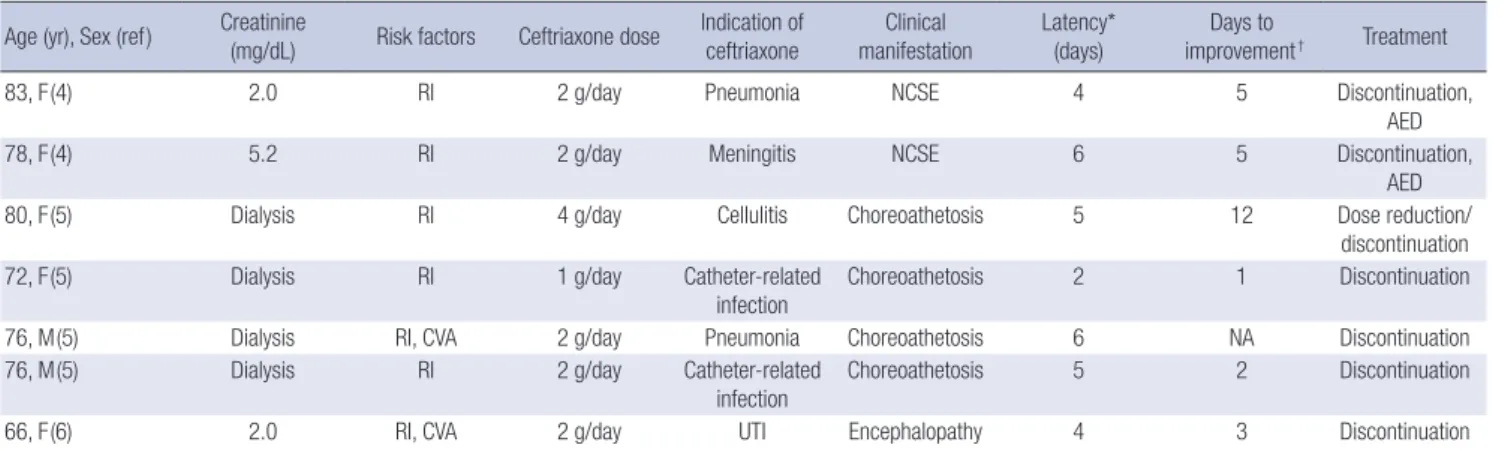
Moreover, the pharmacokinetics of ceftriaxone in patients with renal insufficiency differ markedly from those of other cephalo- sporins. Compared to values in healthy subjects, the half-life of other cephalosporins is prolonged 6- to 8-fold in patients with end-stage renal disease. However, the half-life of ceftriaxone is not greatly affected by a progressive decrease in the renal func- tion (3). Accordingly, dose adjustment of ceftriaxone is not re- quired for CKD patients. These pharmacokinetic characteristics might be related to the characteristics of ceftriaxone neurotox- icity. Only seven cases of ceftriaxone-induced neurotoxicity have been reported to date (Table 1). All the previous cases had renal impairment and 4 cases of those cases were on hemodialysis.
Table 1. Summary of reported cases of ceftriaxone-induced neurotoxicity Age (yr), Sex (ref) Creatinine
(mg/dL) Risk factors Ceftriaxone dose Indication of ceftriaxone
Clinical manifestation
Latency*
(days)
Days to
improvement† Treatment
83, F(4) 2.0 RI 2 g/day Pneumonia NCSE 4 5 Discontinuation,
AED
78, F(4) 5.2 RI 2 g/day Meningitis NCSE 6 5 Discontinuation,
AED
80, F(5) Dialysis RI 4 g/day Cellulitis Choreoathetosis 5 12 Dose reduction/
discontinuation
72, F(5) Dialysis RI 1 g/day Catheter-related
infection
Choreoathetosis 2 1 Discontinuation
76, M(5) Dialysis RI, CVA 2 g/day Pneumonia Choreoathetosis 6 NA Discontinuation
76, M(5) Dialysis RI 2 g/day Catheter-related
infection
Choreoathetosis 5 2 Discontinuation
66, F(6) 2.0 RI, CVA 2 g/day UTI Encephalopathy 4 3 Discontinuation
*Latency is the period between the start of ceftriaxone treatment and the onset of neurologic features; †Days to improvement are the period between the cessation of ceftriax- one and improvement of neurologic findings. RI, renal impairment; CVA, cerebro vascular accident; UTI, urinary tract infection; NCSE, non-convulsive status epilepticus; NA, not available; AED, anti-epileptic drug.
Kim KB, et al. • Ceftriaxone-Induced Neurotoxicity
http://jkms.org 1123
http://dx.doi.org/10.3346/jkms.2012.27.9.1120
There were 4 cases of choreoathetosis, 2 cases of NCSE, and one case of encephalopathy. Notably, there was no case of which the observed neurologic symptoms and signs were improved by dialysis. These findings are compatible with the pharmaco- kinetic property of ceftriaxone that is not removable by dialysis.
Moreover, given that no dose adjustment is required for ceftri- axone in the patient with renal impairment, overdose did not seem to play a role in ceftriaxone-associated neurotoxicity. In the previous reports, the elimination half-life of ceftriaxone was markedly prolonged in some dialysis patients, it might be due to an impaired biliary excretion process that is the alternative pathway of elimination for ceftriaxone in CKD patients (7,16).
These might contribute to the development of infrequent ceftri- axone neurotoxicity in patients with renal insufficiency.
Ceftriaxone can cause NCSE in patients with impaired renal function. This neurotoxicity should be considered carefully in patients with reduced renal function or prior CNS abnormali- ties. In addition, EEG should be performed when a patient re- ceiving ceftriaxone develops neurological symptoms. Early rec- ognition is of the utmost importance because the discontinua- tion of ceftriaxone reverts the symptoms completely.
REFERENCES
1. Rockowitz J, Tunkel AR. Bacterial meningitis. Practical guidelines for management. Drugs 1995; 50: 838-53.
2. Weisfelt M, de Gans J, van de Beek D. Bacterial meningitis: a review of effective pharmacotherapy. Expert Opin Pharmacother 2007; 8: 1493-504.
3. Patel IH, Sugihara JG, Weinfeld RE, Wong EG, Siemsen AW, Berman SJ.
Ceftriaxone pharmacokinetics in patients with various degrees of renal impairment. Antimicrob Agents Chemother 1984; 25: 438-42.
4. Martinez-Rodriguez JE, Barriga FJ, Santamaria J, Iranzo A, Pareja JA, Revilla M, dela Rosa CR. Nonconvulsive status epilepticus associated with cephalosporins in patients with renal failure. Am J Med 2001; 111:
115-9.
5. Sato Y, Morita H, Wakasugi H, Iijima S, Kawashima E, Wakayama Y, Yoshimura A. Reversible chreoathetosis after the administration of cef- triaxone sodium in patients with end-stage renal disease. Am J Med Sci 2010; 340: 382-4.
6. Roncon-Albuquerque R Jr, Pires I, Martins R, Real R, Sousa G, von Hafe P. Ceftriaxone-induced acute reversible encephalopathy in a patient treat- ed for a urinary tract infection. Neth J Med 2009; 67: 72-5.
7. Grill MF, Maganti R. Cephalosporin-induced neurotoxicity: clinical man- ifestations, potential pathogenic mechanisms, and the role of electroen- cephalographic monitoring. Ann Pharmacother 2008; 42: 1843-50.
8. Lam S, Gomolin IH. Cefepime neurotoxicity: case report, pharmacoki- netic considerations, and literature review. Pharmacotherapy 2006; 26:
1169-74.
9. Kim SY, Lee IS, Park SL, Lee J. Cefepime neurotoxicity in patients with renal insufficiency. Ann Rehabil Med 2012; 36: 159-62.
10. Johnson H, Walker A. Intraventricular penicillin: a note of warning.
JAMA 1945; 127: 217-9.
11. De Sarro A, Ammendola D, Zappala M, Grasso S, De Sarro GB. Relation- ship between structure and convulsant properties of some beta-lactam antibiotics following intracerebroventricular microinjection in rats. An- timicrob Agents Chemother 1995; 39: 232-7.
12. Wallace KL. Antibiotics-induced convulsions. Crit Care Clin 1997; 13:
741-62.
13. Alkharfy KM, Kellum JA, Frye RF, Matzke GR. Effect of ceftazidime on systemic cytokine concentrations in rats. Antimicrob Agents Chemother 2000; 44: 3217-9.
14. Schliamser SE, Cars O, Norrby R. Neurotoxicity of beta-lactam antibiot- ics: predisposing factors and pathogenesis. J Antimicrob Chemother 1991; 27: 405-25.
15. Calandra G, Lydick E, Carrigan J, Weiss L, Guess H. Factors predispos- ing to seizures in seriously ill infected patients receiving antibiotics: expe- rience with imipenem/cilastatin. Am J Med 1988; 84: 911-8.
16. Cohen D, Appel GB, Scully B, Neu HC. Pharmacokinetics of ceftriaxone in patients with renal failure and in those undergoing hemodialysis. An- timicrob Agents Chemother 1983; 24: 529-32.