J Korean Soc Coloproctol Vol. 22, No. 4, 2006
285
Treatm ent of Peritoneal Carcinom atosis from Colorectal Cancer
Hyung Jin Kim, M.D., Seong Taek Oh, M.D.
Department of Surgery, College of Medicine, The Catholic Uni- versity of Korea, Seoul, Korea
Intraperitoneal carcinomatosis accounts for 25∼35% of recurrences of colorectal cancer, and peritoneal carcino- matosis from colorectal cancer has been regarded as a lethal condition. However, a combination of aggressive cytoreductive surgery and intraperitoneal chemotherapy has been tried and appears to be beneficial in selected patients. The primary goal of cytoreductive surgery is to remove all visible tumor within the peritoneal cavity. The goal of intraperitoneal chemotherapy is to eradicate the microscopic residual tumor and to prevent its recurrence.
There are various ways to perform intraperitoneal chemo- therapy. One is postoperative intraperitoneal chemotherapy, and another is intraoperative hyperthermic chemotherapy during surgery. Hyperthermia increases the penetration of chemotherapy into tissues and the level of chemotherapy cytotoxicity. The timing of surgery in cases of intraperi- toneal chemotherapy and the optimal dosage of drugs must be evaluated in further studies. In colorectal cancer, the peritoneum should be regarded as an intra-abdominal organ, like the liver. Therefore, intraperitoneal carcinomatosis must be treated by using a combination of aggressive surgical treatment and intraperitoneal chemotherapy. Even- tually, the long-term overall survival will be increased. J Korean Soc Coloproctol 2006;22:285-290
Key Words: Colorectal neoplasm, Peritoneal carcinomatosis, Intraperitoneal chemotherapy
대장암, 복막전이, 복강 내 항암화학요법 ꠏꠏꠏꠏꠏꠏꠏꠏꠏꠏꠏꠏꠏꠏꠏꠏꠏꠏꠏꠏꠏꠏꠏꠏꠏꠏꠏꠏꠏꠏꠏꠏꠏꠏꠏꠏꠏꠏꠏꠏꠏꠏꠏꠏꠏꠏꠏꠏꠏ
서 론
대장암 환자에서 복막전이는 대장암 진단 당시에 10∼15%, 근치적 절제술 후 25∼35%에서 발생하여 간 전이 다음으로 가장 호발하는 전이 병소이다.1,2 하지 만 간이나 폐의 전이성 병변은 완전 절제술을 시행하 였을 경우 5년 생존율이 30∼35%에 달하는 반면 복막 전이의 경우는 평균생존기간이 5∼7개월로 매우 불량 하여 근치적 치료 방법이 없는 말기암 상태로 여겨져 왔으며 최근 새로운 항암화학약제의 복합 요법의 결 과도 매우 실망스럽다.1-3
최근에 복막 전이의 치료 방법이 많이 연구되어 육 안적 병소 제거술 및 복막 절제술(cytoreductive surgery with peritonectomy)과 함께 조기 수술 후 복강 내 화학 요법(early postoperative intraperitoneal chemotherapy, EPIC) 또는 수술 중 복강 내 온열화학요법(intraoper- ative intraperitoneal chemohyperthermia, IPCH)을 시행 하여 생존율을 향상시키고 있다.4,5
본 론
1) 발병 기전
대장암 환자에서 복막 전이가 발생하는 기전은 아직 밝혀져 있지 않다. 하지만 복막 전이가 있는 환자에서 복강 내 암세포의 발견빈도가 높고, 원발암의 침습도 가 높은 경우 복막 전이 빈도가 증가되는 것으로 보아 원발 병소에서 장막을 뚫고 나온 암세포가 복막에 파 종되어 발생하는 것으로 의심되고 있다. 또한 원발 종
대장암에 의한 복막 전이의 치료
가톨릭대학교 의과대학 외과학교실
김 형 진․오 승 택
책임저자: 오승택, 137-701, 서울시 서초구 반포동 505번지 가톨릭대학교 강남성모병원 외과
Tel: 02-590-2781, Fax: 02-595-2992 E-mail: [email protected]
Correspondence to: Seong Taek Oh, Department of Surgery, College of Medicine, The Catholic University of Korea, 505, Banpo-dong, Seocho-gu, Seoul 137-701, Korea
Tel: +82-2-590-2781, Fax: +82-2-595-2992 E-mail: [email protected]
양이 복막을 뚫지 않은 경우에도 복막전이가 발생하 는 것으로 보아 혈행성 전이도 원인이 될 수 있을 것으 로 생각되며, 수술로 인해 림프관 혹은 정맥이 절단되 고 이를 통해 암세포가 유출됨으로써 복막전이가 발 생할 수도 있을 것으로 생각한다.6
2) 진단 및 병기
개복하기 전에 복막 전이를 진단하는 것은 매우 힘 들다. 장 폐색이나 복수가 있을 경우 복막 전이를 의심 할 수 있지만, 초음파 검사나 CT 촬영으로도 5 mm 이 하의 작은 병변은 발견하기 어렵다. CT를 이용한 경우 2 cm 이상의 병변은 70%에서 발견할 수 있지만, 5 mm 이하의 병변은 28%에서만 발견할 수 있다.7
복막전이 환자의 예후를 예측하고 수술의 정도를 결정하기 위해 병기 결정이 필수적 요소이며 병기 결 정 방법은 여러 방법이 있고 각각의 장단점이 있다.
Gilly 등8이 제안한 병기방법에서 0기는 육안적 병변이 없는 경우, 1기는 복강 전이 병소가 복강 내 한 부위에 국한되어 있고 크기가 5 mm 이하인 경우, 2기는 복강
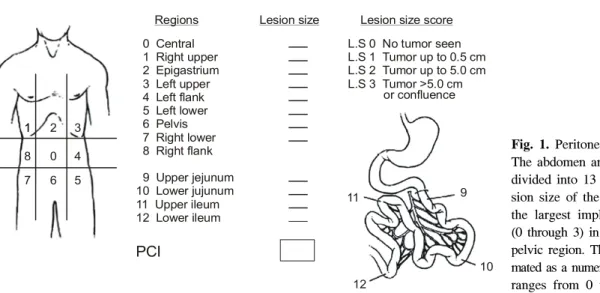
전이의 크기는 5 mm 이하이지만 복강 전체에 퍼져있 는 경우, 3기는 복강 전이의 크기가 5 mm∼2 cm인 경 우, 4기는 2 cm 이상의 전이 병소가 있는 경우로 분류 하였다(Table 1). 이 방법은 비교적 간단하고 재현성이 높은 장점이 있고, 370명의 환자를 대상으로 한 다기 관 연구에서 1, 2기 환자의 중앙생존기간은 6개월인 반면에 3, 4기 환자의 중앙생존기간은 3개월로 예후를 예측할 수 있었다.3 복막암지수(Peritoneal cancer index (PCI) score)는 복막 전이의 분포와 복막 전이의 크기로 평가하는 방법으로 복강을 13부분으로 나누고 각각의 부위에 전이병소가 없으면 0, 5 mm 이하면 1, 0.5∼5 cm이면 2, 5 cm 이상이면 3으로 평가하여 합산한 0∼
39의 수치로 표시하는 방법이다(Fig. 1).9 이 방법으로 전이병소의 육안적 완전 제거가 가능할지를 가늠할 수 있다. 즉 복막암지수가 20 이상인 경우에는 적극적 인 치료가 생존율을 증가시키지 못하므로, 고식적인 치료가 합당하다. 또한 복막암지수가 낮더라도 절제가 불가능한 위치에 있는 복막 전이는 예후가 나쁘다.10 단순복막암지수(simplified peritoneal cancer score)는 네덜란드 암 연구소에서 기술한 방법으로 복막암지수 와 유사하게 복강을 7부위로 나누고 복막 전이의 크기 는 2 cm 이하, 2∼5 cm, 5 cm 이상으로 기술하는 방법 이다.11
3) 복막 전이의 치료
오랫동안 복막 전이는 근치적 절제가 불가능하고 예후가 극히 불량한 말기암으로 여겨져 왔고 보존적 치료로 나타나는 증상의 호전을 위해 스테로이드, 복 수천자, 수술적 우회술 등이 사용되어 왔다.
Fig. 1. Peritoneal cancer index.
The abdomen and the pelvis are divided into 13 regions. The le- sion size of the largest sizes of the largest implants are scored (0 through 3) in each abdomino- pelvic region. They can be sum- mated as a numerical score, which ranges from 0 to 39.
Peritoneal cancer index
0 Central 1 Right upper 2 Epigastrium 3 Left upper 4 Left flank 5 Left lower 6 Pelvis 7 Right lower 8 Right flank 9 Upper jejunum 10 Lower jujunum 11 Upper ileum 12 Lower ileum
Regions Lesion size Lesion size score L.S 0 No tumor seen L.S 1 Tumor up to 0.5 cm L.S 2 Tumor up to 5.0 cm L.S 3 Tumor >5.0 cm
or confluence
9
10 11
12
PCI
1
1 2 3
8 0 4
7 6 5
Table 1. Staging of peritoneal carcinomatosis ꠚꠚꠚꠚꠚꠚꠚꠚꠚꠚꠚꠚꠚꠚꠚꠚꠚꠚꠚꠚꠚꠚꠚꠚꠚꠚꠚꠚꠚꠚꠚꠚꠚꠚꠚꠚꠚꠚꠚꠚꠚꠚꠚꠚꠚꠚꠚꠚꠚ Stage 0 No macroscopic disease
Stage 1 Malignant tumor nodules less than 5 mm in diameter, localized in one part of the abdomen Stage 2 Tumor nodules less than 5 mm in diameter,
diffuse to the whole abdomen Stage 3 Tumor nodules 5∼20 mm in diameter Stage 4 Large (>20 mm diameter) tumor deposits ꠏꠏꠏꠏꠏꠏꠏꠏꠏꠏꠏꠏꠏꠏꠏꠏꠏꠏꠏꠏꠏꠏꠏꠏꠏꠏꠏꠏꠏꠏꠏꠏꠏꠏꠏꠏꠏꠏꠏꠏꠏꠏꠏꠏꠏꠏꠏꠏꠏ
그 후 다양한 항암화학요법의 발전으로 전이성 대 장암의 생존율이 증가하고 있지만, 복막전이의 경우 혈관 형성이 미약하여 암세포에 항암화학약제가 전달 되는 것이 어려워 다른 부위의 전이성 대장암보다도 나쁜 예후를 보이고 있다. 즉 복막전이 환자에서 전신 화학요법의 의의는 약 70%에서 동반되는 다른 장기의 전이를 치료하는데 있다고 하겠다. 이런 전신화학요법 의 한계를 극복하기 위해 국소 치료가 연구되기 시작 하였고, 복강 내 화학요법이 시작되었다.
복강 내 화학요법은 1955년에 Weisberger 등12에 의 해 난소암의 치료로 처음 기술되었고, 1980년대에 들 어 다시 주목받기 시작하였다. 복강내 화학요법은 복 막-혈장막(peritoneal-plasma barrier)으로 인해 분자량이 큰 항암화학약제의 농도를 혈관 내에 비해 복강 내에 20∼40배 이상 유지시킴으로써,13 전신적인 부작용을 최소화하면서 복막 전이를 효과적으로 치료할 수 있 는 장점이 있지만, 약제가 3∼5 mm 이상은 투과할 수 없다는 단점이 있어 육안적 전이병소 절제술과 함께 시행해야 효과를 기대할 수 있다.
복강 내 화학요법을 시행하는 방법은 아직 정형화 되어있지 않고 기관마다 차이를 보이지만 크게 다음 의 두 가지 방법으로 나눠 볼 수 있고 이 두 가지 방법 을 함께 사용하는 경우도 있다. 첫 번째 방법은 조기 수술 후 복강 내 화학요법으로 수술 후 1주일 이내에 1∼2 L의 복막투석액에 항암화학약제를 혼합하여 복 강 내로 주입하고 다음 날 배액하는 방법으로 시행하 며 4∼5일간 지속하고 1개월을 주기로 6∼12개월 동 안 지속한다. 사용 약제는 5-fluorouracil (5-FU)을 단독 으로 또는 leucovorin (LV)과 병합 투여하거나, 5-FU와 mitomycin을 병합 투여하는 기관이 많다.5 이 방법은 특별한 장비가 필요없고 비교적 저렴한 장점이 있지 만, 온열요법을 함께 할 수 없고 약제가 복막 전체에 골고루 전달된다는 보장이 없는 단점이 있다. 두 번째 방법은 술 중 복강 내 온열화학요법를 시행하는 방법 이다. 온열요법은 여러 연구에서 항암작용을 항진시키 는 것으로 보고되었으며, 특히 mitomycin C의 경우 43oC에서 약 40배의 효과를 보였다.14 그외에도 platinum compounds, TNF-α, doxorubicin, irinotecan, vinblastine 등도 온열요법에 의해 항암작용이 항진되었다. 이런 이유로 많은 기관에서 mitomycin을 단독 사용하거나 cisplatin과 함께 사용하고 있다.5
최근 Elias 등15은 20예의 복막 전이 환자에서 육안적 전이병소 절제술을 시행하고 5-FU와 LV을 정맥 주사 한 후 oxalipatin을 이용한 복강내 온열화학요법(42∼
44oC, 30분)를 시행한 결과 복강 내 oxaliplatin의 농도 가 혈중에 비해 25배 높았고 전신 합병증은 없었다고 보고하기도 하였다. 온열요법에 의한 항암화학약제의 항진기전은 세포막 단백질의 변성과 신생혈관 투과도 의 증가로 인한 약제의 투과도 증가로 생각되고 있으 며 40oC에서 시작하여 43oC에서 가장 효과적인 것으로 보고되고 있다.16 또한 온열요법 자체의 암세포에 대한 항암효과도 있다.10 하지만 이 시술의 단점은 반드시 수술실에서 전신마취 하에서만 시행해야 하고 특수한 장비가 필요하다는 점이다. 복강 내 온열화학요법은 개복 상태에서 시행하거나 복강을 봉합한 후 시행할 수 있다. 복강을 봉합하기 전에 시행하면 수술자의 손 을 이용하여 열과 약제가 복강에 전체로 골고루 퍼지 도록 할 수 있는 장점이 있고, 복강을 봉합한 후 시행 하면 안전하고 용이한 장점이 있다. 세부 방법은 기관 마다 차이가 있지만 네덜란드 암연구소에서 시행한 방법은 다음과 같다. 우선 복벽을 견인기로 들어올려 복강 내 용적을 넓히고 플라스틱판으로 복벽을 막아 열과 항암화학약제의 누수를 줄이고, 플라스틱판의 가 운데 부분에 구멍을 만들어 항암화학약제가 주입되는 관을 삽입하고 수술자의 손을 이용하여 약제와 열이 복강 내로 골고루 퍼질 수 있도록 한다. 항암화학약제 의 배출관은 골반과 좌우측의 횡격막하에 설치하며 주입관과 배출관에 열감지 센서를 장착한다. 복막 투 석액 3 L를 주입관의 온도가 41∼42oC가 되도록 하여 1∼2 L/min의 속도로 주입하여 복강 내 온도가 40oC가 되면 투석액에 mitomycin 17.5 mg/m2을 첨가하고 30분 마다 8.8 mg/m2 추가한다. 체온은 39oC를 넘지 않도록 유지하며 약 90분 동안 복강 내 온열화학요법을 시행 한 후 배액한다. 장 문합은 암세포의 착상을 방지하고 문합을 안전하게 하기 위해 복강 내 온열화학요법이 끝난 후에 시행한다.4
복막 전이 환자에서 수술의 목적은 복강 내에 보이 는 모든 암 종괴를 최대한 제거하는 것으로 복강 내 화학요법과 동반했을 경우에 효과를 기대할 수 있고, 전이병소 제거의 완벽도 정도가 예후와 밀접한 상관관 계를 보인다.10 또한 유착 박리술을 시행하여 복강 내 항암화학약제가 골고루 잘 전달될 수 있게 한다. 수술 의 방법은 Sugarbaker17가 제안한 여섯 부위의 수술을 복강 전이 부위에 따라 시행하게 된다. 여섯 부위의 수 술은 비장과 대망 절제술, 좌 상복부 복막절제술, 우 상복부 복막절제술, 담낭 및 소망 절제술, 골반 복막 절제술 및 S자 결장 절제술, 위 전정부 절제술이다.
수술과 국소치료를 함께 시행해야 하는 이론적 근거
는 전이 병소 절제술을 시행하여 5 mm 이상의 육안적 전이 병소를 제거하고, 나머지 5 mm 이하의 미세 전이 병소를 제거하기 위해 복강 내 화학요법를 시행하여 암 세포의 복막 내 착상과 암의 재발을 방지하는 것이다.
Pestieau와 Sugarbaker18는 대장암으로부터 발생한 복 막 전이 환자 104명을 보고하였는데 이들은 육안적 전 이 병소 절제술과 mitomycin C를 이용하여 복강 내 온 열화학요법을 시행한 후 5-FU를 이용하여 조기 수술 후 복강 내 화학요법을 시행하였다. 그 결과 전이 병소 절제술이 완벽했던 경우에 중앙생존기간(24개월 vs 12 개월)과 5년 생존율(30% vs 0%)이 유의하게 증가되었 으며(P<0.0001), 복막암지수도 유의하게 생존율을 예 측할 수 있다고 보고하였다. Glehen 등5은 다기관 연구 에서 대장암으로부터 발생한 복막전이 환자 506명을 조사하였는데, 이 중 383회의 복강 내 온열화학요법이 시행되었고 71.4%에서는 mitomycin을 단독으로, 12.5%
에서 mitomycin과 cisplatin, 8.4%에서 oxaliplatin을 사용 하였으며, 수술후 조기 복강 내 화학요법은 235회 시 행되었고, mitomycin과 5-FU를 함께 사용한 경우가 52.1%, 5-FU만을 사용한 경우가 43.8%, mitomycin을 사용한 경우는 0.9%였다. 전체 결과는 중앙생존기간 이 19.2개월, 5년 생존율이 10%였으며, 전이 병소 절제 술의 완벽여부, 복강전이의 조기단계, 65세 이하, 보조 화학요법의 사용 등이 예후와 연관이 있었다. 그 외 육 안적 전이 병소 절제술과 복강 내 화학요법를 함께 시
행한 경우에 대한 제2상 임상연구들에서 중앙생존기 간이 12∼39개월, 5년 생존율이 20∼30%에 달한다고 보고하였다(Table 2, 3). 2003년 네덜란드 암 연구소에 서 고식적 치료를 전이 병소 절제술 및 복강 내 온열화 Table 2. Literature review of nonrandomized data on patients with peritoneal carcinomatosis treated by cytoreduction and intraoperative hyperthermic chemotherapy
ꠚꠚꠚꠚꠚꠚꠚꠚꠚꠚꠚꠚꠚꠚꠚꠚꠚꠚꠚꠚꠚꠚꠚꠚꠚꠚꠚꠚꠚꠚꠚꠚꠚꠚꠚꠚꠚꠚꠚꠚꠚꠚꠚꠚꠚꠚꠚꠚꠚꠚꠚꠚꠚꠚꠚꠚꠚꠚꠚꠚꠚꠚꠚꠚꠚꠚꠚꠚꠚꠚꠚꠚꠚꠚꠚꠚꠚꠚꠚꠚꠚꠚꠚꠚꠚꠚꠚꠚꠚꠚꠚꠚꠚꠚꠚꠚꠚꠚꠚꠚꠚꠚꠚꠚ Survival
No. of Median survival
Study Year ꠏꠏꠏꠏꠏꠏꠏꠏꠏꠏꠏꠏꠏꠏꠏꠏꠏꠏꠏꠏꠏꠏꠏꠏ
patients (month)
Duration % of
(years) patients
ꠏꠏꠏꠏꠏꠏꠏꠏꠏꠏꠏꠏꠏꠏꠏꠏꠏꠏꠏꠏꠏꠏꠏꠏꠏꠏꠏꠏꠏꠏꠏꠏꠏꠏꠏꠏꠏꠏꠏꠏꠏꠏꠏꠏꠏꠏꠏꠏꠏꠏꠏꠏꠏꠏꠏꠏꠏꠏꠏꠏꠏꠏꠏꠏꠏꠏꠏꠏꠏꠏꠏꠏꠏꠏꠏꠏꠏꠏꠏꠏꠏꠏꠏꠏꠏꠏꠏꠏꠏꠏꠏꠏꠏꠏꠏꠏꠏꠏꠏꠏꠏꠏꠏꠏ
Shen et al19* 2002 109 16 3 33
Piso et al20 2001 17 39 4 75
Elias et al21 2001 64 36 5 27
Witkamp et al22 2001 29 NA 2 45
Beaujard et al23 2000 21 12 1 50
Cavaliere et al24 2000 14 NR 2 64
2000 22† 31 2 52
Loggie et al25 38‡ 15 2 39
Rey et al26 2000 26 NA 2 12
Sugarbaker and Chang27 1999 161 NA 5 30
Fujimara et al28 1999 14 10 2 21
Schneebaum et al29 1996 15 6 NA
ꠏꠏꠏꠏꠏꠏꠏꠏꠏꠏꠏꠏꠏꠏꠏꠏꠏꠏꠏꠏꠏꠏꠏꠏꠏꠏꠏꠏꠏꠏꠏꠏꠏꠏꠏꠏꠏꠏꠏꠏꠏꠏꠏꠏꠏꠏꠏꠏꠏꠏꠏꠏꠏꠏꠏꠏꠏꠏꠏꠏꠏꠏꠏꠏꠏꠏꠏꠏꠏꠏꠏꠏꠏꠏꠏꠏꠏꠏꠏꠏꠏꠏꠏꠏꠏꠏꠏꠏꠏꠏꠏꠏꠏꠏꠏꠏꠏꠏꠏꠏꠏꠏꠏꠏ NA = not available; NR = not reached. *Mixed patient group; †Appendiceal cancer; ‡Colorectal cancer.
Table 3. Literature data on patients treated with cytore- ductive surgery and perioperative interaperitoneal chemo- therapy
ꠚꠚꠚꠚꠚꠚꠚꠚꠚꠚꠚꠚꠚꠚꠚꠚꠚꠚꠚꠚꠚꠚꠚꠚꠚꠚꠚꠚꠚꠚꠚꠚꠚꠚꠚꠚꠚꠚꠚꠚꠚꠚꠚꠚꠚꠚꠚꠚꠚ Survival No. of
Authors Year ꠏꠏꠏꠏꠏꠏꠏꠏꠏꠏꠏꠏ
patients
Year
when %
measured ꠏꠏꠏꠏꠏꠏꠏꠏꠏꠏꠏꠏꠏꠏꠏꠏꠏꠏꠏꠏꠏꠏꠏꠏꠏꠏꠏꠏꠏꠏꠏꠏꠏꠏꠏꠏꠏꠏꠏꠏꠏꠏꠏꠏꠏꠏꠏꠏꠏ
Fujimura et al28 1999 14 3 22
Beaujard et al23 2000 27 1 50
Cavaliere et al24 2000 14 2 64*
Pestieau and Sugarbaker18 2000 104 3 29
Elias et al21 2001 64 5 27†
Witkamp et al22 2001 29 3 23
Culliford et al30 2001 54 5 28*
Verwaal et al4 2002 48 2 63
Shen et al19 2003 40 3 25
Pilati et al31 2003 34 2 31
Elias and Pocard32 2003 34 3 65†
Cavaliere et al33 2003 69 4 45†
ꠏꠏꠏꠏꠏꠏꠏꠏꠏꠏꠏꠏꠏꠏꠏꠏꠏꠏꠏꠏꠏꠏꠏꠏꠏꠏꠏꠏꠏꠏꠏꠏꠏꠏꠏꠏꠏꠏꠏꠏꠏꠏꠏꠏꠏꠏꠏꠏꠏ
*Appendiceal malignancies included; †Complete cytore- ductive surgery.
학요법과 비교 보고한 초기 제 3상 임상연구에서도 전 이 병소 절제술과 복강 내 온열화학요법을 시행한 군 에서 중앙생존기간이 대조군의 12.6개월에 비해 22.3 개월로 연장되고(P=0.032), 2년 생존율도 16%에서 43%로 증가된 결과를 보고하였다(P=0.01).4
수술과 복강 내 화학요법을 함께 시행한 경우의 사 망률은 1.5∼8%, 유병률은 25∼35%로 보고되었으며, 가장 흔하고 문제가 되는 합병증은 장천공과 문합부 누출이다.4-7,10 장 천공과 문합부 누출로 인한 합병증은 수술의 범위 및 수술 정도와 연관이 있다. 즉 복막 전 이가 심할수록 광범위 수술을 시행해야 되며 이는 합 병증의 증가로 연결되는 것이다.4,5,19 그러므로 수술을 시행하기 전에 복막 전이 정도를 평가하여 수술과 함 께 복강 내 화학요법을 시행하는 것이 생존율과 삶의 질에 도움을 줄 수 있을지를 판단해야 한다.
결 론
대장암 환자에서 복막 전이는 한 장기에 전이된 것 으로 간주해야 하며, 다른 장기의 전이 없이 복막 전이 만 있는 경우는 전이 병소 절제술과 복강 내 화학요법 을 근간으로 적극적인 치료를 시행함으로써 생존율의 증가를 기대할 수 있을 것이다. 또한 약 70%의 복막 전이 환자에서 전신 전이가 동반되므로 보조화학요법 을 함께 시행하여야 한다. 하지만 복강 내 화학요법의 방법, 시기 및 약제 등은 아직도 많은 연구가 필요한 부분이며 현재 진행 중인 다기관 무작위 연구를 통해 공감대가 형성될 것으로 기대된다.
REFERENCES
1. Chu DZ, Lang NP, Thompson C, Osteen PK, Westbrook KC. Peritoneal carcinomatosis in nongynecologic malig- nancy: a prospective study of prognostic factors. Cancer 1989;63:364-7.
2. Jayne DG, Fook S, Loi C, Seow-Choen F. Peritoneal carcinomatosis from colorectal cancer. Br J Surg 2002;
89:1545-50.
3. Sadeghi B, Arvieux C, Glehen O, Beaujard AC, Rivoire M, Baulieux J, et al. Peritoneal carcinomatosis from non-gynecologic malignancies: results of the EVOCAPE 1 multicentric prospective study. Cancer 2000;88:358-63.
4. Verwaal VJ, van Ruth S, de Bree E, van Sloothen GW, van Tinteren H, Boot H, et al. Randomized trial of cytoreduction and hyperthermic intraperitoneal chemo- therapy versus systemic chemotherapy and palliative sur-
gery in patients with peritoneal carcinomatosis of colo- rectal cancer. J Clin Oncol 2003;21:3737-43.
5. Glehen O, Kwiatkowski F, Sugarbaker PH, Elias D, Levine EA, De Simone M, et al. Cytoreductive surgery combined with perioperative intraperitoneal chemother- apy for the management of peritoneal carcinomatosis from colorectal cancer: a multi-institutional study. J Clin Oncol 2004;22:3284-92.
6. Knorr C, Reingruber B, Meyer T, Hohenberg W, Stremmel C. Peritoneal carcinomatosis of colorectal cancer: inci- dence, prognosis, and treatment modalities. Int J Colorectal Dis 2004;19:181-7.
7. Jacquet P, Jelinek JS, Steves MA, Sugarbaker PH.
Evaluation of computed tomography in patients with peritoneal carcinomatosis. Cancer 1993;72:1631-6.
8. Gilly FN, Carry PY, Sayag AC, Brachet A, Panteix G, Salle B, et al. Regional chemotherapy (with mitomycin C) and intra-operative hyperthermia for digestive cancers with peritomeal carcinomatosis. Hepatogastroenterology 1994;41:124-9.
9. Sugarbaker PH, Jablonski KA. Prognostic features of 51 colorectal and 130 appendiceal cancer patients with peri- toneal carcinomatosis treated by cytoreductive surgery and intraperitoneal chemotherapy. Ann Surg 1995;221:
124-32.
10. Sugarbaker PH. Successful management of microscopic residual disease in large bowel cancer. Cancer Chemo- ther Pharmacol 1999;43:S15-25.
11. Verwaal VJ, van Tinteren H, van Ruth S, Zoetmulder FA. Predicting the survival of patients with peritoneal carcinomatosis of colorectal origin treated by aggressive cytoreduction and hyperthermic intraperitoneal chemo- therapy. Br J Surg 2004;91:739-46.
12. Weisberger AS, Levine B, Storaasli JP. Use of nitrogen mustard in treatment of serous effusions of neoplastic origin. JAMA 1955;159:1704-7.
13. Fernandez-Trigo V, Stuart OA, Stephens AD, Hoover LD, Sugarbaker PH. Surgically directed chemotherapy:
Heated intraperitoneal lavage with mitomycin C. Cancer Treat Res 1996;81:51-61.
14. Teicher BA, Kowal CD, Kennedy KA, Sartorelli AC. En- hancement by hyperthermia of the in vitro cytotoxicity of mitomycin C toward hypoxic tumor cells. Cancer Res 1981;41:1096-9.
15. Elias D, Bonnay M, Puizillou JM, Antoun S, Demirdjian S, El OA, et al. Heated intra-operative intraperitoneal oxaliplatin after complete resection of peritoneal carcino- matosis: pharmacokinetics and tissue distribution. Ann Oncol 2002;13:267-72.
16. Hahn GM, Shiu EC. Effect of pH and elevated temper- atures on the cytotoxicity of some chemotherapeutic agents on Chinese hamster cells in vitro. Cancer Res
1983;43:5789-91.
17. Sugarbaker PH. Peritonectomy procedures. Ann Surg 1995;221:29-42.
18. Pestieau SR, Sugarbaker PH. Treatment of primary colon cancer with peritoneal carcinomatosis: comparison of concomitant vs. delayed management. Dis Colon Rectum 2000;43:1341-6.
19. Shen P, Levine EA, Hall J, Case D, Russell G, Fleming R, et al. Factors predicting survival after intraperitoneal hyperthermic chemotherapy with mitomycin C after cytoreductive surgery for patients with peritoneal carcino- matosis. Arch Surg 2003;138:26-33.
20. Piso P, Bektas H, Werner U, Schlitt HJ, Kubicka S, Bornscheuer A, et al. Improved prognosis following peritonectomy procedures and hyperthermic intraperitoneal chemotherapy for peritoneal carcinomatosis from ap- pendiceal carcinoma. Eur J Surg Oncol 2001;27:286-90.
21. Elias D, Blot F, El Otmany A, Antoun S, Lasser P, Boige V, et al. Curative treatment of peritoneal carcinomatosis arising from colorectal cancer by complete resection and intraperitoneal chemotherapy. Cancer 2001;92:71-6.
22. Witkamp AJ, de Bree E, Kaag MM, Boot H, Beijnen JH, van Slooten GW, et al. Extensive cytoreductive sur- gery followed by intra-operative hyperthermic intraperi- toneal chemotherapy with mitomycin-C in patients with peritoneal carcinomatosis of colorectal origin. Eur J Cancer 2001;37:979-84.
23. Beaujard AC, Glehen O, Caillot JL, Francois Y, Bienvenu J, Panteix G, et al. Intraperitoneal chemohyperthermia with mitomycin C for digestive tract cancer patients with peritoneal carcinomatosis. Cancer 2000;88:2512-9.
24. Cavaliere F, Perri P, Di Filippo F, Giannarelli D, Botti C, Cosimelli M, et al. Treatment of peritoneal car- cinomatosis with intent to cure. J Surg Oncol 2000;74:
41-4.
25. Loggie BW, Fleming RA, McQuellon RP, Russell GB,
Geisinger KR. Cytoreductive surgery with intraperitoneal hyperthermic chemotherapy for disseminated peritoneal cancer of gastrointestinal origin. Am Surg 2000;66:561-8.
26. Rey Y, Porcheron J, Talabard JN, Szafnicki K, Balique JG. Peritoneal carcinomatosis treated by cytoreductive surgery and intraperitoneal chemohyperthermia. Ann Chir 2000;125:631-42.
27. Sugarbaker PH, Chang D. Results of treatment of 385 patients with peritoneal surface spread of appendiceal malignancy. Ann Surg Oncol 1999;6:727-31.
28. Fujimura T, Yonemura Y, Fujita H, Michiwa Y, Kawamura T, Nojima N, et al. Chemohyperthermic peritoneal per- fusion for peritoneal dissemination in various intra-abdo- minal malignancies. Int Surg 1999;84:60-6.
29. Schneebaum S, Arnold MW, Staubus A, Young DC, Dumond D, Martin EW Jr. Intraperitoneal hyperthermic perfusion with mitomycin C for colorectal cancer with peritoneal metastases. Ann Surg Oncol 1996;3:44-50.
30. Culliford AT 4th, Brooks AD, Sharma S, Saltz LB, Schwartz GK, O'Reilly EM, et al. Surgical debulking and in- traperitoneal chemotherapy for established peritoneal metastases from colon and appendix cancer. Ann Surg Oncol 2001;8:787-95.
31. Pilati P, Mocellin S, Rossi CR, Foletto M, Campana L, Nitti D, et al. Cytoreductive surgery combined with hyperthermic intraperitoneal intraoperative chemotherapy for peritoneal carcinomatosis arising from colon adeno- carcinoma. Ann Surg Oncol 2003;10:508-13.
32. Elias DM, Pocard M. Treatment and prevention of peri- toneal carcinomatosis from colorectal cancer. Surg Oncol Clin N Am 2003;12:543-59.
33. Cavaliere F, Perri P, Rossi CR, Pilati PL, De Simone M, Vaira M, et al. Indications for integrated surgical treat- ment of peritoneal carcinomatosis of colorectal origin:
experience of the Italian Society of Locoregional In- tegrated Therapy in Oncology. Tumori 2003;89:21-3.