814 Korean Chem. Eng. Res., 53(6), 814-817 (2015)
http://dx.doi.org/10.9713/kcer.2015.53.6.814 PISSN 0304-128X, EISSN 2233-9558
Electrochemical Ionic Mass Transfer Correlation in Fluid-Saturated Porous Layer
Eun Su Cho*
*Department of Chemical Engineering, Hoseo University, Asan 31499, Korea
(Received 19 December 2014; Received in revised form 3 February 2015; accepted 23 February 2015)
Abstract − A new ionic mass transfer correlation is derived for the fluid-saturated, horizontal porous layer. Darcy- Forchheimer model is used to explain characteristics of fluid motion. Based on the microscales of turbulence a back- bone mass transfer relation is derived as a function of the Darcy-Rayleigh number, RaD and the porous medium Schmidt number, Scp. For the Darcy’s limit of Scp>>RaD, the Sherwood number, Sh is a function of RaD only. However, for the region of high RaD, Sh can be related with RaDScp. Based on the present backbone equation and the electrochemical mass transfer experiments which are electro plating or electroless plating, the new ionic mass transfer correlation is sug- gested in the porous media.
Key words: Ionic Mass Transfer Correlation, Porous Media, Texture, Microscale Turbulence Model, Electroless Plating, Conductivity
1. Introduction
The convective motion driven by buoyancy-forces is a well- known phenomenon, and has attracted many researchers’ interests.
The analysis of the buoyancy-driven phenomena in porous media has been used in a wide variety of engineering applications, such as geothermal reservoirs, agricultural product storage system, packed- bed catalytic reactors, the pollutant transport in underground and the heat removal of nuclear power plants, ion-transport in fiber-texture.
The buoyancy-driven phenomena in porous media are actively under investigation for the development of engineering application [1].
One of the important problems in buoyancy-driven phenomena is the heat transfer characteristics in thermally fully-developed state. To analyze this problem Howard [2] proposed the boundary layer insta- bility model in which the heat transfer for very high Rayleigh numbers has a close relationship with stability criteria. Based on Howard’s concept, Long [3] and Cheung [4] introduced the backbone equa- tions to predict the heat transport in horizontal fluid layers. By con- sidering microscales of thermal turbulence, Arpaci [5] derived a heat transfer correlation for buoyancy-driven convection.
The experimental determination on the buoyancy-driven convec- tion for a high Rayleigh number is very difficult due to the side effects and the difficulties in the control of boundary conditions. Further- more, the observation of the convective motion in the porous media is hardly detected due to the structural complexity. To overcome the above mentioned problems, electrochemical systems [7-11] under the limiting current condition [12] have been used in the natural con-
vection fields especially for the very large Rayleigh number situa- tions. Lee et al.[13] and Chung et al. [14] showed that this method can be extended to the system of the fluid-saturated porous media.
In the present study a new mass transfer correlation for fluid-satu- rated, horizontal porous layer is studied by considering the analogy between heat transfer and mass transfer. By employing Arpaci’s [5]
microscale turbulence model, we propose the new backbone equa- tions for the buoyancy-driven mass transfer. And also, we conducted mass transfer experiments for the ionic mass transfer system.
2. Theoretical Modeling
2-1. Governing Equations
The system considered here is a fluid-saturated porous layer where electrochemical mass transfer is occurred. For this system the governing equations of flow and concentration fields are expressed employing the Boussinesq approximation and Forchheimer’s extension [1]:
, (1) , (2)
, (3) , (4)
where u is the velocity vector, b the Forchheimder’s constant, K the permeability, ν the kinematic viscosity, μ the viscosity, P the pressure, g the gravitational acceleration, ρ the density, C the con- centration, De the effective mass diffusivity, β the thermal expan- sion coefficient. The subscript "r" represents the reference state.
The detailed discussion on physical properties can be found in the work of Katto and Masuoka [6]. The important parameters to describe
∇ u⋅ =0 u bK+---ν u u K
----μ(–∇P+ρg)
=
∂t∂ ----+u ∇⋅
⎝ ⎠
⎛ ⎞C D= e∇2C ρ ρ= r[1+β C C( – r)]
†To whom correspondence should be addressed.
E-mail: [email protected]
This is an Open-Access article distributed under the terms of the Creative Com- mons Attribution Non-Commercial License (http://creativecommons.org/licenses/by- nc/3.0) which permits unrestricted non-commercial use, distribution, and reproduc- tion in any medium, provided the original work is properly cited.
Electrochemical Ionic Mass Transfer Correlation in Fluid-Saturated Porous Layer 815
Korean Chem. Eng. Res., Vol. 53, No. 6, December, 2015 the present system are the Darcy number Da, the Rayleigh number
Ra, the Darcy-Rayleigh number RaD, the Cozeny-Karman num- ber KC, the Schmidt number Sc and the Sherwood number Sh defined by
, , RaD= DaRa
and ,
where d and m denote the layer thickness and the mass flux, respectively.
2-2. Turbulent Mass Transport Modeling
For the fully developed turbulent buoyant convection regime, the buoyancy-driven convection can be described by the two-layer model.
The mass transfer resistance is mainly confined within the sublayer next to the boundaries. The turbulent properties of flow belong to the core region. The sublayer thickness is assumed to be the Kolmog- orov scale, ηc, and conduction in the core is characterized by the Taylor scale, λc. The schematic of the concentration distribution in the layer is depicted in Fig. 1. The mean mass flux in the sublayer may be written as
, (5)
where c is the concentration at the interface, and u is the sublayer velocity. The above relation means that the order of magnitude of mass fluxes due to the diffusion and the convection is nearly same.
In core region, we may neglect the diffusive mass flux with respect to convective flux and write mass flux as follows:
, (6) where the subscript “t” means the turbulent core region. At the interface of two layers, the mass flux must be continuous, then the following relation can be obtained:
. (7) From the turbulent model of Arpaci [5], where the concentration reversal exist between the core and sublayer region as shown in Fig. 1, the following relation can be assumed:
, (8) where ΔC is the concentration difference of the whole layer. By rearranging the above relation, we can derive the following relation
, (9)
where Pe = utd/De is the turbulent Peclet number.
Long [3] and Cheung [4] proposed the backbone equations to pre- dict the heat transport for the horizontal fluid layer heated internally or from below. By taking microscales of thermal turbulence into account, Arpaci [5] proposed a new heat transfer correlation for the homogeneous fluid layers. Here, we will extend Arpaci's model into the porous-saturated horizontal fluid layers. From the balance of the mean kinetic energy of velocity fluctuation, the following relation can be obtained:
, (10) where Pβ, Pi and (-ε) denote the buoyant production, inertial pro- duction and viscous dissipation, respectively. And, the following relation can be obtained from the buoyancy energy balance:
, (11) where Pc and εc denote the buoyancy energy production and the buoyancy energy dissipation, repectibvely.
Arpaci [5] described volume-average dissipation rate as the product of local dissipation rate in vortex tubes ν( ) and volume fraction of vortex tubes of diameter η, (η/λ)2. Then, the volume-averaged dissipation rate for this model becomes
(12)
where λ and η denote Taylor and Kolmogorov scales, respectively.
Now, we assume the local dissipation rate as ν( ) by consider- ing dimensional reasoning. It implies that Kolmogorov scale is O( ) in Darcy’s limit, i.e.
. (13)
Then the dissipation rate becomes
. (14)
The local production rate in eddies of size λ is , and then the and volume-averaged inertial production rate becomes
. (15) Now, we assume the local production rate as but3from the momen- tum equation. This implies that the Taylor scale is O(1/b), and the Carman-Kozeny number based on the Taylor scale is O(1), i.e.
. (16) Then, Eqs. (10), (14) and (15) lead to
. (17)
Da K
d2 ---
= Ra gβΔCd3 Deν ---
= KC 1
bd---
= Sc ν
De ---
=
Sh md
DeΔC ---
=
m Dec ηc --- uc
∼ ∼
mt∼utct
m m∼ t
c c– t=ΔC
Sh m
DeΔC
--- (d/ηc) 1–(d/ηc)Pet ---
= =
Pβ=Pi+( )–ε
Pc=(–εc)
ut2/η2
ε νut ----η
⎝ ⎠⎛ ⎞2 η λ---
⎝ ⎠⎛ ⎞2
∼
ut2/K
K DaK K
η2 --- O 1∼ ( )
=
ε νut2 --- ηK
λ---
⎝ ⎠⎛ ⎞2
∼
ut3/λ
( )
Pi ut3 ---λ
⎝ ⎠⎛ ⎞ λ ---l
⎝ ⎠⎛ ⎞
∼
KCT 1 bλ --- O 1∼ ( )
=
Pβ ν ut2 ---K
⎝ ⎠⎛ ⎞ η λ---
⎝ ⎠⎛ ⎞2
∼ but3 λ
---l
⎝ ⎠⎛ ⎞ Fig. 1. Sketch of two-layer model. +
816 Eun Su Cho
Korean Chem. Eng. Res., Vol. 53, No. 6, December, 2015 From the buoyancy energy balance, the following relations can be obtained:
or , (18)
. (19)
In the above equations, ut and ct denote the root-mean-square (rms) value of velocity and concentration fluctuations, respectively, l is the integral scale having the same order of magnitude with d. Also, the mechanical and buoyant dissipation are assumed to be isotropic.
It seems reasonable to assume that the momentum and the con- centration boundary layer thicknesses have the same scale in buoyancy driven convection. Then, in Eqs. (17) and (18), we replace λ with λc and η with ηc and obtain the following:
, (20)
Although, l and λc are two different scales, in the isotropic limit they are replaced with the same isotropic scale ηc. Then the fol- lowing relationship can be obtained:
(21)
The above Eqs. (20) and (21) yields
. (22)
According to Arpaci’s results [4], the buoyancy production term Pβ can be represented by
. (23)
Substituting the above Eq. (23) into Eq. (21) yields the following:
, (24)
where the rms of concentration fluctuations is assumed to be pro- portional to the imposed concentration difference (c~ΔC). Then the above Eq. (24) becomes
. (25)
where Scp=Sc KC/Da is the porous medium Schmidt number.
From Eqs. (22) and (25), the following relation can be obtained,
. (26)
A, B, C and D are undetermined constants. Arpaci [4] proposed the Sherwood number as the following form
, (27)
which is backbone of Eq. (9). Substituting the Eqs. (25) and (26) into the above relation, we can obtain the heat transfer correlation for fluid-saturated horizontal porous media.
For the limiting case of very small Scp, Eqs. (25) and (26) are reduced as
and . (28)
And the Sherwood number of Eq. (27) is expressed as
. (29)
The above relation is hold for the region of Scp-1>>ηc/l~(RaDScp)-1/2, i.e. Scp<<RaD. This region has been called Forchheimer’s flow regime. For this regime, Wang and Bejan [15] and Yoon and Choi [17]
suggested the relation of Sh~(RaDScp)1/2 through the scale analysis.
The two coefficients d1 and d2 might be determined from existing experimental data by Jung [19].
3. Results and Discussion
The convective system employed in the present investigation is that of the electrochemical redox reaction of copper ion in aqueous copper sulfate. This electrochemical system has been widely used in studying buoyancy-driven phenomena as copper sulfate has a rea- sonable solubility in water and does not form soluble product on the electrode surface [7-14]. As shown in Fig. 2, the copper plates satu- rated with spherical beads in a horizontal are used as both the cath- ode and the anode. At the cathode following reduction reaction occurs:
,
while the following oxidation reaction proceeds at the anode, .
In Jung’s experiment [19] same as in Fig. 2, the electrolyte con- sists of 0.05~0.2 M CuSO4 solution with 1.5 M H2SO4 as a supporting electrolyte, where sulfuric acid was added as a supporting electro- lyte to lessen the electromigration effect. Copper ion was deposited on the cathode electrode under the limiting current condition, and was dissolved from the anode one.
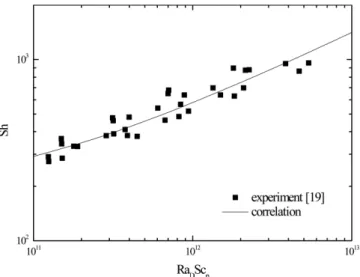
Comparing the experimental results with theoretical one, a new correlation of the Sherwood number is proposed at the fully-devel- oped buoyancy-driven convection:
(30)
for . The coefficients in the above equations have utct2
---- Dl ect λc2
---
∼ ut Del
λc2
---
∼
Pet utl De --- l
λc
---
⎝ ⎠⎛ ⎞2
∼ ∼
λc l1/3 ηc2 DebK ---ν λc
⎩ + ⎭
⎨ ⎬
⎧ ⎫1/6 De2ν KPβ ---
⎝ ⎠
⎛ ⎞1/6
∼
ηc2/3 ηc2 DebK ---ν ηc
⎩ + ⎭
⎨ ⎬
⎧ ⎫1/6 De2ν PβK ---
⎝ ⎠
⎛ ⎞1/6
∼
λc3
ηc2
--- l ηc2+λcDebK/ν ηc2+ηcDebK/ν ---
⎩ ⎭
⎨ ⎬
⎧ ⎫1/2
∼
Pβ gDeβc ηc ---
=
ηc1/3 l1/6 ηc DebK ---ν
⎩ + ⎭
⎨ ⎬
⎧ ⎫1/6 De2ν KgDβΔCl ---
⎝ ⎠
⎛ ⎞1/6
∼
ηc ---l A ηc
---l B Scp ---
⎩ + ⎭
⎨ ⎬
⎧ ⎫1/2RaD–1/2
=
λc
---l
⎝ ⎠⎛ ⎞2 C ηc
---l
⎝ ⎠⎛ ⎞3/4 (ηc/l) DSCp–1
ηc/l ( ) l/λ( c) +
ηc/l ( ) BSc+ p–1
---
⎩ ⎭
⎨ ⎬
⎧ ⎫
=
Sh l/ηc
1–(1/ηc) 1/λ( c)–2 ---
∼
ηc
---l ∼(RaDScp)– /21 λc ---l
⎝ ⎠⎛ ⎞2 ηc ---l
⎝ ⎠⎛ ⎞6/5 (RaDScp)–5/7
∼ ∼
Sh d1(RaDScp)1/2 1 d– 2(RaDScp)– /143 ---
=
Cu2++2e–→Cu
Cu→Cu2++2e–
Sh 9.16 10× –5(RaDScp)1/2 1 9.97 Ra– ( DScp)– /143 ---
=
RaDScp≥1011
Electrochemical Ionic Mass Transfer Correlation in Fluid-Saturated Porous Layer 817
Korean Chem. Eng. Res., Vol. 53, No. 6, December, 2015 been obtained through the regression analysis of experimental
results in the present porous layer. Fig. 3 shows the comparison of experimental results described by symbols and theoretical ones by curves in good agreement for .
4. Conclusions
The mass transfer characteristics of the porous layer are predicted as a function of the Darcy-Rayleigh number by considering the microscales of turbulence. Based on the proposed backbone equa- tion, a new correlation of the Sherwood number for the fluid-satu- rated, horizontal porous layer was proposed. For the limiting case of very high , the mass transfer can be related with Sh ~ RaD1/2. In comparison with experimental results, the present correlation looks very promising for .
Acknowledgement
“This research was supported by the Academic Research fund of Hoseo University in 2013 ”(2013-0104).
References
1. Nield, D. A. and Bejan, A., Convection in Porous Media, 3rd ed., Springer (2006).
2. Howard, L. N., Proc. 11th Int. Cong. Appl. Mech., 449(1964).
3. Long, R. R., “Relation Between Nusselt Number and Rayleigh Number in Turbulent Thermal Convection,” J. Fluid Mech., 73, 445-451(1976).
4. Cheung, F. B., “Heat Source-driven Thermal Convection at Arbi- trary Prandtl Number,” J. Fluid Mech., 97, 743-758(1980).
5. Arpaci, V. S., “Microscales of Turbulence and Heat Transfer Cor- relations,” Int. J. Heat Mass Transfer, 29, 1071-1078(1986).
6. Katto, Y. and Masuoka, T., “Criterion for the Onset of Convective Flow in a Fluid in a Porous Medium,” Int. J. Heat Mass Trans- fer, 10, 297-309(1967).
7. Wragg, A. A., “Free Convection Mass Transfer at Horizontal Electrodes,” Electrochimica Acta, 13, 2159-2165(1968).
8. Fenech, E. J. and Tobias, C. W., “Mass Transfer by Free Convec- tion at Horizontal Electrodes,” Electrochimica Acta, 2, 311-325 (1960).
9. Newman, J. S., Electrochemical System, 2nd ed., Prentice Hall (1991).
10. Goldstein, R. J., Fleischer, A. S. and Hogerton, P. B., “Electro- chemical Mass Transfer at Moderate Rayleigh Numbers,” Trans.
ASME: J. Heat Transfer, 123, 1015-1017(2001).
11. Goldstein, R. J., Chiang, H. D. and See, D. L., “High-Rayleigh- number Convection in a Horizontal Enclosure,” J. Fluid Mech., 213, 111-136(1990).
12. Levich, V. G., Physiochemical Hydrodynamics, Prentice Hall (1962).
13. Shin, S.-I., Yoon, D. Y. and Choi, C. K., “A Mass-transfer Cor- relation of Double-diffusive Convection in a Horizontal Electrolyte Layer with Thermally Stable Stratification,” Hwahak Konghak, 36, 958-967(1998).
14. Chung, T. J., Choi, C. K., Yoon, D.-Y. and Kim, M. C., “Onset of Buoyancy-driven Motion with Laminar Forced Convection Flows in a Horizontal Porous Channel,” Int. J. Heat Mass Trans- fer, 53, 5139-5146(2010).
15. Wang, M. and Bejan, A. “Heat Transfer correlation for Bénard Convection in a Fluid Saturated Porous Layer,” Int. Comm. Heat Mass Transfer, 14, 617-626(1987).
16. Busse, F. H. and Joseph, D. D., “Bounds for Heat Transport in a Porous Layer,” J. Fluid Mech., 54, 521-543(1972).
17. Yoon, D. Y. and Choi, C. K., “Thermal Convection in a Satu- rated Porous Medium Subjected to Isothermal Heating,” Korean J. Chem. Eng., 6, 144-149(1989).
18. Bard, A. J. and Faulkner, L. R., Electrochemical Methods. Fun- damentals and Applications, 2nd ed., Wiley, New York, NY (2001).
19. Jung, J. W., “Ionic Mass Transfer by Natural Convection in a Horizontal Fluid Layer,” M. S. theis, Seoul National University (1988).
RaDScp≥1011
RaDScp
RaDScp≥1011
Fig. 2. Schematic of ionic mass transport in a horizontal porous layer.
Fig. 3. Comparison of correlations with experimental data.