이하선에 발생한 세관선종: 증례보고
김도형, 팽준영, 이성탁, 최소영*
경북대학교 치의학전문대학원 구강악안면외과학 교실
<Abstract>
Canalicular Adenoma of the Parotid Gland: A Rare Case Report and Review of the Literature
Do-Hyoung Kim, Jun-Young Paeng, Sung-Tak Lee, So-Young Choi
*Department of Oral & Maxillofacial Surgery, School of Dentistry, Kyungpook National University
Canalicular adenoma is an uncommon, benign salivary gland tumor. It has a significant predilection for occurrence in the minor salivary glands, with most cases occurring in the upper lip, followed by the buccal mucosa and palate. Rarely, canalicular adenoma can involve the major salivary glands, such as the parotid gland. Only a small number of cases of canalicular adenoma of the parotid gland have been reported in the literature. We report a rare case of canalicular adenoma on the left parotid gland of an 81-year-old man, and present a review of the literature.
Key words : Canalicular adenoma, Parotid gland
Korean Journal of Oral and Maxillofacial Pathology 2017;41(5):245-249 ISSN:1225-1577(Print); 2384-0900(Online) Available online at http://journal.kaomp.org https://doi.org/10.17779/KAOMP.2017.41.5.007
* Correspondence: So-Young Choi, Department of Oral & Maxillofacial Surgery, School of Dentistry, Kyungpook National University Tel: +82-53-600-7561, E-mail: [email protected] ORCID: 0000-0002-2563-3539
Ⅰ. INTRODUCTION
Canalicular adenoma (CA) is an uncommon, benign salivary gland tumor. It has a significant predilection for occurrence in the minor salivary glands, with most cases occurring in the upper lip, followed by the buccal mucosa and palate1,2). Rarely, CA can involve the major salivary glands, such as the parotid gland3-6). CA usually occurs as a single entity, but multi-focal CAs have also been reported1,4,7). Clinically, CAs are grossly well-circumscribed, nodular lesions, and are not usually accompanied by clinical symptoms, such as pain or paresthesia7). Treatment of CA usually consists of local surgical removal of the swollen
area1,7). The prognosis is good and recurrences are not common1,4,7). We report a rare case of CA of the parotid gland in an elderly man, whose histologic examination results were consistent with CA.
Ⅱ. CASE REPORT
An 81-year-old man arrived at the Kyungpook National University Dental Hospital on October 14, 2015, presenting with nodular swelling at the left preauricular area. The patient had no other specific disease or traumatic history.
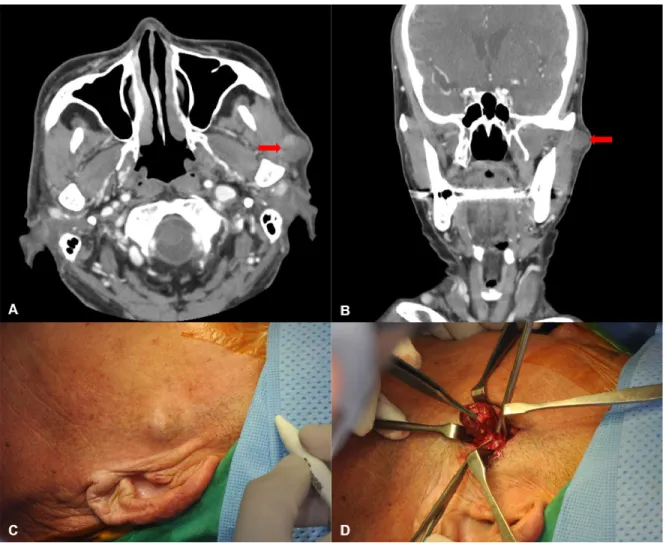
The swelling began about one month previously and had slowly enlarged. The swollen area, measuring around 1.5 cm in diameter, was not evident in the resting position, but became evident during mouth opening (Fig. 1 C). Clinical
Fig. 1. A and B. The axial and coronal views of the enhanced computed tomography scan. A well-demarcated mass is seen in the parotid gland of the left side. C. The appearance of the nodular mass of the left preauricular area. D.
Removal of the mass, which was well-encapsulated by fibrous tissue.
examinations revealed no specific symptoms, such as pain, paresthesia, or motor disturbance of the temporomandibular joint, except for induration. To enable diagnosis, we performed fine needle aspiration (FNA) and computed tomography (CT) of the paranasal sinuses using an intravenous contrast agent. The FNA results suggested that the swelling was caused by Warthin`s tumor. On the CT image, there was a well-circumscribed, oval mass in the left parotid gland (Fig. 1A and B). This radiologic finding also suggested Warthin`s tumor. The lesion, which was found to be a well-capsulated and nodular solid mass, was excised
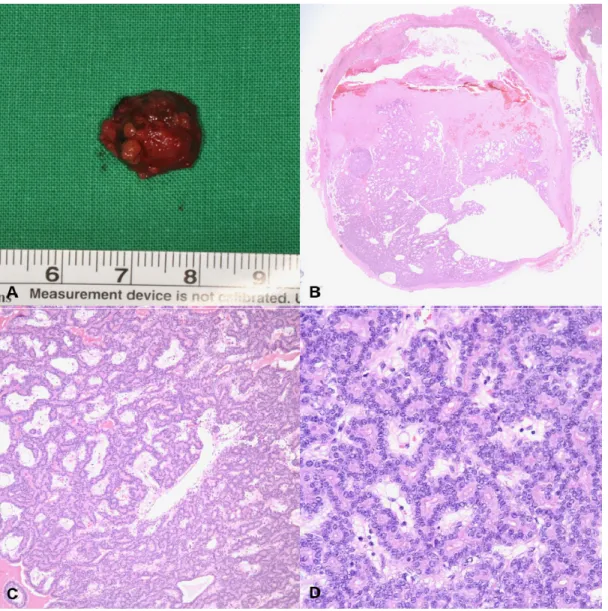
under general anesthesia (Fig. 1D). The specimen was about 1.5 cm in diameter and was surrounded by a thin, fibrous capsule (Fig. 2A and B). The histopathologic examination results revealed that the mass consisted of single-layered cords of uniform, cuboidal epithelial cells, with basophilic nuclei. Parallel rows of cords appeared to form ductal structures or long canals (Fig. 2C and D). These findings were consistent with CA; thus, the final diagnosis was CA. The patient outcome was good, with no complications or recurrence at the time of reporting.
Fig. 2. A. An image of the removed specimen, which was about 1.5 cm in diameter. B. The round mass was well-encapsulated by fibrous tissue (× 12.5 hematoxylin and eosin staining). C. Parallel rows of cord appeared to form ductal structures or long canals (× 100 hematoxylin and eosin staining). D. The mass was composed of single-layered cords of uniform cuboidal cells with basophilic nuclei (× 400 hematoxylin and eosin staining).
Ⅲ. DISCUSSION
CA represents less than 1% of all salivary gland tumors8). Most salivary gland tumors of the head and neck involve the major salivary gland, with benign, minor salivary gland tumors often involving the hard palate, buccal mucosa and
tongue1,7,8). CA, however, has a significant predilection for occurrence in the minor salivary glands, with highest occurrence observed in the upper lip, followed by the buccal mucosa1,2,7). Despite this predilection for the upper lip, there are reports of CA occurring in the lower lip8). There have been no reports of CA of the submandibular gland or sublingual gland, and CA is rarely found in the parotid gland. To our
Table 1. An overview of clinicopathological features of CA of the parotid gland, obtained from the literature
Author Year Age Gender Symptom Site Size Treatment
Rossiell et al .
62002 52 female swelling with pain left 2 cm superficial parotidectomy Philpott et al .
52005 71 female swelling right not available superficial parotidectomy
Liess et al .
42006 26 male swelling left and right 1 cm (left) 2 cm (right)
superficial parotidectomy
Butler et al .
32009 85 female swelling not available 1.7 cm excisional biopsy
Current report 2017 81 male swelling left 1.5 cm local excision
knowledge, only four cases of CA of the parotid gland have been reported that provide specific information, such as clinical symptoms, histologic findings, or treatment methods. These are summarized in Table 13-6). Clinically, CAs are grossly well-circumscribed nodular lesions, which usually present with no clinical symptoms except for swelling1,7), although painful CA has been reported by Rossiello et al6). Commonly, CAs range from 0.5-2.0 cm in diameter and are grossly well-encapsulated1). However, in 1984, Daley et al. reported that approximately 10% of CAs were found in their non-encapsulated forms2). Despite being uncommon, this histologic form could explain the recurrence tendency of CA.
In our patient, we performed FNA and CT with intravenous contrast. FNA is considered a safe, soft, and cost-effective diagnostic modality that causes little discomfort to the patient and carries less risk than more invasive procedures in terms of specimen acquisition1). However, the effectiveness of FNA has been disputed9). Furthermore, when FNA is used during cytological examination of head and neck lesions, accuracy is lowest for lesions of the parotid gland9). This inaccuracy may be due to the complexity, diversity and relatively low incidence rate of parotid gland tumors1,9). Although this makes FNA an ancillary diagnostic modality regarding parotid gland tumor diagnosis, it remains effective at differentiating malignant and benign tumors1). Our FNA results were suggestive of Warthin`s tumor, therefore we suspected that the tumor was more likely to be benign than malignant. To our knowledge, only one literature report has described CT
results as part of CA diagnosis. Yamada et al.10) reported that CA was observed in the CT image as a homogenously enhanced mass with a clear margin. Similarly, our CT image showed an enhanced oval mass on the left side of the parotid gland, which, like the FNA findings, indicated a benign tumor.
Histologically, we observed single-layered cords of uniform cuboidal cells with basophilic nuclei, which were well-encapsulated by fibrous tissue (Fig. 2B and D). The nuclei were monomorphic rather than polymorphic. A mitotic figure was not observed and nucleoli were not conspicuous. Parallel rows of cord appeared to form ductal structures or long canals, with a characteristic beaded appearance (Fig. 2C). These features were in accordance with CA, as described by Barnes et al. in 20051).
The most important lesions to consider in the differential diagnosis of CA are mucocele, pleomorphic adenoma, adenoid cystic carcinoma, and basal cell adenoma1,2,4,7). However, in the parotid area, Warthin’s tumor and adenoid cystic carcinoma should be also differentiated from CA.
Adenoid cystic carcinoma with cribriform, tubular patterns tend to be misdiagnosed as CA8). Historically, CA was considered a subgroup of basal cell adenoma or pleomorphic adenoma2). Pleomorphic adenoma can be differentiated from CA by its chondro-myxomatous components, despite their similar clinical symptoms, such as swelling and free movement7). Basal cell adenoma of the trabecular subtype could be similar to CA histopathologically; however, it can be differentiated from CA by its specific ultrastructural
features and characteristic myoepithelial lineage2). Unlike CA, basal cell adenoma is composed of multilayered cords of polygonal or cuboidal cells, and exhibits a scanty amount of basophilic or amphophilic cytoplasm1,2,7). Differential diagnosis between benign entities is not crucial, because treatment considerations among them do not differ.
However, it is important to differentiate between CA and malignant entities, such as adenoid cystic carcinoma, because the treatment methods are drastically different.
In this case, the radiologic and histologic findings were consistent; they identified the lesion as well-encapsulated, with hypervascularity. Based on the FNA, CT, and clinical results, the lesion was thought to be a benign tumor of the parotid gland. Although superficial parotidectomy could be considered as a surgical treatment option, local surgical excision was adopted as the most appropriate strategy due to the patient’s old age. This strategy was suitable for the patient, as there have been no reports about malignant formation, and this lesion has a relatively low recurrence tendency.
Although CA is an uncommon entity, especially in regions besides the upper lip, it is important to differentiate the diagnosis of CA from pleomorphic adenoma, basal cell adenoma, Warthin’s tumor, and, when CA occurs in the parotid gland, adenoid cystic carcinoma. An appropriate biopsy is required for accurate diagnosis, because it may be inefficient to carry out differential diagnosis using FNA and CT.