Vol. 15, No. 1 pp. 137-143, 2014
A Study on the SMART Education System Based on Cloud and N-screen
Bong-Hyun Kim
1and Sang-Young Oh
2*1Dept. of Computer Engineering, Kyungnam University
1Dept. of Business Administration, Youngdong University
클라우드와 N-스크린 기반의 스마트 교육 시스템 연구
김봉현
1, 오상영
2*1경남대학교 컴퓨터공학과
2영동대학교 경영학과
Abstract Smart education in the information window, type talent in modern society is changing as talented smart shoes, smart automation creative talent through education, training can be called education revolution. In other words, the advent of smart devices, such as knowledge and information and to actively growing individual customized training paradigm change in the way education and training to reflect this approach. Therefore, in this paper, a smart learning environment based technologies for implementing the system was designed to be the next generation of cloud computing and N screen-based smart education system was studied. From this, educational functions and features in a smart media environment, based on the analysis of the utilization of a smart education system, which maximizes the system design were studied.
요 약 스마트 교육은 정보형 인재에서 창의형 인재로 변화되는 현대사회에서 스마트화, 자동화 교육을 통해 창의
적인 스마트 인재를 양성하는 교육 혁명이라 할 수 있다. 즉, 지식정보화와 스마트 기기의 출현 등으로 점차 개인별 능동적 맞춤형 교육 방식으로 교육 패러다임이 변화하고 있으며 이를 반영하는 교육 방식이라 할 수 있다. 따라서,
본 논문에서는 스마트 교육 환경을 구현하기 위한 기반 기술 체계를 설계한 것으로 클라우드 컴퓨팅과 N 스크린 기
반의 차세대 스마트 교육 시스템을 연구하였다. 이를 위해 스마트 미디어 환경에서 교육적 기능과 특징 분석을 기반
으로 스마트 교육 시스템의 활용 방안을 극대화시킨 시스템 설계를 연구하였다.
Key Words : SMART Education, Cloud, N-screen, Next Generation Education System.
*Corresponding Author : Sang-Young Oh(Youngdong Univ.) Tel: +82-43-740-1285 email: [email protected]
Received October 15, 2013 Revised November 6, 2013 Accepted January 9, 2014
1. Introduction
The 21st century, used the smart TV, smart phone etc can be said the smart era. Especially, IT convergence and other industries, the development of a ubiquitous technology areas and creates new value by combining the national level, the new growth engines and has been linked to job creation.
The convergence of IT in the field of education and
has been trying since a long time ago. From the late 1990s to the Internet and multimedia content that can be used in class system was built. Also, IT-Education convergence with the education to overcome the limits of innovation has been used as a tool[1-3].
Thus, in line with rapidly evolving digital age, smart education in the field of education has been increasing interest. Smart education can be called knowledge information such as the advent of smart devices and an
increasingly proactive individual customized education paradigm change in the way education and training to reflect this approach.
Smart education in the information window, type talent in modern society is changing as talented smart shoes, smart automation creative talent through education, training can be called education revolution[2,3].
Studies on smart education based on the principles of smart education design smart learning teaching and learning model can be designed. Also, smart learning teaching and learning proposed strategy. These studies going through smart education and the environment are being embodied with traditional teaching methods are increasingly differentiated.
[Fig. 1] Changes in the education system
The government to strengthen national competitiveness by 2015, with a budget of 2.3 trillion won by putting a smart strategy for promoting educational environment is built. This futuristic nurture talent in the digital age with a new training method is in the process of revolutionary smart education. The government announced the future school plan, Smart education. And it has increased investment to install digitalized learning environments in schools with advanced technologies.
Therefore, to meet the digital age paradigm of education research on smart education system is needed.
Also, the smart education system to be equipped with integrated technology components and design is required.
From this, in this paper, a smart education environment based technologies for implementing the system was designed to be the next generation of smart education system was studied cloud computing and N-screen. In particular, the development of a smart education system,
a variety of technologies and services, depending on the type of service the target, depending on what it is desirable to take appropriate measures. Thus, the introduction of cloud computing and the next generation of smart N-Screen service is important to design an education system.
2. Theory Background
2.1 Smart Education
Smart education in the meaning of SMART ante brilliant, witty, etc. are used interchangeably. Smart education is not smart device education, but rather an educational paradigm shift for digital natives. Teachers cannot imagine what our future will be like after 30 years, so they have to study 21st century skills and know how to apply them to their traditional classroom with ICT.
SMART education is the abbreviation for Self-directed, Motivated, Adaptive, Resource enriched, and Technologies embedded. By 2015, all students will be able to access cloud-based educational services via wireless Internet in school and utilize the learning materials whenever and wherever they want. And the government provides good opportunities for leading teachers to further develop their skills[4,5].
(1) S(Self-Directed) : Self-directed learning Knowledge of the role of students in the audience turned to the producer and teacher assistant in the forwarder as is changing. In other words, it requires the student to select the content itself will be the subject of study.
(2) M(Motivated) : Interest
Experience of structured knowledge-based knowledge- based teaching and learning methods that can be reconfigured to emphasize creative problem solving and an interesting learning content utilization is avoided.
(3) A(Adaptive) : Level and aptitude
Education system, the emphasis is on flexibility and individual aptitudes and preferences and future career for personalized learning in conjunction with the school to
deliver large quantities of standardized knowledge in place to support individualized learning is to switch into place.
(4) R(Resource Enriched) : Wealth of information Types of computer education services, cloud-based public agencies, private companies and individuals developed freely to take advantage of rich content and educating through social networking, co-learning resources is to expand the use and collaborative learning.
(5) T(Technologies Embedded) : IT utilization Information technology can be anywhere you want to learn the teaching methods that ensure maximum variety learning option is to build an educational environment [6-7].
[Fig. 2] Component of SMART education
As a result, the next generation of Smart Education is an essential element of the education system. Therefore, a system based on smart education system design is required. In this paper, we analyze the theoretical background of smart educational cloud computing and applying the N-Screen service training system was studied.
2.2 Cloud Computing and N-screen Cloud computing on the network that you use to upload programs or materials, if necessary, so that you can use anytime, anywhere to find a service that means.
Cloud computing is a term without a commonly accepted unequivocal scientific or technical definition. In science,
cloud computing is a synonym for distributed computing over a network and means the ability to run a program on many connected computers at the same time. The phrase is also, more commonly used to refer to network-based services which appear to be provided by real server hardware, which in fact are served up by virtual hardware, simulated by software running on one or more real machines. Such virtual servers do not physically exist and can therefore be moved around and scaled up (or down) on the fly without affecting the end user - arguably, rather like a cloud.
Cloud computing relies on sharing of resources to achieve coherence and economies of scale similar to a utility (like the electricity grid) over a network. At the foundation of cloud computing is the broader concept of converged infrastructure and shared services[8,9].
In the past, such as an external disk or memory to an external storage device to save data or information out there without the advent of cloud storage for file creation and change is happening[10].
[Fig. 3] Cloud computing environment
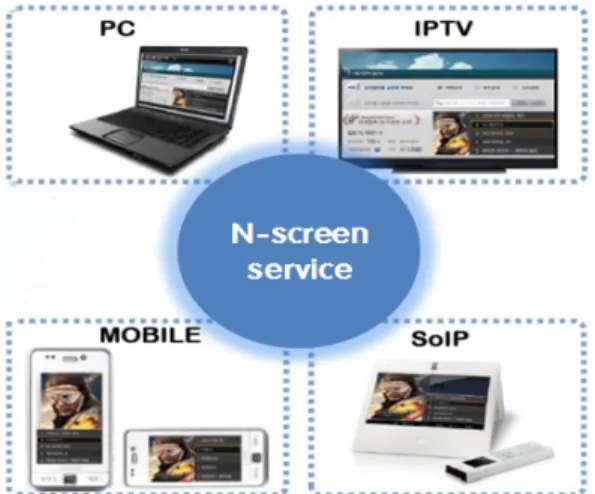
N-screen for the mathematically can go any number of means of N and screen is a combination of a compound.
More specifically, the output device accessible by using a single number that can be output on the screen.
N-screen CPNT (Contents, Platform, Network, Terminal) which are separated by more advanced industrial systems on smart systems and content sharing anytime, anywhere can run a multi-seamless resume possible means user-centric services. Referred to as N-screen before the Web, mobile, TV as a limited connection between the three-screen was sometimes called. Linkage between the evolution of smart devices as
the devices and run service for users to easily share their technical specifications are being made.
DLNA devices in the home network connection between the user and can be done more easily as the industry standard smart TV, smart phones, tablets, laptops, audio equipment or as an essential factor has been applied[11-13].
[Fig. 4] Component of N-screen service
Cloud and N-screen common to easily view the information anytime, anywhere and for that purpose may be the difference of the network. N-screen in a single device connected to the output of various kinds of uses, but if you have a network connection to the cloud service should be. Of the cloud, the network speed, reliability and service operations if you want to be secured is available[12,14].
[Fig. 5] SMART education devices and environment
3. Design of SMART Education System
Using cloud services, text, images, video editing, and sharing aspects of teaching and learning in the classroom teacher to plan, prepare, execute, organize, evaluate at each stage will be used properly to be utilized when and how much worry about whether and analysis is needed.
Available only to a particular terminal server, not the one in the group to take advantage of free digital textbook service. Students can carry it willingly, or with minimum specifications, such as Web access device, only a single server at the university built a digital textbook learning can take place so that all will pursue. Smart Pad, as well as the smaller capacity through smartphones content freely available digital textbooks[15,16].
Education system, the need for digital cloud is as follows. First, the 21 st century learner empowerment as a support system for the intelligent personalized teaching and learning curriculum, teaching methods, assessment is made, including the educational environment of innovation. Second, the information technology (IT) industry, according to the development of society, formed in the past uniform, standardized training approach selectively, tailored training approach by switching to self or can create an environment to grow with education is possible. Third, the offline book form and overcome the limitations of textbooks, classroom improvements and customized curriculum for students by developing and applying digital textbooks are available. Fourth, information technology anytime, anywhere you want to learn, and learning lessons various selection method that ensures the maximum designed a new paradigm of education welfare settlement is achieved. Fifth, cloud based educational services public agencies, private sector and individuals developed freely to take advantage of rich content, training, and collective intelligence, social learning, and utilizing the common use of learning resources and collaborative learning can be established.
Fig. 6 through mobile devices and cloud computing based education system is designed, separated by field.
[Fig. 6] Cloud computing system module based on mobile device
N-screen based smart education system was operating at the university of leveraging existing e-Learning system or through a cross-platform implementation of the new education system should be considered. E-learning systems that leverage existing e-Learning system without a separate education services in a variety of smart devices should be conducted. In addition, the cross-platform education system through the N-Screen for the same content, without making any additional smart phone, smart pad, PC, smart TV and a variety of N-Screen smart machine-to-machine must be provided[15-17].
[Fig. 7] SMART education system based on N-screen service environment
As a result, cloud computing, N-screen-based technology smart linkage between education service delivery, technology, integration is required. Through this education at the university of smart infrastructure and create educational content and smart open-market education system has been designed according to the standard platform.
[Fig. 8] Standard platform of SMART education system
As a result, the educational environment for building smart systems management system is an important design techniques, personalization, content adaptation and interoperability of agents is learning.
Learning management system running on a smart training and learning content management system that receives and stores the results of the training is to manage the execution. Course content distribution managers, user role assignments, lectures, and manage. The learning environment tree learning engine, content management, and learning to manage the properties and conditions.
Learning player behavior tree, the environment tree, the learner receives content tailored to manage reconstruction.
The learner to personalize learning to select appropriate learning progress through personalized means. To do this, students must be able to support the personalized learning, personalized learning, and the learner's learning ability, learning orientation, learning is possible by analyzing the situation.
Content adaptation is a characteristic of a smart education learning is done in a variety of environments suitable for the environment means learning to adapt. In other words, talking about the environment various terminal technology, customized content adaptation, including information about your experience to express the user's environment, information technology and analysis technology, use technology that is appropriate for your environment consists of organizing content.
Finally, the learning agent as well as a variety of different kinds of collaborative learning support functions required to support the technology. In other words, support for collaborative learning in a variety of smart devices and store the results of collaborative learning, or to be able to sync with the server running technology.
[Fig. 9] SMART education system configuration based on N-screen and Cloud
4. Conclusion
Through technologies, classroom activities can be extended to the real world. In the past, students’ seeing, hearing, and feeling were limited to only the classroom.
But now, students can go beyond their classroom by using mobile devices as hardware, virtual reality as software, and the Internet as services. And students communicate, exchange information and progress through collaborative learning projects with colleagues around the world.
In this paper, a smart learning environment based technologies for implementing the system was designed to be the next generation of cloud computing and N-screen based smart education system was studied. From this, educational functions and features in a smart media environment, based on the analysis of the utilization of a smart education system, which maximizes the system design were studied.
As a result, cloud computing, N-screen based technology smart linkage between education service delivery, technology, integration is required. Through this education at the university of smart infrastructure and create educational content and smart open-market education system has been designed according to the standard platform.
References
[1] K. H. Park, “Empowering Factor of IT Convergence Industry in Korea”, Journal of Korean Digital Policy Research Society, Vol.10 No.1, pp.147-154, 2012.
[2] J. R. Kim, D. Y. Kim, E. H. Kim, H. Kim, S. C. Park, Smart Education, p.13-63, Education Science Pub., 2013.
[3] S. K. Lee, H. S. Ryu, “Suggestion on the Key Factors of Smart Education”, Journal of Korean Information Education Society, Vol.17 No.2, pp.101-113, 2013.
[4] S. H. Jang, “The Case Study on SMART education of Converging with Education3.0 and ICT”, Journal of Korean Contents Society, Vol.11 No.1, pp.35-39, 2013.
[5] J. H. Park, J. M. Choi, B. L. Park, H. J. Kang,
“Establishing a Sustainable Future Smart Education System”, Journal of Korean Navigation Society, Vol.16 No.3, pp.495-503, 2012.
DOI: http://dx.doi.org/10.12673/jkoni.2012.16.3.495 [6] M. Y. Kim, Y. K. Bae, “Development of Instructional
Design Model for Smart Education”, Journal of Korean Contents Society, Vol.13 No.1, pp.467-481, 2013.
DOI: http://dx.doi.org/10.5392/JKCA.2013.13.01.467 [7] S. Y. Cheon, J. S. Kim, Smart Education Innovation,
p.25-86, 21C books Pub., 2012.
[8] S. M. Oh, “A study of smart education based on wire-less cloud system”, Soongsil Univ. A Master's Degree Paper, pp.12-24, 2012.
[9] C. Barnatt, A brief guide to cloud computing, Window of future Pub., p.26-73, 2011.
[10] M. H. Kim, J. W. Kim, H. C. Jang, “Today and Tomorrow of Cloud Computing”, Journal of Korean Information Security Society, Vol.20 No.2, pp.56-64, 2010.
[11] D. K. Oh, “N-Screen Service and Development based on the Cloud Computing”, Seoul National Univ. of Science and Technology A Master’s Degree Paper, pp.10-25, 2011.
[12] B. S. Hwang, Smart Platform Strategy, Hanbit Media Pub., p.49-114, 2012.
[13] W. Ryu, S. K. Cho, H. W. Lee, H. J. Lee, “Next Generation N-Screen Service Technology”, Journal of Korean Broadcast Engineers Society, Vol.17 No.1, pp.69-77, 2012.
[14] S. Choi, “N-Screen Strategy for Smart Service”, Journal of Korean Information Processing Society, Vol.19 No.1, pp.41-55, 2012.
[15] J. H. Kim, “Design of Collaborative Learning Support
System for Smart Education”, Korea Univ. A Master’s Degree Paper, pp.13-28, 2012.
[16] T. D. Kim, B. K. Lee, “Mobile Interactive Broadcasting Learning Solution Study on Development of Education”, Journal of Korean Internet Information Society, Vol.13 No.1, pp.57-63, 2012.
DOI: http://dx.doi.org/10.7472/jksii.2012.13.1.57 [17] K. S. Lee, “Development and implementation of EaaS
cloud service model for smart education”, Sunchon National Univ. A Doctor’s Paper, pp.9-23, 2013.
Bong-Hyun Kim
[Regular member]• Feb. 2002 : Hanbat Univ., Computer, MS
• Feb. 2009 : Hanbat Univ., Computer, PhD
• Jan. 2004 ~ Feb. 2012 : ATEK IT LtD., Director
• Mar. 2012 ~ current : Kyungnam Univ., Dept. of Computer, Professor
<Research Interests>
BIT Convergence, RFID/USN application, Education, u-Healthcare
Sang-Young Oh
[Regular member]• Feb. 2001 : Chungbuk Univ., Business, PhD
• Mar. 2002 ~ Feb. 2010 : Cheongju Univ., College of Business Admin., Professor
• Sep. 2010 ~ current : Youngdong Univ., Dept. of Business Administration, Professor
<Research Interests>
KMS, e-Biz, BSC, Education