REVIEW ARTICLE
중증 알코올 간염의 진단 및 치료 전략
김 원
서울특별시보라매병원 소화기내과
Diagnostic and Therapeutic Strategies for Severe Alcoholic Hepatitis
Won Kim
Department of Internal Medicine, SMG-SNU Boramae Medical Center, Seoul, Korea
Alcoholic hepatitis (AH) is defined as an acute hepatic manifestation resulting from heavy alcohol intake. Histologically, alcoholic steatohepatitis (ASH) is characterized by hepatocellular steatosis, inflammation, and fibrosis. Alcohol abstinence is the sine qua non of therapy for AH and, in the milder forms, is prerequisite to clinical recovery. Severe ASH may lead to multi-organ failure such as acute kidney injury and infection, which has a major impact on survival and thus should be closely monitored.
Patients with severe ASH have a drastic short-term mortality of up to 40-50%. Specific therapies should be considered for patients with severe ASH at risk of early death. Corticosteroids are the standard of care for patients with severe ASH. When corticosteroids are contraindicated, pentoxifylline may be an alternative option. Steroid responsiveness should be evaluated on the basis of Lille score. Tactically, we should explore novel therapeutic targets to suppress inflammation based on cytokine profiles, promote hepatic regeneration, limit innate immune responses, and restore altered gut mucosal integrity in severe ASH. (Korean J Gastroenterol 2015;65:4-11)
Key Words: Alcoholic steatohepatitis; Infection; Renal insufficiency; Corticosteroids; Pentoxifylline
CC This is an open access article distributed under the terms of the Creative Commons Attribution Non-Commercial License (http://creativecommons.org/licenses/
by-nc/3.0) which permits unrestricted non-commercial use, distribution, and reproduction in any medium, provided the original work is properly cited.
Copyright © 2015. Korean Society of Gastroenterology.
교신저자: 김 원, 156-849, 서울시 동작구 보라매로5길 20, 서울특별시보라매병원 소화기내과
Correspondence to: Won Kim, Department of Internal Medicine, SMG-SNU Boramae Medical Center, 20 Boramae-ro 5-gil, Dongjak-gu, Seoul 156-849, Korea.
Tel: +82-2-870-2233, Fax: +82-2-831-2826, E-mail: [email protected] Financial support: None. Conflict of interest: None.
서 론
알코올 간질환은 세계적으로 만성 간질환의 주요 원인 중 하나로서 단순 지방간, 지방간염, 간경변 등 다양한 간질환을 포괄한다.1 특히 중증 알코올 지방간염 환자의 3개월 단기 사 망률은 40-50%에 이를 정도로 매우 높다.2,3 몇 가지 약물 치 료법은 중증 알코올 간염 환자의 생존율 개선에 유용하지만, 전반적 예후는 이러한 치료에도 불구하고 여전히 불량한 것으 로 알려져 있다.
최근 미국에서 다양한 입원 상병 중 가장 의료비용이 많이 요구되는 질환은 높은 합병증 발생률과 사망률을 보이는 중증 알코올 간염인 것으로 보고되었다.4 따라서 고위험 환자의 조 기 발견과 즉각적 치료는 중증 알코올 간염과 관련된 의료비
용을 최소화하는 데 도움이 될 뿐만 아니라 정확한 예후 예측 은 알코올 간염 환자들의 개별화된 치료법 선택에 있어 매우 필수적인 단계라 할 수 있다. 최근까지 중증 알코올 간염과 관련한 몇 가지 예후 점수 체계들이 서구에서 개발되어 유효 성이 검증되었다.5-10
알코올 남용자에서 보이는 황달과 간기능 이상 등의 임상 증후군을 흔히 ‘급성 알코올 간염’이라고 부르지만, 알코올 간 염은 대개 장기간의 광범위한 간섬유화 및 간경변과 관련되기 때문에 현재는 ‘급성’이라는 용어를 사용하지 않는다. 알코올 지방간염은 ‘지방 침착, 간세포 팽창성 변성, 중성백혈구 침윤 및 동주위 섬유화 등의 혼재’로 정의되는 병리학적 진단명이 다.11 알코올 지방간염은 알코올 간염에서만 나타나는 것은 아 니고 단순지방간, 간염, 섬유화, 간경변 등 알코올 간질환의
Table 1. Components of Clinical Scoring Systems to Assess Prognosis in Alcoholic Hepatitis
Bilirubin PT/
INR
Cr/
BUN WBC Age Albumin Potassium Change in bilirubin from
day 0 to day 7
MDF10 + + − − − − − −
MELD6 + + + − − − − −
GAHS7 + + + + + − − −
ABIC5 + + + − + + − −
Lille9 + + + − + + − +
MAGIC8 + + + − − − + +
Cr, creatinine; WBC, white blood cell; MDF, Maddrey’s discriminant function; MELD, model for end-stage liver disease; GAHS, Glasgow alcoholic hepatitis score; ABIC, age-bilirubin-INR-creatinine score; MAGIC, model for alcoholic hepatitis to grade severity in an Asian patient cohort.
어느 단계에서나 중첩되어 나타날 수 있다.12,13 그러나 알코올 지방간염 환자 중 어떤 경우에 임상적으로 뚜렷한 알코올 간 염으로 진행하는지에 대해서는 알려진 것이 거의 없다. 뿐만 아니라 일반인에서 알코올 지방간염 혹은 알코올 간염의 실제 발생률이나 유병률에 대해서도 알려진 것이 거의 없는데, 이 는 알코올 간염에 대한 임상 진단기준이 모호하고 조직검사에 의해 확인된 알코올 지방간염을 보고한 연구 결과가 지금까지 거의 없기 때문이다.
최근 발표된 알코올 간질환의 치료와 관련된 임상 지침을 미국 간학회와 유럽 간학회에서 보고하였다.14,15 따라서 본 고 에서는 알코올 유발 간부전의 개념과 유형, 알코올 간염의 새 로운 예후 예측 체계, 그리고 중증 알코올 지방간염 환자들을 위한 잠재적 표적 치료법들에 대해 임상적 견지에서 고찰하고 자 한다.
진 단
1. 알코올 유발 간부전의 유형
전통적으로 서로 다른 예후를 보이고 다른 치료적 접근을 요하는 두 가지 유형의 간부전이 있다. 첫 번째는 기존 간질환 이 없는 환자들에서 갑자기 발생하는 급성 간부전이다. 두 번 째는 기저 간질환의 진행 결과로서, 말기 간경변 환자에서 나 타나는 만성 대상부전 형태의 만성 간부전이다. 알부민 투석 의 도입과 함께, 새로운 유형의 만성 간부전인 만성 간부전의 급성 악화(acute-on-chronic liver failure, ACLF) 개념이 최 근 임상에 도입되어 주목받고 있다.16-18 ACLF는 기저 대상성 간경변이 수 주 내 급성으로 급격하게 간기능이 악화되면서 초기 단계에 심한 황달, 신손상, 간성 혼수, 다발성 장기부전 등이 동반되는 것을 특징으로 한다.19 알코올 간경변으로 입원 한 환자 중 만성 대상부전의 경우 20%의 3개월 사망률을 보 이는 것에 반해 ACLF는 60%의 3개월 사망률을 보여 ACLF 가 만성 간부전에 비해 중증도가 더 높음을 알 수 있다.20 최근 연구 결과에 따르면, 장내 미생물과 지질다당류와 같은 세균
성분에 대한 과도한 염증 유발 반응이 장과 간 혹은 문맥 및 전신 혈류의 연결 고리로서 ACLF의 병태 생리에 중요한 역 할을 수행하는 것으로 알려져 있다.21
마찬가지로 알코올 역시 두 가지 유형의 간손상(ACLF와 만성 대상부전)을 초래할 수 있다. 알코올 유발 간부전 중 가 장 심각한 경우는 알코올 간경변에 중첩된 중증 알코올 지방 간염 환자들이고(ACLF), 그 외에도 비대상성 알코올 간경변 등이 간부전의 원인일 수 있다. 정맥류 출혈, 세균 감염, B형 간염 바이러스의 재활성화 등과 같은 악화 인자가 ACLF 발 생에 중요한데, 그 이유는 이러한 악화 인자들의 교정이 ACLF의 완전한 호전을 가져올 수 있기 때문이다. 이러한 견 지에서 조기에 경경정맥 간내 문맥전신 단락술을 시행하게 되 면, 고위험 정맥류 환자에서 ACLF 발생을 효과적으로 예방 할 수 있다.22 또한 강력한 항바이러스제 치료로 조기에 B형간 염 바이러스 증식을 억제하는 것이, B형간염 환자에서 자발적 활성화에 이은 다발성 장기 부전으로의 진행을 막는 데 도움 이 된다.23 만성 대상부전은 알코올 유발 간부전의 가장 흔한 형태로, 간문맥 고혈압의 합병증이 빈번하게 나타나고 조기에 중등도의 황달이 나타난다. 알코올 간경변 환자에서 간문맥 고혈압의 합병증으로서 복수가 출현하는 경우 1년 사망률은 29%이고 간성 혼수가 발생하는 경우 64%로 추정된다.24 ACLF는 알코올 유발 간부전의 또 다른 형태로서 3차 의료기 관을 통한 응급 입원 환자 중 40% 이상의 원인이다.20 ACLF 의 가장 흔한 유발 인자는 중증 알코올 지방간염으로 전체 ACLF 환자 중 대략 25%의 유발 원인으로 알려져 있다.20
2. 알코올 간염의 예후 점수 체계
알코올 유발 ACLF를 호전시키는 가장 좋은 방법은 저절로 회복될 가능성이 거의 없는 중증 알코올 지방간염을 가능한 한 조기에 발견하고 치료하는 것이다. 이러한 관점에서 다양 한 예후 점수들이 일차적으로 조기 사망의 고위험군에 속하는 중증 알코올 지방간염 환자들을 선별하기 위해 개발되었 다.5-10 알코올 간질환 특이적 예후 모델에는 Maddrey’s dis-
criminant function (MDF), Glasgow alcoholic hepatitis score (GAHS), age-bilirubin-INR-creatinine score (ABIC), Lille model, model for alcoholic hepatitis to grade the severity in an Asian patient cohort (MAGIC) 등이 있고, 알코올 간질환 비특이적 모델에는 model for end-stage liver disease (MELD)가 있다(Table 1).5-10
MDF는 32점을 기준으로, 알코올 지방간염 환자들의 생존 여부를 예측하는 데 가장 흔히 사용되는 예후 모델이다.10,25 MDF 32점 이상의 중증 알코올 지방간염은 대개 다른 원인의 ACLF에서도 종종 관찰되는 전신 염증성 반응 증후군과 다발 성 장기 부전으로 진행할 수 있다. MAGIC은 알코올 간염으 로 입원한 한국인에서 간질환 관련 사망을 예측하기 위해 최 근에 개발된 새로운 모형이다.8 이 모델의 독특한 특징은 알코 올 간염을 갖는 동양인에서 최초로 개발된 예후 모형이고, 치 료받지 않은 알코올 간염 환자들의 자연 경과 예측에 초점을 두었고, 알코올 간염에서 고칼륨혈증의 예후 예측 역할을 최 초로 밝혀냈으며, 무엇보다 중요한 것은 자발적 빌리루빈의 호전 여부가 모형에 포함됨으로써 생존율 향상과 관련하여 조 기 간기능 호전의 중요성을 강조하였다는 점이다. 그러나 추 후 다른 인종의 중증 알코올 지방간염 환자군에서도 유효성 평가가 이루어져야 한다.
스테로이드는 위장관 출혈, 간신증후군, 조절이 안되는 감 염, B형간염, 췌장염 등의 금기증이 없는 중증 알코올 지방간 염 환자들에서 생존 가능성을 증가시킨다.14,15 최근 5개의 무 작위 대조군 연구의 개별 환자 데이터를 이용한 메타분석에서 28일 생존율이 위약군보다 스테로이드 치료군에서 유의하게 높았다(80% vs. 66%).26 초기 단계에서 MDF, GAHS, MELD 등은 중증 알코올 지방간염을 진단하고 언제 스테로이드 치료 를 시작할지 결정하는 데 도움이 된다. 반면에 치료 전후 빌리 루빈의 조기 변화, 체외 스테로이드 내성 검사, 치료 후 1주째 Lille 점수 등은 스테로이드 반응성과 중단 여부를 결정하는 데 도움이 된다.9,27-29
최근 개발된 알코올 간염 조직학적 점수가 조직검사에서 입증된 알코올 지방간염 환자들의 생존 가능성을 비교적 정확 하게 예측한다고 보고되었다.30 또한 이 점수 체계는 간 섬유 화의 범위, 중성백혈구 침윤 정도, 빌리루빈 정체 유형, 거대 미토콘드리아 유무를 등급화함으로써 계산된다.30 특히 빌리 루빈 정체 유형은 입원 기간 중 세균 감염 발생과 밀접하게 관련되는 것으로 알려져 있다.30,31
치 료
1. 일반적 치료 방법
금주 실패는 알코올 간염 환자에서 사망률을 높이기 때문
에 금주는 알코올 간염 치료의 근간이다.32 그러나 항갈망제 (disulfiram, naltrexone, acamprostate)의 잠재적 간독성 때 문에 단주 치료가 중증 알코올 간염 환자에서 항상 추천되는 것은 아니다. 중증 알코올 간염으로 입원한 환자들에서 비록 시급하게 투여되지는 않더라도 간기능 회복 후에 알코올 사용 장애 재발을 줄이기 위해서 단주 치료는 꼭 필요하다. 바클로 펜은 간독성 유발 없이 알코올 간경변 환자들에서 알코올 갈 망을 억제하고 금주를 유지하는 데 효과적이다. 따라서 향후 중증 알코올 간염 환자에서 바클로펜이 음주에 대한 항갈망 효능을 보이는지 확인하기 위한 추가 연구가 필요하다.33
알코올 간염 환자는 불규칙한 식이 습관, 알코올 관련 설 사, 소장 흡수능 감소, 식욕부진, 과도한 이화 상태 등에 의한 심각한 영양 불량으로 고생하는데 이는 직접적으로 사망률 증 가와 관련된다.34 따라서 대부분의 경우 적절한 칼로리와 단백 공급뿐만 아니라 비타민 B, 미네랄 보충 등을 포함한 영양 공급이 필요하다. 경구 식이가 불가능할 때에는 지용성 비타 민과 경장 영양 공급이 필요할 수도 있다. 그러나 중증 알코올 간염 환자에서 경장 영양 공급과 스테로이드를 비교하는 이전 연구에서 1개월 생존율의 유의한 차이는 나타나지 않았다.35 그럼에도 불구하고 조기 사망은 경장 영양 공급군에서 흔하고 후기 사망은 스테로이드 치료군에서 흔하였기 때문에 향후 병 용 치료군이 생존율에 미치는 영향에 대한 추가적 연구가 시 행되어야 한다.
중증 알코올 간염 환자에서 신손상은 입원 중 흔한 증상이 고 감염과 생존의 중요한 예측 인자이기도 하다. 급성 신기능 저하의 가장 흔한 원인은 간신증후군이다. 간신증후군을 예방 하기 위해서는 비스테로이드 항염증 약제, 아미노글라이코사 이드, 이뇨제, 조영제 등과 같은 신독성 약제들의 사용을 피해 야 하고 알부민이나 신선냉동혈장과 같은 혈액 확장제의 투여 가 필요할 수 있다.
알코올 지방간염에서 나타나는 비감염성 염증과 관련하여 전신 염증성 반응 증후군의 진단 기준에 부합할 경우 세균 감염의 동반 여부를 감별 진단하기 어려울 수 있다. 세균 감염 은 입원 시 중증 알코올 지방간염 환자의 25%에서 관찰되고 또 다른 25%에서는 입원 중 스테로이드 치료 중 새롭게 발생 한다.36 감염과 신부전은 알코올 지방간염 환자에서 생존율에 지대한 영향을 미치므로 입원 중 어떤 시기에도 선별 검사와 예방 및 치료에 최선을 다해야 한다. 경험적 항생제 예방 치료 는 입원 시 실제 광범위하게 사용되고 있지만 항상 추천되는 것은 아니다. 최근 보고에 따르면, 감염을 완전히 조절한 후 알코올 지방간염 환자는 스테로이드 치료가 더 이상 금기 대 상이 되지 않는다.36 그러나 스테로이드 치료 중 발생한 감염 은 스테로이드 자체의 면역억제에 의한 것이라기보다는 심각 한 간손상을 시사하는 스테로이드 불응성의 결과로 보는 것이
타당하다.36 따라서 경험적 항생제 치료는 스테로이드 반응군 에서 생존율을 개선함으로써 스테로이드 무반응군보다 더 유 용하게 사용될 수 있겠다.
2. 특이적 치료 방법 1) 스테로이드
일반적 치료 방법과 별개로 조기 사망 위험이 높은 MDF 32점 이상의 중증 알코올 간염 환자에서는 특이적 치료법이 필요하다.26 다양한 연구 디자인의 이질성과 조직학적 확인이 누락된 모호한 진단 기준으로 인한 선택 편견 때문에 지난 수십 년간 스테로이드 치료가 중증 알코올 간염 환자의 생존 에 미치는 영향은 계속 논란이 되어 왔다. 더욱이 알코올 간염 에 대한 스테로이드의 치료 기전은 여전히 불확실하다.
최근 알코올 간손상 실험 모델에서 스테로이드의 간손상과 재생에 대한 흥미로운 연구 결과가 보고되었다.37 일반적으로 스테로이드는 염증성 혹은 면역 매개 간손상을 억제하지만 현 저한 항동화 작용 때문에 간재생을 억제하고 간세포 증식과 재생을 조절하는 유전자(pSTAT3) 발현을 억제함으로써 염증 치유 속도를 늦춘다.37
최근의 메타분석에서 스테로이드 치료군은 위약군에 비해 유의하게 28일 생존율이 향상되었기 때문에 스테로이드는 현 재 조직학적으로 확진된, 중증 알코올 지방간염의 일차적 표 준 치료로 인정받고 있다.26 스테로이드는 종종 알코올 지방간 염이 배제된 상태에서는 오히려 해로울 수도 있는데, 즉 임상 적으로 진단된 알코올 간염의 10-30%에서는 지방간염이 아 닌 세균 감염과 관련한 대상 부전에 의해 간기능이 악화되기 때문이다. 또한 경미한 알코올 간염에 대해서는 일반적으로 스테로이드 치료가 추천되지 않는다. 스테로이드에 의한 생존 향상 이득은 오직 조직학적으로 입증된, 중증 알코올 지방간 염에만 국한되며, 중증 알코올 지방간염 환자의 대략 60%에 서 스테로이드에 대한 반응을 보인다.
조기에 스테로이드 무반응군(40%)을 확인하는 것은, 스테 로이드 중단 규칙을 정의하고 불필요한 스테로이드 노출을 최 소화하기 위해 반드시 필요하다.9 스테로이드 치료 1주째 0.56 이상의 Lille 점수를 보이는 경우 스테로이드 무반응군으 로 정의된다. 지속적 스테로이드 치료에도 불구하고 무반응군 에서는 28일 생존율이 50%를 넘지 못한다.26
2) 펜톡시필린
펜톡시필린은 항산화 효과를 보이고 종양괴사인자(tumor necrosis factor-alpha, TNF-) 합성을 경미하게 억제한다.
펜톡시필린 치료를 받는 중증 알코올 지방간염 환자에서 6개 월 생존율은 위약군보다 유의하게 높았다.38 이러한 생존율 증 가는 간신증후군 발생률의 감소에서 비롯된 것이지만, 이러한 이로운 효과는 최근에 시행된 두 개의 메타분석에서 상반된
결과가 발표되었다. 비록 최종 결론이 난 것은 아니지만, 메타 분석 결과 펜톡시필린은 심각한 간신증후군의 위험을 줄였지 만 위약군에 비해 생존율을 유의하게 향상시키지는 못했기 때
문이다.39,40 최근 시행된 국내 다기관 임상 연구는 펜톡시필린
과 스테로이드의 알코올 간염 환자에서 생존율의 차이를 직접 전향적으로 비교하였다.41 6개월 생존율의 견지에서 펜톡시필 린의 효능은 스테로이드와 통계적으로 동등하지 못했고, 이는 스테로이드가 중증 알코올 간염 환자에서 펜톡시필린보다 우 선적으로 선호되는 치료라는 점을 시사한다. 그러나 스테로이 드 금기를 보이는 중증 알코올 간염 환자에서는 여전히 펜톡 시필린이 대체 약제로 고려될 수 있다.14,15 중증 알코올 지방 간염 환자 270명을 포함한 전향적 연구에서 펜톡시필린과 스 테로이드 병합 치료는 스테로이드 단독에 비해 유의한 생존율 향상을 가져오지 못했다.42 그러나 이 연구의 제한점은 펜톡시 필린 단독군을 포함하지 못했다는 점이다.43 이를 극복하기 위 해 최근 펜톡시필린, 스테로이드, 병합 치료를 중증 알코올 간 염 환자에서 비교하는 대규모 무작위 연구가 영국에서 진행되 고 있다.44 스테로이드 무반응의 중증 알코올 지방간염 환자에 서 펜톡시필린 조기 교체는 생존율 향상에 기여하지 못했다.45 종합적으로 펜톡시필린은 중증 알코올 지방간염 환자에서 스 테로이드와 병용하더라도 추가적 생존 이득이 없었고, 스테로 이드 무반응군에서 펜톡시필린으로의 단독 교체 역시 이로운 효과가 없었다.
3) 아세틸시스테인
최근 항산화제인 아세틸시스테인과 스테로이드 병합 치료 는 비록 장기적 효과는 보이지 못했지만, 간신증후군과 감염 을 예방함으로써 1개월 생존율에서 스테로이드 단독 치료보 다 우월한 생존율을 보였다.46 그러나 아세틸시스테인 병합 치 료군에서 생존율 증가 쪽으로의 경향성을 고려한다면, 최적의 용량과 치료 기간 결정을 위한 추가적 연구가 필요하다.
4) 항 종양괴사인자 약제
알코올 간질환 실험 모델에서 TNF-의 중추적 역할에 대 한 강력한 근거들이 존재하기 때문에 중증 알코올 지방간염 환자들에서 infliximab과 스테로이드 병합 치료에 대한 무작 위 임상 시험이 시행되었다.47 TNF-를 차단하는 치료는 위약 군에 비해 유의하게 높은 감염률과 사망률을 보였다.47,48 아마 장기간의 과도한 TNF- 차단은 현저한 면역억제를 초래하고, 간재생에 부정적 영향을 미치기 때문일 것으로 추정된다.49-51 5) 간이식
대부분의 알코올 간염 환자들은 금주 후 적어도 6개월 동 안 간기능이 완전히 회복되고, 6개월 금주 규칙을 통상 이식 전에 따르기 때문에 초기 단계에서는 일반적으로 간이식을 즉 각적으로 고려하지 않는다.52 6개월 금주 규칙이 사회적으로 통용되고 낮은 유해 음주 재발률과 깊은 관련을 보이지만 사
Table 2. Summary of Potential Molecular Targets and Novel Targeted Therapies for Alcoholic Hepatitis
Key element of the pathogenesis Treatment Effect Clinical trial
FXR dysregulation OCA55 FXR agonist Moderately severe AH (placebo vs. OCA)
Altered gut integrity Zinc56 Restoration of gut integrity Severe AH
LGG57 Probiotic effect Mild to moderate AH (placebo vs. LGG) Rifaximin58 Intestinal decontamination Severe AH (steroid vs. steroid+rifaximin) Innate immune activation Imm 12-E59 Anti-LPS antibody Severe AH
(steroid vs. steroid+low/high dose Imm 12-E)
Anakinra60-62 IL-1RA Severe AH
(steroid vs. anakinra+pentoxifylline+zinc) Rilonacept60,61 IL-1 inhibitor Severe AH with response to steroid at day 7
(steroid vs. steroid+rilonacept) Mycophenolate
mofetil
IMPDH inhibitor Severe AH without response to steroid at day 7 (standard of care vs. steroid+mycophenolate) Sterile necrosis and apoptosis Emricasan Pancaspase inhibitor Severe AH with steroid contraindications
(placebo vs. emricasan) Impaired regeneration G-CSF63,64
IL-2265-67
HPC mobilization
Hepatoprotective effect
Severe AH without response to steroid at day 7 (placebo vs. G-CSF)
Only preclinical studies
FXR, farnesoid X receptor; OCA, obeticholic acid; AH, alcoholic hepatitis; LGG, lactobacillus GG; LPS, lipopolysaccharide; IL, interleukin;
IL-1RA, IL-1 receptor antagonist; IMPDH, inosine-5'-monophosphate dehydrogenase; G-CSF, granulocyte-colony stimulating factor; HPC, hepatic progenitor cell.
회 및 가정 내 지지나 정신과적 중독 질환의 부재와 같은 금주 유지 성공을 예측할 수 있는 다른 요인들이 6개월 금주 규칙 을 대신할 수도 있다.52 Lille 모델은 6개월 생존율이 25%에 불과한 스테로이드 무반응군의 조기 확인에 도움이 된다. 최 근 조기 간이식 개념이 스테로이드에 반응이 없는, 처음 발생 된 중증 알코올 지방간염 환자들을 위해 제안되었다.53 스테로 이드 무반응 대조군에 비해 조기 간이식군에서 뚜렷한 생존율 의 증가를 관찰할 수 있었다.53 따라서 조기 간이식은 처음 발생한, 중증 알코올 지방간염이면서 양호한 중독 성향을 보 이고 스테로이드에 반응이 없는, 일부 선택된 환자군에서만 고려될 수 있다.
3. 새로운 치료 방법
중증 알코올 간염에 대한 기존의 특이적 치료에도 불구하 고 전반적 예후는 여전히 매우 불량하다. 이용 가능한 치료적 방법은 제한되어 있으므로 새롭고 혁신적인 중증 알코올 간염 에 대한 치료법의 시급한 도입이 간절한 상황이다. 지난 수십 년간 알코올 간염의 임상 경과를 이해하는 데 커다란 발전이 있었지만, 새로운 치료적 목표를 탐색하는 데 성공하지는 못 했다. 알코올 간염에서 대부분의 임상 시험이 실패한 이유는, 우선 핵심 질환 유발 원인에 대한 지식이 부족하고, 목표 지향 임상 연구를 시작하기 전에 체계적 대규모 연구가 필요하지만 현재까지 거의 없었으며, 대부분의 동물 모델은 인체에서의 중증 간질환보다는 경미한 알코올 간질환만을 재현하기 때문 이다.
상기의 문제들의 해결을 위해 공통의 임상 프로토콜을 사
용하고, 생물표지자 연구를 포함하며, 다양한 범주의 알코올 간염을 포함하는 다기관 협동 연구가 먼저 수행되어야 한다.
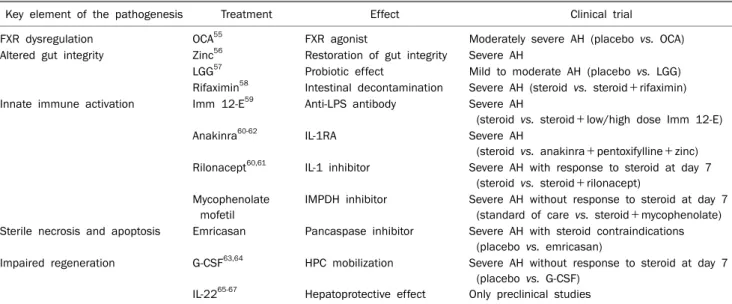
최근 이러한 목적 달성을 위해 미국 National Institute on Alcohol Abuse and Alcoholism (NIAAA)는 알코올 간염을 위한 중개 및 임상 연구를 진행 중인 4개의 알코올 간염 컨소 시엄에 대한 연구 지원을 결정하였다.54 상기 임상 연구들에서 유전학적 혹은 생물학적 검체를 수집 및 보관하고 분자생물학, 유전학, 후생유전학 및 시스템 생물학 등의 중개 연구를 위한 사전 동의를 환자들에게 취득할 예정이다. 현재 이미 여러 중 재 연구가 알코올 간염에 대한 신약의 기전 관련 개념 증명을 위해 다기관 컨소시엄 형태를 통해 진행 중이다(Table 2).55-67
최근 알코올 간염의 새로운 생물표지자와 표적치료 개발을 위해 과학적 통합 접근법을 통해 몇 가지 알코올 간염의 병인 에 대한 핵심 요소들에 초점을 맞추고 있다. 우선 첫 번째로 염증 반응과 선천 면역계 활성화는 경증 알코올 간염에 비해 중증 알코올 간염에서 관찰되는 현저한 특징들이다.60,65,68,69
즉, 알코올 간염 증후군의 기저 병인은 심한 간내 염증과 사이 토카인 이상조절로 알려져 있다.65,70 두 번째는 알코올 간염에 서 장관 방어능(gut integrity)이 감소하기 때문에 병원체-연 관 분자패턴(pathogen-associated molecular pattern, PAMP)이 간문맥과 전신 혈류 순환계로 쉽게 유입되고 선천 면역의 활성화를 유발한다.71,72 염증을 유발하는 장관 유래 내 독소와 기타 세균 산물들은 모두 장관 투과성의 증가와 장벽 기능 변화의 결과물들이다.72 세 번째로 알코올 간염에서 세포 생존과 사멸 신호는 간기능 저하와 손상된 세포-관련 분자패 턴(damage-associated molecular pattern, DAMP) 방출에
기여하는데, 이는 간세포 자멸사, 무균성 괴사, 간손상을 더욱 부채질하게 된다.71 마지막으로 간부전이 나타난 심한 알코올 지방간염 환자에서 간세포 재생능은 심오하게 손상된다. 이러 한 견지에서 불량한 간세포 재생 기전을 규명하고, 간 전구세 포의 기능성 성숙 간세포로의 분화를 촉진시킬 수 있는 것이 치료적으로 중요하다.63,64,73,74
결 론
알코올 간염을 다른 간질환과 감별하기 위해 새롭게 정립 된 질병 정의의 필요성이 날로 증대되고 있다. 질병 정의는 분류학적 명료성을 극대화하고 기초병인 대 임상양상에 따른 분류 간 차이를 최소화하며 치료 결정 과정에 도움이 되도록 질병위험도와 임상경과를 내포하고 있어야 한다. 알코올 간염 의 명명법을 표준화하기 위해 무증상의 초기 알코올 지방간염 과 황달 혹은 대상부전이 나타나는 전통적 중증 알코올 간염 의 임상적, 분석적, 분자생물학적 특징을 서로 비교할 필요가 있다. 금주는 알코올 간염 치료의 근간이면서 특히 경미한 경 우에는 임상적 회복을 위한 필수 전제 조건이다. 중증 알코올 지방간염은 다기관 부전으로 진행할 수 있는데, 특히 신손상 이나 감염은 선별, 예방, 치료가 필요한 가장 중요한 합병증들 이다. MDF나 MELD와 같은 임상 예후 점수는 치료를 시작할 지 여부를 결정하는 데 유용한 지표들이고 치료 후 1주째 Lille 점수는 스테로이드 반응성을 평가하여 치료 중단 여부 를 결정하는 데 활용될 수 있다. 펜톡시필린은 스테로이드 금 기증이 있는 중증 알코올 지방간염 환자에서 1차 치료로서 대신 사용될 수 있다. 그러나 펜톡시필린은 스테로이드를 투 여받는 중증 알코올 지방간염 환자들에서 병용 시 추가적 이 득은 없다. 스테로이드 무반응군에서 조기에 펜톡시필린으로 변경하는 것 역시 생존율의 유의한 증가가 관찰되지 않아 추 천되지 않는다.
결론으로 향후 알코올 간염에 대한 연구는 균일한 환자들 을 대상으로 하면서, 특히 중등도의 알코올 간염이나 스테로 이드 치료 부분 반응군 혹은 무반응군에 집중해야 한다. 전략 적으로 중증 알코올 지방간염에서 손상된 장관 점막 방어능을 회복하고, 사이토카인 특성에 따른 염증 반응을 억제하며, 간 재생능을 촉진하면서, 선천 면역 반응을 제한하는 것이 새로 운 치료제 개발과 관련되어 중요하다.
REFERENCES
1. Kim WR, Brown RS Jr, Terrault NA, El-Serag H. Burden of liver dis- ease in the United States: summary of a workshop. Hepatology 2002;36:227-242.
2. Lucey MR, Mathurin P, Morgan TR. Alcoholic hepatitis. N Engl J
Med 2009;360:2758-2769.
3. Mathurin P, Duchatelle V, Ramond MJ, et al. Survival and prog- nostic factors in patients with severe alcoholic hepatitis treated with prednisolone. Gastroenterology 1996;110:1847-1853.
4. Liangpunsakul S. Clinical characteristics and mortality of hospi- talized alcoholic hepatitis patients in the United States. J Clin Gastroenterol 2011;45:714-719.
5. Dominguez M, Rincón D, Abraldes JG, et al. A new scoring system for prognostic stratification of patients with alcoholic hepatitis.
Am J Gastroenterol 2008;103:2747-2756.
6. Dunn W, Jamil LH, Brown LS, et al. MELD accurately predicts mortality in patients with alcoholic hepatitis. Hepatology 2005;41:353-358.
7. Forrest EH, Evans CD, Stewart S, et al. Analysis of factors pre- dictive of mortality in alcoholic hepatitis and derivation and vali- dation of the Glasgow alcoholic hepatitis score. Gut 2005;
54:1174-1179.
8. Lee M, Kim W, Choi Y, et al. Spontaneous evolution in bilirubin levels predicts liver-related mortality in patients with alcoholic hepatitis. PLoS One 2014;9:e100870.
9. Louvet A, Naveau S, Abdelnour M, et al. The Lille model: a new tool for therapeutic strategy in patients with severe alcoholic hepatitis treated with steroids. Hepatology 2007;45:1348- 1354.
10. Maddrey WC, Boitnott JK, Bedine MS, Weber FL Jr, Mezey E, White RI Jr. Corticosteroid therapy of alcoholic hepatitis.
Gastroenterology 1978;75:193-199.
11. MacSween RN, Burt AD. Histologic spectrum of alcoholic liver disease. Semin Liver Dis 1986;6:221-232.
12. Dhanda AD, Collins PL, McCune CA. Is liver biopsy necessary in the management of alcoholic hepatitis? World J Gastroenterol 2013;19:7825-7829.
13. Sougioultzis S, Dalakas E, Hayes PC, Plevris JN. Alcoholic hep- atitis: from pathogenesis to treatment. Curr Med Res Opin 2005;21:1337-1346.
14. European Association for the Study of Liver. EASL clinical prac- tical guidelines: management of alcoholic liver disease. J Hepatol 2012;57:399-420.
15. O'Shea RS, Dasarathy S, McCullough AJ; Practice Guideline Committee of the American Association for the Study of Liver Diseases; Practice Parameters Committee of the American College of Gastroenterology. Alcoholic liver disease. Hepatology 2010;51:307-328.
16. Bañares R, Nevens F, Larsen FS, et al; RELIEF study group.
Extracorporeal albumin dialysis with the molecular adsorbent recirculating system in acute-on-chronic liver failure: the RELIEF trial. Hepatology 2013;57:1153-1162.
17. Hassanein TI, Tofteng F, Brown RS Jr, et al. Randomized con- trolled study of extracorporeal albumin dialysis for hepatic ence- phalopathy in advanced cirrhosis. Hepatology 2007;46:1853- 1862.
18. Kribben A, Gerken G, Haag S, et al; HELIOS Study Group. Effects of fractionated plasma separation and adsorption on survival in patients with acute-on-chronic liver failure. Gastroenterology 2012;142:782-789.e3.
19. Sarin SK, Kumar A, Almeida JA, et al. Acute-on-chronic liver fail-
ure: consensus recommendations of the Asian Pacific Associa- tion for the study of the liver (APASL). Hepatol Int 2009;3: 269- 282.
20. Katoonizadeh A, Laleman W, Verslype C, et al. Early features of acute-on-chronic alcoholic liver failure: a prospective cohort study. Gut 2010;59:1561-1569.
21. Verbeke L, Nevens F, Laleman W. Bench-to-beside review:
acute-on-chronic liver failure - linking the gut, liver and systemic circulation. Crit Care 2011;15:233.
22. García-Pagán JC, Caca K, Bureau C, et al; Early TIPS (Transjugular Intrahepatic Portosystemic Shunt) Cooperative Study Group. Early use of TIPS in patients with cirrhosis and vari- ceal bleeding. N Engl J Med 2010;362:2370-2379.
23. Garg H, Sarin SK, Kumar M, Garg V, Sharma BC, Kumar A.
Tenofovir improves the outcome in patients with spontaneous reactivation of hepatitis B presenting as acute-on-chronic liver failure. Hepatology 2011;53:774-780.
24. Jepsen P, Ott P, Andersen PK, Sørensen HT, Vilstrup H. Clinical course of alcoholic liver cirrhosis: a Danish population-based co- hort study. Hepatology 2010;51:1675-1682.
25. Carithers RL Jr, Herlong HF, Diehl AM, et al. Methylprednisolone therapy in patients with severe alcoholic hepatitis. A random- ized multicenter trial. Ann Intern Med 1989;110:685-690.
26. Mathurin P, O'Grady J, Carithers RL, et al. Corticosteroids im- prove short-term survival in patients with severe alcoholic hep- atitis: meta-analysis of individual patient data. Gut 2011;60:
255-260.
27. Dhanda AD, di Mambro AJ, Hunt VL, et al. Long-term outcome in patients with severe alcoholic hepatitis can be reliably determined using an in vitro measure of steroid sensitivity. Hepatology 2014.
doi: 10.1002/hep.27211. [Epub ahead of print]
28. di Mambro AJ, Parker R, McCune A, Gordon F, Dayan CM, Collins P. In vitro steroid resistance correlates with outcome in severe alcoholic hepatitis. Hepatology 2011;53:1316-1322.
29. Mathurin P, Abdelnour M, Ramond MJ, et al. Early change in bilir- ubin levels is an important prognostic factor in severe alcoholic hepatitis treated with prednisolone. Hepatology 2003;38:
1363-1369.
30. Altamirano J, Miquel R, Katoonizadeh A, et al. A histologic scor- ing system for prognosis of patients with alcoholic hepatitis.
Gastroenterology 2014;146:1231-1239.e6.
31. Lefkowitch JH. Morphology of alcoholic liver disease. Clin Liver Dis 2005;9:37-53.
32. Potts JR, Goubet S, Heneghan MA, Verma S. Determinants of long-term outcome in severe alcoholic hepatitis. Aliment Pharmacol Ther 2013;38:584-595.
33. Addolorato G, Leggio L, Ferrulli A, et al. Effectiveness and safety of baclofen for maintenance of alcohol abstinence in alco- hol-dependent patients with liver cirrhosis: randomised, dou- ble-blind controlled study. Lancet 2007;370:1915-1922.
34. Mendenhall CL, Moritz TE, Roselle GA, et al; The VA Cooperative Study Group #275. Protein energy malnutrition in severe alco- holic hepatitis: diagnosis and response to treatment. JPEN J Parenter Enteral Nutr 1995;19:258-265.
35. Cabré E, Rodríguez-Iglesias P, Caballería J, et al. Short- and long-term outcome of severe alcohol-induced hepatitis treated
with steroids or enteral nutrition: a multicenter randomized trial.
Hepatology 2000;32:36-42.
36. Nguyen-Khac E, Thevenot T, Piquet MA, et al; AAH-NAC Study Group. Glucocorticoids plus N-acetylcysteine in severe alcoholic hepatitis. N Engl J Med 2011;365:1781-1789.
37. Louvet A, Wartel F, Castel H, et al. Infection in patients with severe alcoholic hepatitis treated with steroids: early response to ther- apy is the key factor. Gastroenterology 2009;137:541-548.
38. Kwon HJ, Won YS, Park O, Feng D, Gao B. Opposing effects of pre- dnisolone treatment on T/NKT cell- and hepatotoxin-mediated hepatitis in mice. Hepatology 2014;59:1094-1106.
39. Akriviadis E, Botla R, Briggs W, Han S, Reynolds T, Shakil O.
Pentoxifylline improves short-term survival in severe acute alco- holic hepatitis: a double-blind, placebo-controlled trial. Gastro- enterology 2000;119:1637-1648.
40. Parker R, Armstrong MJ, Corbett C, Rowe IA, Houlihan DD.
Systematic review: pentoxifylline for the treatment of severe al- coholic hepatitis. Aliment Pharmacol Ther 2013;37:845-854.
41. Whitfield K, Rambaldi A, Wetterslev J, Gluud C. Pentoxifylline for alcoholic hepatitis. Cochrane Database Syst Rev 2009;(4):
CD007339.
42. Park SH, Kim DJ, Kim YS, et al; Korean Association for the Study of the Liver (KASL)-Alcohol Related Problems Study Group.
Pentoxifylline vs. corticosteroid to treat severe alcoholic hep- atitis: a randomised, non-inferiority, open trial. J Hepatol 2014;61:792-798.
43. Mathurin P, Louvet A, Duhamel A, et al. Prednisolone with vs without pentoxifylline and survival of patients with severe alco- holic hepatitis: a randomized clinical trial. JAMA 2013;310:
1033-1041.
44. Halegoua-De Marzio DL, Fenkel JM. Treatment of severe alco- holic hepatitis with corticosteroids and pentoxifylline. JAMA 2013;310:1029-1030.
45. Forrest E, Mellor J, Stanton L, et al. Steroids or pentoxifylline for alcoholic hepatitis (STOPAH): study protocol for a randomised controlled trial. Trials 2013;14:262.
46. Louvet A, Diaz E, Dharancy S, et al. Early switch to pentoxifylline in patients with severe alcoholic hepatitis is inefficient in non-responders to corticosteroids. J Hepatol 2008;48:465-470.
47. Naveau S, Chollet-Martin S, Dharancy S, et al; Foie-Alcool group of the Association Française pour l'Etude du Foie. A double-blind randomized controlled trial of infliximab associated with pre- dnisolone in acute alcoholic hepatitis. Hepatology 2004;39:
1390-1397.
48. Boetticher NC, Peine CJ, Kwo P, et al. A randomized, double- blinded, placebo-controlled multicenter trial of etanercept in the treatment of alcoholic hepatitis. Gastroenterology 2008;135:
1953-1960.
49. Akerman P, Cote P, Yang SQ, et al. Antibodies to tumor necrosis factor-alpha inhibit liver regeneration after partial hepatectomy.
Am J Physiol 1992;263:G579-G585.
50. Strieter RM, Kunkel SL, Bone RC. Role of tumor necrosis fac- tor-alpha in disease states and inflammation. Crit Care Med 1993;21(10 Suppl):S447-S463.
51. Yamada Y, Kirillova I, Peschon JJ, Fausto N. Initiation of liver growth by tumor necrosis factor: deficient liver regeneration in
mice lacking type I tumor necrosis factor receptor. Proc Natl Acad Sci U S A 1997;94:1441-1446.
52. Dew MA, DiMartini AF, Steel J, et al. Meta-analysis of risk for re- lapse to substance use after transplantation of the liver or other solid organs. Liver Transpl 2008;14:159-172.
53. Mathurin P, Moreno C, Samuel D, et al. Early liver transplantation for severe alcoholic hepatitis. N Engl J Med 2011;365:1790- 1800.
54. Singal AK, Kamath PS, Gores GJ, Shah VH. Alcoholic hepatitis:
current challenges and future directions. Clin Gastroenterol Hepatol 2014;12:555-564.
55. Mudaliar S, Henry RR, Sanyal AJ, et al. Efficacy and safety of the farnesoid X receptor agonist obeticholic acid in patients with type 2 diabetes and nonalcoholic fatty liver disease. Gastroen- terology 2013;145:574-582.e1.
56. Zhong W, McClain CJ, Cave M, Kang YJ, Zhou Z. The role of zinc deficiency in alcohol-induced intestinal barrier dysfunction. Am J Physiol Gastrointest Liver Physiol 2010;298:G625-G633.
57. Kirpich IA, Solovieva NV, Leikhter SN, et al. Probiotics restore bowel flora and improve liver enzymes in human alcohol-induced liver injury: a pilot study. Alcohol 2008;42:675-682.
58. Hazeldine S, Sheron N. Current treatment options for alcohol-re- lated liver disease. Curr Opin Gastroenterol 2014;30:238-244.
59. Mizrahi M, Shabat Y, Ben Ya'acov A, et al. Alleviation of insulin resistance and liver damage by oral administration of Imm124-E is mediated by increased Tregs and associated with increased serum GLP-1 and adiponectin: results of a phase I/II clinical trial in NASH. J Inflamm Res 2012;5:141-150.
60. Dinarello CA, van der Meer JW. Treating inflammation by blocking interleukin-1 in humans. Semin Immunol 2013;25:469-484.
61. Joosten LA, Netea MG, Dinarello CA. Interleukin-1 in innate inflammation, autophagy and immunity. Semin Immunol 2013;
25:416-424.
62. Salliot C, Dougados M, Gossec L. Risk of serious infections dur- ing rituximab, abatacept and anakinra treatments for rheuma- toid arthritis: meta-analyses of randomised placebo-controlled trials. Ann Rheum Dis 2009;68:25-32.
63. Garg V, Garg H, Khan A, et al. Granulocyte colony-stimulating fac- tor mobilizes CD34(+) cells and improves survival of patients
with acute-on-chronic liver failure. Gastroenterology 2012;142:
505-512.e1.
64. Singh V, Sharma AK, Narasimhan RL, Bhalla A, Sharma N, Sharma R. Granulocyte colony-stimulating factor in severe alco- holic hepatitis: a randomized pilot study. Am J Gastroenterol 2014;109:1417-1423.
65. Gao B. Hepatoprotective and anti-inflammatory cytokines in al- coholic liver disease. J Gastroenterol Hepatol 2012;27(Suppl 2):89-93.
66. Ki SH, Park O, Zheng M, et al. Interleukin-22 treatment amelio- rates alcoholic liver injury in a murine model of chronic-binge ethanol feeding: role of signal transducer and activator of tran- scription 3. Hepatology 2010;52:1291-1300.
67. Kong X, Feng D, Mathews S, Gao B. Hepatoprotective and anti-fi- brotic functions of interleukin-22: therapeutic potential for the treatment of alcoholic liver disease. J Gastroenterol Hepatol 2013;28(Suppl 1):56-60.
68. Petrasek J, Bala S, Csak T, et al. IL-1 receptor antagonist amelio- rates inflammasome-dependent alcoholic steatohepatitis in mice. J Clin Invest 2012;122:3476-3489.
69. Hritz I, Mandrekar P, Velayudham A, et al. The critical role of toll-like receptor (TLR) 4 in alcoholic liver disease is independent of the common TLR adapter MyD88. Hepatology 2008;48:
1224-1231.
70. Szabo G, Mandrekar P, Petrasek J, Catalano D. The unfolding web of innate immune dysregulation in alcoholic liver injury.
Alcohol Clin Exp Res 2011;35:782-786.
71. Kubes P, Mehal WZ. Sterile inflammation in the liver. Gastroen- terology 2012;143:1158-1172.
72. Bjarnason I, Peters TJ, Wise RJ. The leaky gut of alcoholism: possi- ble route of entry for toxic compounds. Lancet 1984;1:179-182.
73. Spahr L, Lambert JF, Rubbia-Brandt L, et al. Granulocyte-colony stimulating factor induces proliferation of hepatic progenitors in alcoholic steatohepatitis: a randomized trial. Hepatology 2008;48:221-229.
74. Piscaglia AC, Shupe TD, Oh SH, Gasbarrini A, Petersen BE.
Granulocyte-colony stimulating factor promotes liver repair and induces oval cell migration and proliferation in rats. Gastroenter- ology 2007;133:619-631.