Received:August 13, 2020, Revised:October 10, 2020, Accepted:October 29, 2020 Corresponding to:Chang-Hoon Lee http://orcid.org/0000-0002-7351-3806
Division of Rheumatology, Department of Internal Medicine, Wonkwang University School of Medicine, 895 Muwang-ro, Iksan 54538, Korea. E-mail:[email protected]
*These authors contributed equally to this work.
Copyright ⓒ 2021 by The Korean College of Rheumatology. All rights reserved.
This is an Open Access article, which permits unrestricted non-commerical use, distribution, and reproduction in any medium, provided the original work is properly cited.
The Impact of Tinnitus on Fibromyalgia
Chong Hyuk Chung, M.D.*, Gyuho Jang, M.D.*, Chang-Hoon Lee, M.D., Ph.D.
Division of Rheumatology, Department of Internal Medicine, Wonkwang University School of Medicine, Iksan, Korea
Objective. Fibromyalgia (FM) is a disorder characterized by chronic diffuse pain and enhanced pain response to stimuli and is caused by central sensitization. Tinnitus also is related to central sensitization. So we investigated the impact of tinnitus on FM.
Methods. We included 22 FM patients with tinnitus and 25 FM patients without tinnitus. We assessed a range of symptoms us- ing the Widespread Pain Index; Symptom Severity Score scale; Visual Analogue Scale of pain; and the Korean versions of the Fibromyalgia Impact Questionnaire (FIQ), the Insomnia Severity Index, and the Short-form Health Survey (SF-36). Information about the severity of tinnitus in FM patients was evaluated using the Korean version of the Tinnitus Handicap Questionnaire (THQ-K). Results. There were significant differences between the group that had mild tinnitus (THQ<38) and the group that had moderate-to-severe tinnitus (THQ≥38) for FIQ score (p=0.025) and for the physical functioning (p=0.003), social func- tioning (p=0.035), and mental health (p=0.017) components of the SF-36. Also, after dividing patients into 2 groups according to insomnia severity, significant differences were observed in FIQ score (p=0.002) and in body pain (p=0.001), general health (p=0.008), vitality (p=0.003), social functioning (p=0.003), role limitation due to emotional condition (p=0.001), and mental health (p<0.001) components of the SF-36. Conclusion. The FM patients with severe tinnitus had more functional impairments and lower quality of life than those with mild tinnitus. Severe insomnia also was accompanied by worse health status and lower quality of life. (J Rheum Dis 2021;28:31-37)
Key Words. Fibromyalgia, Tinnitus, Insomnia, Quality of life
INTRODUCTION
Fibromyalgia (FM) is a disorder characterized by chron- ic diffuse muscle pain due to an exaggerated response to peripheral stimuli known as central sensitization [1-3].
The prevalence of FM rates varies from 2% to 11% in the general population but has predominance in middle-aged female [2,4].
FM frequently accompanies centrally mediated symp- toms such as fatigue and non-restorative sleep [5]. Some patients with FM have distressing neuropsychiatric symptoms and functional impairments [2]. It is well-known that otologic symptoms such as dizziness, hearing loss, and tinnitus also often associate with FM [6,7].
The cause of tinnitus is not well known in most cases, so there is no curative treatment [8]. Recently, there is in- creasing evidence that changes in the central nervous sys- tem such as central gaining and centralization are asso- ciated with tinnitus [9]. But the relationship between tin- nitus and FM is not well understood. In this study, we evaluated the impact of tinnitus on FM.
MATERIALS AND METHODS
Patients
We conduct a cross-sectional survey of participants who were identified through an advertisement from a single rheumatology outpatient clinic at Wonkwang University Hospital. Patients were recruited from March 2020 through
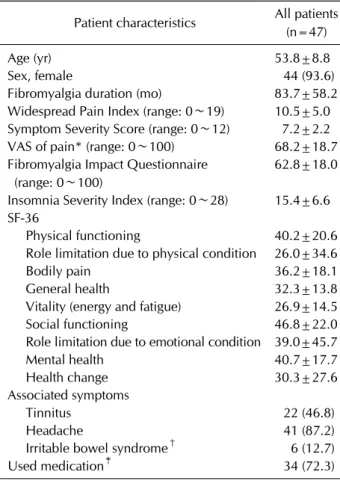
Table 1. Baseline characteristics
Patient characteristics All patients (n=47)
Age (yr) 53.8±8.8
Sex, female 44 (93.6)
Fibromyalgia duration (mo) 83.7±58.2 Widespread Pain Index (range: 0∼19) 10.5±5.0 Symptom Severity Score (range: 0∼12) 7.2±2.2 VAS of pain* (range: 0∼100) 68.2±18.7 Fibromyalgia Impact Questionnaire
(range: 0∼100)
62.8±18.0 Insomnia Severity Index (range: 0∼28) 15.4±6.6 SF-36
Physical functioning 40.2±20.6
Role limitation due to physical condition 26.0±34.6
Bodily pain 36.2±18.1
General health 32.3±13.8
Vitality (energy and fatigue) 26.9±14.5
Social functioning 46.8±22.0
Role limitation due to emotional condition 39.0±45.7
Mental health 40.7±17.7
Health change 30.3±27.6
Associated symptoms
Tinnitus 22 (46.8)
Headache 41 (87.2)
Irritable bowel syndrome† 6 (12.7)
Used medication‡ 34 (72.3)
Values are presented as mean±standard deviation or number (%). SF-36: Short-form Health Survey. *The Visual Analog Scale (VAS) of pain intensity is a 100-point linear gauge in which 0=no pain and 100=worst pain imaginable. †Satisfies the Rome IV diagnostic criteria. ‡Medication including selective serotonin reuptake inhibitor/serotonin-norepinephrine reuptake inhibitor/Pregabalin.
May 2020 and were eligible for enrollment if they were at least 18 years old and had FM according to the classi- fication criteria of the American College of Rheumatology [10]. Exclusion criteria were evidence of organic brain disease or organic otolaryngological illness.
Ethics statement
The local Institutional Review Board (IRB) approved this study (IRB no. 2019-12-029-002). Written informed consent was obtained from all patients before study entry.
Study variables
Demographic (age and sex) and clinical variables (FM duration, FM-associated symptoms, location and severity of tinnitus (if present), irritable bowel syndrome symp- toms, and insomnia severity) were collected through a standard protocol of questionnaires. Core measures of FM symptoms and comorbidities were assessed by Korean-validated scores and scales: Widespread Pain Index (WPI); Symptom Severity Score (SSS) Scale [10];
Visual Analogue Scale (VAS) of pain; and the Korean ver- sions of the Fibromyalgia Impact Questionnaire (FIQ) [11], the Insomnia Severity Index (ISI-K) [12], the Tinnitus Handicap Questionnaire (THQ-K) [13], and the Short-form Health Survey (SF-36) [14,15].
WPI and SSS scale are used to diagnose FM. The WPI captures the number of painful areas reported over the previous week by FM patients over a range from 0∼19.
The SSS scale assesses the severity of symptoms in FM pa- tients and ranges from 0∼12, with higher scores indicat- ing greater severity [10].
The THQ is a self-reporting tinnitus questionnaire, vali- dated in Korean, which consists of 27 items that sum to a total score ranging from 0 (no handicap) to 100 (catastrophic difficulties) [13].
To compare quality of life between FM patients with and without tinnitus, we used three questionnaires: 1) the SF-36 is a self-administered questionnaire, validated in Korean, that assesses eight health-related quality-of-life dimensions: physical functioning, role limitation due to physical condition, body pain, general health, vitality (energy and fatigue), social functioning, role limitation due to emotional condition, and mental health. Each scale is scored using norm-based methods, with higher scores indicating better health. Scores are aggregated further to produce physical and mental component summary meas- ures of health status, using norm-based methods. The subscale scores are standardized and range from 0∼100,
with higher scores reflecting higher health-related quality of life in the measured domain [15].
2) The FIQ is a self-administered questionnaire, vali- dated in Korean, to assess health-related quality of life over the previous week, specifically in patients with fibromyalgia. It consists of VAS questions and those re- garding limitations in daily living activities. The total score ranges from 0∼100, with higher scores indicating greater negative impact [11].
3) The ISI is a self-report questionnaire, validated in Korean, to assess the nature and severity of insomnia. It consists of 7 components that sum to a total score ranging from 0 (no difficulties) to 28 (severe difficulties) [12].
Statistical analysis
Data obtained from the questionnaires were analyzed
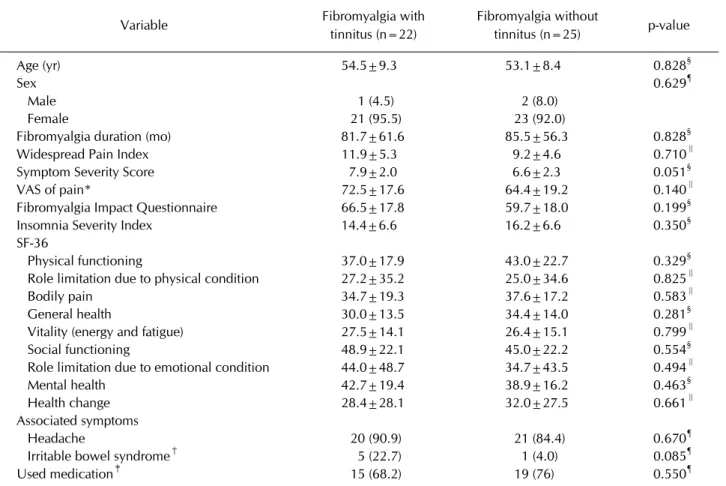
Table 2. Comparison between Fibromyalgia patients with and without tinnitus
Variable Fibromyalgia with
tinnitus (n=22)
Fibromyalgia without
tinnitus (n=25) p-value
Age (yr) 54.5±9.3 53.1±8.4 0.828§
Sex 0.629¶
Male 1 (4.5) 2 (8.0)
Female 21 (95.5) 23 (92.0)
Fibromyalgia duration (mo) 81.7±61.6 85.5±56.3 0.828§
Widespread Pain Index 11.9±5.3 9.2±4.6 0.710∥
Symptom Severity Score 7.9±2.0 6.6±2.3 0.051§
VAS of pain* 72.5±17.6 64.4±19.2 0.140∥
Fibromyalgia Impact Questionnaire 66.5±17.8 59.7±18.0 0.199§
Insomnia Severity Index 14.4±6.6 16.2±6.6 0.350§
SF-36
Physical functioning 37.0±17.9 43.0±22.7 0.329§
Role limitation due to physical condition 27.2±35.2 25.0±34.6 0.825∥
Bodily pain 34.7±19.3 37.6±17.2 0.583∥
General health 30.0±13.5 34.4±14.0 0.281§
Vitality (energy and fatigue) 27.5±14.1 26.4±15.1 0.799∥
Social functioning 48.9±22.1 45.0±22.2 0.554§
Role limitation due to emotional condition 44.0±48.7 34.7±43.5 0.494∥
Mental health 42.7±19.4 38.9±16.2 0.463§
Health change 28.4±28.1 32.0±27.5 0.661∥
Associated symptoms
Headache 20 (90.9) 21 (84.4) 0.670¶
Irritable bowel syndrome† 5 (22.7) 1 (4.0) 0.085¶
Used medication‡ 15 (68.2) 19 (76) 0.550¶
Values are presented as mean±standard deviation or number (%). SF-36: Short-form Health Survey. *The Visual Analog Scale (VAS) of pain intensity is a 100-point linear gauge in which 0=no pain and 100=worst pain imaginable. †Satisfies the Rome IV diagnostic criteria. ‡Medication including selective serotonin reuptake inhibitor/serotonin-norepinephrine reuptake inhibitor/
Pregabalin. §t-test; ∥Mann–Whitney U-test; ¶chi-square test.
using SPSS software version 26 (IBM Co., Armonk, NY, USA). We conducted comparative analyses via chi-square test for qualitative variables and by t-test and one-way ANOVA for quantitative variables. The Mann–Whitney U-test and Kruskal-Wallis test were used when the com- parison group distribution was non-normal according to the Shapiro-Wilk test. Statistical significance was at the 5% level. All the tests were two-sided.
RESULTS
All 47 FM patients completed the study protocol. About 90% are women and suffered from headache. Also, about half the patients had tinnitus. Widespread moder- ate-to-severe pain, insomnia, and decreased quality of life were also observed (Table 1).
While we found a mildly significant difference between the 22 FM patients with tinnitus and the 25 FM patients
without tinnitus with regard to SSS (p=0.051), there were no statistical differences in demographics and clin- ical variables between the two groups (as shown in Table 2).
Among the 22 patients who had tinnitus and FM, two did not answer the Tinnitus Handicap Questionnaire.
Our study showed significant differences between pa- tients with mild tinnitus (THQ<38) and patients with moderate-to-severe tinnitus (THQ≥38) for FIQ (p=
0.025) and the physical functioning (p=0.003), social functioning (p=0.035), and mental health (p=0.017) components of the SF-36 (Table 3). These results suggest that FM patients who had more severe tinnitus had more severe FM symptoms and suffered more negative impacts on their quality of life.
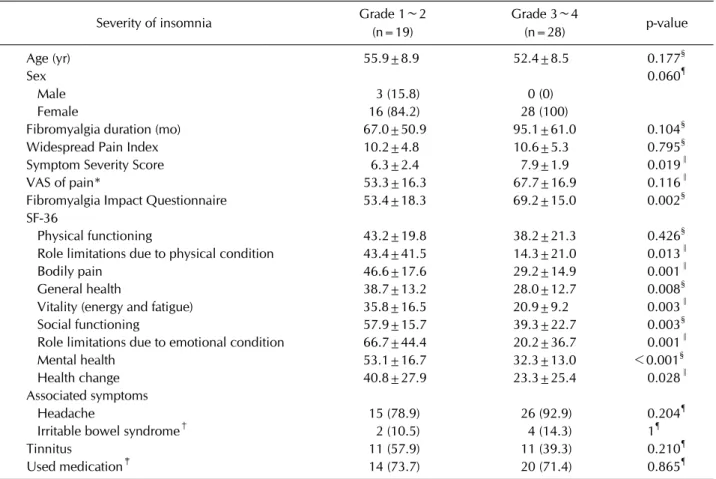
When we divided FM patients into two groups by in- somnia severity (insomnia grade 1∼2 and insomnia grade 3∼4), we found significant differences in FIQ (p=
0.002) and in bodily pain (p=0.001), general health (p=
Table 3. Comparison between Fibromyalgia patients with mild tinnitus and moderate-to-severe tinnitus Severity of tinnitus Tinnitus grade
1∼2 (n=12)*
Tinnitus grade
3∼5 (n=8)* p-value
Age (yr) 55.2±7.5 53.2±13.0 0.666∥
Sex 0.209**
Male 0 (0)ㅤ 1 (12.5)
Female 12 (100) 7 (87.5)
Fibromyalgia duration (mo) 81.7±63.7 98.3±58.7 0.561∥
Tinnitus duration (mo) 46.8±43.0 111.6±119.5 0.178∥
Tinnitus side 0.303**
Left side 1 (8.3) 0 (0)
Right side 6 (50.0) 2 (25.0)
Both sides 5 (41.7) 6 (75.0)
Widespread Pain Index 10.8±4.5 14.1±6.4 0.192¶
Symptom Severity Score 7.6±2.0 8.8±1.9 0.206∥
VAS of pain† 70.8±13.8 80.6±20.1 0.211∥
Fibromyalgia Impact Questionnaire 63.6±11.9 78.6±15.6 0.025∥
Insomnia Severity Index 13.9±5.9 17.8±5.4 0.160∥
SF-36
Physical functioning 43.3±10.5 21.9±17.3 0.003∥
Role limitation due to physical condition 25.0±28.2 15.6±35.2 0.517¶
Bodily pain 37.9±20.0 24.1±19.8 0.107∥
General health 30.4±9.4 23.8±14.3 0.223¶
Vitality (energy and fatigue) 30.4±14.4 18.8±9.2 0.058∥
Social functioning 55.2±20.3 34.4±19.8 0.035∥
Role limitation due to emotional condition 47.2±48.1 25.0±46.3 0.318¶
Mental health 49.3±16.7 29.0±17.6 0.017∥
Health change 31.3±28.5 12.5±13.3 0.065¶
Associated symptoms
Headache 11 (91.7) 7 (87.5) 1**
Irritable bowel syndrome‡ 1 (8.3) 4 (50.0) 0.109**
Used medication§ 6 (50.0) 8 (100) 0.042**
Values are presented as mean±standard deviation or number (%). SF-36: Short-form Health Survey. *Tinnitus grade was calculated using the Tinnitus Handicap Questionnaire. †The Visual Analog Scale (VAS) of pain intensity is a 100-point linear gauge in which 0=no pain and 100=worst pain imaginable. ‡Satisfies the Rome IV diagnostic criteria. §Medication including selective serotonin reuptake inhibitor/serotonin-norepinephrine reuptake inhibitor/Pregabalin. ∥t-test; ¶Mann–Whitney U-test; **chi-square test.
0.008), vitality (p=0.003), social functioning (p=0.003), role limitation due to emotional condition (p=0.001), and mental health (p<0.001) components of the SF-36 (Table 4). This suggests that insomnia severity has a pos- itive correlation with FM severity and a negative correla- tion with quality of life in FM patients.
DISCUSSION
In this study, we evaluated the association between tin- nitus severity and FM. Previous studies demonstrate that tinnitus and FM have a common pathophysiology, called central sensitization. Also, the conditions are treated with similar drugs. However, no previous studies have ex-
plored links between them.
In this study, 93.6% of the 47 FM patients were female and their mean age was 53.8±8.8 years. A recent study in- vestigated 86 FM patients in South Korea, among whom 94.4% were female and their mean age was 50.9±11.8 years [11], which is consistent with the high prevalence of FM in middle-aged women. We showed that 46.8% and 87.2% of the 47 FM patients had tinnitus and headache, respectively, suggesting a high incidence of these symp- toms in FM. Koca et al. [16] found that FM patients had more otologic symptoms, including tinnitus and high lev- el of oxidative stress. In another study, 74.3% of 101 FM patients had tinnitus despite having audiological test re- sults in the normal range [7]. Herein, we confirm that fi-
Table 4. Comparison of Fibromyalgia patients by insomnia severity
Severity of insomnia Grade 1∼2
(n=19)
Grade 3∼4
(n=28) p-value
Age (yr) 55.9±8.9 52.4±8.5 0.177§
Sex 0.060¶
Male 3 (15.8) 0 (0)
Female 16 (84.2) 28 (100)
Fibromyalgia duration (mo) 67.0±50.9 95.1±61.0 0.104§
Widespread Pain Index 10.2±4.8 10.6±5.3 0.795§
Symptom Severity Score 6.3±2.4 7.9±1.9 0.019∥
VAS of pain* 53.3±16.3 67.7±16.9 0.116∥
Fibromyalgia Impact Questionnaire 53.4±18.3 69.2±15.0 0.002§
SF-36
Physical functioning 43.2±19.8 38.2±21.3 0.426§
Role limitations due to physical condition 43.4±41.5 14.3±21.0 0.013∥
Bodily pain 46.6±17.6 29.2±14.9 0.001∥
General health 38.7±13.2 28.0±12.7 0.008§
Vitality (energy and fatigue) 35.8±16.5 20.9±9.2 0.003∥
Social functioning 57.9±15.7 39.3±22.7 0.003§
Role limitations due to emotional condition 66.7±44.4 20.2±36.7 0.001∥
Mental health 53.1±16.7 32.3±13.0 <0.001§
Health change 40.8±27.9 23.3±25.4 0.028∥
Associated symptoms
Headache 15 (78.9) 26 (92.9) 0.204¶
Irritable bowel syndrome† 2 (10.5) 4 (14.3) 1¶
Tinnitus 11 (57.9) 11 (39.3) 0.210¶
Used medication‡ 14 (73.7) 20 (71.4) 0.865¶
Values are presented as mean±standard deviation or number (%). SF-36: Short-form Health Survey. *The Visual Analog Scale (VAS) of pain intensity is a 100-point linear gauge in which 0=no pain and 100=worst pain imaginable. †Satisfies the Rome IV diagnostic criteria. ‡Medication including selective serotonin reuptake inhibitor/serotonin-norepinephrine reuptake inhibitor/
Pregabalin. §One-way ANOVA test; ∥Kruskal-Wallis test; ¶chi-square test.
bromyalgia frequently accompanies tinnitus. Furthermore, we show that the more severe is the tinnitus, the more se- vere are the FM symptoms and the lower is the quality of life, all of which cause limited physical activity and mood disturbance.
Our study suggests that tinnitus is a key component of centrally mediated symptoms in FM, indicating that tin- nitus severity is closely related to FM severity and should be assessed in all FM patients. Due to altered neurological processing known as central sensitization, FM patients feel pain associated with peripheral nociceptive stimuli more acutely (allodynia) and more intensely (hyperalgesia) [2]. Centrally mediated symptoms such as fatigue, sleep- lessness, and mood disturbance are characteristics in cen- tral sensitization [1,5]. There is some evidence that FM patients have increased activation of a pain-related brain lesion and significant imbalances among pain-processing areas and cognition-attention networks of the brain [1].
Also, evidence suggests that the activity of centrally act- ing neurotransmitters is altered in FM. Russell et al.
[17,18] investigated the neurotransmitters in FM pa- tients and found elevated level of substance P and re- duced levels of serotonin, norepinephrine, and dopamine in the cerebrospinal fluid. Furthermore, centrally acting drugs such as serotonin-norepinephrine reuptake in- hibitors (SNRIs), tricyclic antidepressants, and gaba- pentinoids are used to treat FM. These drugs not only have an analgesic effect, they also diminish centrally mediated symptoms in FM patients [5,19]. From these findings, we hypothesize that the imbalance of neuro- transmitters in central sensitization plays an essential role in FM. Additionally, assuming that tinnitus is a result of imbalance in neurotransmitters, we found that FM se- verity correlated with tinnitus severity rather than tinni- tus presence, as shown in Tables 2 and 3. Moreover, we as- sume that drugs taken to treat FM will also affect tinnitus.
We could confirm that the rate of taking drugs such as se- lective serotonin reuptake inhibitors, SNRI and pre- gabalin was significantly higher in the moderate-to-severe tinnitus group than in the mild tinnitus group, as shown in Table 3 (p=0.042). In a single, small study that eval- uated the efficacy of some FM drugs for tinnitus, pre- gabalin and duloxetine were found to alleviate tinnitus in FM patients but not to a statistically significant degree be- tween pregabalin and duloxetine [7]. More research about the effectiveness of these drugs for tinnitus is needed.
Numerous studies have found that reduced input of pe- ripheral sensory neurons activates homeostatic plasticity to result in central sensitization. Noreña and Farley [9]
suggested that this process ultimately causes tinnitus, even if hearing loss is not detected in the audiogram.
Additionally, centralization of tinnitus may become pro- gressive over time, making it less dependent on periph- eral sensory input. So, there is a possibility that tinnitus is one of the aggravating causes of FM, not a result of FM.
Therefore, it may be appropriate to evaluate and treat tin- nitus early in FM patients.
We predicted that tinnitus severity would be associated with insomnia severity in FM patients, but we found no meaningful difference between the mild tinnitus and moderate-to-severe tinnitus groups in Insomnia Severity Index scores (p=0.16; Table 3). This may be due to our small sample size. Further studies are needed to better evaluate these associations. A cross-sectional survey showed that poor quality of sleep is associated with in- creased pain intensity and decreased quality of life in women with FM [20]. Our study also concluded that in- somnia is a significant symptom of FM and should be carefully evaluated.
To our knowledge, this is the first study of the impact of tinnitus in FM patients. We concluded that tinnitus se- verity is related to FM severity and lower quality of life.
We also reconfirmed that insomnia severity has a positive correlation with FM severity and an inverse correlation with quality of life, as shown in Table 4. However, we found no significant correlation between tinnitus pres- ence and FM severity.
Our study has some limitations. First, this was a study conducted in a tertiary hospital, our participants may rep- resent a subset of patients with more severe FM symp- toms than would be expected in FM patients overall.
Second, we performed a single-center cross-sectional study. Third, we could not measure the hearing capacity
in tinnitus group since the patients had difficulty getting a hearing test at the otolaryngology clinic for time reasons.
Fourth, due to our small sample size, we used non-nor- mal distribution tests. Further large-scale, multicenter, and cohort studies are necessary.
CONCLUSION
FM patients with severe tinnitus have more functional impairments and lower quality of life than patients with mild tinnitus. Insomnia severity also has a positive corre- lation with poor health status and lower quality of life in FM patients. We identified a need for early evaluation and treatment of tinnitus and the significance of insomnia in FM patients.
ACKNOWLEDGMENTS
This study was supported by Wonkwang University Grant in 2021.
CONFLICT OF INTEREST
No potential conflict of interest relevant to this article was reported.
AUTHOR CONTRIBUTIONS
C.H.L. designed the study. C.H.L., C.H.C., and G.H.J.
drafted the manuscript. C.H.C. and G.H.J. contributed to the acquisition and analysis of data. C.H.C. and G.H.J.
contributed equally to this manuscript. All authors ap- proved the final manuscript.
REFERENCES
1. Cagnie B, Coppieters I, Denecker S, Six J, Danneels L, Meeus M. Central sensitization in fibromyalgia? A system- atic review on structural and functional brain MRI. Semin Arthritis Rheum 2014;44:68-75.
2. Clauw DJ. Fibromyalgia: a clinical review. JAMA 2014;311:
1547-55.
3. Cohen H. Controversies and challenges in fibromyalgia: a review and a proposal. Ther Adv Musculoskelet Dis 2017;
9:115-27.
4. Lee HJ, Choi E, Nahm FS, Choi SS, Kim YH, Moon JY, et al.
Prevalence of fibromyalgia in fourteen Korean tertiary care university hospital pain clinics. J Pain Res 2018;11:2417-23.
5. Phillips K, Clauw DJ. Central pain mechanisms in the rheu- matic diseases: future directions. Arthritis Rheum 2013;65:
291-302.
6. Watson NF, Buchwald D, Goldberg J, Noonan C, Ellenbogen RG. Neurologic signs and symptoms in fibromyalgia.
Arthritis Rheum 2009;60:2839-44.
7. Cil ÖÇ, Zateri C, Güçlü O, Oymak S, Tezcan E. The effect of fibromyalgia treatment on tinnitus. Am J Otolaryngol 2020;41:102390.
8. Cima RFF, Mazurek B, Haider H, Kikidis D, Lapira A, Noreña A, et al. A multidisciplinary European guideline for tinnitus: diagnostics, assessment, and treatment. HNO 2019;67(Suppl 1):10-42.
9. Noreña AJ, Farley BJ. Tinnitus-related neural activity: theo- ries of generation, propagation, and centralization. Hear Res 2013;295:161-71.
10. Wolfe F, Clauw DJ, Fitzcharles MA, Goldenberg DL, Häuser W, Katz RL, et al. 2016 Revisions to the 2010/2011 fi- bromyalgia diagnostic criteria. Semin Arthritis Rheum 2016;46:319-29.
11. Kang JH, An M, Choi SE, Xu H, Park DJ, Lee JK, et al.
Performance of the revised 2016 fibromyalgia diagnostic criteria in Korean patients with fibromyalgia. Int J Rheum Dis 2019;22:1734-40.
12. Cho YW, Song ML, Morin CM. Validation of a Korean ver- sion of the insomnia severity index. J Clin Neurol 2014;
10:210-5.
13. Jun HJ, Yoo IW, Hwang SJ, Hwang SY. Validation of a Korean version of the tinnitus handicap questionnaire. Clin Exp Otorhinolaryngol 2015;8:198-201.
14. Han CW, Lee EJ, Iwaya T, Kataoka H, Kohzuki M.
Development of the Korean version of Short-Form 36-Item Health Survey: health related QOL of healthy elderly people and elderly patients in Korea. Tohoku J Exp Med 2004;
203:189-94.
15. Ware JE Jr, Gandek B. Overview of the SF-36 Health Survey and the International Quality of Life Assessment (IQOLA) Project. J Clin Epidemiol 1998;51:903-12.
16. Koca TT, Seyithanoglu M, Sagiroglu S, Berk E, Dagli H.
Frequency of audiological complaints in patients with fi- bromyalgia syndrome and its relationship with oxidative stress. Niger J Clin Pract 2018;21:1271-7.
17. Russell IJ, Vaeroy H, Javors M, Nyberg F. Cerebrospinal flu- id biogenic amine metabolites in fibromyalgia/fibrositis syndrome and rheumatoid arthritis. Arthritis Rheum 1992;
35:550-6.
18. Russell IJ, Orr MD, Littman B, Vipraio GA, Alboukrek D, Michalek JE, et al. Elevated cerebrospinal fluid levels of sub- stance P in patients with the fibromyalgia syndrome.
Arthritis Rheum 1994;37:1593-601.
19. Russell IJ. Management of pain in the fibromyalgia syndrome.
J Arthritis 2018;7:273.
20. Liedberg GM, Björk M, Börsbo B. Self-reported non- restorative sleep in fibromyalgia - relationship to impair- ments of body functions, personal function factors, and quality of life. J Pain Res 2015;8:499-505.