Ⅰ. Introduction
Extranodal nasal type natural killer (NK)/T cell (NKTC) lymphoma is classified as a subtype of peripheral T-cell lym- phoma, according to the new World Health Organization (WHO) classification system for lymphoid neoplasms estab- lished in 19991-3. NKTC lymphoma has a higher geographic incidence in Orientals, Mexicans, and South Americans com- pared to the Western population1. In Korea, the rate of occur- rence of NKTC lymphoma is 9-12% of all non-Hodgkin’s lymphomas3. Its poor prognosis is caused by the prompt pro- gression of the lesion into distinct organs4. Therefore, early diagnosis can be a valuable factor for improving survival rate and treatment outcome. The most prevalent area of NKTC lymphoma is the midface including the nasal cavity, orophar- ynx, and nasopharynx5. It presents as a progressive ulceration and necrotic granulomatous change when found in the midfa- cial area6-8. Although NKTC lymphoma rarely arises as a pri-
mary tumor intraorally, tumors of the nasal cavity may extend into the oral cavity, affecting the hard and soft palate6.
Initial oral manifestations of NKTC lymphomas are similar to the non-specific inflammatory process which may be easily misjudged with bacterial, viral or fungal infections or other inflammatory disease, such as cellulitis, abscess, periodontitis and recurrent aphthous ulcer (RAU). Therefore, it is common for NKTC lymphoma to be post-operatively diagnosed. The following cases are patients who came to the Yonsei University Dental Hospital complaining of inflammatory signs in the oral cavity and were ultimately diagnosed with NKTC lymphoma. In this article, we report these cases along with review of literature.
Ⅱ. Case report
1. Case 1
A 34 year old woman visited the Yonsei University Dental Hospital outpatient clinic, complaining of an unhealed ulcera- tion on her lower right posterior gingival area that has first appeared 1 month ago. During the first examination, a whitish necrotic ulceration was observed on the buccal gingival of #46, 47.(Fig. 1) #46 and 47 presented no mobility or percussion.
Also paresthesia of the left chin and lower lip was noticed. The 김 형 준
120-752 서울시 서대문구 성산로250 연세대학교 치과대학 구강악안면외과학교실 Hyung Jun Kim
Department of Oral and Maxillofacial Surgery College of Dentistry, Yonsei University
250 Seongsanno, Seodaemoon Gu, Seoul, 120-752, Korea TEL: +82-2-2228-3132 FAX: +82-2-2227-8022 E-mail: [email protected]
Extranodal NK/T cell Lymphoma, nasal type:
clinical, radiological, histological features for early diagnosis
Kyung-Ran Park1, Seon-Hee Han2,3, Hyun-Sil Kim2,3, Seung-Jun Lee1, In-Ho Cha1,3, Hyung-Jun Kim1 Departments of 1Oral and Maxillofacial Surgery, 2Oral Pathology, 3Oral Cancer Research Institute,
College of Dentistry, Yonsei University, Seoul, Korea
Primary nasal type natural killer (NK)/T cell (NKTC) lymphoma, a specific form of malignant lymphoma, has a higher geographic incidence in Oriental, Mexican, and South American populations than the Western population. In Koreans, it comprises 9-12% of all cases of non-Hodgkin’s lym- phoma. This type of lymphoma has also been named as angiocentic lymphoma and lethal midline granuloma because the most common site is the upper airway area and its clinical aggressiveness presents with a necrotic and destructive pattern. NKTC lymphoma can also be detected in different organs (testis, spleen, parotid gland, skin, gastroinstinal tract, central nervous system, lungs, bone marrow, etc.) other than the upper airway including the oral cavity. The lymphoma detected in the oral cavity shows various destructive and inflammatory changes, similar to the signs of inflammation and infection from periodontitis and pulpal disease, making a diagnosis difficult with just the clinical signs. For early detection, clinical, radiological, and pathological examinations are required. This report describes the clinical, radiological and histological characteristics with a case report for the early detection of NKTC lymphoma in the oral cavity.
Key words:Extranodal NK/T cell lymphoma nasal type, Early diagnosis, Clinical, Radiological, Histological
[paper submitted 2010. 9. 14 / revised 2010. 12. 16 / accepted 2010. 12. 20]
Abstract (J Korean Assoc Oral Maxillofac Surg 2010;36:497-501)
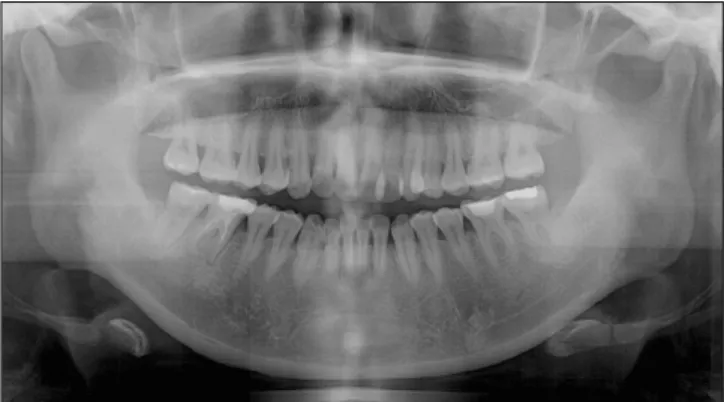
panoramic view showed a periodontal ligament space widen- ing of #46 and 47 along with mucosal thickening and haziness of both the maxillary sinus.(Fig. 2) Due to the clinical charac- teristics of the lesion, it was misjudged with RAU. After com- puted tomography (CT) image analysis, destructive changes of the nasal cavity, paranasal area, and right preseptal orbit were observed.(Fig. 3) It was decided to confirm the differential diagnosis of NKTC lymphoma through a biopsy of the right posterior gingiva. The initial biopsy showed a polymorphic infiltration of inflammatory cells, macrophage, B and T lym- phocytes. A second biopsy and immunohistochemical study was preformed a week later. The final diagnosis was NKTC lymphoma and she was treated with chemotherapy for 6 months. However, the patient died of gastrointestal bleeding related to NKTC lymphoma involvement.
Fig. 1. A: First examination: whitish ulceration was seen on right posterior gingival, B: After 1 week: progressed necrotic ulceration was seen after biopsy, C: After 2 weeks - more progressed fetid, grey to brown, necrotic, painful ulceration with malodour after re-biopsy.
Fig. 2. The initial panoramic view showed a PDL space widening of #46 and 47, haziness and mucosal thickening in the maxillary sinus, both.
(PDL: periodontal ligament)
A B C
A B
2. Case 2
A 68 year old male was referred to the Yonsei University Dental Hospital outpatient clinic, for an unresolved midfacial swelling. At our hospital the patient was treated for left canine space abscess with incision and drainage and antibiotic therapy for 1 week, followed by extraction of the canine. Treatment was not effective and facial palsy of the left side arised after coming to our hospital. The panoramic view showed periapical radiolucency on #23 similar to an apical abscess and haziness
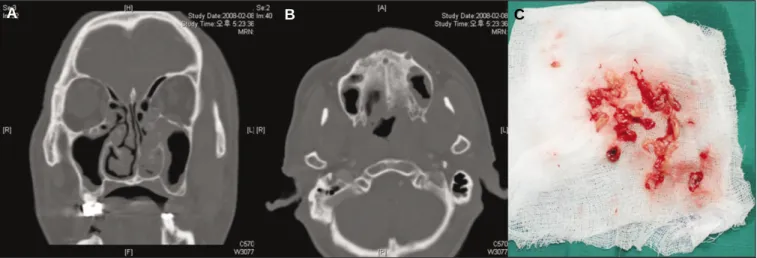
of both the maxillary sinuses.(Fig. 4) CT images showed mucosal thickening on the left maxillary and ethmoidal sinus, and an infiltration close to the left orbit.(Figs. 5. A, B) The patient was referred to the department of ear, nose and throat (ENT), where a middle meatal antrostomy was preformed for biopsy purpose under general anesthesia.(Fig. 5. C) He was finally diagnosed with NKTC lymphoma. And he was treated successfully with concurrent chemotherapy and radiotherapy and is still alive with periodic follow up.
Fig. 4. A: The initial panoramic view showed a periapical radiolucency on #23 and haziness in maxillary sinus, both, B: A late facial palsy of the left side arised with previous midfacial and left orbital swelling.
Fig. 5.A, B: CT showing mucosal thickening of Lt. maxillary and ethmoidal sinus, C: Surgical specimen.
(CT: computed tomography)
A B
A B C
Ⅲ. Discussion
At the time of diagnosis, the most commonly observed symptoms of NKTC lymphoma suggesting involvement of nasal cavity are: nasal bleeding, congestion, and rhinorrhea.
Oral cavity manifestations are extremely rare, especially involving the mandible as the primary tumor, and may easily be misjudged with other conditions. Such is the case of our first patient case, which presented an ulcerative lesion on the
NKTC lymphoma involving the maxillary area usually shows necrotic granulation tissue formation, midfacial swelling, with or without oroantral fistula formation on involved area. It can be easily misdiagnosed with other dental related conditions, without considering clinical and radiologic findings simultaneously for a deferential diagnosis as in the case of our second patient, who presented an unresolved mid- facial swelling and was misjudged with canine space abscess.
Clinical findings of lymphoma in the oral cavity are charac-
Fig. 6. Extranodal NK/T-cell lymphoma in the oral mucosa.
The lymphomatous infiltrate involves the surface epithelium and subepithelial connective tissue.(original magnification x40)
(NK: natural killer)
Fig. 7. Extranodal NK/T-cell lymphoma in the oral mucosa.
An angiocentric and angiodestructive growth pattern is not- ed. This tumor is composed of predominantly of small cells with irregular nuclei.(original magnification x200)
(NK: natural killer)
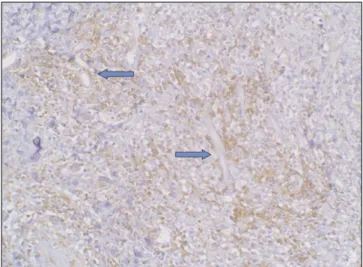
Fig. 8. CD3 expression in the extranodal NK/T-cell lym- phoma.(arrow marker: vessel, original magnification x200) (NK: natural killer)
Fig. 9. TIA/Granzyme B expression in the extranodal NK/T- cell lymphoma.(arrow marker: vessel, original magnification x200)
(TIA: T cell intracellular antigen, NK: natural killer)
ynx, posterior tongue, maxillary gingiva may be involved6. NKTC lymphomas have a tendency to infiltrate and destroy surrounding tissues, like skin, paranasal area, orbit, masseter, temporalis, buccinator muscles, parotid gland, etc. If the dis- ease disseminates, cheek and orbit swelling, sore throat, dys- phagia, epistaxis, trismus, parotid gland swelling is often pre- sent4,6. Also, rarely we have experienced palsy of the trigermi- nal nerve and facial nerve in our presented cases. Gingival involvement presents fetid, grey-to-brown, necrotic, painful ulceration which later causes bony destruction, mobility and exfoliation of teeth6. The systemic symptoms may include mild fever, weight loss, headache, and general weakness4. However, due to the wide variety of clinical symptoms, the attending physicians must analyze the information provided in the radio- logic findings in order to facilitate its diagnosis.
On CT image, the presence of diffuse tumor infiltration along the walls of the nasal cavity, simultaneous involvement of the nasal/oropharynx and tumor extension into the adjacent soft tissue structures suggests the possibility of NKTC lym- phoma3. A rapid biopsy and histopathologic confirmation is required for the establishment of a definitive diagnosis.
Histological findings showed lymphomatous infiltration with irregular nuclei involving the surface epithelium and subep- ithelial connective tissue, called polymorphic reticulosis. In addition, angiocentric, angiodestructive growths pattern were also shown with widespread ischemic necrosis1,4,10. However, due to its histological variations and confusion with other non- specific inflammation, the search for a diagnostic marker is needed for warrantee.(Figs. 6, 7)
Usually NKTC lymphomas express CD2, CD3, and CD564,6,11. Also expression of perforin, T cell intracellular antigen (TIA- 1), granzyme B, and Fas ligand suggests a high cytotoxic activity, and Epstein-Barr virus (EBV) status suggests a more aggressive and necrotic malignancy, which makes as a poor prognostic factor7,10,12.(Figs. 8, 9)
Ⅳ. Conclusion
In the field of oral and maxillofacial surgery and other dental disciplines, initial manifestations similar to those of NKTC lymphoma, is not common. Therefore, unhealed intraoral ulcerations, facial swellings, necrotic tissue formation caused by NKTC lymphoma may be misjudged with other conditions related to dental origin, causing a delay in diagnosis.
Due to prompt progression of the lesion into distinct organs, NKTC lymphomas have a poor prognosis with the cumulative probability of survival at 5 years ranging from 37.9% to 45.3%6. Its prognosis is influenced by stage of disease, histo- logical grade of malignancy and the presence of EBV infec- tion. Therefore, early diagnosis and staging with appropriate treatment are essential to achieve optimal treatment results. For an early diagnosis, clinicians must pay close attention to not only a patient’s clinical manistifestations, but also to findings that may resemble radiographic characteristics of NKTC lym- phoma and perform a tissue biopsy for an early diagnosis of NKTC lymphoma that may improve treatment outcome.
References
1. Suzuki R, Takeuchi K, Ohshima K, Nakamura S. Extranodal NK/T-cell lymphoma: diagnosis and treatment cues. Hematol Oncol 2008;26:66-72.
2. Lu P. Staging and classification of lymphoma. Semin Nucl Med 2005;35:160-4.
3. Kim J, Kim EY, Lee SK, Kim DI, Kim CH, Kim SH, et al.
Extranodal nasal-type NK/T-cell lymphoma: computed tomogra- phy findings of head and neck involvement. Acta Radiol 2010;51:164-9.
4. Harabuchi Y, Takahara M, Kishibe K, Moriai S, Nagato T, Ishii H. Nasal natural killer (NK)/T-cell lymphoma: clinical, histologi- cal, virological, and genetic features. Int J Clin Oncol 2009;14:
181-90.
5. Ko YH, Cho EY, Kim JE, Lee SS, Huh JR, Chang HK, et al. NK and NK-like T-cell lymphoma in extranasal sites: a comparative clinicopathological study according to site and EBV status.
Histopathology 2004;44:480-9.
6. Al-Hakeem DA, Fedele S, Carlos R, Porter S. Extranodal NK/T- cell lymphoma, nasal type. Oral Oncol 2007;43:4-14.
7. Chiang AK, Chan AC, Srivastava G, Ho FC. Nasal T/natural killer (NK)-cell lymphomas are derived from Epstein-Barr virus- infected cytotoxic lymphocytes of both NK- and T-cell lineage.
Int J Cancer 1997;73:332-8.
8. Seishima M, Yuge M, Kosugi H, Nagasaka T. Extranodal NK/T- cell lymphoma, nasal type, possibly arising from chronic Epstein- Barr virus infection. Acta Derm Venereol 2010;90:102-3.
9. Ko YH, Ree HJ, Kim WS, Choi WH, Moon WS, Kim SW.
Clinicopathologic and genotypic study of extranodal nasal-type natural killer/T-cell lymphoma and natural killer precursor lym- phoma among Koreans. Cancer 2000;89:2106-16.
10. Peh SC, Quen QW. Nasal and nasal-type natural killer (NK)/T- cell lymphoma: immunophenotype and Epstein-Barr virus (EBV) association. Med J Malaysia 2003;58:196-204.
11. Chan JK, Sin VC, Wong KF, Ng CS, Tsang WY, Chan CH, et al.
Nonnasal lymphoma expressing the natural killer cell marker CD56: a clinicopathologic study of 49 cases of an uncommon ag- gressive neoplasm. Blood 1997;89:4501-13.
12. Garcl′a-Cosl′o M, Santo′n A, Me′ndez MC, Rivas C, Martl′n C, Bellas C. Nasopharyngeal/nasal type T/NK lymphomas: analysis of 14 cases and review of the literature. Tumori 2003;89:278-84.