© 2013 Korean Breast Cancer Society. All rights reserved. http://ejbc.kr | pISSN 1738-6756
INTRODUCTION
Breast cancer is the leading cancer in Asian females [1], and the incidence of breast cancer has been increasing in Asia [2,3]. Approximately 10% of breast cancer cases are thought to be hereditary, and about 25% of these are caused by inherited mutations in the tumor-suppressor genes BRCA1 and BRCA2 (BRCA1/2) [4]. Although less than 5% of all breast cancer pa- tients have mutations in the BRCA1/2 genes, individuals car- rying mutations in either one of these genes have a 47% to 55% probability of developing breast cancer and a 17% to 39%
risk of ovarian cancer by the age 70 years [5,6]. Given such high risks of cancer in women with BRCA1/2 mutations, al-
terations in these genes are regarded as some of the most sig- nificant predictors for breast cancer development. These mu- tations are more prevalent among women who have a family history of breast or ovarian cancers, a personal history of breast cancer at young age, or triple-negative breast cancer (i.e., estrogen receptor, progesterone receptor, and HER2-neg- ative) [7-10]. Moreover, the frequency of these genetic muta- tions varies among ethnic groups and countries [11,12].
Since the identification of the BRCA1/2 genes, a number of studies to evaluate epidemiologic characteristics of BRCA1/2 mutations among diverse ethnicities have been conducted [12-15]. Earlier studies of BRCA1/2 mutations were largely based on Caucasian populations; however, a number of recent studies have focused on Asian patients in order to define the distributions of these genetic mutations in the Asian popula- tion [16-29]. Because Asian patients develop breast cancer at a younger age than their Caucasian counterparts [2,30], the contributions of BRCA1/2 mutations in Asians are expected to be different from those in Caucasians.
Knowledge of mutation frequency in the Asian population is vital to optimize the counseling of Asian breast cancer pa- tients and establishing criteria for BRCA1/2 testing. We re- viewed the literature regarding BRCA1/2 mutations in Asian
Distribution of BRCA1 and BRCA2 Mutations in Asian Patients with Breast Cancer
Haeyoung Kim, Doo Ho Choi
1Department of Radiation Oncology, Hallym University Dongtan Sacred Heart Hospital, Hwaseong, 1Department of Radiation Oncology, Samsung Medical Center, Sungkyunkwan University School of Medicine, Seoul, Korea
REVIEW ARTICLE
Breast cancer is the most prevalent cancer in Asian females, and the incidence of breast cancer has been increasing in Asia. Be
cause Asian patients develop breast cancer at a younger age than their Caucasian counterparts, the contributions of BRCA1 and BRCA2 (BRCA1/2) mutations in Asians are expected to be different than in Caucasians. The prevalence of BRCA1/2 muta
tions in the Asian population varies among countries and studies.
Most Asian studies have reported more frequent mutations in BRCA2 than in BRCA1, with the exception of studies from India and Pakistan. In addition, the contribution of large genomic re
arrangements of BRCA1/2 genes is relatively small in Asian pop
ulations in comparison to other ethnic populations. Various sta
tistical models for the prediction of BRCA1/2 mutations have un
derestimated the risk of having these genetic mutations in Asians, especially in predicting BRCA2 gene mutation. Until recently, BRCA1/2 mutation analyses in Asia were mostly conducted by independent single institutions with different patient selection cri
teria and using various genotyping methods. However, a couple of Asian groups have initiated nationwide studies collecting BRCA1/2 mutational data. These national collaborative studies will help a comprehensive understanding of the prevalence of BRCA1/2 mutations in the Asian population.
Key Words: Asians, BRCA genes, Breast neoplasms
Correspondence to: Doo Ho Choi
Department of Radiation Oncology, Samsung Medical Center,
Sungkyunkwan University School of Medicine, 81 Irwon-ro, Gangnam-gu, Seoul 135-710, Korea
Tel: +82-2-3410-2436, Fax: +82-2-3410-2619 E-mail: [email protected]
This study was partially supported by a Samsung Biomedical Research Institute grant, #SBRI C-B1-132-1, which contributed to genetic testing for BRCA mutations.
Received: May 23, 2013 Accepted: September 19, 2013
Cancer
breast cancer patients to identify the epidemiologic character- istics of BRCA1/2 mutations in Asian populations.
PREVALENCE OF BRCA1/2 DELETERIOUS MUTATIONS IN ASIAN PATIENTS
Korea
Since the first report of BRCA1 mutations in Korean heredi- tary breast cancer patients in 1995, there have been approxi- mately a dozen studies evaluating the prevalence of BRCA1/2 mutations in Korea. Until the late 2000s, most BRCA1/2 muta- tion data were derived from studies involving different geno- typing methods at various single institutions. Moreover, the in- clusion criteria for genetic testing of breast cancer patients have not been well defined. Therefore, in 2007, the Korean Heredi- tary Breast Cancer (KOHBRA) study was initiated in order to establish BRCA1/2 carrier cohorts of Korean ethnicity [31].
In the KOHBRA study, genotyping of the BRCA1/2 genes was offered to patients with a family history of breast or ovari- an cancers. Mutation analysis was also offered to patients with high risk factors for hereditary breast cancer, such as early-on- set breast cancer, bilateral breast cancer, a personal history of breast or ovarian cancer, male breast cancer, or cancers involv-
ing multiple organs. In the KOHBRA study, the frequencies of
BRCA1/2 mutations in nonfamilial high-risk breast cancer pa-tients and familial breast cancer patients were found to be 17.8% and 21.7%, respectively. In another analysis conducted on pooled Korean mutational data of BRCA1/2 genes not cov- ered by the KOHBRA study, 14.9% of high-risk breast cancer patients were found to have BRCA1/2 mutations, and 3.0% of sporadic breast cancer patients had alterations in BRCA1/2 genes [16]. The prevalence of BRCA1/2 mutations in Korean patients is summarized in Table 1.
China
Epidemiologic studies of BRCA1/2 mutations in Chinese breast cancer patients have been performed in mainland Chi- na, Hong Kong, Taiwan, and Singapore. Two studies from Singapore predominately included ethnic Chinese patients.
Therefore, for this review, the data from these studies will be considered representative of those from an ethnic Chinese population. Mutational analysis was performed in each study using various detection techniques, including single-strand conformation polymorphism (SSCP), protein truncation test, denaturing high-performance liquid chromatography, high- resolution DNA melting analysis, and direct sequencing. The
Table 1. Frequencies of BRCA1 and BRCA2 mutations in Korean breast cancer patientsReference Year of publication No. of patients No. of mutation cases (%)
Methods BRCA1 BRCA2 Total
Familial breast cancer
Kang et al. [63] 2002 21 5 (23.8) 4 (19.0) 9 (42.9) PTT, SSCP, DHPLC
Ahn et al. [64] 2007 144 15 (10.4) 13 (9.0) 28 (19.4) F-CSGE
Seong et al. [45] 2009 90 10 (11.1) 17 (18.9) 27 (30.0) MLPA, DS
Han et al. [17] 2013 775 72 (9.3) 96 (12.4) 168 (21.7) F-CSGE, DHPLC, DS, MLPA*
Early-onset breast cancer
Choi et al. [65] 2004 60 6 (10.0) 5 (8.3) 9 (15)† DS
Ahn et al. [64] 2007 183 13 (7.1) 6 (3.3) 19 (10.4) F-CSGE
Seong et al. [45] 2009 65 7 (10.7) 7 (10.7) 14 (21.4) MLPA, DS
Son et al. [18] 2012 625 22 (3.5) 31 (5.0) 53 (8.5) F-CSGE, DHPLC, DS, MLPA
Sporadic breast cancer
Seo et al. [66] 2004 97 2 (2.1) 1 (1) 3 (3.1) F-CSGE
Han et al. [67] 2006 793 8 (1.0) 10 (1.3) 18 (2.3) DHPLC
Seong et al. [45] 2009 50 1 (0.5) 3 (1.5) 4 (1.9) MLPA, DS
Kim et al. [16] 2012 471 7 (1.5) 7 (1.5) 14 (3.0) DHPLC
Bilateral breast cancer
Son et al. [18] 2012 124 7 (5.6) 15 (12.1) 22 (17.7) F-CSGE, DHPLC, DS, MLPA
High-risk breast cancer‡
Oh et al. [68] 1995 18 1 (5.5) - 1 (5.5) SSCP
Seong et al. [69] 2009 122 1 (0.8) 0 1 (0.8) MLPA
Son et al. [18] 2012 151 10 (6.6) 17 (11.2) 27 (17.8) F-CSGE, DHPLC, DS, MLPA
Kim et al. [16] 2012 1,668 120 (7.2) 130 (7.8) 250 (14.9) F-CSCE/CSGE, DS
PTT=protein truncation test; SSCP=single-strand conformation polymorphism; DHPLC=denaturing high-performance liquid chromatography; F-CSGE=
fluorescence-conformation sensitive gel electrophoresis; MLPA=multiple ligation-dependent probe amplification; DS=direct sequencing.
*BRCA1/2 genetic testing was conducted by four laboratories, and MLPA was performed in one laboratory; †Two patients had pathogenic mutations in both BRCA1 and BRCA2 (double heterozygosity); ‡Breast cancer patients at high risk (with one or more risk factors for BRCA mutations, such as familial, bilateral, early-onset, male, multi-organ cancer).
two studies examined large genomic rearrangements (LGRs) of BRCA1/2 genes using multiplex ligation-dependent probe amplification. The Chinese studies initially included a small number of patients at single institutions, but coverage was lat- er expanded to include a larger number of patients across multiple institutions.
Table 2 shows the frequencies of BRCA1/2 mutations in Chinese breast cancer patients. Definitions of familial breast cancer, early-onset breast cancer, or high-risk breast cancer varied among the studies. The prevalence of BRCA1/2 muta- tions in familial breast cancer and early-onset breast cancer patients ranged from 8.0% to 13.5% and from 8.7% to 11.4%, respectively. In a report by Kwong et al. [32], 7.8% of high-risk breast and/or ovarian cancer patients had BRCA1/2 gene mu- tations. The report included those with familial breast and/or ovarian cancers, early-onset breast cancer, bilateral breast can- cer, triple-negative breast cancer, or multiple cancers. In addi- tion, Suter et al. [33] found that 1.8% of patients with sporadic breast cancer had BRCA1/2 mutations.
Japan
There have been few studies of the prevalence of BRCA1/2 mutations in Japanese breast cancer patients. Mutational anal- ysis was performed by SSCP in the majority of the studies
shown in Table 3. In the early 1990s, genotyping was per- formed for the BRCA1 gene only. The studies showed that 3.5% to 10.0% of familial or high-risk breast cancer patients had mutations in the BRCA1 gene, whereas 0.8% of sporadic breast cancer patients had BRCA1 gene mutations. In reports evaluating BRCA1 in combination with BRCA2 gene muta- tions, 15.0% to 31.8% of Japanese familial breast cancer pa- tients were reported to have mutations in the BRCA1/2 genes.
In all Japanese studies, the mutation prevalence of the BRCA2 gene was higher than that of the BRCA1 gene [21,34-36].
India, Pakistan, Malaysia, Indonesia, the Philippines, and Vietnam
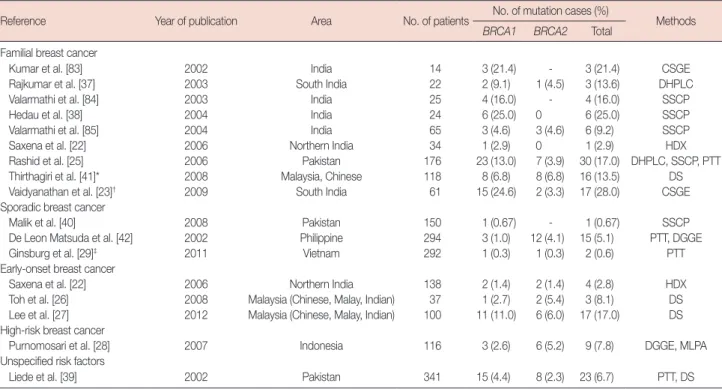
The populations of India, Pakistan, Malaysia, and Indonesia consist of multiethnic groups. Since it is difficult to estimate the prevalence of BRCA1/2 mutations according to ethnic group within these countries, the mutation rates were instead evaluated according to region. The mutational frequencies in India, Pakistan, Malaysia, Indonesia, the Philippines, and Vietnam are shown in Table 4.
In India, there are several reports of small numbers of fa- milial breast cancer patients with BRCA1/2 mutations. The frequency of BRCA1/2 genetic mutations was reported to range from 2.9% to 28.0% among Indian familial breast can-
Table 2. Frequencies of BRCA1 and BRCA2 mutations in Chinese breast cancer patientsReference Year of publication Area No. of patients No. of mutation cases (%)
Methods BRCA1 BRCA2 Total
Familial breast cancer
Li et al. [70] 1999 Southern Taiwan 18* 2 (-) 3 (-) 5 (-) SSCP
Sng et al. [71] 2000 Singapore 16 1 (6.2) - 1 (6.2) SSCP
Zhi et al. [72] 2002 Tianjin, China 25 1 (4.0) 1 (4.0) 2 (8.0) SSCP
Li et al. [73] 2008 Southern, Northern China 241 17 (7.1) 14 (5.8) 31 (12.9) DHPLC
Chen et al. [74] 2009 Northern China 68 4 (5.9) - 4 (5.9) DHPLC
Zang et al. [75] 2012 Northern China 409 16 (3.9) 27 (6.6) 43 (10.5) DS
Early-onset breast cancer
Sng et al. [71] 2000 Singapore, Chinese 76 6 (7.8) - 6 (7.8) SSCP
Song et al. [76] 2006 Shanghai, China 70 6 (8.6) 2 (2.9) 8 (11.4) DS
Li et al. [73] 2008 Southern Northern China 253 12 (4.7) 10 (4.0) 22 (8.7) DHPLC
Chen et al. [74] 2009 Northern China 71 2 (2.8) - 2 (2.8) DS
Sporadic breast cancer
Suter et al. [33]† 2004 Shanghai, China 594 5 (0.8) 6 (1.0) 11 (1.8) SSCP
Li et al. [73] 2008 Southern, Northern China 426 2 (0.18) - 2 (0.18) DHPLC
High-risk breast cancer
Ang et al. [77]‡ 2007 Singapore, Chinese (76%) 94 6 (6.7) 8 (8.9) 14 (14.8) PTT, MLPA
Kwong et al. [20]§ 2012 Hong Kong, China 451 29 (6.4) 40 (8.9) 69 (15.3) DS, MLPA, HRMII
SSCP=single-strand conformation polymorphism; DHPLC=denaturing high-performance liquid chromatography; DS=direct sequencing; PTT=protein truncation test; MLPA=multiple ligation-dependent probe amplification; HRM=high-resolution melting analysis.
*Number of families; †This study included 256 patients who were diagnosed with breast cancer who were under 45 years of age; ‡Breast cancer patients with family history of breast or ovarian cancer, or patients with early-onset breast cancer; §Patients (1) had at least one first- or second-degree relative with breast and/or ovari- an cancer; (2) were less than 50 years of age at diagnosis; (3) had bilateral breast cancer; (4) had triple-negative breast cancer; (5) had at least one relative with can- cers other than breast and ovarian cancer such as stomach or prostate that are known to be related to BRCA mutation; (6) ovarian cancer patients with a family history of breast cancer; IIA total of 451 patients were analyzed by full gene sequencing and HRM assay, while 200 patients were analyzed by HRM screening assay targeting recurrent mutation only. The frequency of mutation was presented from the data analyzed by full gene sequencing.
cer patients. Furthermore, 2.8% of early-onset breast cancer patients in the Indian population were found to have BRCA1/2 mutations. Notably, the occurrence rates of BRCA2 mutations were lower than those of BRCA1 in almost all Indian studies [22,23,37,38].
The frequency of BRCA1/2 gene was investigated in three breast cancer studies of Pakistani patients [25,39,40]. Rashid
et al. [25] reported that 17.0% of familial breast cancer pa- tients have BRCA1/2 gene mutations, whereas Liede et al. [39]
found the prevalence of BRCA1/2 mutations to be 6.7% in breast cancer patients in Pakistan. Moreover, 0.67% of Paki- stani sporadic breast cancer patients had BRCA1 mutations.
The occurrence of these genetic mutations varied across eth- nicities within the Pakistani population [24].
Table 3. Frequencies of BRCA1 and BRCA2 mutations in Japanese breast cancer patients
Reference Year of publication No. of patients No. of mutation cases (%)
Methods
BRCA1 BRCA2 Total
Familial breast cancer
Inoue et al. [78] 1995 20 2 (10.0) - 2 (10.0) SSCP
Inoue et al. [79]* 1997 20 0 3 (15.0) 3 (15.0) SSCP
Fukutomi et al. [34] 1997 23 2 (8.6) 3 (13.0) 5 (21.7) SSCP
Ikeda et al. [35] 2001 113 15 (13.3) 21 (18.6) 36 (31.8) SSCP
Kawahara et al. [36] 2004 50 4 (8.0) 5 (10.0) 10 (20.0) SC assay
Sugano et al. [21] 2008 135 17 (12.6) 19 (14.1) 36 (26.7) DS
Sporadic breast cancer
Emi et al. [80] 1998 1,000 8 (0.8) - 8 (0.8) SSCP
High-risk breast cancer
Katagiri et al. [81]† 1996 1031 4 (3.8) - 4 (3.8) SSCP
Kijima et al. [82]‡ 1998 56 2 (3.5) - 2 (3.5) SSCP
SSCP=single-strand conformation polymorphism; SC assay=stop codon assay; DS=direct sequencing.
*This study included breast cancer patients without BRCA1 gene mutations; †Patients with early-onset breast cancer (<35 of age), or familial breast cancer, or bilat- eral breast cancer were included; ‡This study was performed in patients without any family history of breast cancer.
Table 4. Frequencies of BRCA1 and BRCA2 mutations in other Asian patients
Reference Year of publication Area No. of patients No. of mutation cases (%)
Methods BRCA1 BRCA2 Total
Familial breast cancer
Kumar et al. [83] 2002 India 14 3 (21.4) - 3 (21.4) CSGE
Rajkumar et al. [37] 2003 South India 22 2 (9.1) 1 (4.5) 3 (13.6) DHPLC
Valarmathi et al. [84] 2003 India 25 4 (16.0) - 4 (16.0) SSCP
Hedau et al. [38] 2004 India 24 6 (25.0) 0 6 (25.0) SSCP
Valarmathi et al. [85] 2004 India 65 3 (4.6) 3 (4.6) 6 (9.2) SSCP
Saxena et al. [22] 2006 Northern India 34 1 (2.9) 0 1 (2.9) HDX
Rashid et al. [25] 2006 Pakistan 176 23 (13.0) 7 (3.9) 30 (17.0) DHPLC, SSCP, PTT
Thirthagiri et al. [41]* 2008 Malaysia, Chinese 118 8 (6.8) 8 (6.8) 16 (13.5) DS
Vaidyanathan et al. [23]† 2009 South India 61 15 (24.6) 2 (3.3) 17 (28.0) CSGE
Sporadic breast cancer
Malik et al. [40] 2008 Pakistan 150 1 (0.67) - 1 (0.67) SSCP
De Leon Matsuda et al. [42] 2002 Philippine 294 3 (1.0) 12 (4.1) 15 (5.1) PTT, DGGE
Ginsburg et al. [29]‡ 2011 Vietnam 292 1 (0.3) 1 (0.3) 2 (0.6) PTT
Early-onset breast cancer
Saxena et al. [22] 2006 Northern India 138 2 (1.4) 2 (1.4) 4 (2.8) HDX
Toh et al. [26] 2008 Malaysia (Chinese, Malay, Indian) 37 1 (2.7) 2 (5.4) 3 (8.1) DS
Lee et al. [27] 2012 Malaysia (Chinese, Malay, Indian) 100 11 (11.0) 6 (6.0) 17 (17.0) DS High-risk breast cancer
Purnomosari et al. [28] 2007 Indonesia 116 3 (2.6) 6 (5.2) 9 (7.8) DGGE, MLPA
Unspecified risk factors
Liede et al. [39] 2002 Pakistan 341 15 (4.4) 8 (2.3) 23 (6.7) PTT, DS
CSGE=conformation-sensitive gel electrophoresis; DHPLC=denaturing high-performance liquid chromatography; SSCP=single-strand conformation polymor- phism; HDX=heteroduplex analysis; PTT=protein truncation test; DGGE=denaturing gradient gel electrophoresis; DS=direct sequencing; MLPA=multiple ligation- dependent probe amplification.
*Patients with familial breast cancer (n=78), or early-onset breast cancer patients (n=40); †This study was performed in patients with familial breast or ovarian can- cer; ‡PTT was performed for 17 founder mutations which had been reported in other Asian populations.
In Malaysia, 13.5% of familial breast cancer patients had mutations in the BRCA1/2 genes [41]. In addition, two Malay- sian studies reported that 8.1% to 17.0% of patients with early- onset breast cancers had BRCA1/2 mutations. Early-onset cancer was defined as the occurrence breast cancer at the age of ≤35 years in one study [27] and at the age of ≤40 years in another [26].
A study by Purnomosari et al. [28] in Indonesia found that 7.8% of patients at high risk for hereditary breast cancer, such as patients having early-onset breast cancer, familial breast cancers, or bilateral breast cancers, had BRCA1/2 genetic al- terations.
The frequencies of BRCA1/2 mutations in sporadic breast cancer patients from the Philippines and Vietnam were re- ported to be 5.1% and 0.6%, respectively [29,42].
LARGE GENOMIC REARRANGEMENT IN BRCA1/2 IN ASIAN BREAST CANCER PATIENTS
Disease-causing mutations in BRCA1/2 genes mainly consist of single base changes, deletions or insertions of a small num- bers of bases, or point mutations that result in protein trunca- tion. These mutations lead to significant dysfunction of the BRCA proteins. In addition to alterations in genetic sequence, large rearrangements of DNA segments in the BRCA1/2 genes also contribute to pathogenic mutations. LGRs in BRCA1/2 genes have been studied in various population groups, mainly involving patients in Europe or the United States [43]. None- theless, there have been some studies on the contribution of LGR in Asian high-risk breast cancer patients.
In a study of the Singaporean population, 3% (3/100) of high-risk breast or ovarian patients who tested negative for
BRCA1/2 deleterious mutations were found to have LGRs inthe BRCA genes [44]. On the other hand, a Korean study found that only 0.8% (1/122) of BRCA deleterious mutations- negative high-risk breast cancer patients had LGR in the
BRCA genes in the Korean population [45]. Two Malaysianstudies found LGRs in the BRCA genes in 2% (2/100) and 0.9% (3/324) of high-risk breast cancer patients, respectively [46,47]. Furthermore, LGRs account for 6.3% of the total mu- tations in BRCA1/2 genes in a Malaysian cohort [47]. A recent report from southern China found that 0.7% (4/555) of high- risk breast or ovarian cancer patients had LGRs in their BRCA genes, representing 5.8% of overall BRCA1/2 mutations in their cohort [48]. These studies suggest that LGRs in the
BRCA genes of Asian high-risk patients amount to less than7% of all BRCA mutations.
EPIDEMIOLOGIC CHARACTERISTICS OF BCRA MUTATIONS IN ASIAN PATIENTS
The prevalence of BRCA1/2 mutation in Asian patients with familial breast cancer and early-onset breast cancer has been reported to be 8.0% to 31.8%, and 2.8% to 21.4%, respectively (Tables 1-4). The likelihood of mutations in familial breast cancer among Asians was comparable to that of African American or Hispanic Americans although it is lower than that of Ashkenazi-Jews, or Caucasian in North America. The frequency of BRCA1/2 mutations in Asian patients with early- onset breast cancer is similar in range to that in Caucasians or African Americans (Table 5). Direct comparison of BRCA mutation frequency in Asian patients to that of other races cannot be performed due to the differences in the inclusion criteria and variable genotyping methods. Unlike most United States and European studies, only a small number of studies in Asia have been based on complete sequencing of BRCA1/2 genes. The prevalence of BRCA1/2 mutations in Asians is like- ly to have been underestimated because some genotyping methods adopted in Asian countries are less sensitive than complete DNA sequencing in the detection of BRCA gene mutations [49]. Nonetheless, a United States study concluded that the prevalence of BRCA mutations was similar across di- verse ethnicities after complete sequencing of BRCA genes among female patients of various ethnicities who were tested at Myriad Genetic Laboratories, Inc. (Myriad; Salt Lake City, USA) [15]. The study analyzed 1,183 Asian females, which ac- counted for 2.6% of the study population. Among the Asian patients, 12.7% had BRCA1/2 mutation. The mutation fre- quencies of BRCA1/2 genes in Western European, Latin American, African, and Middle Eastern females were 12.1%, 14.8%, 15.6%, and 9.4%, respectively. Haffty et al. [50] com- pared the prevalence of BRCA1/2 mutations in Caucasian, Af- rican-American and Korean patients with early-onset breast cancer and found similar BRCA1/2 mutation frequencies of 17% in Caucasian, 14% in African-American, and 14% in Ko- reans. These studies indicate that mutations of BRCA genes in Asian breast cancer patients are occur at similar rates com- pared to other racial groups. Except for Pakistani and Indian patients, BRCA2 mutations in the Asian population were de- tected equally, or more frequently than BRCA1 mutations when compared to other ethnicities. It is a distinct feature of
BRCA mutations in Asians because other ethnicities havemore BRCA1 mutations than BRCA2 mutations [51].
Notably, the contribution of LGRs to overall BRCA muta-
tions in the Asian population is lower than that reported for
other ethnicities. According to an analysis of the Myriad data-
base, which includes 48,456 breast cancer patients of various
ethnicities, LGRs in BRCA genes were detected in 1.3% of Asian high-risk patients, comprising 5.3% of all BRCA muta- tions in their Asian cohorts. The proportion of LGRs in the overall BRCA mutations in the Asian population is lower than in European (9.6%) and Latin American (21.4%) populations [52].
BRCA MUTATION PREDICTION MODELS FOR ASIAN BREAST CANCER PATIENTS
To optimize genetic counseling and provide patient guide- lines for BRCA1/2 genotyping, a high-risk group needs to be identified. Several computational models, such as BRCAPRO [53], Couch [54], Myriad II [55], BOADICEA [56], and Man- chester [57], have been formulated to determine the probability of a person inheriting mutations in the BRCA genes based on the individual’s personal and family history of breast and ovari- an cancer. Because these predictive models were constructed using mutation data from Caucasian populations, there have been questions about the accuracy of predicting mutations in other ethnicities variation in the accuracy of such predictive models have also been found between African American and Hispanic populations in the United States [58,59].
Several studies have found a tendency of BRCA1/2 mutation prediction models to underestimate the risk of BRCA1/2 mu- tations in Asian populations [32,41,60-62]. In a study of Asian Americans, the BRCAPRO and Myriad II models underesti- mated the proportion of Asian BRCA1/2 mutation carriers by two-fold. Moreover, the underestimation by BCRAPRO was
more substantial for BRCA2 than BRCA1 [60]. Both BRCAP- RO and Myriad II also underestimated the risk of BRCA1/2 mutations in the Korean population [62]. Additionally, a study from Hong Kong found that BRCAPRO overestimated the number of BRCA1/2 mutation carriers in females with a carri- er probability of ≥20%, but underestimated it in women with a carrier probability of <20%. Both Myriad II and BOADI- CEA underestimated the proportion of BRCA1/2 mutation carriers in Chinese women. Based on these studies, the exist- ing BRCA mutation prediction models are considered inap- propriate as guidelines for testing for BRCA gene mutations in Asian individuals because these models underestimate the likelihood of BRCA1/2 mutations in Asian populations.
FUTURE DIRECTIONS
Genetic testing for BRCA1/2 mutations has become an inte- gral part of patients care. Substantial research has been con- ducted on BRCA1/2 genetic mutations in Asian countries to gain information on the diversity of these genetic mutations across different ethnicities. Until recently, BRCA1/2 mutation- al analyses in Asian regions have been conducted in single in- stitutions with different patient selection criteria and genotyp- ing methods. Therefore, mutation frequencies have been in- consistent among studies even when they were performed in the same country. This has led to difficulties in genetic coun- seling in Asian breast cancer patients. The Hong Kong Hered- itary and High Risk Breast Cancer Program (HRBCP), and the KOHBRA are national studies designed to provide accu-
Table 5. Frequencies of BRCA1 and BRCA2 mutations among familial or early-onset breast cancers according to race and ethnicityPopulation No. of patients Prevalence (%)
Methods Reference
BRCA1 BRCA2 Total (%) Familial breast cancer
USA
Whites 78 30.8 15.4 46.2 DS Nanda et al. [86]
Ashkenazi Jews 29 41.4 27.6 69.0 DS
African-Americans 46 16.3 11.6 27.9 DS
Hispanic-Americans 110 22.7 8.2 30.9 DS Weitzel et al. [87]
95 16.8 7.4 24.2 DS Vogel et al. [59]
Asian-Americans 200 11.5 13.0 24.5 DS Kurian et al. [60]
Early-onset breast cancer
Whites, UK 617 2.6 2.3 4.9 SSCP Peto et al. [88]
Ashkenazi Jews, USA 91 25.3 7.7 33.0 Founder mutation Robson et al. [9]
Whites, USA 203 5.9 3.4 9.3 SSCP Malone et al. [89]
166 12.7 4.2 16.9 DS Haffty et al. [50]
African-American 66 4.5 9.1 13.6 DS Haffty et al. [50]
Germany 91 3.3 2.2 5.5 PTT, SSCP Hamann et al. [90]
Swedish 234 6.8 2.1 8.9 PTT, SSCP, DHPLC Loman et al. [91]
DS=direct sequencing; SSCP=single strand conformation polymorphism; PTT=protein truncation test; DHPLC=denaturing high performance liquid chromatog- raphy.
rate data on BRCA1/2 gene mutations for Asian populations.
In addition to these efforts, Korea, Japan, China, Hong Kong, Indonesia, Malaysia, and Singapore have launched the Asian
BRCA Consortium (ABRCA) to study hereditary breast andovarian cancer. A more comprehensive understanding of
BRCA1/2 mutations in the Asian population will be estab-lished through these international collaborations.
CONCLUSIONS
The prevalence of BRCA mutations in Asian breast cancer patients is similar in range to that of other ethnic populations.
BRCA2 mutations were detected equally, or more frequently
than BRCA1 mutations in Asian populations with the excep- tion of Pakistan or Indian breast cancer patients. The contri- bution of LGRs to overall BRCA mutations in the Asian popu- lation is lower than that reported for other ethnicities. Existing statistical models for predicting BRCA1/2 mutations may not be applicable to Asian population as they tend to underesti- mate the risk of these genetic mutations, particularly for pre- dicting BRCA2 gene mutations.
CONFLICT OF INTEREST
The authors declare that they have no competing interests.
REFERENCES
1. Shin HR, Carlos MC, Varghese C. Cancer control in the Asia Pacific re- gion: current status and concerns. Jpn J Clin Oncol 2012;42:867-81.
2. Jung YS, Na KY, Kim KS, Ahn SH, Lee SJ, Park HK, et al. Nation-wide Korean breast cancer data from 2008 using the breast cancer registra- tion program. J Breast Cancer 2011;14:229-36.
3. Yang L, Parkin DM, Ferlay J, Li L, Chen Y. Estimates of cancer incidence in China for 2000 and projections for 2005. Cancer Epidemiol Bio- markers Prev 2005;14:243-50.
4. Bradbury AR, Olopade OI. Genetic susceptibility to breast cancer. Rev Endocr Metab Disord 2007;8:255-67.
5. Ripperger T, Gadzicki D, Meindl A, Schlegelberger B. Breast cancer sus- ceptibility: current knowledge and implications for genetic counselling.
Eur J Hum Genet 2009;17:722-31.
6. Chen S, Parmigiani G. Meta-analysis of BRCA1 and BRCA2 pene- trance. J Clin Oncol 2007;25:1329-33.
7. Daly MB, Axilbund JE, Buys S, Crawford B, Farrell CD, Friedman S, et al. Genetic/familial high-risk assessment: breast and ovarian. J Natl Compr Canc Netw 2010;8:562-94.
8. Gonzalez-Angulo AM, Timms KM, Liu S, Chen H, Litton JK, Potter J, et al. Incidence and outcome of BRCA mutations in unselected patients with triple receptor-negative breast cancer. Clin Cancer Res 2011;17:
1082-9.
9. Robson M, Gilewski T, Haas B, Levin D, Borgen P, Rajan P, et al. BRCA-
associated breast cancer in young women. J Clin Oncol 1998;16:1642-9.
10. Young SR, Pilarski RT, Donenberg T, Shapiro C, Hammond LS, Miller J, et al. The prevalence of BRCA1 mutations among young women with triple-negative breast cancer. BMC Cancer 2009;9:86.
11. Ferla R, Calò V, Cascio S, Rinaldi G, Badalamenti G, Carreca I, et al.
Founder mutations in BRCA1 and BRCA2 genes. Ann Oncol 2007;18 Suppl 6:vi93-8.
12. Liede A, Narod SA. Hereditary breast and ovarian cancer in Asia: genet- ic epidemiology of BRCA1 and BRCA2. Hum Mutat 2002;20:413-24.
13. Fackenthal JD, Olopade OI. Breast cancer risk associated with BRCA1 and BRCA2 in diverse populations. Nat Rev Cancer 2007;7:937-48.
14. Janavičius R. Founder BRCA1/2 mutations in the Europe: implications for hereditary breast-ovarian cancer prevention and control. EPMA J 2010;1:397-412.
15. Hall MJ, Reid JE, Burbidge LA, Pruss D, Deffenbaugh AM, Frye C, et al.
BRCA1 and BRCA2 mutations in women of different ethnicities un- dergoing testing for hereditary breast-ovarian cancer. Cancer 2009;115:
2222-33.
16. Kim H, Cho DY, Choi DH, Choi SY, Shin I, Park W, et al. Characteris- tics and spectrum of BRCA1 and BRCA2 mutations in 3,922 Korean patients with breast and ovarian cancer. Breast Cancer Res Treat 2012;
134:1315-26.
17. Han SA, Kim SW, Kang E, Park SK, Ahn SH, Lee MH, et al. The preva- lence of BRCA mutations among familial breast cancer patients in Ko- rea: results of the Korean Hereditary Breast Cancer study. Fam Cancer 2013;12:75-81.
18. Son BH, Ahn SH, Kim SW, Kang E, Park SK, Lee MH, et al. Prevalence of BRCA1 and BRCA2 mutations in non-familial breast cancer patients with high risks in Korea: the Korean Hereditary Breast Cancer (KOH- BRA) Study. Breast Cancer Res Treat 2012;133:1143-52.
19. Cao W, Wang X, Li JC. Hereditary breast cancer in the Han Chinese population. J Epidemiol 2013;23:75-84.
20. Kwong A, Ng EK, Wong CL, Law FB, Au T, Wong HN, et al. Identifica- tion of BRCA1/2 founder mutations in Southern Chinese breast cancer patients using gene sequencing and high resolution DNA melting anal- ysis. PLoS One 2012;7:e43994.
21. Sugano K, Nakamura S, Ando J, Takayama S, Kamata H, Sekiguchi I, et al. Cross-sectional analysis of germline BRCA1 and BRCA2 mutations in Japanese patients suspected to have hereditary breast/ovarian cancer.
Cancer Sci 2008;99:1967-76.
22. Saxena S, Chakraborty A, Kaushal M, Kotwal S, Bhatanager D, Mohil RS, et al. Contribution of germline BRCA1 and BRCA2 sequence alter- ations to breast cancer in Northern India. BMC Med Genet 2006;7:75.
23. Vaidyanathan K, Lakhotia S, Ravishankar HM, Tabassum U, Mukher- jee G, Somasundaram K. BRCA1 and BRCA2 germline mutation anal- ysis among Indian women from south India: identification of four nov- el mutations and high-frequency occurrence of 185delAG mutation. J Biosci 2009;34:415-22.
24. Farooq A, Naveed AK, Azeem Z, Ahmad T. Breast and ovarian cancer risk due to prevalence of BRCA1 and BRCA2 variants in Pakistani population: a Pakistani database report. J Oncol 2011;2011:632870.
25. Rashid MU, Zaidi A, Torres D, Sultan F, Benner A, Naqvi B, et al. Preva- lence of BRCA1 and BRCA2 mutations in Pakistani breast and ovarian cancer patients. Int J Cancer 2006;119:2832-9.
26. Toh GT, Kang P, Lee SS, Lee DS, Lee SY, Selamat S, et al. BRCA1 and
BRCA2 germline mutations in Malaysian women with early-onset breast cancer without a family history. PLoS One 2008;3:e2024.
27. Lee DS, Yoon SY, Looi LM, Kang P, Kang IN, Sivanandan K, et al. Com- parable frequency of BRCA1, BRCA2 and TP53 germline mutations in a multi-ethnic Asian cohort suggests TP53 screening should be offered together with BRCA1/2 screening to early-onset breast cancer patients.
Breast Cancer Res 2012;14:R66.
28. Purnomosari D, Pals G, Wahyono A, Aryandono T, Manuaba TW, Haryono SJ, et al. BRCA1 and BRCA2 germline mutation analysis in the Indonesian population. Breast Cancer Res Treat 2007;106:297-304.
29. Ginsburg OM, Dinh NV, To TV, Quang LH, Linh ND, Duong BT, et al.
Family history, BRCA mutations and breast cancer in Vietnamese women. Clin Genet 2011;80:89-92.
30. Kurian AW, Fish K, Shema SJ, Clarke CA. Lifetime risks of specific breast cancer subtypes among women in four racial/ethnic groups.
Breast Cancer Res 2010;12:R99.
31. Kim EK, Kim KS, Park SK, Ahn SH, Lee MH, Kim SW, et al. The Kore- an Hereditary Breast Cancer (KOHBRA) Study: protocol review. J Breast Cancer 2007;10:241-7.
32. Kwong A, Wong CH, Suen DT, Co M, Kurian AW, West DW, et al. Ac- curacy of BRCA1/2 mutation prediction models for different ethnici- ties and genders: experience in a southern Chinese cohort. World J Surg 2012;36:702-13.
33. Suter NM, Ray RM, Hu YW, Lin MG, Porter P, Gao DL, et al. BRCA1 and BRCA2 mutations in women from Shanghai China. Cancer Epide- miol Biomarkers Prev 2004;13:181-9.
34. Fukutomi T, Ushijima T, Inoue R, Akashi-Tanaka S, Nanasawa T, Tsuda H. BRCA1 and BRCA2 germline mutations in Japanese with hereditary breast cancer families. Breast Cancer 1997;4:256-258.
35. Ikeda N, Miyoshi Y, Yoneda K, Shiba E, Sekihara Y, Kinoshita M, et al.
Frequency of BRCA1 and BRCA2 germline mutations in Japanese breast cancer families. Int J Cancer 2001;91:83-8.
36. Kawahara M, Sakayori M, Shiraishi K, Nomizu T, Takeda M, Abe R, et al. Identification and evaluation of 55 genetic variations in the BRCA1 and the BRCA2 genes of patients from 50 Japanese breast cancer fami- lies. J Hum Genet 2004;49:391-5.
37. Rajkumar T, Soumittra N, Nancy NK, Swaminathan R, Sridevi V, Shan- ta V. BRCA1, BRCA2 and CHEK2 (1100 del C) germline mutations in hereditary breast and ovarian cancer families in South India. Asian Pac J Cancer Prev 2003;4:203-8.
38. Hedau S, Jain N, Husain SA, Mandal AK, Ray G, Shahid M, et al. Novel germline mutations in breast cancer susceptibility genes BRCA1, BRCA2 and p53 gene in breast cancer patients from India. Breast Can- cer Res Treat 2004;88:177-86.
39. Liede A, Malik IA, Aziz Z, Rios Pd Pde L, Kwan E, Narod SA. Contribu- tion of BRCA1 and BRCA2 mutations to breast and ovarian cancer in Pakistan. Am J Hum Genet 2002;71:595-606.
40. Malik FA, Ashraf S, Kayani MA, Jiang WG, Mir A, Ansar M, et al. Con- tribution of BRCA1 germline mutation in patients with sporadic breast cancer. Int Semin Surg Oncol 2008;5:21.
41. Thirthagiri E, Lee SY, Kang P, Lee DS, Toh GT, Selamat S, et al. Evalua- tion of BRCA1 and BRCA2 mutations and risk-prediction models in a typical Asian country (Malaysia) with a relatively low incidence of breast cancer. Breast Cancer Res 2008;10:R59.
42. De Leon Matsuda ML, Liede A, Kwan E, Mapua CA, Cutiongco EM,
Tan A, et al. BRCA1 and BRCA2 mutations among breast cancer pa- tients from the Philippines. Int J Cancer 2002;98:596-603.
43. Ewald IP, Ribeiro PL, Palmero EI, Cossio SL, Giugliani R, Ashton-Prolla P. Genomic rearrangements in BRCA1 and BRCA2: a literature review.
Genet Mol Biol 2009;32:437-46.
44. Lim YK, Lau PT, Ali AB, Lee SC, Wong JE, Putti TC, et al. Identification of novel BRCA large genomic rearrangements in Singapore Asian breast and ovarian patients with cancer. Clin Genet 2007;71:331-42.
45. Seong MW, Cho S, Noh DY, Han W, Kim SW, Park CM, et al. Compre- hensive mutational analysis of BRCA1/BRCA2 for Korean breast cancer patients: evidence of a founder mutation. Clin Genet 2009;76:152-60.
46. Sharifah NA, Nurismah MI, Lee HC, Aisyah AN, Clarence-Ko CH, Naqiyah I, et al. Identification of novel large genomic rearrangements at the BRCA1 locus in Malaysian women with breast cancer. Cancer Epi- demiol 2010;34:442-7.
47. Kang P, Mariapun S, Phuah SY, Lim LS, Liu J, Yoon SY, et al. Large BRCA1 and BRCA2 genomic rearrangements in Malaysian high risk breast-ovarian cancer families. Breast Cancer Res Treat 2010;124:579-84.
48. Kwong A, Ng EK, Law FB, Wong HN, Wa A, Wong CL, et al. Novel BRCA1 and BRCA2 genomic rearrangements in Southern Chinese breast/ovarian cancer patients. Breast Cancer Res Treat 2012;136:931-3.
49. Gerhardus A, Schleberger H, Schlegelberger B, Gadzicki D. Diagnostic accuracy of methods for the detection of BRCA1 and BRCA2 muta- tions: a systematic review. Eur J Hum Genet 2007;15:619-27.
50. Haffty BG, Choi DH, Goyal S, Silber A, Ranieri K, Matloff E, et al.
Breast cancer in young women (YBC): prevalence of BRCA1/2 muta- tions and risk of secondary malignancies across diverse racial groups.
Ann Oncol 2009;20:1653-9.
51. Anglian Breast Cancer Study Group. Prevalence and penetrance of BRCA1 and BRCA2 mutations in a population-based series of breast cancer cases. Br J Cancer 2000;83:1301-8.
52. Judkins T, Rosenthal E, Arnell C, Burbidge LA, Geary W, Barrus T, et al.
Clinical significance of large rearrangements in BRCA1 and BRCA2.
Cancer 2012;118:5210-6.
53. Berry DA, Parmigiani G, Sanchez J, Schildkraut J, Winer E. Probability of carrying a mutation of breast-ovarian cancer gene BRCA1 based on family history. J Natl Cancer Inst 1997;89:227-38.
54. Couch FJ, DeShano ML, Blackwood MA, Calzone K, Stopfer J, Campeau L, et al. BRCA1 mutations in women attending clinics that evaluate the risk of breast cancer. N Engl J Med 1997;336:1409-15.
55. Frank TS, Deffenbaugh AM, Reid JE, Hulick M, Ward BE, Lingenfelter B, et al. Clinical characteristics of individuals with germline mutations in BRCA1 and BRCA2: analysis of 10,000 individuals. J Clin Oncol 2002;20:1480-90.
56. Antoniou AC, Pharoah PP, Smith P, Easton DF. The BOADICEA mod- el of genetic susceptibility to breast and ovarian cancer. Br J Cancer 2004;91:1580-90.
57. Evans DG, Eccles DM, Rahman N, Young K, Bulman M, Amir E, et al.
A new scoring system for the chances of identifying a BRCA1/2 muta- tion outperforms existing models including BRCAPRO. J Med Genet 2004;41:474-80.
58. Kurian AW, Gong GD, John EM, Miron A, Felberg A, Phipps AI, et al.
Performance of prediction models for BRCA mutation carriage in three racial/ethnic groups: findings from the Northern California Breast Cancer Family Registry. Cancer Epidemiol Biomarkers Prev 2009;18:
1084-91.
59. Vogel KJ, Atchley DP, Erlichman J, Broglio KR, Ready KJ, Valero V, et al.
BRCA1 and BRCA2 genetic testing in Hispanic patients: mutation prevalence and evaluation of the BRCAPRO risk assessment model. J Clin Oncol 2007;25:4635-41.
60. Kurian AW, Gong GD, Chun NM, Mills MA, Staton AD, Kingham KE, et al. Performance of BRCA1/2 mutation prediction models in Asian Americans. J Clin Oncol 2008;26:4752-8.
61. Rao NY, Hu Z, Yu JM, Li WF, Zhang B, Su FX, et al. Evaluating the per- formance of models for predicting the BRCA germline mutations in Han Chinese familial breast cancer patients. Breast Cancer Res Treat 2009;116:563-70.
62. Kang E, Park SK, Yang JJ, Park B, Lee MH, Lee JW, et al. Accuracy of BRCA1/2 mutation prediction models in Korean breast cancer pa- tients. Breast Cancer Res Treat 2012;134:1189-97.
63. Kang HC, Kim IJ, Park JH, Kwon HJ, Won YJ, Heo SC, et al. Germline mutations of BRCA1 and BRCA2 in Korean breast and/or ovarian can- cer families. Hum Mutat 2002;20:235.
64. Ahn SH, Son BH, Yoon KS, Noh DY, Han W, Kim SW, et al. BRCA1 and BRCA2 germline mutations in Korean breast cancer patients at high risk of carrying mutations. Cancer Lett 2007;245:90-5.
65. Choi DH, Lee MH, Bale AE, Carter D, Haffty BG. Incidence of BRCA1 and BRCA2 mutations in young Korean breast cancer patients. J Clin Oncol 2004;22:1638-45.
66. Seo JH, Cho DY, Ahn SH, Yoon KS, Kang CS, Cho HM, et al. BRCA1 and BRCA2 germline mutations in Korean patients with sporadic breast cancer. Hum Mutat 2004;24:350.
67. Han SH, Lee KR, Lee DG, Kim BY, Lee KE, Chung WS. Mutation anal- ysis of BRCA1 and BRCA2 from 793 Korean patients with sporadic breast cancer. Clin Genet 2006;70:496-501.
68. Oh JH, Noh DY, Choe KJ, Kang SB, Kim LS, Ro MS, et al. Germline mutation of BRCA1 gene in Korean breast and ovarian cancer patients.
J Korean Cancer Assoc 1995;27:1061-9.
69. Seong MW, Cho SI, Noh DY, Han W, Kim SW, Park CM, et al. Low contribution of BRCA1/2 genomic rearrangement to high-risk breast cancer in the Korean population. Fam Cancer 2009;8:505-8.
70. Li SS, Tseng HM, Yang TP, Liu CH, Teng SJ, Huang HW, et al. Molecular characterization of germline mutations in the BRCA1 and BRCA2 genes from breast cancer families in Taiwan. Hum Genet 1999;104:201-4.
71. Sng JH, Chang J, Feroze F, Rahman N, Tan W, Lim S, et al. The preva- lence of BRCA1 mutations in Chinese patients with early onset breast cancer and affected relatives. Br J Cancer 2000;82:538-42.
72. Zhi X, Szabo C, Chopin S, Suter N, Wang QS, Ostrander EA, et al.
BRCA1 and BRCA2 sequence variants in Chinese breast cancer fami- lies. Hum Mutat 2002;20:474.
73. Li WF, Hu Z, Rao NY, Song CG, Zhang B, Cao MZ, et al. The preva- lence of BRCA1 and BRCA2 germline mutations in high-risk breast cancer patients of Chinese Han nationality: two recurrent mutations were identified. Breast Cancer Res Treat 2008;110:99-109.
74. Chen W, Pan K, Ouyang T, Li J, Wang T, Fan Z, et al. BRCA1 germline mutations and tumor characteristics in Chinese women with familial or early-onset breast cancer. Breast Cancer Res Treat 2009;117:55-60.
75. Zhang J, Pei R, Pang Z, Ouyang T, Li J, Wang T, et al. Prevalence and characterization of BRCA1 and BRCA2 germline mutations in Chinese
women with familial breast cancer. Breast Cancer Res Treat 2012;132:
421-8.
76. Song CG, Hu Z, Wu J, Luo JM, Shen ZZ, Huang W, et al. The prevalence of BRCA1 and BRCA2 mutations in eastern Chinese women with breast cancer. J Cancer Res Clin Oncol 2006;132:617-26.
77. Ang P, Lim IH, Lee TC, Luo JT, Ong DC, Tan PH, et al. BRCA1 and BRCA2 mutations in an Asian clinic-based population detected using a comprehensive strategy. Cancer Epidemiol Biomarkers Prev 2007;16:
2276-84.
78. Inoue R, Fukutomi T, Ushijima T, Matsumoto Y, Sugimura T, Nagao M.
Germline mutation of BRCA1 in Japanese breast cancer families. Can- cer Res 1995;55:3521-4.
79. Inoue R, Ushijima T, Fukutomi T, Fukami A, Sugimura H, Inoue S, et al.
BRCA2 germline mutations in Japanese breast cancer families. Int J Cancer 1997;74:199-204.
80. Emi M, Matsushima M, Katagiri T, Yoshimoto M, Kasumi F, Yokota T, et al. Multiplex mutation screening of the BRCA1 gene in 1000 Japa- nese breast cancers. Jpn J Cancer Res 1998;89:12-6.
81. Katagiri T, Emi M, Ito I, Kobayashi K, Yoshimoto M, Iwase T, et al. Mu- tations in the BRCA1 gene in Japanese breast cancer patients. Hum Mutat 1996;7:334-9.
82. Kijima G, Murakami Y, Ohuchi N, Satomi S, Sekiya T. Nonsense muta- tion at codon 63 of the BRCA1 gene in Japanese breast cancer patients.
Jpn J Cancer Res 1998;89:837-41.
83. Kumar BV, Lakhotia S, Ankathil R, Madhavan J, Jayaprakash PG, Nair MK, et al. Germline BRCA1 mutation analysis in Indian breast/ovarian cancer families. Cancer Biol Ther 2002;1:18-21.
84. Valarmathi MT, A A, Deo SS, Shukla NK, Das SN. BRCA1 germline mutations in Indian familial breast cancer. Hum Mutat 2003;21:98-9.
85. Valarmathi MT, Sawhney M, Deo SS, Shukla NK, Das SN. Novel germ- line mutations in the BRCA1 and BRCA2 genes in Indian breast and breast-ovarian cancer families. Hum Mutat 2004;23:205.
86. Nanda R, Schumm LP, Cummings S, Fackenthal JD, Sveen L, Ademuy- iwa F, et al. Genetic testing in an ethnically diverse cohort of high-risk women: a comparative analysis of BRCA1 and BRCA2 mutations in American families of European and African ancestry. JAMA 2005;294:
1925-33.
87. Weitzel JN, Lagos V, Blazer KR, Nelson R, Ricker C, Herzog J, et al.
Prevalence of BRCA mutations and founder effect in high-risk Hispan- ic families. Cancer Epidemiol Biomarkers Prev 2005;14:1666-71.
88. Peto J, Collins N, Barfoot R, Seal S, Warren W, Rahman N, et al. Preva- lence of BRCA1 and BRCA2 gene mutations in patients with early-on- set breast cancer. J Natl Cancer Inst 1999;91:943-9.
89. Malone KE, Daling JR, Neal C, Suter NM, O’Brien C, Cushing-Haugen K, et al. Frequency of BRCA1/BRCA2 mutations in a population-based sample of young breast carcinoma cases. Cancer 2000;88:1393-402.
90. Hamann U, Liu X, Bungardt N, Ulmer HU, Bastert G, Sinn HP. Similar contributions of BRCA1 and BRCA2 germline mutations to early-onset breast cancer in Germany. Eur J Hum Genet 2003;11:464-7.
91. Loman N, Johannsson O, Kristoffersson U, Olsson H, Borg A. Family history of breast and ovarian cancers and BRCA1 and BRCA2 muta- tions in a population-based series of early-onset breast cancer. J Natl Cancer Inst 2001;93:1215-23.