Copyrights © 2015 by The Korean Gastric Cancer Association www.jgc-online.org This is an open-access article distributed under the terms of the Creative Commons Attribution Non-Commercial License (http://creativecommons.org/
licenses/by-nc/4.0) which permits unrestricted noncommercial use, distribution, and reproduction in any medium, provided the original work is properly cited.
Introduction
Laparoscopic gastrectomy (LG) is accepted as the primary treatment for early gastric cancer in Eastern Asia. Many stud- ies have reported that LG has several clinical advantages over open gastrectomy, including reduced blood loss and postopera- tive pain, faster bowel recovery, and better short-term quality of life.1-5 A recent large-scale, multicenter, retrospective study
showed that long-term results are comparable between LG and open gastrectomy. Therefore, LG may be indicated for a variety of situations, including advanced cancer, remnant gastric cancer, extremely elderly patients, and obese patients.6-9
Performing LG on obese patients with gastric cancer is a challenging issue. Because obesity is a well-known risk factor for postoperative complications and makes appropriate radical lymphadenectomy difficult, some surgeons recommend against using the laparoscopic procedure for gastric cancer in obese pa- tients.10 Recently, several studies have suggested that LG is safe and has clinical advantages over open gastrectomy,7,11-13 but the impact of obesity on LG remains controversial.
Body mass index (BMI) is a simple and commonly used tool to assess obesity. However, BMI may not reflect the amount of Correspondence to: Sang-Yong Son
Department of Surgery, Ajou University School of Medicine, 164 WorldCup-ro, Yeongtong-gu, Suwon 16499, Korea
Tel: +82-31-219-5200, Fax: +82-31-219-5755 E-mail: [email protected]
Received June 17, 2015 Revised July 8, 2015 Accepted July 10, 2015
Is There any Role of Visceral Fat Area for Predicting Difficulty of Laparoscopic Gastrectomy for Gastric Cancer?
Ho-Jung Shin, Sang-Yong Son, Long-Hai Cui, Cheulsu Byun, Hoon Hur, Jei Hee Lee1, Young Chul Kim1, Sang-Uk Han, and Yong Kwan Cho Departments of Surgery and 1Radiology, Ajou University School of Medicine, Suwon, Korea
Purpose: Obesity is associated with morbidity following gastric cancer surgery, but whether obesity influences morbidity after laparo- scopic gastrectomy (LG) remains controversial. The present study evaluated whether body mass index (BMI) and visceral fat area (VFA) predict postoperative complications.
Materials and Methods: A total of 217 consecutive patients who had undergone LG for gastric cancer between May 2003 and Decem- ber 2005 were included in the present study. We divided the patients into two groups (‘before learning curve’ and ‘after learning curve’) based on the learning curve effect of the surgeon. Each of these groups was sub-classified according to BMI (<25 kg/m2 and ≥25 kg/
m2) and VFA (<100 cm2 and ≥100 cm2). Surgical outcomes, including operative time, quantity of blood loss, and postoperative com- plications, were compared between BMI and VFA subgroups.
Results: The mean operative time, length of hospital stay, and complication rate were significantly higher in the before learning curve group than in the after learning curve group. In the subgroup analysis, complication rate and length of hospital stay did not differ accord- ing to BMI or VFA; however, for the before learning curve group, mean operative time and blood loss were significantly higher in the high VFA subgroup than in the low VFA subgroup (P=0.047 and P=0.028, respectively).
Conclusions: VFA may be a better predictive marker than BMI for selecting candidates for LG, which may help to get a better surgical outcome for inexperienced surgeons.
Key Words: Stomach neoplasms; Laparoscopic; Gastrectomy; Obesity; Intra-abdominal fat
intra-abdominal fat, which makes the laparoscopic procedure more difficult. Several studies have reported that visceral fat is associated with longer operative time, greater intraoperative blood loss, and is a significant predictor of postoperative com- plications.14-17 However, few reports have investigated the impact of visceral fat on LG, and no study has investigated the relation- ship between visceral fat and surgeon experience with LG.
This study evaluated whether visceral fat area (VFA) and surgeon experience were associated with postoperative compli- cations and surgical outcomes in patients with gastric cancer.
Materials and Methods
1. Patients
A total of 217 consecutive patients underwent LG by a single surgeon between May 2003 and December 2005 at Ajou Univer- sity Hospital. Of these, 25 patients were excluded because mea- surement of abdominal fat area was technically impossible due to the poor quality of the computed tomography (CT) images, which were scanned from films imported from another hospital.
The remaining 192 patients were included and analyzed for the present study.
We previously reported that the 50th case was the approxi- mate cut-off for determining surgeon experience with the LG procedure based on the moving average method.18 Thus, we di- vided the patients into ‘before learning curve’ and ‘after learn- ing curve’ groups by the 50th case. Each of these groups was classified into two subgroups based on previous studies: BMI-L and BMI-H were defined as BMI<25 kg/m2 and ≥25 kg/m2, respectively; and VFA-L and VFA-H were defined as VFA
<100 cm2 and ≥100 cm2, respectively.10,13,17 Surgical outcomes, including operative time, blood loss, and postoperative compli- cations, were compared between BMI and VFA subgroups.
2. Estimation of body fat compartments
Abdominal fat distribution was analyzed on preoperatively scanned CT images at the level of the umbilicus.10,13,17 Fatscan software (Extended Brilliance Workspace ver. 3.5; Philips, Best, Netherlands) was used to measure abdominal fat compartments.
The adipose tissue was determined electronically by setting the attenuation values for a region of interest within the range of -190 to -30 Hounsfield units. The cross-sectional surface areas (cm2) including total fat area, subcutaneous fat area, and VFA were quantified automatically by the software.
3. Surgical technique
LG was performed with the patient in the supine position under general anesthesia. The operator and endoscopist stood on the right side of the patient, and the first assistant stood on the left side. Two 12 mm ports and three 5 mm ports were placed, and the pneumoperitoneum was maintained at 10 to 13 mmHg.
A harmonic scalpel (LCS; Ethicon Endo-Surgery Inc., Cincin- nati, OH, USA) was used for lymph node dissection. After radi- cal lymphadenectomy, a mini-laparotomy was performed on the epigastric area, and specimen delivery and anastomosis were conducted via mini-laparotomy.
For reconstruction after LG, gastroduodenostomy was made using a circular stapler (Proximate CDH; Ethicon Endo-Surgery Inc.), and gastrojejunostomy was performed by hand sewing.
After total gastrectomy, esophagojejunostomy was made using a circular stapler and jejunojejunostomy was performed 50 cm from the esophagojejunostomy by hand sewing.
4. Statistical analysis
All statistical analyses were performed using IBM SPSS ver- sion 20.0 (IBM Co., Armonk, NY, USA). The χ2 test, Fisher’s exact test, Student’s t test, and Mann-Whitney U test were used for between-group comparisons. Linear regression with a coef- ficient of determination was used for correlations between BMI and abdominal fat area. The overall survival rates were estimated using Kaplan-Meier curves and compared using the log-rank test. A P-value <0.05 was considered statistically significant.
Results
1. Patient characteristics
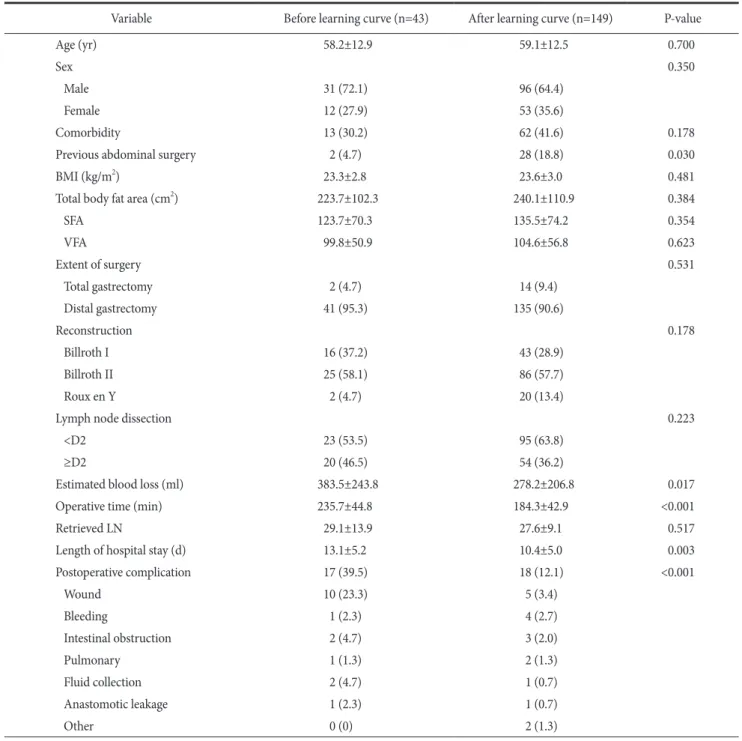
Patient characteristics and surgical outcomes are listed in Table 1. The two groups did not differ in age, sex, comorbid- ity, BMI, abdominal fat area, extent of surgery, reconstruction methods, or lymph node dissection. However, a greater propor- tion of individuals in the ‘after learning curve’ group reported previous history of abdominal surgery.
Regarding short-term surgical outcomes, ‘before learn- ing curve’ group showed a longer mean operative time (235.7 vs. 184.3 minutes, P<0.001), greater mean blood loss (383.5 vs.
278.2 ml, P=0.017), and longer hospital stay (13.1 vs. 10.4 days, P=0.003) than the ‘after learning curve’ group. The complication rate was significantly different between the two groups; in par- ticular, wound problems occurred more frequently in the ‘before
learning curve’ group.
2. Correlation between body mass index and body fat compartments
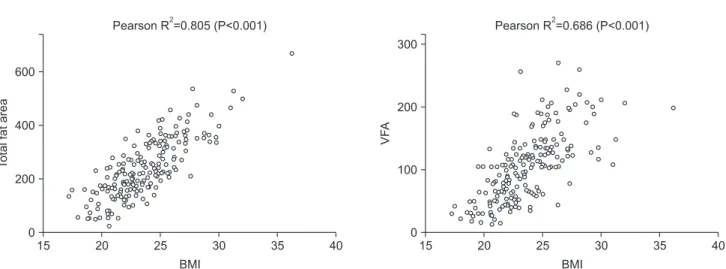
Fig. 1 shows the correlations between BMI and body fat compartments. BMI and total fat area were significantly cor- related (R2=0.805, P<0.0001) and had a higher correlation ef-
ficiency than BMI and VFA (R2=0.686, P<0.0001).
3. Subgroup analysis according to body mass index and visceral fat area
To evaluate the impact of BMI and VFA on surgical out- comes, we performed subgroup analysis on each of the group (Table 2).
Table 1. Clinical and surgical outcomes according to surgeon experience
Variable Before learning curve (n=43) After learning curve (n=149) P-value
Age (yr) 58.2±12.9 59.1±12.5 0.700
Sex 0.350
Male 31 (72.1) 96 (64.4)
Female 12 (27.9) 53 (35.6)
Comorbidity 13 (30.2) 62 (41.6) 0.178
Previous abdominal surgery 2 (4.7) 28 (18.8) 0.030
BMI (kg/m2) 23.3±2.8 23.6±3.0 0.481
Total body fat area (cm2) 223.7±102.3 240.1±110.9 0.384
SFA 123.7±70.3 135.5±74.2 0.354
VFA 99.8±50.9 104.6±56.8 0.623
Extent of surgery 0.531
Total gastrectomy 2 (4.7) 14 (9.4)
Distal gastrectomy 41 (95.3) 135 (90.6)
Reconstruction 0.178
Billroth I 16 (37.2) 43 (28.9)
Billroth II 25 (58.1) 86 (57.7)
Roux en Y 2 (4.7) 20 (13.4)
Lymph node dissection 0.223
<D2 23 (53.5) 95 (63.8)
≥D2 20 (46.5) 54 (36.2)
Estimated blood loss (ml) 383.5±243.8 278.2±206.8 0.017
Operative time (min) 235.7±44.8 184.3±42.9 <0.001
Retrieved LN 29.1±13.9 27.6±9.1 0.517
Length of hospital stay (d) 13.1±5.2 10.4±5.0 0.003
Postoperative complication 17 (39.5) 18 (12.1) <0.001
Wound 10 (23.3) 5 (3.4)
Bleeding 1 (2.3) 4 (2.7)
Intestinal obstruction 2 (4.7) 3 (2.0)
Pulmonary 1 (1.3) 2 (1.3)
Fluid collection 2 (4.7) 1 (0.7)
Anastomotic leakage 1 (2.3) 1 (0.7)
Other 0 (0) 2 (1.3)
Values are presented as mean±standard deviation or number (%). BMI = body mass index; SFA = subcutaneous fat area; VFA = visceral fat area;
LN = lymph node.
Table 2. Comparison of surgical outcomes after LG between BMI and VFA subgroups
Variable BMI
P-value VFA
P-value
BMI-L BMI-H VFA-L VFA-H
Before learning curve
No. of patient 30 13 20 23
Extent of surgery 0.518 1.000
Total gastrectomy 1 (3.3) 1 (7.7) 1 (5.0) 1 (4.3)
Distal gastrectomy 29 (96.7) 12 (92.3) 19 (95.0) 22 (95.7)
Blood loss (ml) 223.0±277.0 376.9±231.5 0.109 189.5±263.7 352.2±256.9 0.047
Operation time (min) 227.8±45.6 253.8±38.8 0.080 219.8±44.8 249.6±40.9 0.028
Retrieved LN 29.4±10.2 28.4±20.5 0.859 30.0±11.4 28.4±15.9 0.701
Length of hospital stay (d) 13.1±5.4 13.1±5.1 0.988 12.1±5.8 13.9±4.7 0.240
Complication 0.559 0.223
None 19 (63.3) 7 (53.8) 14 (70.0) 12 (52.2)
Yes 11 (36.7) 6 (46.2) 6 (30.0) 11 (47.8)
After learning curve
No. of patient 106 43 69 80
Extent of surgery 0.352 0.393
Total gastrectomy 12 (11.3) 2 (4.7) 8 (11.6) 6 (7.5)
Distal gastrectomy 94 (88.7) 41 (95.3) 61 (88.4) 74 (92.5)
Blood loss (ml) 217.4±231.1 217.0±181.4 0.994 210.3±241.2 216.3±194.2 0.867
Operation time (min) 184.4±42.9 186.1±43.7 0.827 182.4±42.7 187.2±43.7 0.869
Retrieved LN 27.9±10.0 27.0±6.6 0.496 28.6±10.5 26.8±7.6 0.078
Length of hospital stay (d) 10.2±5.2 10.5±4.8 0.746 10.2±5.3 10.4±4.8 0.786
Complication 0.317 0.501
None 95 (89.6) 36 (83.7) 62 (89.9) 69 (86.3)
Yes 11 (10.4) 7 (16.3) 7 (10.1) 11 (13.8)
Values are presented as number only, number (%) or mean±standard deviation. LG = laparoscopic gastrectomy; BMI = body mass index; VFA = visceral fat area; BMI-L = BMI <25 kg/m2; BMI-H = BMI ≥25 kg/m2; VFA-L = VFA<100 cm2; VFA-H = VFA≥100 cm2; LN = lymph node.
Fig. 1. Correlation between body mass index (BMI) and visceral fat area (VFA). The correlation efficiency was lower between BMI and VFA than between BMI and total fat area.
15 20 25 30 35
600
400
200
40
Totalfatarea
BMI 0
Pearson R =0.805 (P<0.001)2
15 20 25 30 35
300
200
100
40
VFA
BMI 0
Pearson R =0.686 (P<0.001)2
In ‘before learning curve’ group, the BMI-H subgroup tend- ed to have greater blood loss, longer operative time, and higher complication rate, although these relationships were not statisti- cally significant. However, the operative time was longer and blood loss was greater in the VFA-H group than in the VFA- L group (P=0.028 and P=0.047, respectively). Complication rates were not different among any of the subgroups.
In the ‘after learning curve’ group, no difference in surgical outcomes were observed between BMI and VFA subgroups.
4. Overall survival according to obesity status and surgeon experience
Overall survival is shown in Fig. 2. In the ‘before learning curve’ group, the 5-year overall survival was 86.7% and 84.6%
in the BMI-L and BMI-H subgroups (P=0.967), and 90.0%
and 82.6% in the VFA-L and VFA-H subgroups, respectively (P=0.280). In the ‘after learning curve’ group, the 5-year over-
all survival was 94.3% and 93.0% in the BMI-L and BMI-H subgroups (P=0.685), and 92.8% and 95.0% in the VFA-L and VFA-H subgroups, respectively (P=0.422).
Discussion
Obese population is increasing not only in Western countries but also in Eastern Asia.19,20 According to the Korean Society for the Study of Obesity, the prevalence of obesity (BMI≥25 kg/m2) is over 30%, and the incidence of severe obesity is steadily in- creasing.21 Therefore, the number of obese patients who require surgery for gastric cancer will likely increase in the near future.
Laparoscopic technique is emerging as an alternative option for the treatment of gastric cancer and is accepted as a standard treatment for early-stage gastric cancer. However, the impact of obesity on LG remains controversial. A few studies have report- ed that obesity does not increase surgical morbidities associated Fig. 2. Overall survival of patients according to obesity and surgeon experience. Although the difference was not statistically significant, the overall survival rate tended to be lower in patients with high visceral fat area (VFA) in the ‘before learning curve’ group. BMI = body mass index; BMI-H = BMI ≥25 kg/m2; VFA-L = VFA<100 cm2; VFA-H = VFA≥100 cm2
Before learning curve After learning curve
0 20 40 60 80
1.0
0.8
0.6
0.4
0.2
100
Cumulativeoverallsurvivalrate
Time (mo) 0.0
BMI-L BMI-H P=0.967
0 20 40 60 80
1.0
0.8
0.6
0.4
0.2
100
Cumulativeoverallsurvivalrate
Time (mo) 0.0
BMI-L BMI-H P=0.685
0 20 40 60 80
1.0
0.8
0.6
0.4
0.2
100
Cumulativeoverallsurvivalrate
Time (mo) 0.0
VFA-L -H VFA P=0.280
0 20 40 60 80
1.0
0.8
0.6
0.4
0.2
100
Cumulativeoverallsurvivalrate
Time (mo) 0.0
VFA-L VFA-H P=0.422
Before learning curve After learning curve
with LG, whereas others show that a high BMI is a significant predictor of technical difficulties during LG and postoperative complication.11,12,22,23
Recent research indicates that high VFA is a more accurate predictor of perioperative risk than high BMI in obese patients with gastric cancer.10,11,16 Excess visceral fat tissue may make it difficult to identify organs, vessels, and lymph nodes accurately, which may increase the difficulty of the laparoscopic procedure.
However, BMI may not reflect accurately the amount of intra- abdominal fat because it is a simple calculation of body volume based on height and weight. In the present study, Fig. 1 shows that the correlation efficiency was high (Pearson R2=0.805) between BMI and total fat area, but relatively low (Pearson R2=0.686) between BMI and VFA. Moreover, blood loss and operative time were significantly higher in the VFA-H subgroup before learning curve, but these surgical outcomes were not sig- nificantly different between the BMI-L and BMI-H subgroups before or after learning curve. These results suggest that, VFA was a better predictor of laparoscopic procedure difficulty than BMI in obese patients.
Obesity did not increase postoperative morbidity after LG, but the complication rate tended to be higher in the BMI-H and VFA-H subgroups than in the BMI-L and VFA-L subgroups.
For example, the complication rate in the VFA-H subgroup before learning curve (47.8%) was 1.5 times that of the VFA-L subgroup (30.0%). However, because the sample size in the ‘be- fore learning curve’ group was small a large sample size from a multicenter study is needed to confirm this result.
To our knowledge, the present study was the first to evaluate the contribution of VFA and surgeon experience for predict- ing postoperative outcomes in LG procedures. Although several reports on the impact of VFA or surgeons experience on the surgical outcome after LG have been published, no study has investigate the relationship between visceral fat and surgeon experience with LG.10,14-17,24,25 Thus, we hypothesized that high VFA would affect surgical outcomes more for an inexperienced laparoscopic surgeon. Our data showed that blood loss and op- erative time did not differ between VFA subgroups after learn- ing curve but significantly differed in VFA-H subgroup before learning curve, suggesting that the excess visceral fat may have influenced the LG technique of the inexperienced surgeon more than the experienced surgeon. Therefore, surgeons who have performed fewer than 50 LG procedures in patients with gastric cancer should check VFA rather than BMI to select appropriate
candidates for the procedure, and thereby reduce the risk of an unsatisfactory surgical outcome.
In the present study, we evaluated survival according to obesity index and surgeon experience whether the short-term outcomes of this study affect long-term survival. The overall survival rate seems to be lower in patients with high VFA in the
‘before learning curve’ group, but the difference was not sta- tistically significant (P=0.280). Recently, a study evaluating the impact of obesity on surgical outcome and prognosis in patients with gastric cancer reported similar results.26 This study divided the patients according to BMI class and VFA quartile. Although the third quartile (VFA, 103~150 cm2) showed a 1.513 hazard ratio compared with the fourth quartile (VF>150 cm2) in the univariate analysis, the overall survival was not significantly different according to BMI class or VFA quartile. Therefore, further investigations are needed to clarify the impact of BMI or VFA on long-term survival after LG for gastric cancer.
Our study had some limitations. First, the study was ret- rospectively designed and confined to a single center and one surgeon’s experience. Second, we excluded 25 patients from the present study due to the poor quality of scanned CT images, which may have created a selection bias. Further retrospective studies are needed to confirm the impact of VFA on surgical outcomes of LG for inexperienced surgeons.
In conclusion, the present study demonstrated that excess visceral fat accumulation was associated with technical difficul- ties for surgeons who have performed fewer than 50 cases of LG for gastric cancer. Therefore, VFA may be a better predic- tive marker than BMI for selecting candidates for LG and therefore helping to get a better surgical outcome for inexperienced surgeons.
Acknowledgments
This study was supported by a grant from the National R&D Program for Cancer Control, Ministry of Health & Welfare, Republic of Korea (1320270). The funding source had no role in the design of this article and will not have any role during its execution or publication.
Conflicts of Interest
No potential conflict of interest relevant to this article was reported.
References
1. Hayashi H, Ochiai T, Shimada H, Gunji Y. Prospective ran- domized study of open versus laparoscopy-assisted distal gas- trectomy with extraperigastric lymph node dissection for early gastric cancer. Surg Endosc 2005;19:1172-1176.
2. Huscher CG, Mingoli A, Sgarzini G, Sansonetti A, Di Paola M, Recher A, et al. Laparoscopic versus open subtotal gastrectomy for distal gastric cancer: five-year results of a randomized pro- spective trial. Ann Surg 2005;241:232-237.
3. Jiang L, Yang KH, Guan QL, Cao N, Chen Y, Zhao P, et al.
Laparoscopy-assisted gastrectomy versus open gastrectomy for resectable gastric cancer: an update meta-analysis based on randomized controlled trials. Surg Endosc 2013;27:2466-2480.
4. Kim YW, Yoon HM, Yun YH, Nam BH, Eom BW, Baik YH, et al. Long-term outcomes of laparoscopy-assisted distal gastrec- tomy for early gastric cancer: result of a randomized controlled trial (COACT 0301). Surg Endosc 2013;27:4267-4276.
5. Adachi Y, Suematsu T, Shiraishi N, Katsuta T, Morimoto A, Kitano S, et al. Quality of life after laparoscopy-assisted Billroth I gastrectomy. Ann Surg 1999;229:49-54.
6. Kim HH, Han SU, Kim MC, Hyung WJ, Kim W, Lee HJ, et al. Long-term results of laparoscopic gastrectomy for gastric cancer: a large-scale case-control and case-matched Korean multicenter study. J Clin Oncol 2014;32:627-633.
7. Son SY, Jung DH, Lee CM, Ahn SH, Ahn HS, Park do J, et al.
Laparoscopic gastrectomy versus open gastrectomy for gas- tric cancer in patients with body mass index of 30 kg/m(2) or more. Surg Endosc 2015;29:2126-2132.
8. Son SY, Lee CM, Jung DH, Lee JH, Ahn SH, Park do J, et al.
Laparoscopic completion total gastrectomy for remnant gastric cancer: a single-institution experience. Gastric Cancer 2015;
18:177-182.
9. Kim HH, Son SY, Ahn S, Han SU. Reply to M. Honda et al. J Clin Oncol 2014;32:3201-3202.
10. Kunisaki C, Makino H, Takagawa R, Sato K, Kawamata M, Kanazawa A, et al. Predictive factors for surgical complications of laparoscopy-assisted distal gastrectomy for gastric cancer.
Surg Endosc 2009;23:2085-2093.
11. Hiki N, Fukunaga T, Yamaguchi T, Ogura T, Miyata S, Toku- naga M, et al. Increased fat content and body shape have little effect on the accuracy of lymph node retrieval and blood loss in laparoscopic distal gastrectomy for gastric cancer. J Gastro- intest Surg 2009;13:626-633.
12. Lee HJ, Kim HH, Kim MC, Ryu SY, Kim W, Song KY, et al; Ko- rean Laparoscopic Gastrointestinal Surgery Study Group. The impact of a high body mass index on laparoscopy assisted gas- trectomy for gastric cancer. Surg Endosc 2009;23:2473-2479.
13. Ojima T, Iwahashi M, Nakamori M, Nakamura M, Takifuji K, Katsuda M, et al. The impact of abdominal shape index of patients on laparoscopy-assisted distal gastrectomy for early gastric cancer. Langenbecks Arch Surg 2012;397:437-445.
14. Go JE, Kim MC, Kim KH, Oh JY, Kim YM. Effect of visceral fat area on outcomes of laparoscopyassisted distal gastrectomy for gastric cancer: subgroup analysis by gender and parameters of obesity. Ann Surg Treat Res 2015;88:318-324.
15. Sugisawa N, Tokunaga M, Tanizawa Y, Bando E, Kawamura T, Terashima M. Intra-abdominal infectious complications following gastrectomy in patients with excessive visceral fat.
Gastric Cancer 2012;15:206-212.
16. Ueda J, Ichimiya H, Okido M, Kato M. The impact of visceral fat accumulation on laparoscopy-assisted distal gastrectomy for early gastric cancer. J Laparoendosc Adv Surg Tech A 2009;19:157-162.
17. Miyaki A, Imamura K, Kobayashi R, Takami M, Matsumoto J. Impact of visceral fat on laparoscopy-assisted distal gastrec- tomy. Surgeon 2013;11:76-81.
18. Jin SH, Kim DY, Kim H, Jeong IH, Kim MW, Cho YK, et al.
Multidimensional learning curve in laparoscopy-assisted gas- trectomy for early gastric cancer. Surg Endosc 2007;21:28-33.
19. Kubo M, Sano T, Fukagawa T, Katai H, Sasako M. Increasing body mass index in Japanese patients with gastric cancer. Gas- tric Cancer 2005;8:39-41.
20. Khang YH, Yun SC. Trends in general and abdominal obesity among Korean adults: findings from 1998, 2001, 2005, and 2007 Korea National Health and Nutrition Examination Sur- veys. J Korean Med Sci 2010;25:1582-1588.
21. Oh SW, Shin SA, Yun YH, Yoo T, Huh BY. Cut-off point of BMI and obesity-related comorbidities and mortality in mid- dle-aged Koreans. Obes Res 2004;12:2031-2040.
22. Kim KH, Kim MC, Jung GJ, Kim HH. The impact of obesity on LADG for early gastric cancer. Gastric Cancer 2006;9:303-307.
23. Shim JH, Song KY, Kim SN, Park CH. Laparoscopy-assisted distal gastrectomy for overweight patients in the Asian popula- tion. Surg Today 2009;39:481-486.
24. Kim MC, Jung GJ, Kim HH. Learning curve of laparoscopy- assisted distal gastrectomy with systemic lymphadenectomy for early gastric cancer. World J Gastroenterol 2005;11:7508-7511.
25. Yoo CH, Kim HO, Hwang SI, Son BH, Shin JH, Kim H. Short- term outcomes of laparoscopic-assisted distal gastrectomy for gastric cancer during a surgeon's learning curve period. Surg Endosc 2009;23:2250-2257.
26. Kim JH, Chin HM, Hwang SS, Jun KH. Impact of intra- abdominal fat on surgical outcome and overall survival of pa- tients with gastric cancer. Int J Surg 2014;12:346-352.